
Exploring the Effects of Brand Personality on Brand
Exploring the Effects of Brand Personality on Brand Trust, Affect, and Loyalty in the Luxury Hotel Context Mi. Ran Kim, Laee Choi, & Bonnie Knutson
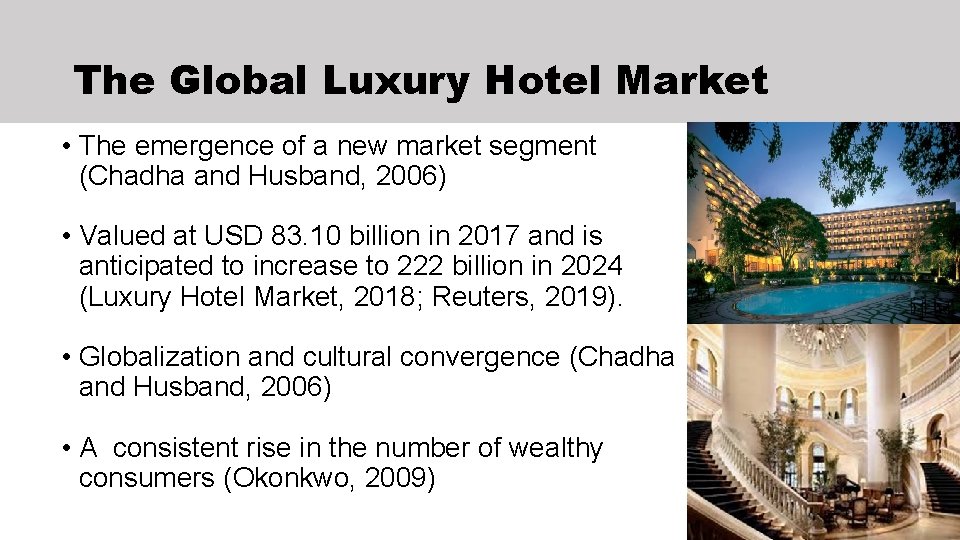
The Global Luxury Hotel Market • The emergence of a new market segment (Chadha and Husband, 2006) • Valued at USD 83. 10 billion in 2017 and is anticipated to increase to 222 billion in 2024 (Luxury Hotel Market, 2018; Reuters, 2019). • Globalization and cultural convergence (Chadha and Husband, 2006) • A consistent rise in the number of wealthy consumers (Okonkwo, 2009)

Top Five Global Luxury Hotel Companies § The top five companies (Marriott Hilton, Hyatt Hotels, Four Seasons, and Shangri-La ) make up more than 25% market share of the luxury hotels segment.

Brand Personality • Brand Personality is the set of human characteristics associated with a brand (Aaker, 1997). • Customers are more likely to choose a specific brand that they like and that is consistent with their personalities (Health and Scott, 1998). • Brand personality relates to consumer trust and emotions (Kim and Kim, 2004) and strong and differentiated brands are intangible assets that enhance a firm’s financial value and brand equity
Luxury Hotel Brand Personality • Customers feel better about themselves by purchasing luxury brands as they feel a sense of pride, accomplishment, and fulfillment in owning products and services of luxury brands (Keller, 2009). • In the luxury hotel market, brand personality can be a critical driver to develop strong relationships with customers and loyalty with one brand over another (Siguaw et al. , 1999). • As an important emerging market, the study of brand-personality functions in this luxury hotel segment will be timely for hotel marketers.
Study Objectives • Based on Aaker’s (1997) Brand Personality Dimensions, this study is to: Ø Examine the impact of brand personality dimensions-sincerity, excitement, competence, and sophistication-on brand trust, affect, and loyalty in the luxury hotel context. Ø Explore the relative impact of each brand personality dimension on brand trust and affect through dominance analysis. Ø Considering that little research has been conducted on the role of brand personality on actual consumer behaviors in the hospitality
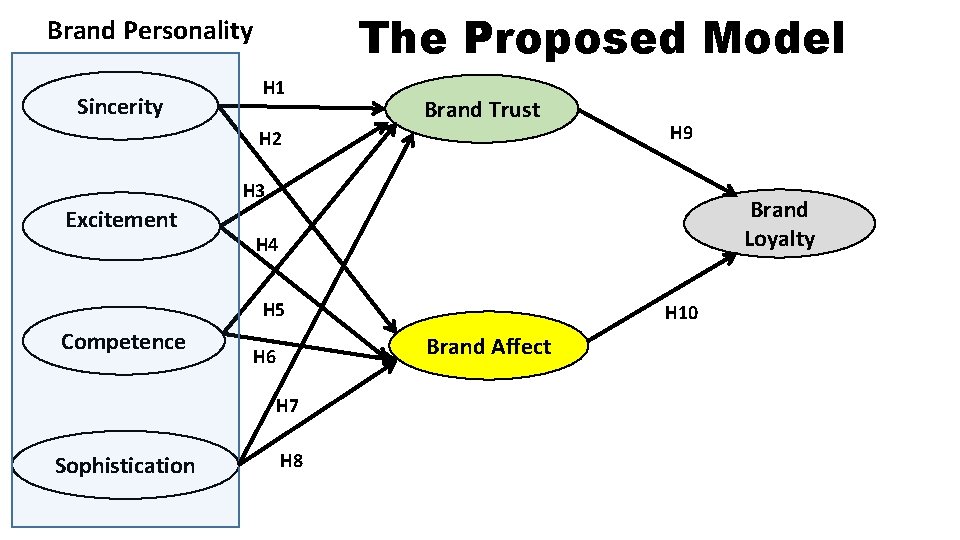
The Proposed Model Brand Personality Sincerity H 1 Brand Trust H 2 H 9 H 3 Excitement Brand Loyalty H 4 H 5 Competence Brand Affect H 6 H 7 Sophistication H 10 H 8
Methodology A pilot study (n=30) A self-administered on-line survey using Qualtrics Luxury hotel guests in the U. S. Conducted the survey December 2018 A five-point Likert scale (1=not at all to 5: exactly, 1=strongly disagree to 5=strongly agree) Used SPSS 22. 0 software for descriptive statistics and multiple regression. Conducted dominance analysis
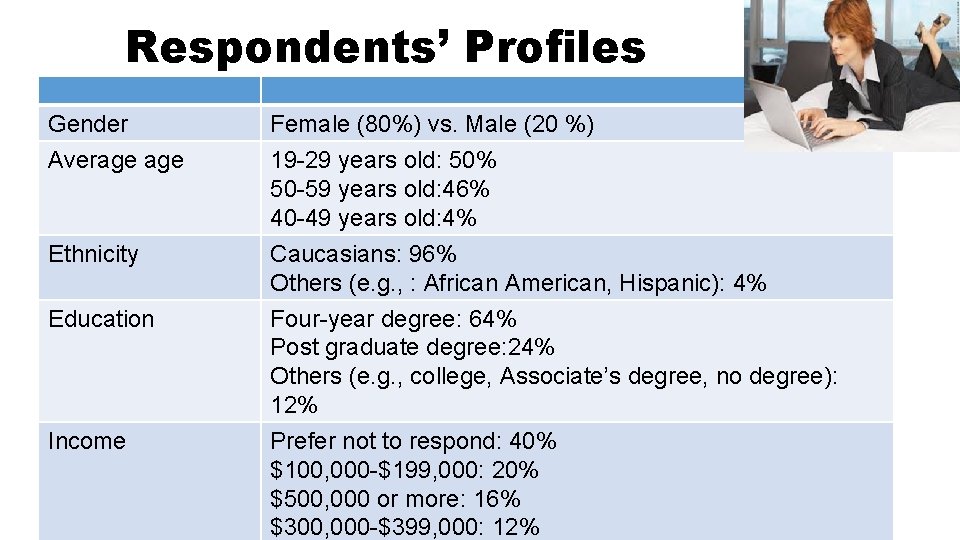
Respondents’ Profiles Gender Average Female (80%) vs. Male (20 %) 19 -29 years old: 50% 50 -59 years old: 46% 40 -49 years old: 4% Ethnicity Caucasians: 96% Others (e. g. , : African American, Hispanic): 4% Education Four-year degree: 64% Post graduate degree: 24% Others (e. g. , college, Associate’s degree, no degree): 12% Prefer not to respond: 40% $100, 000 -$199, 000: 20% $500, 000 or more: 16% $300, 000 -$399, 000: 12% Income
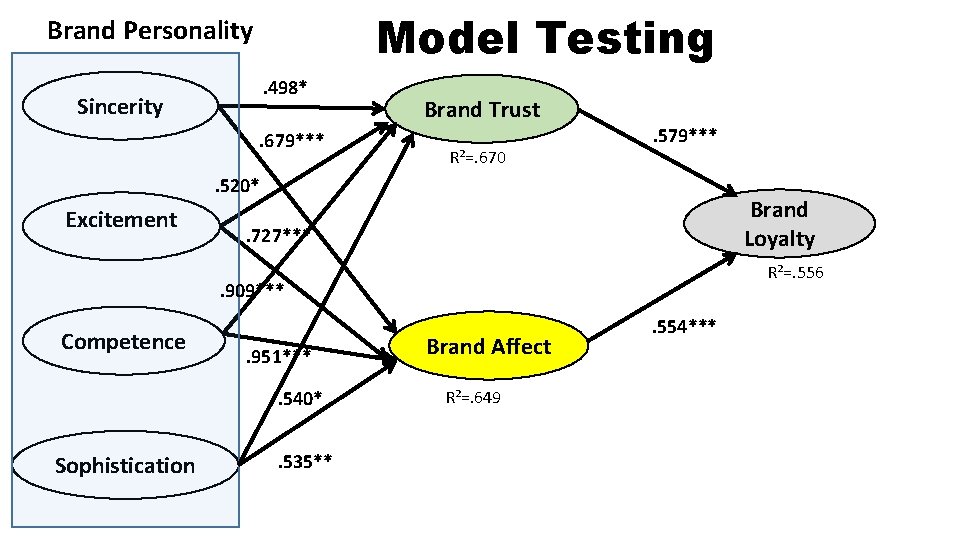
Model Testing Brand Personality. 498* Sincerity . 679*** Brand Trust R²=. 670 . 579*** . 520* Excitement Brand Loyalty . 727*** R²=. 556 . 909*** Competence . 951***. 540* Sophistication . 535** Brand Affect R²=. 649 . 554***

Dominance Analysis: Relative importance of brand personality dimensions on brand trust and affect

Dominance Analysis: Relative importance of brand personality dimensions on trust and affect
Implications & Discussion • The findings of this study can make valuable contributions to brand personality literature and brand managers who may apply the findings to develop more competitive brand strategies and create better brand value • In particular, this study provides a deeper understanding of the customer-brand relationship in the hospitality business context.
Implications & Future Study • Further, the brand personality dimensions developed by Aaker (1997) (i. e. , sincerity, excitement, competence, and sophistication) were shown to be a reliable and valid framework in our study. • To provide a deeper and more precise understanding of brand personality, future research can add new dimensions of brand personality (e. g. , exclusiveness, innovativeness) and other constructs (e. g. , perceived value) in the proposed research model.

Thank You!
- Slides: 15