
Exploring the Effect of Data Augmentation on the

- Slides: 42
Exploring the Effect of Data Augmentation on the Quality of Text Classification Shabnam Sadegharmaki, May 2019 Chair of Software Engineering for Business Information Systems (sebis) Faculty of Informatics Technische Universität München wwwmatthes. in. tum. de
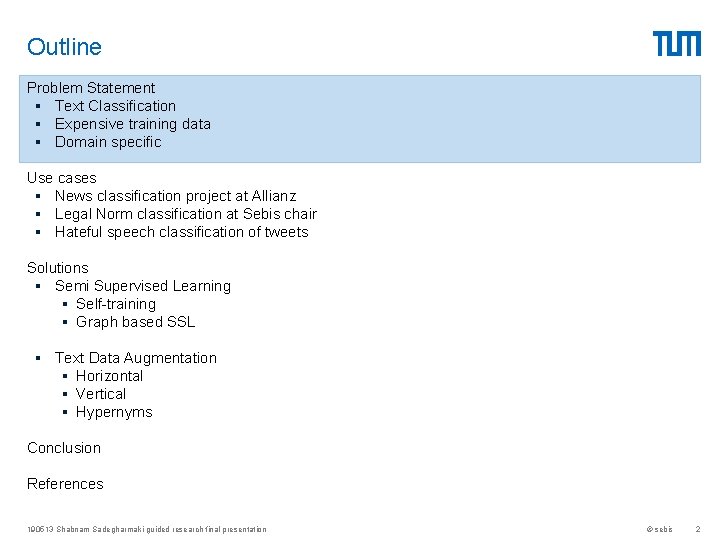
Outline Problem Statement § Text Classification § Expensive training data § Domain specific Use cases § News classification project at Allianz § Legal Norm classification at Sebis chair § Hateful speech classification of tweets Solutions § Semi Supervised Learning § Self-training § Graph based SSL § Text Data Augmentation § Horizontal § Vertical § Hypernyms Conclusion References 190513 Shabnam Sadegharmaki guided research final presentation © sebis 2
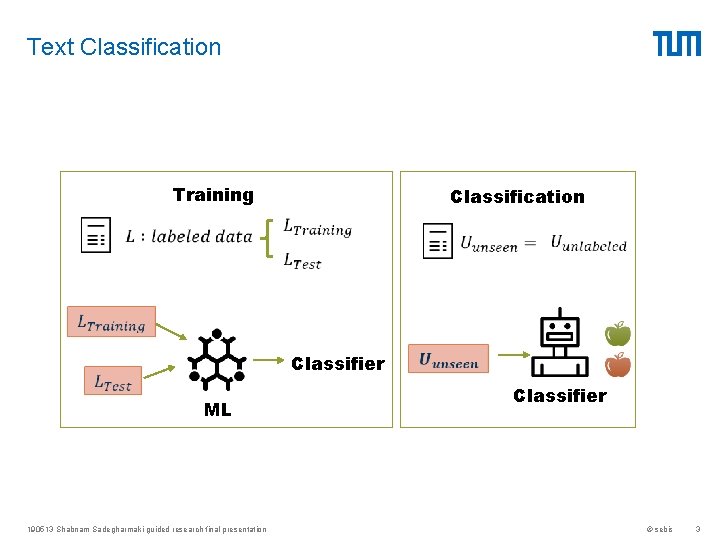
Text Classification Training Classification Classifier ML 190513 Shabnam Sadegharmaki guided research final presentation Classifier © sebis 3
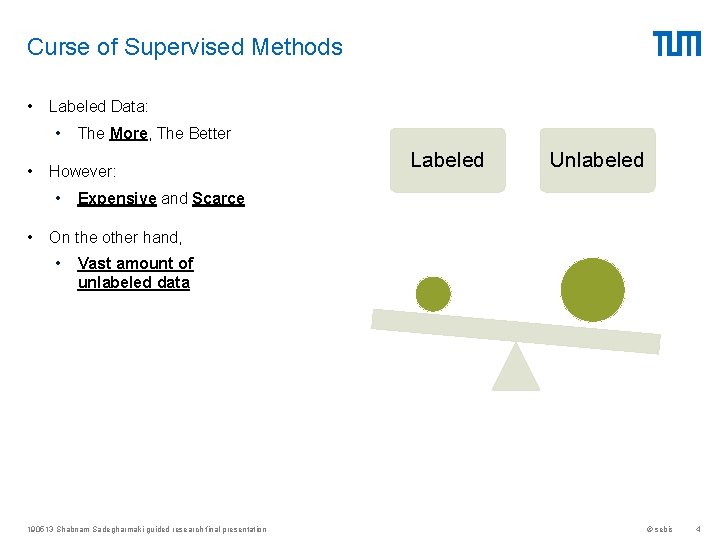
Curse of Supervised Methods • Labeled Data: • • However: • • The More, The Better Labeled Unlabeled Expensive and Scarce On the other hand, • Vast amount of unlabeled data 190513 Shabnam Sadegharmaki guided research final presentation © sebis 4
Counter attacks • Semi-supervised learning • Self-training • Label propagation • Thesaurus-based data augmentation • Multi-instance learning • Transfer Learning © clipart-library The focus is limited to text classification 190513 Shabnam Sadegharmaki guided research final presentation © sebis 5
But … The solutions do not work in all domains Therefore … We chose three diverse datasets 1. to investigate their effects on different domains 2. to estimate their generalization power 190513 Shabnam Sadegharmaki guided research final presentation © sebis 6
Outline Problem Statement § Text Classification § Expensive training data § Domain specific Use cases § News classification project at Allianz § Legal Norm classification at Sebis chair § Hateful speech classification of tweets Solutions § Semi Supervised Learning § Self-training § Graph based SSL § Text Data Augmentation § Horizontal § Vertical § Hypernyms Conclusion References 190513 Shabnam Sadegharmaki guided research final presentation © sebis 7
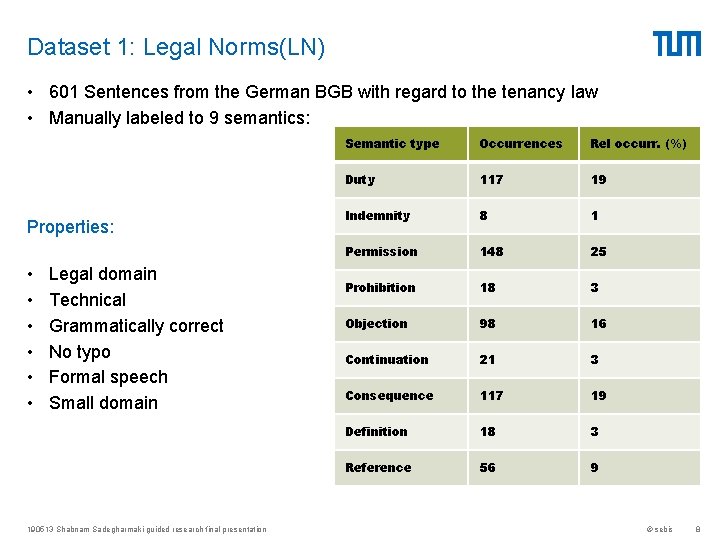
Dataset 1: Legal Norms(LN) • 601 Sentences from the German BGB with regard to the tenancy law • Manually labeled to 9 semantics: Properties: • • • Legal domain Technical Grammatically correct No typo Formal speech Small domain 190513 Shabnam Sadegharmaki guided research final presentation Semantic type Occurrences Rel occurr. (%) Duty 117 19 Indemnity 8 1 Permission 148 25 Prohibition 18 3 Objection 98 16 Continuation 21 3 Consequence 117 19 Definition 18 3 Reference 56 9 © sebis 8
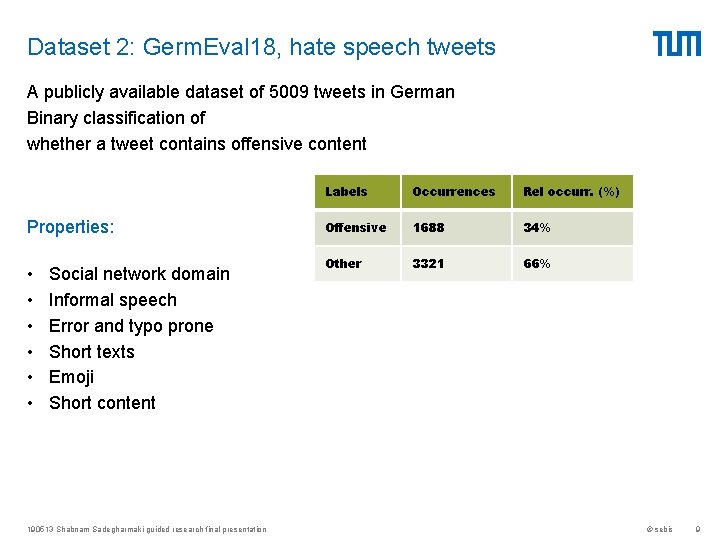
Dataset 2: Germ. Eval 18, hate speech tweets A publicly available dataset of 5009 tweets in German Binary classification of whether a tweet contains offensive content Properties: • • • Social network domain Informal speech Error and typo prone Short texts Emoji Short content 190513 Shabnam Sadegharmaki guided research final presentation Labels Occurrences Rel occurr. (%) Offensive 1688 34% Other 3321 66% © sebis 9
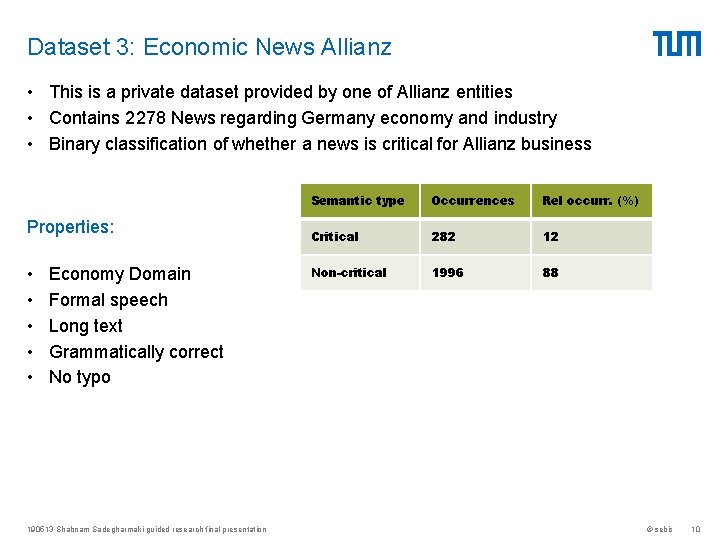
Dataset 3: Economic News Allianz • This is a private dataset provided by one of Allianz entities • Contains 2278 News regarding Germany economy and industry • Binary classification of whether a news is critical for Allianz business Properties: • • • Economy Domain Formal speech Long text Grammatically correct No typo 190513 Shabnam Sadegharmaki guided research final presentation Semantic type Occurrences Rel occurr. (%) Critical 282 12 Non-critical 1996 88 © sebis 10
Outline Problem Statement § Text Classification § Expensive training data § Domain specific Use cases § News classification project at Allianz § Legal Norm classification at Sebis chair § Hateful speech classification of tweets Solutions § Semi Supervised Learning § Self-training § Graph based SSL § Text Data Augmentation § Horizontal § Vertical § Hypernyms Conclusion References 190513 Shabnam Sadegharmaki guided research final presentation © sebis 11
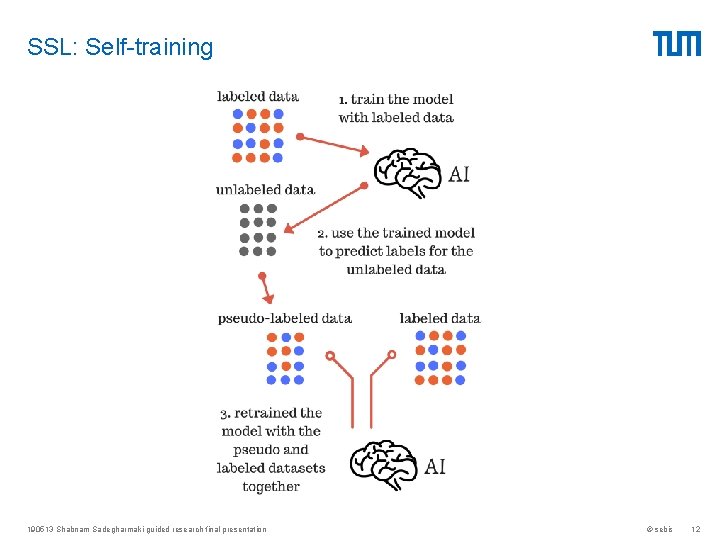
SSL: Self-training 190513 Shabnam Sadegharmaki guided research final presentation © sebis 12
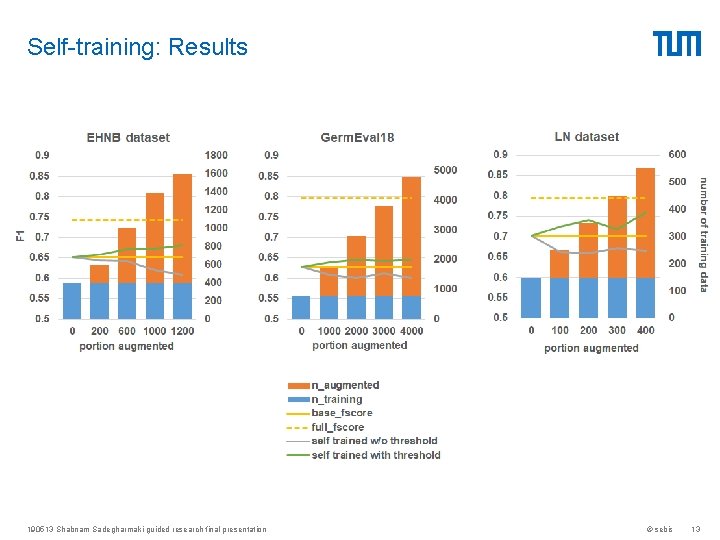
Self-training: Results 190513 Shabnam Sadegharmaki guided research final presentation © sebis 13
Outline Problem Statement § Text Classification § Expensive training data § Domain specific Use cases § News classification project at Allianz § Legal Norm classification at Sebis chair § Hateful speech classification of tweets Solutions § Semi Supervised Learning § Self-training § Graph based SSL § Text Data Augmentation § Horizontal § Vertical § Hypernyms Conclusion References 190513 Shabnam Sadegharmaki guided research final presentation © sebis 14
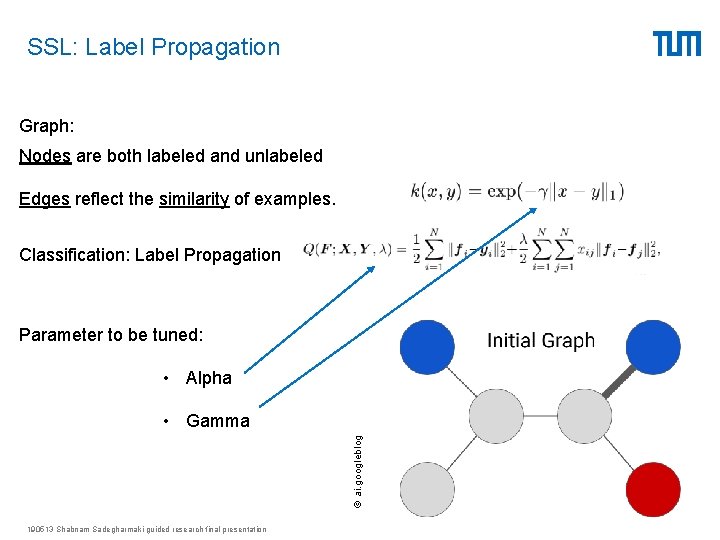
SSL: Label Propagation Graph: Nodes are both labeled and unlabeled Edges reflect the similarity of examples. Classification: Label Propagation Parameter to be tuned: • Alpha © ai. googleblog • Gamma 190513 Shabnam Sadegharmaki guided research final presentation © sebis 15
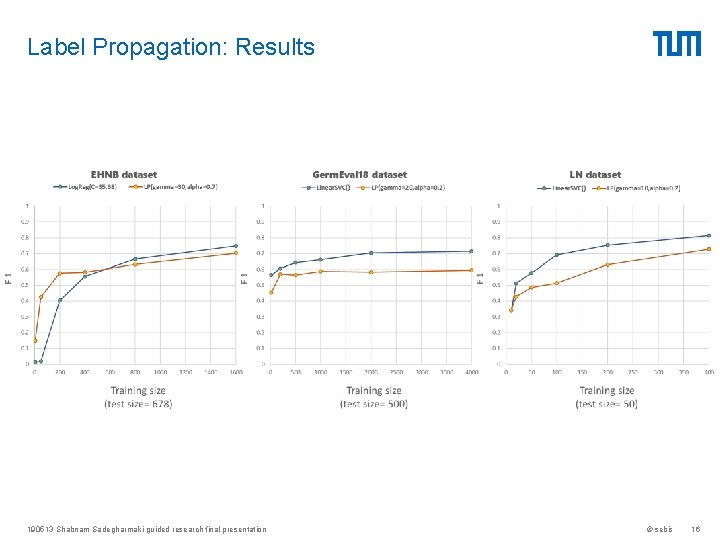
Label Propagation: Results 190513 Shabnam Sadegharmaki guided research final presentation © sebis 16
Outline Problem Statement § Text Classification § Expensive training data § Domain specific Use cases § News classification project at Allianz § Legal Norm classification at Sebis chair § Hateful speech classification of tweets Solutions § Semi Supervised Learning § Self-training § Graph based SSL § Text Data Augmentation § Horizontal § Vertical § Hypernyms Conclusion References 190513 Shabnam Sadegharmaki guided research final presentation © sebis 17
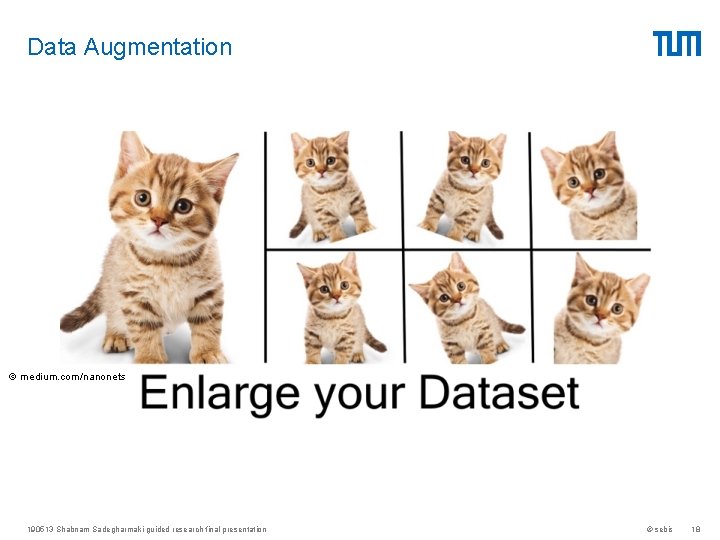
Data Augmentation © medium. com/nanonets 190513 Shabnam Sadegharmaki guided research final presentation © sebis 18
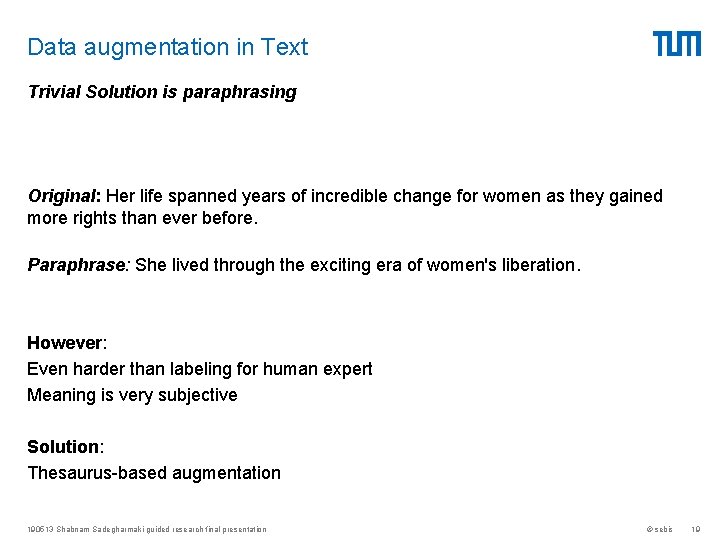
Data augmentation in Text Trivial Solution is paraphrasing Original: Her life spanned years of incredible change for women as they gained more rights than ever before. Paraphrase: She lived through the exciting era of women's liberation. However: Even harder than labeling for human expert Meaning is very subjective Solution: Thesaurus-based augmentation 190513 Shabnam Sadegharmaki guided research final presentation © sebis 19
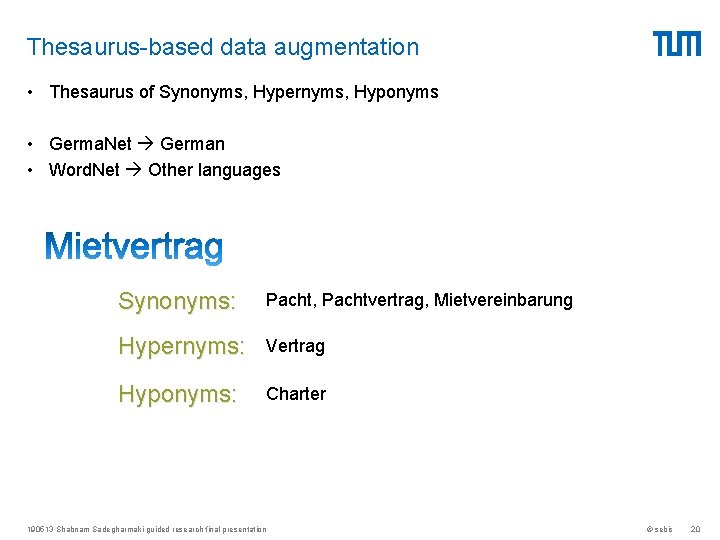
Thesaurus-based data augmentation • Thesaurus of Synonyms, Hypernyms, Hyponyms • Germa. Net German • Word. Net Other languages Synonyms: Pacht, Pachtvertrag, Mietvereinbarung Hypernyms: Vertrag Hyponyms: Charter 190513 Shabnam Sadegharmaki guided research final presentation © sebis 20
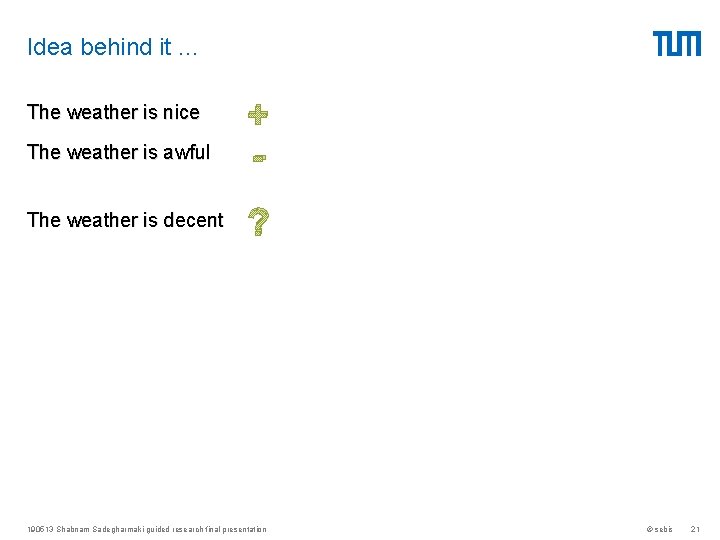
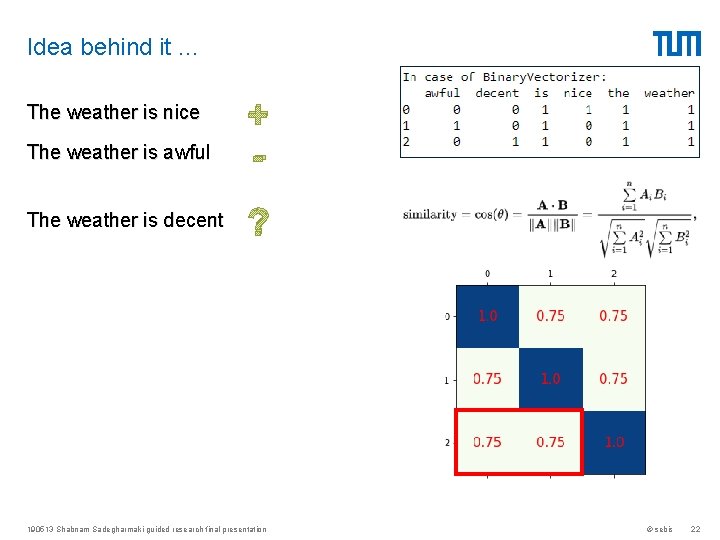
Idea behind it … The weather is awful + - The weather is decent ? The weather is nice 190513 Shabnam Sadegharmaki guided research final presentation © sebis 21
Idea behind it … The weather is awful + - The weather is decent ? The weather is nice 190513 Shabnam Sadegharmaki guided research final presentation © sebis 22
Data Augmentation This is not only about increasing training size But also expanding the semantics Alternations: • Horizontal augmentation by synonyms • Vertical augmentation by synonyms • Augmentation by hypernyms 190513 Shabnam Sadegharmaki guided research final presentation © sebis 23
Outline Problem Statement § Text Classification § Expensive training data § Domain specific Use cases § News classification project at Allianz § Legal Norm classification at Sebis chair § Hateful speech classification of tweets Solutions § Semi Supervised Learning § Self-training § Graph based SSL § Text Data Augmentation § Horizontal § Vertical § Hypernyms Conclusion References 190513 Shabnam Sadegharmaki guided research final presentation © sebis 24
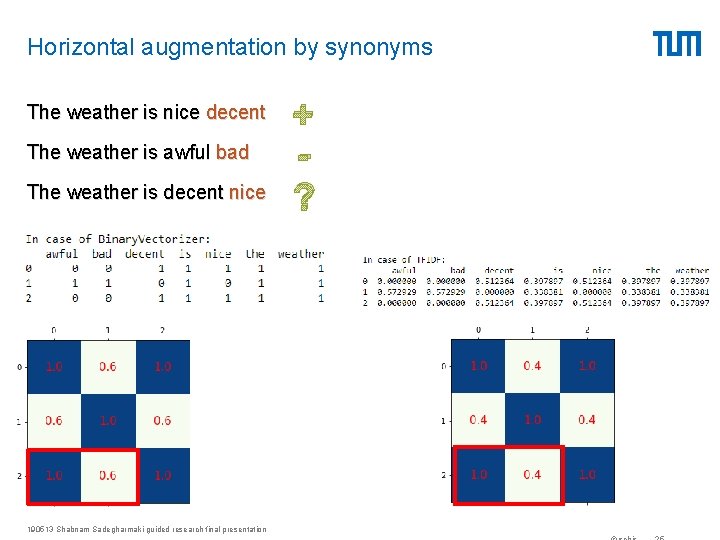
Horizontal augmentation by synonyms The weather is nice decent The weather is awful bad The weather is decent nice 190513 Shabnam Sadegharmaki guided research final presentation + ?
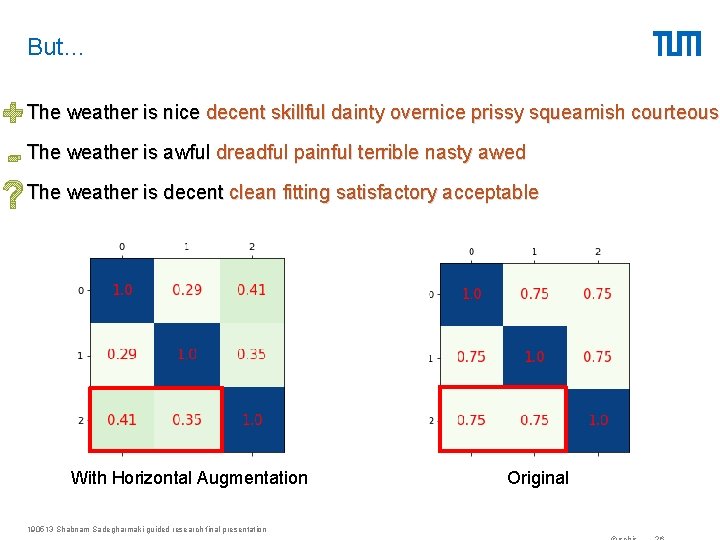
But… + The weather is nice decent skillful dainty overnice prissy squeamish courteous - The weather is awful dreadful painful terrible nasty awed ? The weather is decent clean fitting satisfactory acceptable With Horizontal Augmentation 190513 Shabnam Sadegharmaki guided research final presentation Original
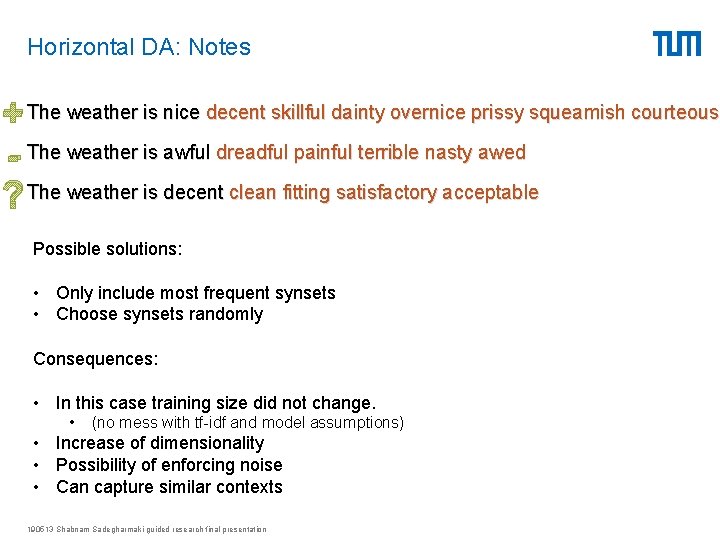
Horizontal DA: Notes + The weather is nice decent skillful dainty overnice prissy squeamish courteous - The weather is awful dreadful painful terrible nasty awed ? The weather is decent clean fitting satisfactory acceptable Possible solutions: • Only include most frequent synsets • Choose synsets randomly Consequences: • In this case training size did not change. • (no mess with tf-idf and model assumptions) • Increase of dimensionality • Possibility of enforcing noise • Can capture similar contexts 190513 Shabnam Sadegharmaki guided research final presentation
Outline Problem Statement § Text Classification § Expensive training data § Domain specific Use cases § News classification project at Allianz § Legal Norm classification at Sebis chair § Hateful speech classification of tweets Solutions § Semi Supervised Learning § Self-training § Graph based SSL § Text Data Augmentation § Horizontal § Vertical § Hypernyms Conclusion References 190513 Shabnam Sadegharmaki guided research final presentation © sebis 28
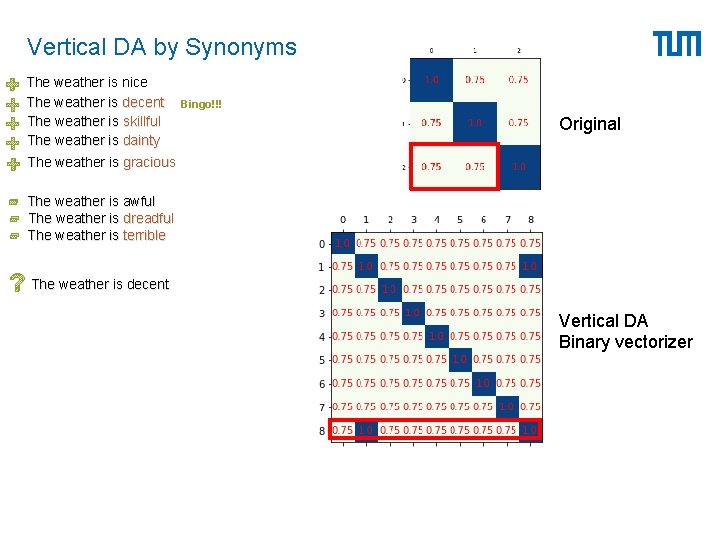
Vertical DA by Synonyms + The weather is nice + The weather is decent Bingo!!! + The weather is skillful + The weather is dainty + The weather is gracious - The weather is awful - The weather is dreadful - The weather is terrible Original ? The weather is decent Vertical DA Binary vectorizer
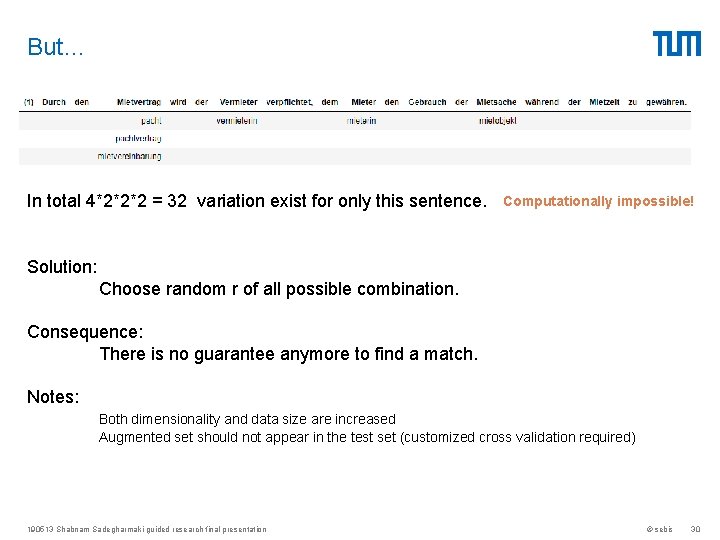
But… In total 4*2*2*2 = 32 variation exist for only this sentence. Computationally impossible! Solution: Choose random r of all possible combination. Consequence: There is no guarantee anymore to find a match. Notes: Both dimensionality and data size are increased Augmented set should not appear in the test set (customized cross validation required) 190513 Shabnam Sadegharmaki guided research final presentation © sebis 30
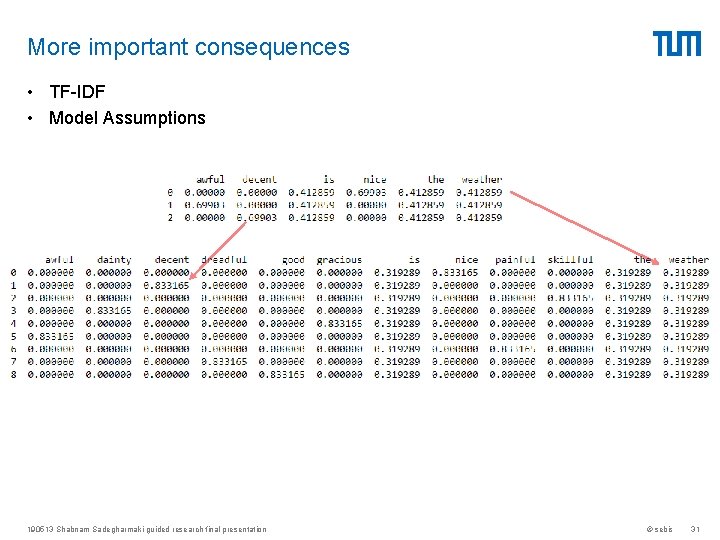
More important consequences • TF-IDF • Model Assumptions 190513 Shabnam Sadegharmaki guided research final presentation © sebis 31
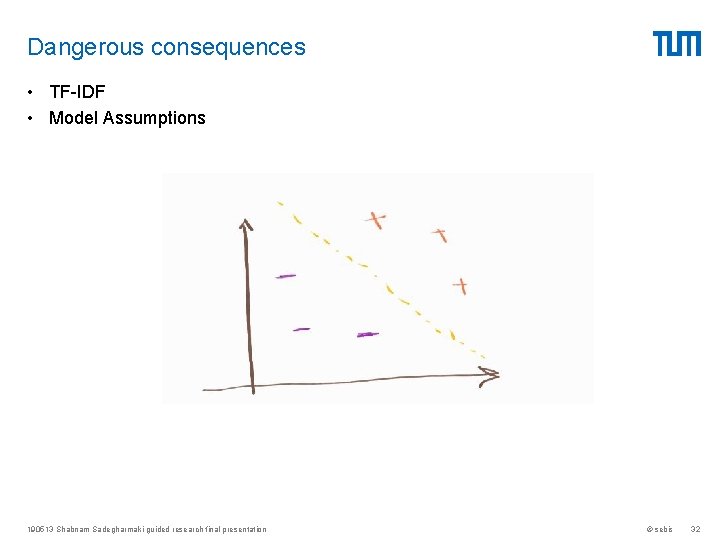
Dangerous consequences • TF-IDF • Model Assumptions 190513 Shabnam Sadegharmaki guided research final presentation © sebis 32
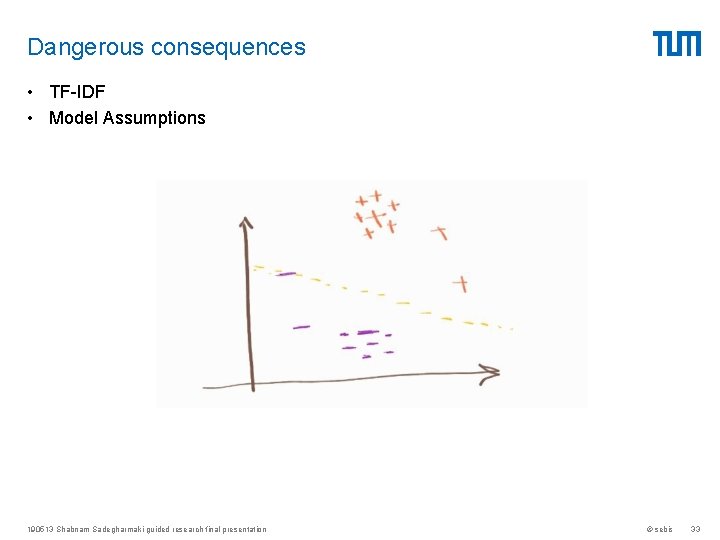
Dangerous consequences • TF-IDF • Model Assumptions 190513 Shabnam Sadegharmaki guided research final presentation © sebis 33
Outline Problem Statement § Text Classification § Expensive training data § Domain specific Use cases § News classification project at Allianz § Legal Norm classification at Sebis chair § Hateful speech classification of tweets Solutions § Semi Supervised Learning § Self-training § Graph based SSL § Text Data Augmentation § Horizontal § Vertical § Hypernyms Conclusion References 190513 Shabnam Sadegharmaki guided research final presentation © sebis 34
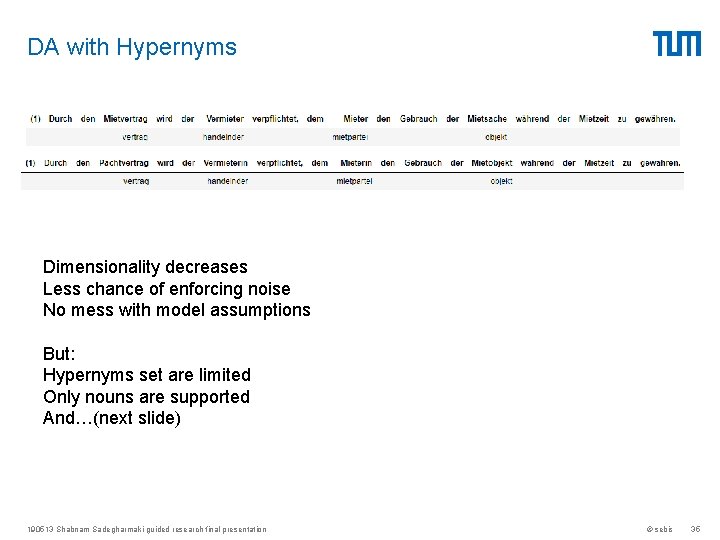
DA with Hypernyms Dimensionality decreases Less chance of enforcing noise No mess with model assumptions But: Hypernyms set are limited Only nouns are supported And…(next slide) 190513 Shabnam Sadegharmaki guided research final presentation © sebis 35
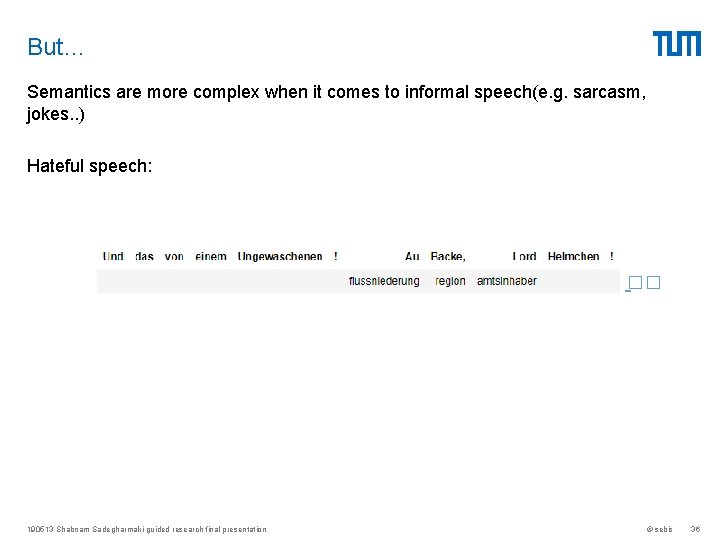
But… Semantics are more complex when it comes to informal speech(e. g. sarcasm, jokes. . ) Hateful speech: �� 190513 Shabnam Sadegharmaki guided research final presentation © sebis 36
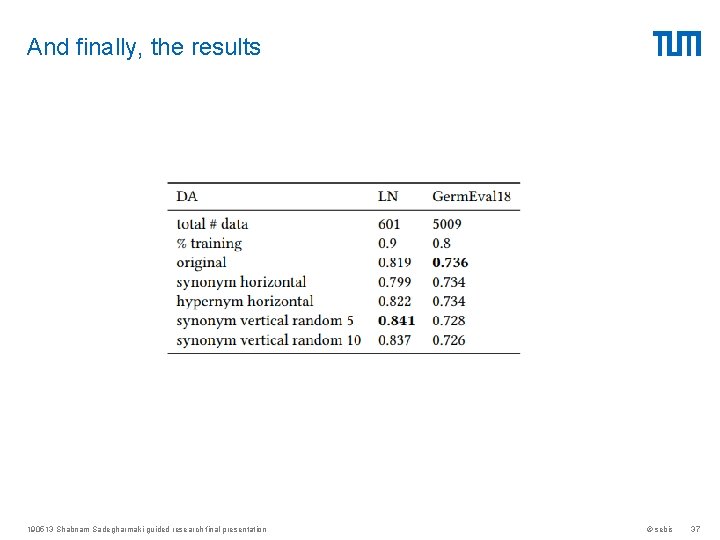
And finally, the results 190513 Shabnam Sadegharmaki guided research final presentation © sebis 37
Outline Problem Statement § Text Classification § Expensive training data § Domain specific Use cases § News classification project at Allianz § Legal Norm classification at SEBIS chair § Hateful speech classification of tweets, Germ. Eval 18 Solutions § Semi Supervised Learning § Self-training § Graph based SSL § Text Data Augmentation § Horizontal § Vertical § Hypernyms Conclusion References 190513 Shabnam Sadegharmaki guided research final presentation © sebis 38
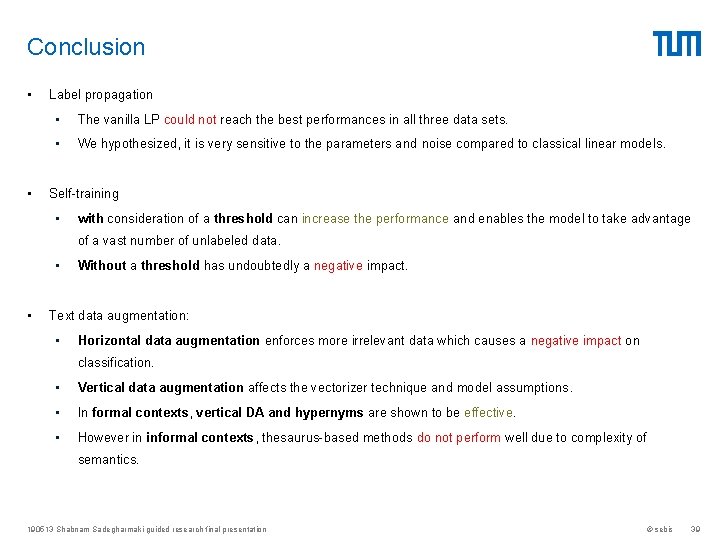
Conclusion • • Label propagation • The vanilla LP could not reach the best performances in all three data sets. • We hypothesized, it is very sensitive to the parameters and noise compared to classical linear models. Self-training • with consideration of a threshold can increase the performance and enables the model to take advantage of a vast number of unlabeled data. • • Without a threshold has undoubtedly a negative impact. Text data augmentation: • Horizontal data augmentation enforces more irrelevant data which causes a negative impact on classification. • Vertical data augmentation affects the vectorizer technique and model assumptions. • In formal contexts, vertical DA and hypernyms are shown to be effective. • However in informal contexts, thesaurus-based methods do not perform well due to complexity of semantics. 190513 Shabnam Sadegharmaki guided research final presentation © sebis 39
References [1] Mehdi Allahyari, Seyedamin Pouriyeh, Mehdi Assefi, Saied Safaei, Elizabeth D Trippe, Juan B Gutierrez, and Krys Kochut. 2017. A brief survey of text mining: Classification, clustering and extraction techniques. ar. Xiv preprint ar. Xiv: 1707. 02919(2017). [2] Daniel Cer, Yinfei Yang, Sheng-yi Kong, Nan Hua, Nicole Limtiaco, Rhomni St John, Noah Constant, Mario Guajardo. Cespedes, Steve Yuan, Chris Tar, et al. 2018. Universalsentence encoder. ar. Xiv preprint ar. Xiv: 1803. 11175(2018). [3] O. Chapelle, B. Scholkopf, and A. Zien, Eds. 2009. Semi-Supervised Learning (Chapelle, O. et al. , Eds. ; 2006) [Book reviews]. IEEE Transactions on Neural Networks 20, 3 (March 2009), 542– 542. https: //doi. org/10. 1109/TNN. 2009. 2015974 [4] Veronika Cheplygina, Marleen de Bruijne, and Josien PW Pluim. 2019. Not-so-supervised: a survey of semi-supervised, multi-instance, and transfer learning in medical imageanalysis. Medical Image Analysis(2019). [5] Stephen Clark, James R Curran, and Miles Osborne. 2003. Bootstrapping POS taggers using unlabelled data. In. Proceedings of the seventh conference on Natural languagelearning at HLT-NAACL 2003 -Volume 4. Association for Computational Linguistics, 49– 55. [6] Christiane Fellbaum. 2010. Word. Net. In. Theory and applications of ontology: computer applications. Springer, 231– 243. [7] Birgit Hamp and Helmut Feldweg. 1997. Germanet-a lexical-semantic net for german. Automatic information extraction and building of lexical semantic resources for NLPapplications(1997). [8] Verena Henrich and Erhard Hinrichs. 2010. Gern. Edi. T-the Germa. Net editing tool. Proceedings of the ACL 2010 System Demonstrations(2010), 19– 24. [9] Matthew Honnibal and Ines Montani. 2017. spacy 2: Natural language understanding with bloom embeddings, convolutional neural networks and incremental parsing. Toappear(2017). [10] Jeremy Howard and Sebastian Ruder. 2018. Universal language model fine-tuning for text classification. ar. Xiv preprint ar. Xiv: 1801. 06146(2018). [10] Rie Johnson and Tong Zhang. 2016. Supervised and semi-supervised text categorization using LSTM for region embeddings. ar. Xiv preprint ar. Xiv: 1602. 02373(2016). [11] Anjuli Kannan, Karol Kurach, Sujith Ravi, Tobias Kaufmann, Andrew Tomkins, Balint Miklos, Greg Corrado, Laszlo Lukacs, Marina Ganea, Peter Young, et al. 2016. Smartreply: Automated response suggestion for email. In. Proceedings of the 22 nd ACM SIGKDD International Conference on Knowledge Discovery and Data Mining. ACM, 955– 964. [12] David Mc. Closky, Eugene Charniak, and Mark Johnson. 2006. Effective self-training for parsing. In. Proceedings of the main conference on human language technology conferenceof the North American Chapter of the Association of Computational Linguistics. Association for Computational Linguistics, 152– 159. [13] Takeru Miyato, Andrew M Dai, and Ian Goodfellow. 2016. Adversarial training methods for semi-supervised text classification. ar. Xiv preprint ar. Xiv: 1605. 07725(2016). 190513 Shabnam Sadegharmaki guided research final presentation © sebis 40
References [14] Miha Pavlinek and Vili Podgorelec. 2017. Text classification method based on self-training and LDA topic models. Expert Systems with Applications 80 (2017), 83– 93. [15] F. Pedregosa, G. Varoquaux, A. Gramfort, V. Michel, B. Thirion, O. Grisel, M. Blondel, P. Prettenhofer, R. Weiss, V. Dubourg, J. Vanderplas, A. Passos, D. Cournapeau, M. Brucher, M. Perrot, and E. Duchesnay. 2011. Scikit-learn: Machine Learning in Python. Journal of Machine Learning Research 12 (2011), 2825– 2830. [16] Luis Perez and Jason Wang. 2017. The effectiveness of data augmentation in image classification using deep learning. ar. Xiv preprint ar. Xiv: 1712. 04621(2017). [17] Shrutika S Sawant and Manoharan Prabukumar. 2018. A review on graph-based semi-supervised learning methods for hyperspectral image classification. The Egyptian Journalof Remote Sensing and Space Science(2018). [18] Xiao Sun and Jiajin He. 2018. A novel approach to generate a large scale of supervised data for short text sentiment analysis. Multimedia Tools and Applications(2018), 1– 21. [19] Bernhard Waltl, Georg Bonczek, Elena Scepankova, and Florian Matthes. 2019. Semantic types of legal norms in German laws: classification and analysis using local linearexplanations. Artificial Intelligence and Law 27, 1 (2019), 43– 71. [20] Bernhard Waltl, Johannes Muhr, Ingo Glaser, Georg Bonczek, Elena Scepankova, and Florian Matthes. 2017. Classifying Legal Norms with Active Machine Learning. . In. JURIX. 11– 20. [21] Michael Wiegand, Melanie Siegel, and Josef Ruppenhofer. 2018. Overview of the Germ. Eval 2018 Shared Task on the Identification of Offensive Language. In 14 th Conference on. Natural Language Processing KONVENS 2018. [22] Yibing Yang and M Omair Shafiq. 2018. Large scale and parallel sentiment analysis based on Label Propagation in Twitter Data. In 2018 17 th IEEE International Conference On. Trust, Security And Privacy In Computing And Communications/12 th IEEE International Conference On Big Data Science And Engineering (Trust. Com/Big. Data. SE). IEEE, 1791– 1798. [23] Xiang Zhang and Yann Le. Cun. 2015. Text understanding from scratch. ar. Xiv preprint ar. Xiv: 1502. 01710(2015). [24] Dengyong Zhou, Olivier Bousquet, Thomas N Lal, Jason Weston, and Bernhard Schölkopf. 2004. Learning with local and global consistency. In. Advances in neural informationprocessing systems. 321– 328. [25] Xiaojin Zhu, Zoubin Ghahramani, and John D Lafferty. 2003. Semi-supervised learning using gaussian fields and harmonic functions. In. Proceedings of the 20 th Internationalconference on Machine learning (ICML-03). 912– 919. [26] Xiaojin Zhu and Andrew B Goldberg. 2009. Introduction to semi-supervised learning. Synthesis lectures on artificial intelligence and machine learning 3, 1 (2009), 1– 130. [27] Xiaojin Jerry Zhu. 2005. Semi-supervised learning literature survey. Technical Report. University of Wisconsin-Madison Department of Computer Sciences. 190513 Shabnam Sadegharmaki guided research final presentation © sebis 41
Thank You Question? 190513 Shabnam Sadegharmaki guided research final presentation © sebis 42