
Exploring the direct and indirect role of physical
- Slides: 1
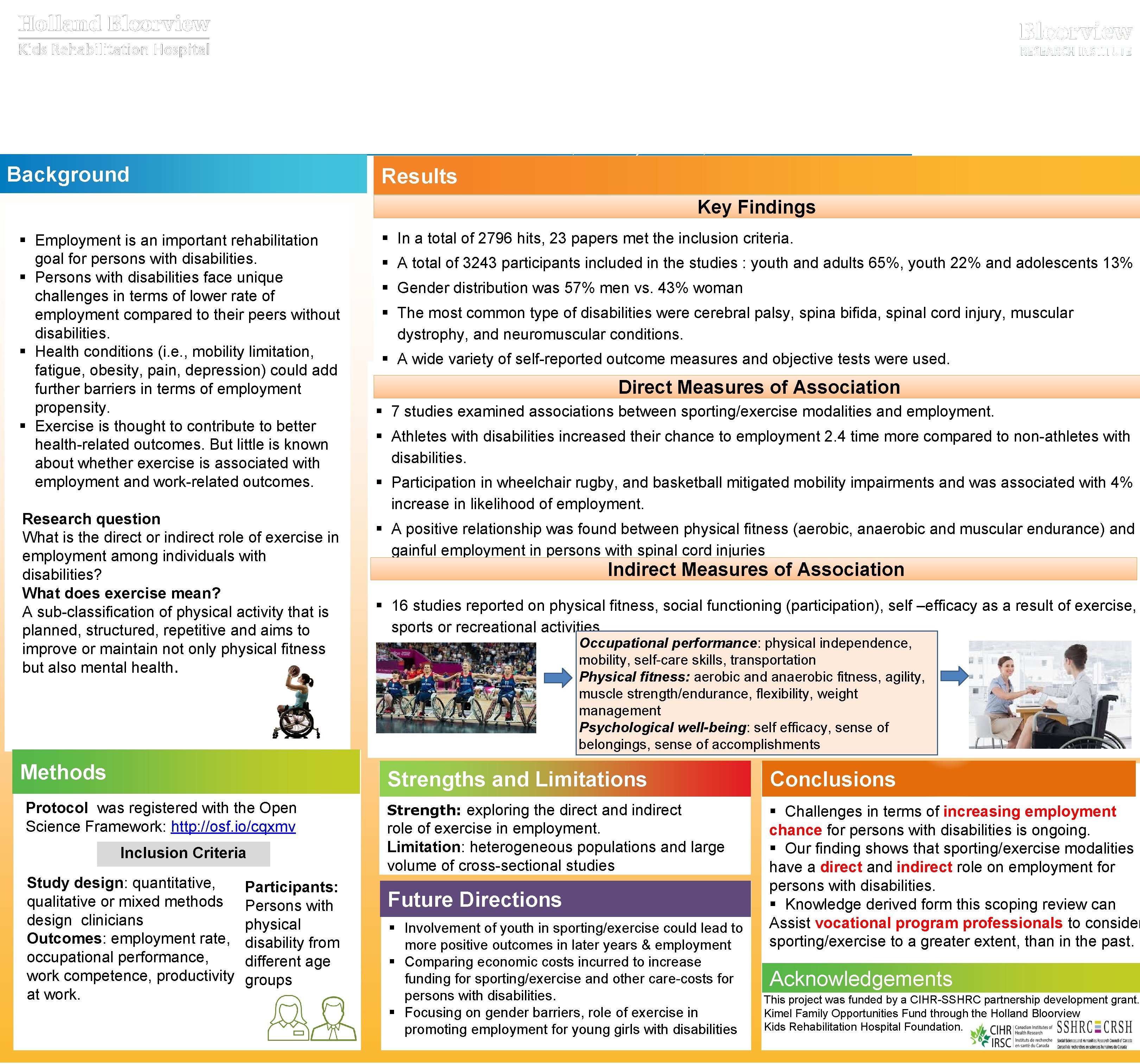
Exploring the direct and indirect role of physical activity on employment Among individuals with disabilities: A scoping review Azar 1 Background 1 Varahra , Hiba 1 Ahmed , Sally 1, 2 Lindsay, Bloorview Research Institute, 2 University of Toronto, Results Key Findings § Employment is an important rehabilitation goal for persons with disabilities. § Persons with disabilities face unique challenges in terms of lower rate of employment compared to their peers without disabilities. § Health conditions (i. e. , mobility limitation, fatigue, obesity, pain, depression) could add further barriers in terms of employment propensity. § Exercise is thought to contribute to better health-related outcomes. But little is known about whether exercise is associated with employment and work-related outcomes. Research question What is the direct or indirect role of exercise in employment among individuals with disabilities? What does exercise mean? A sub-classification of physical activity that is planned, structured, repetitive and aims to improve or maintain not only physical fitness but also mental health. Methods Protocol was registered with the Open Science Framework: http: //osf. io/cqxmv Inclusion Criteria Study design: quantitative, qualitative or mixed methods design clinicians Outcomes: employment rate, occupational performance, work competence, productivity at work. Participants: Persons with physical disability from different age groups § In a total of 2796 hits, 23 papers met the inclusion criteria. § A total of 3243 participants included in the studies : youth and adults 65%, youth 22% and adolescents 13% § Gender distribution was 57% men vs. 43% woman § The most common type of disabilities were cerebral palsy, spina bifida, spinal cord injury, muscular dystrophy, and neuromuscular conditions. § A wide variety of self-reported outcome measures and objective tests were used. Direct Measures of Association § 7 studies examined associations between sporting/exercise modalities and employment. § Athletes with disabilities increased their chance to employment 2. 4 time more compared to non-athletes with disabilities. § Participation in wheelchair rugby, and basketball mitigated mobility impairments and was associated with 4% increase in likelihood of employment. § A positive relationship was found between physical fitness (aerobic, anaerobic and muscular endurance) and gainful employment in persons with spinal cord injuries Indirect Measures of Association § 16 studies reported on physical fitness, social functioning (participation), self –efficacy as a result of exercise, sports or recreational activities. Occupational performance: physical independence, mobility, self-care skills, transportation Physical fitness: aerobic and anaerobic fitness, agility, muscle strength/endurance, flexibility, weight management Psychological well-being: self efficacy, sense of belongings, sense of accomplishments Strengths and Limitations Conclusions Strength: exploring the direct and indirect § Challenges in terms of increasing employment chance for persons with disabilities is ongoing. § Our finding shows that sporting/exercise modalities have a direct and indirect role on employment for persons with disabilities. § Knowledge derived form this scoping review can Assist vocational program professionals to consider sporting/exercise to a greater extent, than in the past. role of exercise in employment. Limitation: heterogeneous populations and large volume of cross-sectional studies Future Directions § Involvement of youth in sporting/exercise could lead to more positive outcomes in later years & employment § Comparing economic costs incurred to increase funding for sporting/exercise and other care-costs for persons with disabilities. § Focusing on gender barriers, role of exercise in promoting employment for young girls with disabilities Acknowledgements This project was funded by a CIHR-SSHRC partnership development grant. Kimel Family Opportunities Fund through the Holland Bloorview Kids Rehabilitation Hospital Foundation.