
EXPLORING THE DIMENSIONS OF QUALITY IN EDUCATION OECD
- Slides: 31
EXPLORING THE DIMENSIONS OF QUALITY IN EDUCATION - OECD perspective - Tanja Bastianić Organisation for Economic Co-operation and Development (OECD) 26 th October 2018 – Belgrade, Serbia
Organisation for Economic Co-operation and Development (OECD) – quick facts Paris based, staff of 3 000 around 200 in Education and Skills Directorate Better policies for better lives 250 publications/year, PISA test, Economic Outlook, OECD. Stat, etc. 35 member countries: 23 of the 28 EU countries plus US, Canada, Australia, New Zealand, Japan, Korea, Mexico, etc. 2
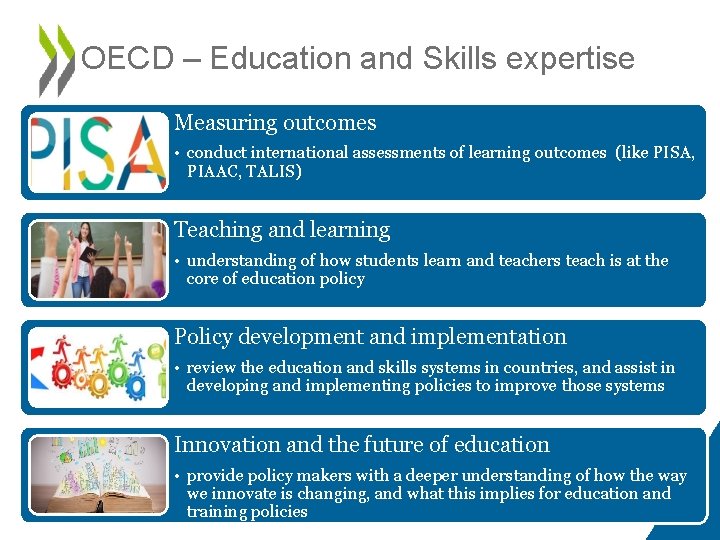
OECD – Education and Skills expertise Measuring outcomes • conduct international assessments of learning outcomes (like PISA, PIAAC, TALIS) Teaching and learning • understanding of how students learn and teachers teach is at the core of education policy Policy development and implementation • review the education and skills systems in countries, and assist in developing and implementing policies to improve those systems Innovation and the future of education • provide policy makers with a deeper understanding of how the way we innovate is changing, and what this implies for education and training policies 3
Why does quality in education matter? 4
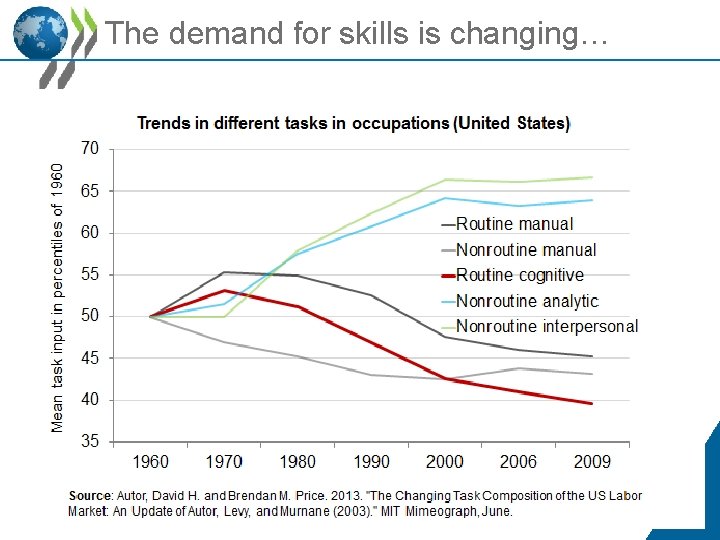
The demand for skills is changing…
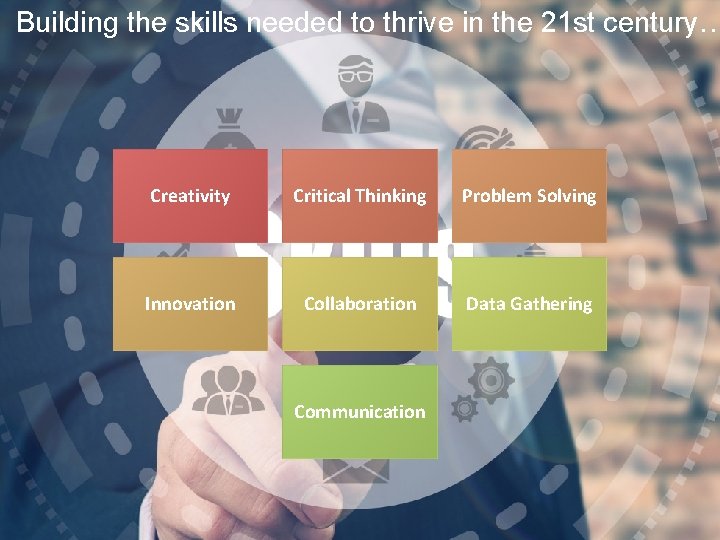
Building the skills needed to thrive in the 21 st century… Creativity Critical Thinking Problem Solving Innovation Collaboration Data Gathering Communication
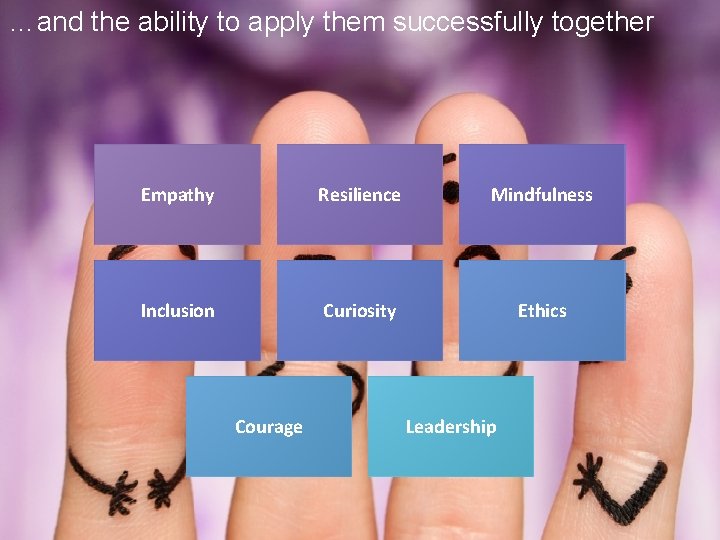
…and the ability to apply them successfully together Character qualities Empathy Resilience Mindfulness Inclusion Curiosity Ethics Courage Leadership
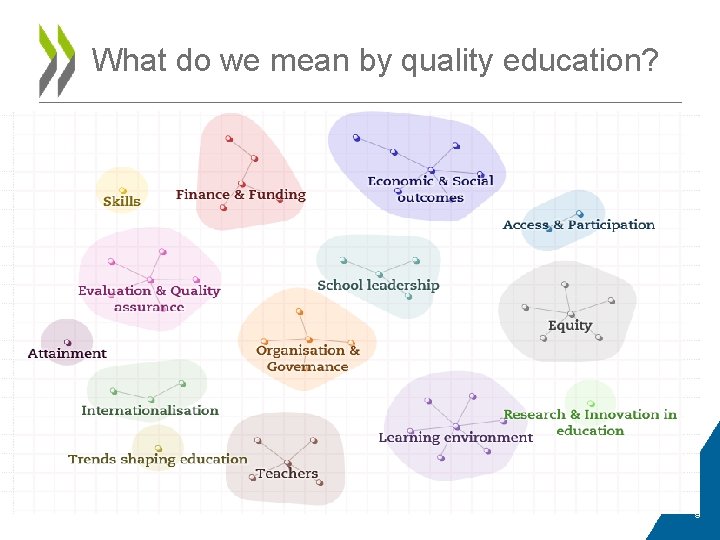
What are different dimensions of quality in education? 8
What do we mean by quality education? 9
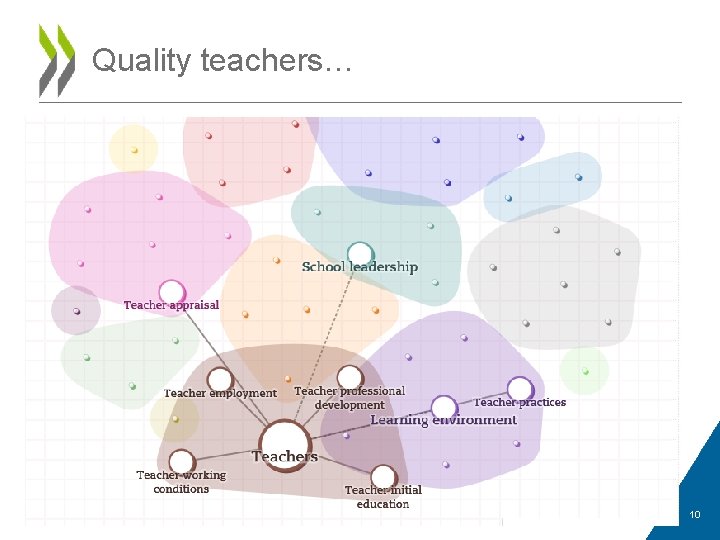
Quality teachers… 10
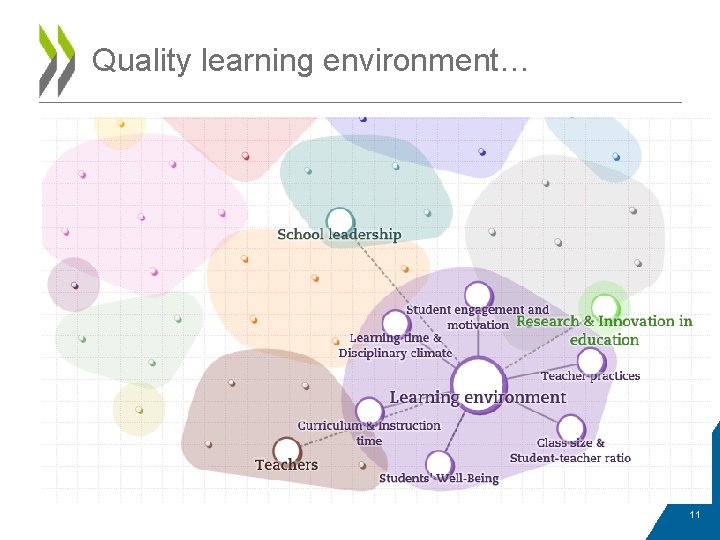
Quality learning environment… 11
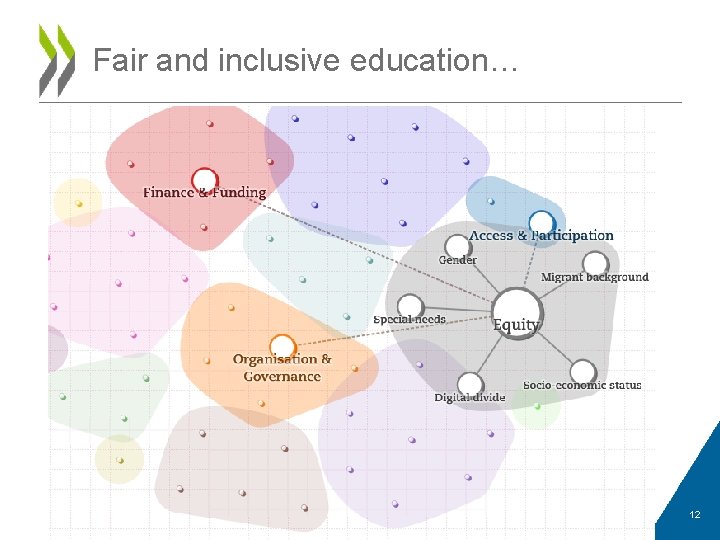
Fair and inclusive education… 12
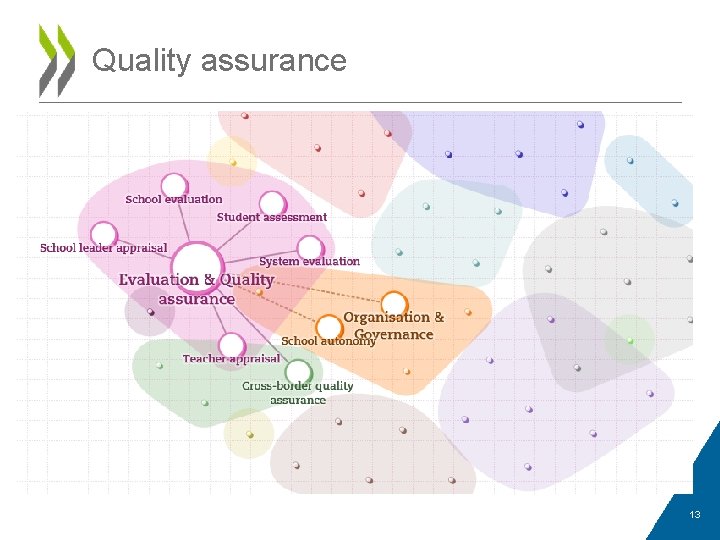
Quality assurance 13
How can quality in education be measured? 14
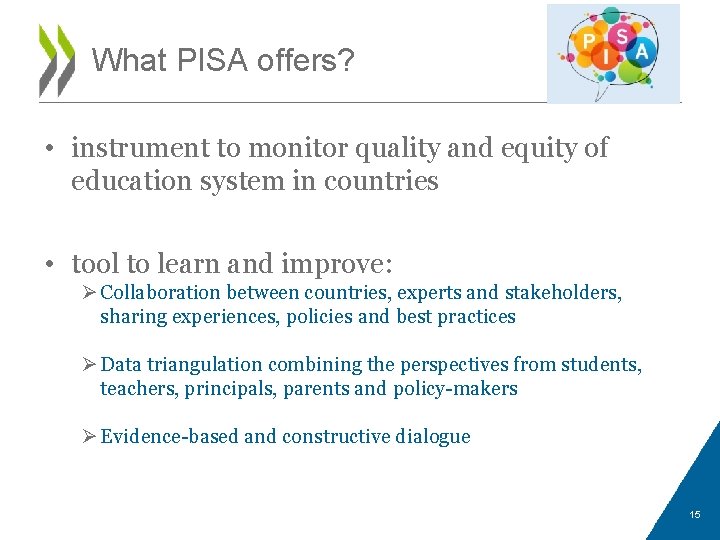
What PISA offers? • instrument to monitor quality and equity of education system in countries • tool to learn and improve: Ø Collaboration between countries, experts and stakeholders, sharing experiences, policies and best practices Ø Data triangulation combining the perspectives from students, teachers, principals, parents and policy-makers Ø Evidence-based and constructive dialogue 15
What is PISA? • Approximately 540 000 students… Ø representing about 29 million 15 -year-olds in the schools of the 72 participating countries and economies … took a computer-based test lasting a total of 2 hours… Ø Not only evaluates if students can reproduce what they have learned at school… Ø …assesses students’ capacity to apply creatively their knowledge and skills in a variety of situations related to science, reading, mathematics, financial literacy and collaborative problem solving … and answered questions about their schools, personal context and attitudes towards learning • Parents, principals, teachers and policy-makers provided information about … Ø School policies, practices, resources and institutional factors that can explain the differences in performance 16
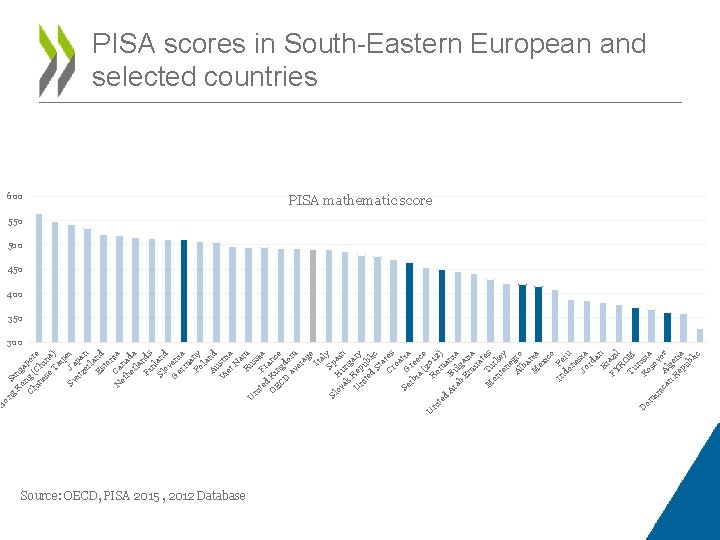
S Ko ing n a Ch g ( por in Ch e es in e a) Ta ip Sw Ja ei itz pa er n la Es nd to n N Ca ia et na he d rla a Fi nds nl Sl and ov G en er ia m a Po ny la Au nd Vi str et ia N am R U us ni te F sia d r O Ki anc EC ng e D do av m er ag e It al Sp y Sl ov Hu ain ak n g U Rep ary ni te ub d lic St a Cr tes oa Se G tia rb re ia ec (2 e U Ro 012 ni te m ) d Ar B ani u ab lg a Em ari ira a t M Tu es on rk te ey ne Al gro ba n M ia ex ic o In Pe do ru ne Jo sia rd a Br n a FY zi RO l Tu M n D Ko isia om so in ic A vo* an lg Re eri pu a bl ic on g H PISA scores in South-Eastern European and selected countries 600 Source: OECD, PISA 2015 , 2012 Database PISA mathematic score 550 500 450 400 350 300
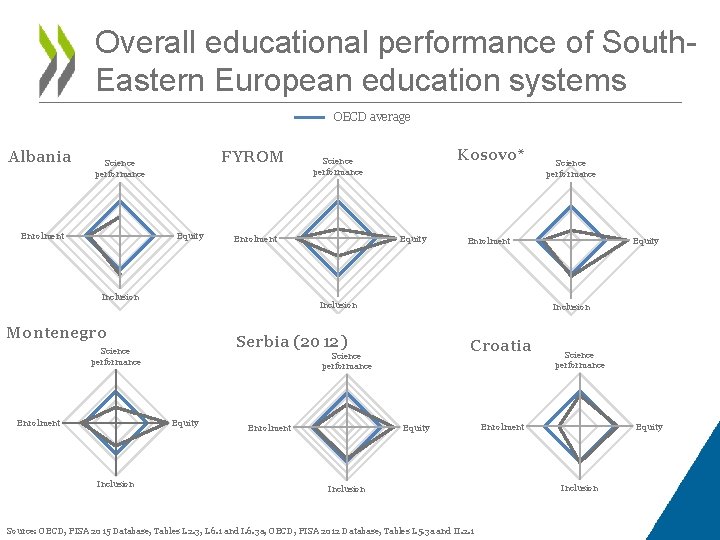
Overall educational performance of South. Eastern European education systems OECD average Albania FYROM Science performance Enrolment Equity Enrolment Inclusion Enrolment Croatia Science performance Equity Enrolment Science performance Equity Inclusion Serbia (2012) Science performance Inclusion Equity Inclusion Montenegro Enrolment Kosovo* Science performance Equity Inclusion Source: OECD, PISA 2015 Database, Tables I. 2. 3, I. 6. 1 and I. 6. 3 a, OECD, PISA 2012 Database, Tables I. 5. 3 a and II. 2. 1 Science performance Enrolment Equity Inclusion
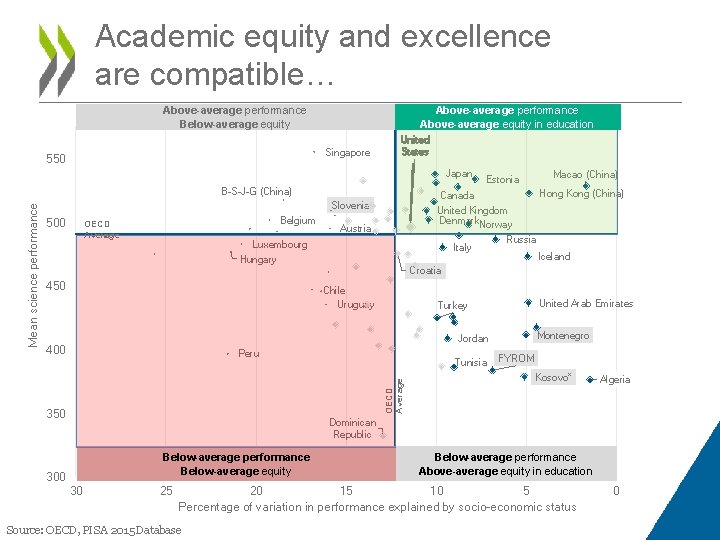
Academic equity and excellence are compatible… Above-average performance Below-average equity Above-average performance Above-average equity in education Singapore 550 United States Japan 500 Belgium OECD Average Hong Kong (China) Canada Slovenia United Kingdom Denmark. Norway Austria Luxembourg Hungary Italy Russia Iceland Croatia 450 Chile Uruguay United Arab Emirates Turkey Montenegro Jordan 400 Peru Tunisia OECD Average Mean science performance B-S-J-G (China) Macao (China) Estonia 350 FYROM Kosovo* Algeria Dominican Republic Below-average performance Below-average equity 300 30 25 Below-average performance Above-average equity in education 20 15 10 5 Percentage of variation in performance explained by socio-economic status Source: OECD, PISA 2015 Database 0
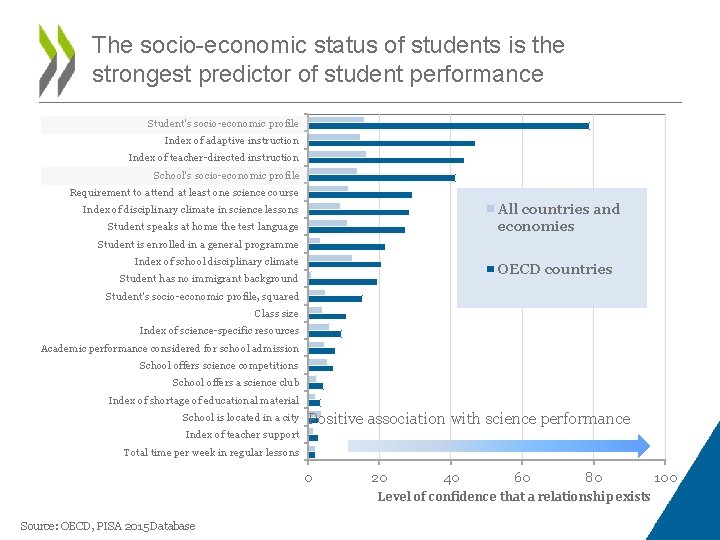
The socio-economic status of students is the strongest predictor of student performance Student's socio-economic profile Index of adaptive instruction Index of teacher-directed instruction School's socio-economic profile Requirement to attend at least one science course All countries and economies Index of disciplinary climate in science lessons Student speaks at home the test language Student is enrolled in a general programme Index of school disciplinary climate OECD countries Student has no immigrant background Student's socio-economic profile, squared Class size Index of science-specific resources Academic performance considered for school admission School offers science competitions School offers a science club Index of shortage of educational material School is located in a city Positive association with science performance Index of teacher support Total time per week in regular lessons 0 20 40 60 80 Level of confidence that a relationship exists Source: OECD, PISA 2015 Database 100
More spending does not ensure better performance Positive relationship No relationship 21 Source: OECD, PISA 2015 Database
How can quality education be fostered at the school level? 22
Global quest for better teaching & learning Schools around the world are seeking ways to: • • • Equip their students with 21 st century skills Introduce competence-based assessment Build capacity for data-driven school improvement Benchmark their performance internationally Connect with, and learn from, other schools 23
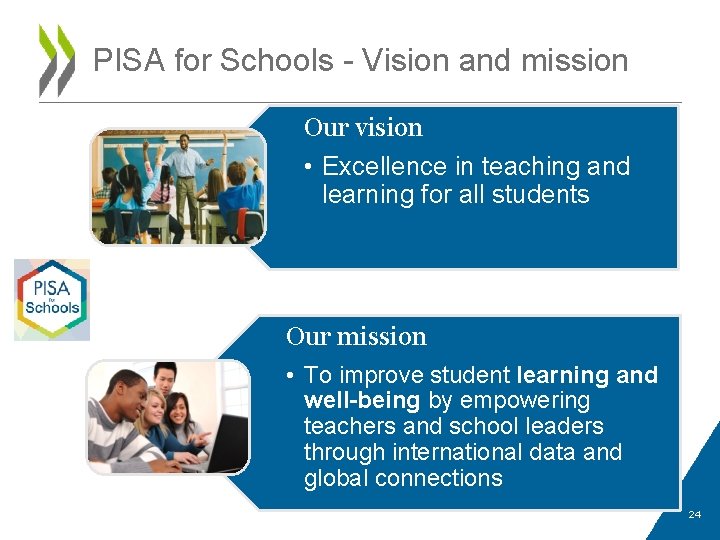
PISA for Schools - Vision and mission Our vision • Excellence in teaching and learning for all students Our mission • To improve student learning and well-being by empowering teachers and school leaders through international data and global connections 24
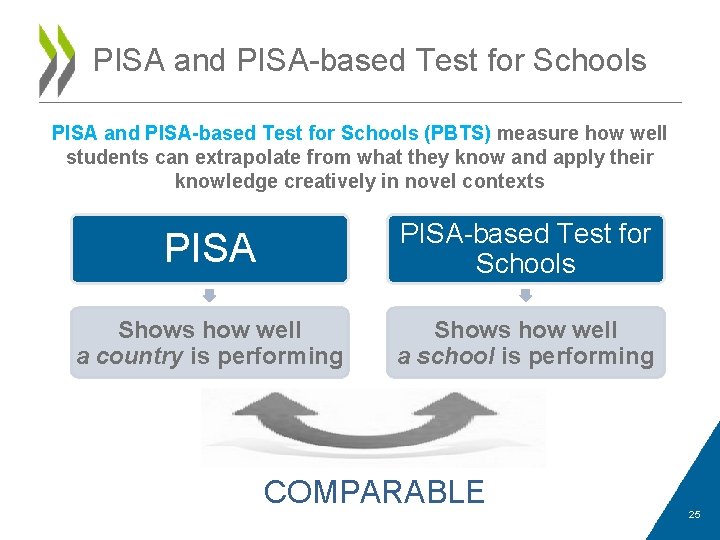
PISA and PISA-based Test for Schools (PBTS) measure how well students can extrapolate from what they know and apply their knowledge creatively in novel contexts PISA-based Test for Schools Shows how well a country is performing Shows how well a school is performing COMPARABLE 25
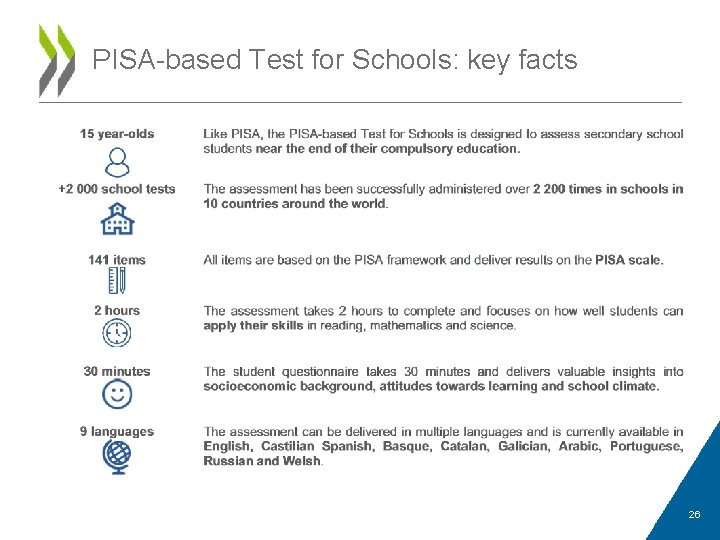
PISA-based Test for Schools: key facts 26
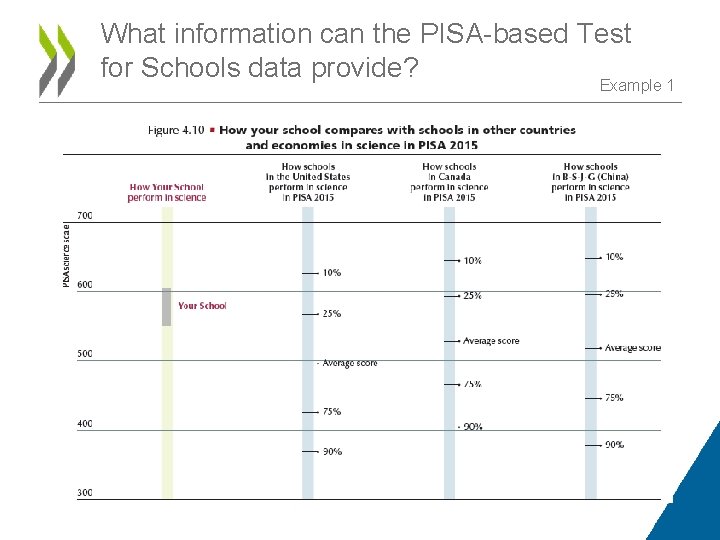
What information can the PISA-based Test for Schools data provide? Example 1
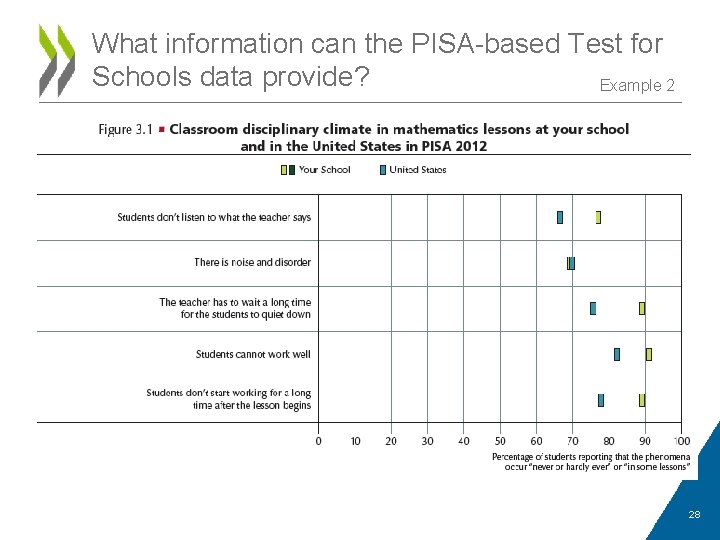
What information can the PISA-based Test for Schools data provide? Example 2 28
Concluding remarks Why? § The demand for skills is changing… § Skills drive prosperity and social inclusion § The quality of education can be a strong predictor of a country’s economic and social prosperity How? § Policy alignment foster high quality and equity education systems § Monitoring and assessment generate insights for action 29
Questions • What are the most challenging dimensions of quality education in SEE countries? • What difficulties do SEE countries face in improving their education system? • How could OECD be most useful? 30
Follow us on: Hvala Tanja. Bastianic@oecd. org http: //www. oecd. org/pisa-based-test-for-schools/