
Exploring the Brain Connectivity Questions Challenges and Recent
Exploring the Brain Connectivity: Questions, Challenges and Recent Findings Ying Guo, Ph. D Department of Biostatistics and Bioinformatics Emory University Joint work with Phebe Kemmer, Yikai Wang, Jian Kang, Du. Bois Bowman
f. MRI Networking Modeling “Top-3” network modeling methods based on simulation studies (Smith et al. , Neuro. Image, 2011) 2
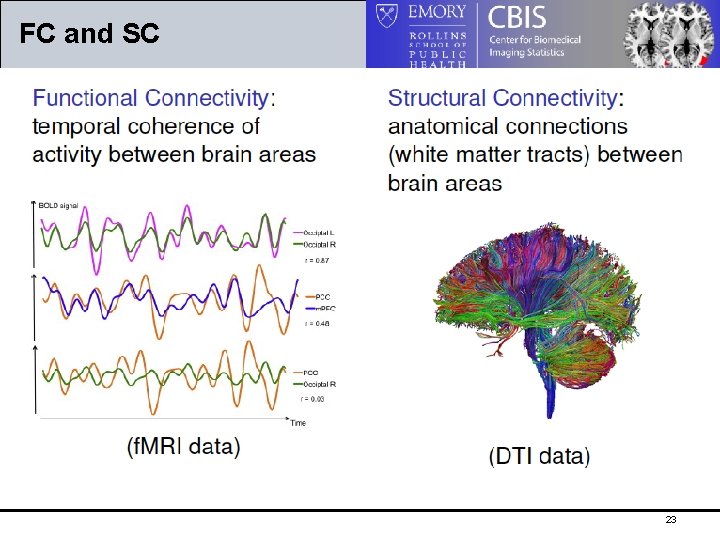
Questions we aim to investigate: • Network based on direct connectivity vs. marginal connectivity? • Sparse network estimation: how does the brain network change when applying different levels of sparse regularization? • Whether and how functional connections are related to structural connections in brain networks. 3
Brain Functional Connectivity • • Marginal connectivity vs. Direct connectivity Effects of sparse regularization on estimated connectivity 4
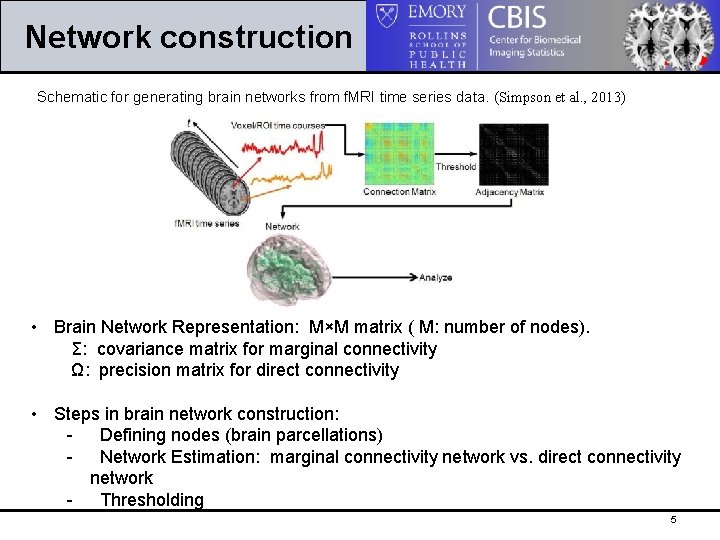
Network construction Schematic for generating brain networks from f. MRI time series data. (Simpson et al. , 2013) • Brain Network Representation: M×M matrix ( M: number of nodes). Σ: covariance matrix for marginal connectivity Ω: precision matrix for direct connectivity • Steps in brain network construction: - Defining nodes (brain parcellations) - Network Estimation: marginal connectivity network vs. direct connectivity network - Thresholding 5

Node Definition Nodes: individual voxels • • • computationally challenging the network tends to be very noisy: high noise level in voxel signals The network tends to have high between-subject variability Intermediate node system Nodes: a coarse parcellation of the brain into large regions • • can cause a loss in spatial resolutions in connectivity analysis high variability in temporal dynamics within the same region 6
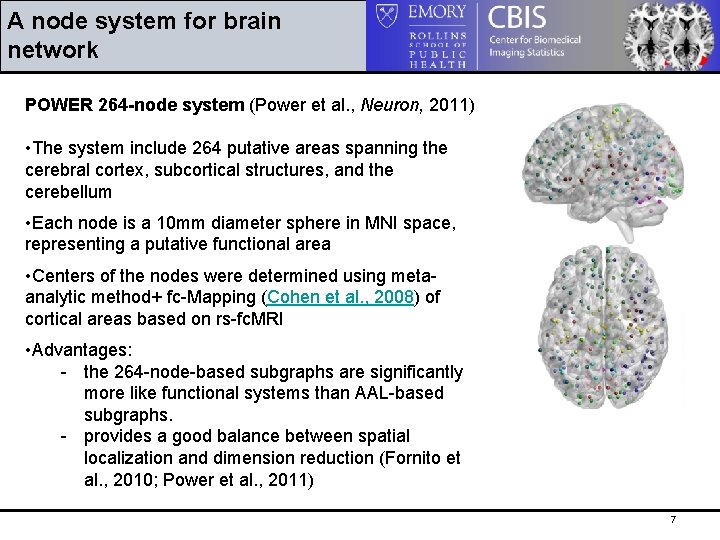
A node system for brain network POWER 264 -node system (Power et al. , Neuron, 2011) • The system include 264 putative areas spanning the cerebral cortex, subcortical structures, and the cerebellum • Each node is a 10 mm diameter sphere in MNI space, representing a putative functional area • Centers of the nodes were determined using metaanalytic method+ fc-Mapping (Cohen et al. , 2008) of cortical areas based on rs-fc. MRI • Advantages: - the 264 -node-based subgraphs are significantly more like functional systems than AAL-based subgraphs. - provides a good balance between spatial localization and dimension reduction (Fornito et al. , 2010; Power et al. , 2011) 7
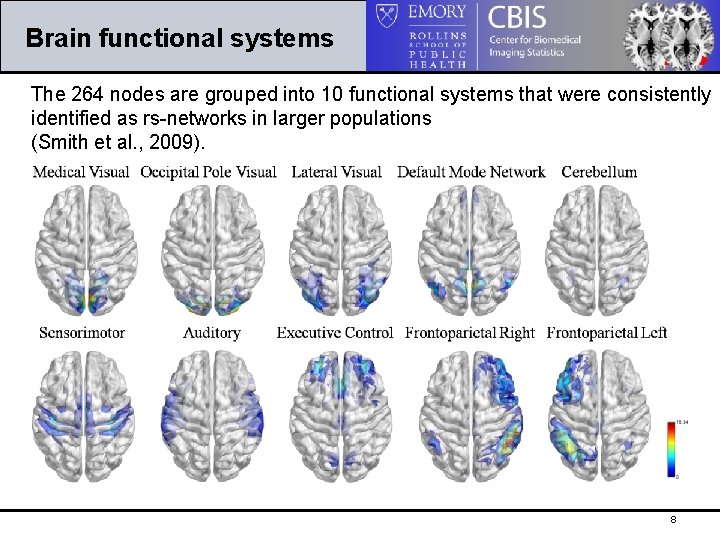
Brain functional systems The 264 nodes are grouped into 10 functional systems that were consistently identified as rs-networks in larger populations (Smith et al. , 2009). 8
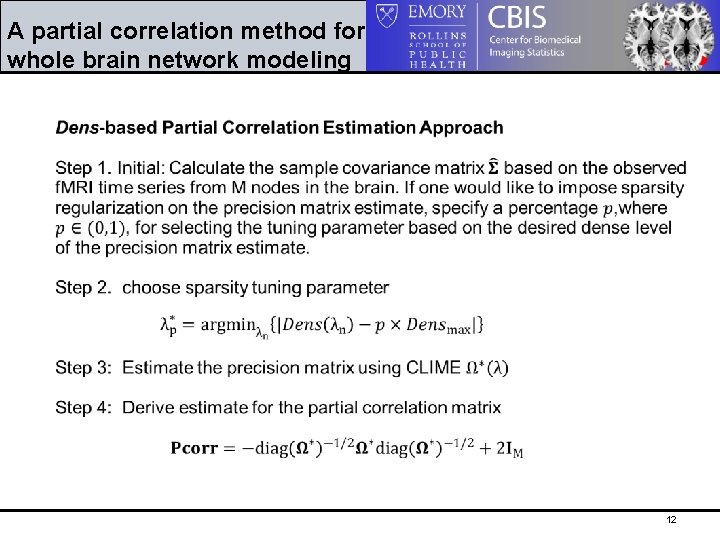
Network Estimation • Marginal Connectivity: Full correlation • Direct Connectivity: Partial correlation Methods for estimating Partial correlations in high dimensional case: Ridge regression (Hoerl and Kennar, 1970); shrinkage estimator (Schäfer J et al. , 2005); Graphical Lasso(Banerjee 2006 ; Friedmann et al. , 2008); etc. Constrained L 1 -minimization Approach (CLIME) (Cai et al. , 2011): - Theoretical advantage: CLIME precision matrix estimators are shown to converge to the true precision matrix at a faster rate as compared to the traditional L 1 regularization methods - Computational advantage: o easily implemented by linear programming o scalable to high dimensional precision matrix with a large number of nodes A challenge: selecting the tuning parameter. Issues with the existing selection methods: - not flexible to choose the desired sparsity level (e. g some methods tend to select overly dense networks); - computationally expensive. 9

Dens-based tuning parameter selection method 10
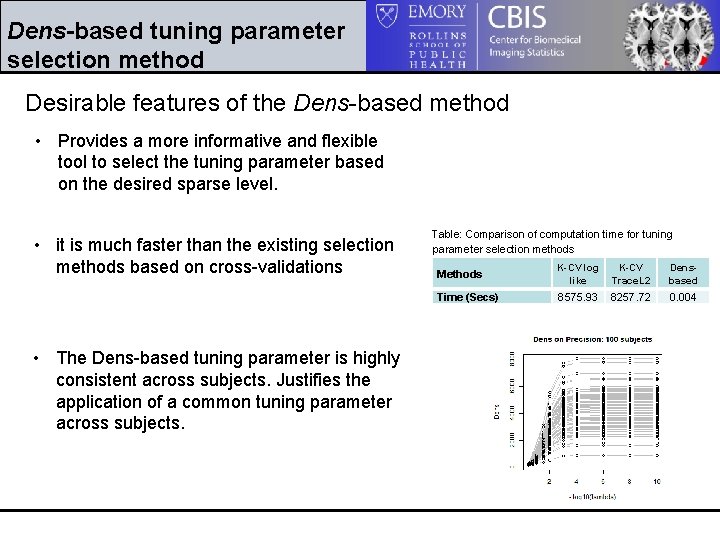
Dens-based tuning parameter selection method Desirable features of the Dens-based method • Provides a more informative and flexible tool to select the tuning parameter based on the desired sparse level. • it is much faster than the existing selection methods based on cross-validations • The Dens-based tuning parameter is highly consistent across subjects. Justifies the application of a common tuning parameter across subjects. Table: Comparison of computation time for tuning parameter selection methods Methods K-CV log like K-CV Trace. L 2 Densbased Time (Secs) 8575. 93 8257. 72 0. 004
A partial correlation method for whole brain network modeling 12
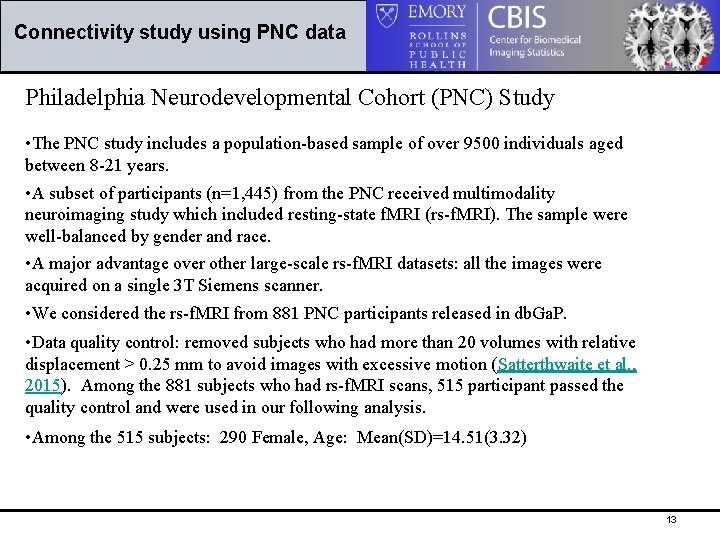
Connectivity study using PNC data Philadelphia Neurodevelopmental Cohort (PNC) Study • The PNC study includes a population-based sample of over 9500 individuals aged between 8 -21 years. • A subset of participants (n=1, 445) from the PNC received multimodality neuroimaging study which included resting-state f. MRI (rs-f. MRI). The sample were well-balanced by gender and race. • A major advantage over other large-scale rs-f. MRI datasets: all the images were acquired on a single 3 T Siemens scanner. • We considered the rs-f. MRI from 881 PNC participants released in db. Ga. P. • Data quality control: removed subjects who had more than 20 volumes with relative displacement > 0. 25 mm to avoid images with excessive motion (Satterthwaite et al. , 2015). Among the 881 subjects who had rs-f. MRI scans, 515 participant passed the quality control and were used in our following analysis. • Among the 515 subjects: 290 Female, Age: Mean(SD)=14. 51(3. 32) 13
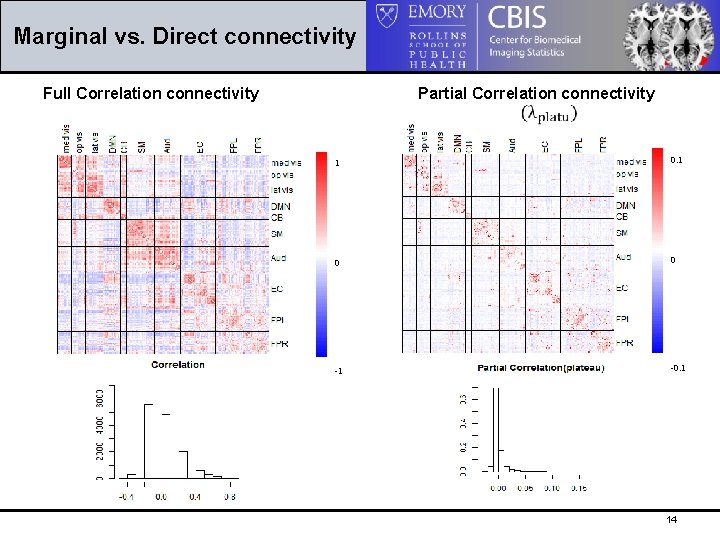
Marginal vs. Direct connectivity Full Correlation connectivity Partial Correlation connectivity 1 0 0 -1 -0. 1 14
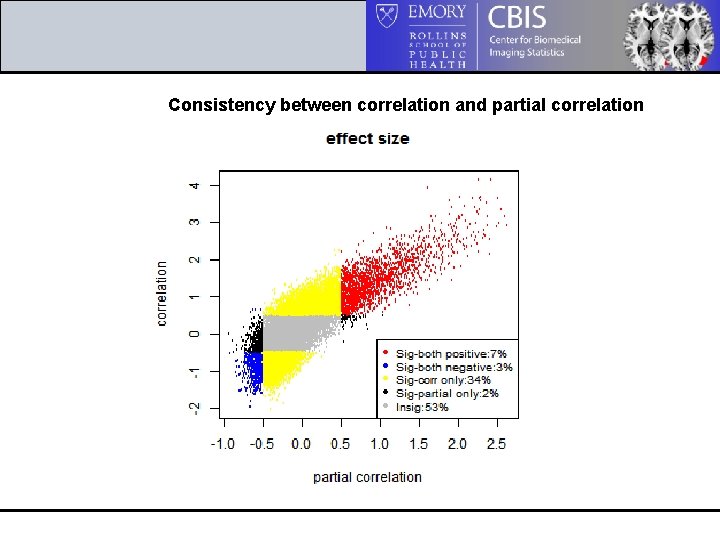
Consistency between correlation and partial correlation
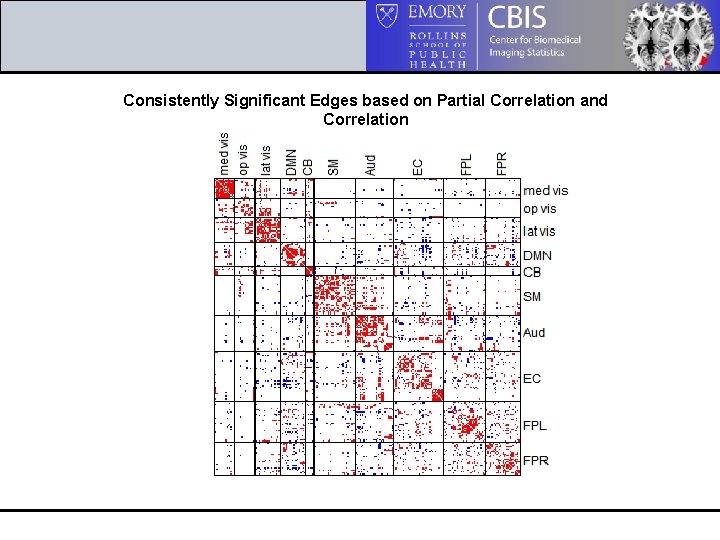
Consistently Significant Edges based on Partial Correlation and Correlation
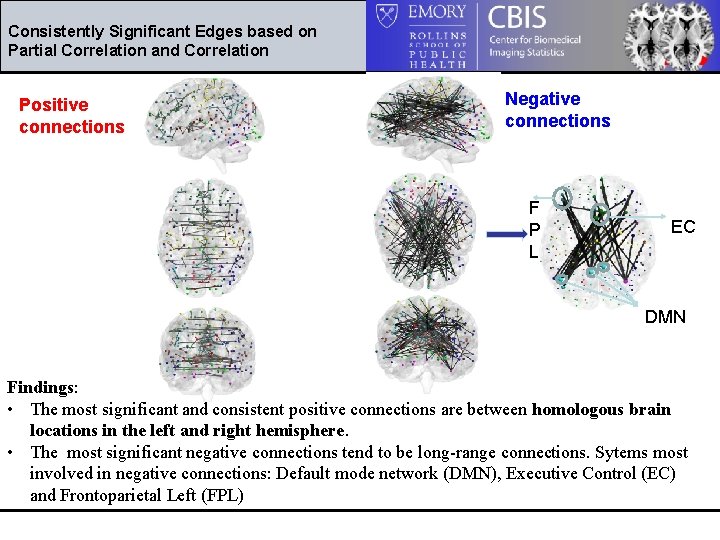
Consistently Significant Edges based on Partial Correlation and Correlation Positive connections Negative connections F P L EC DMN Findings: • The most significant and consistent positive connections are between homologous brain locations in the left and right hemisphere. • The most significant negative connections tend to be long-range connections. Sytems most involved in negative connections: Default mode network (DMN), Executive Control (EC) and Frontoparietal Left (FPL)
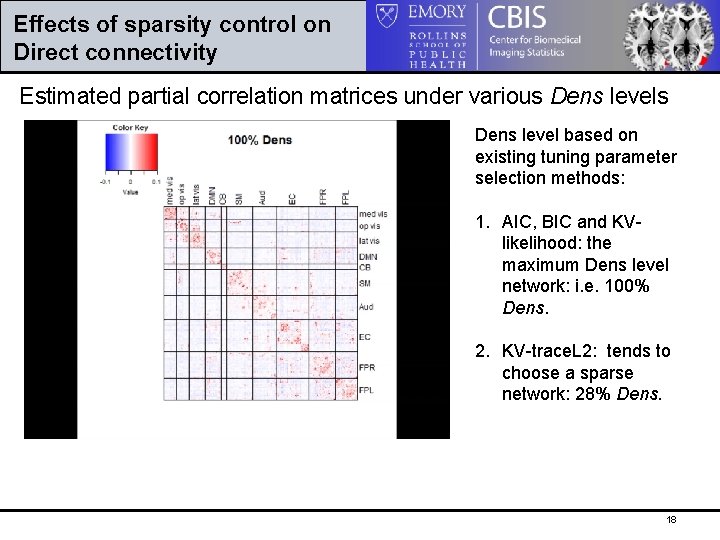
Effects of sparsity control on Direct connectivity Estimated partial correlation matrices under various Dens level based on existing tuning parameter selection methods: 1. AIC, BIC and KVlikelihood: the maximum Dens level network: i. e. 100% Dens. 2. KV-trace. L 2: tends to choose a sparse network: 28% Dens. 18
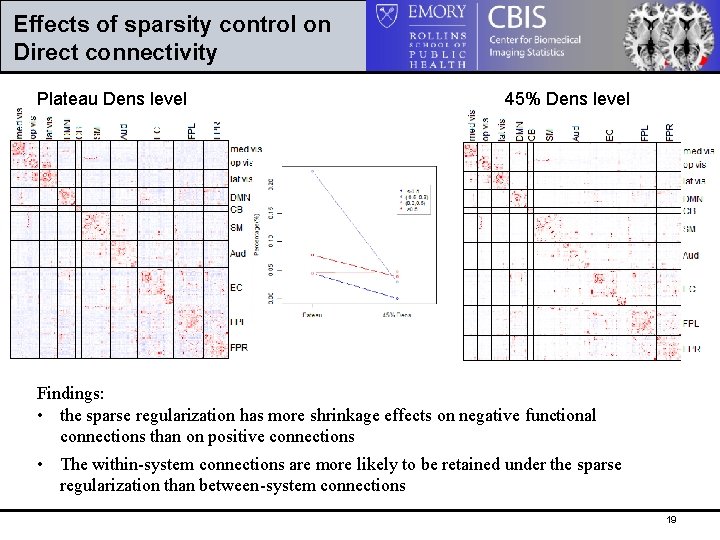
Effects of sparsity control on Direct connectivity Plateau Dens level 45% Dens level Findings: • the sparse regularization has more shrinkage effects on negative functional connections than on positive connections • The within-system connections are more likely to be retained under the sparse regularization than between-system connections 19
Summary for Functional Connectivity Analysis • Marginal FC and direct FC are more consistent within functional systems than between functional systems. The most consistent and highly significant positive connections are between homologous regions in the left and right hemisphere. • The sparsity regularization has more shrinkage effect on negative connections than positive connections. Positive and negative FC very likely reflect different underlying physiological mechanisms. • Within-functional-system connections are more likely to be retained in sparse networks. 20
Functional Connectivity & Structural Connectivity 21
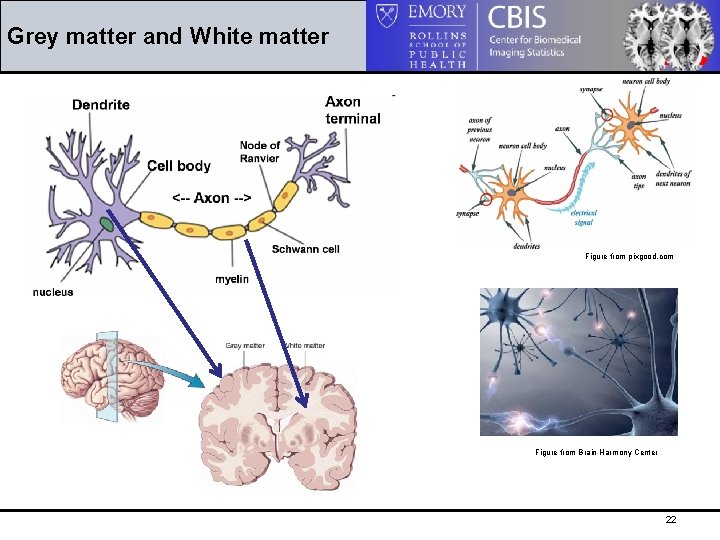
Grey matter and White matter Figure from pixgood. com Figure from Brain Harmony Center 22
FC and SC 23
FC and SC 24
The proposed s. SC measure 25
The proposed s. SC measure 26
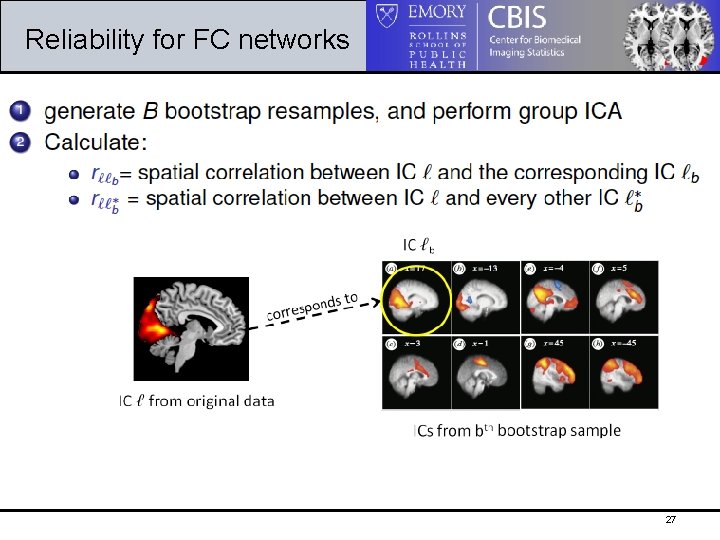
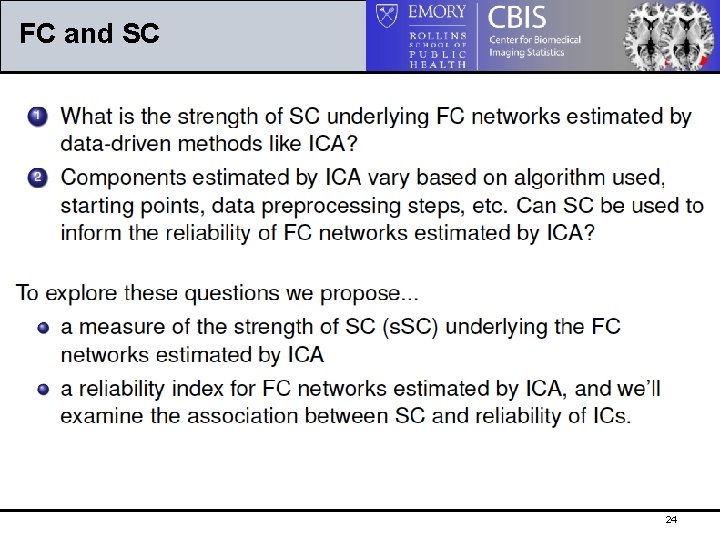
Reliability for FC networks 27
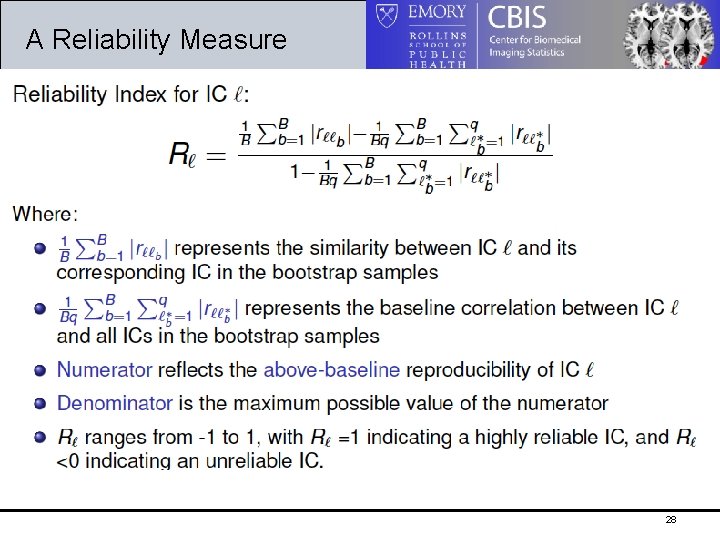
A Reliability Measure 28
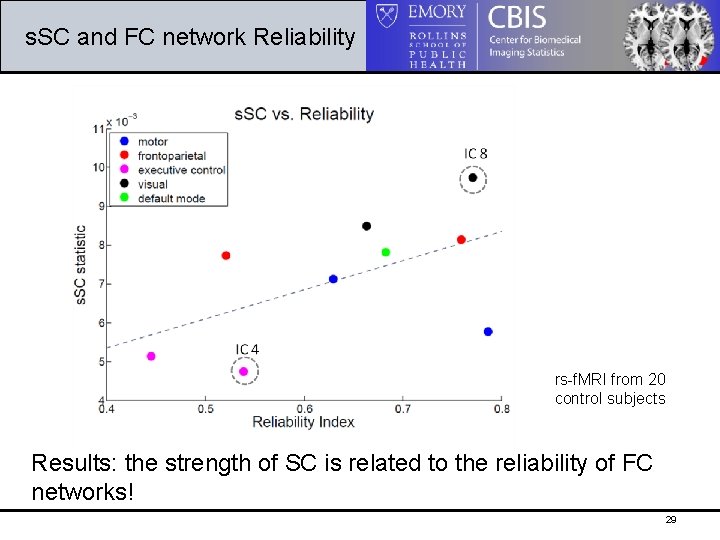
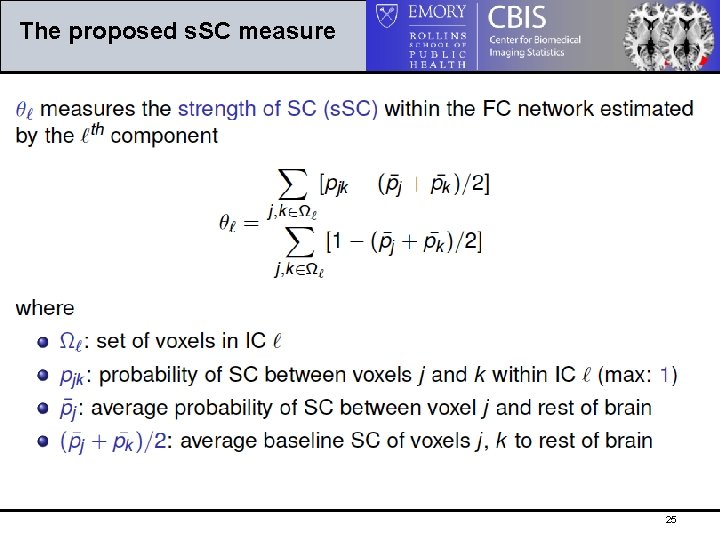
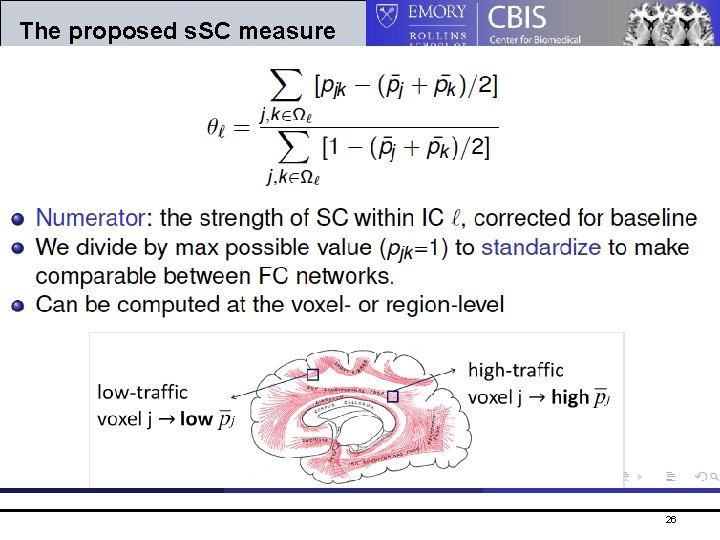
s. SC and FC network Reliability rs-f. MRI from 20 control subjects Results: the strength of SC is related to the reliability of FC networks! 29
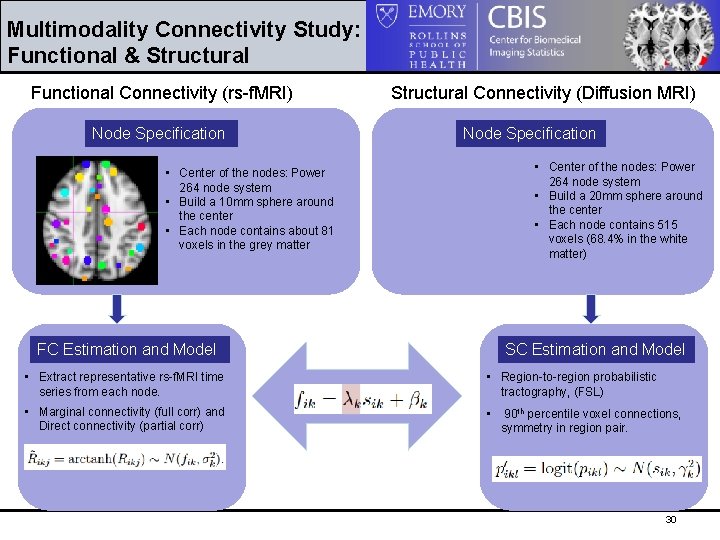
Multimodality Connectivity Study: Functional & Structural Functional Connectivity (rs-f. MRI) Node Specification • Center of the nodes: Power 264 node system • Build a 10 mm sphere around the center • Each node contains about 81 voxels in the grey matter FC Estimation and Model Structural Connectivity (Diffusion MRI) Node Specification • Center of the nodes: Power 264 node system • Build a 20 mm sphere around the center • Each node contains 515 voxels (68. 4% in the white matter) SC Estimation and Model • Extract representative rs-f. MRI time series from each node. • Region-to-region probabilistic tractography, (FSL) • Marginal connectivity (full corr) and Direct connectivity (partial corr) • 90 th percentile voxel connections, symmetry in region pair. 30
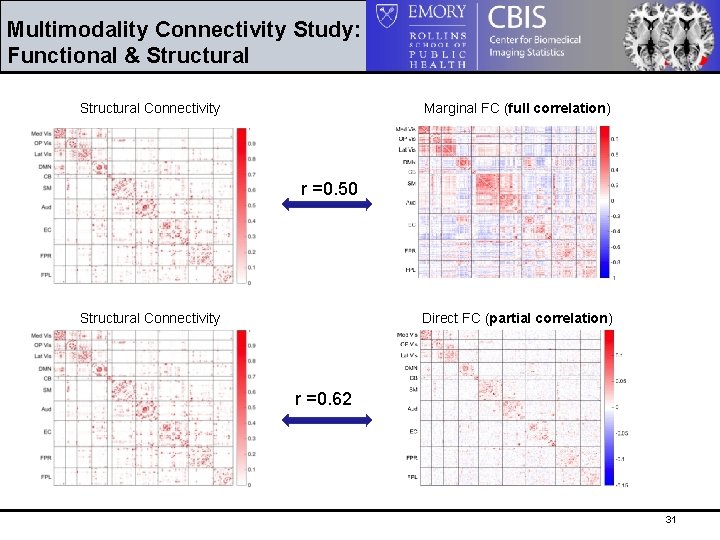
Multimodality Connectivity Study: Functional & Structural Connectivity Marginal FC (full correlation) r =0. 50 Structural Connectivity Direct FC (partial correlation) r =0. 62 31
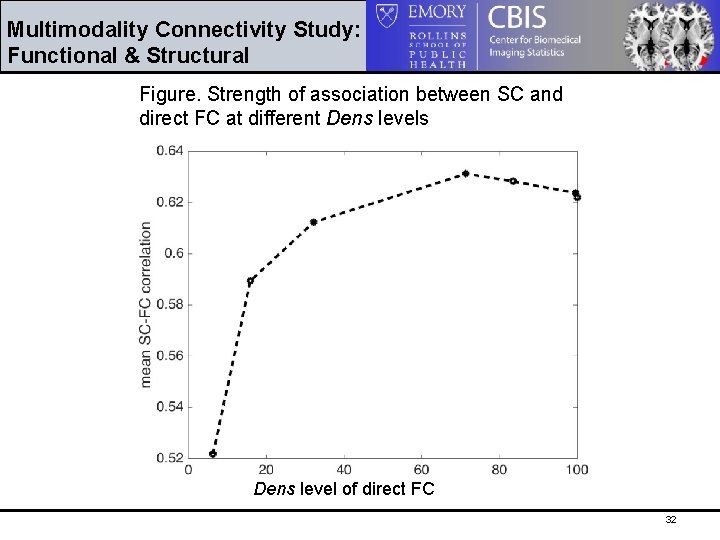
Multimodality Connectivity Study: Functional & Structural Figure. Strength of association between SC and direct FC at different Dens levels Dens level of direct FC 32
Summary for FC&SC • SC has stronger association with direct FC than with marginal FC. Direct FC is more likely caused by direct structural (white fiber tracts) connections between grey matter functional areas. • Using information from SC, we may be able to distinguish different kinds of functional connections: - FC caused by direct structural connections (more reproducible, more likely to be retained in sparse functional networks). - FC resulting from common connections to hub nodes, membership in the same functional system and between-system co-activations 33
Acknowledgements CBIS students: Phebe B. Kemmer Yikai Wang Grants: NIMH (2 R 01 MH 079448 -04 A 1 and 1 R 01 MH 105561 -01). 34
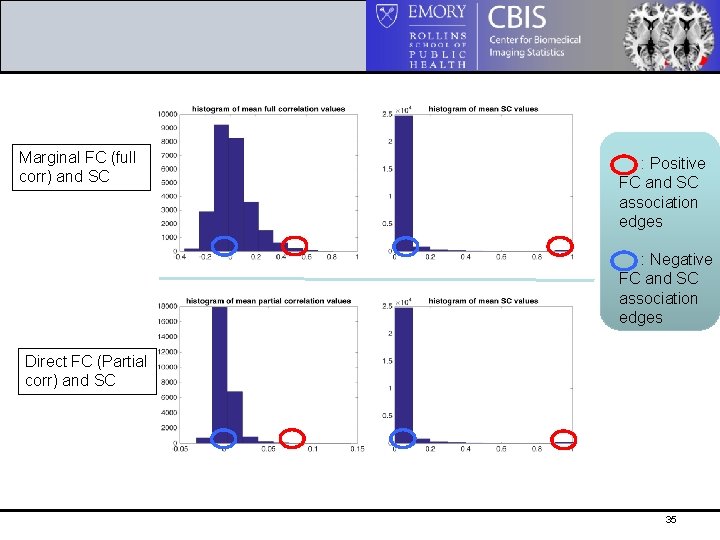
Marginal FC (full corr) and SC : Positive FC and SC association edges : Negative FC and SC association edges Direct FC (Partial corr) and SC 35
- Slides: 35