
Exploring the alpha cluster structure of nuclei using
- Slides: 10
Exploring the alpha cluster structure of nuclei using the thick target inverse kinematics technique for multiple alpha decays. The 24 Mg case Marina Barbui, August 19 th, 2013
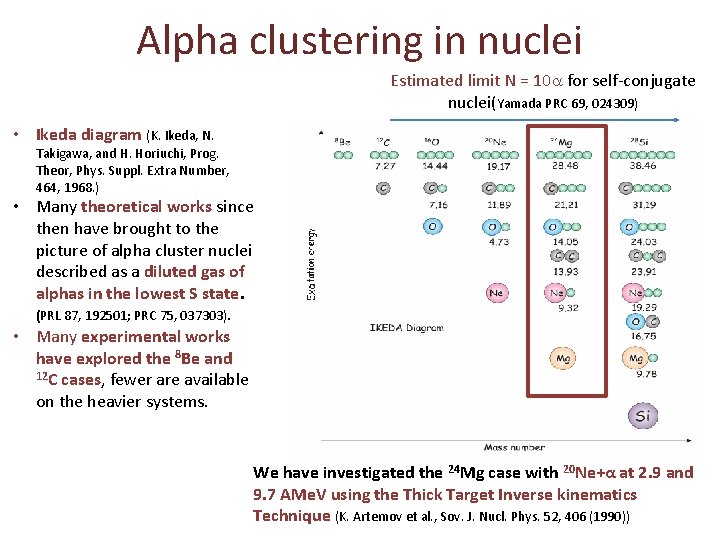
Alpha clustering in nuclei Estimated limit N = 10 a for self-conjugate nuclei(Yamada PRC 69, 024309) • Ikeda diagram (K. Ikeda, N. Takigawa, and H. Horiuchi, Prog. Theor, Phys. Suppl. Extra Number, 464, 1968. ) • Many theoretical works since then have brought to the picture of alpha cluster nuclei described as a diluted gas of alphas in the lowest S state. (PRL 87, 192501; PRC 75, 037303). • Many experimental works have explored the 8 Be and 12 C cases, fewer are available on the heavier systems. We have investigated the 24 Mg case with 20 Ne+α at 2. 9 and 9. 7 AMe. V using the Thick Target Inverse kinematics Technique (K. Artemov et al. , Sov. J. Nucl. Phys. 52, 406 (1990))
The thick target inverse kinematics technique • Allows covering a large range of incident energies in the same experiment. • In the inverse kinematics, the reaction products are focused at forward angles. • Allows measuring reaction products emitted at 0 o. • This Method (K. Artemov et al. , Sov. J. Nucl. Phys. 52, 406 (1990)) has been used several times to measure the resonant elastic scattering (Eur. Phys. J. A (2011) 47: 73; Eur. Phys. J. A (2011) 47: 96; AIP Conf. Proc. 1213, 137 (2010) ) and is used here for the first time to detect multiple alpha decays.
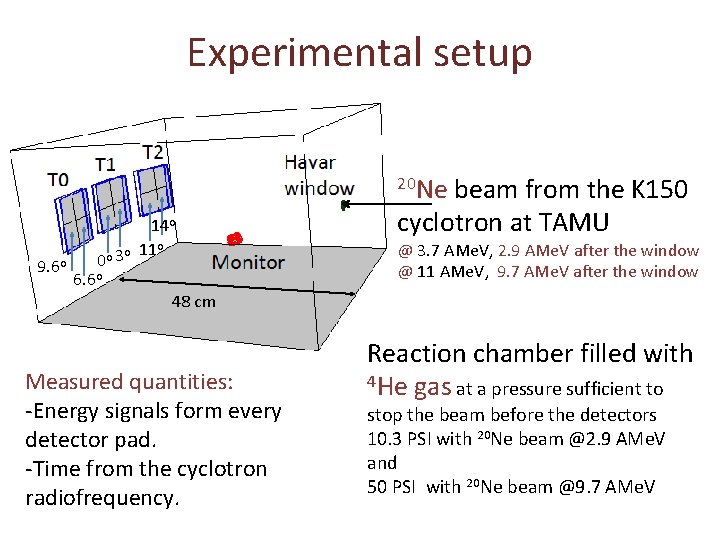
Experimental setup 20 Ne 9. 6 o 14 o o o 11 o 3 0 6. 6 o beam from the K 150 cyclotron at TAMU @ 3. 7 AMe. V, 2. 9 AMe. V after the window @ 11 AMe. V, 9. 7 AMe. V after the window 48 cm Measured quantities: -Energy signals form every detector pad. -Time from the cyclotron radiofrequency. Reaction chamber filled with 4 He gas at a pressure sufficient to stop the beam before the detectors 10. 3 PSI with 20 Ne beam @2. 9 AMe. V and 50 PSI with 20 Ne beam @9. 7 AMe. V
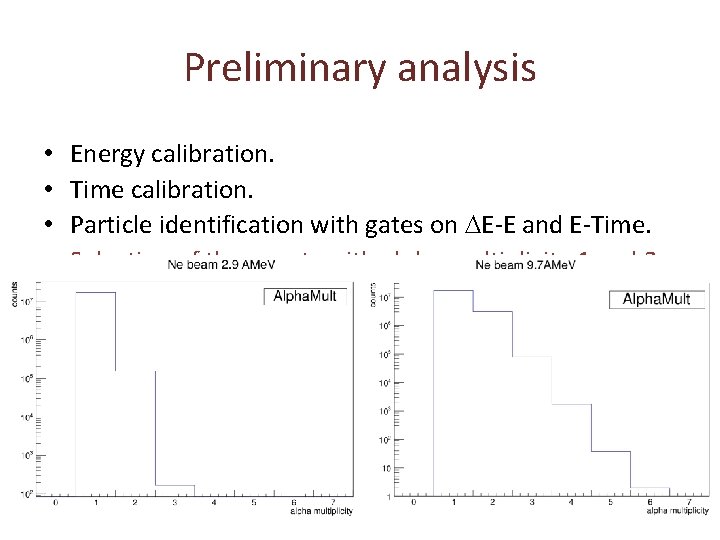
Preliminary analysis Energy calibration. Time calibration. Particle identification with gates on DE-E and E-Time. Selection of the events with alpha multiplicity 1 and 2 for further analysis. • Reconstruction of the interaction point in the gas using the kinematics, the measured alpha energies and the energy-range tables from SRIM (double check with the measured time). • Reconstruction of the excitation energy of the 24 Mg. • •
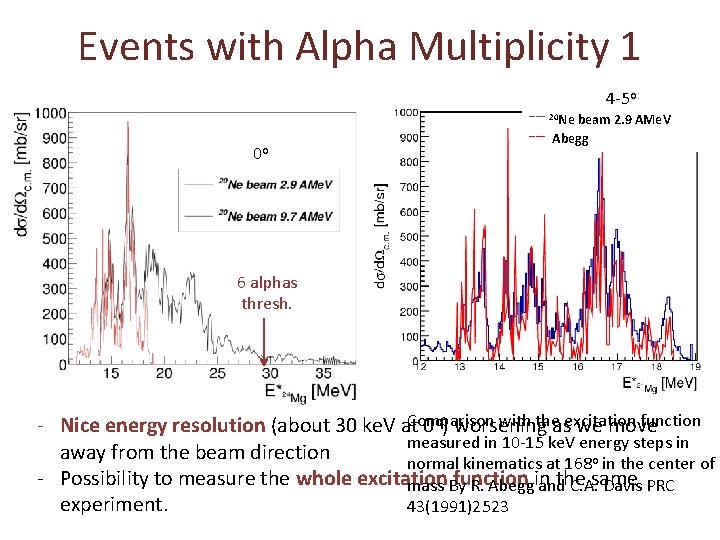
Events with Alpha Multiplicity 1 4 -5 o ----- 20 Ne beam 2. 9 AMe. V ----- 0 o Abegg 6 alphas thresh. Comparison with theasexcitation function - Nice energy resolution (about 30 ke. V at 0 o) worsening we move measured in 10 -15 ke. V energy steps in away from the beam direction normal kinematics at 168 o in the center of - Possibility to measure the whole excitation function the mass By R. Abeggin and C. A. same Davis PRC experiment. 43(1991)2523
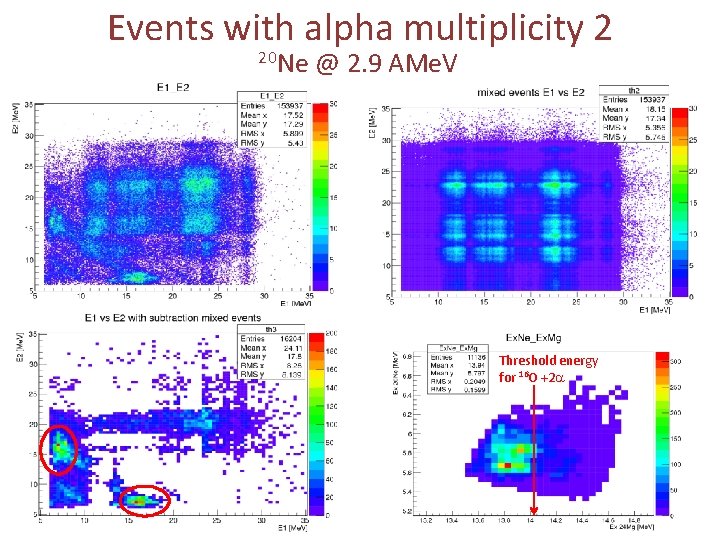
Events with alpha multiplicity 2 20 Ne @ 2. 9 AMe. V Estimate of the uncorrelated events by randomly mixing 2 events with multiplicity 1 Threshold energy for 16 O +2 a After subtraction of the uncorrelated events 24 Mg* a 1 20 Ne* a 2 16 O g. s.
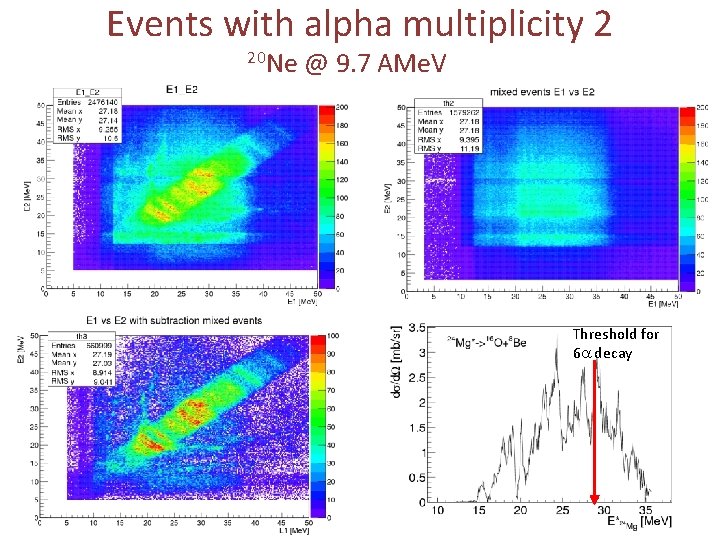
Events with alpha multiplicity 2 20 Ne @ 9. 7 AMe. V Estimate of the uncorrelated events Threshold for 6 a decay After subtraction of the uncorrelated 8 Be 24 Mg* 16 O
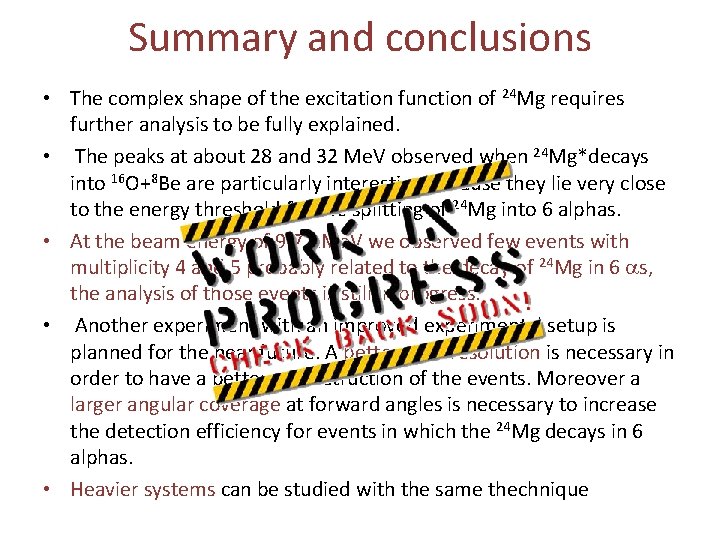
Summary and conclusions • The complex shape of the excitation function of 24 Mg requires further analysis to be fully explained. • The peaks at about 28 and 32 Me. V observed when 24 Mg*decays into 16 O+8 Be are particularly interesting because they lie very close to the energy threshold for the splitting of 24 Mg into 6 alphas. • At the beam energy of 9. 7 AMe. V we observed few events with multiplicity 4 and 5 probably related to the decay of 24 Mg in 6 as, the analysis of those events is still in progress. • Another experiment with an improved experimental setup is planned for the near future. A better time resolution is necessary in order to have a better reconstruction of the events. Moreover a larger angular coverage at forward angles is necessary to increase the detection efficiency for events in which the 24 Mg decays in 6 alphas. • Heavier systems can be studied with the same thechnique
Thank you for your attention! M. Barbui 1, K. Hagel 1, V. Z. Goldberg 1, J. B. Natowitz 1, H. Zheng 1, G. Giuliani 1, G. Rapisarda 1, S. Wuenschel 1, E. J. Kim 1 and X. Q. Liu 1, 2 Cyclotron Institute, Texas A&M University, MS 3366 College Station, TX 2 Institute of modern physics, Chinese Academy of Sciences, Lanzhou, China 1