
Exploring Temperate Forests Presented by Lisa Ranous EDU
Exploring Temperate Forests! Presented by: Lisa Ranous EDU 505 - Harrison Yang 6/23/07
Introduction The local museum needs your help!! They are creating a new exhibit about biomes around the world. Our class has been asked to create a display for the temperate forest biome. We need to find out as much information as we can about this topic including where these forests are located and what characteristics they have!
Task • Locate temperate forests in the world. • Describe the characteristics of three different type of temperate forests. – Characteristics include: climate, plant life and animal life. • Use these descriptions to create models of the displays to be used in the museum.
Process- Step 1 • As a class we will define what a temperate forest is and identify three types of temperate forests. We will include this basic information on a poster for the entrance of our display. • We will then locate where temperate forests are in the world and create our own map to reflect real-life. This map will also be used as an introduction to the display.
Process- Step 2 • You will be divided into groups of 5. Each group will research temperate “deciduous” forests. • You need to define what it is and identify plants and animals that can be found in this type of temperate forest. • Draw a display for a temperate deciduous forest. Use pictures of plants and animals from this region to make your display easier to visualize.
Process- Step 3 • Working your groups from Step 2, each group will research temperate “coniferous” forests. • You need to define what it is and identify plants and animals that can be found in this type of temperate forest. • Draw a display for a temperate coniferous forest. Use pictures of plants and animals from this region to make your display easier to visualize.
Process- Step 4 • Working with the same group, each group will research temperate “rain” forests. • You need to define what it is and identify plants and animals that can be found in this type of temperate forest. • Draw a display for a temperate rainforest. Use pictures of plants and animals from this region to make your display easier to visualize.
Process- Step 5 • Each group will present their 3 mini-displays. Do your best to convince us yours is the best! • The class will vote on their favorite in each category (deciduous forests, coniferous forests, temperate rainforests).
Process- Step 6 • Using the winning designs, we will present our plan for the display to the museum curators.
Resources • Definition and location of biome: http: //www. windows. ucar. edu/tour/link=/earth/for est_eco. html • Temperate Deciduous Forests: http: //www. blueplanetbiomes. org/deciduous_fore st. htm http: //earthobservatory. nasa. gov/Laboratory/Bio me/biotemperate. html http: //www. runet. edu/~swoodwar/CLASSES/GE OG 235/biomes/tbdf. html
Resources Continued • Temperate Coniferous Forests: http: //earthobservatory. nasa. gov/Laboratory/Biome/bioco niferous. html http: //inchinapinch. com/hab_pgs/terres/coniferous/c_fore st. htm http: //www. scsc. k 12. ar. us/2005 outwest/Projects/Conifero us%20 Forest/default. htm • Temperate Rainforest: http: //www. marietta. edu/~biol/biomes/temprain. htm http: //curriculum. calstatela. edu/courses/builders/lessons/ less/biomes/rainforest/temp_rain/temprain. html http: //www. nceas. ucsb. edu/nceasweb/kids/biomes/rainforest. htm
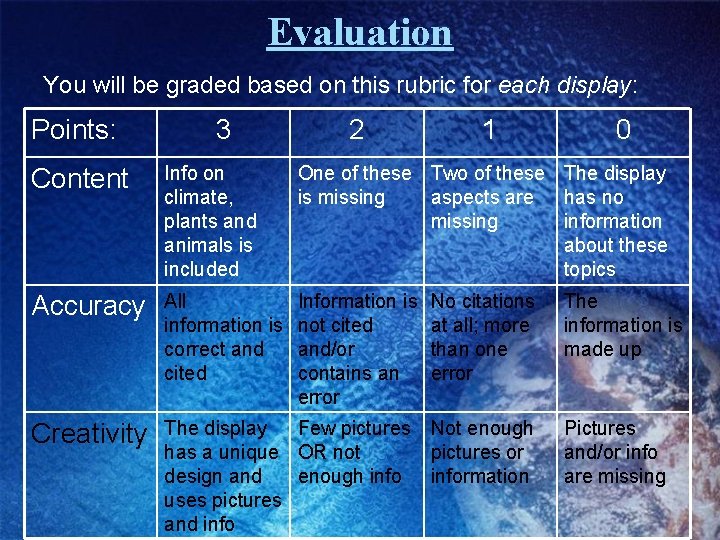
Evaluation You will be graded based on this rubric for each display: Points: 3 2 1 0 Content Info on climate, plants and animals is included One of these Two of these The display is missing aspects are has no missing information about these topics Accuracy All information is correct and cited Information is not cited and/or contains an error Creativity The display Few pictures Not enough has a unique OR not pictures or design and enough information uses pictures and info No citations at all; more than one error The information is made up Pictures and/or info are missing
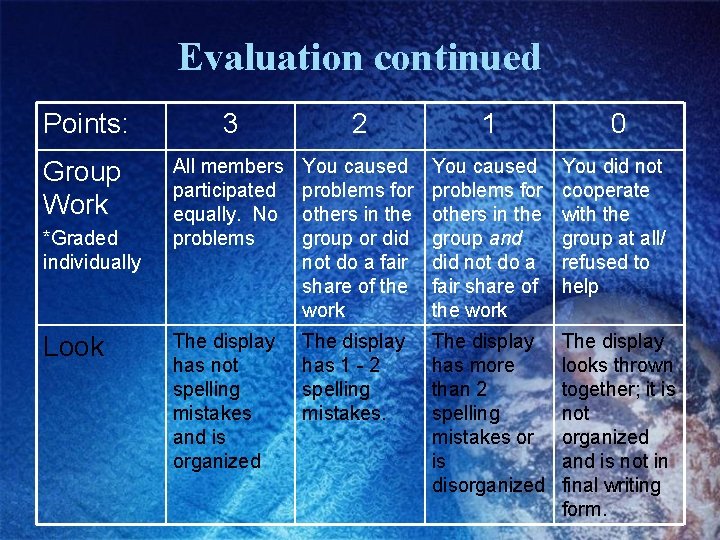
Evaluation continued Points: 3 2 1 0 Group Work All members participated equally. No problems You caused problems for others in the group or did not do a fair share of the work You caused problems for others in the group and did not do a fair share of the work You did not cooperate with the group at all/ refused to help The display has not spelling mistakes and is organized The display has 1 - 2 spelling mistakes. The display has more than 2 spelling mistakes or is disorganized The display looks thrown together; it is not organized and is not in final writing form. *Graded individually Look
Conclusion Congratulations! You’ve helped create the Temperate Forest display at the museum and we’ll be seeing it brought to life soon! In the process, you’ve learned a lot about many temperate forests. What was your favorite part of this project? Which temperate forest biome is your favorite?
- Slides: 14