
Exploring Symmetry Outlier Detection Twinning update Peter Zwart
- Slides: 25
Exploring Symmetry, Outlier Detection & Twinning update Peter Zwart Computational Crystallography Initiative Physical Biosciences Division
Overview • Exploring metric symmetry – iotbx. explore_metric_symmetry • Outlier detection – mmtbx. remove_outliers • Twinning – mmtbx. twin_map_utils – Actually: cctbx. python $MMTBX_DIST/mmtbx/twinning/twin_map_utils. py Computational Crystallography Initiative Physical Biosciences Division
Exploring metric symmetry • Protein crystals grown under various conditions can sometimes exhibit drastic changes in symmetry and unit cell dimensions • Sometimes, the crystal symmetries are related – The relation is not always obvious – Finding the relation between two unit cells can be not so straightforward • Knowing the relations between the different crystal forms can be helpful during structure solution Computational Crystallography Initiative Physical Biosciences Division
Exploring metric symmetry • How to find relations between unit cells? – A sub-lattice formalism allows one to generate a family of related lattices from a given lattice • The number of unique unit cells that are N times larger than the original unit cell is quite small Rutherford, Acta Cryst. (2006). A 62, 93 -97 – Unit cells of approximate equal volume can be compared to each other by checking a large number of uni-modular transforms • Ralfs work Computational Crystallography Initiative Physical Biosciences Division
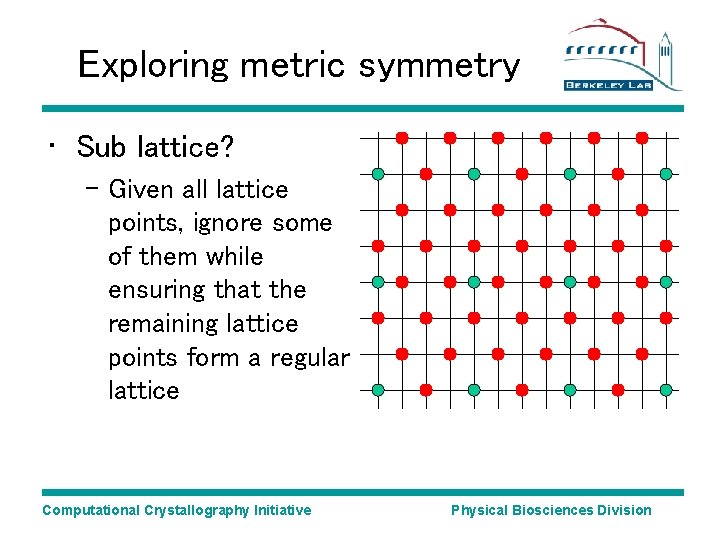
Exploring metric symmetry • Sub lattice? – Given all lattice points, ignore some of them while ensuring that the remaining lattice points form a regular lattice Computational Crystallography Initiative Physical Biosciences Division
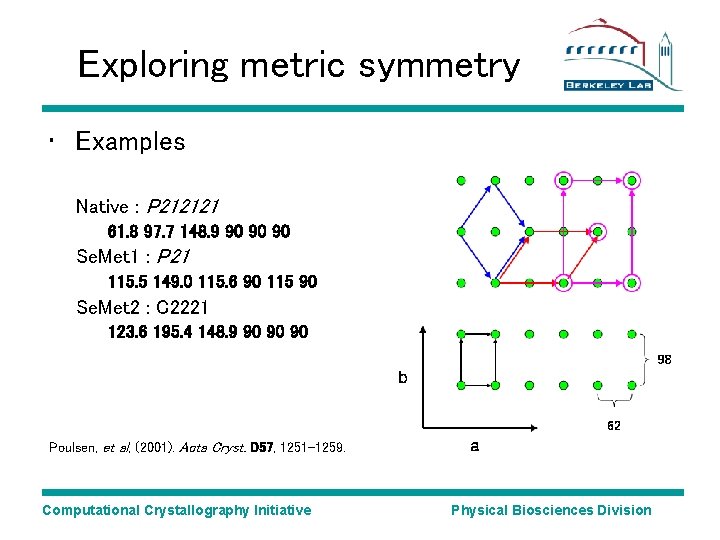
Exploring metric symmetry • Examples Native : P 212121 61. 8 97. 7 148. 9 90 90 90 Se. Met 1 : P 21 115. 5 149. 0 115. 6 90 115 90 Se. Met 2 : C 2221 123. 6 195. 4 148. 9 90 90 90 Poulsen, et al, (2001). Acta Cryst. D 57, 1251 -1259. Computational Crystallography Initiative Physical Biosciences Division
Exploring metric symmetry • Future – Provide reindexing methods between related unit cells. • Would make molecular replacement of related structures easier • Useful for multi crystal averaging – Obtain non-merohedral twin laws from this analyses Computational Crystallography Initiative Physical Biosciences Division
Outlier detection • Outliers can have a detrimental effect on the progress of structure solution and refinement – Read, Acta Cryst. (1999). D 55, 1759 -1764 • The detection of outliers should be performed on the basis of all information available. – Use model info if you can • One would like to have the flexibility of correcting for mistakes made earlier – Those reflection with E-values larger then 5 could have been valid observations! Computational Crystallography Initiative Physical Biosciences Division
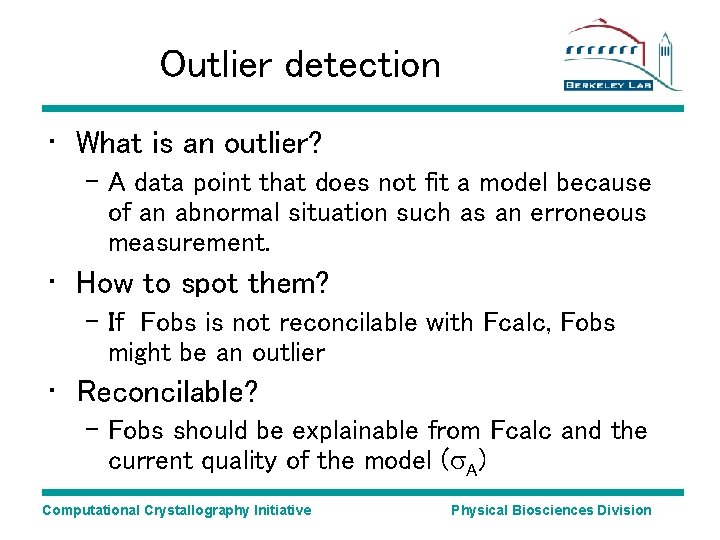
Outlier detection • What is an outlier? – A data point that does not fit a model because of an abnormal situation such as an erroneous measurement. • How to spot them? – If Fobs is not reconcilable with Fcalc, Fobs might be an outlier • Reconcilable? – Fobs should be explainable from Fcalc and the current quality of the model ( A) Computational Crystallography Initiative Physical Biosciences Division
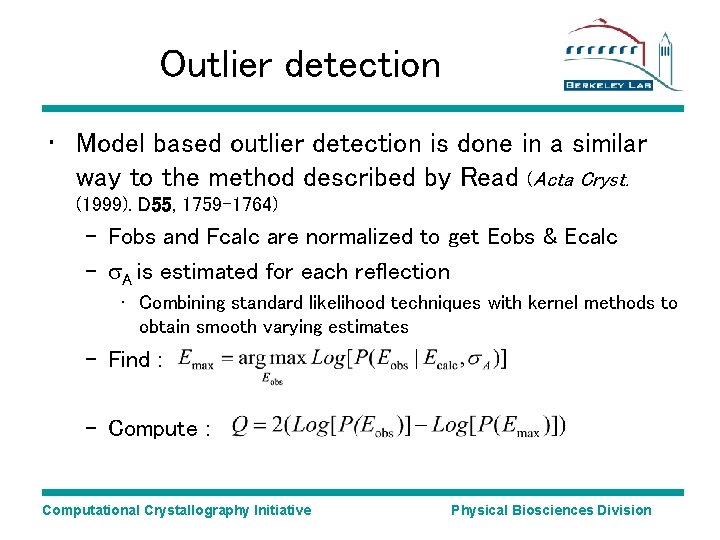
Outlier detection • Model based outlier detection is done in a similar way to the method described by Read (Acta Cryst. (1999). D 55, 1759 -1764) – Fobs and Fcalc are normalized to get Eobs & Ecalc – A is estimated for each reflection • Combining standard likelihood techniques with kernel methods to obtain smooth varying estimates – Find : – Compute : Computational Crystallography Initiative Physical Biosciences Division
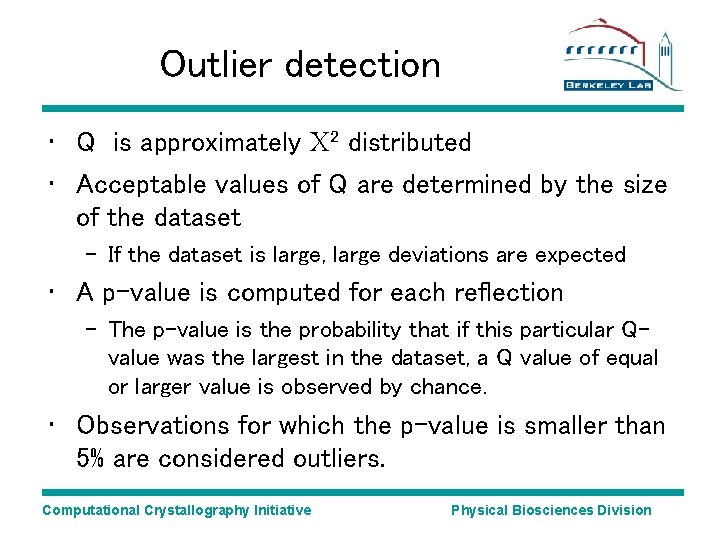
Outlier detection • Q is approximately 2 distributed • Acceptable values of Q are determined by the size of the dataset – If the dataset is large, large deviations are expected • A p-value is computed for each reflection – The p-value is the probability that if this particular Qvalue was the largest in the dataset, a Q value of equal or larger value is observed by chance. • Observations for which the p-value is smaller than 5% are considered outliers. Computational Crystallography Initiative Physical Biosciences Division
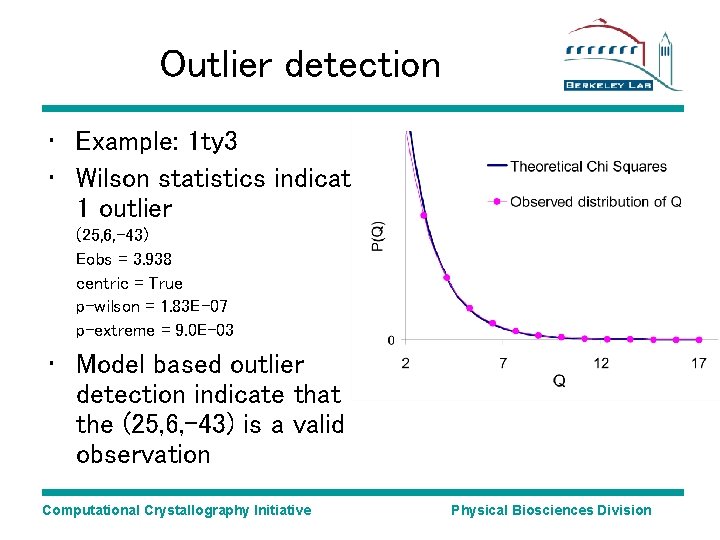
Outlier detection • Example: 1 ty 3 • Wilson statistics indicate 1 outlier (25, 6, -43) Eobs = 3. 938 centric = True p-wilson = 1. 83 E-07 p-extreme = 9. 0 E-03 • Model based outlier detection indicate that the (25, 6, -43) is a valid observation Computational Crystallography Initiative Physical Biosciences Division
Outlier Detection • The outlier detection algorithm is embedded in a class that caches the original observed data. • This will allow one to perform outlier detection during different macrocycles/rebuilding states and update • Will be incorporated in phenix. refine at the appropriate juncture – Command line tool available Computational Crystallography Initiative Physical Biosciences Division
Twinning progress report • Routines available – Least squares target functions • Both intensity and amplitude • Target values and first derivatives – Detwinning • Standard and a la Sheldrick – R-values – Map coefficients • 2 m. Fo-DFc & gradient maps – Bulk solvent scaling • Estimation of twin fraction, ksol Bsol, U* and overall scale on twinned data – Using global optimizer (differential evolution) for the moment Computational Crystallography Initiative Physical Biosciences Division
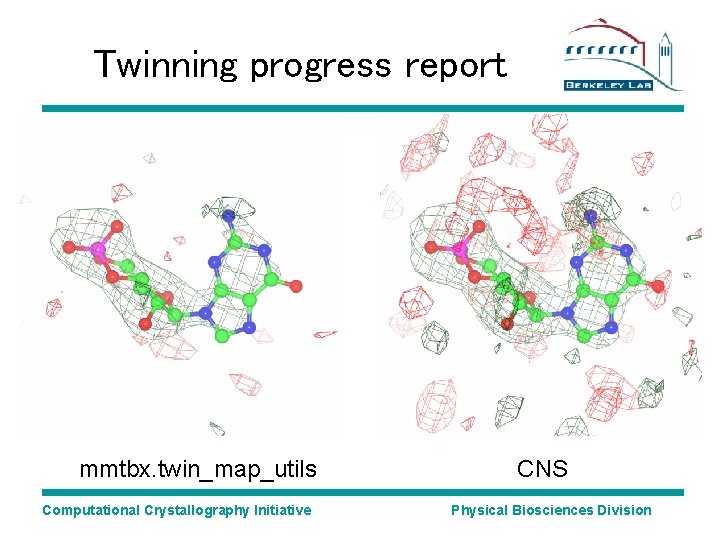
Twinning progress report • Bulk solvent scaling and detwinned map generation available as a command line tool mmtbx. twin_map_utils • Results similar to CNS • mmtbx. twin_map_utils should be seen as the first step to full integration of twin utilities in phenix. refine Computational Crystallography Initiative Physical Biosciences Division
Twinning progress report mmtbx. twin_map_utils Computational Crystallography Initiative CNS Physical Biosciences Division
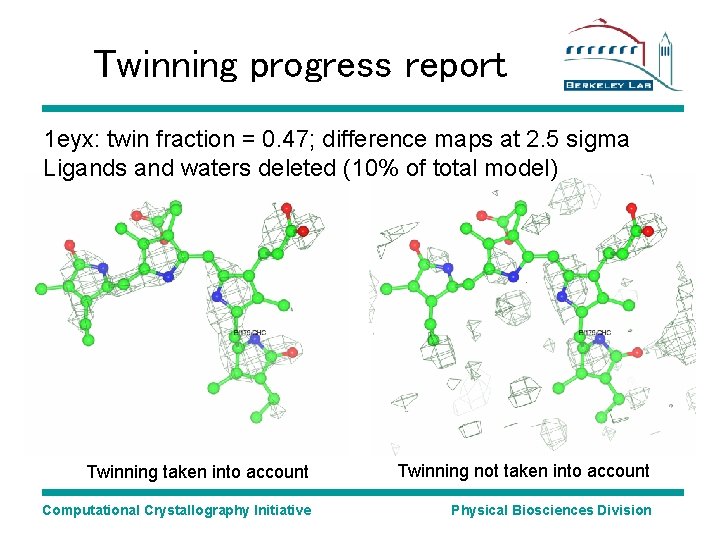
Twinning progress report 1 eyx: twin fraction = 0. 47; difference maps at 2. 5 sigma Ligands and waters deleted (10% of total model) Twinning taken into account Twinning not taken into account Computational Crystallography Initiative Physical Biosciences Division
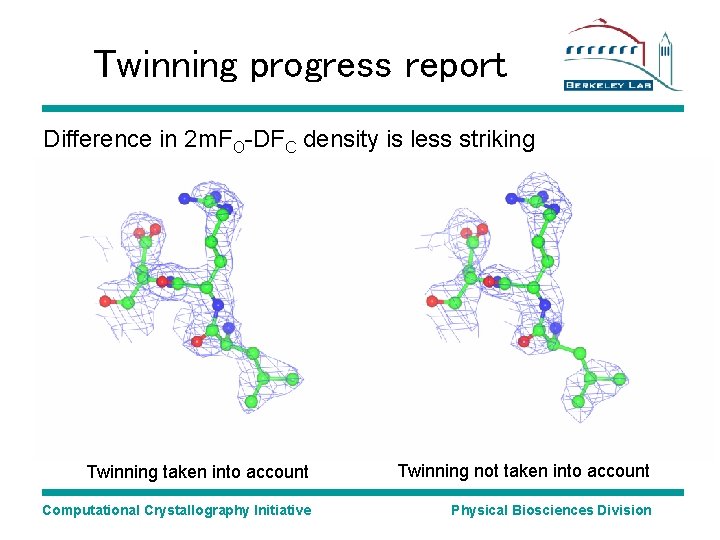
Twinning progress report Difference in 2 m. FO-DFC density is less striking Twinning taken into account Twinning not taken into account Computational Crystallography Initiative Physical Biosciences Division
Twinning progress report • Future plans – Likelihood based map coefficients • in collaboration with Randy Read – Incorporation of least squares targets in phenix. refine – Likelihood based targets • in collaboration with Randy Read Computational Crystallography Initiative Physical Biosciences Division
Ackowledgements Paul Adams Ralf Grosse-Kunstleve Pavel Afonine Nigel Moriarty Nick Sauter Michael Hohn Funding: – LBNL (DE-AC 03 -76 SF 00098) – NIH/NIGMS (P 01 GM 063210) – PHENIX Industrial Consortium Computational Crystallography Initiative Cambridge Randy Read Airlie Mc. Coy Los Alamos Tom Terwilliger Li Wei Hung Texas A&M Univeristy Jim Sacchettini Tom Ioerger Eric Mc. Kee Duke University Jane Richardson David Richardson Phenix industrial Consortium Robert Nolte Eric Vogan Physical Biosciences Division
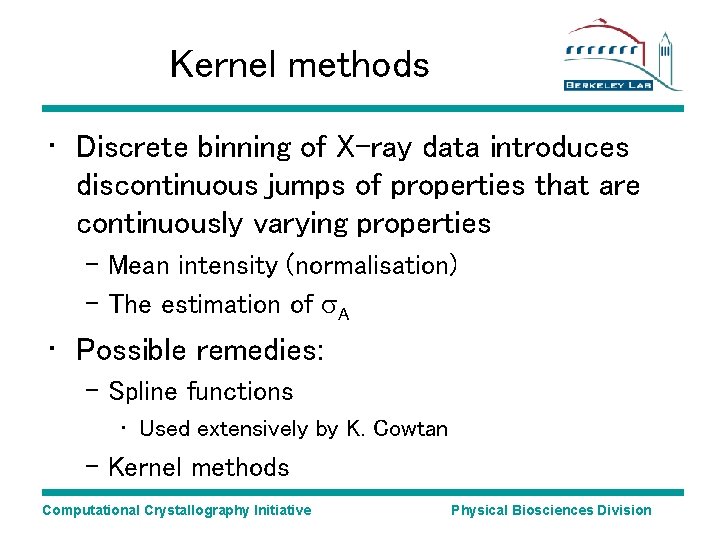
Kernel methods • Discrete binning of X-ray data introduces discontinuous jumps of properties that are continuously varying properties – Mean intensity (normalisation) – The estimation of A • Possible remedies: – Spline functions • Used extensively by K. Cowtan – Kernel methods Computational Crystallography Initiative Physical Biosciences Division
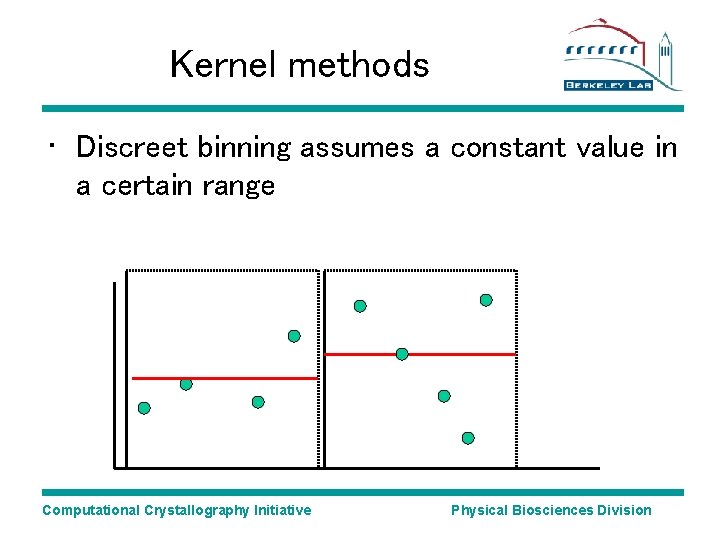
Kernel methods • Discreet binning assumes a constant value in a certain range Computational Crystallography Initiative Physical Biosciences Division
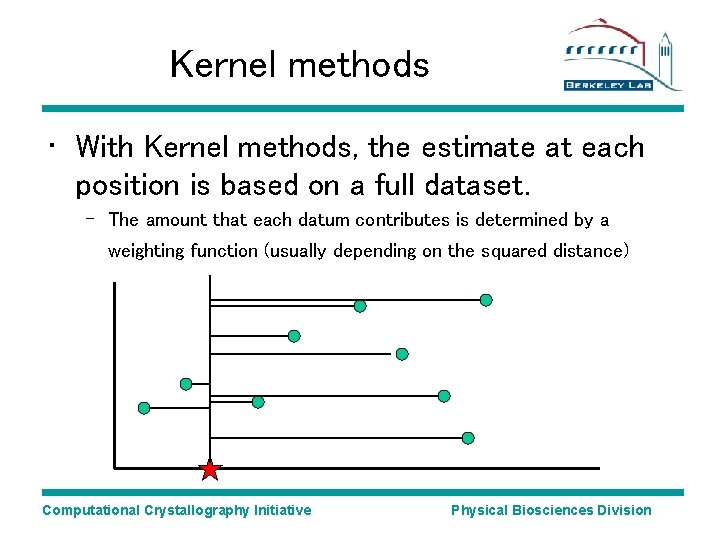
Kernel methods • With Kernel methods, the estimate at each position is based on a full dataset. – The amount that each datum contributes is determined by a weighting function (usually depending on the squared distance) Computational Crystallography Initiative Physical Biosciences Division
Kernel methods • Kernel method available for normalisation – Used by xtriage in intensity statistics • Kernel method available for of A estimation – Used in the outlier detection Computational Crystallography Initiative Physical Biosciences Division
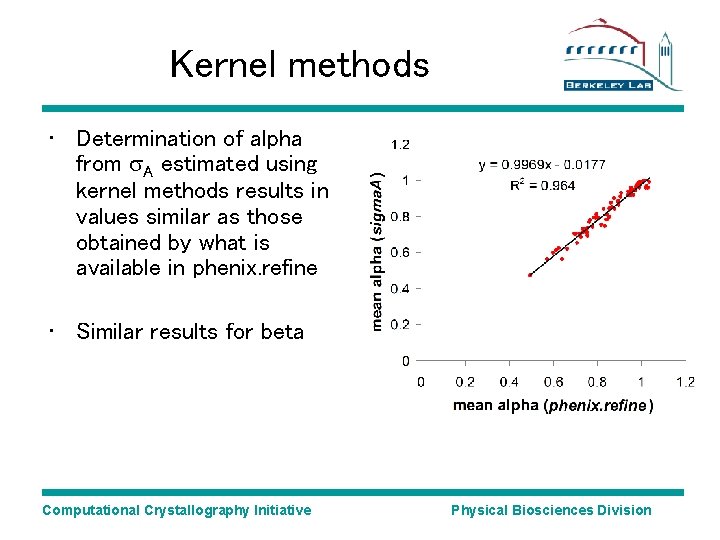
Kernel methods • Determination of alpha from A estimated using kernel methods results in values similar as those obtained by what is available in phenix. refine • Similar results for beta Computational Crystallography Initiative Physical Biosciences Division