
Exploring Suitability of Linux for Embedded Vision Applications
Exploring Suitability of Linux for Embedded Vision Applications Mini Project Ankit Mathur Mayank Agarwal 2000101 2000117

Objectives Explore suitability of Linux for embedded systems Explore ways to tailor Linux for a specific application Implement a miniature customizable running setup Implement an embedded vision surveillance application on the setup

Requirements of embedded systems Applications of the system are limited and fixed beforehand Optimizing the resources used - memory, flash, etc critical to success of the product Full functionality of a workstation not needed

Why embed Linux? Large support for various architectures, devices, file systems Open source Stable, scalable Familiar, easily customizable Large amounts of source code available
Steps in miniaturizing Linux Pruning the Kernel Selecting a suitable replacement for Glib. C Providing shell and other command-line tools needed for the application Including other support – device drivers, etc. needed by the application
Miniaturizing the Kernel: Options Use a small older distribution like 2. 0. 36 Use the latest 2. 4 series, compiled with minimal features Use other distributions tailored for embedded systems like µClinux
Option: An Older Kernel – 2. 0. 36 Extremely small (compiled image around 360 k. B) Major changes in kernel structure and kernel symbols, large parts of code might need to be recoded to port Lacking support for newer File Systems, drivers for newer devices
Option: Working with 2. 4 kernel Wide driver and file system support Lots of open source code available, no compatibility problems in compiling and using Rather large (~ 1 MB) However, the size can be pushed down to about 600 – 700 k. B or even less by selecting only the desired modules
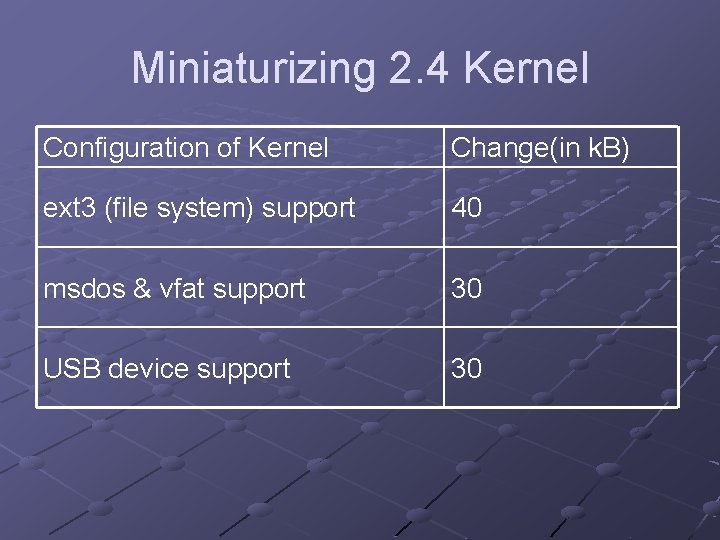
Miniaturizing 2. 4 Kernel Configuration of Kernel Change(in k. B) ext 3 (file system) support 40 msdos & vfat support 30 USB device support 30
Options: Specialized Distributions Many specialized distributions available e. g. Thin. Linux, µClinux Extremely small foot-print µClinux based on 2. 0. 36 kernel, provides a patch for it No MMU support in µClinux Generally, device drivers – a problem
Lib. C Large number of features provided by Glib. C can be done away with New. Lib, µc. Libc much better suited for embedded applications Our choice - µc. Libc
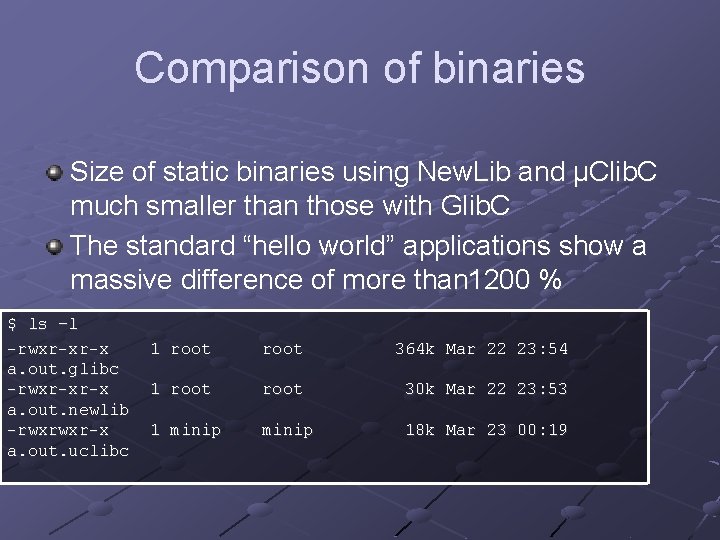
Comparison of binaries Size of static binaries using New. Lib and µClib. C much smaller than those with Glib. C The standard “hello world” applications show a massive difference of more than 1200 % $ ls –l -rwxr-xr-x a. out. glibc -rwxr-xr-x a. out. newlib -rwxrwxr-x a. out. uclibc 1 root 364 k Mar 22 23: 54 1 root 30 k Mar 22 23: 53 1 minip 18 k Mar 23 00: 19

Busybox A single binary providing most of the commonly used command-line tools Options to choose the required functions by editing the file “Config. h” Replaces all commonly used commandtools with one single executable, thus achieving massive miniaturization
Busybox (cont’d) Make sym-links from required commands to busybox Easily compiled with µc. Lib. C Static binary (with µc. Lib. C) size only ~250 k. B

A Demo Application 2. 4 Kernel + Busybox + Tiny. Login A chat server that allows users on remote machines to chat with each other Tiny. Login provides Login and User management facilities in a single binary

Conclusion Linux well-suited for our embedded application The following combination found suitable n n n 2. 4 Kernel µclib. C Busybox Option for shared library/static linking Depending on the application
Future Targets Vision – based surveillance application Target architecture – x 86 based VIA board Targeted memory – n n 16/32 MB flash 16/32/64 MB RAM USB support for camera required Network (ethernet) support for communication with server required
- Slides: 17