
Exploring Structure and Content on the Web Extraction
Exploring Structure and Content on the Web Extraction and Integration of the Semi-Structured Web Tim Weninger Department of Computer Science University of Illinois Urbana-Champaign weninge 1@illinois. edu
Rules of this tutorial 1. Ask questions 2. Ask lots of questions 3. If something is not clear, ask a question

The Web Social Networks › › Early Messenger Networks Social Media Gaming Networks Professional Networks Hyperlink Networks › Blog Networks › Wiki-networks › Web-at-large » Internal links » External links
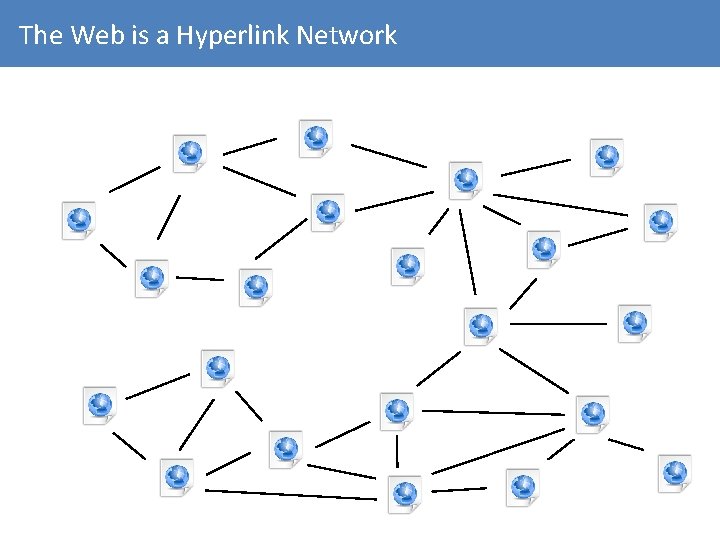
The Web is a Hyperlink Network
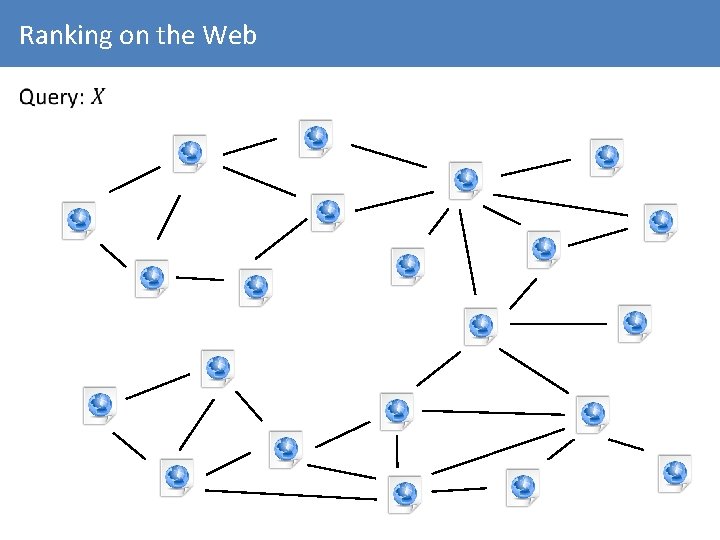
Ranking on the Web
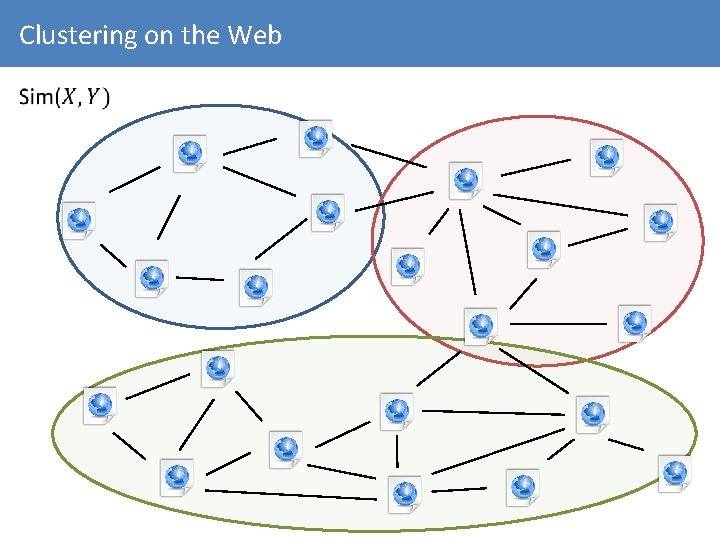
Clustering on the Web
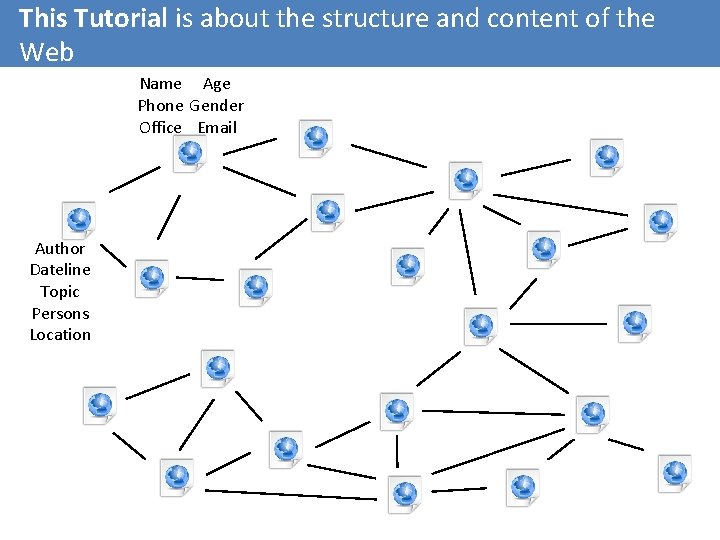
This Tutorial is about the structure and content of the Web Name Age Phone Gender Office Email Author Dateline Topic Persons Location
Imagine what we could do… Search › Show structured information in response to query › Automatically rank and cluster entities › Reasoning on the Web » Who are the people at some company? » What are the courses in some college department? Analysis › Expand the known information of an entity » What is a professor’s phone number, email, courses taught, research, etc?
Outline Preliminaries Information Extraction Break (30 min) Information Integration Web Information Networks
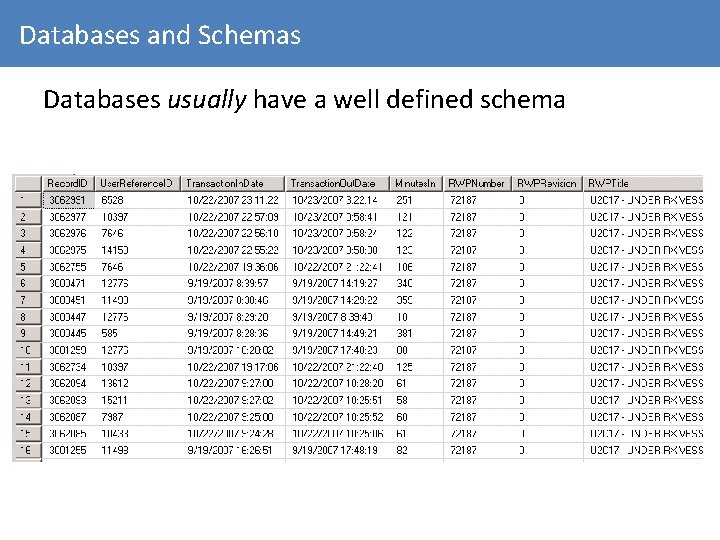
Databases and Schemas Databases usually have a well defined schema
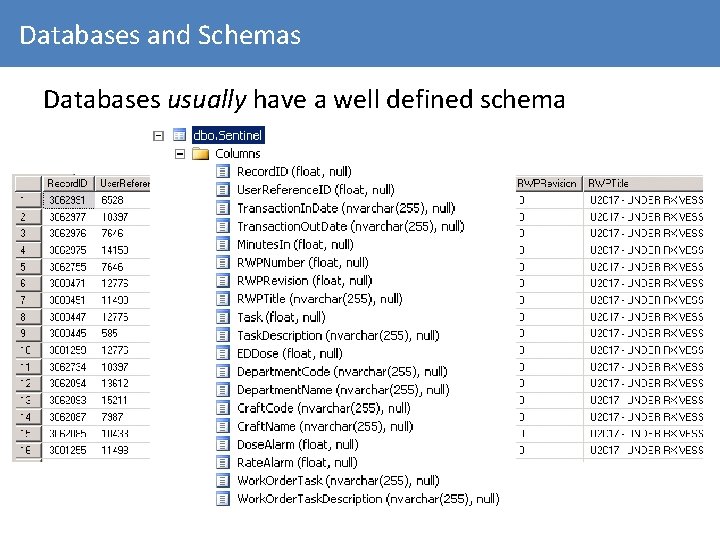
Databases and Schemas Databases usually have a well defined schema
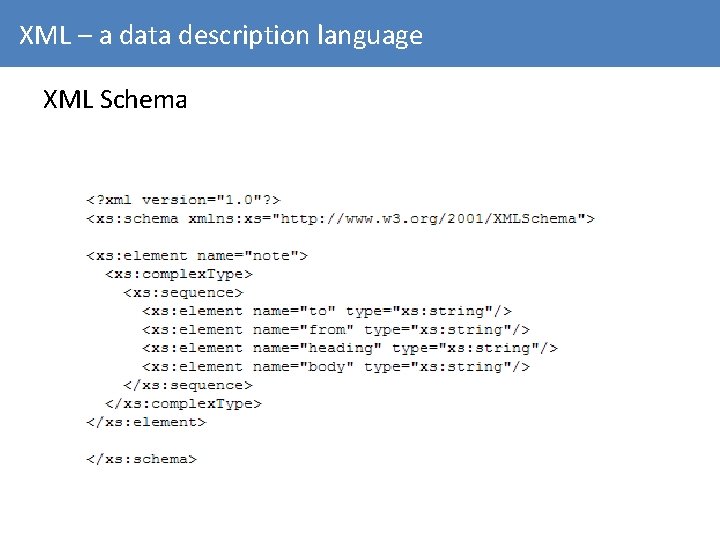
XML – a data description language XML Schema
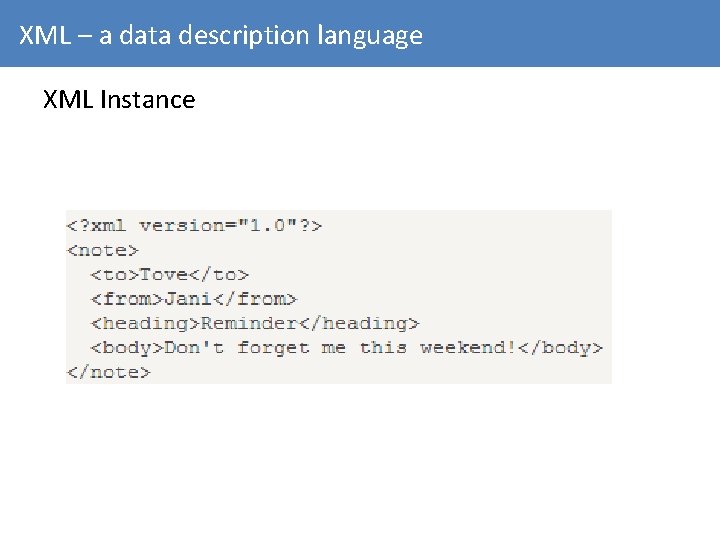
XML – a data description language XML Instance
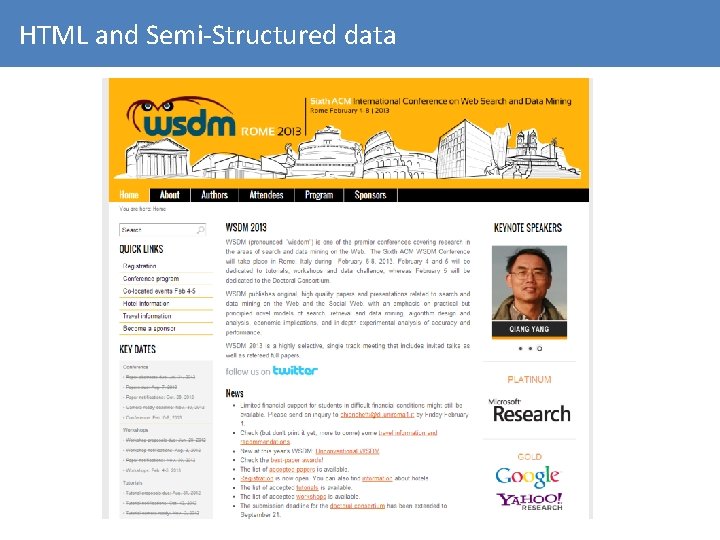
HTML and Semi-Structured data
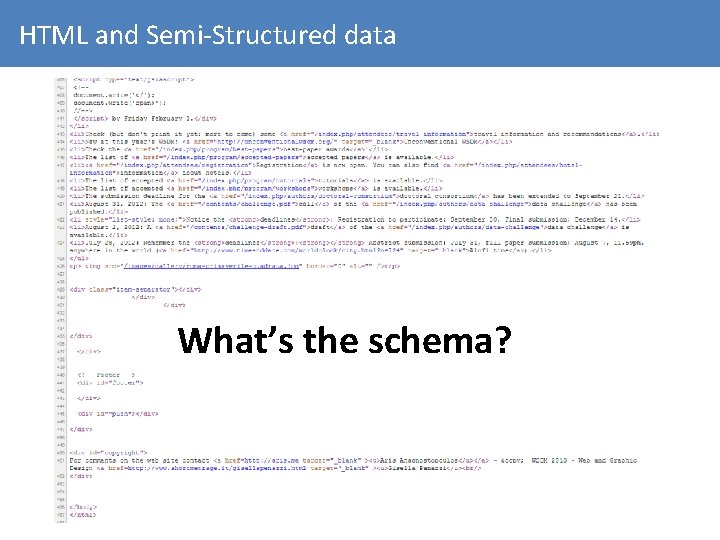
HTML and Semi-Structured data What’s the schema?
HTML and Semi-Structured data HTML has no schema! HTML is a markup language › A description for a browser to render › HTML describes how the data should be displayed HTML was never meant to describe the data.
HTML and Semi-Structured data HTML was never meant to describe the data. But there is so much data on the Web …we have to try
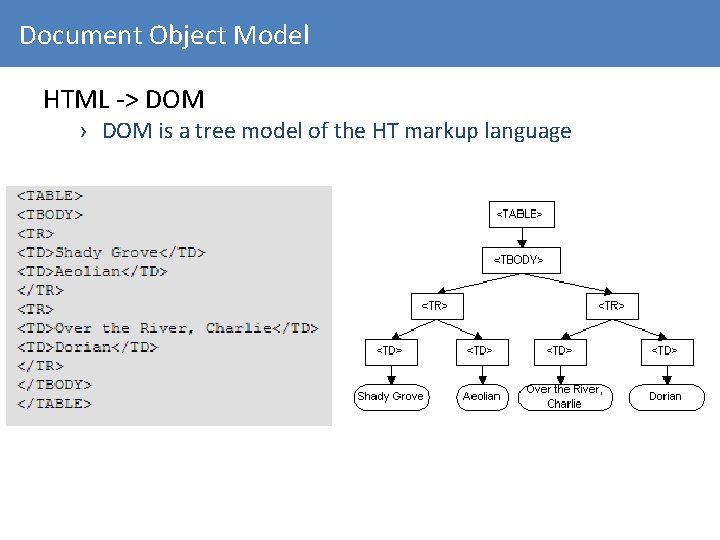
Document Object Model HTML -> DOM › DOM is a tree model of the HT markup language
What the DOM is not From the W 3 C: The Document Object Model does not define what information in a document is relevant or how information in a document is structured. For XML, this is specified by the W 3 C XML Information Set [Infoset]. The DOM is simply an API to this information set.
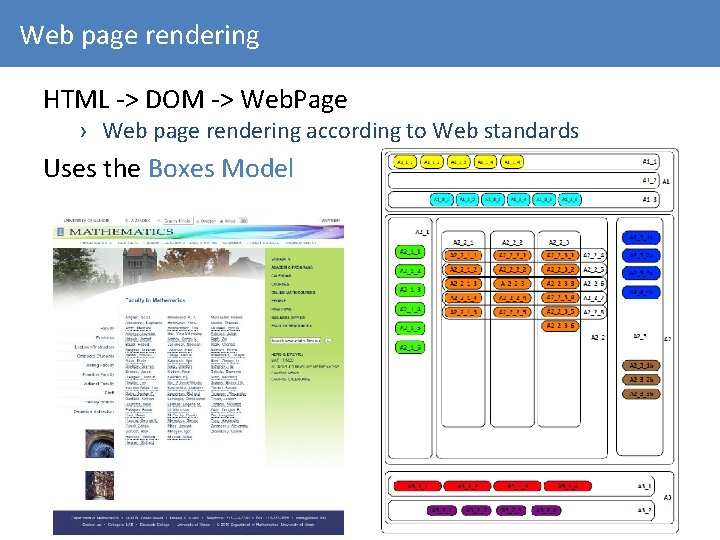
Web page rendering HTML -> DOM -> Web. Page › Web page rendering according to Web standards Uses the Boxes Model
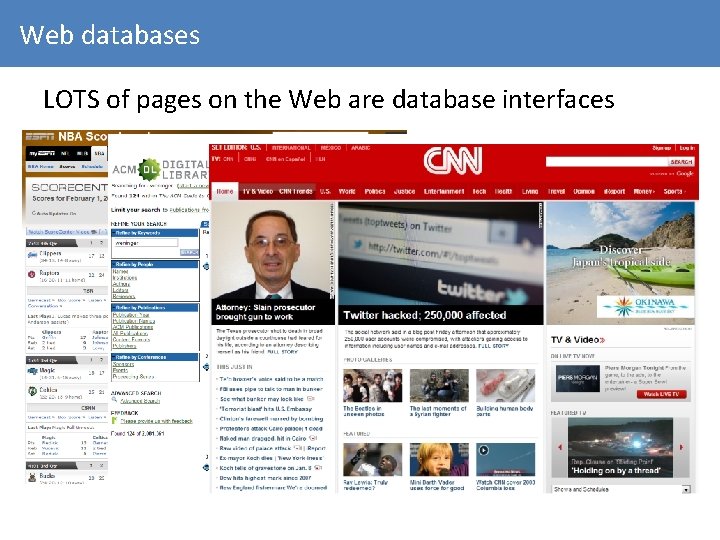
Web databases LOTS of pages on the Web are database interfaces
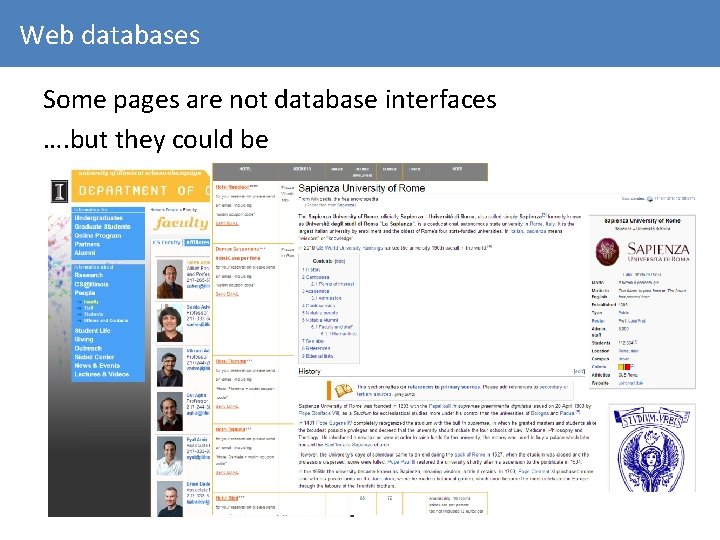
Web databases Some pages are not database interfaces …. but they could be
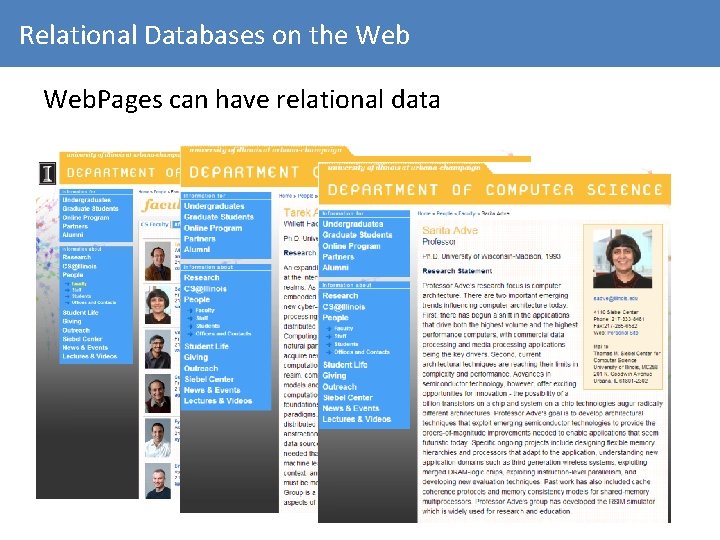
Relational Databases on the Web. Pages can have relational data
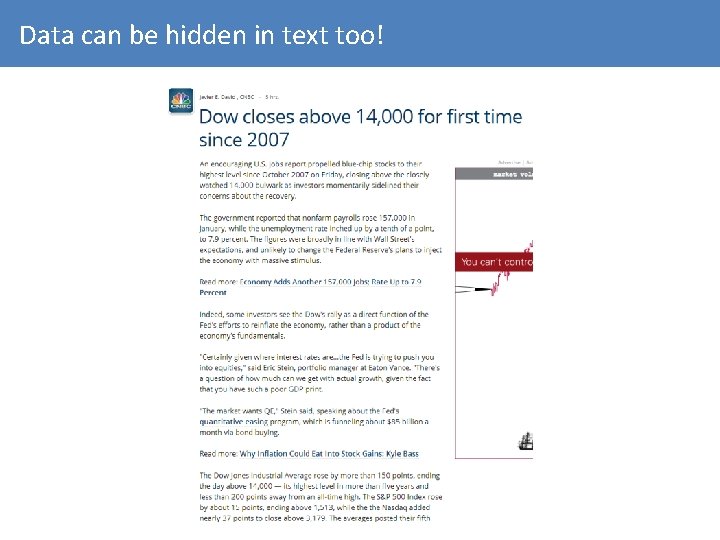
Data can be hidden in text too!
HTML and Semi-Structured data Our goal is to extract information from the Web …and make sense out of it!
Outline Preliminaries Information Extraction from text Break (30 min) Information Extraction from tables and lists Web Information Networks
Content Extraction
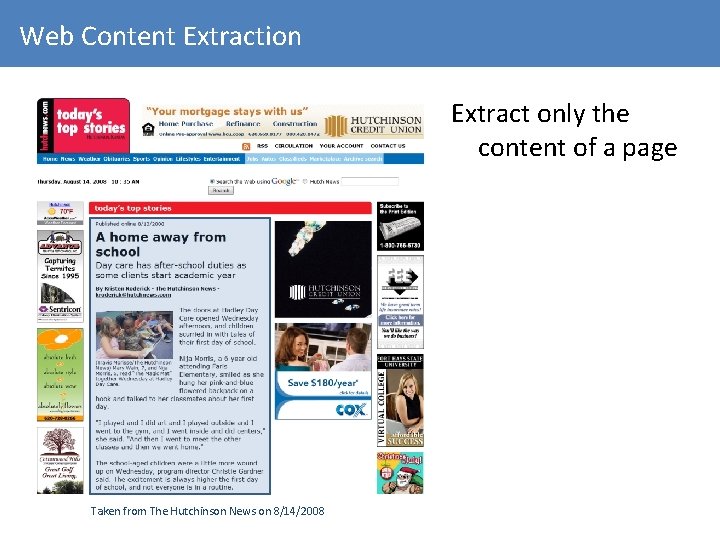
Web Content Extraction Extract only the content of a page Taken from The Hutchinson News on 8/14/2008
Web Content Extraction Two Approaches 1. Heuristic Approaches Work one “document-at-a-time” 2. Template Detection Approaches Require multiple documents that contain the same template Benefits of content extraction • Reduce the noise in the document » Reduce document size » Better indexing, search processing » Easier to fit on small screens
Wrapper Generation Documents on the Web are made from templates • Popularity of Content Management Systems • Database queries are used to “fill out” HTML content Template are the framework of the Web page(s) • The structure of is very similar (near identical) among template Web pages. 1. Cluster similarly structured documents 2. Generate Wrappers 3. Extract Information
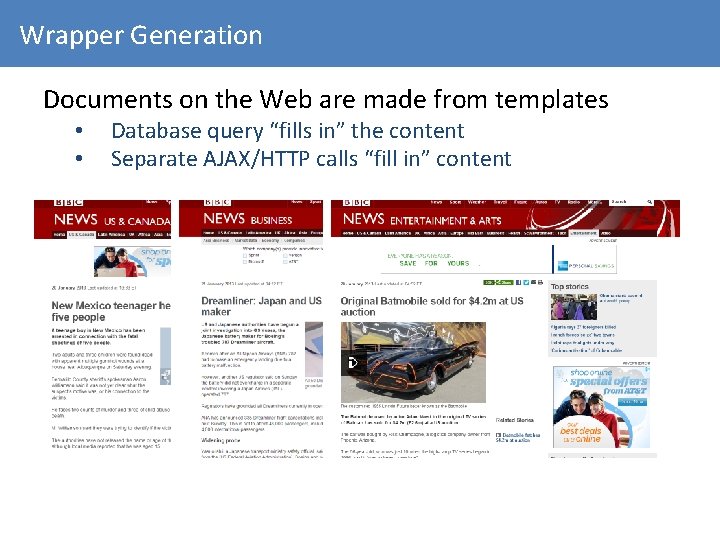
Wrapper Generation Documents on the Web are made from templates • • Database query “fills in” the content Separate AJAX/HTTP calls “fill in” content
Locating Web page templates First Bar-Yossef and Rajagopalan ‘ 02 proposed a template recognition algorithm using DOM tree segmentation • Template detection via data mining and its applications Lin and Ho ‘ 02 developed Info. Discoverer which uses the heuristic that template generated contents appear more frequently. • Discovering informative content blocks from web documents Debnath et al. ‘ 05 develop Content. Extractor but also include features like image or script elements. • Automatic extraction of informative blocks from webpages
Locating Web page templates Yi, Liu and Li ‘ 03 use the Site Style Tree(SST) approach finds that identically formatted DOM sub-trees denote the template • Eliminating noisy information in web pages for data mining Crecensi et al. ’ 01 develop Roadrunner which uses the Align, collapse under mismatch and extract (ACME) approach to generate wrappers. • Towards Automatic Data Extraction from Large Web Sites. Buttler ‘ 04 proposes the path shingling approach which makes use of the shingling technique. • A short survey of document structure similarity algorithms
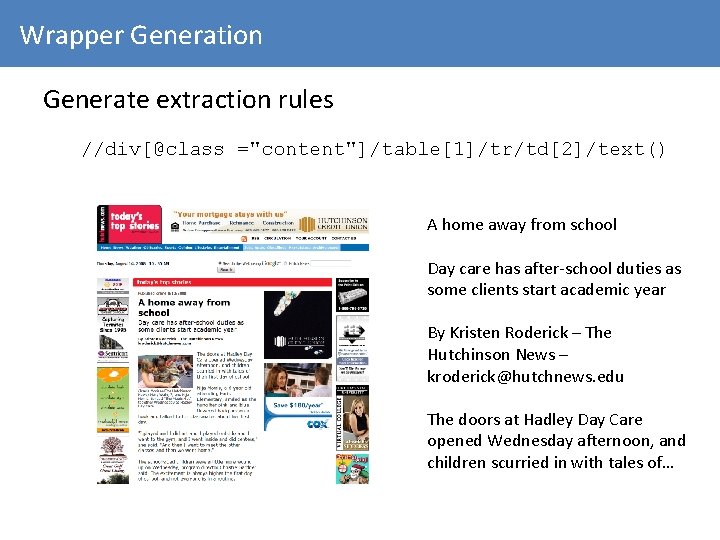
Wrapper Generation Generate extraction rules //div[@class ="content"]/table[1]/tr/td[2]/text() A home away from school Day care has after-school duties as some clients start academic year By Kristen Roderick – The Hutchinson News – kroderick@hutchnews. edu The doors at Hadley Day Care opened Wednesday afternoon, and children scurried in with tales of…
Wrapper Generation Advantages • • Easy to implement and learn Can have perfect precision and recall Disadvantages • Web sites change their templates often » Any small change breaks the wrapper • Need several examples to learn the wrapper » Called “domain-centric” approaches
Single Document Content Extraction Look at a single document at a time • Use heuristics and data mining principles to find main content. No template detection No extraction rule learning Called “Web-centric” approaches
Early Content Extraction Approaches Body Text Extraction (BTE) • • Interprets HTML document as word and tag tokens Identifies a single, continuous region which contains most words while excluding most tags. Document Slope Curves (DSC) • Extension of BTE that looks at several document regions. Link Quota Filters (LQF) • Remove DOM elements which consist mainly of text occurring in hyperlink anchors.
Tag Ratios Content Extraction Two algorithms • • Same time, same conference Same concept Gottron, et al. ‘ 07 Content Code Blurring Weninger, et al. ‘ 07 Content Extraction via Tag Ratios
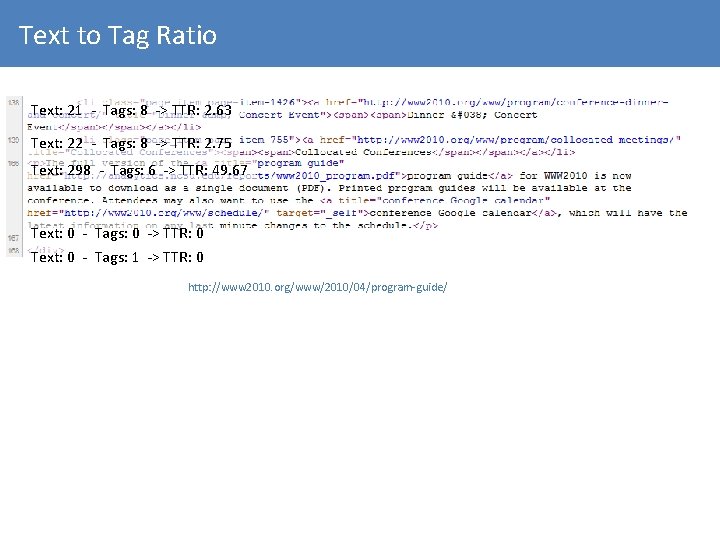
Text to Tag Ratio Text: 21 - Tags: 8 -> TTR: 2. 63 Text: 22 - Tags: 8 -> TTR: 2. 75 Text: 298 - Tags: 6 -> TTR: 49. 67 Text: 0 - Tags: 0 -> TTR: 0 Text: 0 - Tags: 1 -> TTR: 0 http: //www 2010. org/www/2010/04/program-guide/
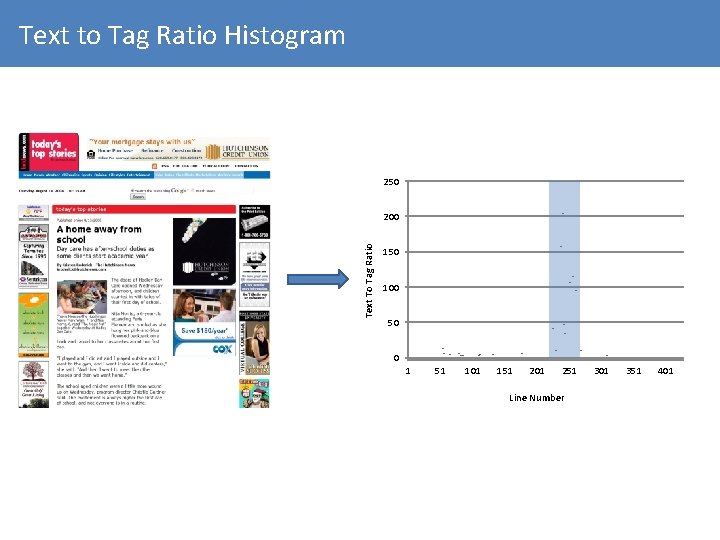
Text to Tag Ratio Histogram 250 Text To Tag Ratio 200 150 100 50 0 1 51 101 151 201 251 Line Number 301 351 401
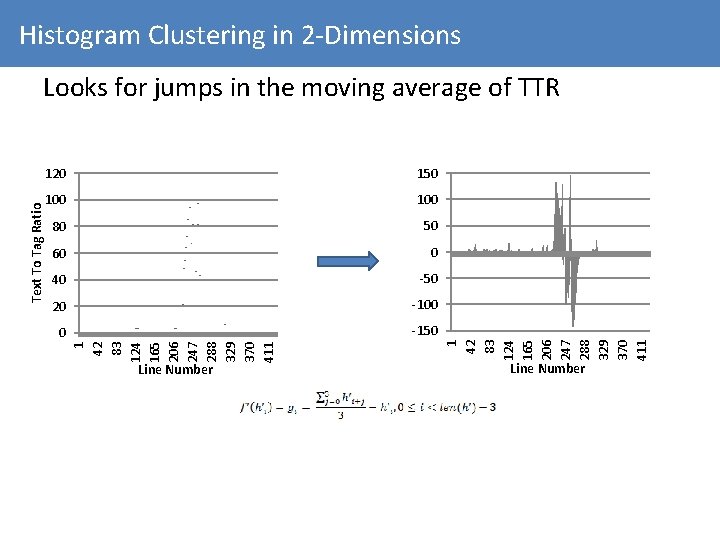
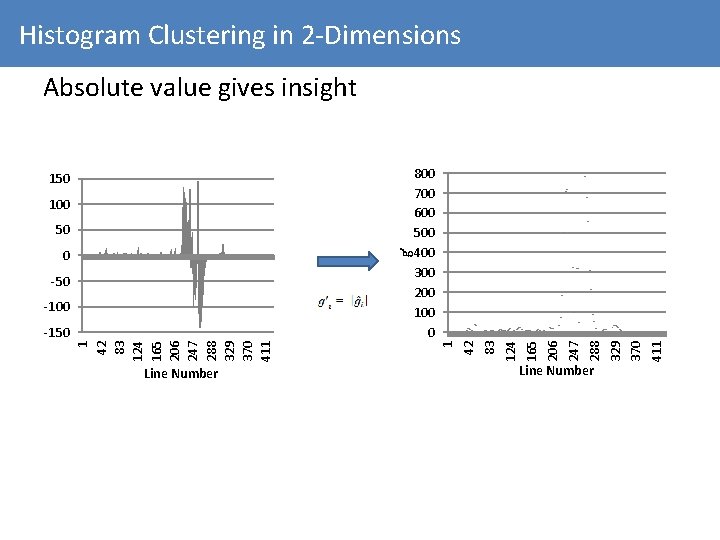
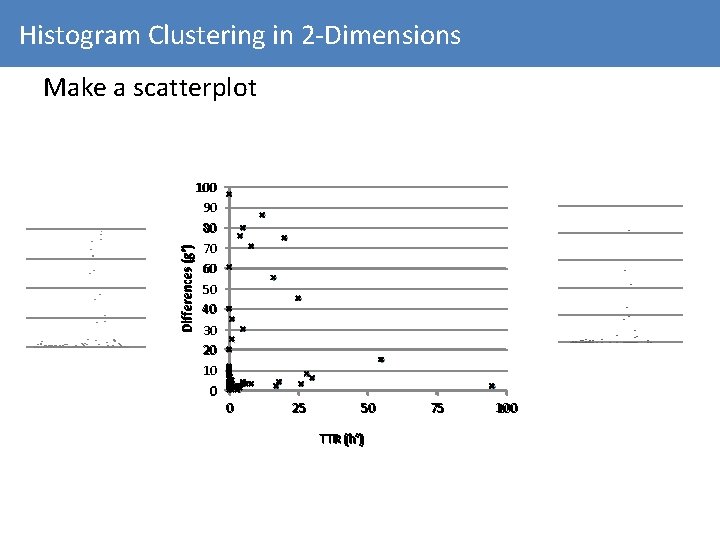
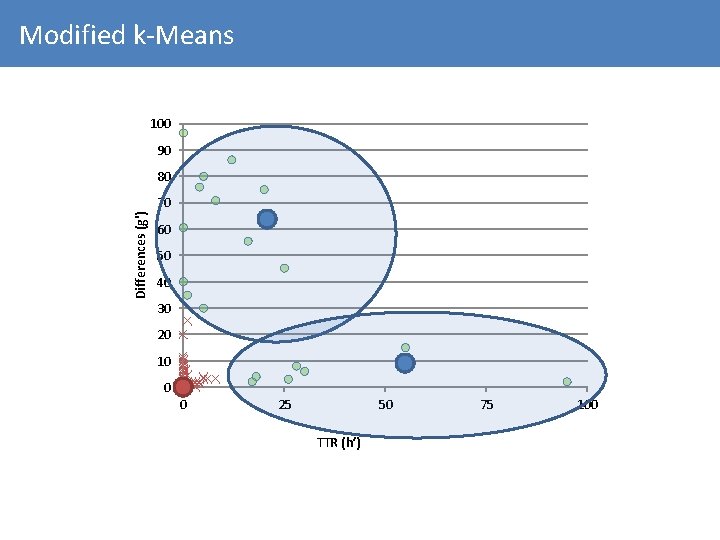
Histogram Clustering in 2 -Dimensions 150 100 80 50 60 0 40 -50 20 -100 0 -150 Line Number 1 42 83 124 165 206 247 288 329 370 411 120 1 42 83 124 165 206 247 288 329 370 411 Text To Tag Ratio Looks for jumps in the moving average of TTR Line Number
Histogram Clustering in 2 -Dimensions Absolute value gives insight 100 50 gʹ 0 -50 -100 1 42 83 124 165 206 247 288 329 370 411 -150 Line Number 800 700 600 500 400 300 200 100 0 1 42 83 124 165 206 247 288 329 370 411 150 Line Number
Histogram Clustering in 2 -Dimensions Make a scatterplot Differences (g') 100 90 80 70 60 50 40 30 20 10 0 0 25 50 TTR (hʹ) 75 100
Modified k-Means 100 90 80 Differences (g') 70 60 50 40 30 20 10 0 0 25 50 TTR (hʹ) 75 100
Single Document Content Extraction Advantages › Only need a single document at a time › Unsupervised » No training required Disadvantages › Precision and Recall varies » On the (1) algorithm, (2) parameters, (3) Web page
Rule Extraction
Textual Extraction Web text holds good information, but full NLP understanding is difficult Two flavors of text extraction › Domain-at-a-time › Web-at-large (domain-agnostic) Very different techniques required for each
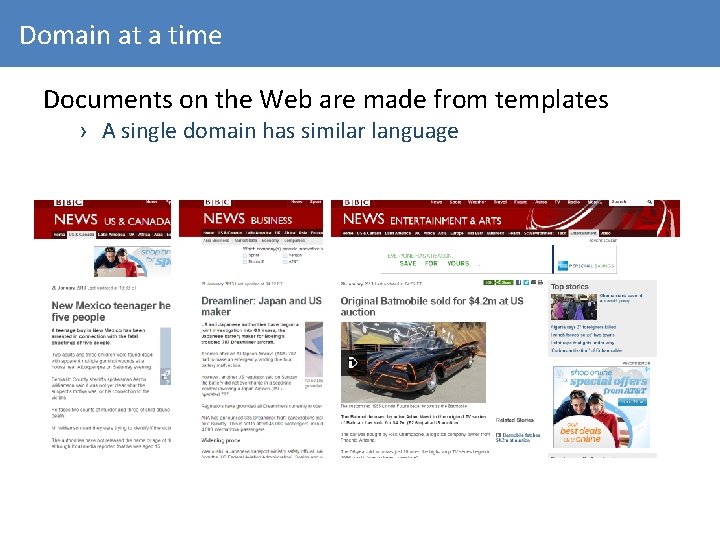
Domain at a time Documents on the Web are made from templates › A single domain has similar language
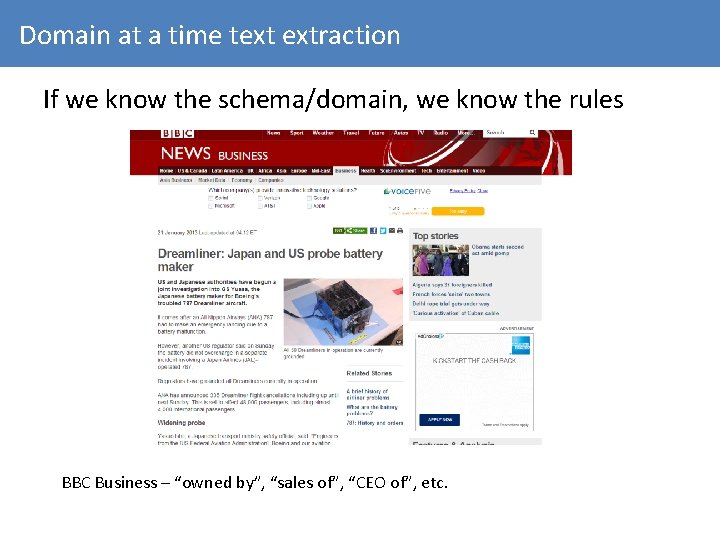
Domain at a time text extraction If we know the schema/domain, we know the rules BBC Business – “owned by”, “sales of”, “CEO of”, etc.
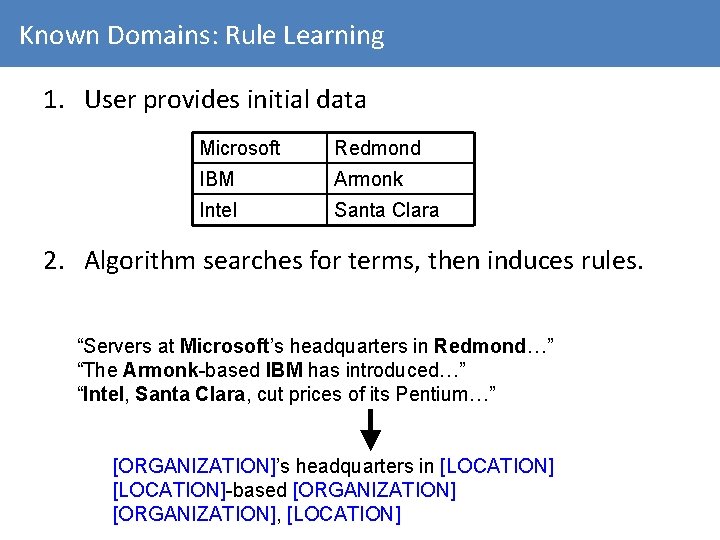
Known Domains: Rule Learning 1. User provides initial data Microsoft Redmond IBM Armonk Intel Santa Clara 2. Algorithm searches for terms, then induces rules. “Servers at Microsoft’s headquarters in Redmond…” “The Armonk-based IBM has introduced…” “Intel, Santa Clara, cut prices of its Pentium…” [ORGANIZATION]’s headquarters in [LOCATION]-based [ORGANIZATION], [LOCATION]
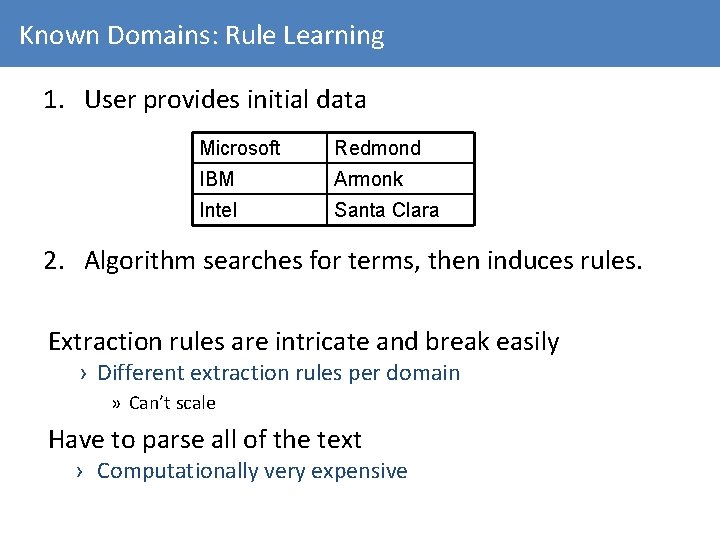
Known Domains: Rule Learning 1. User provides initial data Microsoft Redmond IBM Armonk Intel Santa Clara 2. Algorithm searches for terms, then induces rules. Extraction rules are intricate and break easily › Different extraction rules per domain » Can’t scale Have to parse all of the text › Computationally very expensive
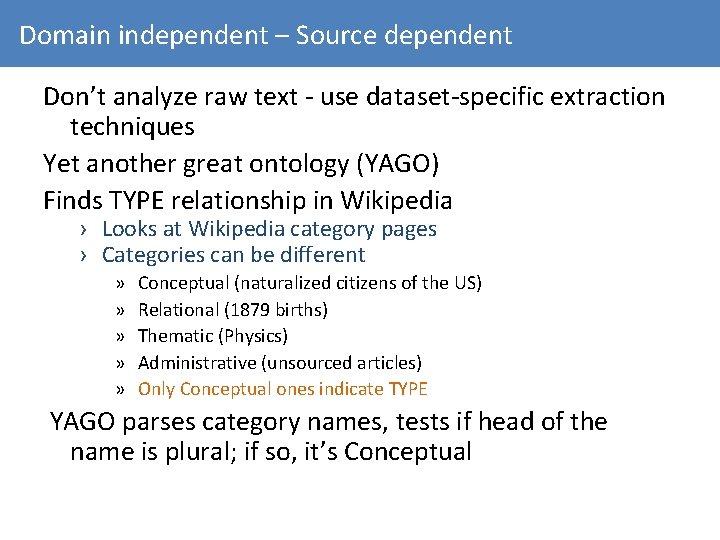
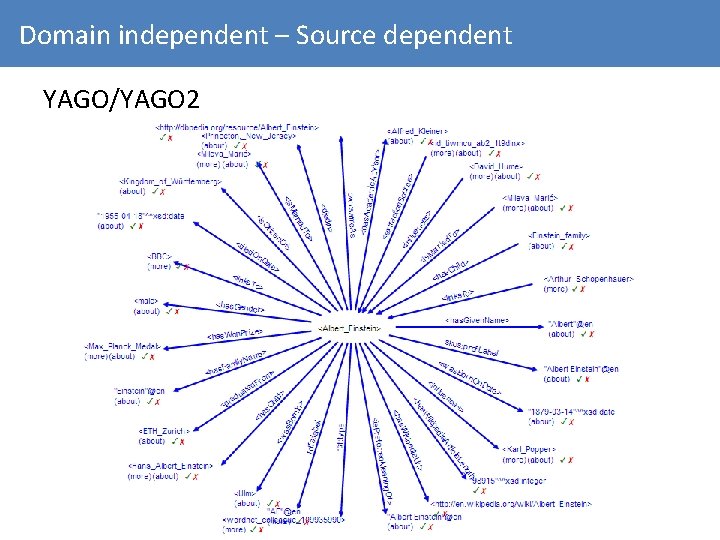
Domain independent – Source dependent Don’t analyze raw text - use dataset-specific extraction techniques Yet another great ontology (YAGO) Finds TYPE relationship in Wikipedia › Looks at Wikipedia category pages › Categories can be different » » » Conceptual (naturalized citizens of the US) Relational (1879 births) Thematic (Physics) Administrative (unsourced articles) Only Conceptual ones indicate TYPE YAGO parses category names, tests if head of the name is plural; if so, it’s Conceptual
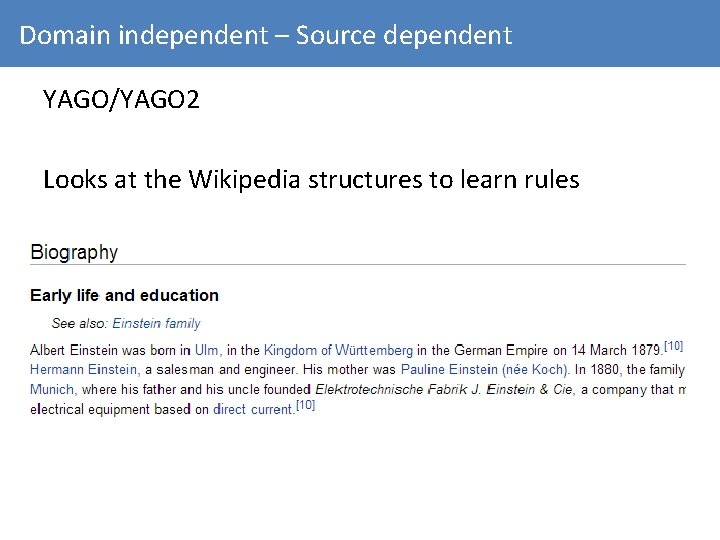
Domain independent – Source dependent YAGO/YAGO 2 Looks at the Wikipedia structures to learn rules
Domain independent – Source dependent YAGO/YAGO 2
YAGO Techniques are not general at all › Limited to 14 -100 hand-picked relations » Manually generate the relationships we want to look for Great performance › Able to extract 40 Million facts in YAGO › 80 million facts in YAGO 2
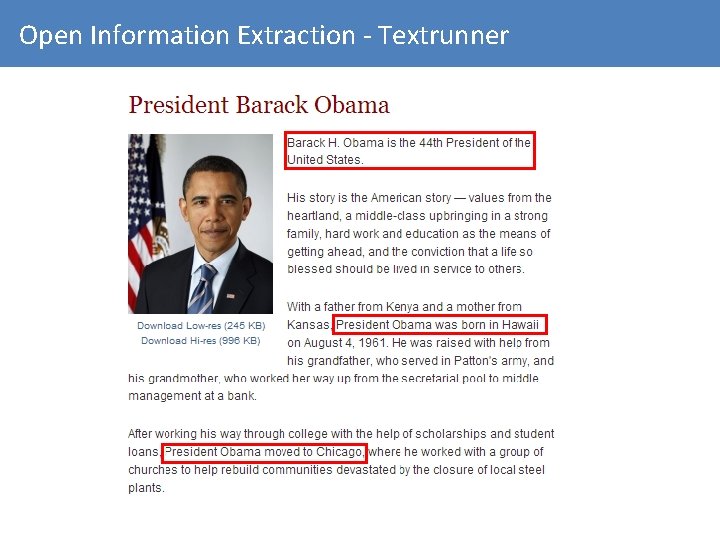
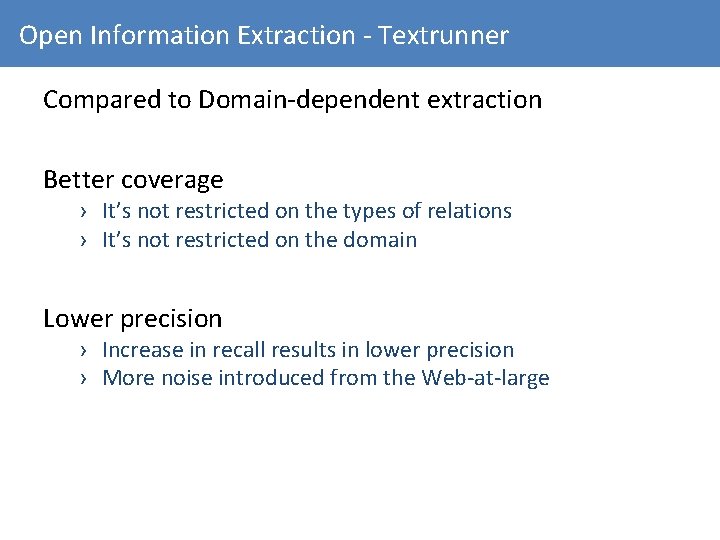
Web-At-Large Text Extraction “Open Information Extraction” Discovers rules/predicates on the fly Does not require domain semantics or much human input. › Run on the whole Web Textrunner Banko et al. ‘ 07
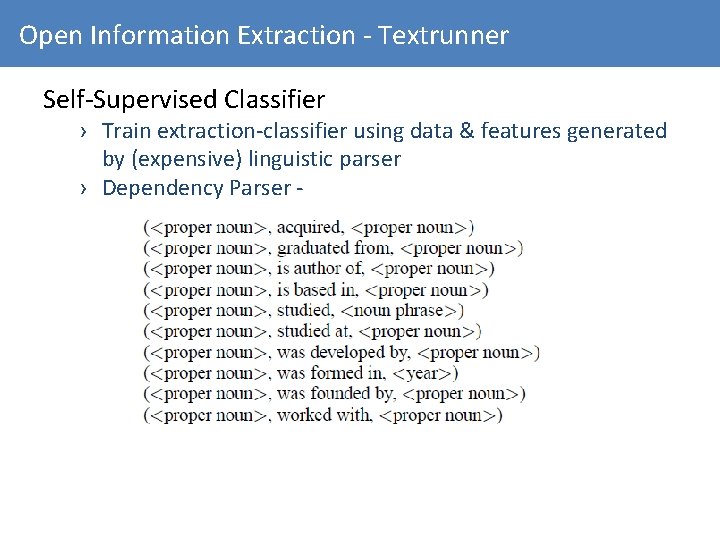
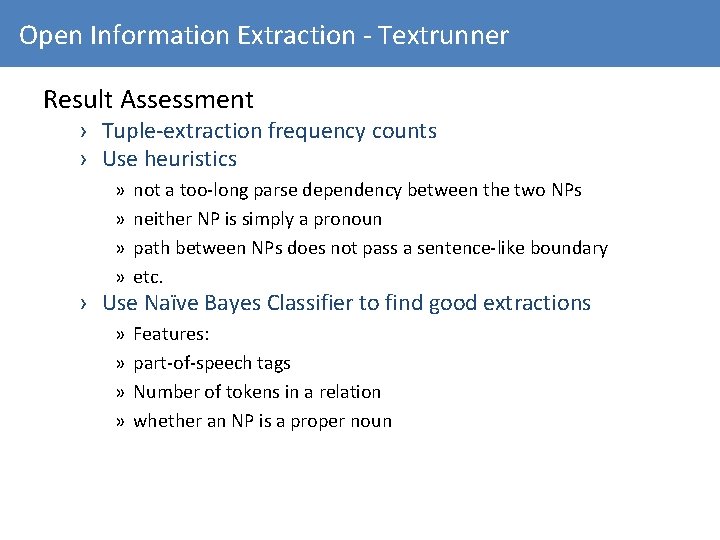
Open Information Extraction - Textrunner Self-Supervised Classifier › Train extraction-classifier using data & features generated by (expensive) linguistic parser › Dependency Parser -
Open Information Extraction - Textrunner
Open Information Extraction - Textrunner Result Assessment › Tuple-extraction frequency counts › Use heuristics » » not a too-long parse dependency between the two NPs neither NP is simply a pronoun path between NPs does not pass a sentence-like boundary etc. » » Features: part-of-speech tags Number of tokens in a relation whether an NP is a proper noun › Use Naïve Bayes Classifier to find good extractions
Open Information Extraction - Textrunner Compared to Domain-dependent extraction Better coverage › It’s not restricted on the types of relations › It’s not restricted on the domain Lower precision › Increase in recall results in lower precision › More noise introduced from the Web-at-large
Outline Preliminaries Information Extraction from text Break (30 min) Information Extraction from tables and lists Web Information Networks
Outline Preliminaries Information Extraction from text Break (30 min) Information Extraction from tables and lists Web Information Networks
Record Extraction
Record Extraction Find structured data in semi-structured HTML • Find database tables (rows & columns) in a Web page Data Record Extraction List Extraction Web. Table Integration
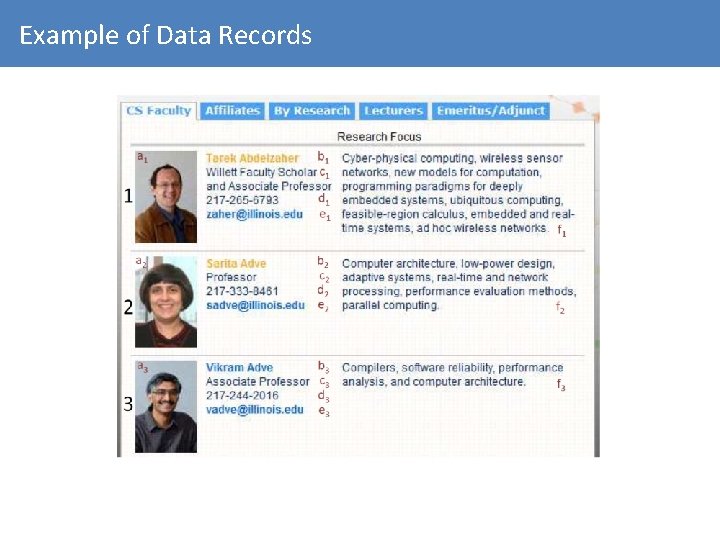
Example of Data Records
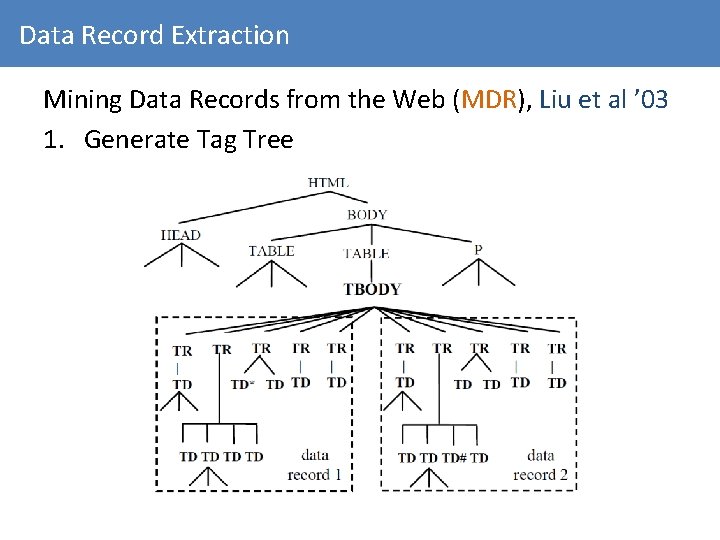
Data Record Extraction Mining Data Records from the Web (MDR), Liu et al ’ 03 1. Generate Tag Tree
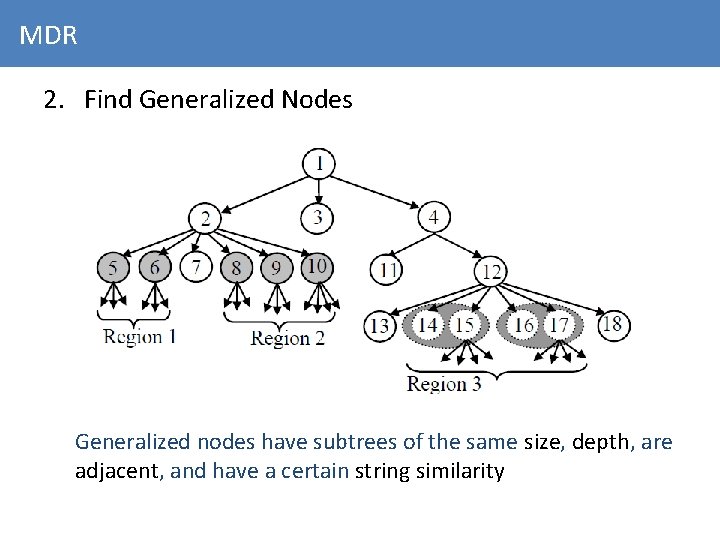
MDR 2. Find Generalized Nodes Generalized nodes have subtrees of the same size, depth, are adjacent, and have a certain string similarity
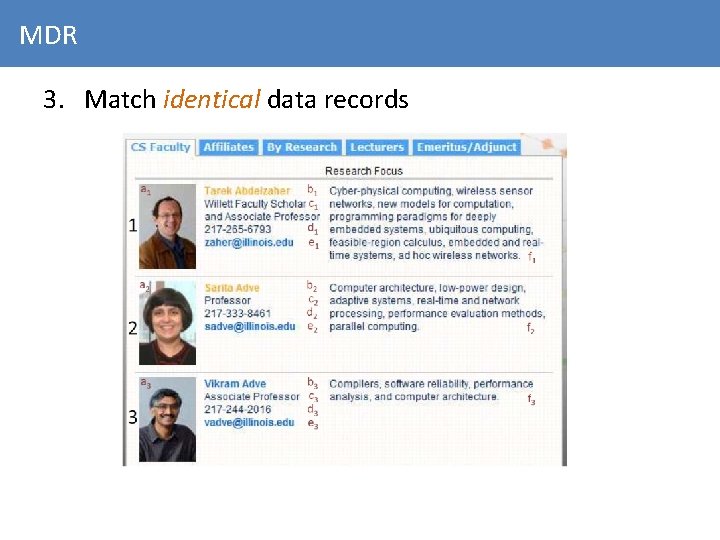
MDR 3. Match identical data records
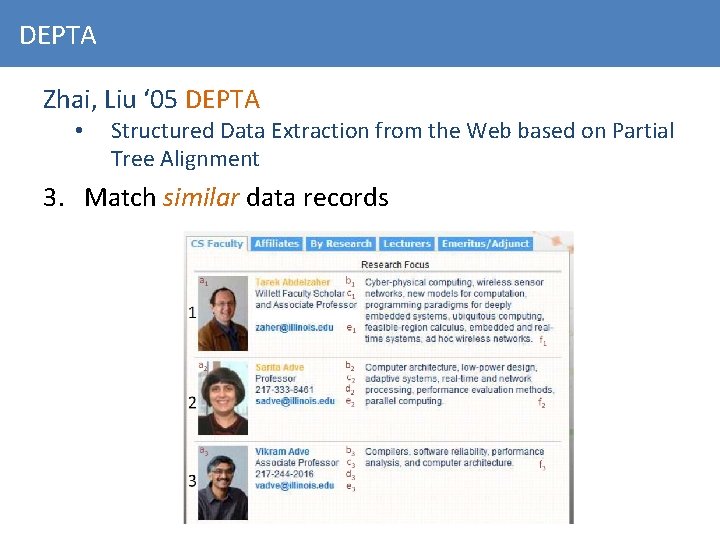
DEPTA Zhai, Liu ‘ 05 DEPTA • Structured Data Extraction from the Web based on Partial Tree Alignment 3. Match similar data records
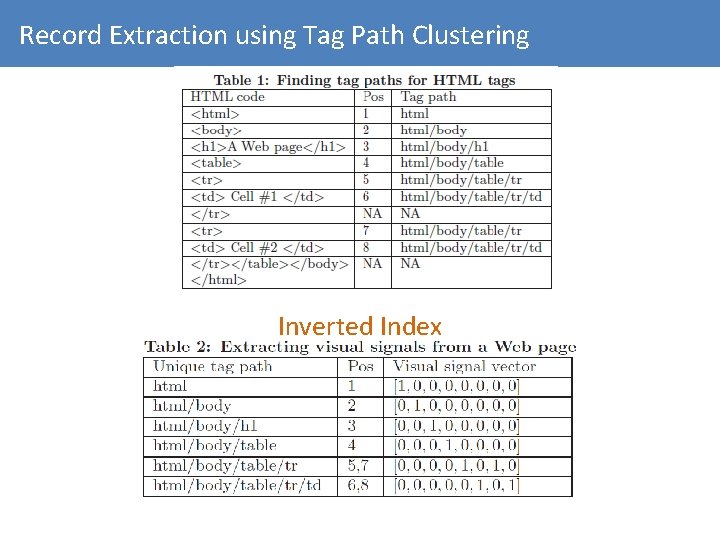
Record Extraction using Tag Path Clustering Inverted Index
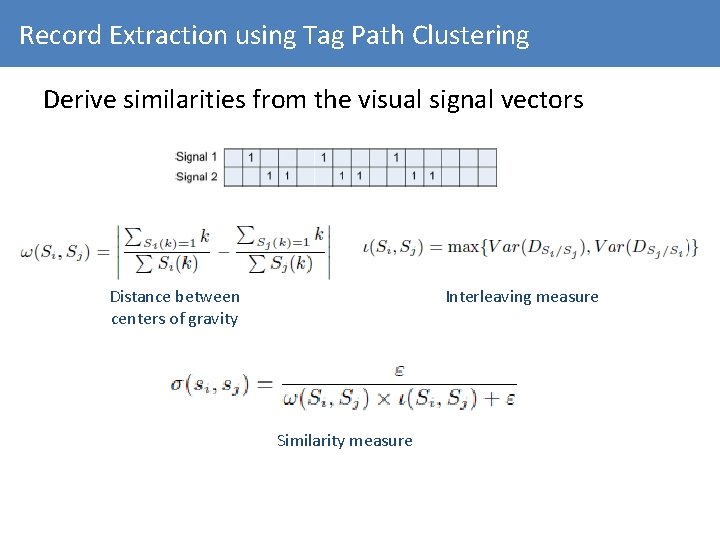
Record Extraction using Tag Path Clustering Derive similarities from the visual signal vectors Distance between centers of gravity Interleaving measure Similarity measure
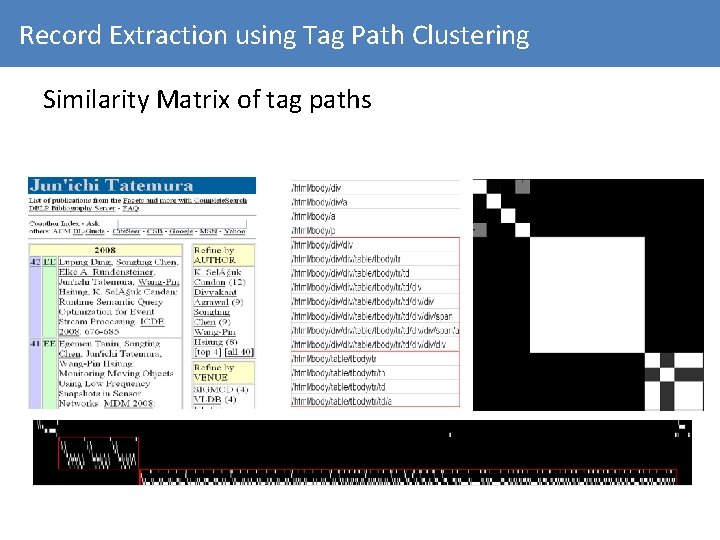
Record Extraction using Tag Path Clustering Similarity Matrix of tag paths
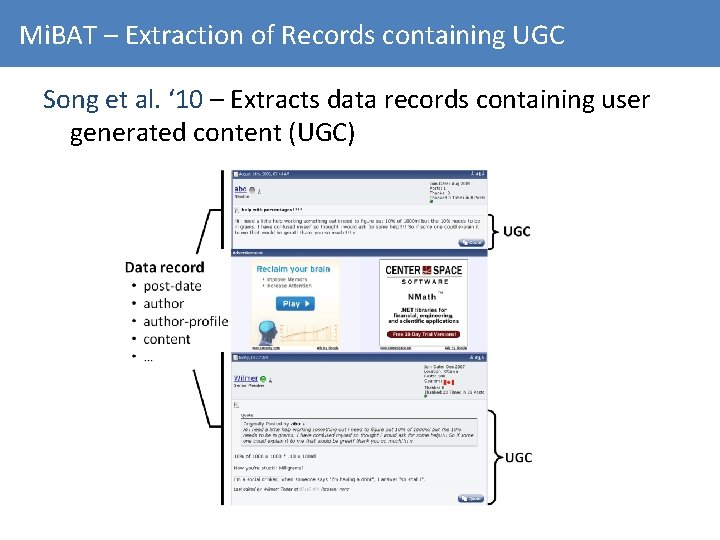
Mi. BAT – Extraction of Records containing UGC Song et al. ‘ 10 – Extracts data records containing user generated content (UGC)
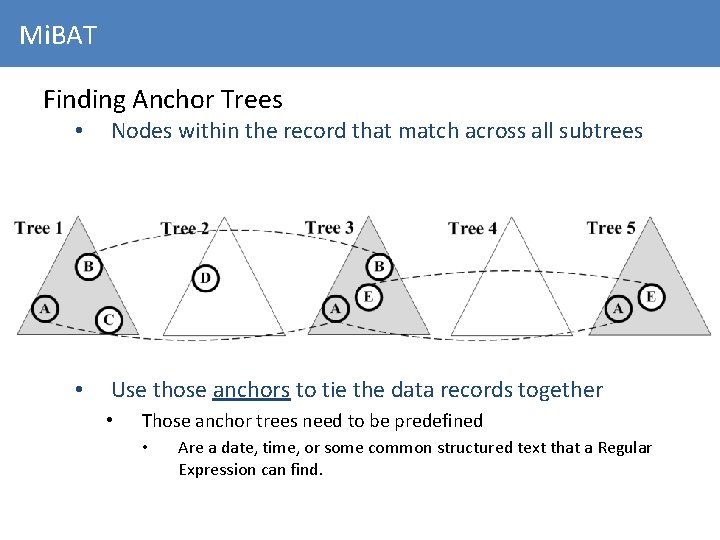
Mi. BAT Finding Anchor Trees • Nodes within the record that match across all subtrees • Use those anchors to tie the data records together • Those anchor trees need to be predefined • Are a date, time, or some common structured text that a Regular Expression can find.
DOM Record Extraction Advantages • Unsupervised » Only needs one page at a time • Tag-agnostic » Doesn’t matter what the type of the HTML tag is Disadvantages • Precision and Recall varies » Depends on the Web page and assumptions of the algorithm • HTML is not a schema » Misses AJAX, Javascript, other HTTP calls » What is the purpose of HTML?
Visual Based Record Extraction Assumptions: • • • HTML describes the structure of a document Repeating Patterns = Records HTML is a markup language We need to render the Web page
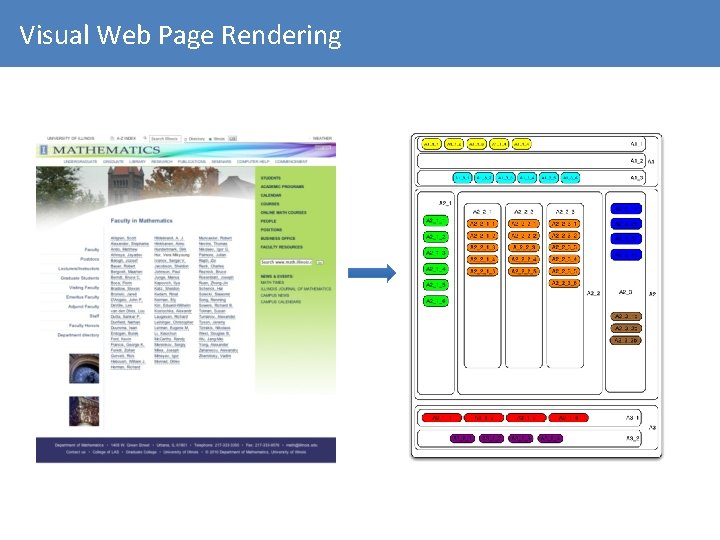
Visual Web Page Rendering
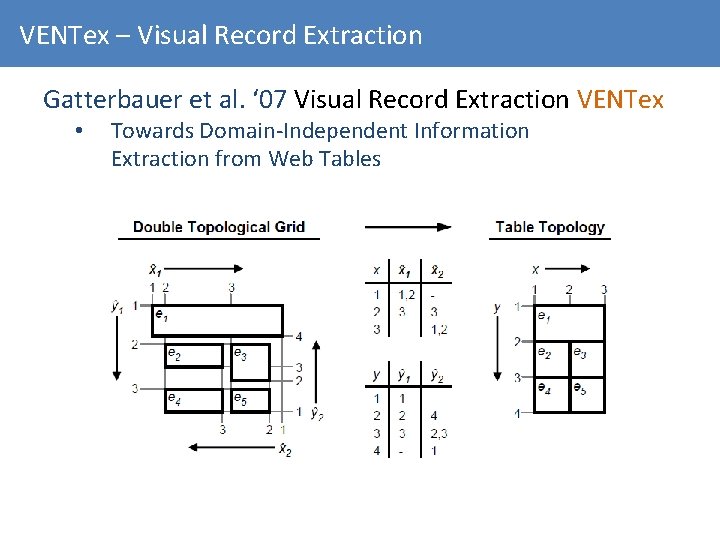
VENTex – Visual Record Extraction Gatterbauer et al. ‘ 07 Visual Record Extraction VENTex • Towards Domain-Independent Information Extraction from Web Tables
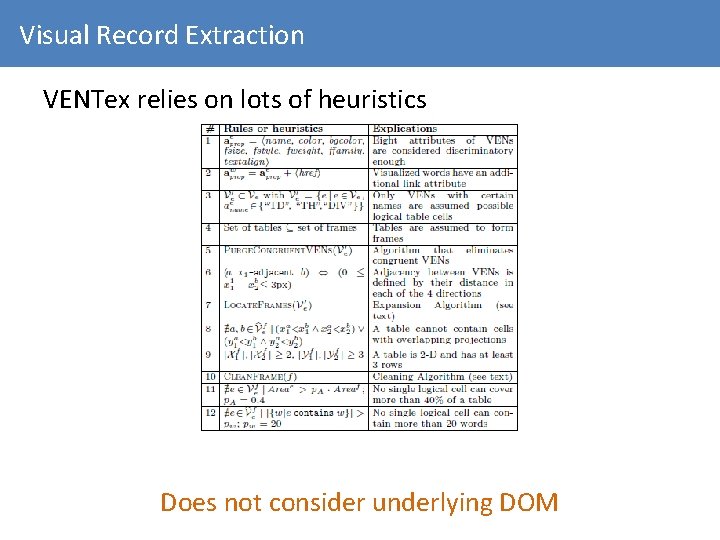
Visual Record Extraction VENTex relies on lots of heuristics Does not consider underlying DOM
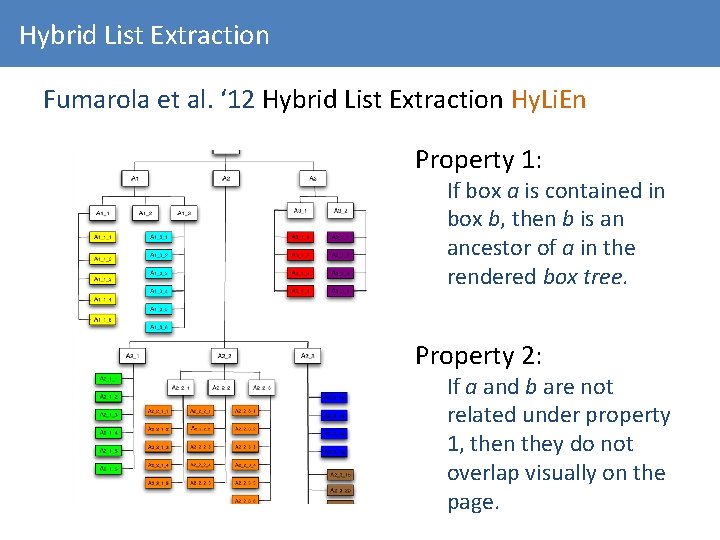
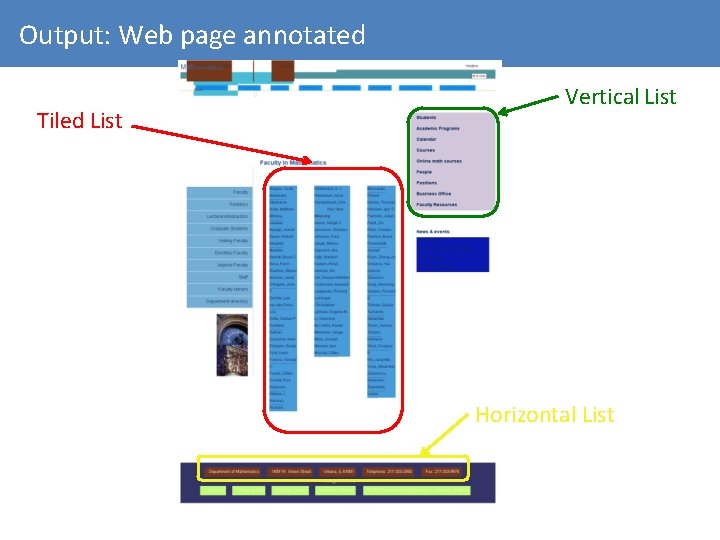
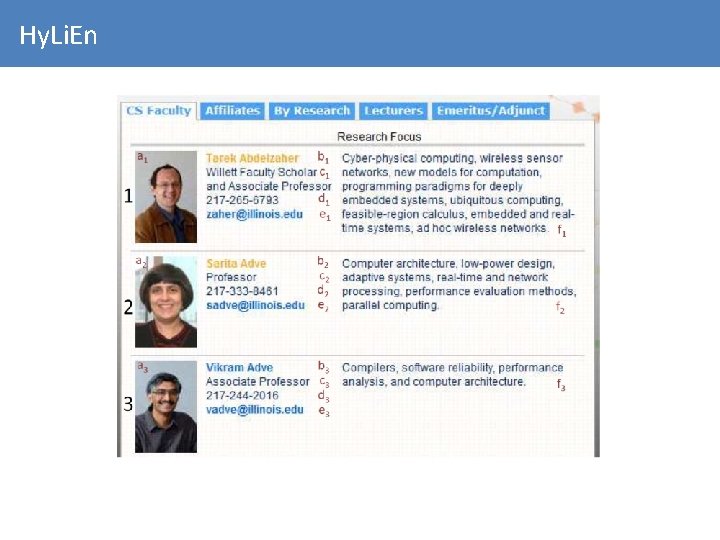
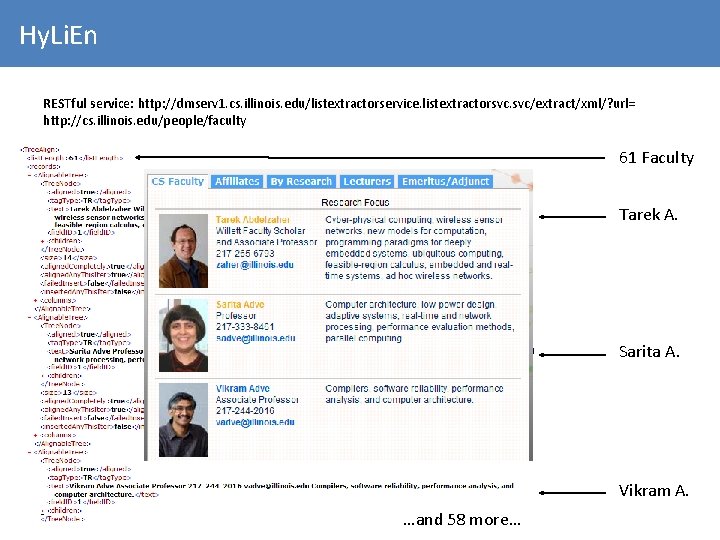
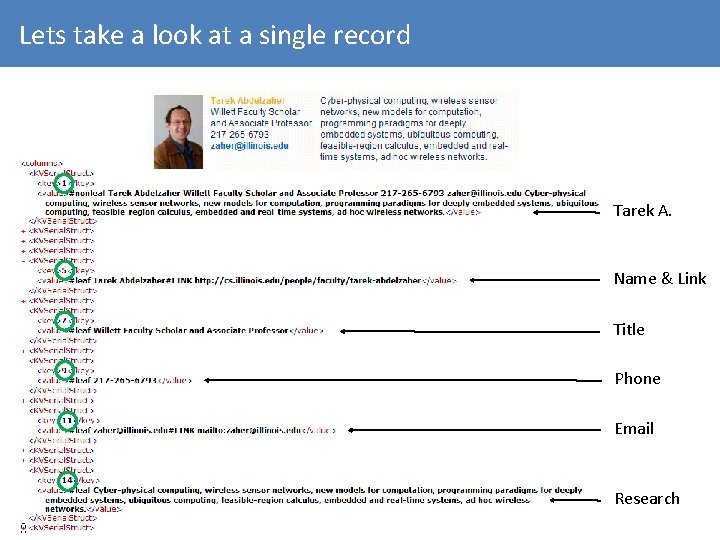
Hybrid List Extraction Fumarola et al. ‘ 12 Hybrid List Extraction Hy. Li. En Property 1: If box a is contained in box b, then b is an ancestor of a in the rendered box tree. Property 2: If a and b are not related under property 1, then they do not overlap visually on the page.
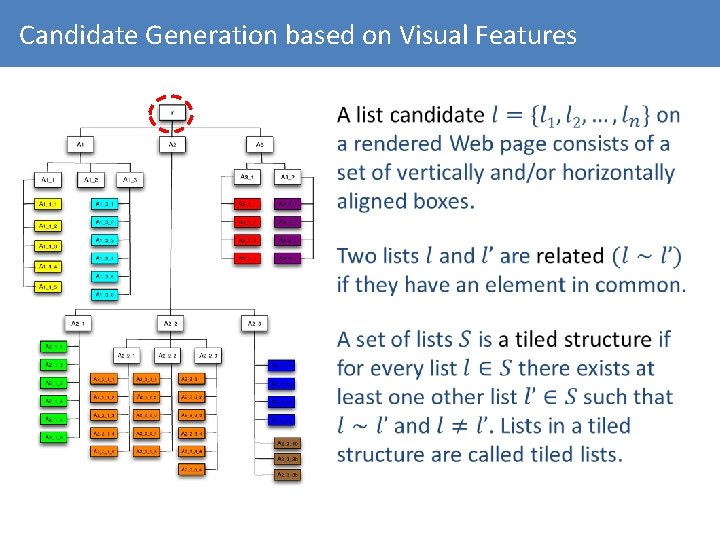
Candidate Generation based on Visual Features
Output: Web page annotated Tiled List Vertical List Horizontal List
Hy. Li. En
Hy. Li. En RESTful service: http: //dmserv 1. cs. illinois. edu/listextractorservice. listextractorsvc. svc/extract/xml/? url= http: //cs. illinois. edu/people/faculty 61 Faculty Tarek A. Sarita A. Vikram A. …and 58 more…
Lets take a look at a single record Tarek A. Name & Link Title Phone Email Research
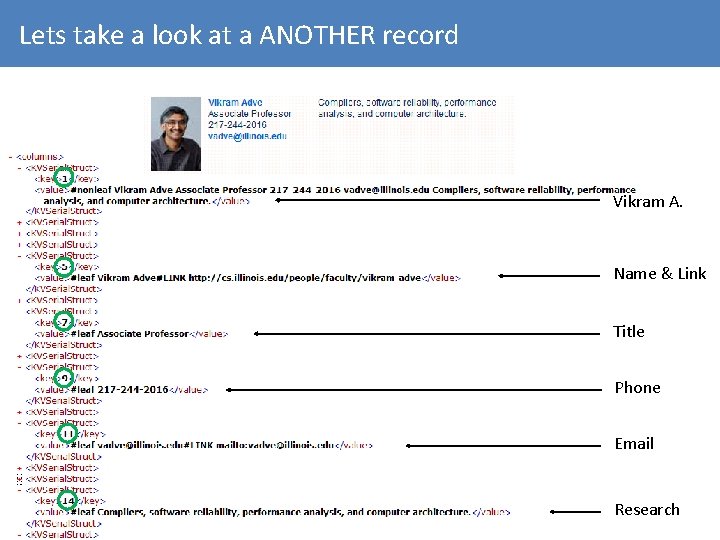
Lets take a look at a ANOTHER record Vikram A. Name & Link Title Phone Email Research
Visual Record Extraction Advantages • • More accurate than DOM-methods Unsupervised » Only needs one page at a time • Tag-agnostic » Doesn’t matter what the type of the HTML tag is Disadvantages • Precision and Recall varies » Depends on the Web page and assumptions of the algorithm » Precision not as good as tag-gnostic methods » Recall not as good as wrappers
Integrating Web data
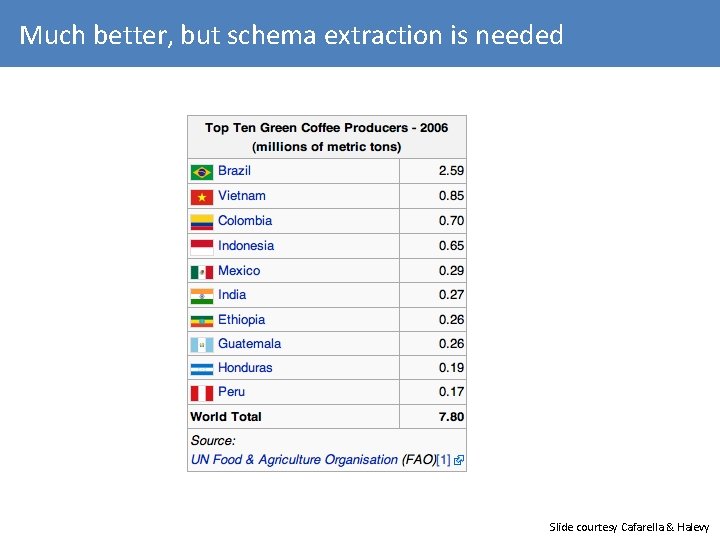
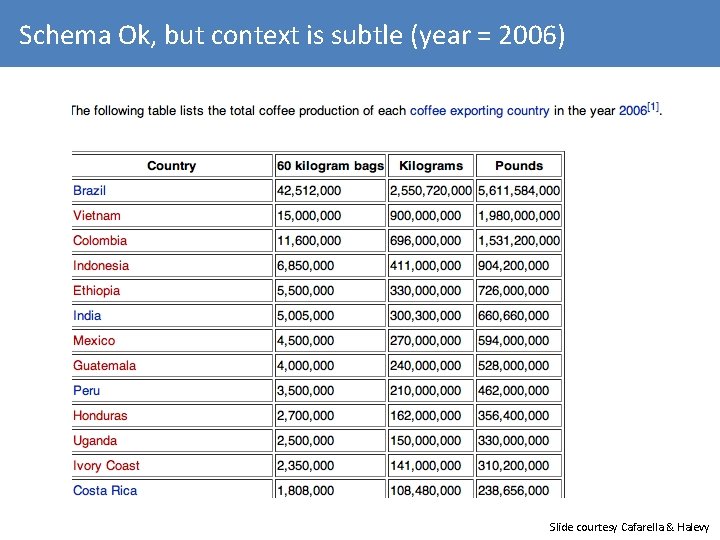
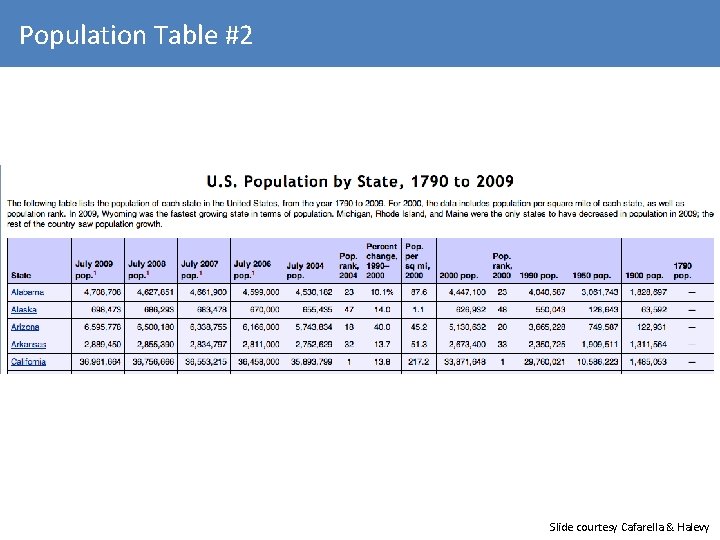
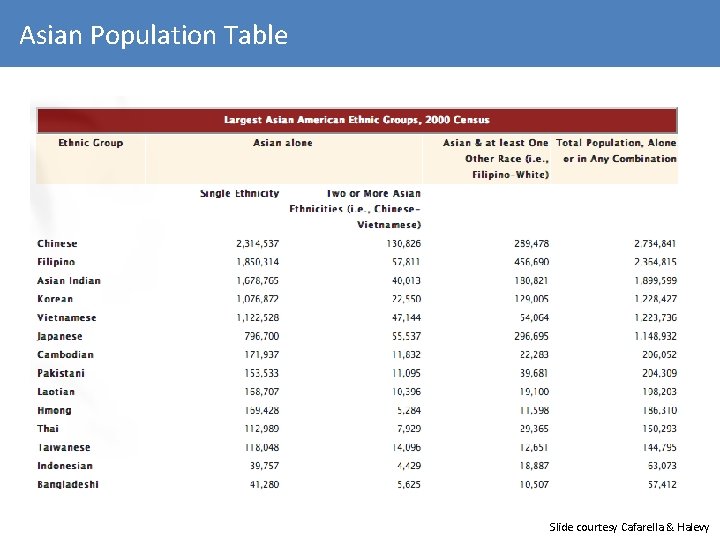
Web. Tables Cafarella et al. ‘ 08 – The Relational Web. Tables • Exploring the Relational Web In corpus of 14 B raw tables, they estimate 154 M are “good” relations › Single-table databases; Schema = attr labels + types › Largest corpus of databases & schemas available The Web. Tables system: › Recovers good relations from crawl and enables search › Builds novel apps on the recovered data
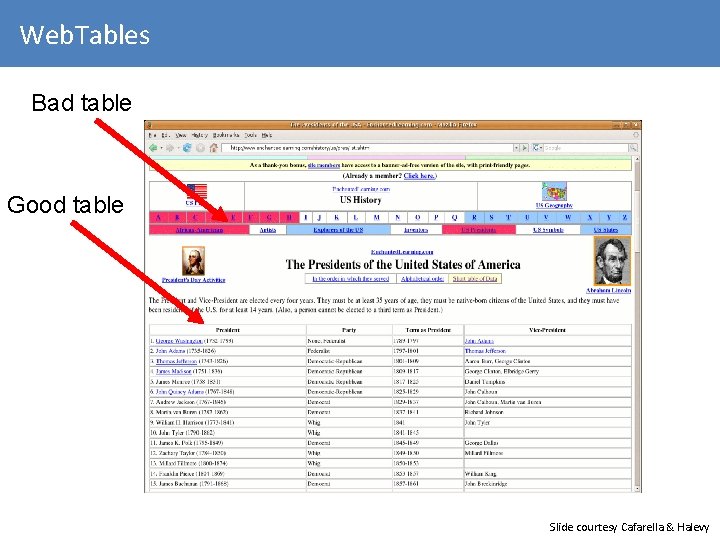
Web. Tables Bad table Good table Slide courtesy Cafarella & Halevy
Some Challenges Data is semi-structured: › › No schema Columns do not have uniform type Quality varies a lot Finding real tables is hard, as is extraction Data is about everything. › You can’t build a schema over everything
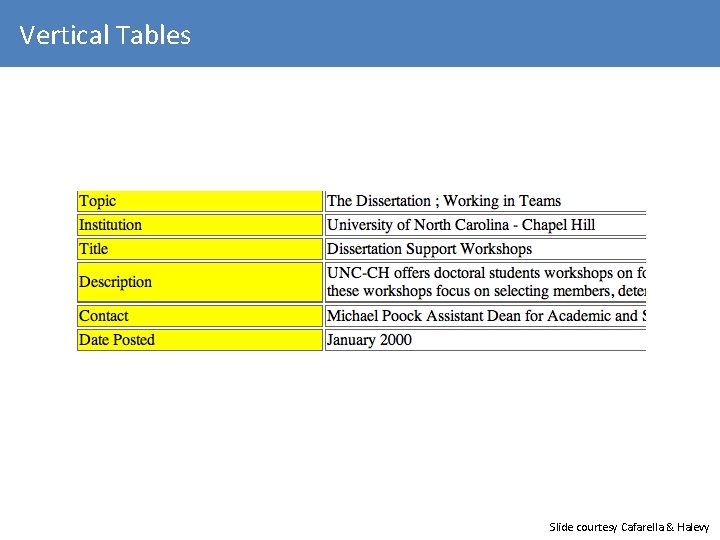
Vertical Tables Slide courtesy Cafarella & Halevy
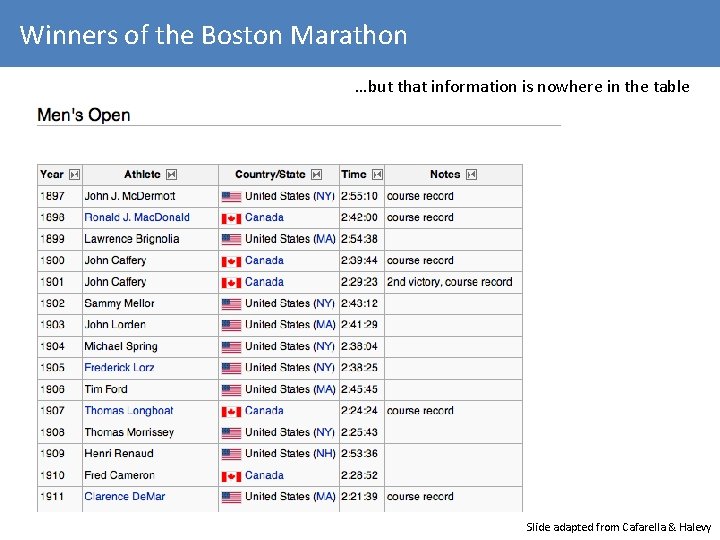
Winners of the Boston Marathon …but that information is nowhere in the table Slide adapted from Cafarella & Halevy
Much better, but schema extraction is needed Slide courtesy Cafarella & Halevy
Schema Ok, but context is subtle (year = 2006) Slide courtesy Cafarella & Halevy
Population Table #2 Slide courtesy Cafarella & Halevy
Asian Population Table Slide courtesy Cafarella & Halevy
Web. Tables: Exploring the Relational Web In corpus of 14 B raw tables, Cafarella et al estimate 154 M are “good” relations › Single-table databases; Schema = attr labels + types › Largest database ever! The Webtables system: › Recovers good relations from crawl and enables search › Builds novel apps on the recovered data
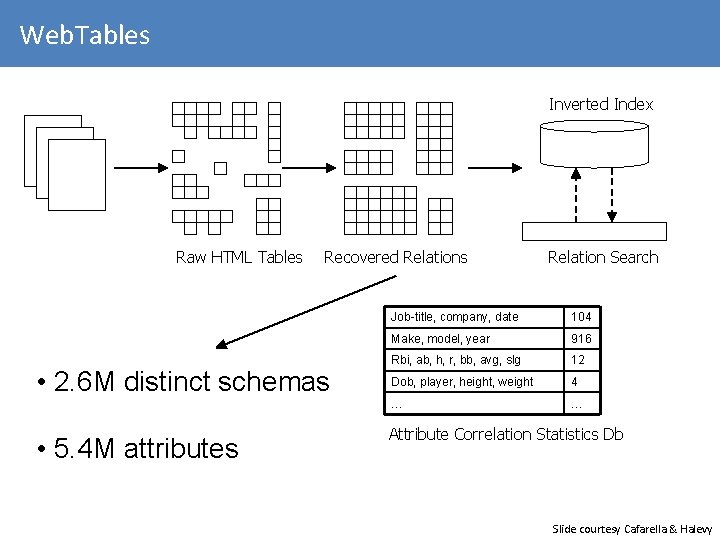
Web. Tables Inverted Index Raw HTML Tables Recovered Relations • 2. 6 M distinct schemas • 5. 4 M attributes Relation Search Job-title, company, date 104 Make, model, year 916 Rbi, ab, h, r, bb, avg, slg 12 Dob, player, height, weight 4 … … Attribute Correlation Statistics Db Slide courtesy Cafarella & Halevy
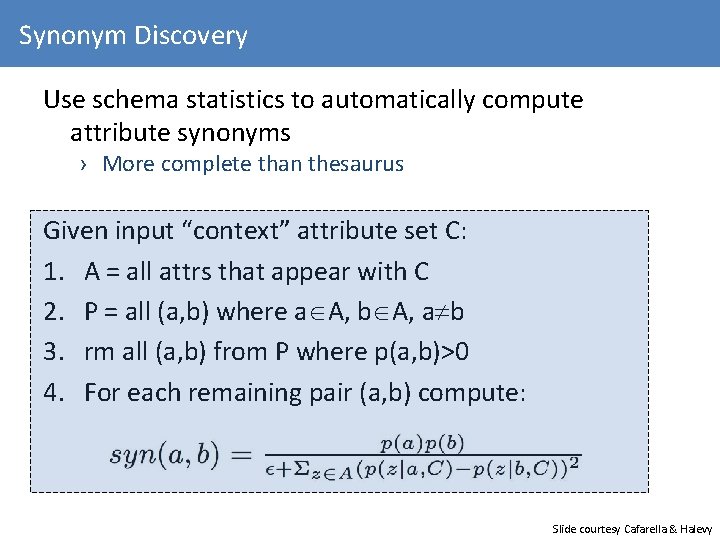
Synonym Discovery Use schema statistics to automatically compute attribute synonyms › More complete than thesaurus Given input “context” attribute set C: 1. A = all attrs that appear with C 2. P = all (a, b) where a A, b A, a b 3. rm all (a, b) from P where p(a, b)>0 4. For each remaining pair (a, b) compute: Slide courtesy Cafarella & Halevy
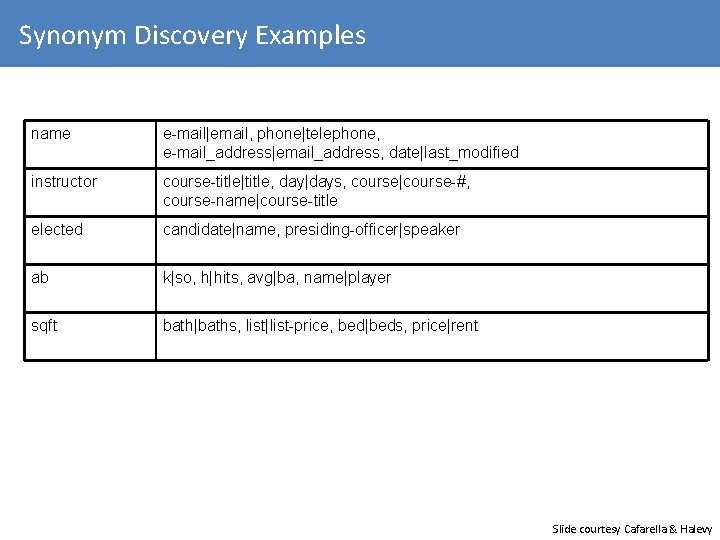
Synonym Discovery Examples name e-mail|email, phone|telephone, e-mail_address|email_address, date|last_modified instructor course-title|title, day|days, course|course-#, course-name|course-title elected candidate|name, presiding-officer|speaker ab k|so, h|hits, avg|ba, name|player sqft bath|baths, list|list-price, bed|beds, price|rent Slide courtesy Cafarella & Halevy
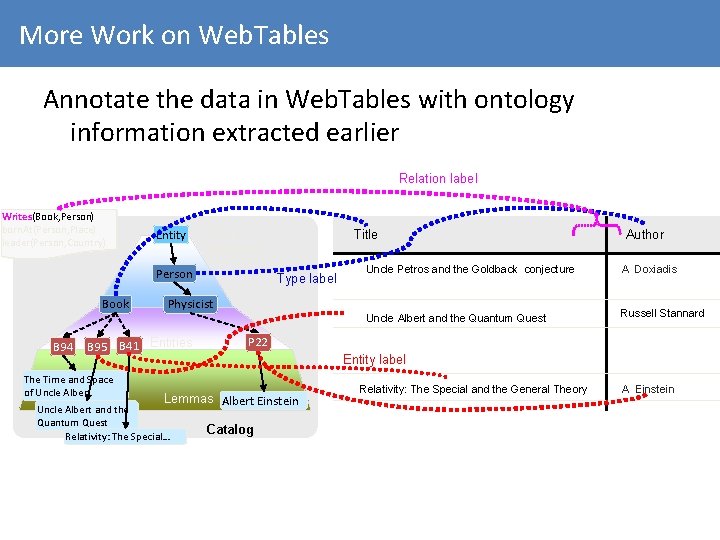
More Work on Web. Tables Annotate the data in Web. Tables with ontology information extracted earlier Relation label Writes(Book, Person) born. At(Person, Place) leader(Person, Country) Entity Type hierarchy Person Book B 94 Type label Physicist B 95 B 41 Entities The Time and Space of Uncle Albert Title Uncle Petros and the Goldback conjecture A Doxiadis Uncle Albert and the Quantum Quest Russell Stannard P 22 Entity label Lemmas Albert Einstein Uncle Albert and the Quantum Quest Relativity: The Special… Author Catalog Relativity: The Special and the General Theory A Einstein
Further Challenges Noisy data › A. Einstien vs Albert Einstein vs Einstien Ambiguity of entity names › “Michael Jordan” is both a computer scientist and an athlete Missing type links in Ontology › Universities in Rome -> Universities in Italy
Outline Preliminaries Information Extraction Break (30 min) Information Integration Web Information Networks
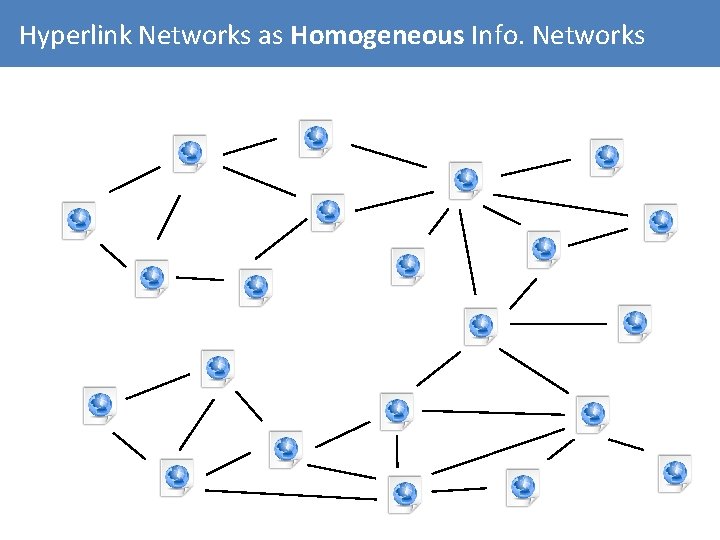
Hyperlink Networks as Homogeneous Info. Networks
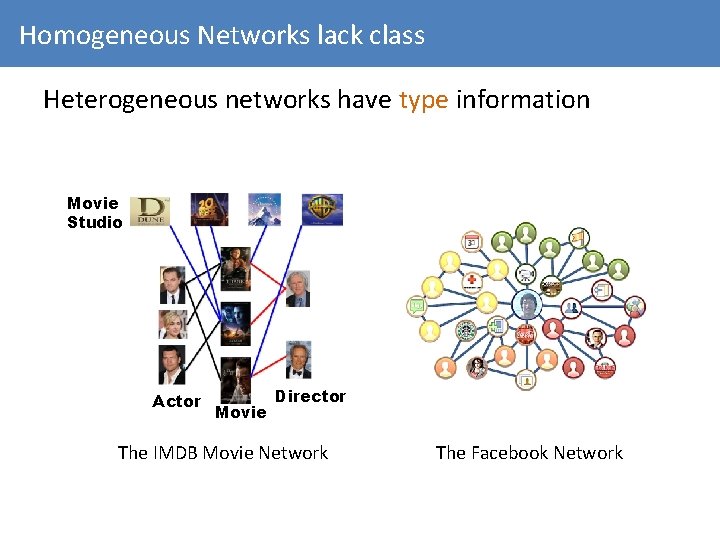
Homogeneous Networks lack class Heterogeneous networks have type information Movie Studio Actor Movie Director The IMDB Movie Network The Facebook Network
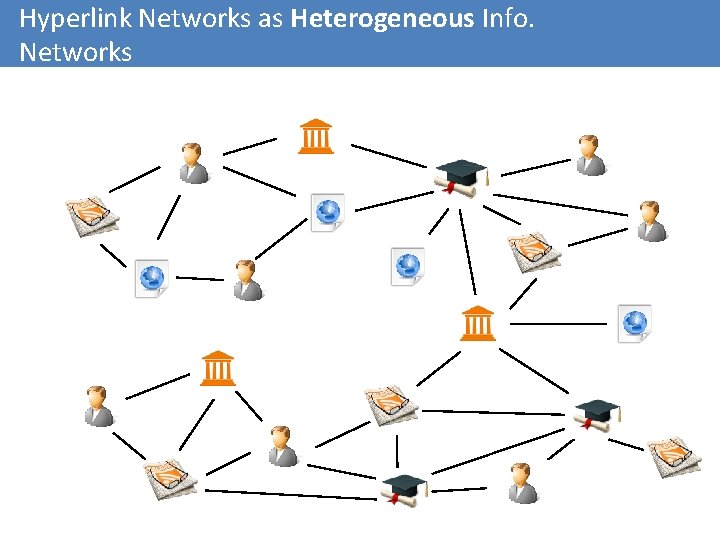
Hyperlink Networks as Heterogeneous Info. Networks
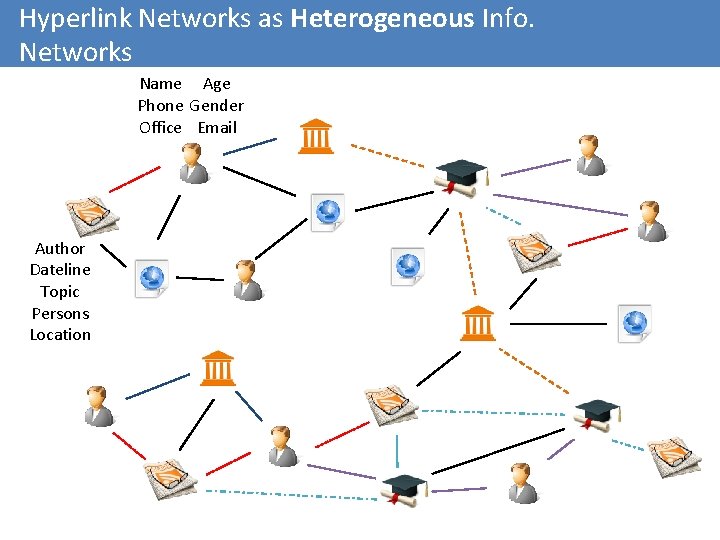
Hyperlink Networks as Heterogeneous Info. Networks Name Age Phone Gender Office Email Author Dateline Topic Persons Location
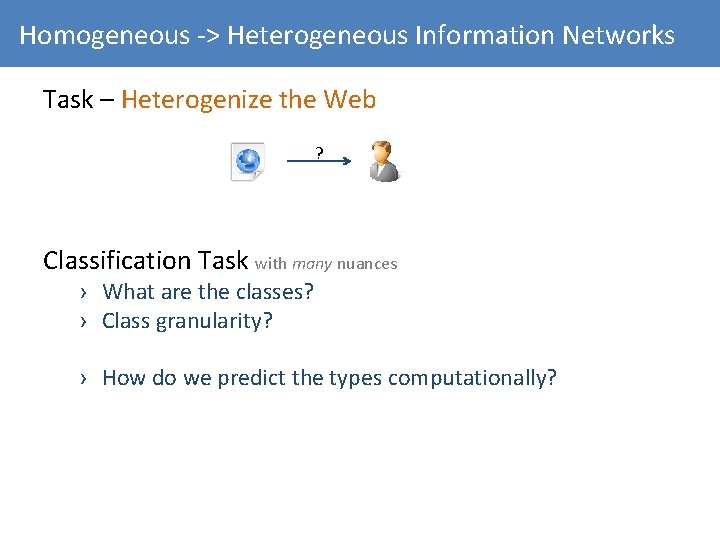
Homogeneous -> Heterogeneous Information Networks Task – Heterogenize the Web ? Classification Task with many nuances › What are the classes? › Class granularity? › How do we predict the types computationally?
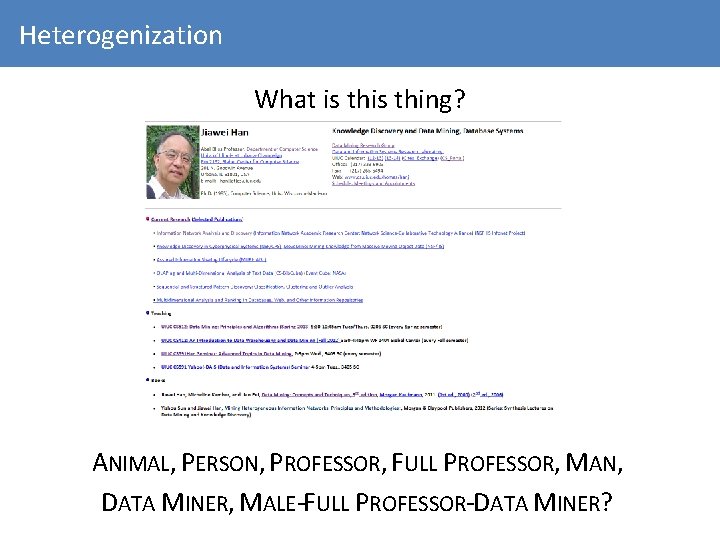
Heterogenization What is thing? ANIMAL, PERSON, PROFESSOR, FULL PROFESSOR, MAN, DATA MINER, MALE-FULL PROFESSOR-DATA MINER?
Heterogenization ANIMAL, PERSON, PROFESSOR, FULL PROFESSOR, MAN, DATA MINER, MALE-FULL PROFESSOR-DATA MINER? This is the goal! The answer is important We use these results to do other things HINT - The network tells us
Hierarchical Web Information Networks
Web Hierarchies
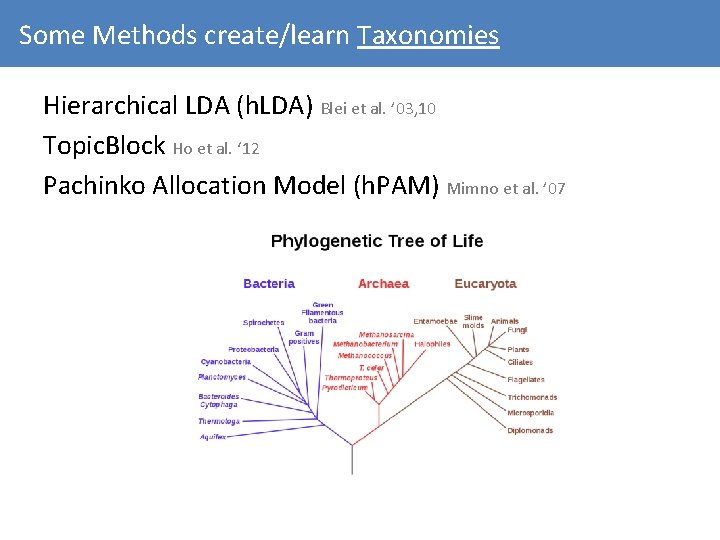
Some Methods create/learn Taxonomies Hierarchical LDA (h. LDA) Blei et al. ’ 03, 10 Topic. Block Ho et al. ‘ 12 Pachinko Allocation Model (h. PAM) Mimno et al. ’ 07
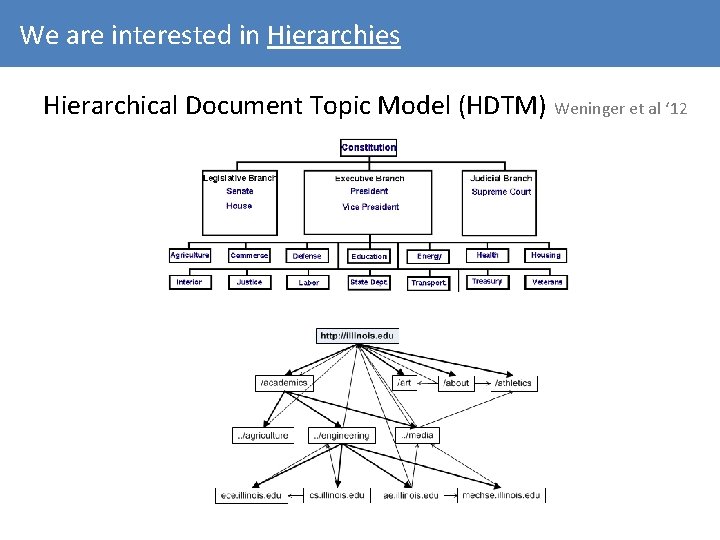
We are interested in Hierarchies Hierarchical Document Topic Model (HDTM) Weninger et al ‘ 12
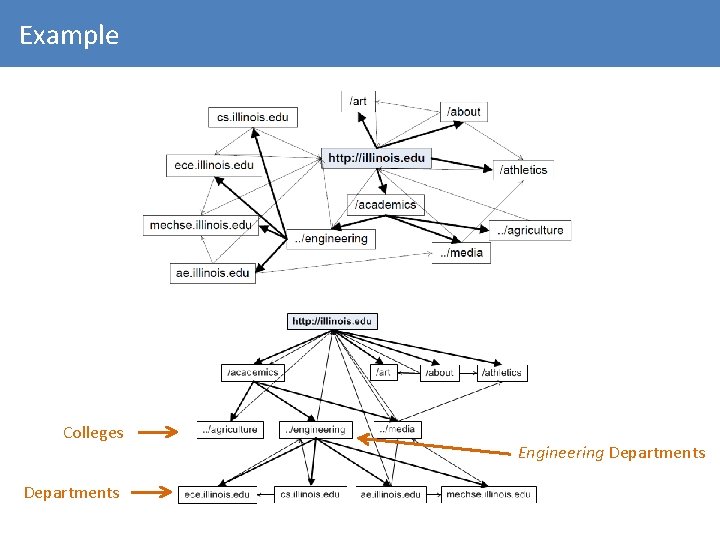
Example Colleges Departments Engineering Departments
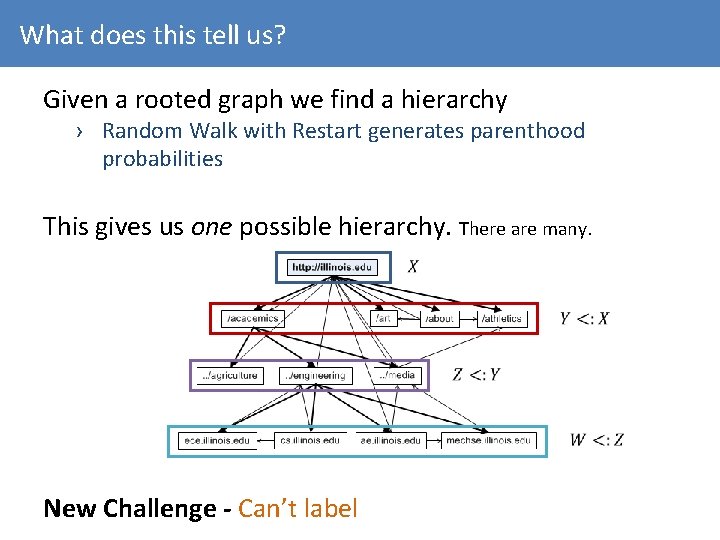
What does this tell us? Given a rooted graph we find a hierarchy › Random Walk with Restart generates parenthood probabilities This gives us one possible hierarchy. There are many. New Challenge - Can’t label
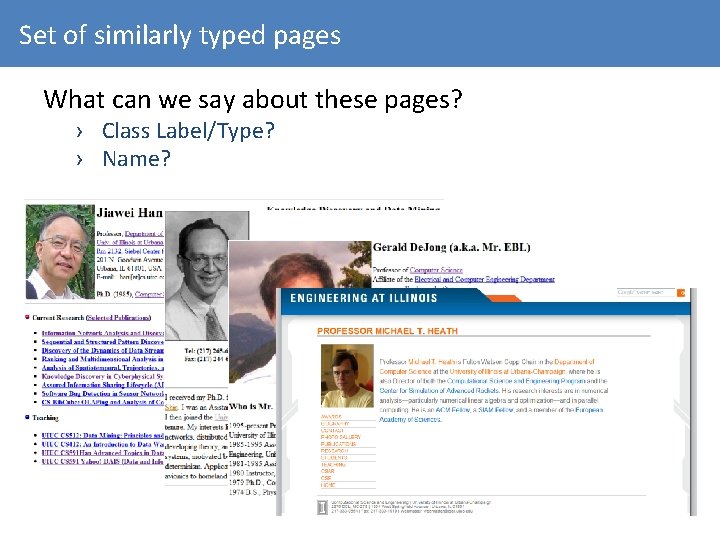
Set of similarly typed pages What can we say about these pages? › Class Label/Type? › Name?
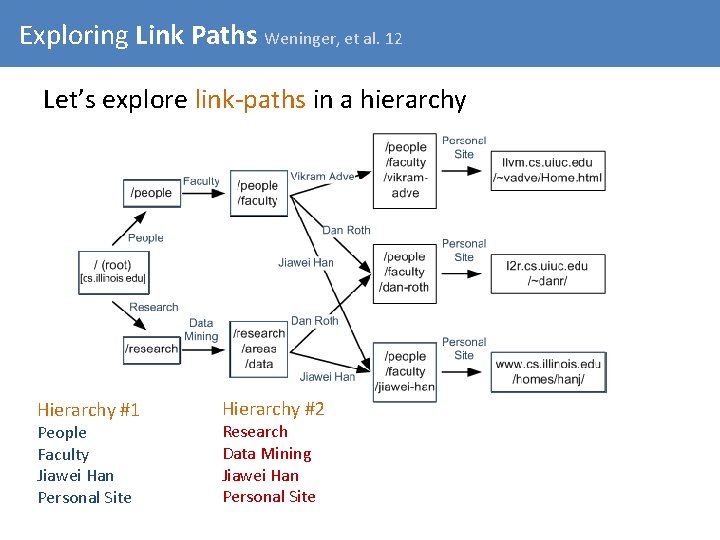
Exploring Link Paths Weninger, et al. 12 Let’s explore link-paths in a hierarchy Hierarchy #1 People Faculty Jiawei Han Personal Site Hierarchy #2 Research Data Mining Jiawei Han Personal Site
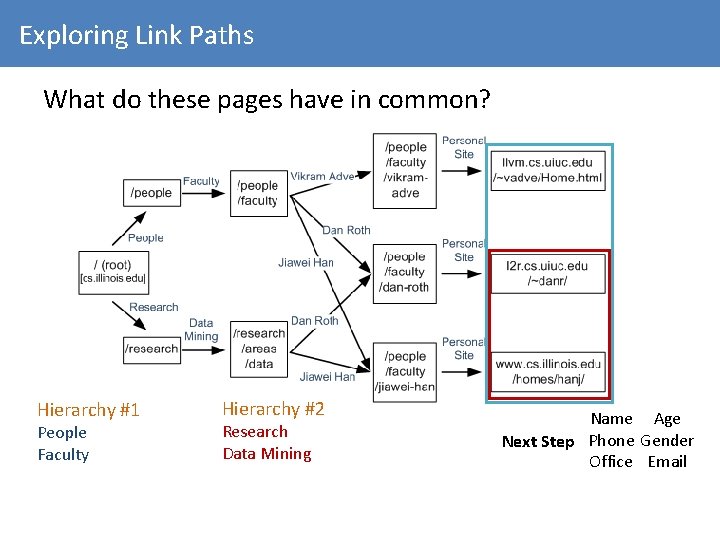
Exploring Link Paths What do these pages have in common? Hierarchy #1 People Faculty Hierarchy #2 Research Data Mining Name Age Next Step Phone Gender Office Email
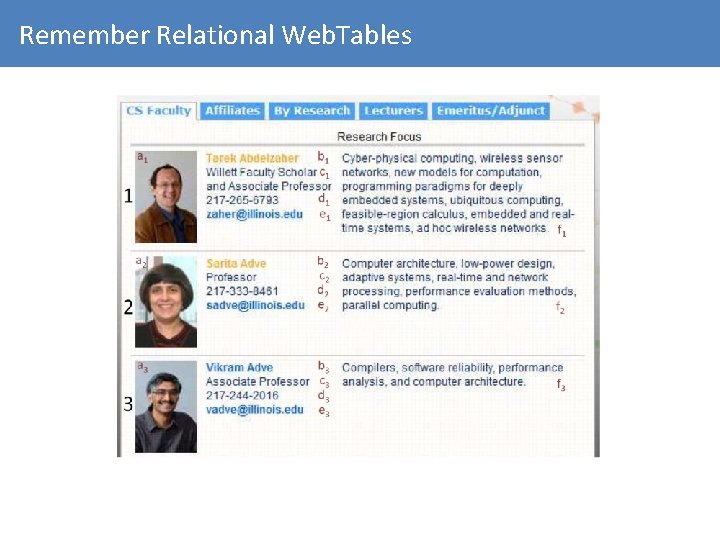
Remember Relational Web. Tables
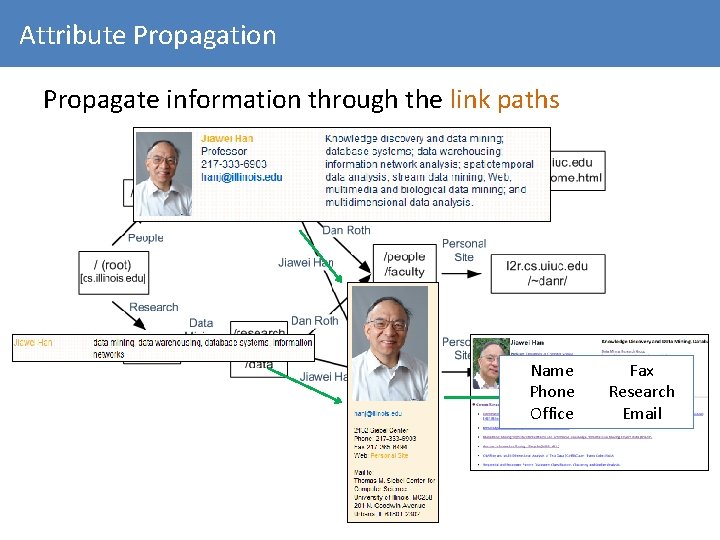
Attribute Propagation Propagate information through the link paths Name Phone Office Fax Research Email
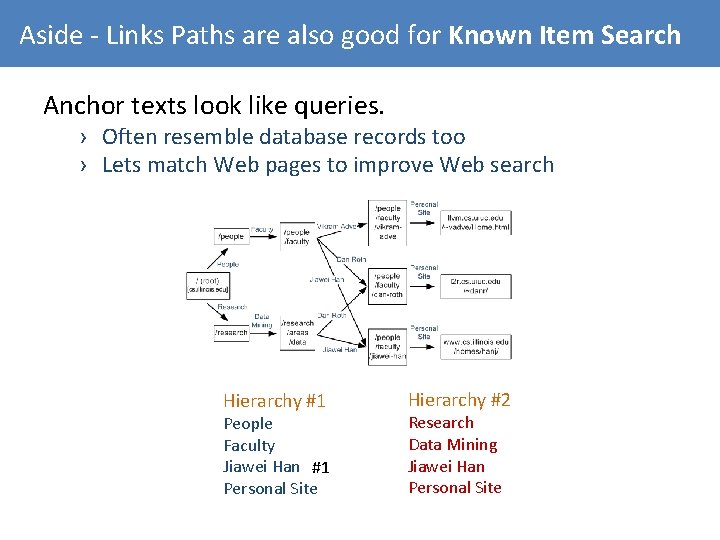
Aside - Links Paths are also good for Known Item Search Anchor texts look like queries. › Often resemble database records too › Lets match Web pages to improve Web search Hierarchy #1 People Faculty Jiawei Han #1 Personal Site Hierarchy #2 Research Data Mining Jiawei Han Personal Site
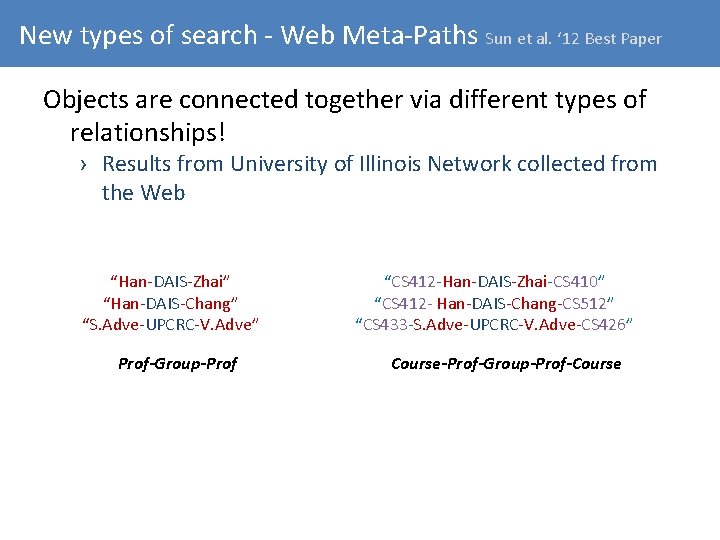
New types of search - Web Meta-Paths Sun et al. ‘ 12 Best Paper Objects are connected together via different types of relationships! › Results from University of Illinois Network collected from the Web “Han-DAIS-Zhai” “Han-DAIS-Chang” “S. Adve-UPCRC-V. Adve” Prof-Group-Prof “CS 412 -Han-DAIS-Zhai-CS 410” “CS 412 - Han-DAIS-Chang-CS 512” “CS 433 -S. Adve-UPCRC-V. Adve-CS 426” Course-Prof-Group-Prof-Course

Thank you
- Slides: 125