
Exploring Strategy 11 th edition Text and Cases
- Slides: 35
Exploring Strategy 11 th edition Text and Cases Chapter 13 Strategy development processes Copyright © 2017, 2014, 2011 Pearson Education, Inc. All Rights Reserved
Learning outcomes • Understand what is meant by deliberate and emergent strategy development. • Identify deliberate processes of strategy development in organisations including: the role of strategic leadership, strategic planning systems and externally imposed strategy. • Identify processes that give rise to emergent strategy development such as: logical incrementalism, political processes and organisational structures and systems. • Consider the implications and challenges of managing strategy development in organisations. Copyright © 2017, 2014, 2011 Pearson Education, Inc. All Rights Reserved
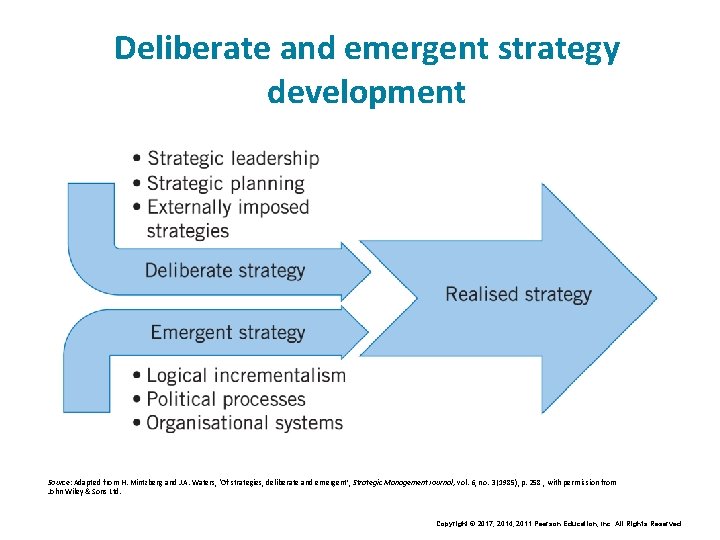
Deliberate and emergent strategy development Source: Adapted from H. Mintzberg and J. A. Waters, ‘Of strategies, deliberate and emergent’, Strategic Management Journal, vol. 6, no. 3 (1985), p. 258 , with permission from John Wiley & Sons Ltd. Copyright © 2017, 2014, 2011 Pearson Education, Inc. All Rights Reserved
Deliberate strategy involves intentional formulation or planning. Deliberate strategy can come about through: • Strategic leaders; • Strategic planning mechanisms; • External imposition. Copyright © 2017, 2014, 2011 Pearson Education, Inc. All Rights Reserved
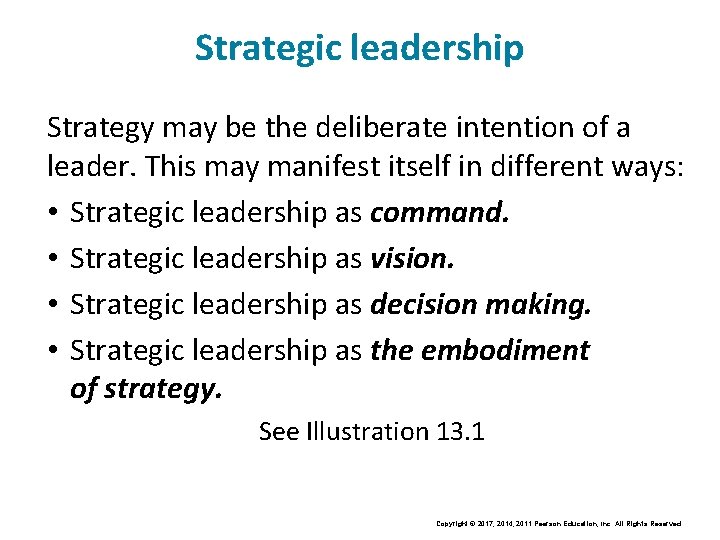
Strategic leadership Strategy may be the deliberate intention of a leader. This may manifest itself in different ways: • Strategic leadership as command. • Strategic leadership as vision. • Strategic leadership as decision making. • Strategic leadership as the embodiment of strategy. See Illustration 13. 1 Copyright © 2017, 2014, 2011 Pearson Education, Inc. All Rights Reserved
Strategic planning systems Strategic planning takes the form of systematic analysis and exploration to develop an organisation’s strategy. See Illustration 13. 2 Copyright © 2017, 2014, 2011 Pearson Education, Inc. All Rights Reserved
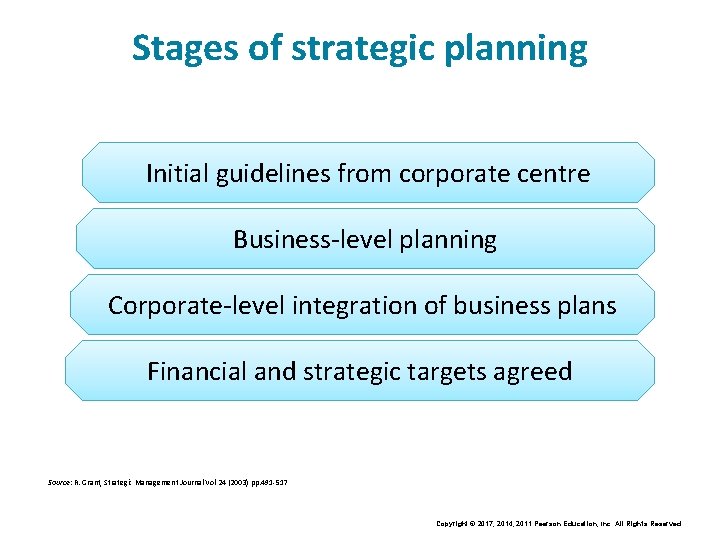
Stages of strategic planning Initial guidelines from corporate centre Business-level planning Corporate-level integration of business plans Financial and strategic targets agreed Source: R. Grant, Strategic Management Journal Vol 24 (2003) pp. 491 -517 Copyright © 2017, 2014, 2011 Pearson Education, Inc. All Rights Reserved
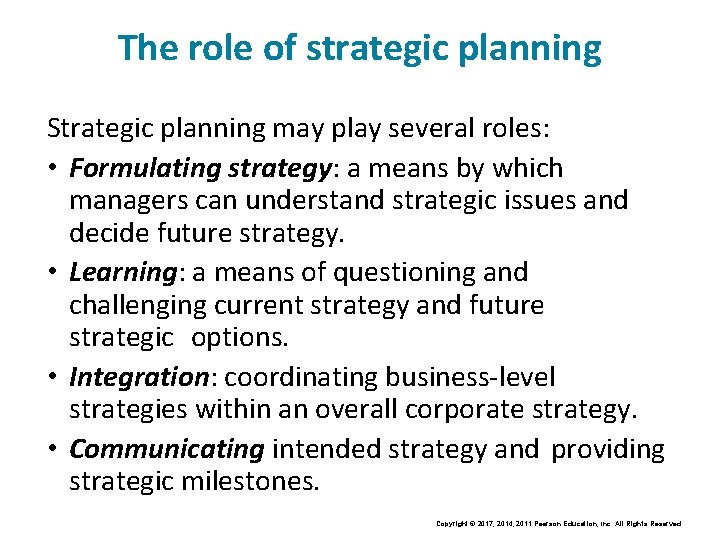
The role of strategic planning Strategic planning may play several roles: • Formulating strategy: a means by which managers can understand strategic issues and decide future strategy. • Learning: a means of questioning and challenging current strategy and future strategic options. • Integration: coordinating business-level strategies within an overall corporate strategy. • Communicating intended strategy and providing strategic milestones. Copyright © 2017, 2014, 2011 Pearson Education, Inc. All Rights Reserved
Benefits of planning Additional benefits: • can provide opportunities for involvement. • leads to a sense of ownership. • provides security to managers. • re-assures managers and stakeholders that the strategy is ‘logical’. Copyright © 2017, 2014, 2011 Pearson Education, Inc. All Rights Reserved
Dangers associated with planning Some dangers in planning: • • • Confusing managing strategy with planning. Detachment from reality. Paralysis by analysis. Over-complex planning processes. Dampening of innovation. Copyright © 2017, 2014, 2011 Pearson Education, Inc. All Rights Reserved
Externally imposed strategy Strategies may be imposed by powerful external stakeholders. Examples include: • Government can determine strategy in public sector organisations (e. g. schools). • Government can shape strategy in regulated industries (e. g. public utilities). • Multinational companies may have elements of strategy imposed by host governments (e. g. the requirement to form local alliances). • Business units may have their strategy imposed by head office (e. g. part of a global strategy). • Venture capital firms may impose strategy on companies they buy into. Copyright © 2017, 2014, 2011 Pearson Education, Inc. All Rights Reserved
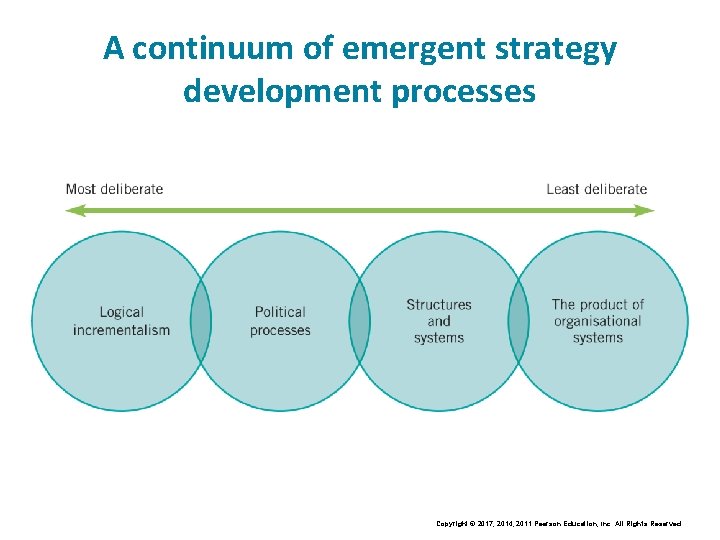
Emergent strategy: strategies emerge on the basis of a series of decisions, which forms a pattern that becomes clear over time. Strategy is not a ‘grand plan’ – managers draw together emerging themes of strategy from lower down the organisation rather than direct strategy from the top. Copyright © 2017, 2014, 2011 Pearson Education, Inc. All Rights Reserved
A continuum of emergent strategy development processes Copyright © 2017, 2014, 2011 Pearson Education, Inc. All Rights Reserved
Logical incrementalism (1 of 2) Logical incrementalism is the development of strategy by experimentation and learning ‘from partial commitments rather than through global formulations of total strategies’. See Illustration 13. 3 Copyright © 2017, 2014, 2011 Pearson Education, Inc. All Rights Reserved
Logical incrementalism (2 of 2) There are three main characteristics of logical incrementalism: • Environmental uncertainty – constant environment scanning and change. • General goals – avoiding too early commitment to specific goals. • Experimentation – building a strong but flexible core business but engaging in ‘side bet’ ventures to test out new strategies. Copyright © 2017, 2014, 2011 Pearson Education, Inc. All Rights Reserved
Learning organisation – an organisation capable of continual regeneration from the variety of knowledge, experience and skills within a culture that encourages questioning and challenge. Proponents of learning organisations argue: • Formal systems stifle creativity. • Top managers should facilitate rather than direct strategy – encouraging new ideas from below. • Experimentation is the norm. Copyright © 2017, 2014, 2011 Pearson Education, Inc. All Rights Reserved
Strategy as the outcome of political processes The political view of strategy development is that strategies develop as the outcome of bargaining and negotiation among powerful interest groups (or stakeholders). The approach of different people to strategic problems is influenced by: • Position and personal experience. • Competition for resources and influence. • The relative influence of stakeholders. • Different access to information. Copyright © 2017, 2014, 2011 Pearson Education, Inc. All Rights Reserved
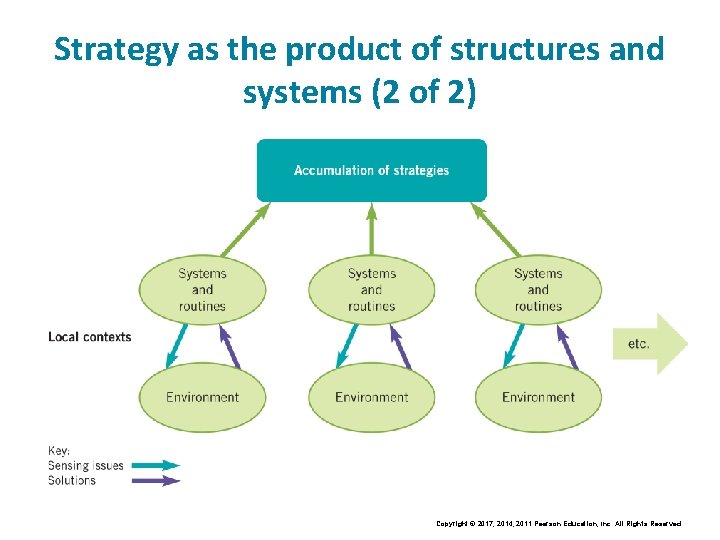
Strategy as the product of structures and systems (1 of 2) Strategy development as the outcome of managers making sense of, and dealing with, strategic issues by applying established ways of doing things. Strategy development is influenced by the systems and routines with which managers are familiar in their particular context. Copyright © 2017, 2014, 2011 Pearson Education, Inc. All Rights Reserved
Strategy as the product of structures and systems (2 of 2) Copyright © 2017, 2014, 2011 Pearson Education, Inc. All Rights Reserved
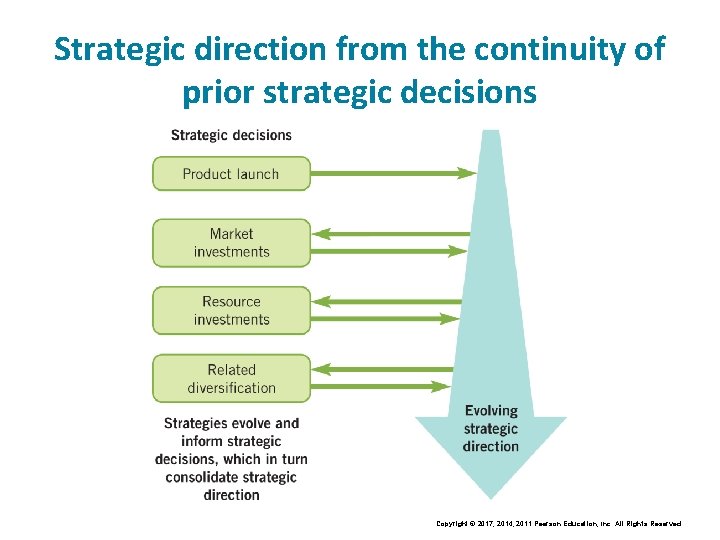
Strategic direction from the continuity of prior strategic decisions Copyright © 2017, 2014, 2011 Pearson Education, Inc. All Rights Reserved
Implications for managing strategy development • Multiple strategy development processes – most organisations develop strategy through several different processes. • There is no one right way to develop strategy but the context can be important. See Illustration 13. 4 Copyright © 2017, 2014, 2011 Pearson Education, Inc. All Rights Reserved
Perceptions of strategy development – strategy will be seen differently by different people: • Senior executives tend to see strategy as intended, rational and analytical whereas middle managers see it as a cultural and political process. • Managers in public sector organisations see strategy as externally imposed since they are answerable to government bodies. • People in family businesses see the influence of powerful individuals, who may be the owners of the businesses. Copyright © 2017, 2014, 2011 Pearson Education, Inc. All Rights Reserved
Strategy development in different contexts (1 of 5) Strategy development processes will differ according to context: • Organisational characteristics differ – in terms of size, form and complexity. • The nature of the environment differs – it may be stable or dynamic; simple or complex. • Life cycle effects – development processes will evolve and change over the life cycle. Copyright © 2017, 2014, 2011 Pearson Education, Inc. All Rights Reserved
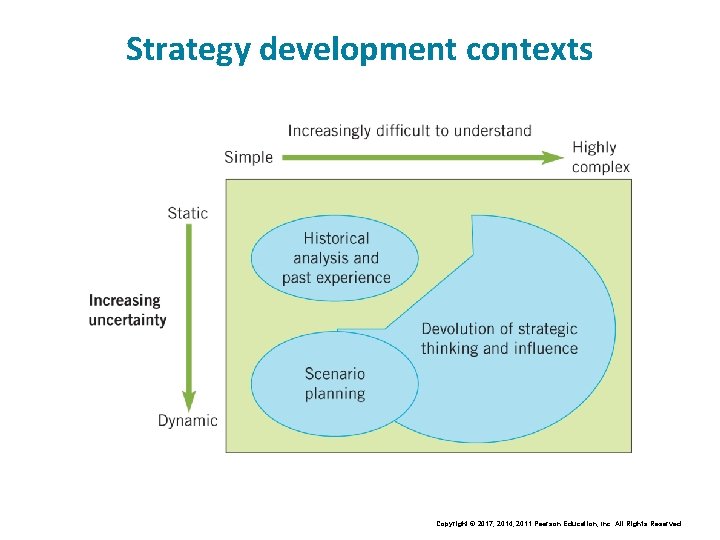
Strategy development contexts Copyright © 2017, 2014, 2011 Pearson Education, Inc. All Rights Reserved
Strategy development in different contexts (2 of 5) • Simple/static conditions Environment is straightforward and not undergoing significant change. The organisation is not complex e. g. single product firms in basic industries, some public services. Historical analysis is useful. Strategic planning from the centre is possible. Past experience is also useful BUT there is a threat if condtions become more dynamic. Copyright © 2017, 2014, 2011 Pearson Education, Inc. All Rights Reserved
Strategy development in different contexts (3 of 5) • Dynamic conditions Managers need to consider the environment of the future with increasing uncertainty. Use of structured ways of making sense of the future, such as scenario planning. Encouraging active sensing of changes by people lower down in the organisation. Logical incrementalism and organisational learning are more relevant. Copyright © 2017, 2014, 2011 Pearson Education, Inc. All Rights Reserved
Strategy development in different contexts (4 of 5) • Organisations in complex situations The environment is difficult to comprehend e. g. multinational firm/major public service. Use of structural solutions e. g. sub-divide the organisation. There is a need to devolve strategy thinking and influence within the organisation. Use of the development of a portfolio of real options; corporate venturing and intrapreneurship. Copyright © 2017, 2014, 2011 Pearson Education, Inc. All Rights Reserved
Strategy development in different contexts (5 of 5) Different contexts have implications for strategy: • The top management role in strategy development. • Different strategy development roles at different organisational levels. • The roles of strategic planning. • Strategic inflection points. Copyright © 2017, 2014, 2011 Pearson Education, Inc. All Rights Reserved
Managing deliberate and emergent strategy (1 of 3) • Unrealised strategy Aspects of a deliberate strategy are not realised in practice – due unworkable or unacceptable plans or an emergent strategy that comes to dominate the plan. Managers may espouse a deliberate strategy as a result of a strategic planning process, but the organisation may be following a different strategy in reality e. g. Managers may espouse customer service but the organisation does not deliver it. Copyright © 2017, 2014, 2011 Pearson Education, Inc. All Rights Reserved
Managing deliberate and emergent strategy (2 of 3) • Managing deliberate strategy Feedback plays an important role as it may change deliberate strategy. Communication of strategy may give rise to immediate feedback from different stakeholders arguing for adjustments to that strategy. Control systems set up to monitor the strategy may signal that key objectives are not being met. A strategy that requires too radical cultural changes may have to be adjusted. Copyright © 2017, 2014, 2011 Pearson Education, Inc. All Rights Reserved
Managing deliberate and emergent strategy (3 of 3) • Managing emergent strategy The processes of strategy development that give rise to emergent strategy are not unmanageable. Political processes can be analysed and managed. Organisational structures and resource allocation can be changed. A clear mission or vision can help direct the bottomup strategy development and strategic planning systems can help coordinate the outcomes of such processes. Copyright © 2017, 2014, 2011 Pearson Education, Inc. All Rights Reserved
The challenge of strategic drift Strategic drift may be a natural outcome of the influence of political processes, organisational structure and systems and prior strategic decisions. Strategy development processes in organisations need to encourage people to have the capacity and willingness to challenge and change their core assumptions and ways of doing things. Copyright © 2017, 2014, 2011 Pearson Education, Inc. All Rights Reserved
Summary (1 of 3) • It is important to distinguish between deliberate strategy – the desired strategic direction deliberately planned by managers – and emergent strategy, which may develop in a less deliberate way from the behaviours and activities inherent within an organisation. • Most often the process of strategy development is described in terms of a deliberately formulated intended strategy as a result of planning systems carried out objectively and dispassionately. There advantages and disadvantages of formal strategic planning systems. • Deliberate strategy may also come about on the basis of central command, the vision of strategic leaders or the imposition of strategies by external stakeholders. Copyright © 2017, 2014, 2011 Pearson Education, Inc. All Rights Reserved
Summary (2 of 3) Strategies may emerge from within organisations. This may be explained in terms of: • How organisations may proactively try to cope through processes of logical incrementalism and organisational learning. • The outcome of the bargaining associated with political activity resulting in a negotiated strategy. • Strategies developing because organisational structures and systems favour some strategy projects over others and strategies often develop on the basis of continuity or organisational culture. Copyright © 2017, 2014, 2011 Pearson Education, Inc. All Rights Reserved
Summary (3 of 3) In managing strategy development processes, managers face challenges including: • Recognising that different processes of strategy development may be needed in different contexts. • Managing the processes that may give rise to emergent strategy as well as deliberate strategy. Copyright © 2017, 2014, 2011 Pearson Education, Inc. All Rights Reserved