
Exploring Strategies for Assessing Connection to Nature A
- Slides: 10
Exploring Strategies for Assessing Connection to Nature A project funded by Pisces Foundation to University of Florida, Stanford University, NAAEE, and Children & Nature Network
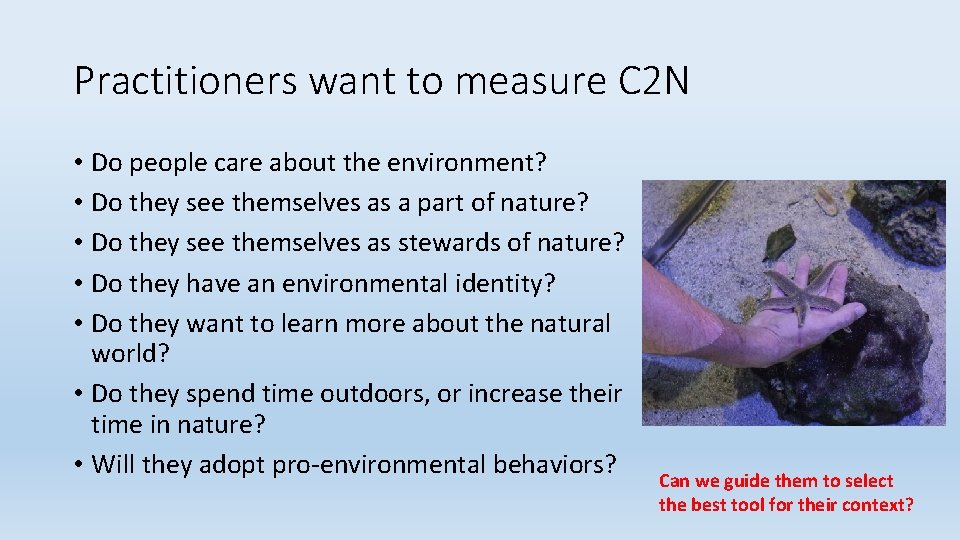
Practitioners want to measure C 2 N • Do people care about the environment? • Do they see themselves as a part of nature? • Do they see themselves as stewards of nature? • Do they have an environmental identity? • Do they want to learn more about the natural world? • Do they spend time outdoors, or increase their time in nature? • Will they adopt pro-environmental behaviors? Can we guide them to select the best tool for their context?
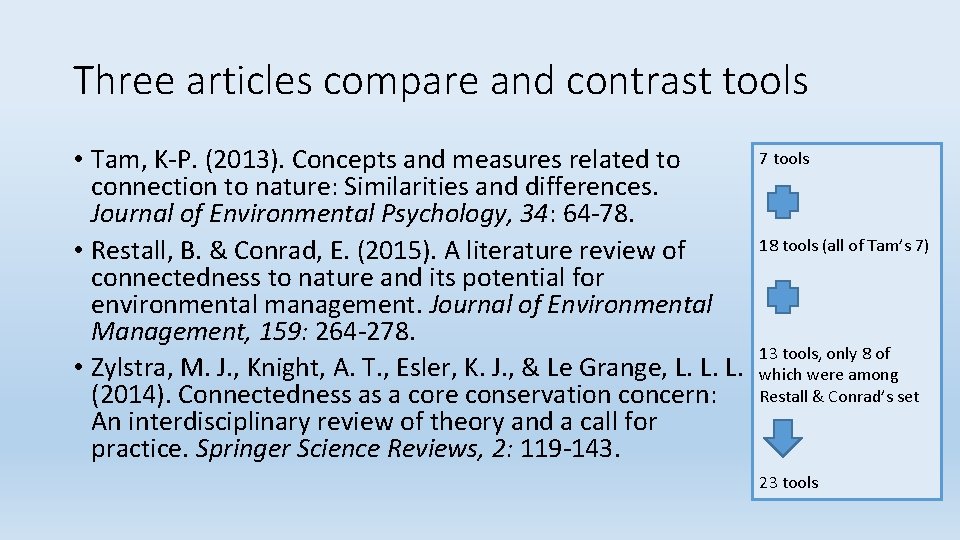
Three articles compare and contrast tools • Tam, K-P. (2013). Concepts and measures related to connection to nature: Similarities and differences. Journal of Environmental Psychology, 34: 64 -78. • Restall, B. & Conrad, E. (2015). A literature review of connectedness to nature and its potential for environmental management. Journal of Environmental Management, 159: 264 -278. • Zylstra, M. J. , Knight, A. T. , Esler, K. J. , & Le Grange, L. L. L. (2014). Connectedness as a core conservation concern: An interdisciplinary review of theory and a call for practice. Springer Science Reviews, 2: 119 -143. 7 tools 18 tools (all of Tam’s 7) 13 tools, only 8 of which were among Restall & Conrad’s set 23 tools
These tools are paper/pencil tools • Vast majority are surveys with agree-disagree scales • A few frequency or truthfulness scales • A few written tests • And a few use the seven pairs of overlapping circles (inclusion in nature)
So we found a few more • An interview guide • A puppet show • Photographs and journaling records
Surveyed practitioners • Over 1000 respondents from the NAAEE and C&NN lists • Do they develop programs or desire to measure connection to nature? • What tools do they currently use? • What aspects of connection to nature do they wish to measure?
Our plan • Host a workshop of authors, users, researchers to discuss the tools • October 6 -7, 2018 in Spokane WA • Organize the tools by the purposes needed by practitioners • Identify: • Which tools can be used for what purposes in which contexts? • What small tweaks might help extend the usefulness of existing tools? • What research questions should be answered in time?
Intended Outputs • Guide for practitioners • Which tools for what purpose • Team graduate students with practitioners to answer “miniresearch questions” to test tweaks • Report on findings at NAAEE’s Research Symposium in 2019 • Publish a list of needs for future researchers