
Exploring sphericalwave reflection coefficients Chuck Ursenbach Arnim Haase
“Exploring” spherical-wave reflection coefficients Chuck Ursenbach Arnim Haase Research Report: Ursenbach & Haase, “An efficient method for calculating spherical-wave reflection coefficients”
Outline • • • Motivation: Why spherical waves? Theory: How to calculate efficiently Application: Testing exponential wavelet Analysis: What does the calculation “look” like? Deliverable: The Explorer Future Work: Possible directions
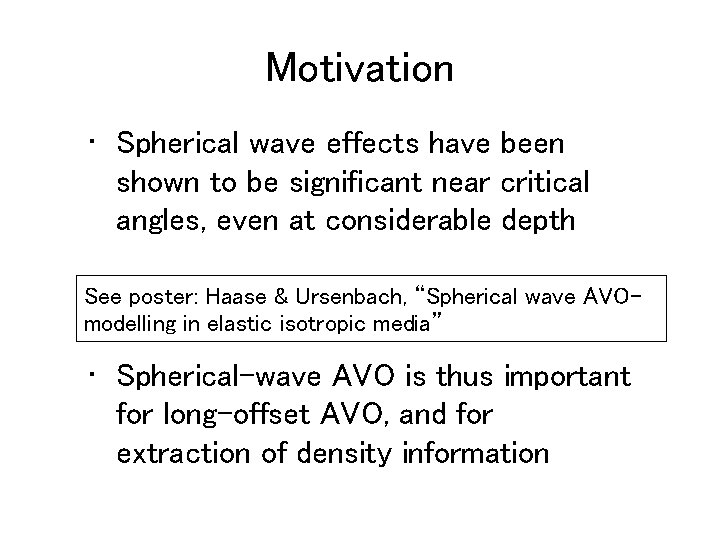
Motivation • Spherical wave effects have been shown to be significant near critical angles, even at considerable depth See poster: Haase & Ursenbach, “Spherical wave AVOmodelling in elastic isotropic media” • Spherical-wave AVO is thus important for long-offset AVO, and for extraction of density information
Outline • • • Motivation: Why spherical waves? Theory: How to calculate efficiently Application: Testing exponential wavelet Analysis: What does the calculation “look” like? Deliverable: The Explorer Future Work: Possible directions
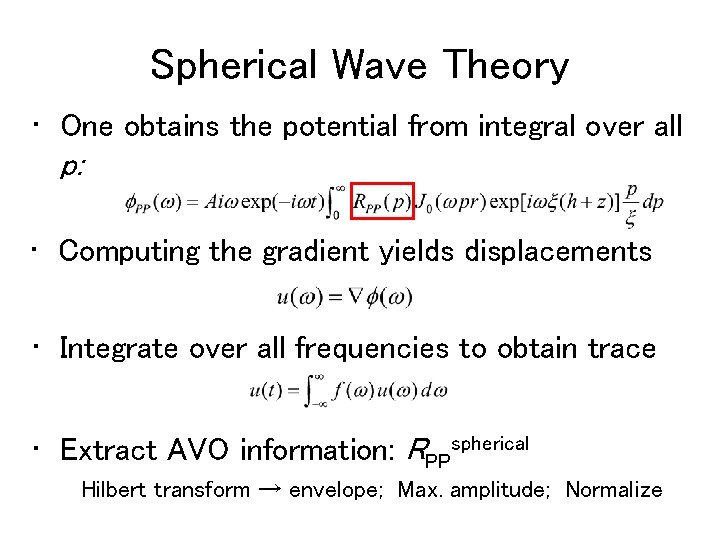
Spherical Wave Theory • One obtains the potential from integral over all p: • Computing the gradient yields displacements • Integrate over all frequencies to obtain trace • Extract AVO information: RPPspherical Hilbert transform → envelope; Max. amplitude; Normalize

Alternative calculation route
Outline • • • Motivation: Why spherical waves? Theory: How to calculate efficiently Application: Testing exponential wavelet Analysis: What does the calculation “look” like? Deliverable: The Explorer Future Work: Possible directions
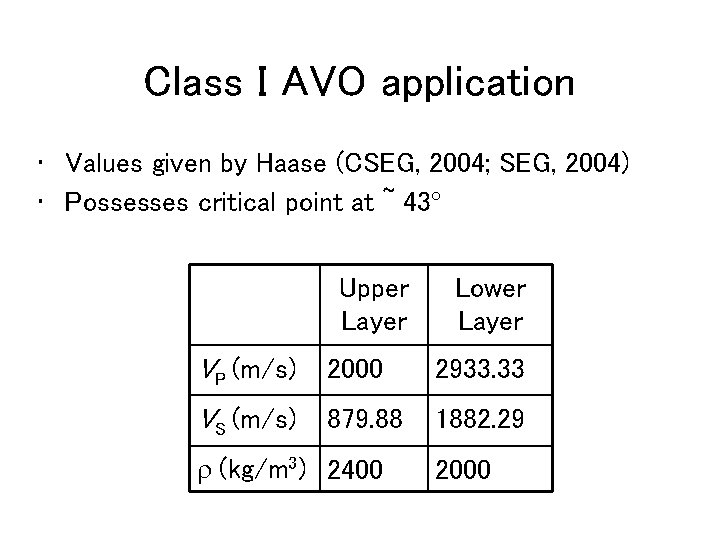
Class I AVO application • Values given by Haase (CSEG, 2004; SEG, 2004) • Possesses critical point at ~ 43 Upper Layer Lower Layer VP (m/s) 2000 2933. 33 VS (m/s) 879. 88 1882. 29 r (kg/m 3) 2400 2000
![Test of method for f (n) = n 4 exp( [. 173 Hz-1]n)](http://slidetodoc.com/presentation_image_h2/4bd9e6e3485ec08aebd3ff8a17e31349/image-9.jpg "Test of method for f (n) = n 4 exp( [. 173 Hz-1]n)")
Test of method for f (n) = n 4 exp( [. 173 Hz-1]n)

Wavelet comparison
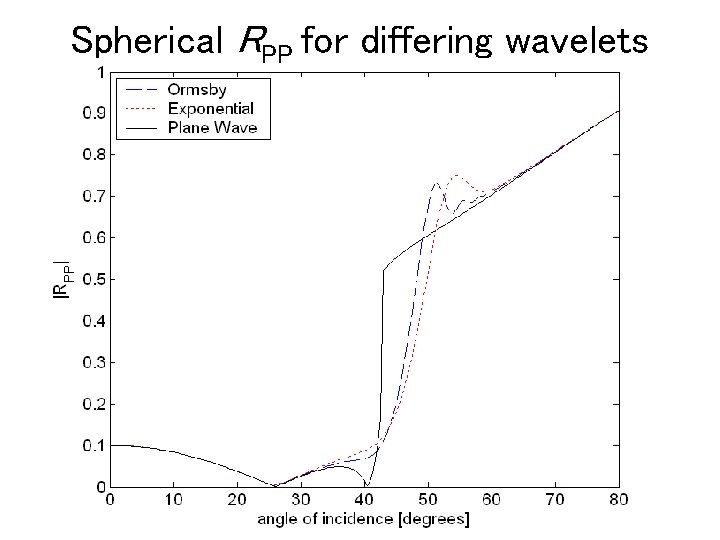
Spherical RPP for differing wavelets
Outline • • • Motivation: Why spherical waves? Theory: How to calculate efficiently Application: Testing exponential wavelet Analysis: What does the calculation “look” like? Deliverable: The Explorer Future Work: Possible directions
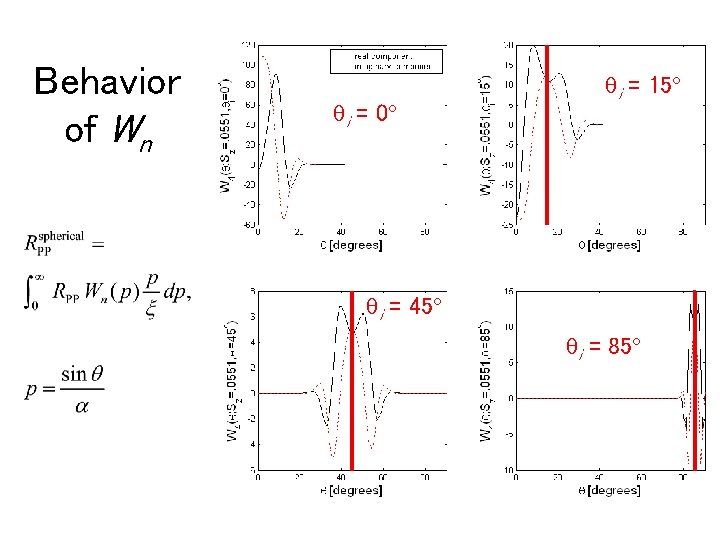
Behavior of Wn qi = 0 qi = 15 qi = 45 qi = 85
Outline • • • Motivation: Why spherical waves? Theory: How to calculate efficiently Application: Testing exponential wavelet Analysis: What does the calculation “look” like? Deliverable: The Explorer Future Work: Possible directions
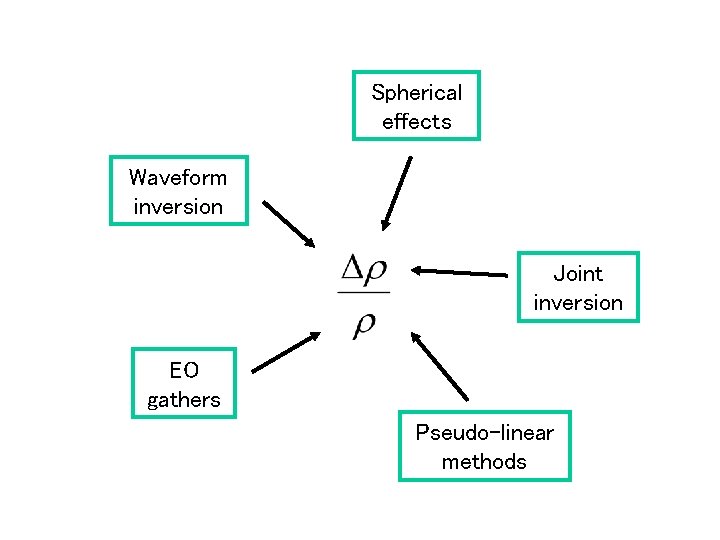
Spherical effects Waveform inversion Joint inversion EO gathers Pseudo-linear methods
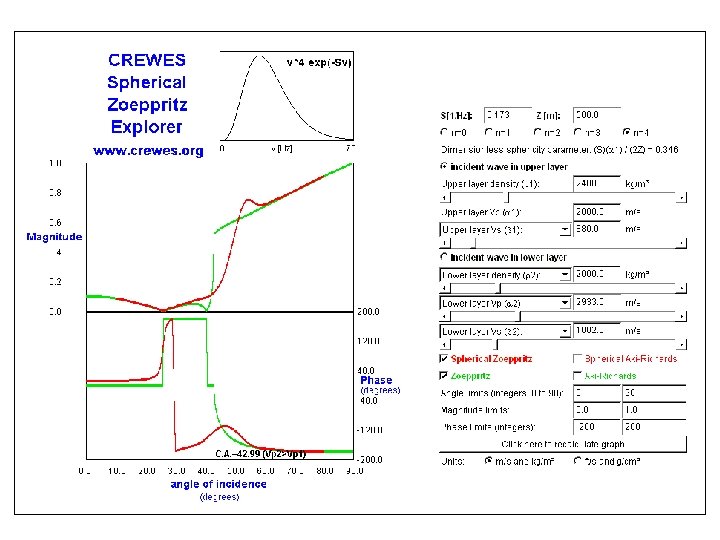
Conclusions • RPPsph can be calculated semi-analytically with appropriate choice of wavelet • Spherical effects are qualitatively similar for wavelets with similar lower bounds • New method emphasizes that RPPsph is a weighted integral of nearby RPPpw • Calculations are efficient enough for incorporation into interactive explorer • May help to extract density information from AVO
Possible Future Work • Include n > 4 • Use multi-term wavelet: Sn An wn exp(-|snw|) • Layered overburden (effective depth, non-sphericity) • Include cylindrical wave reflection coefficients • Extend to PS reflections
Acknowledgments The authors wish to thank the sponsors of CREWES for financial support of this research, and Dr. E. Krebes for careful review of the manuscript.
- Slides: 19