
Exploring Scaffolded Silent Reading Sc SR Effective Practice




- Slides: 63
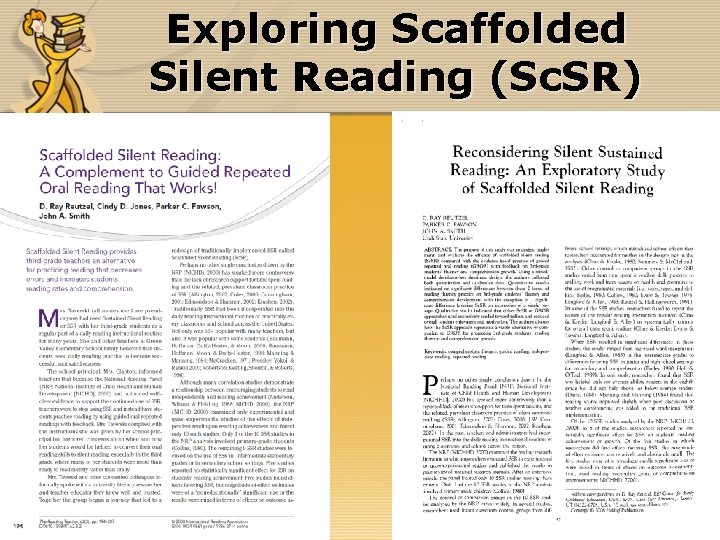
Exploring Scaffolded Silent Reading (Sc. SR) : Effective Practice for Increasing Reading Fluency and Comprehension Reutzel, D. R. , Jones, C. D. , Fawson, P. C. , & Smith, J. A. (2008). Scaffolded Silent Reading (Sc. SR): An Alternative to Guided Oral Repeated Reading that Works! The Reading Teacher, 62 (3), pp. 194 -207 Reutzel, D. R. , Fawson, P. C. , & Smith, J. A. (2008). Reconsidering Silent Sustained Reading: An Exploratory Study of Scaffolded Silent Reading (Sc. SR). Journal of Educational Research, 102(2), pp. 37 -50.
Exploring Scaffolded Silent Reading (Sc. SR)
What happened to Silent Reading Practice? • The National Reading Panel (NRP, 2000) found substantial numbers of studies that showed a correlation between volume reading and reading achievement. • The National Reading Panel (NRP, 2000) failed to find sufficient converging evidence to recommend independent reading as an evidencebased.
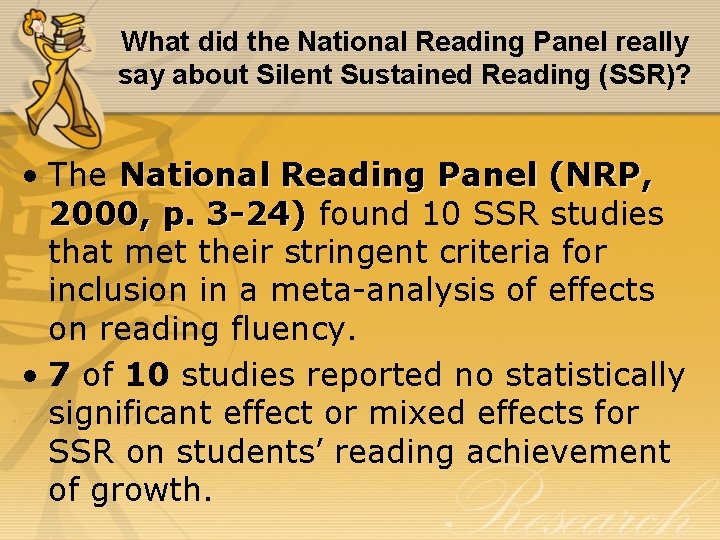
What did the National Reading Panel really say about Silent Sustained Reading (SSR)? • The National Reading Panel (NRP, 2000, p. 3 -24) found 10 SSR studies that met their stringent criteria for inclusion in a meta-analysis of effects on reading fluency. • 7 of 10 studies reported no statistically significant effect or mixed effects for SSR on students’ reading achievement of growth.
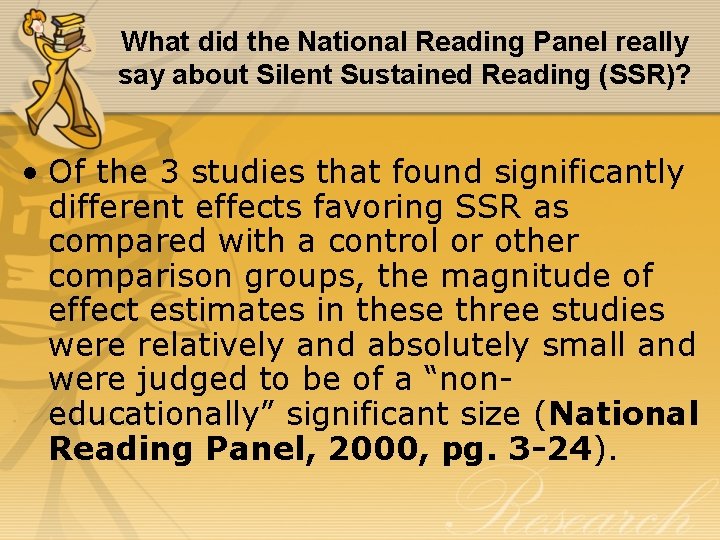
What did the National Reading Panel really say about Silent Sustained Reading (SSR)? • Of the 3 studies that found significantly different effects favoring SSR as compared with a control or other comparison groups, the magnitude of effect estimates in these three studies were relatively and absolutely small and were judged to be of a “noneducationally” significant size (National Reading Panel, 2000, pg. 3 -24).
Why didn’t SSR work very well as a way to practice reading effectively for fluency? • One of the concerns and criticisms surrounding traditionally implemented SSR focused upon the conspicuous absence of teacher and student interactions around the reading of texts.
Why didn’t SSR work very well as a way to practice reading effectively for fluency? • Stahl (2004, p. 206 ) noted that, “Many SSR advocates do not allow teachers to check up on children or recommend that teachers read their own books during this time to be a model of a reader. ” • Manning & Manning (1984) found that coupling SSR with peer discussions or teacher conferences led to improvements in reading achievement compared to a control group.
Why didn’t SSR work very well as a way to practice reading effectively for fluency? • Teachers were led to believe that reading a book silently constituted modeling the reading process when, in fact, the effectiveness of modeling the behaviors of a silent, engaged “reader” has never been established.
Why didn’t SSR work very well as a way to practice reading effectively for fluency? • Teacher modeling of “silent reading behaviors” without discussing, interacting, and explaining the processes of how one accomplishes the reading of a text is largely invisible for many young and struggling readers.
Why didn’t SSR work very well as a way to practice reading effectively for fluency? • Steven Stahl contended that (2004, p. 206), “One failing of SSR is that teachers may not monitor their students’ reading…”
Why didn’t SSR work very well as a way to practice reading effectively for fluency? • Bryan, Fawson & Reutzel (2003) demonstrated that when classroom teachers monitored their students’ silent reading during SSR using brief interactions and accountability conferences that the even the most disengaged students in the class remained on task for up to three weeks without additional monitoring visits.
Why didn’t SSR work very well as a way to practice reading effectively for fluency? • Allowing choice of reading materials increases student motivation (Guthrie & Wigfield, 1997). BUT unguided choice can often lead to students selecting inappropriately difficult books for reading practice (Donovan, Smolkin, and Lomax, 2000; Fresch, 1995).
Why didn’t SSR work very well as a way to practice reading effectively for fluency? • The National Reading Panel (NRP, 2000) found another feature of effective reading practice involved students’ receiving feedback about their reading.
Why didn’t SSR work very well as a way to practice reading effectively for fluency? • In summary, the implementation of traditional SSR in elementary classrooms has been roundly criticized for teachers failing to teach, monitor, interact with, and hold students accountable for their time spent in reading practice.
What is Scaffolded Silent Reading (Sc. SR)? • Scaffolded Silent Reading (Sc. SR) is silent reading practice that redesigns practice conditions to deal affirmatively with past concerns and criticisms surrounding traditionally implemented Silent Sustained Reading (SSR).
What is Scaffolded Silent Reading (Sc. SR)? • Sc. SR is intended to provide students with necessary support, guidance, structure, appropriate text difficulty, accountability, and monitoring that will assist them in transferring their oral reading skills to successful and effective silent reading practice.
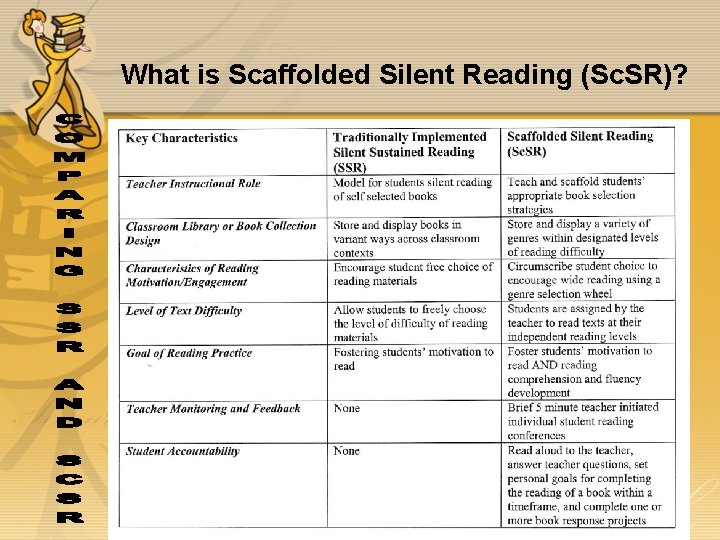
What is Scaffolded Silent Reading (Sc. SR)?
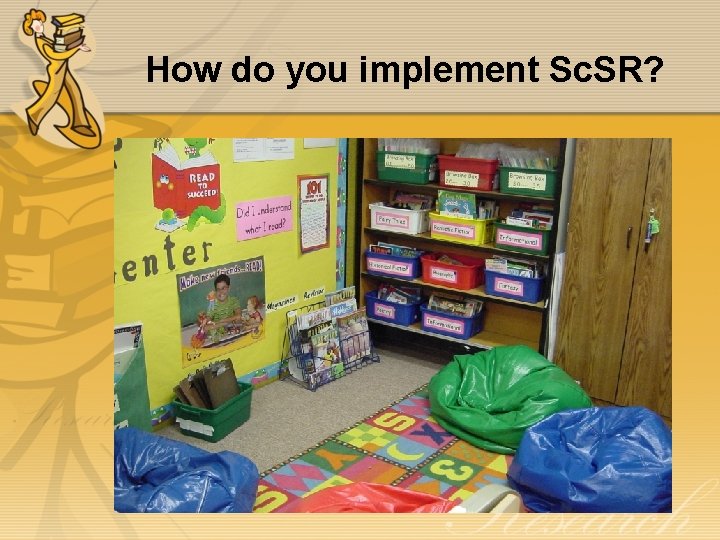
How do you implement Sc. SR? 1. Arrange the classroom library to support and guide children’s book reading choices toward appropriately challenging books. Place reading materials of differing reading levels into clearly labeled shelves or plastic bins representing differing levels of reading difficulty.
How do you implement Sc. SR? 2. Color code the difficulty levels of books within the classroom library using different colors of cloth tape on the book binding or using stickers in the upper right hand corners of the covers.
How do you implement Sc. SR?
How do you implement Sc. SR? 3. Since children receive less frequent feedback and support in Sc. SR than in other forms of reading practice like guided oral repeated readings with feedback, children practice reading texts they can process accurately and effortlessly at their independent reading levels (Stahl & Heubach, 2006).
How do you implement Sc. SR? • Teach a series of explicit book selection strategy lessons including: 1) orient students to the classroom library, 2) give book talks to hook children on books, 3) select a “just right” or appropriately leveled book from the classroom library, 4) select books from a variety of genres in the classroom library, 5) confirm selections of appropriate difficulty levels using the “three finger” rule.
How do you implement Sc. SR? • • • Example Lesson: Selecting an Appropriate Independent Level Book from the Classroom Library Objective: To help students learn the location and organization for leveled books in the classroom library, as well as to demonstrate the use of the “Greasy Fingers” strategy for evaluating the appropriate difficulty of a book. Needed Supplies: Different colored dots on the covers of the books Different colored plastic bins or book storage boxes A poster showing the names of students and the colors of books that are their individual independent reading levels A strategy poster for using the “Greasy Fingers” technique to evaluate the difficulty of a book.
How do you implement Sc. SR? Example Lesson: Selecting an Appropriate Independent Level Book from the Classroom Library • Explanation: Tell the children that soon they will be allowed to select books from the classroom library for their own reading, but before doing so they need to learn about how the classroom library is organized to support their book selections. Today they will be learning about the way the different levels of books are arranged and stored in the classroom library.
How do you implement Sc. SR? Example Lesson: Selecting an Appropriate Independent Level Book from the Classroom Library Continued • Modeling: Seat the children in and around the classroom library so they can see the shelves. Show them the poster with their names on the poster and the level of books that represent their independent levels. Each level of book is represented by a different colored dot on the poster that matches with the color of dots on the book storage bins and on the books inside the bins.
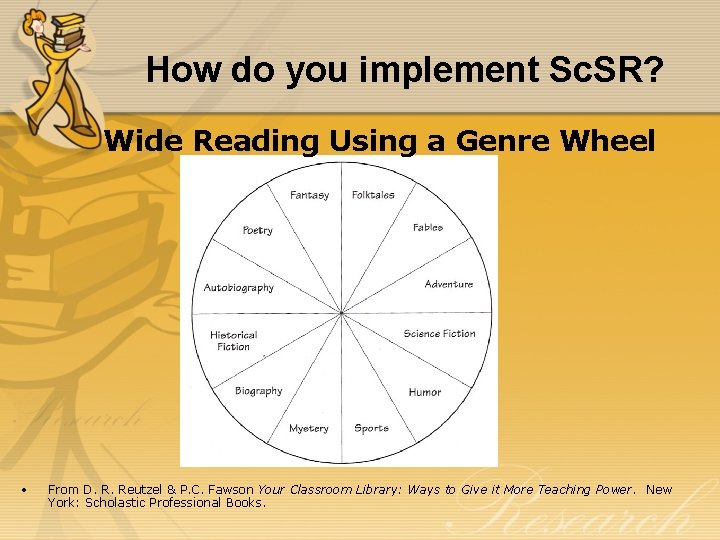
How do you implement Sc. SR? Example Lesson: Selecting an Appropriate Independent Level Book from the Classroom Library Continued • Modeling: Demonstrate how if you were one of the children (pick a name) you would look at the poster showing your name and independent reading level colored dot. Next, show where that color of bin(s) is located on the library shelves. Then show them how that each book also has a colored dot that is the same as on the outside of the bin. Remind them that they are to choose a book that represents one of the genres in the Genre Wheel. Demonstrate how you might select a book about Babe Ruth in the bin as an example of a biography.
How do you implement Sc. SR? Example Lesson: Selecting an Appropriate Independent Level Book from the Classroom Library Continued • Teach children the "three finger" rule. This rule is described by Allington (2001) and involves children in marking with three fingers of one hand the words they don't recognize on a page of print. If there are three or more unrecognized words marked by the fingers on a page of print, the text is considered to be too difficult.
How do you implement Sc. SR? Example Lesson: Selecting an Appropriate Independent Level Book from the Classroom Library Continued • Teach: Show them the “three finger” strategy poster and model reading aloud a single page from the Babe Ruth book. Show them how many words on the page you did not know. If you placed more three fingers on this page, then you should choose another book either from this level or ask the teacher for another book level color you might select from that would be a bit easier.
How do you implement Sc. SR? Selecting an Appropriate Independent Level Book from the Classroom Library Continued • Application: Continue modeling with the help of one to two children role playing the selection of an appropriately leveled book with decreasing amounts of guidance from you. Tell the children you will be allowing them the opportunity to go to the classroom library to select an appropriately leveled reading book one at a time. This will be their chance to show that they have listened and understand what you have taught them before they can actually go to the classroom library on their own in the future.
How do you implement Sc. SR? Selecting an Appropriate Independent Level Book from the Classroom Library Continued • Monitoring for Success: Monitor each child’s book selection levels and their ability to use the “ 3 finger rule” for selecting a book.
How do you implement Sc. SR? • Wide Reading: Oral wide reading from a variety of literary genres increases motivation, fluency, and comprehension (Stahl, 2004; Kuhn, 2005).
How do you implement Sc. SR? Wide Reading Using a Genre Wheel • From D. R. Reutzel & P. C. Fawson Your Classroom Library: Ways to Give it More Teaching Power. New York: Scholastic Professional Books.
How do you implement Sc. SR? 5. Sc. SR time begins with a short, 58 minute, teacher explanation and modeling of 1) an aspect or element of fluent reading and/or 2) how to apply a comprehension strategy during reading using a teacher selected text.
How do you implement Sc. SR? 6. Following this brief lesson, children are dismissed from the group to select a new book or retrieve a previously selected book from the classroom library.
How do you implement Sc. SR? 7. Provide approximately 20 minutes reading practice time each day. 8. During reading practice time, the teacher conducts Individual Monitoring Conferences (IMCs).
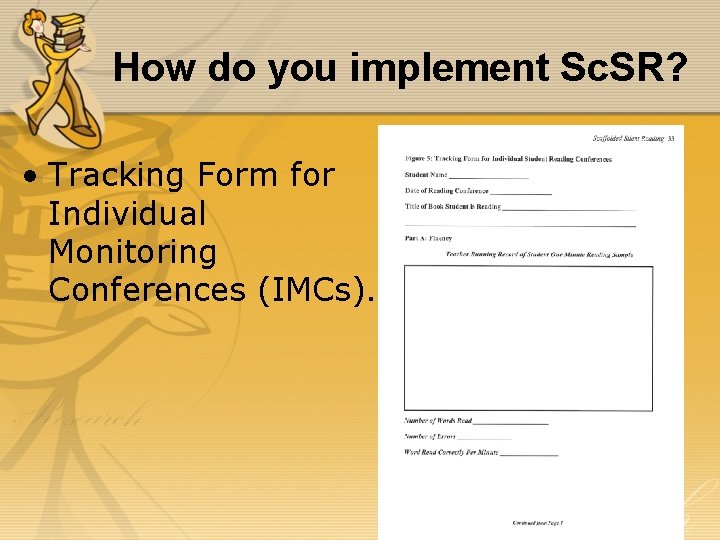
How do you implement Sc. SR? Individual Monitoring Conferences (IMCs) include the following: • Children are asked to read aloud from their book while the teacher records a running record analysis of their reading. • After reading aloud for 1 -2 minutes, the teacher initiates a discussion with each student about the book. The child is asked to retell what they read aloud.
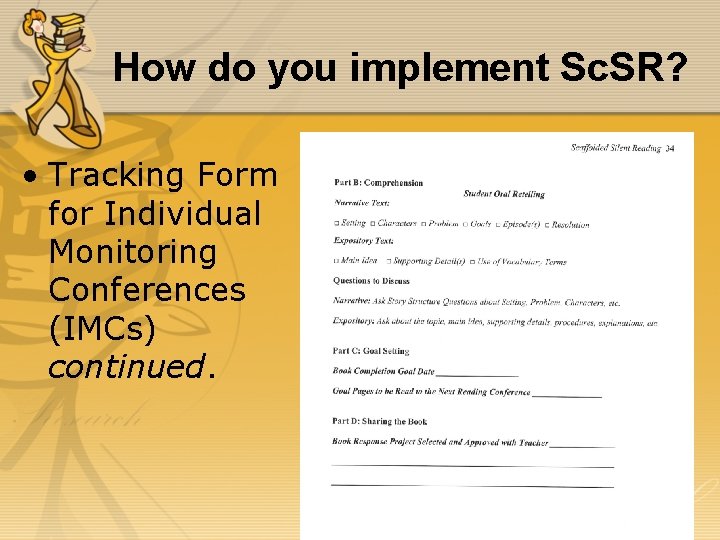
How do you implement Sc. SR? Individual Monitoring Conferences (IMCs) include the following: • Follow up with general story structure questions if the book is a narrative. If the book is about information, ask students to explain the information or answer questions about facts related to the topic of the book. This is a brief discussion of about 2 minutes.
How do you implement Sc. SR? • Individual Monitoring Conferences (IMCs) include the following: • Finally during each IMC, ask each child to set a goal for a date to finish the book and select how they will share what the book is about from a displayed menu of “book response projects”
How do you implement Sc. SR? • Tracking Form for Individual Monitoring Conferences (IMCs).
How do you implement Sc. SR? • Tracking Form for Individual Monitoring Conferences (IMCs) continued.
How do you implement Sc. SR? • Conducting IMCs with 4 -5 students per day ensures that children are engaged and accountable for the time spent reading silently (Stahl, 2004).
How do you implement Sc. SR? 9. At the end of the Sc. SR time, children quietly return their books and reading folders to their places around the classroom or in the classroom library. 10. Quickly transition to the next part of the daily routine.
What is the evidence for Sc. SR? • To determine the effectiveness of Sc. SR, we conducted a year long controlled experiment in which the effectiveness of Sc. SR was compared to the NRP’s (2000) recommended form of reading practice – guided repeated oral reading with feedback (GROR).
What is the evidence for Sc. SR? • The study involved four classrooms, four third-grade teachers, and 72 randomly assigned third-grade children.
What is the evidence for Sc. SR? • The teachers rotated through teaching both treatments (Sc. SR & GROR) during the school year to control for teacher effects.
What is the evidence for Sc. SR? • The schools in which the study was conducted were designated high poverty, low performing schools with approximately 35 -50% diversity (African-American, Asian, and Hispanic) with over half of the children in the schools qualifying for free or reduced lunch.
What is the evidence for Sc. SR? • Reading rate and accuracy were calculated using a words correct per minute (wcpm) metric and 3 rd grade reading passages drawn from the 3 rd Grade DIBELS Oral Reading Fluency Test (ORF). • Reading expression was judged using the Multi-dimensional Fluency Scale (MFS)
What is the evidence for Sc. SR? • Statistical comparisons of students’ pretest passage mean scores for accuracy, rate, expression and comprehension confirmed no significant initial (pretest) differences between the two groups (Sc. SR and GROR) on fluency or comprehension.
What is the evidence for Sc. SR? • Statistical comparisons using gain scores of students’ pretest and post test passage mean scores for accuracy, rate, expression and comprehension confirmed no significant differences between the two groups (Sc. SR and GROR) on fluency or comprehension except for expression on one passage which favored the Sc. SR group.
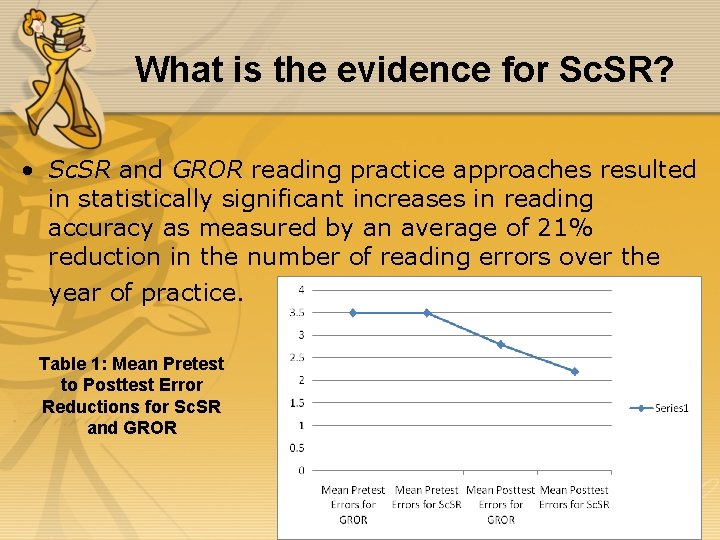
What is the evidence for Sc. SR? • Sc. SR and GROR reading practice approaches resulted in statistically significant increases in reading accuracy as measured by an average of 21% reduction in the number of reading errors over the year of practice. Table 1: Mean Pretest to Posttest Error Reductions for Sc. SR and GROR
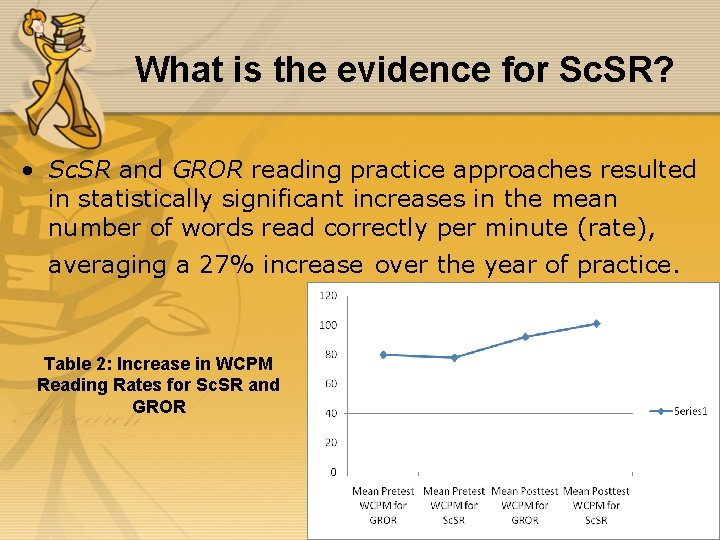
What is the evidence for Sc. SR? • Sc. SR and GROR reading practice approaches resulted in statistically significant increases in the mean number of words read correctly per minute (rate), averaging a 27% increase over the year of practice. Table 2: Increase in WCPM Reading Rates for Sc. SR and GROR
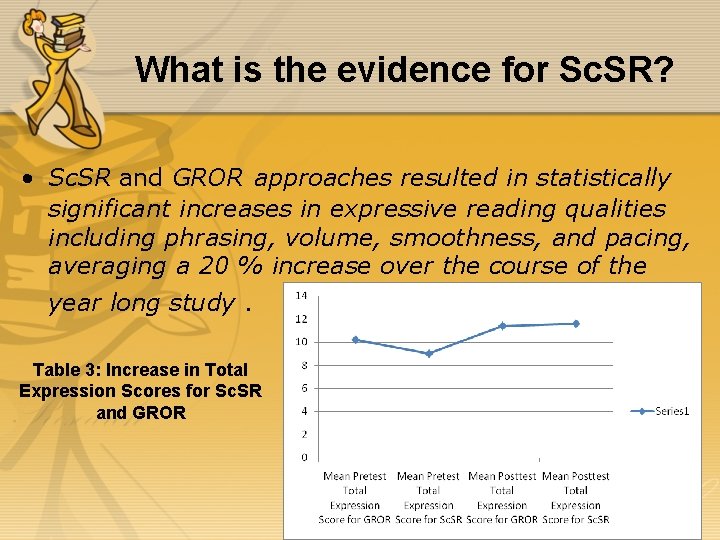
What is the evidence for Sc. SR? • Sc. SR and GROR approaches resulted in statistically significant increases in expressive reading qualities including phrasing, volume, smoothness, and pacing, averaging a 20 % increase over the course of the year long study. Table 3: Increase in Total Expression Scores for Sc. SR and GROR
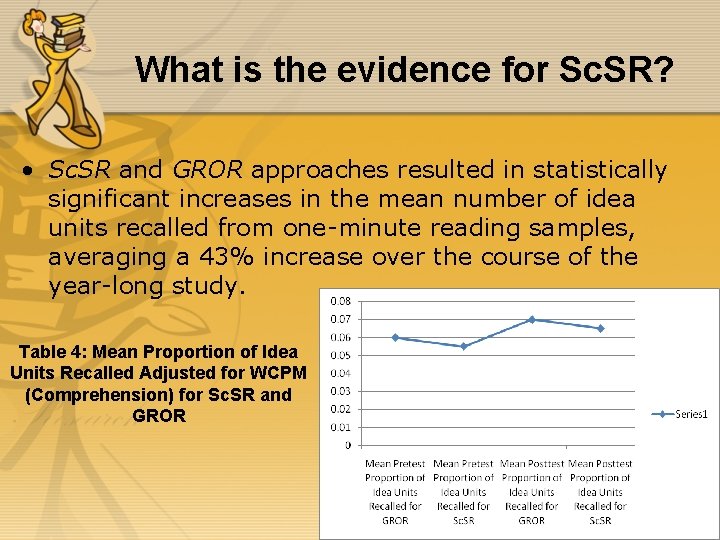
What is the evidence for Sc. SR? • Sc. SR and GROR approaches resulted in statistically significant increases in the mean number of idea units recalled from one-minute reading samples, averaging a 43% increase over the course of the year-long study. Table 4: Mean Proportion of Idea Units Recalled Adjusted for WCPM (Comprehension) for Sc. SR and GROR
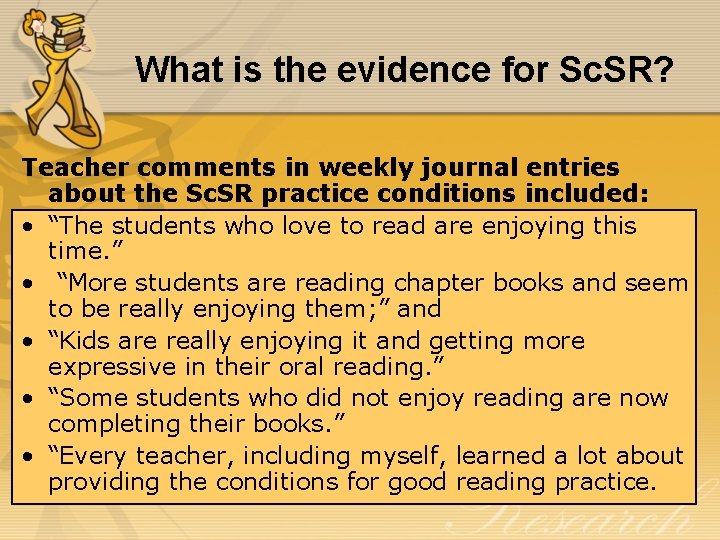
What is the evidence for Sc. SR? Teacher comments in weekly journal entries about the Sc. SR practice conditions included: • “The students who love to read are enjoying this time. ” • “More students are reading chapter books and seem to be really enjoying them; ” and • “Kids are really enjoying it and getting more expressive in their oral reading. ” • “Some students who did not enjoy reading are now completing their books. ” • “Every teacher, including myself, learned a lot about providing the conditions for good reading practice.
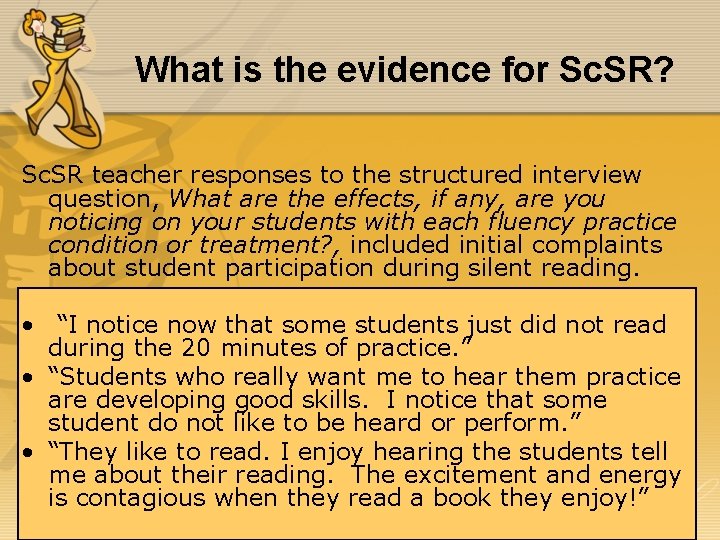
What is the evidence for Sc. SR? Sc. SR teacher responses to the structured interview question, What are the effects, if any, are you noticing on your students with each fluency practice condition or treatment? , included initial complaints about student participation during silent reading. • “I notice now that some students just did not read during the 20 minutes of practice. ” • “Students who really want me to hear them practice are developing good skills. I notice that some student do not like to be heard or perform. ” • “They like to read. I enjoy hearing the students tell me about their reading. The excitement and energy is contagious when they read a book they enjoy!”
What are the conditions for effective reading practice? • Regular engagement with print (Topping, 2006).
What are the conditions for effective reading practice? • The issue of appropriate text difficulty is far from settled. Where little support or scaffolding is provided to students, the text level for practice should be easier. On the other hand, when support or scaffolding is readily available, then students can benefit from reading much more difficult text (Stahl & Heubach, 2006).
What are the conditions for effective reading practice? • What mattered was that monitoring and feedback were provided - either by the teacher in Sc. SR, or other students and the teacher in GROR.
What are the conditions for effective reading practice? • Allocated practice time is insufficient to guarantee student engagement, BUT it is nevertheless foundational.
What Can We Conclude about Sc. SR? • In summary, Sc. SR reading practice approach was systematically designed to address acknowledged weaknesses in past implementations of traditional SSR reading practice.
What Can We Conclude about Sc. SR? Some weaknesses included: • no teacher guidance for students about how to select appropriately challenging texts to read; • poor monitoring of students during the time allocated for reading practice; • little or no teacher interaction with students around reading texts; and • no student accountability, purposes, or goals for the time spent in reading practice.
What Can We Conclude about Sc. SR? CONCLUSION • The findings of this study argue that Scaffolded Silent Reading (Sc. SR) is an equally effective, complementary practice to the scientific-based, recommended reading practice method of Guided Repeated Oral Reading (GROR) with feedback for this group of third-grade students.
If you want more information please contact: D. Ray Reutzel, Ph. D. Emma Eccles Jones Professor Utah State University www. cehs. usu. edu/ecc Presentations Button Left Hand Side or IRA Board of Directors International Reading Association rreutzel@reading. org