
EXPLORING PSYCHOLOGY 7 th Edition in Modules David
- Slides: 25
EXPLORING PSYCHOLOGY (7 th Edition in Modules) David Myers Power. Point Slides Aneeq Ahmad Henderson State University Worth Publishers, © 2008
Classical Conditioning Module 26
Learning How Do We Learn? Classical Conditioning § Pavlov’s Experiments § Extending Pavlov’s Understanding § Pavlov’s Legacy
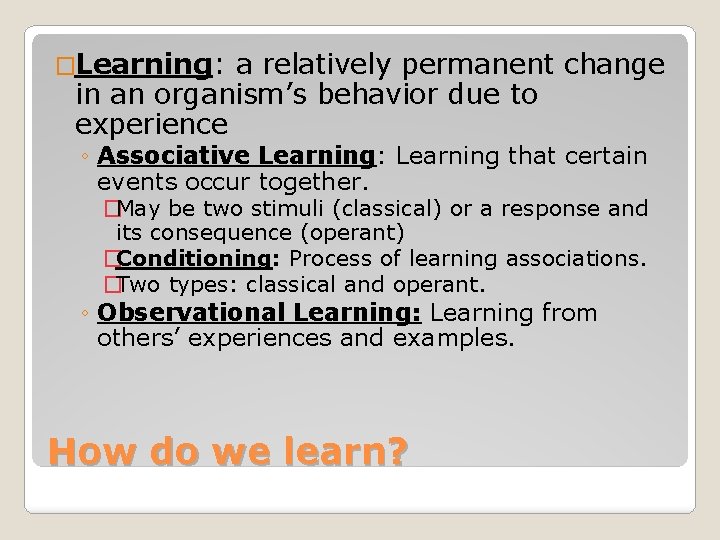
�Learning: a relatively permanent change in an organism’s behavior due to experience ◦ Associative Learning: Learning that certain events occur together. �May be two stimuli (classical) or a response and its consequence (operant) �Conditioning: Process of learning associations. �Two types: classical and operant. ◦ Observational Learning: Learning from others’ experiences and examples. How do we learn?
�The Office: Classical Conditioning
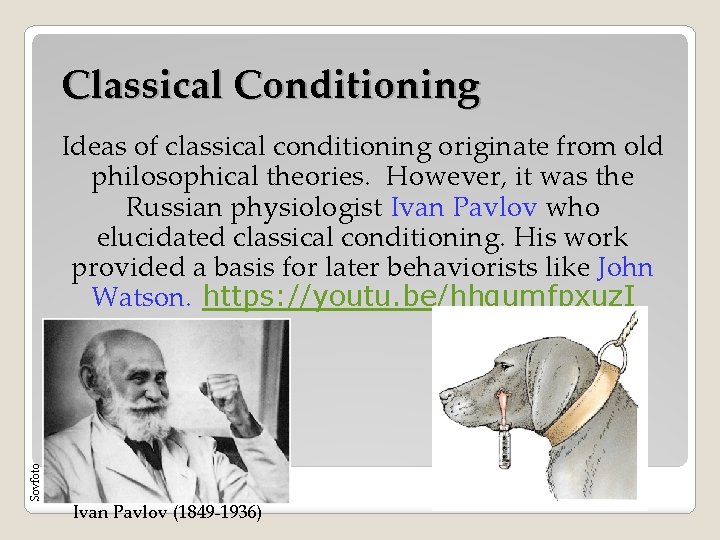
Classical Conditioning Sovfoto Ideas of classical conditioning originate from old philosophical theories. However, it was the Russian physiologist Ivan Pavlov who elucidated classical conditioning. His work provided a basis for later behaviorists like John Watson. https: //youtu. be/hhqumfpxuz. I Ivan Pavlov (1849 -1936)
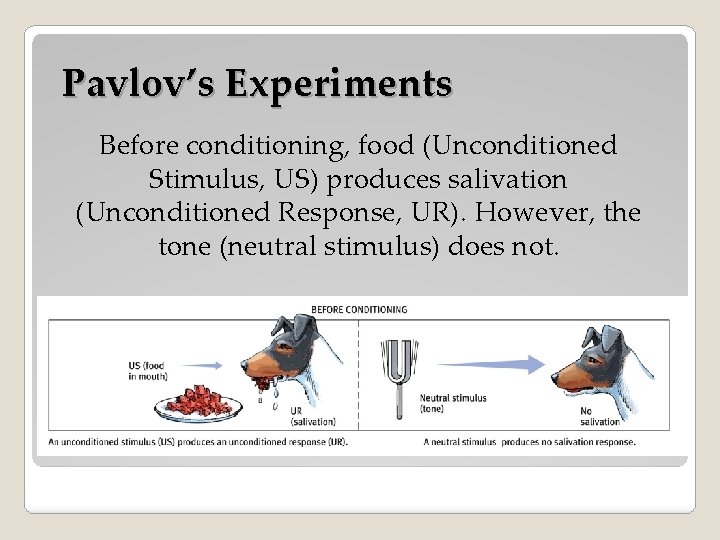
Pavlov’s Experiments Before conditioning, food (Unconditioned Stimulus, US) produces salivation (Unconditioned Response, UR). However, the tone (neutral stimulus) does not.
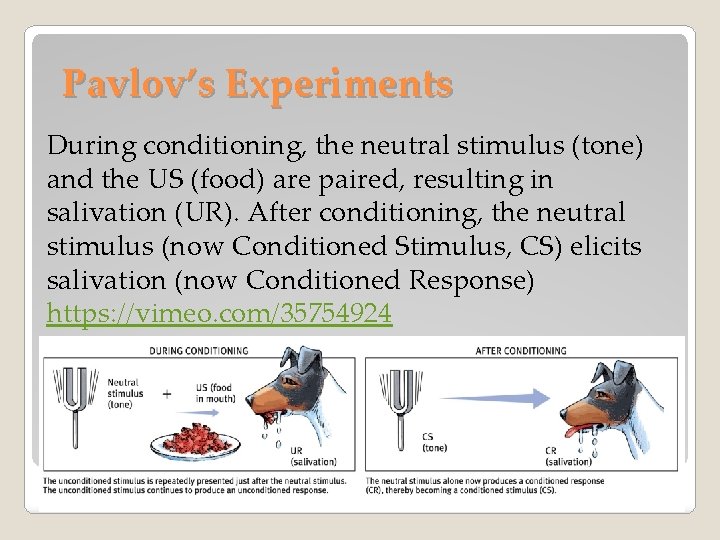
Pavlov’s Experiments During conditioning, the neutral stimulus (tone) and the US (food) are paired, resulting in salivation (UR). After conditioning, the neutral stimulus (now Conditioned Stimulus, CS) elicits salivation (now Conditioned Response) https: //vimeo. com/35754924 esponse) nse, CR)
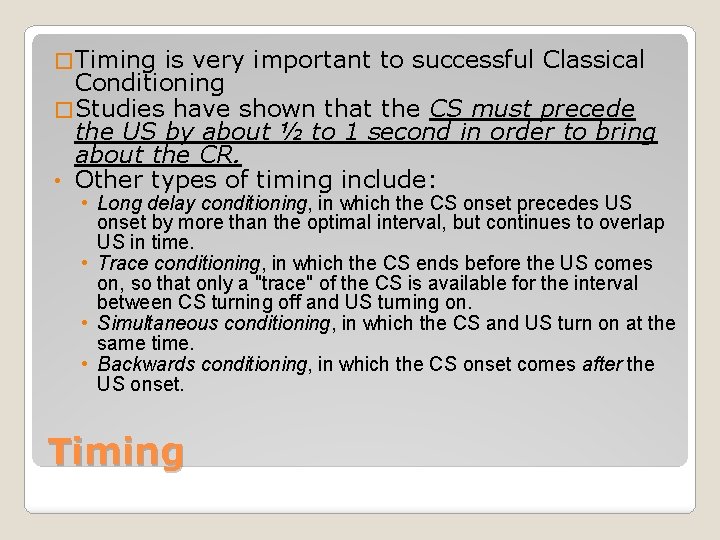
� Timing is very important to successful Classical Conditioning � Studies have shown that the CS must precede the US by about ½ to 1 second in order to bring about the CR. • Other types of timing include: • Long delay conditioning, in which the CS onset precedes US onset by more than the optimal interval, but continues to overlap US in time. • Trace conditioning, in which the CS ends before the US comes on, so that only a "trace" of the CS is available for the interval between CS turning off and US turning on. • Simultaneous conditioning, in which the CS and US turn on at the same time. • Backwards conditioning, in which the CS onset comes after the US onset. Timing
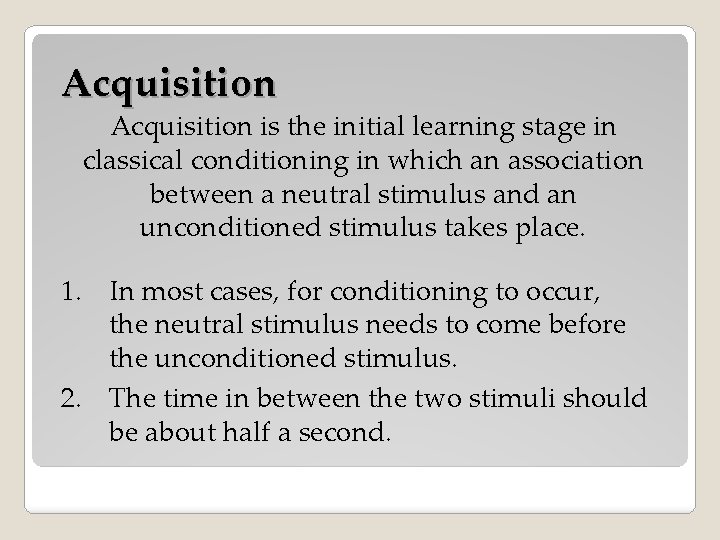
Acquisition is the initial learning stage in classical conditioning in which an association between a neutral stimulus and an unconditioned stimulus takes place. 1. In most cases, for conditioning to occur, the neutral stimulus needs to come before the unconditioned stimulus. 2. The time in between the two stimuli should be about half a second.
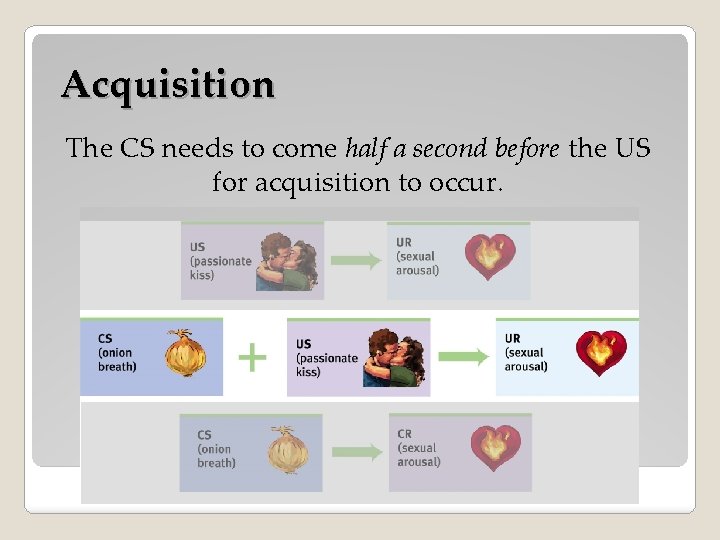
Acquisition The CS needs to come half a second before the US for acquisition to occur.
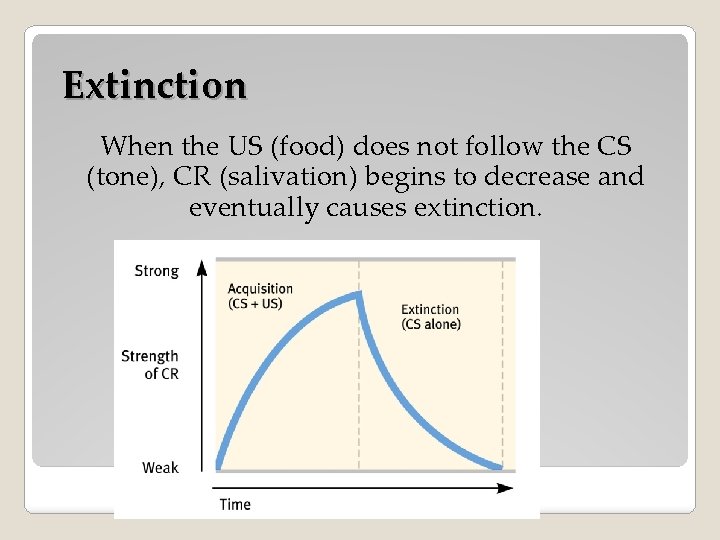
Extinction When the US (food) does not follow the CS (tone), CR (salivation) begins to decrease and eventually causes extinction.
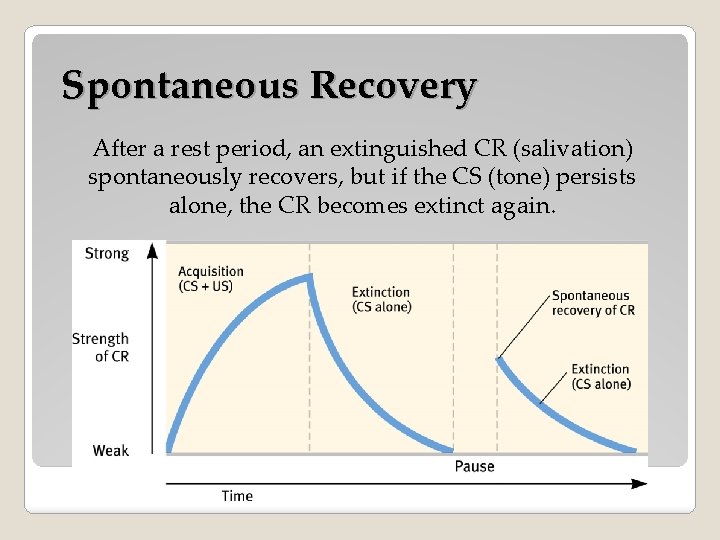
Spontaneous Recovery After a rest period, an extinguished CR (salivation) spontaneously recovers, but if the CS (tone) persists alone, the CR becomes extinct again.
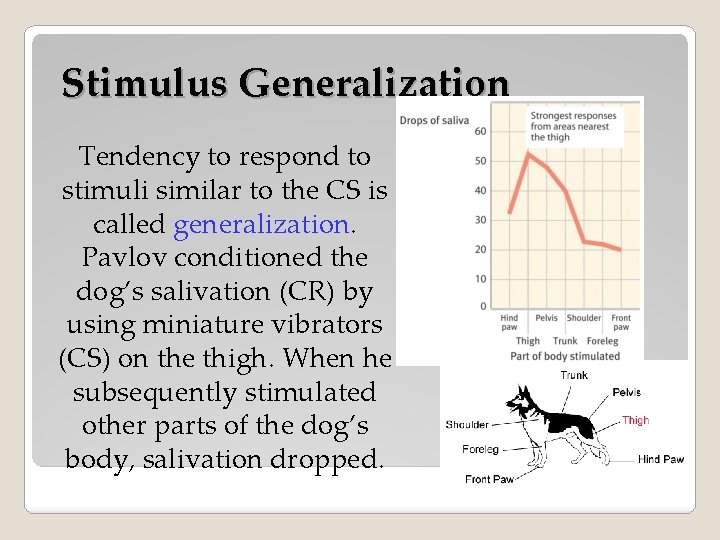
Stimulus Generalization Tendency to respond to stimuli similar to the CS is called generalization. Pavlov conditioned the dog’s salivation (CR) by using miniature vibrators (CS) on the thigh. When he subsequently stimulated other parts of the dog’s body, salivation dropped.
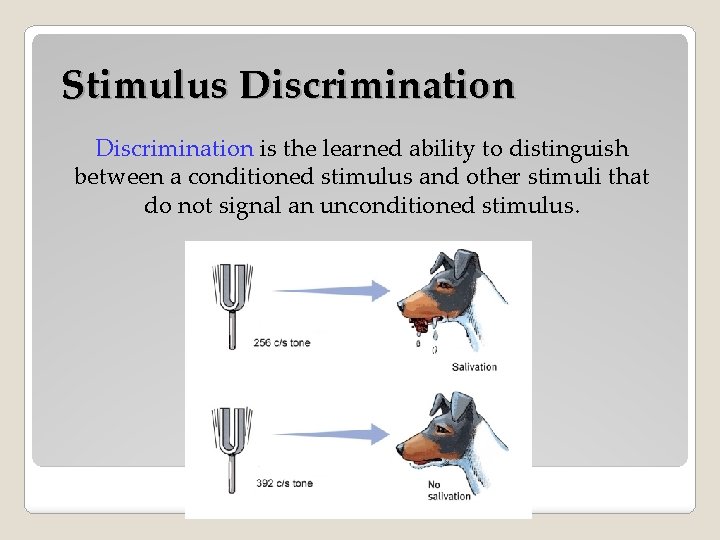
Stimulus Discrimination is the learned ability to distinguish between a conditioned stimulus and other stimuli that do not signal an unconditioned stimulus.
Extending Pavlov’s Understanding Pavlov and Watson considered consciousness, or mind, unfit for the scientific study of psychology. However, they underestimated the importance of cognitive processes and biological constraints.
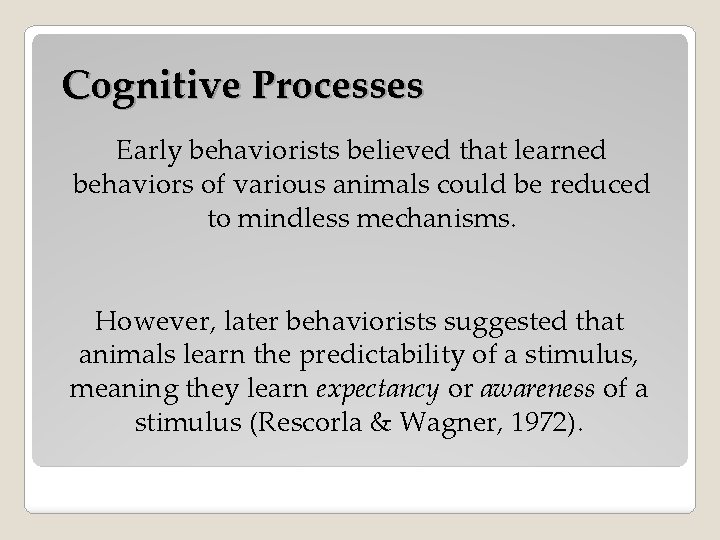
Cognitive Processes Early behaviorists believed that learned behaviors of various animals could be reduced to mindless mechanisms. However, later behaviorists suggested that animals learn the predictability of a stimulus, meaning they learn expectancy or awareness of a stimulus (Rescorla & Wagner, 1972).
Biological Predispositions Pavlov and Watson believed that laws of learning were similar for all animals. Therefore, a pigeon and a person do not differ in their learning. However, behaviorists later suggested that learning is constrained by an animal’s biology.
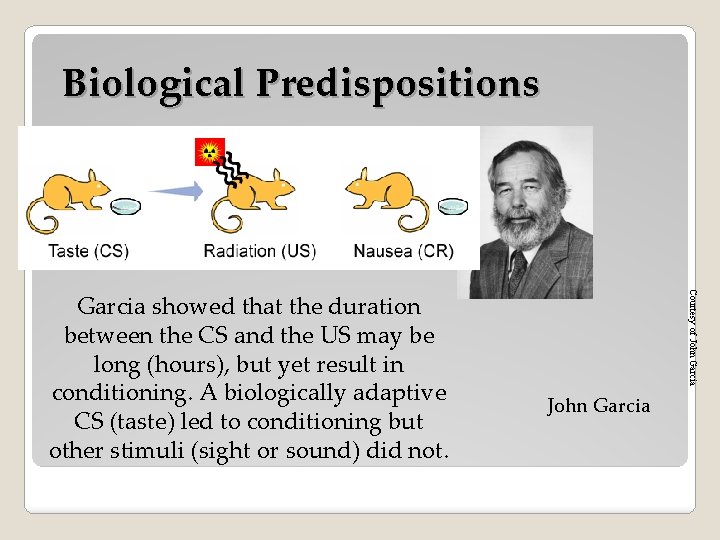
Biological Predispositions Courtesy of John Garcia showed that the duration between the CS and the US may be long (hours), but yet result in conditioning. A biologically adaptive CS (taste) led to conditioning but other stimuli (sight or sound) did not. John Garcia
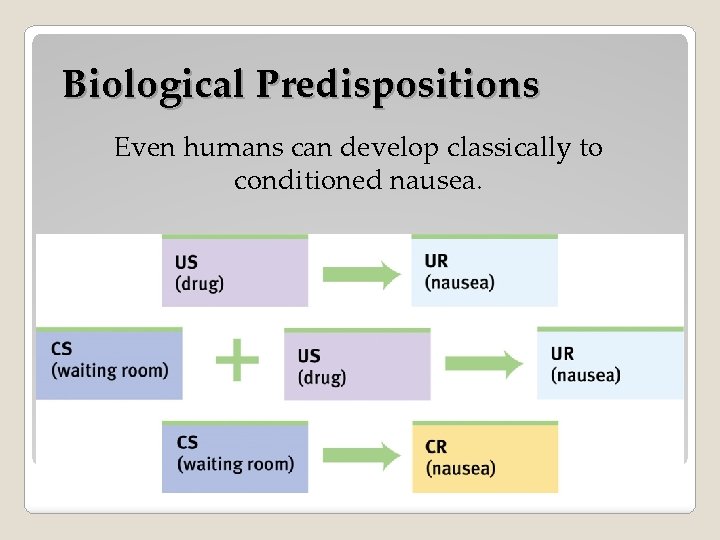
Biological Predispositions Even humans can develop classically to conditioned nausea.
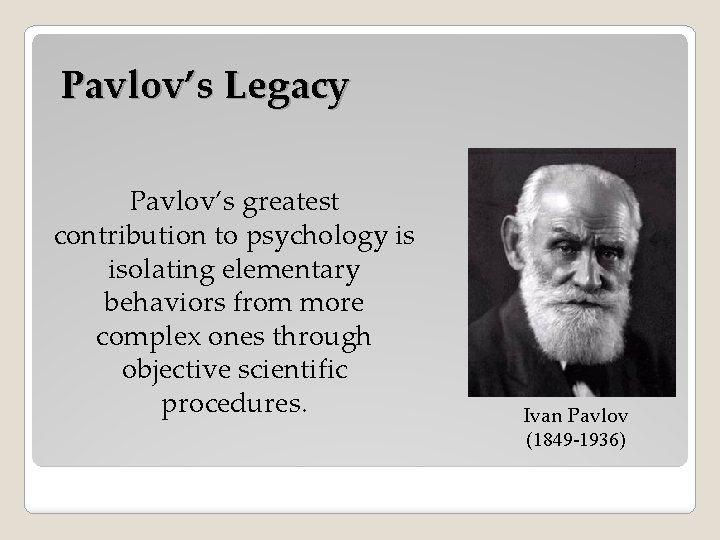
Pavlov’s Legacy Pavlov’s greatest contribution to psychology is isolating elementary behaviors from more complex ones through objective scientific procedures. Ivan Pavlov (1849 -1936)
Applications of Classical Conditioning 1. 2. Former crack cocaine users should avoid cues (people, places) associated with previous drug use. Through classical conditioning, a drug (plus its taste) that affects the immune response may cause the taste of the drug to invoke the immune response.
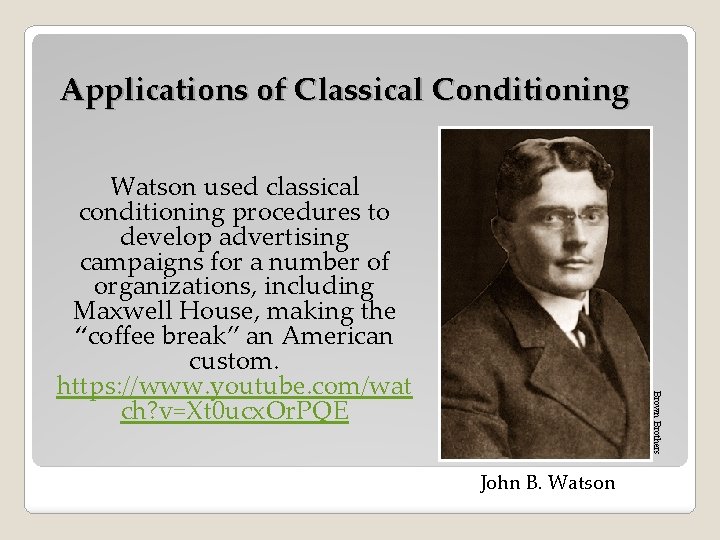
Applications of Classical Conditioning Brown Brothers Watson used classical conditioning procedures to develop advertising campaigns for a number of organizations, including Maxwell House, making the “coffee break” an American custom. https: //www. youtube. com/wat ch? v=Xt 0 ucx. Or. PQE John B. Watson
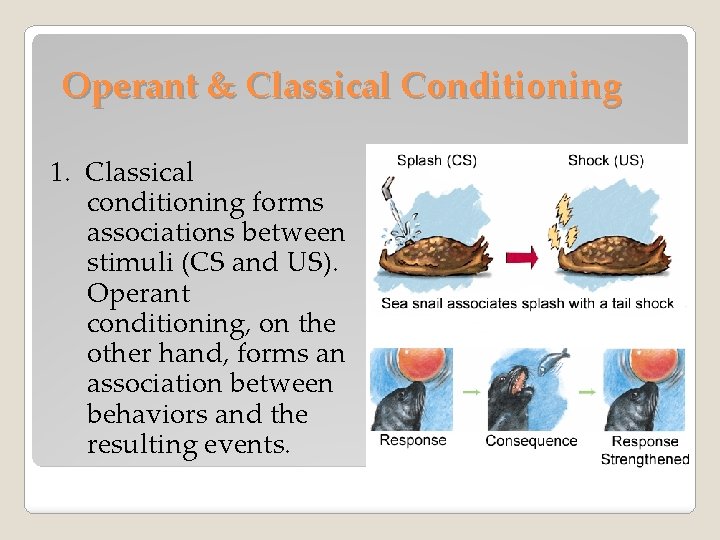
Operant & Classical Conditioning 1. Classical conditioning forms associations between stimuli (CS and US). Operant conditioning, on the other hand, forms an association between behaviors and the resulting events.
Operant & Classical Conditioning 2. Classical conditioning involves respondent behavior that occurs as an automatic response to a certain stimulus. Operant conditioning involves operant behavior, a behavior that operates on the environment, producing rewarding or punishing stimuli.