
Exploring Personal Core Space For Data Space Management
- Slides: 21
Exploring Personal Core. Space For Data. Space Management Li Yukun and Xiaofeng Meng WAMDM Lab Renmin University of China
Outline o Introduction o Core. Space Overview o Core. Space Design o Core. Space Implementation o Conclusion
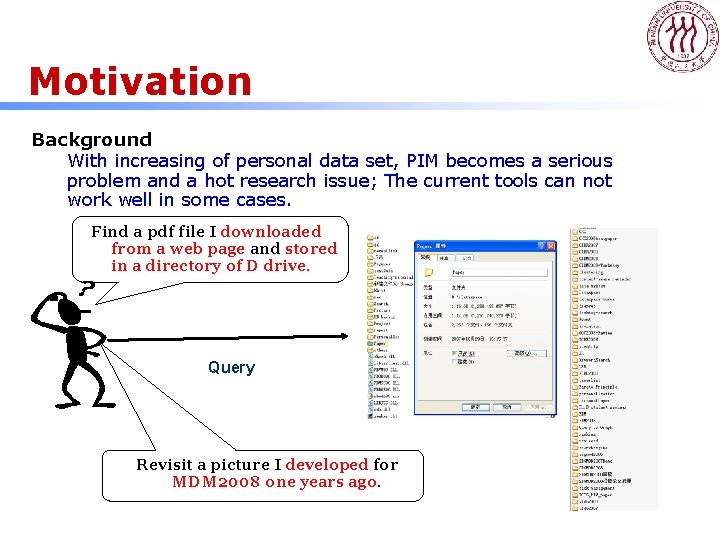
Motivation Background With increasing of personal data set, PIM becomes a serious problem and a hot research issue; The current tools can not work well in some cases. Find a pdf file I downloaded from a web page and stored in a directory of D drive. Query Revisit a picture I developed for MDM 2008 one years ago.
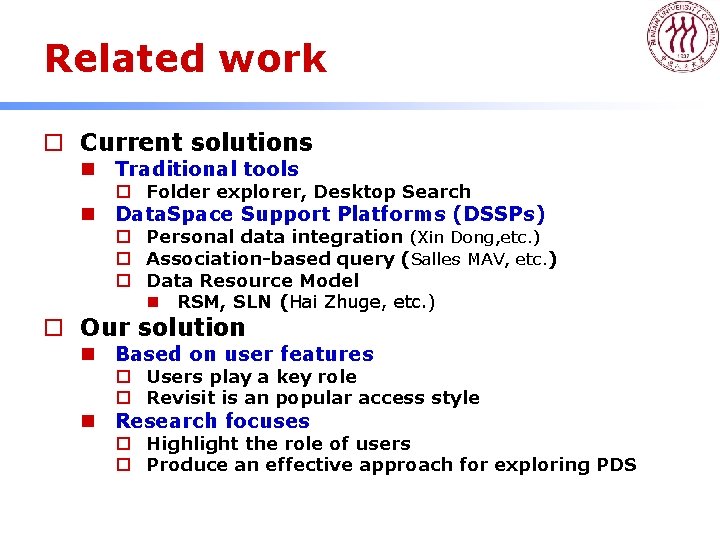
Related work o Current solutions n Traditional tools o Folder explorer, Desktop Search n Data. Space Support Platforms (DSSPs) o Personal data integration (Xin Dong, etc. ) o Association-based query (Salles MAV, etc. ) o Data Resource Model n RSM, SLN (Hai Zhuge, etc. ) o Our solution n Based on user features o Users play a key role o Revisit is an popular access style n Research focuses o Highlight the role of users o Produce an effective approach for exploring PDS
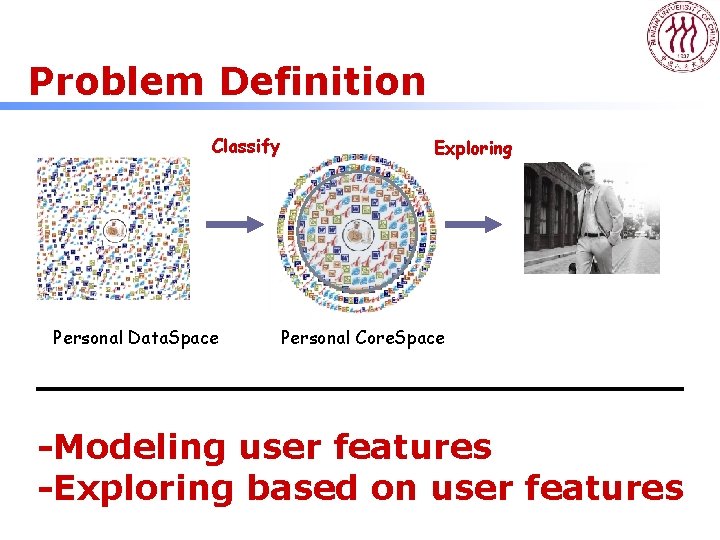
Problem Definition Classify Personal Data. Space Exploring Personal Core. Space -Modeling user features -Exploring based on user features
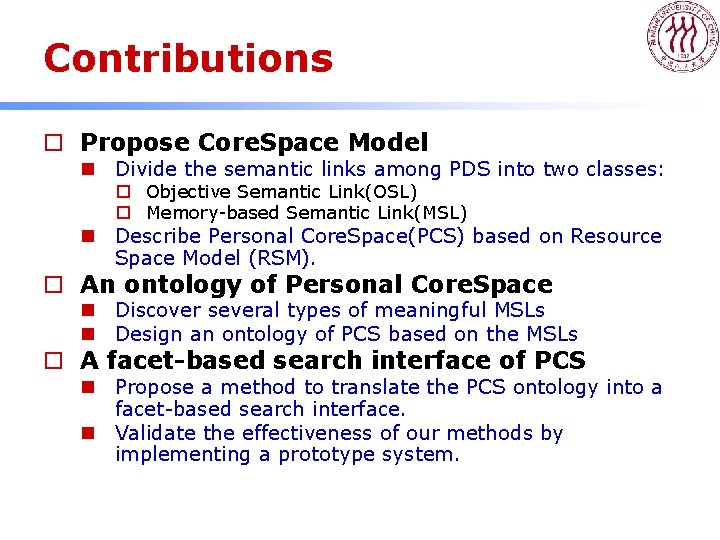
Contributions o Propose Core. Space Model n Divide the semantic links among PDS into two classes: o Objective Semantic Link(OSL) o Memory-based Semantic Link(MSL) n Describe Personal Core. Space(PCS) based on Resource Space Model (RSM). o An ontology of Personal Core. Space n Discover several types of meaningful MSLs n Design an ontology of PCS based on the MSLs o A facet-based search interface of PCS n Propose a method to translate the PCS ontology into a facet-based search interface. n Validate the effectiveness of our methods by implementing a prototype system.
Outline o Introduction o Core. Space Overview o Core. Space Design o Core. Space Implement o Conclussion
Features of personal data o Features of personal data n Versatile, heterogeneous, personalized , complex, evolutionary o Features of personal data operations n n Pay-Go Integration Known-item relocation-- “revisit” Multiple query methods Simple interface
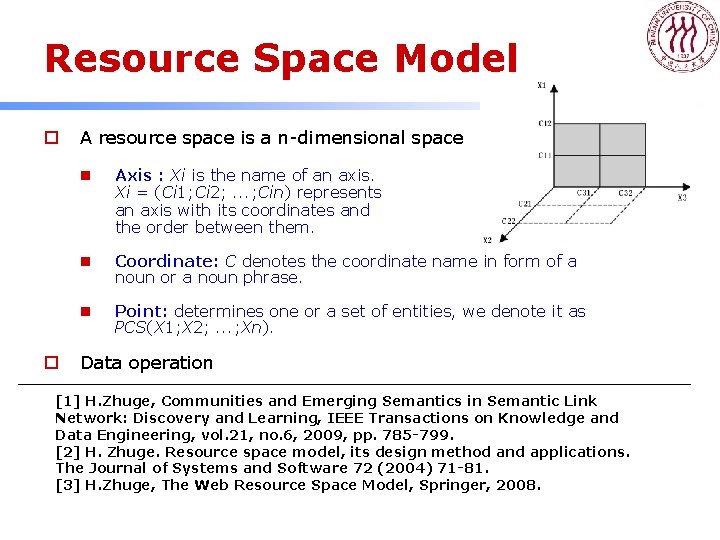
Resource Space Model o o A resource space is a n-dimensional space n Axis : Xi is the name of an axis. Xi = (Ci 1; Ci 2; . . . ; Cin) represents an axis with its coordinates and the order between them. n Coordinate: C denotes the coordinate name in form of a noun or a noun phrase. n Point: determines one or a set of entities, we denote it as PCS(X 1; X 2; . . . ; Xn). Data operation [1] H. Zhuge, Communities and Emerging Semantics in Semantic Link Network: Discovery and Learning, IEEE Transactions on Knowledge and Data Engineering, vol. 21, no. 6, 2009, pp. 785 -799. [2] H. Zhuge. Resource space model, its design method and applications. The Journal of Systems and Software 72 (2004) 71 -81. [3] H. Zhuge, The Web Resource Space Model, Springer, 2008.
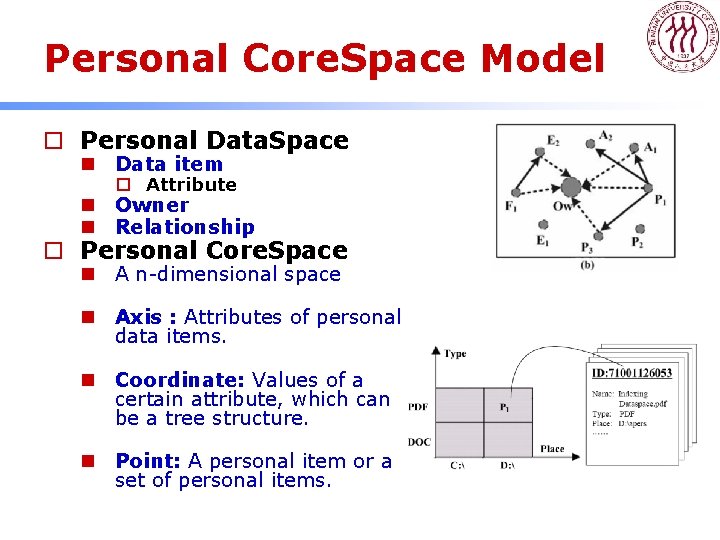
Personal Core. Space Model o Personal Data. Space n Data item o Attribute n Owner n Relationship o Personal Core. Space n A n-dimensional space n Axis : Attributes of personal data items. n Coordinate: Values of a certain attribute, which can be a tree structure. n Point: A personal item or a set of personal items.
Outline o Introduction o Core. Space Overview o Core. Space Design o Core. Space Implementation o Conclussion
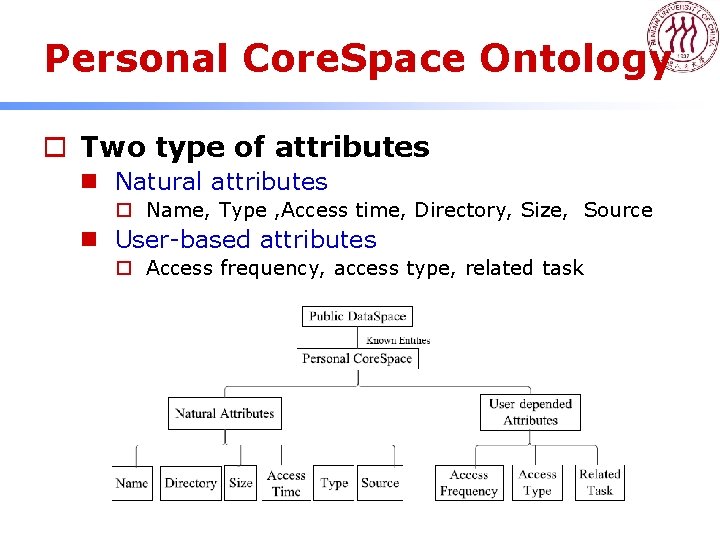
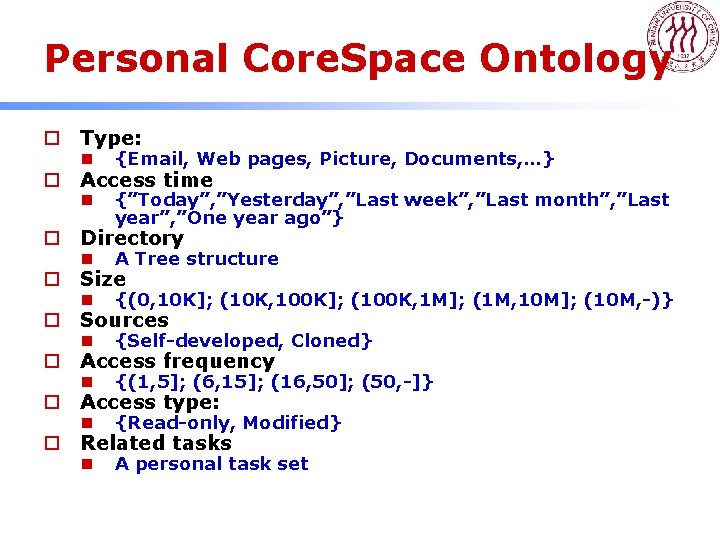
Personal Core. Space Ontology o Two type of attributes n Natural attributes o Name, Type , Access time, Directory, Size, Source n User-based attributes o Access frequency, access type, related task
Personal Core. Space Ontology o Type: n {Email, Web pages, Picture, Documents, …} n {”Today”, ”Yesterday”, ”Last week”, ”Last month”, ”Last year”, ”One year ago”} o Access time o Directory n A Tree structure n {(0, 10 K]; (10 K, 100 K]; (100 K, 1 M]; (1 M, 10 M]; (10 M, -)} n {Self-developed, Cloned} n {(1, 5]; (6, 15]; (16, 50]; (50, -]} n {Read-only, Modified} n A personal task set o Size o Sources o Access frequency o Access type: o Related tasks
Outline o Introduction o Core. Space Overview o Core. Space Design o Core. Space Implementation o Conclussion
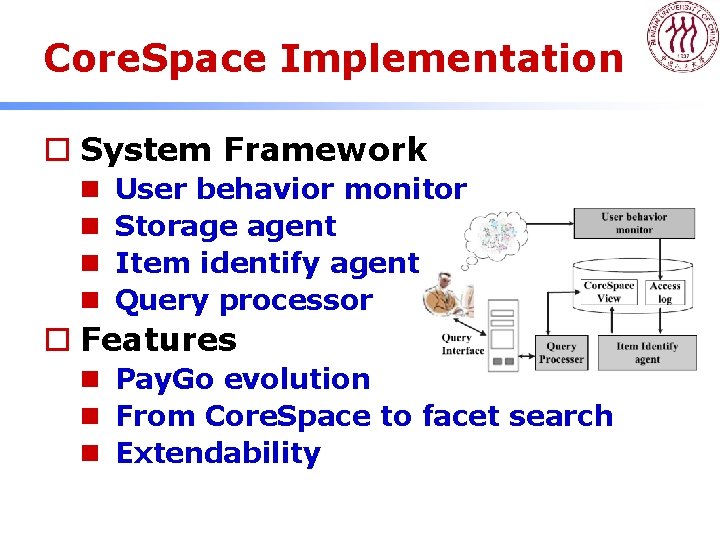
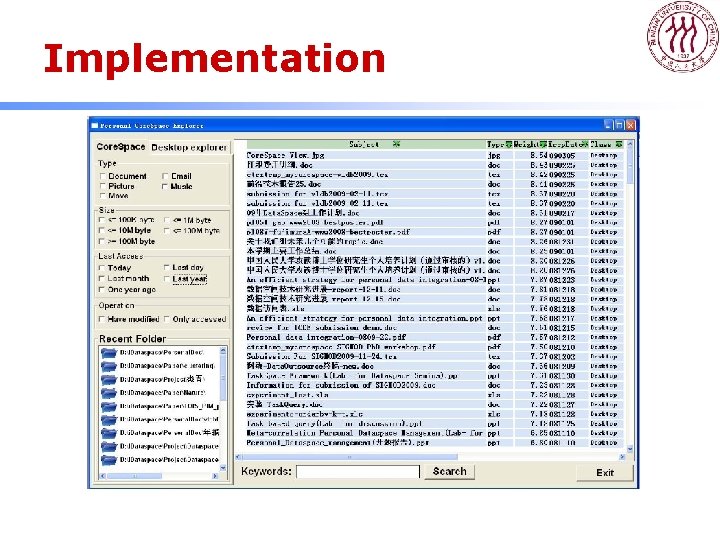
Core. Space Implementation o System Framework n n User behavior monitor Storage agent Item identify agent Query processor o Features n Pay. Go evolution n From Core. Space to facet search n Extendability
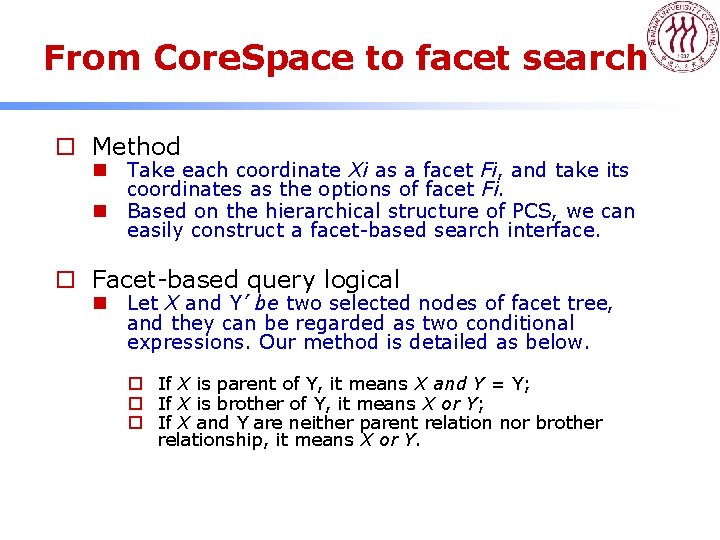
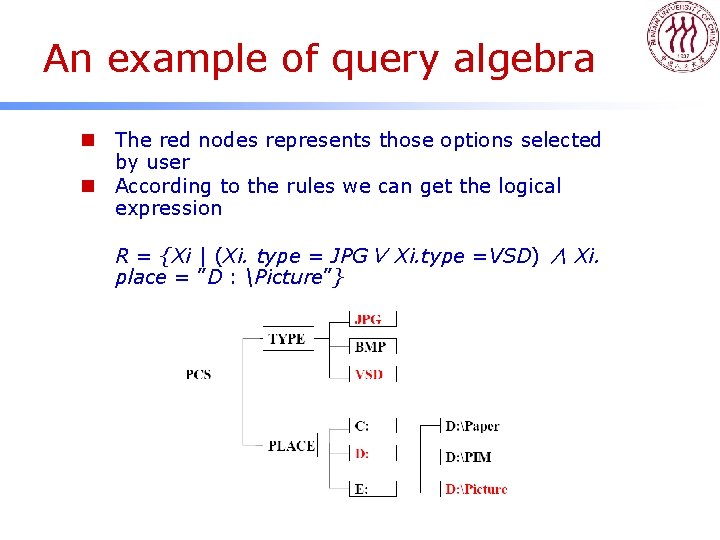
From Core. Space to facet search o Method n Take each coordinate Xi as a facet Fi, and take its coordinates as the options of facet Fi. n Based on the hierarchical structure of PCS, we can easily construct a facet-based search interface. o Facet-based query logical n Let X and Y’ be two selected nodes of facet tree, and they can be regarded as two conditional expressions. Our method is detailed as below. o If X is parent of Y, it means X and Y = Y; o If X is brother of Y, it means X or Y; o If X and Y are neither parent relation nor brother relationship, it means X or Y.
An example of query algebra n The red nodes represents those options selected by user n According to the rules we can get the logical expression R = {Xi | (Xi. type = JPG∨ Xi. type =VSD) ∧ Xi. place = ”D : Picture”}
Implementation
Outline o Introduction o Core. Space Overview o Core. Space Design o Core. Space Implementation o Conclussion
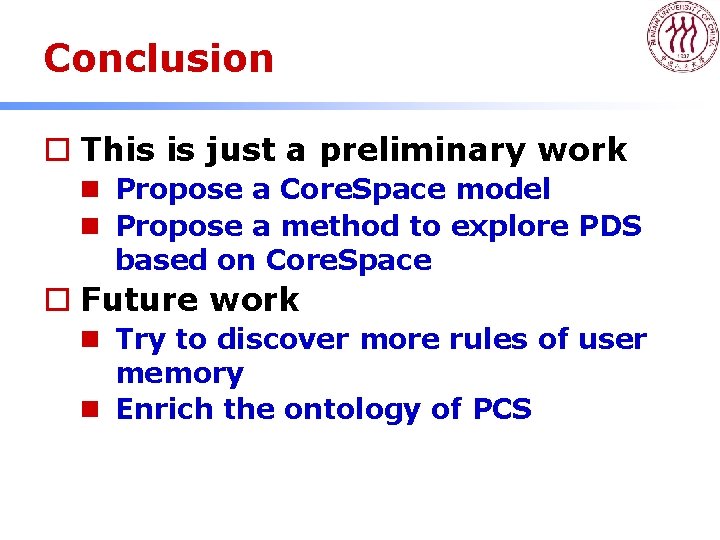
Conclusion o This is just a preliminary work n Propose a Core. Space model n Propose a method to explore PDS based on Core. Space o Future work n Try to discover more rules of user memory n Enrich the ontology of PCS
Thanks