
Exploring particles at school with ALICE Looking for
- Slides: 15
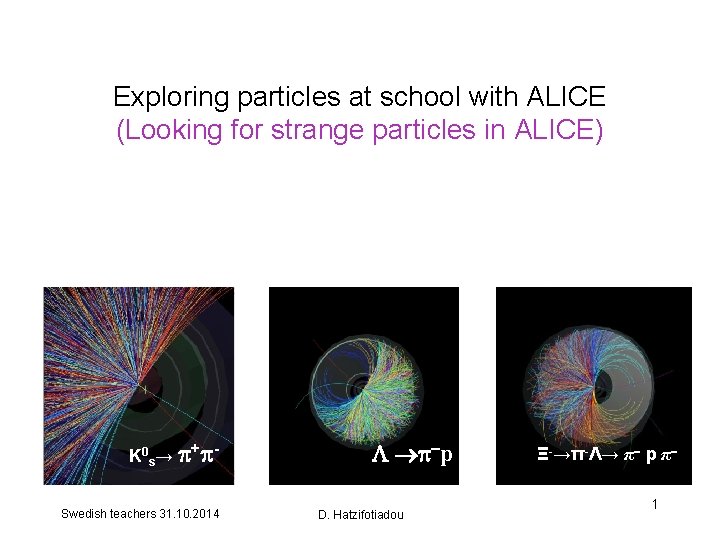
Exploring particles at school with ALICE (Looking for strange particles in ALICE) K 0 s → p + p Swedish teachers 31. 10. 2014 L ®p-p D. Hatzifotiadou Ξ-→π-Λ→ π - p π 1
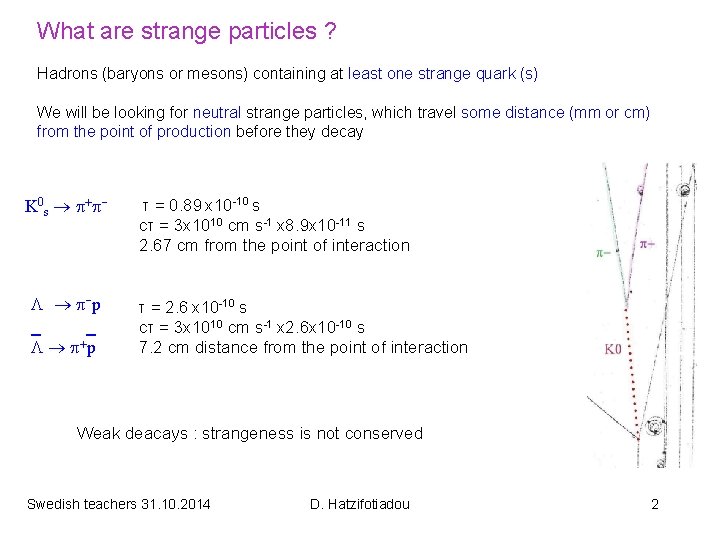
What are strange particles ? Hadrons (baryons or mesons) containing at least one strange quark (s) We will be looking for neutral strange particles, which travel some distance (mm or cm) from the point of production before they decay K 0 s ® p p L ® p p _ _ L ® p p τ = 0. 89 x 10 -10 s cτ = 3 x 1010 cm s-1 x 8. 9 x 10 -11 s 2. 67 cm from the point of interaction τ = 2. 6 x 10 -10 s cτ = 3 x 1010 cm s-1 x 2. 6 x 10 -10 s 7. 2 cm distance from the point of interaction Weak deacays : strangeness is not conserved Swedish teachers 31. 10. 2014 D. Hatzifotiadou 2
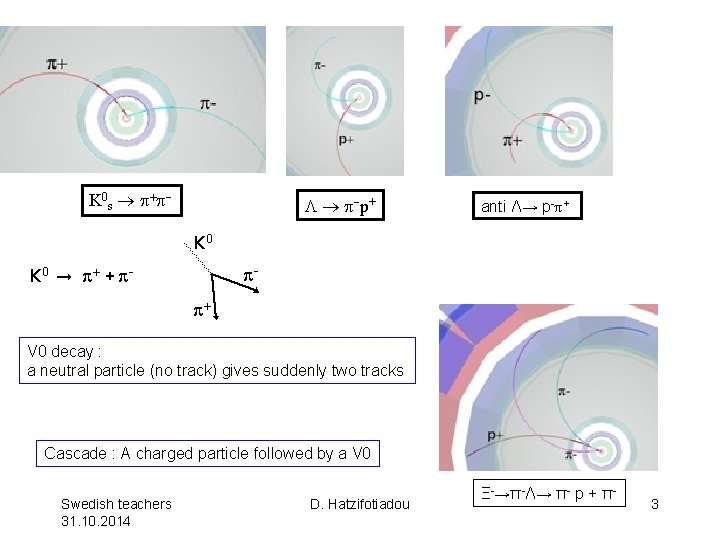
K 0 s ® p p L ® p p+ anti Λ→ p-π + V 0 decay : a neutral particle (no track) gives suddenly two tracks Cascade : A charged particle followed by a V 0 Swedish teachers 31. 10. 2014 D. Hatzifotiadou Ξ-→π-Λ→ π- p + π- 3
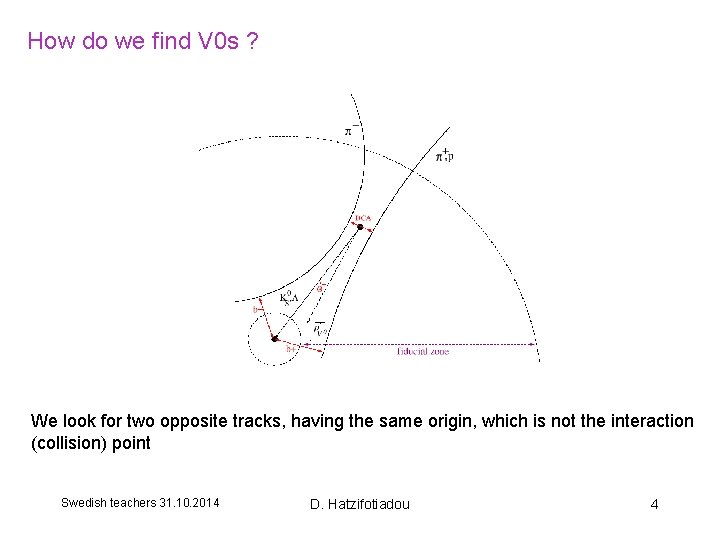
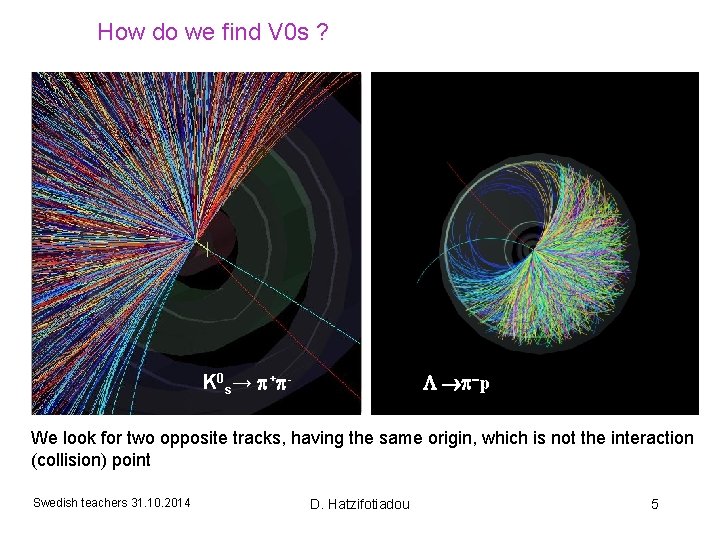
How do we find V 0 s ? We look for two opposite tracks, having the same origin, which is not the interaction (collision) point Swedish teachers 31. 10. 2014 D. Hatzifotiadou 4
How do we find V 0 s ? L ®p-p K 0 s → p + p - We look for two opposite tracks, having the same origin, which is not the interaction (collision) point Swedish teachers 31. 10. 2014 D. Hatzifotiadou 5
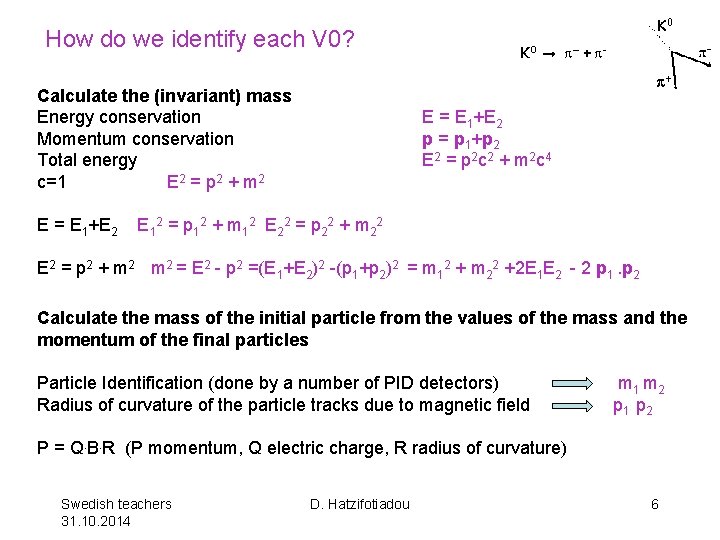
How do we identify each V 0? Calculate the (invariant) mass Energy conservation Momentum conservation Total energy c=1 E 2 = p 2 + m 2 E = E 1+E 2 p = p 1+p 2 E 2 = p 2 c 2 + m 2 c 4 E 12 = p 12 + m 12 E 22 = p 22 + m 22 E 2 = p 2 + m 2 = E 2 - p 2 =(E 1+E 2)2 -(p 1+p 2)2 = m 12 + m 22 +2 E 1 E 2 - 2 p 1. p 2 Calculate the mass of the initial particle from the values of the mass and the momentum of the final particles Particle Identification (done by a number of PID detectors) Radius of curvature of the particle tracks due to magnetic field m 1 m 2 p 1 p 2 P = Q. B. R (P momentum, Q electric charge, R radius of curvature) Swedish teachers 31. 10. 2014 D. Hatzifotiadou 6
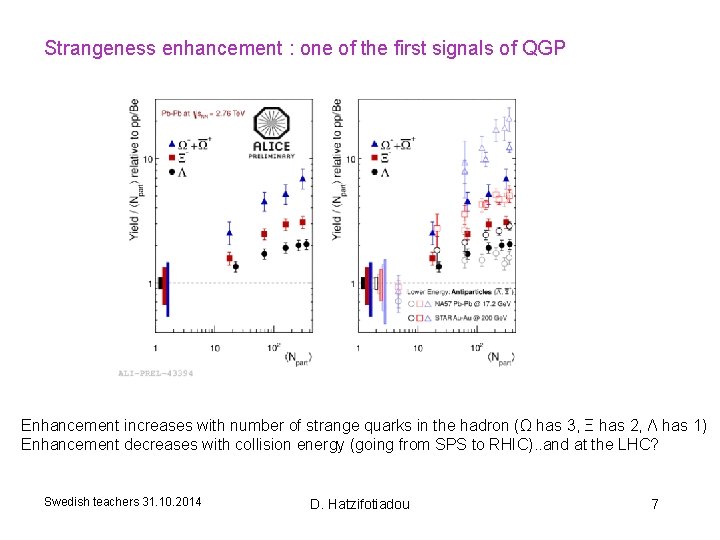
Strangeness enhancement : one of the first signals of QGP Enhancement increases with number of strange quarks in the hadron (Ω has 3, Ξ has 2, Λ has 1) Enhancement decreases with collision energy (going from SPS to RHIC). . and at the LHC? Swedish teachers 31. 10. 2014 D. Hatzifotiadou 7
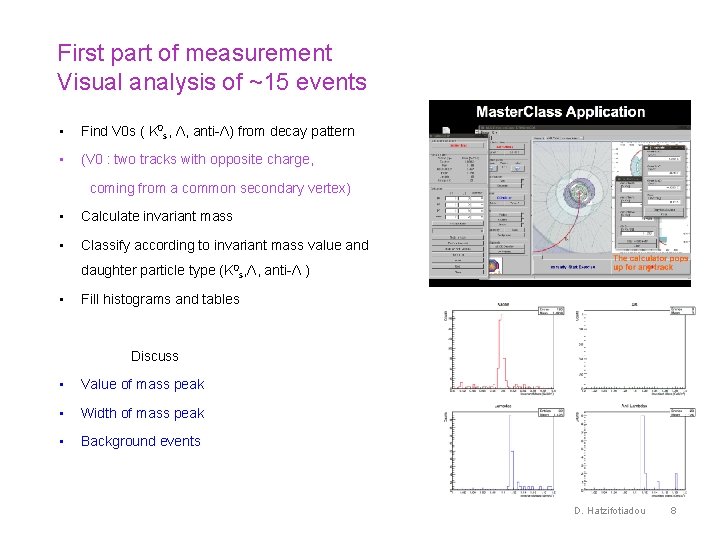
First part of measurement Visual analysis of ~15 events • Find V 0 s ( K 0 s, Λ, anti-Λ) from decay pattern • (V 0 : two tracks with opposite charge, coming from a common secondary vertex) • Calculate invariant mass • Classify according to invariant mass value and daughter particle type (K 0 s, Λ, anti-Λ ) • Fill histograms and tables Discuss • Value of mass peak • Width of mass peak • Background events D. Hatzifotiadou 8
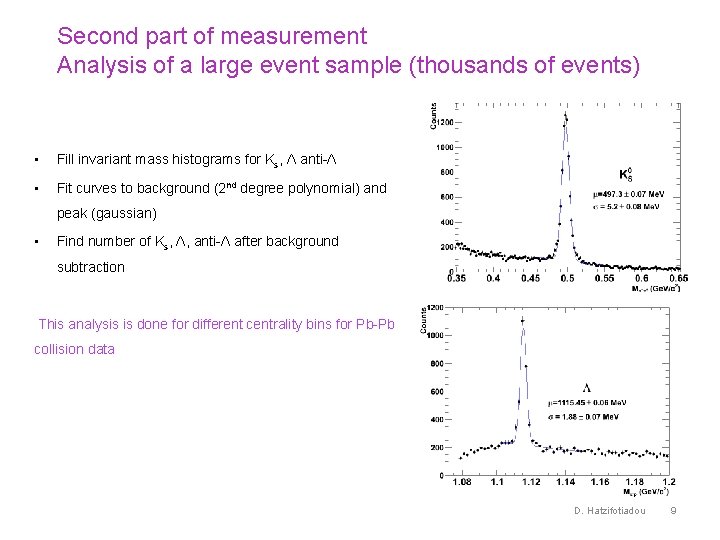
Second part of measurement Analysis of a large event sample (thousands of events) • Fill invariant mass histograms for Ks, Λ anti-Λ • Fit curves to background (2 nd degree polynomial) and peak (gaussian) • Find number of Ks, Λ, anti-Λ after background subtraction This analysis is done for different centrality bins for Pb-Pb collision data D. Hatzifotiadou 9
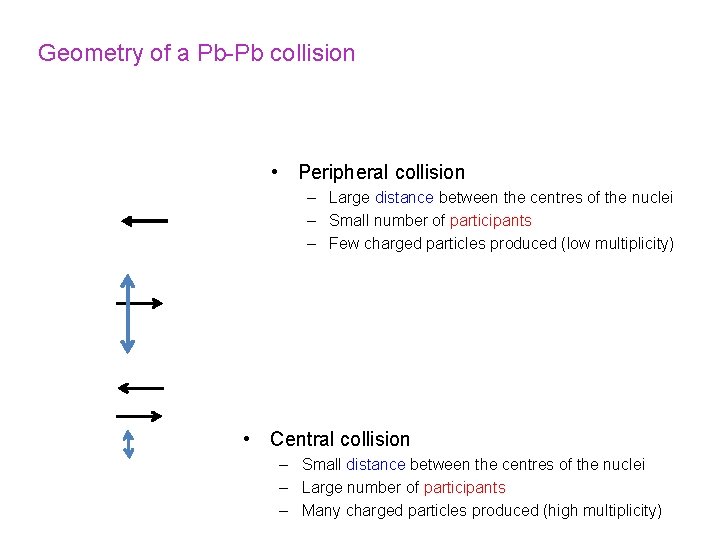
Geometry of a Pb-Pb collision • Peripheral collision – Large distance between the centres of the nuclei – Small number of participants – Few charged particles produced (low multiplicity) • Central collision – Small distance between the centres of the nuclei – Large number of participants – Many charged particles produced (high multiplicity)
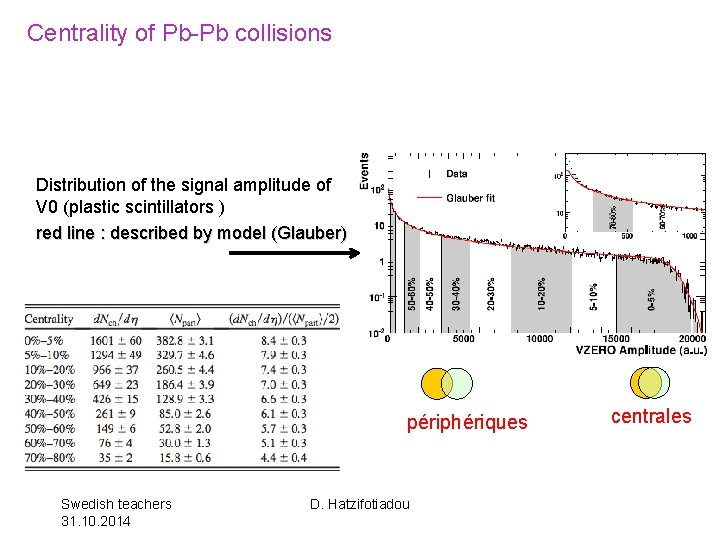
Centrality of Pb-Pb collisions Distribution of the signal amplitude of V 0 (plastic scintillators ) red line : described by model (Glauber) périphériques Swedish teachers 31. 10. 2014 D. Hatzifotiadou centrales
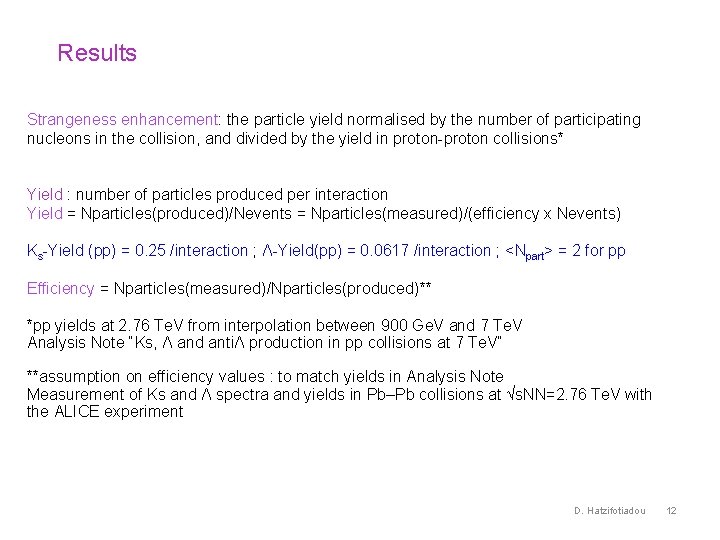
Results Strangeness enhancement: the particle yield normalised by the number of participating nucleons in the collision, and divided by the yield in proton-proton collisions* Yield : number of particles produced per interaction Yield = Nparticles(produced)/Nevents = Nparticles(measured)/(efficiency x Nevents) Ks-Yield (pp) = 0. 25 /interaction ; Λ-Yield(pp) = 0. 0617 /interaction ; <Npart> = 2 for pp Efficiency = Nparticles(measured)/Nparticles(produced)** *pp yields at 2. 76 Te. V from interpolation between 900 Ge. V and 7 Te. V Analysis Note “Ks, Λ and antiΛ production in pp collisions at 7 Te. V” **assumption on efficiency values : to match yields in Analysis Note Measurement of Ks and Λ spectra and yields in Pb–Pb collisions at √s. NN=2. 76 Te. V with the ALICE experiment D. Hatzifotiadou 12
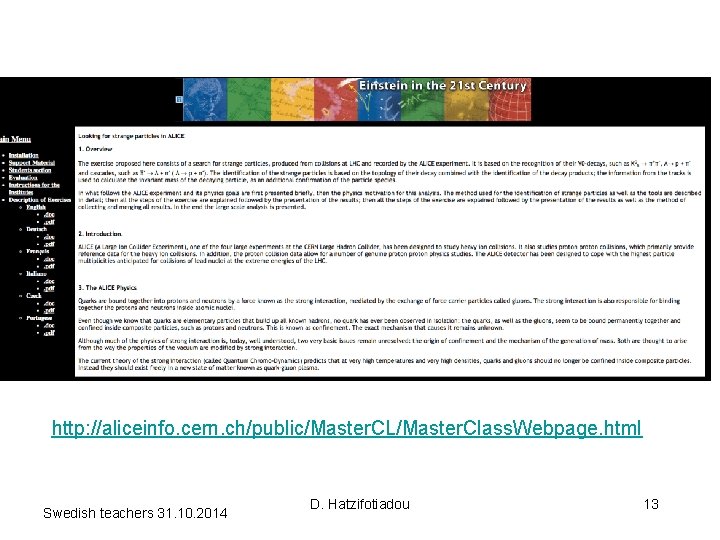
http: //aliceinfo. cern. ch/public/Master. CL/Master. Class. Webpage. html Swedish teachers 31. 10. 2014 D. Hatzifotiadou 13
New portal under construction http: //opendata. cern. ch/ for education and research Easy procedure to install virtual box; create a VM; configure a VM http: //opendata. cern. ch/VM/ALICE#configure Once this done, you are in an environment where you have • both ALICE masterclasses (strangeness and RAA) • a simple program producing PT distributions using released ALICE data Alternative solution for running the masterclasses packages independent of operating system and installation of software tools (ROOT) Swedish teachers 31. 10. 2014 D. Hatzifotiadou 14
Thanks for your attention despina. hatzifotiadou@cern. ch Swedish teachers 31. 10. 2014 D. Hatzifotiadou 15