
Exploring Magnetically Confined Burning Plasmas in the Laboratory
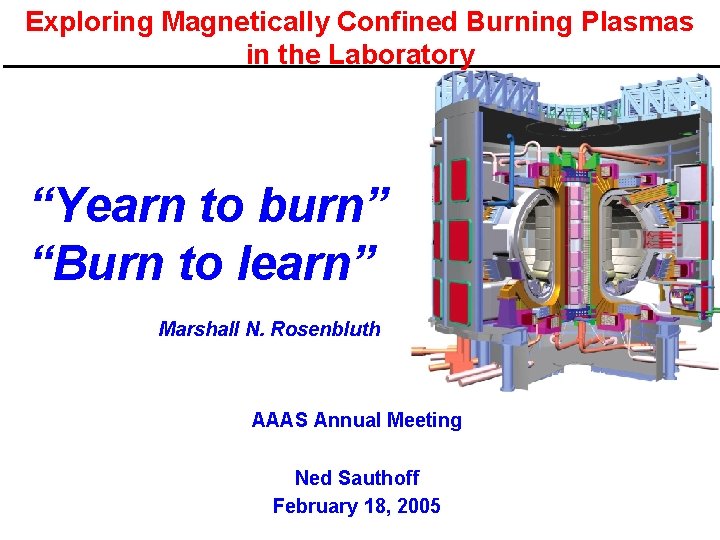
Exploring Magnetically Confined Burning Plasmas in the Laboratory “Yearn to burn” “Burn to learn” Marshall N. Rosenbluth AAAS Annual Meeting Ned Sauthoff February 18, 2005
Roadmap… Promise: Scientific Benefits and Energy Potential Prognosis: Scientific and Technological Readiness Process: Approaches to the Study of Burning Plasmas Prospects: Technical and Organizational Outlooks
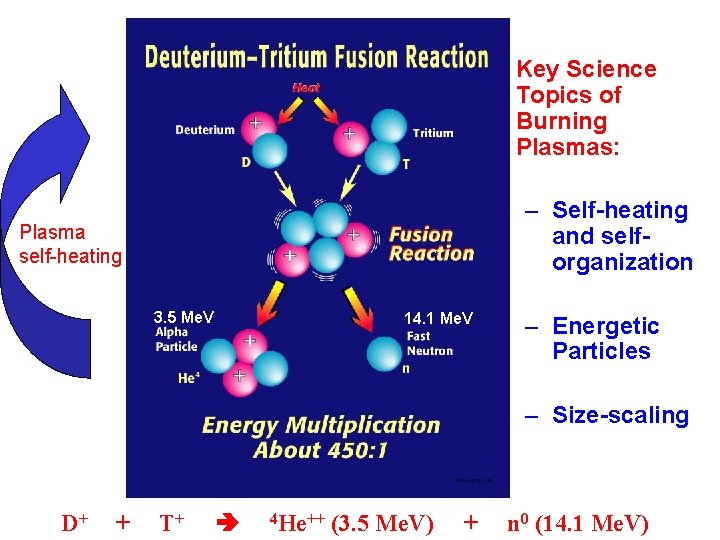
Key Science Topics of Burning Plasmas: – Self-heating and selforganization Plasma self-heating 3. 5 Me. V 14. 1 Me. V – Energetic Particles – Size-scaling D+ + T+ 4 He++ (3. 5 Me. V) + n 0 (14. 1 Me. V)
Roadmap… Promise: Scientific Benefits and Energy Potential Prognosis: Scientific and Technological Readiness Process: Approaches to the Study of Burning Plasmas Prospects: Technical and Organizational Outlooks
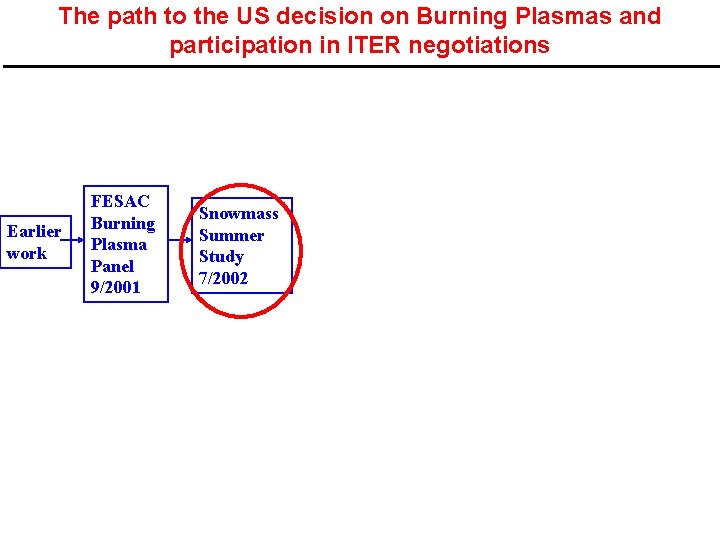
The path to the US decision on Burning Plasmas and participation in ITER negotiations Earlier work FESAC Burning Plasma Panel 9/2001 Snowmass Summer Study 7/2002
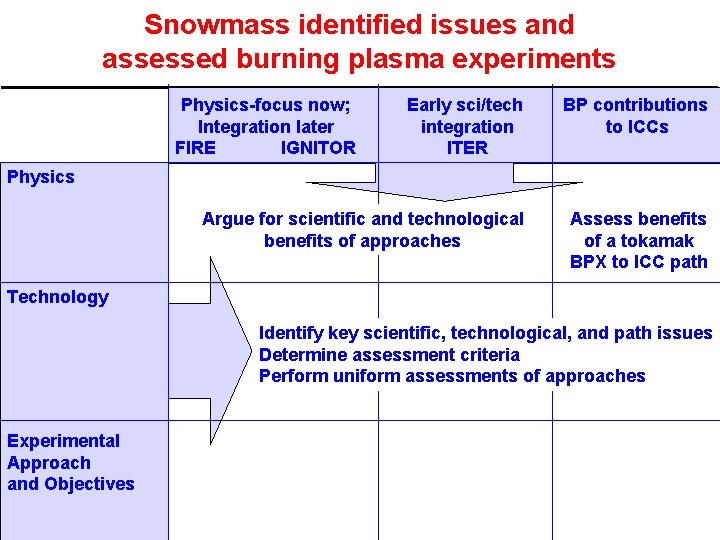
Snowmass identified issues and assessed burning plasma experiments Physics-focus now; Integration later FIRE IGNITOR Early sci/tech integration ITER BP contributions to ICCs Argue for scientific and technological benefits of approaches Assess benefits of a tokamak BPX to ICC path Physics Technology Identify key scientific, technological, and path issues Determine assessment criteria Perform uniform assessments of approaches Experimental Approach and Objectives
The overwhelming consensus: • burning plasmas are opportunities ripe for exploration and discovery • tokamaks are ready to proceed to the burning plasma stage • the commonality of physics and technology would allow other toroidal configurations to benefit from a burning tokamak plasma
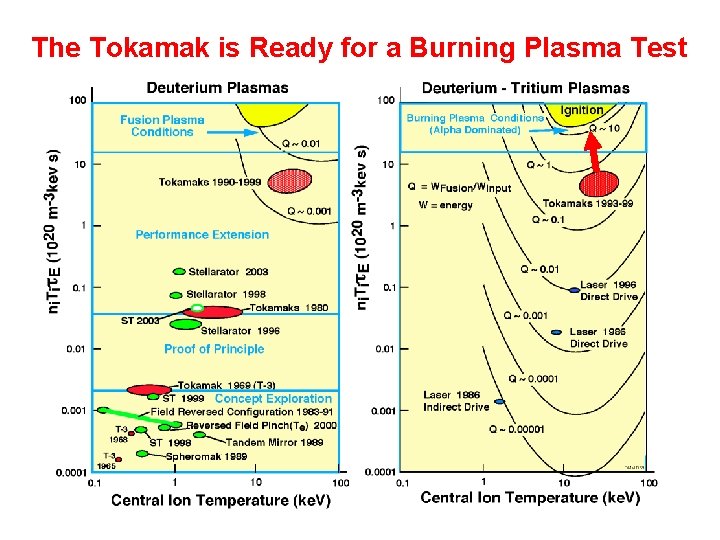
The Tokamak is Ready for a Burning Plasma Test
Roadmap… Promise: Scientific Benefits and Energy Potential Prognosis: Scientific and Technological Readiness Process: Approaches to the Study of Burning Plasmas Prospects: Technical and Organizational Outlooks
Assessment of contributions of the options • IGNITOR, FIRE, and ITER would enable studies of the physics of burning plasma, advance fusion technology, and contribute to the development of fusion energy. • The contributions of the three approaches would differ considerably.
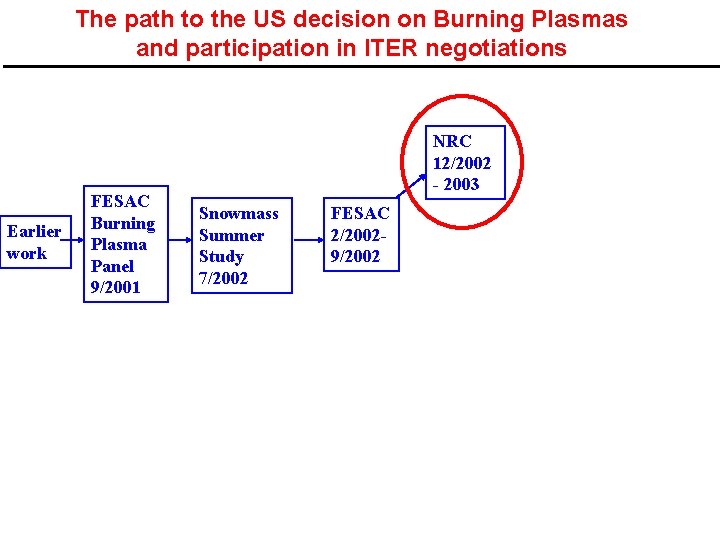
The path to the US decision on Burning Plasmas and participation in ITER negotiations Earlier work FESAC Burning Plasma Panel 9/2001 NRC 12/2002 - 2003 Snowmass Summer Study 7/2002 FESAC 2/20029/2002
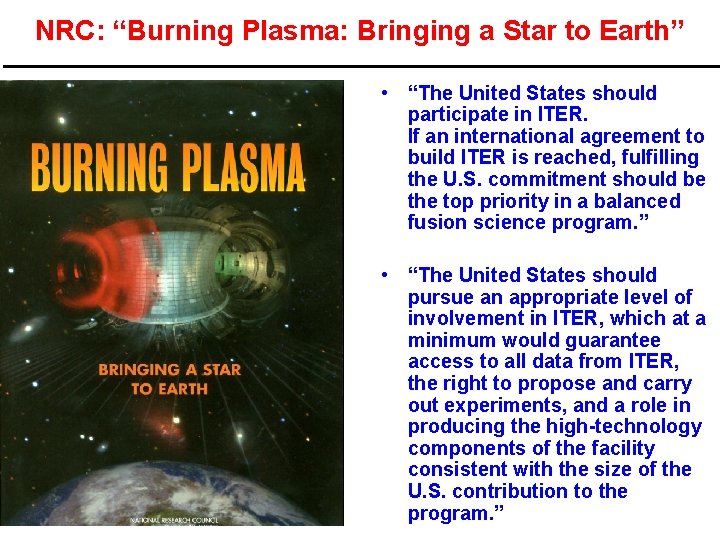
NRC: “Burning Plasma: Bringing a Star to Earth” • “The United States should participate in ITER. If an international agreement to build ITER is reached, fulfilling the U. S. commitment should be the top priority in a balanced fusion science program. ” • “The United States should pursue an appropriate level of involvement in ITER, which at a minimum would guarantee access to all data from ITER, the right to propose and carry out experiments, and a role in producing the high-technology components of the facility consistent with the size of the U. S. contribution to the program. ”
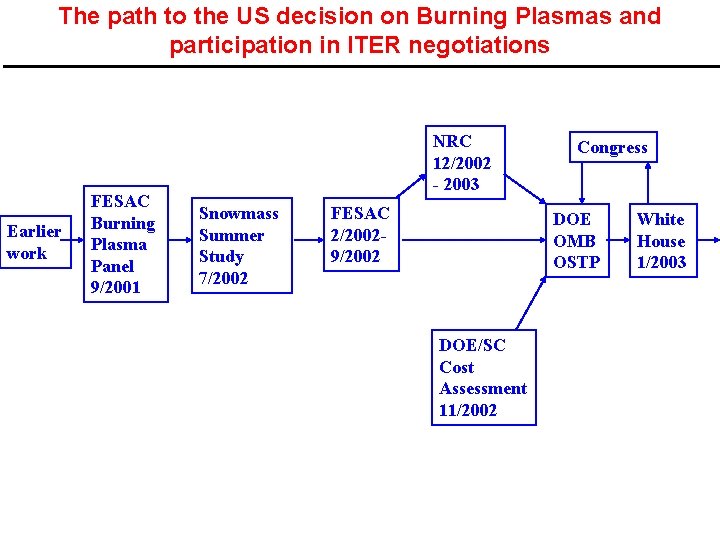
The path to the US decision on Burning Plasmas and participation in ITER negotiations Earlier work FESAC Burning Plasma Panel 9/2001 NRC 12/2002 - 2003 Snowmass Summer Study 7/2002 FESAC 2/20029/2002 Congress DOE OMB OSTP DOE/SC Cost Assessment 11/2002 White House 1/2003
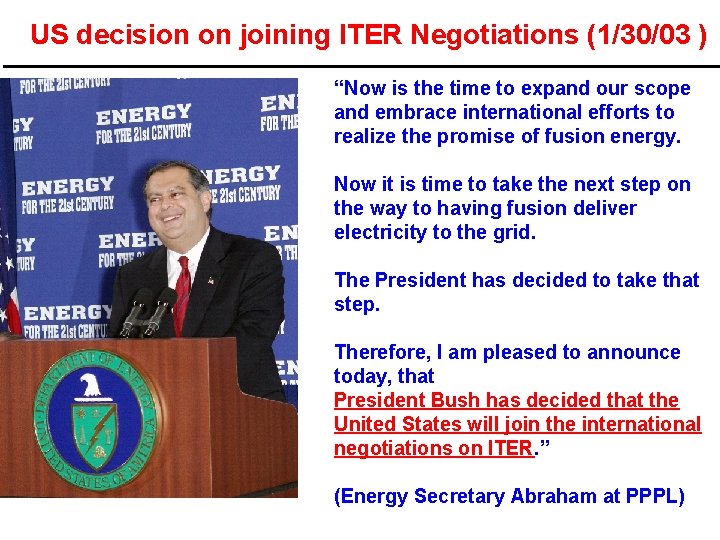
US decision on joining ITER Negotiations (1/30/03 ) “Now is the time to expand our scope and embrace international efforts to realize the promise of fusion energy. Now it is time to take the next step on the way to having fusion deliver electricity to the grid. The President has decided to take that step. Therefore, I am pleased to announce today, that President Bush has decided that the United States will join the international negotiations on ITER. ” (Energy Secretary Abraham at PPPL)
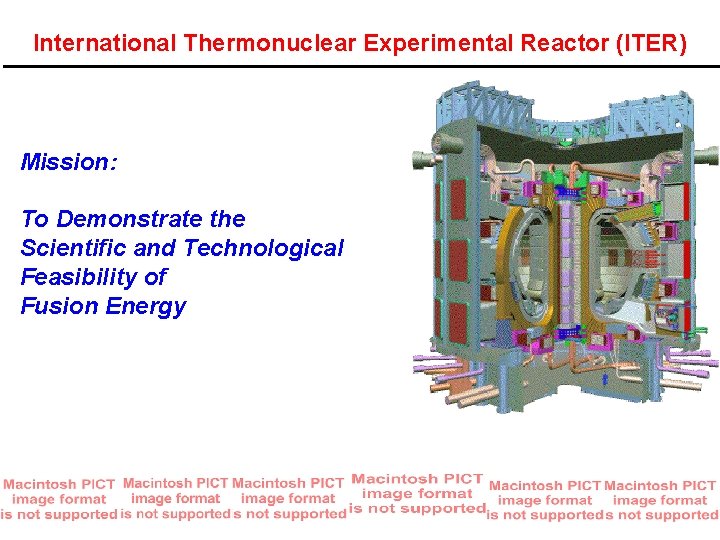
International Thermonuclear Experimental Reactor (ITER) Mission: To Demonstrate the Scientific and Technological Feasibility of Fusion Energy
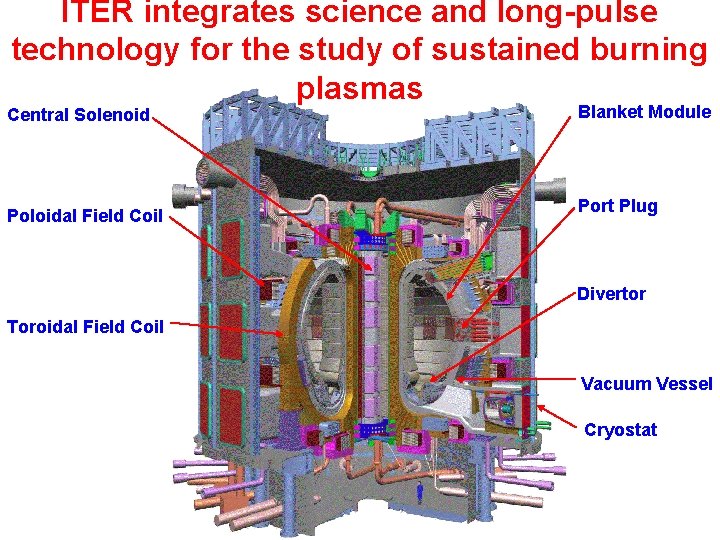
ITER integrates science and long-pulse technology for the study of sustained burning plasmas Central Solenoid Poloidal Field Coil Blanket Module Port Plug Divertor Toroidal Field Coil Vacuum Vessel Cryostat
Central Solenoid Model Coil Radius 3. 5 m Height 2. 8 m Bmax=13 T W = 640 MJ 0. 6 T/sec
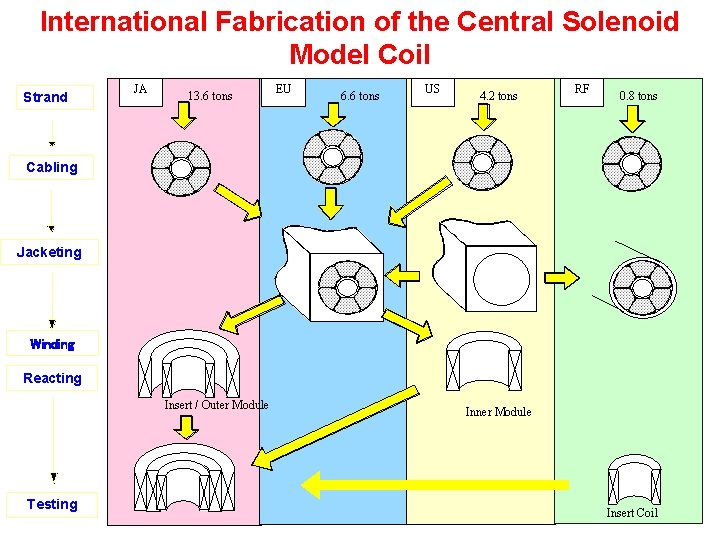
International Fabrication of the Central Solenoid H. Tsuji et al. /Fusion Engineering and Design 55 (2001) Model Coil Strand JA 13. 6 tons EU 6. 6 tons US 4. 2 tons RF 0. 8 tons Cabling Jacketing Winding Reacting Insert / Outer Module Testing Inner Module Insert Coil
Toroidal Field Model Coil Height 4 m Width 3 m Bmax=7. 8 T Imax = 80 k. A
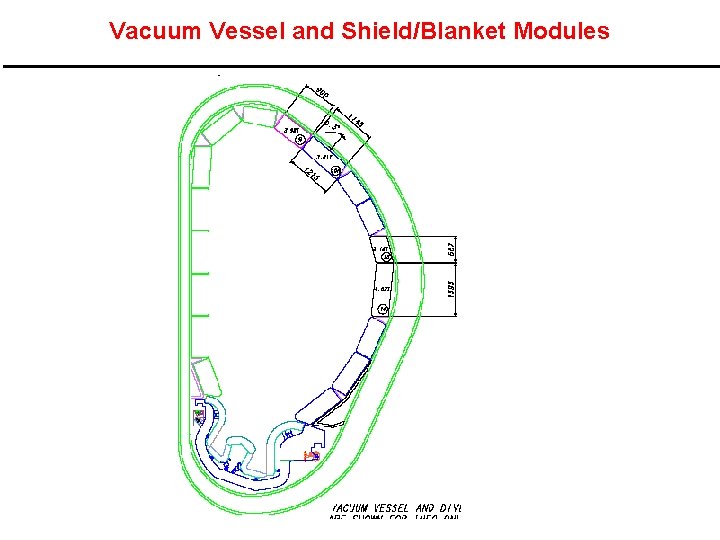
Vacuum Vessel and Shield/Blanket Modules
Blanket Module HIP Joining Tech Size : 1. 6 m x 0. 93 m x 0. 35 m
Remote Maintenance of Blanket 4 t Blanket Sector Attachment Tolerance ± 0. 25 mm
Divertor Cassette
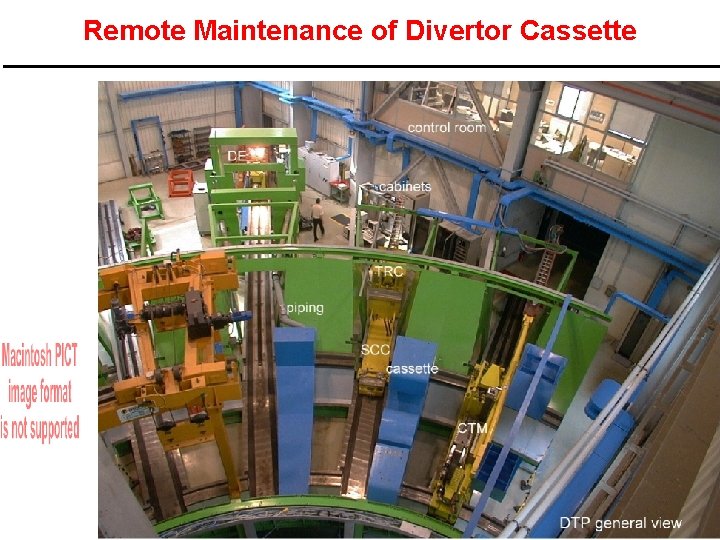
Remote Maintenance of Divertor Cassette
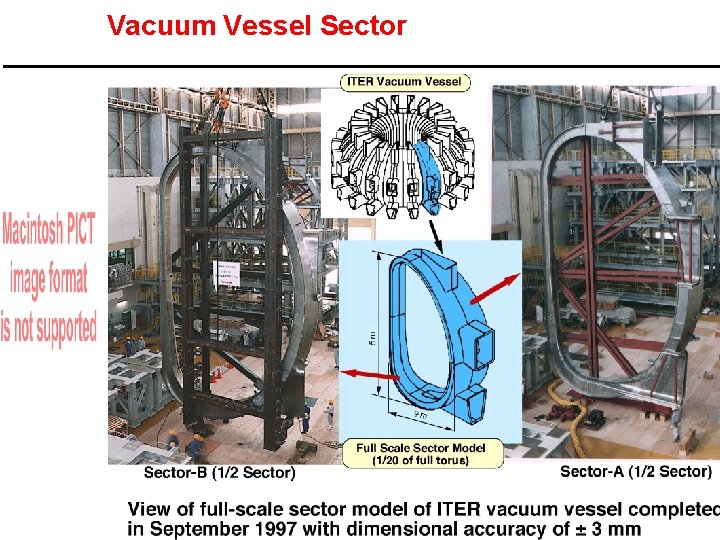
Vacuum Vessel Sector
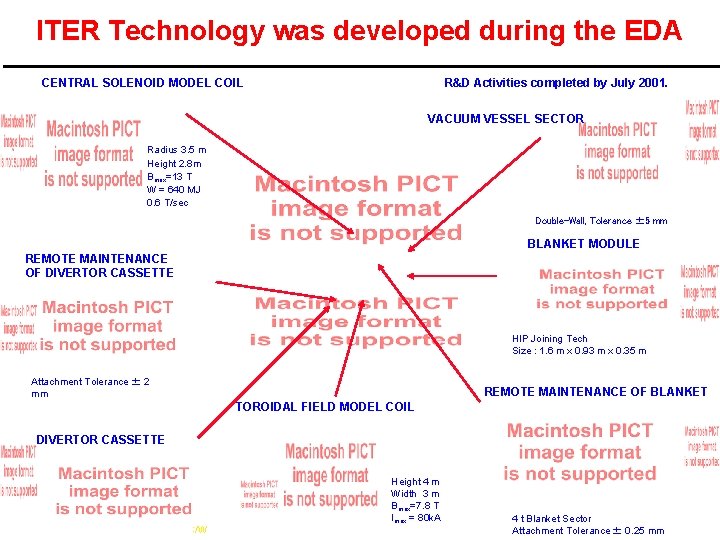
ITER Technology was developed during the EDA CENTRAL SOLENOID MODEL COIL R&D Activities completed by July 2001. VACUUM VESSEL SECTOR Radius 3. 5 m Height 2. 8 m Bmax=13 T W = 640 MJ 0. 6 T/sec Double-Wall, Tolerance ± 5 mm BLANKET MODULE REMOTE MAINTENANCE OF DIVERTOR CASSETTE HIP Joining Tech Size : 1. 6 m x 0. 93 m x 0. 35 m Attachment Tolerance ± 2 mm REMOTE MAINTENANCE OF BLANKET TOROIDAL FIELD MODEL COIL DIVERTOR CASSETTE Heat Flux >15 MW/m 2, CFC/W Height 4 m Width 3 m Bmax=7. 8 T Imax = 80 k. A 4 t Blanket Sector Attachment Tolerance ± 0. 25 mm
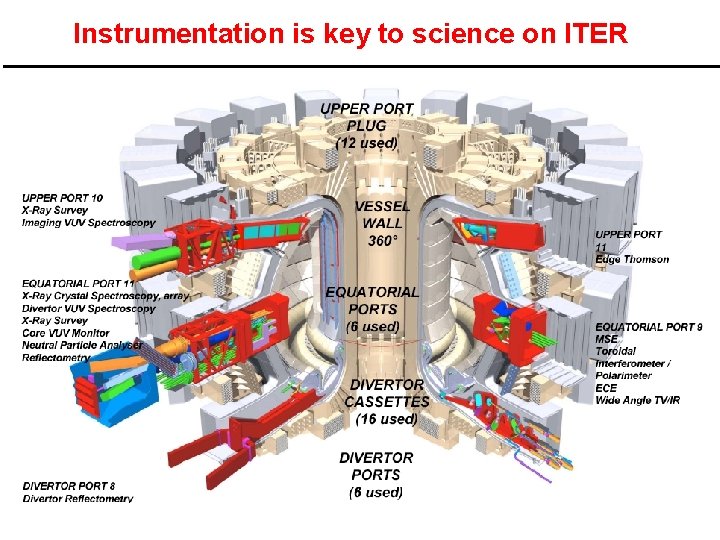
Instrumentation is key to science on ITER
Roadmap… Promise: Scientific Benefits and Energy Potential Prognosis: Scientific and Technological Readiness Process: Approaches to the Study of Burning Plasmas Prospects: Technical and Organizational Outlooks
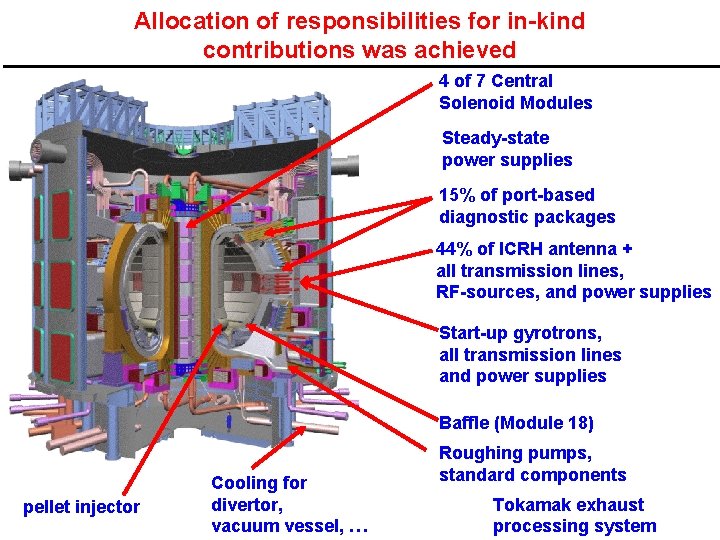
Allocation of responsibilities for in-kind contributions was achieved 4 of 7 Central Solenoid Modules Steady-state power supplies 15% of port-based diagnostic packages 44% of ICRH antenna + all transmission lines, RF-sources, and power supplies Start-up gyrotrons, all transmission lines and power supplies Baffle (Module 18) pellet injector Cooling for divertor, vacuum vessel, … Roughing pumps, standard components Tokamak exhaust processing system
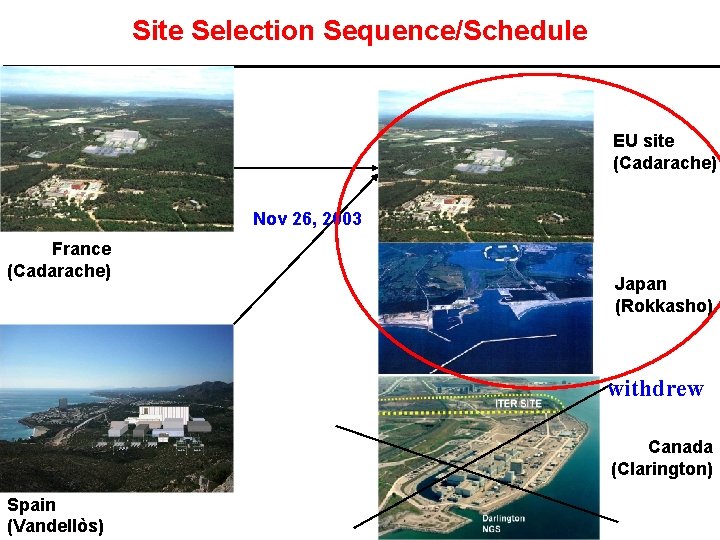
Site Selection Sequence/Schedule EU site (Cadarache) Nov 26, 2003 France (Cadarache) Japan (Rokkasho) withdrew Canada (Clarington) Spain (Vandellòs)
Scientific and technological work continues • Despite the lack of site-decision, technical work continues – completing R&D and design on in-kind contributions – Manufacturing studies and vendor qualification • The International Tokamak Physics Activity is identifying and addressing key scientific questions that relate to the performance of burning plasmas – Supporting the design activity – Leading to more effective research on ITER by • Improving understanding • Discovering new integrated scenarios to exploit understanding • Building integrated tools and simulations • Developing a strong work-force • Integrating international topical teams as precursors for ITER’s research operations
Following the site-decision, innovative arrangements will be needed • Procurement systems, including in-kind contributions and change management • Resource management, with most funds remaining in the parties • Staffing by secondees, direct employees of the international organization, and contracts • Engaging the world’s industrial base for roles in management, fabrication, assembly/installation, and operations • Engaging the worldwide fusion research community to see ITER as an opportunity • Effective distributed project management the integrates the activities of the parties
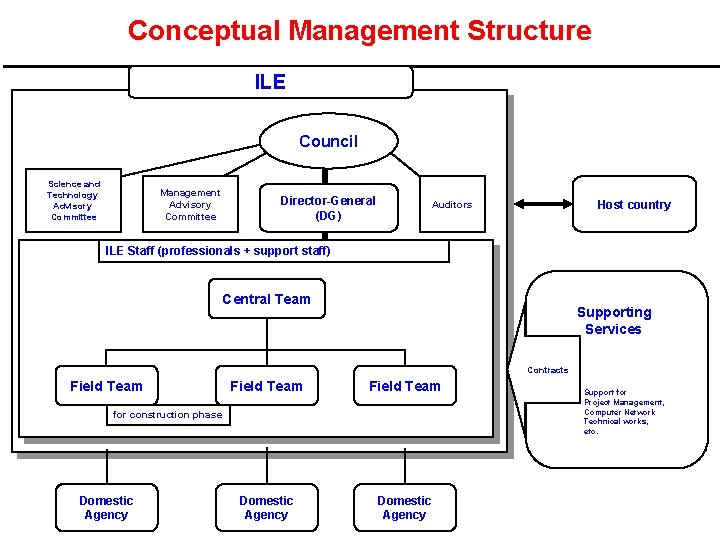
Conceptual Management Structure ILE Council Science and Technology Advisory Committee Management Advisory Committee Director-General (DG) Host country Auditors ILE Staff (professionals + support staff) Central Team Supporting Services Contracts Field Team Domestic Agency for construction phase Domestic Agency Support for Project Management, Computer Network Technical works, etc.
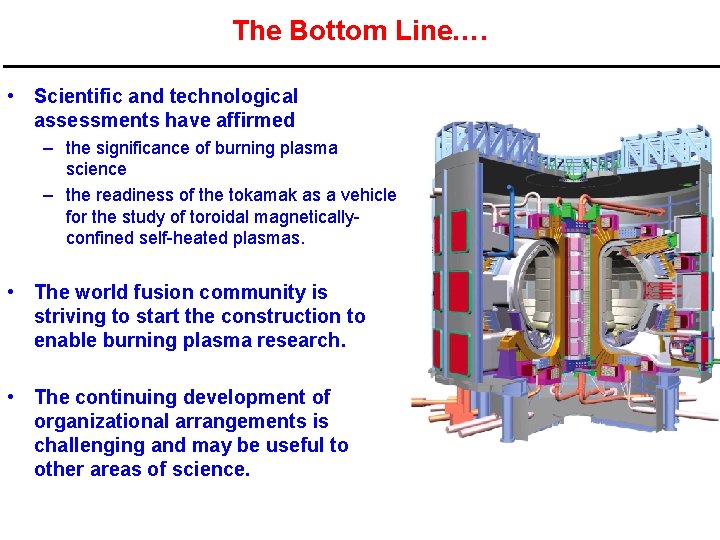
The Bottom Line…. • Scientific and technological assessments have affirmed – the significance of burning plasma science – the readiness of the tokamak as a vehicle for the study of toroidal magneticallyconfined self-heated plasmas. • The world fusion community is striving to start the construction to enable burning plasma research. • The continuing development of organizational arrangements is challenging and may be useful to other areas of science.
- Slides: 34