
Exploring Lifespan Development Third Edition Laura E Berk
Exploring Lifespan Development Third Edition Laura E. Berk Chapter 13 Physical and Cognitive Development in Early Adulthood Copyright © 2014, 2011, 2008 by Pearson Education, Inc. All Rights Reserved.
Exploring Lifespan Development Third Edition Laura E. Berk Senescence § Influences: § § genetic lifestyle environment historical period § Multidimensional and multidirectional § Average life expectancy has increased 25– 30 years over past century Copyright © 2014, 2011, 2008 by Pearson Education, Inc. All Rights Reserved.
Exploring Lifespan Development Third Edition Laura E. Berk Theories of Biological Aging DNA-Cellular Level Organ/Tissue Level § Programmed effects of specific genes: § Cross-linkage theory § Gradual failure of endocrine system § Declines in immune system functioning § “aging genes” § telomere shortening § Random events: § mutations and cancer § free radicals Copyright © 2014, 2011, 2008 by Pearson Education, Inc. All Rights Reserved.
Exploring Lifespan Development Third Edition Laura E. Berk Cardiovascular and Respiratory Changes § Heart: § few resting changes but reduced performance under stress, exercise § hypertension, atherosclerosis § disease declining due to better lifestyle § Lungs: § maximum vital capacity declines after age 25 § stiffness makes breathing harder with age Copyright © 2014, 2011, 2008 by Pearson Education, Inc. All Rights Reserved.
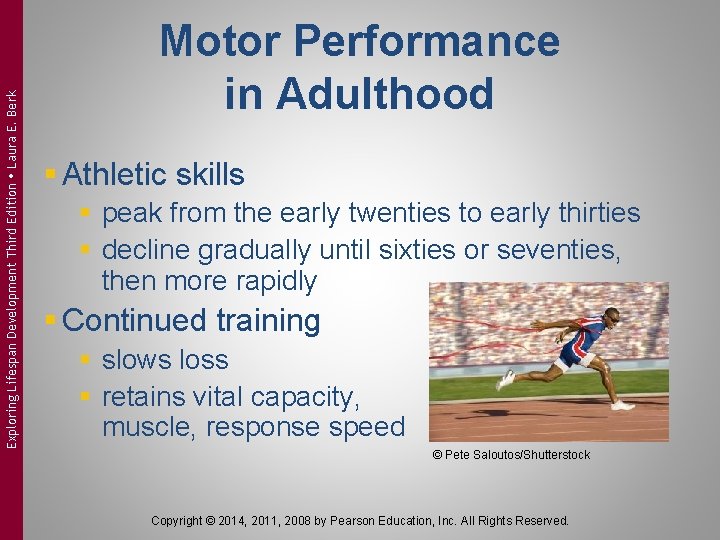
Exploring Lifespan Development Third Edition Laura E. Berk Motor Performance in Adulthood § Athletic skills § peak from the early twenties to early thirties § decline gradually until sixties or seventies, then more rapidly § Continued training § slows loss § retains vital capacity, muscle, response speed © Pete Saloutos/Shutterstock Copyright © 2014, 2011, 2008 by Pearson Education, Inc. All Rights Reserved.
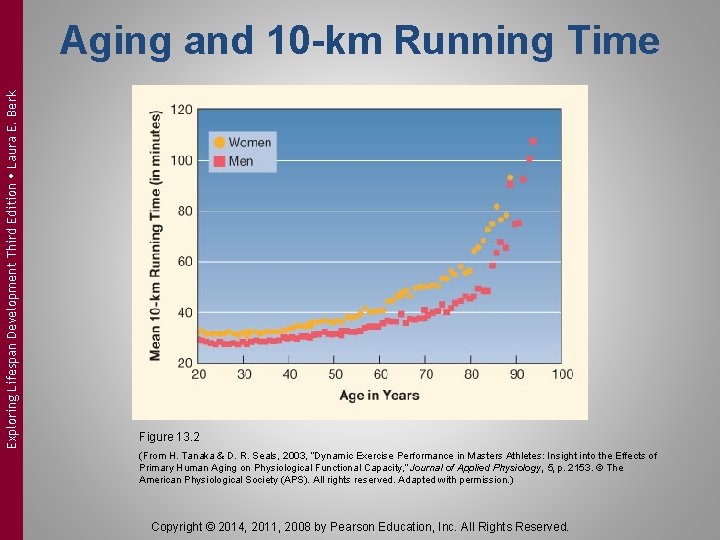
Exploring Lifespan Development Third Edition Laura E. Berk Aging and 10 -km Running Time Figure 13. 2 (From H. Tanaka & D. R. Seals, 2003, “Dynamic Exercise Performance in Masters Athletes: Insight into the Effects of Primary Human Aging on Physiological Functional Capacity, ” Journal of Applied Physiology, 5, p. 2153. © The American Physiological Society (APS). All rights reserved. Adapted with permission. ) Copyright © 2014, 2011, 2008 by Pearson Education, Inc. All Rights Reserved.
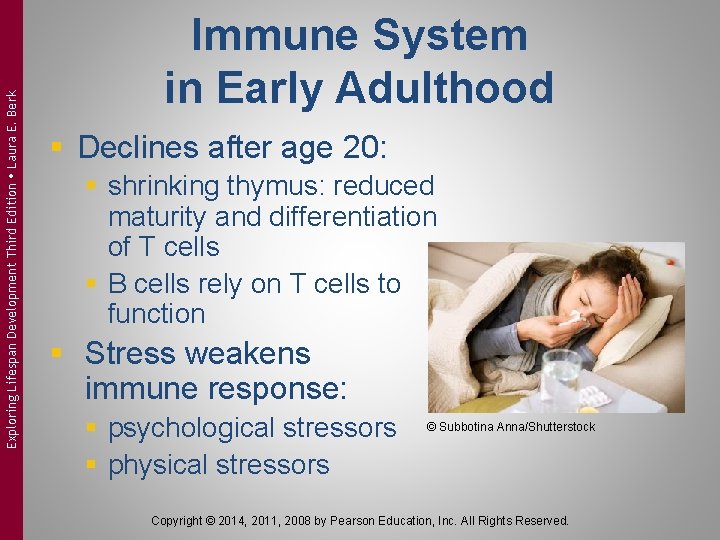
Exploring Lifespan Development Third Edition Laura E. Berk Immune System in Early Adulthood § Declines after age 20: § shrinking thymus: reduced maturity and differentiation of T cells § B cells rely on T cells to function § Stress weakens immune response: § psychological stressors § physical stressors © Subbotina Anna/Shutterstock Copyright © 2014, 2011, 2008 by Pearson Education, Inc. All Rights Reserved.
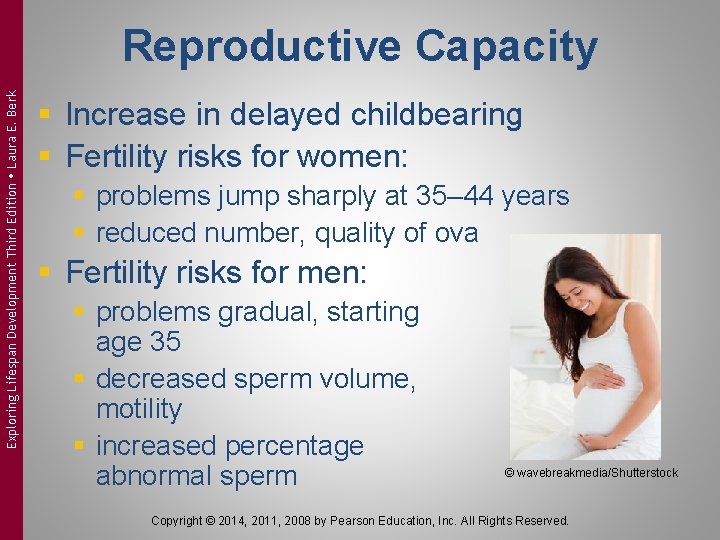
Exploring Lifespan Development Third Edition Laura E. Berk Reproductive Capacity § Increase in delayed childbearing § Fertility risks for women: § problems jump sharply at 35– 44 years § reduced number, quality of ova § Fertility risks for men: § problems gradual, starting age 35 § decreased sperm volume, motility § increased percentage abnormal sperm © wavebreakmedia/Shutterstock Copyright © 2014, 2011, 2008 by Pearson Education, Inc. All Rights Reserved.
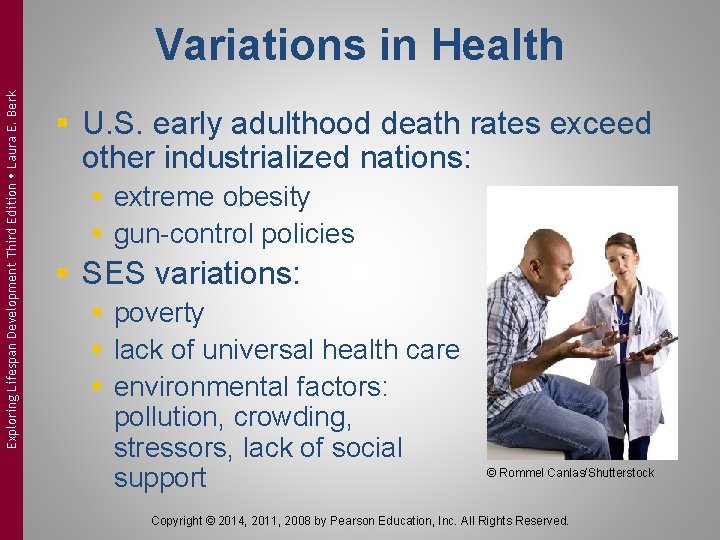
Exploring Lifespan Development Third Edition Laura E. Berk Variations in Health § U. S. early adulthood death rates exceed other industrialized nations: § extreme obesity § gun-control policies § SES variations: § poverty § lack of universal health care § environmental factors: pollution, crowding, stressors, lack of social support © Rommel Canlas/Shutterstock Copyright © 2014, 2011, 2008 by Pearson Education, Inc. All Rights Reserved.
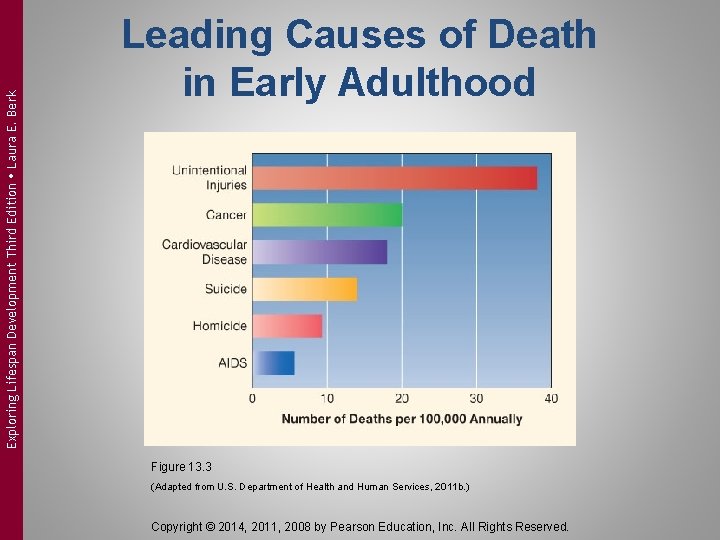
Exploring Lifespan Development Third Edition Laura E. Berk Leading Causes of Death in Early Adulthood Figure 13. 3 (Adapted from U. S. Department of Health and Human Services, 2011 b. ) Copyright © 2014, 2011, 2008 by Pearson Education, Inc. All Rights Reserved.
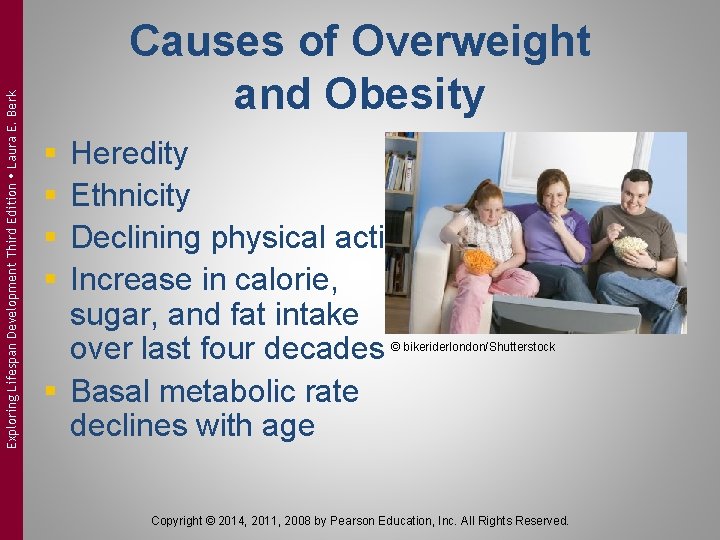
Exploring Lifespan Development Third Edition Laura E. Berk Causes of Overweight and Obesity § § Heredity Ethnicity Declining physical activity Increase in calorie, sugar, and fat intake over last four decades § Basal metabolic rate declines with age © bikeriderlondon/Shutterstock Copyright © 2014, 2011, 2008 by Pearson Education, Inc. All Rights Reserved.
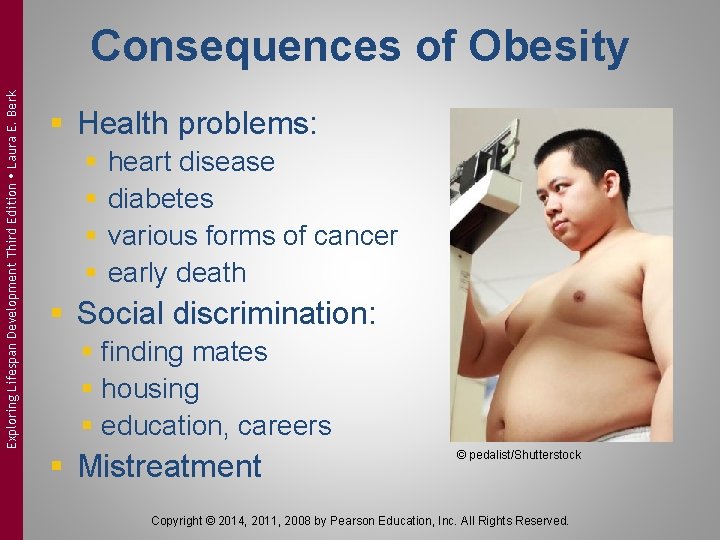
Exploring Lifespan Development Third Edition Laura E. Berk Consequences of Obesity § Health problems: § § heart disease diabetes various forms of cancer early death § Social discrimination: § finding mates § housing § education, careers § Mistreatment © pedalist/Shutterstock Copyright © 2014, 2011, 2008 by Pearson Education, Inc. All Rights Reserved.
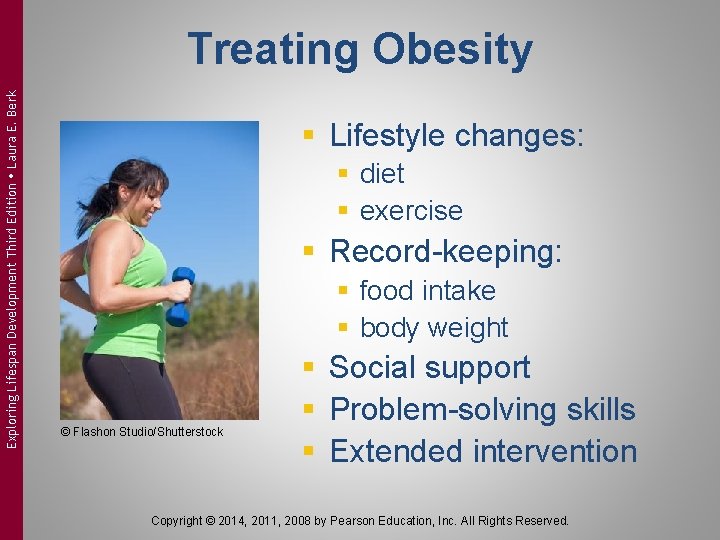
Exploring Lifespan Development Third Edition Laura E. Berk Treating Obesity § Lifestyle changes: § diet § exercise § Record-keeping: § food intake § body weight © Flashon Studio/Shutterstock § Social support § Problem-solving skills § Extended intervention Copyright © 2014, 2011, 2008 by Pearson Education, Inc. All Rights Reserved.
Exploring Lifespan Development Third Edition Laura E. Berk Dietary Fat § Saturated fat from meat and dairy § plays a role in breast and colon cancer and in heart disease § should account for 7% or less of daily calories § Replace saturated fat with unsaturated fat from fish, vegetables § Total fat should account for 30% or less of daily calories Copyright © 2014, 2011, 2008 by Pearson Education, Inc. All Rights Reserved.
Exploring Lifespan Development Third Edition Laura E. Berk Exercise § Over half of Americans are inactive: § more women than men § low SES: § less safe neighborhoods § less social support for exercising § Recommendations: § 30 minutes per day of moderately intense physical exercise § increased intensity offers greater health protection Copyright © 2014, 2011, 2008 by Pearson Education, Inc. All Rights Reserved.
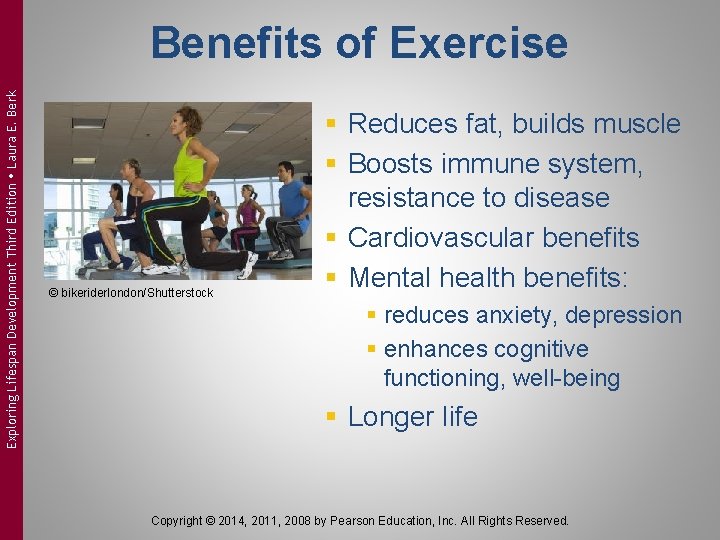
Exploring Lifespan Development Third Edition Laura E. Berk Benefits of Exercise © bikeriderlondon/Shutterstock § Reduces fat, builds muscle § Boosts immune system, resistance to disease § Cardiovascular benefits § Mental health benefits: § reduces anxiety, depression § enhances cognitive functioning, well-being § Longer life Copyright © 2014, 2011, 2008 by Pearson Education, Inc. All Rights Reserved.
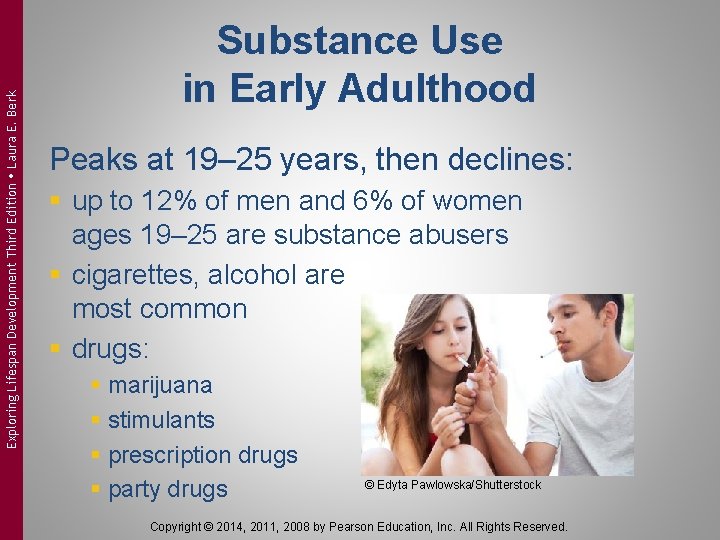
Exploring Lifespan Development Third Edition Laura E. Berk Substance Use in Early Adulthood Peaks at 19– 25 years, then declines: § up to 12% of men and 6% of women ages 19– 25 are substance abusers § cigarettes, alcohol are most common § drugs: § marijuana § stimulants § prescription drugs § party drugs © Edyta Pawlowska/Shutterstock Copyright © 2014, 2011, 2008 by Pearson Education, Inc. All Rights Reserved.
Exploring Lifespan Development Third Edition Laura E. Berk Cigarette Smoking § About 19% of U. S. adults smoke cigarettes: § numbers slowly declining § fewer college graduates; more college students, high school dropouts § more men, but gender gap shrinking § Deadly health risks § Hard to quit: most treatment programs do not use effective strategies Copyright © 2014, 2011, 2008 by Pearson Education, Inc. All Rights Reserved.
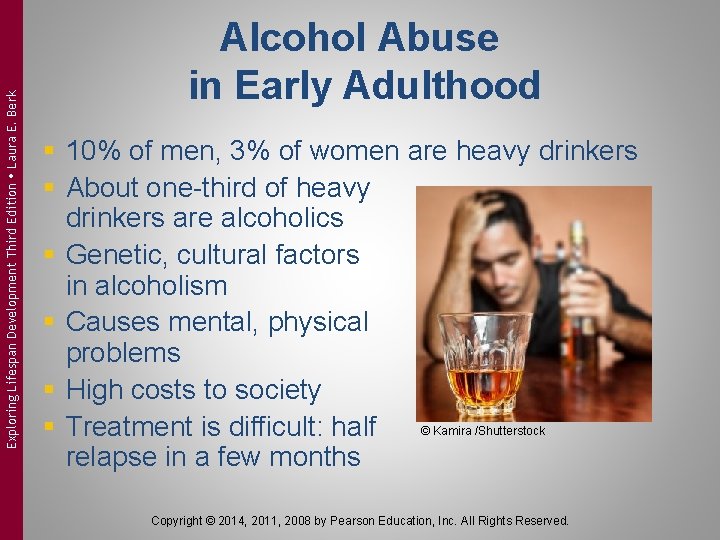
Exploring Lifespan Development Third Edition Laura E. Berk Alcohol Abuse in Early Adulthood § 10% of men, 3% of women are heavy drinkers § About one-third of heavy drinkers are alcoholics § Genetic, cultural factors in alcoholism § Causes mental, physical problems § High costs to society © Kamira /Shutterstock § Treatment is difficult: half relapse in a few months Copyright © 2014, 2011, 2008 by Pearson Education, Inc. All Rights Reserved.
Exploring Lifespan Development Third Edition Laura E. Berk Heterosexual Attitudes and Behavior § Most have intercourse by age 25 § Most sex in context of a relationship: § 70% had only one partner in past year § partners similar to each other § Sex less frequent than media suggest: § only one-third twice a week or more § more often in twenties, declines with age § Most satisfied with their sex lives; only a minority report sexual problems Copyright © 2014, 2011, 2008 by Pearson Education, Inc. All Rights Reserved.
Exploring Lifespan Development Third Edition Laura E. Berk Homosexual Attitudes and Behavior § Public acceptance growing: majority say it’s “OK, ” support civil liberties, job opportunities § Estimated 3. 5% of U. S. population are homosexual or bisexual § Sexual behavior similar to that of heterosexuals § Tend to live in larger cities, college towns Copyright © 2014, 2011, 2008 by Pearson Education, Inc. All Rights Reserved.
Exploring Lifespan Development Third Edition Laura E. Berk Factors Related to Sexual Coercion Perpetrator Characteristics § Manipulative, remorseless § Approve of violence against women § Accept rape myths § Misinterpret social cues § Childhood sexual abuse § Sexual promiscuity § Alcoholism Cultural Forces § Men taught to be dominant, competitive § Women taught to be submissive § Acceptance of violence § Dulled sensitivity due to media, pornography Copyright © 2014, 2011, 2008 by Pearson Education, Inc. All Rights Reserved.
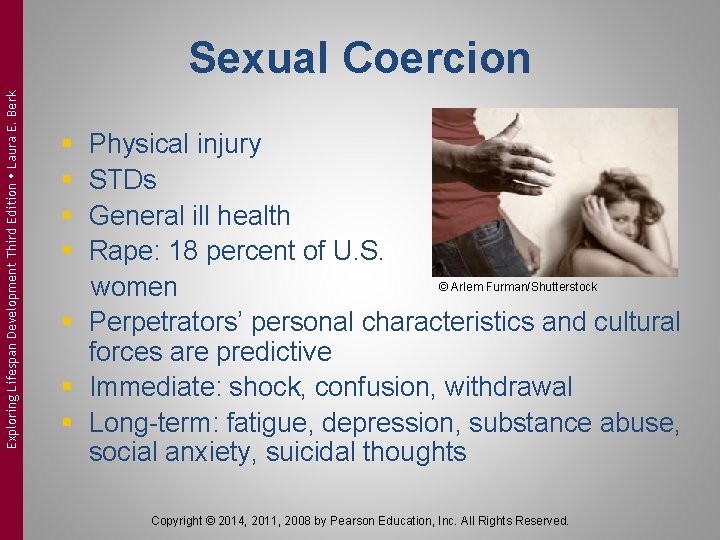
Exploring Lifespan Development Third Edition Laura E. Berk Sexual Coercion § § Physical injury STDs General ill health Rape: 18 percent of U. S. © Arlem Furman/Shutterstock women § Perpetrators’ personal characteristics and cultural forces are predictive § Immediate: shock, confusion, withdrawal § Long-term: fatigue, depression, substance abuse, social anxiety, suicidal thoughts Copyright © 2014, 2011, 2008 by Pearson Education, Inc. All Rights Reserved.
Exploring Lifespan Development Third Edition Laura E. Berk Preventing and Treating Rape and Abuse § Community services: § underfunded § few for victimized men § Routine screening § Validation of experience § Safety planning © Kenfotos/Shutterstock Copyright © 2014, 2011, 2008 by Pearson Education, Inc. All Rights Reserved.
Exploring Lifespan Development Third Edition Laura E. Berk Psychological Stress § Related to § social conditions § traumatic experiences, life events § daily hassles § Caused or worsened by low SES § Associated with § § overweight and obesity diabetes cardiovascular problems decreased immunity Copyright © 2014, 2011, 2008 by Pearson Education, Inc. All Rights Reserved.
Exploring Lifespan Development Third Edition Laura E. Berk Cognitive Changes in Early Adulthood § Piaget: § postformal thought § Perry: § epistemic cognition § Labouvie-Vief: § pragmatic thought § cognitive-affective complexity © wavebreakmedia/Shutterstock Copyright © 2014, 2011, 2008 by Pearson Education, Inc. All Rights Reserved.
Exploring Lifespan Development Third Edition Laura E. Berk Development of Epistemic Cognition § § Dualistic thinking Relativistic thinking Commitment within relativistic thinking Contributing factors: § opportunities to tackle challenging ill-structured problems § peer interaction § metacognition Copyright © 2014, 2011, 2008 by Pearson Education, Inc. All Rights Reserved.
Exploring Lifespan Development Third Edition Laura E. Berk Development of Pragmatic Thought § Adulthood brings § increased experience with real-world problems § new ways of thinking that thrive on contradiction and compromise § Increase in cognitive-affective complexity: § greater awareness of one’s own and others’ perspectives § improved emotion regulation Copyright © 2014, 2011, 2008 by Pearson Education, Inc. All Rights Reserved.
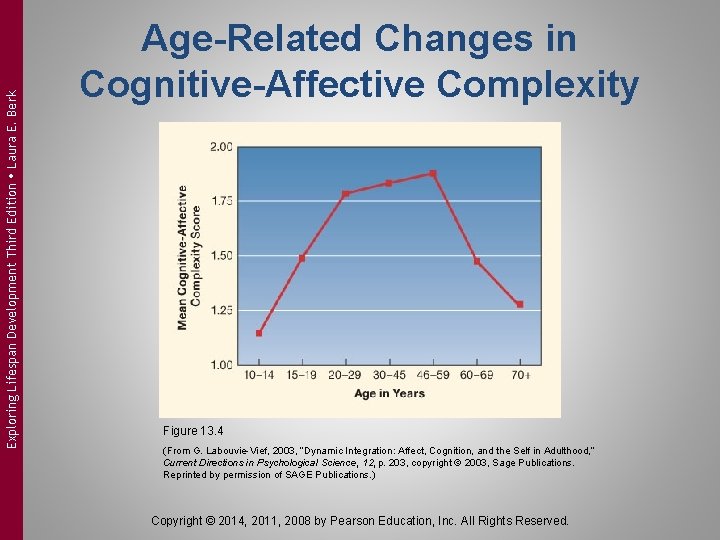
Exploring Lifespan Development Third Edition Laura E. Berk Age-Related Changes in Cognitive-Affective Complexity Figure 13. 4 (From G. Labouvie-Vief, 2003, “Dynamic Integration: Affect, Cognition, and the Self in Adulthood, ” Current Directions in Psychological Science, 12, p. 203, copyright © 2003, Sage Publications. Reprinted by permission of SAGE Publications. ) Copyright © 2014, 2011, 2008 by Pearson Education, Inc. All Rights Reserved.
Exploring Lifespan Development Third Edition Laura E. Berk Expertise and Creativity § Expertise: § acquisition of extensive knowledge in a field § takes many years § enhances information processing § Essential for creativity: § § move to problem finding 10 -year rule rise in creative productivity in early adulthood requires multiple personal qualities Copyright © 2014, 2011, 2008 by Pearson Education, Inc. All Rights Reserved.
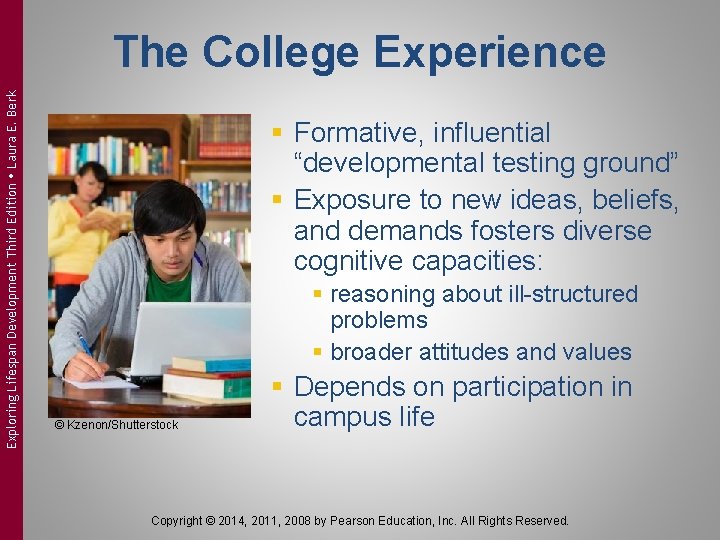
Exploring Lifespan Development Third Edition Laura E. Berk The College Experience § Formative, influential “developmental testing ground” § Exposure to new ideas, beliefs, and demands fosters diverse cognitive capacities: § reasoning about ill-structured problems § broader attitudes and values © Kzenon/Shutterstock § Depends on participation in campus life Copyright © 2014, 2011, 2008 by Pearson Education, Inc. All Rights Reserved.
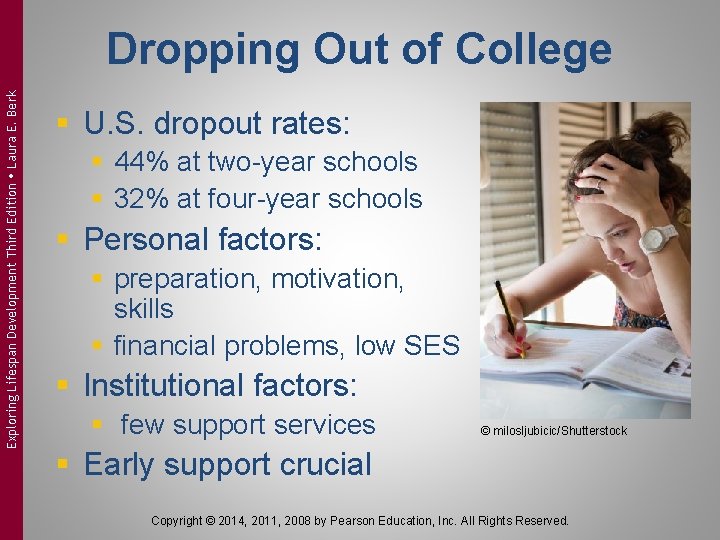
Exploring Lifespan Development Third Edition Laura E. Berk Dropping Out of College § U. S. dropout rates: § 44% at two-year schools § 32% at four-year schools § Personal factors: § preparation, motivation, skills § financial problems, low SES § Institutional factors: § few support services © milosljubicic/Shutterstock § Early support crucial Copyright © 2014, 2011, 2008 by Pearson Education, Inc. All Rights Reserved.
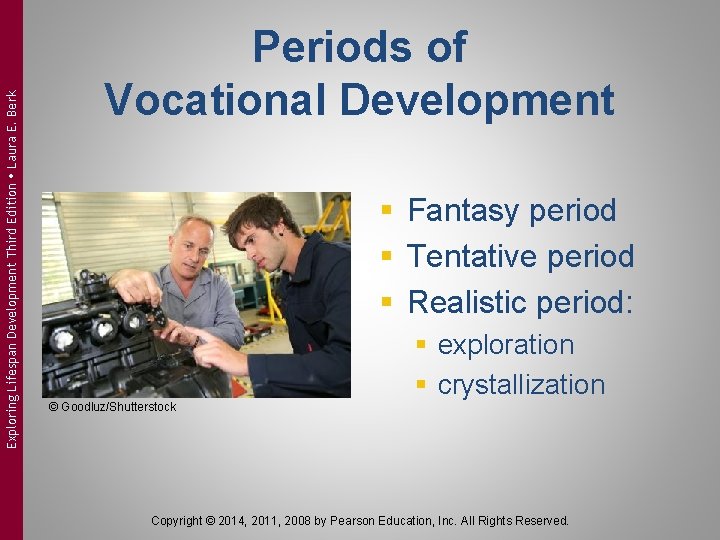
Exploring Lifespan Development Third Edition Laura E. Berk Periods of Vocational Development § Fantasy period § Tentative period § Realistic period: © Goodluz/Shutterstock § exploration § crystallization Copyright © 2014, 2011, 2008 by Pearson Education, Inc. All Rights Reserved.
Exploring Lifespan Development Third Edition Laura E. Berk Factors Influencing Vocational Choice § Personality § Family influences: § parent–child vocational similarity § Teachers § Gender stereotypes: © michaeljung/Shutterstock § gender-role conformity diminishing slowly Copyright © 2014, 2011, 2008 by Pearson Education, Inc. All Rights Reserved.
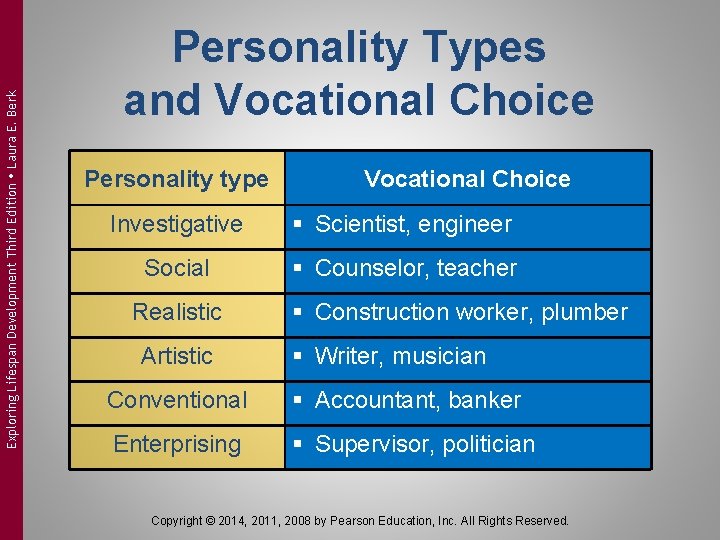
Exploring Lifespan Development Third Edition Laura E. Berk Personality Types and Vocational Choice Personality type Vocational Choice Investigative § Scientist, engineer Social § Counselor, teacher Realistic Artistic § Construction worker, plumber § Writer, musician Conventional § Accountant, banker Enterprising § Supervisor, politician Copyright © 2014, 2011, 2008 by Pearson Education, Inc. All Rights Reserved.
Exploring Lifespan Development Third Edition Laura E. Berk Vocational Preparation of Non-College-Bound Young Adults § U. S. high school graduates poorly prepared for skilled occupations § Lack vocational placement, counseling services § Work–study apprenticeships can help: § European model programs § rare in the United States Copyright © 2014, 2011, 2008 by Pearson Education, Inc. All Rights Reserved.

Exploring Lifespan Development Third Edition Laura E. Berk Readers may view, browse, and/or download material for temporary copying purposes only, provided these uses are for noncommercial personal purposes. Except as provided by law, this material may not be further reproduced, distributed, transmitted, modified, adapted, performed, displayed, published, or sold in whole or in part, without prior written permission from the publisher. Copyright © 2014, 2011, 2008 by Pearson Education, Inc. All Rights Reserved.
- Slides: 37