
Exploring Life Chapter 9 Lesson 3 The Development
- Slides: 13
Exploring Life Chapter 9 Lesson 3
The Development of Microscopes � The invention of microscopes enabled people to see details of living things that could not be seen with the unaided eye. � One of the first microscopes, invented by Anton van Leeuwenhoek in the late 1600 s, could magnify an image about 270 times its original size.
The Development of Microscopes (cont. ) In the early 1700 s Robert Hooke used a microscope to observe and name cells for the first time.
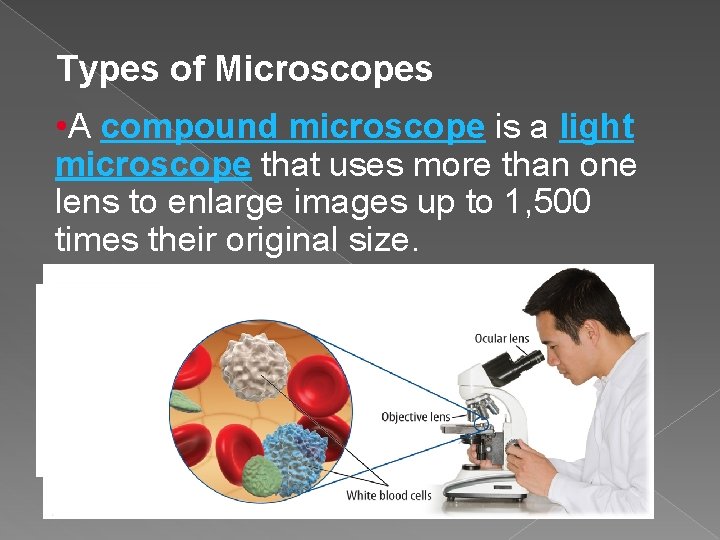
Types of Microscopes • A compound microscope is a light microscope that uses more than one lens to enlarge images up to 1, 500 times their original size.
Types of Microscopes (cont. ) • An electron microscope can magnify an image up to 100, 000 times or more. • Because objects must be mounted in plastic and sliced, a transmission electron microscope (TEM) can only be used to view nonliving objects.
Types of Microscopes (cont. ) • A scanning electron microscope (SEM) is used to view a threedimensional image of an object.
Using Microscopes • Microscopes can assist doctors by enabling them to view a surgical area in greater detail.
Using Microscopes (cont. ) � There are many uses for microscopes in fields in addition to health care: • Forensic scientists use microscopes to study evidence from crime scenes. • People who study fossils use microscopes to examine fossils and other materials from where fossils are found.
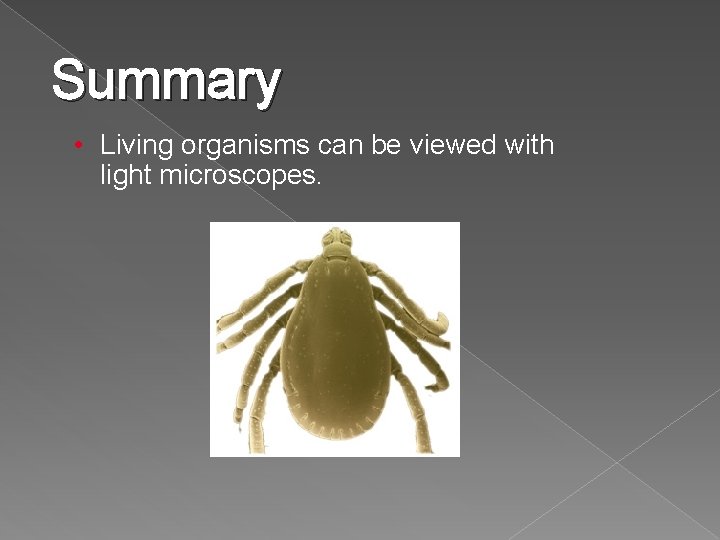
Summary • Living organisms can be viewed with light microscopes.
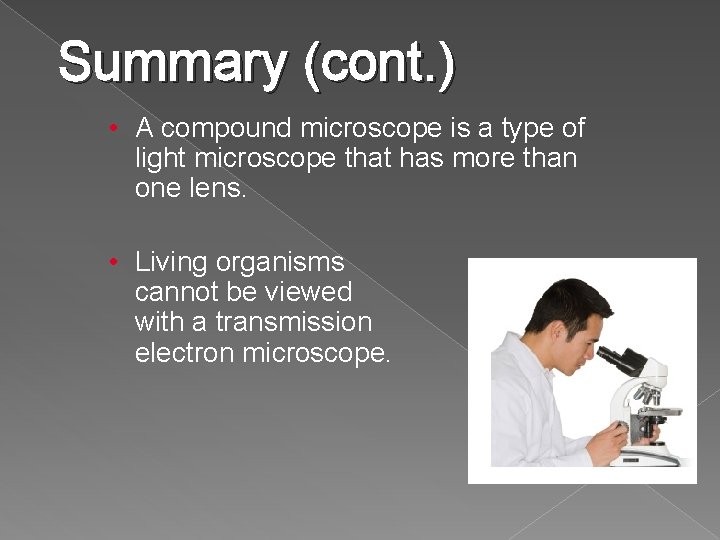
Summary (cont. ) • A compound microscope is a type of light microscope that has more than one lens. • Living organisms cannot be viewed with a transmission electron microscope.
Review Questions Anton van Leeuwenhoek’s early version of the microscope could magnify an image to about how many times its original size? A. 2 C. 100, 000 B. 100 D. 270
What type of microscopes use more than one lens to magnify an image up to 1, 500 times its original size? A. transmission electron microscope B. scanning electron microscope C. compound microscope D. electron microscope
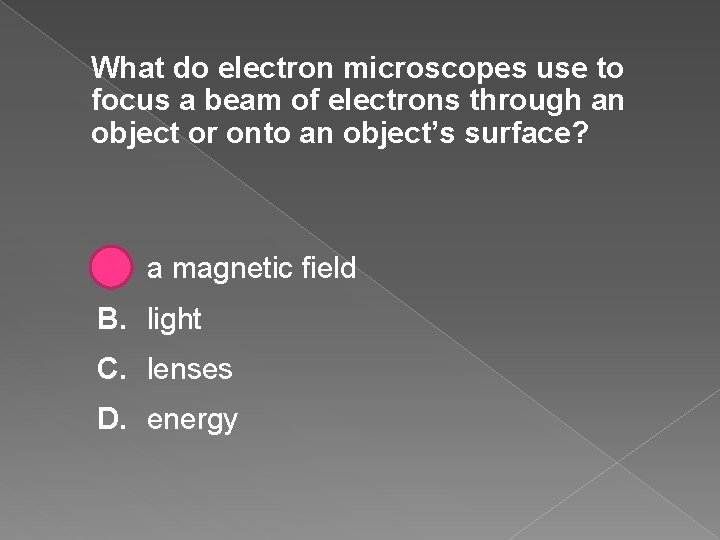
What do electron microscopes use to focus a beam of electrons through an object or onto an object’s surface? A. a magnetic field B. light C. lenses D. energy