
Exploring Life Chapter 1 General Biology Science Majors
Exploring Life Chapter 1 General Biology – Science Majors I – 1406
What is Biology? • Biology is the science of life and of living organisms, including their structure, function, growth, origin, evolution, and distribution.
Unifying Themes Three Major Groups: 1. Exploring Life on Its Many Levels 2. Evolution, Unity, and Diversity 3. The Process of Science
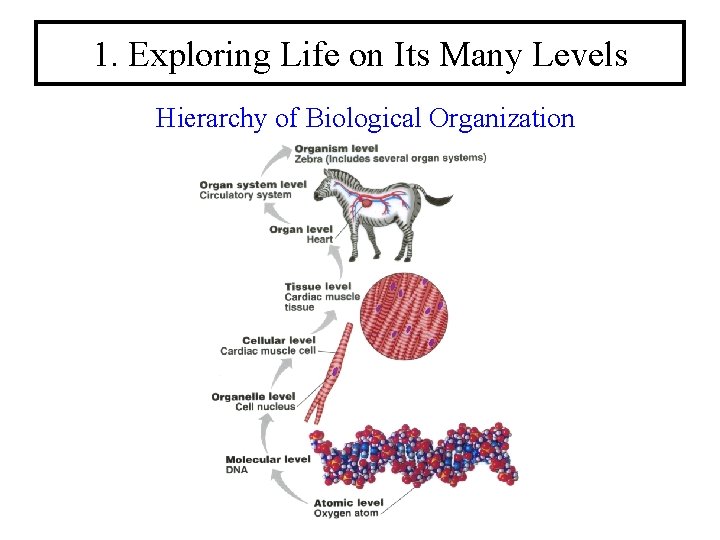
1. Exploring Life on Its Many Levels Hierarchy of Biological Organization

2. Emergent Properties of Life Reproduction • All organisms are capable of reproducing and passing their genetic material to their offspring. • Organisms reproduce only their own kind. • Life comes only from life.

Emergent Properties of Life Growth and Development • All organisms are capable of growing. • DNA directs the pattern of growth and development of an organism.
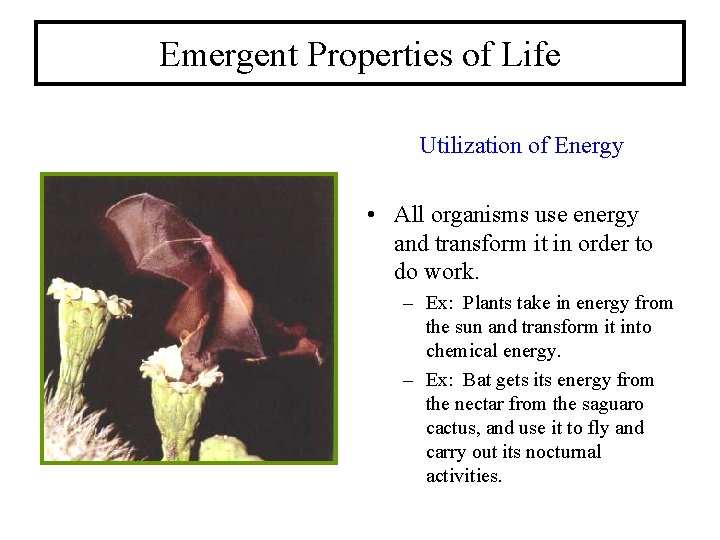
Emergent Properties of Life Utilization of Energy • All organisms use energy and transform it in order to do work. – Ex: Plants take in energy from the sun and transform it into chemical energy. – Ex: Bat gets its energy from the nectar from the saguaro cactus, and use it to fly and carry out its nocturnal activities.
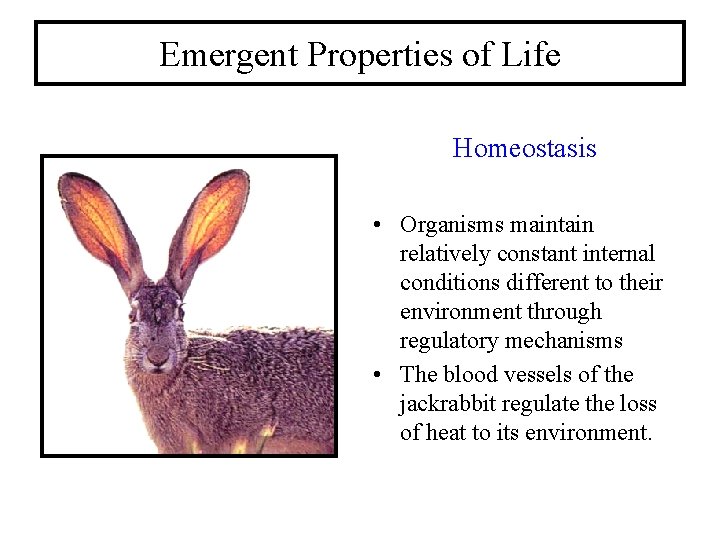
Emergent Properties of Life Homeostasis • Organisms maintain relatively constant internal conditions different to their environment through regulatory mechanisms • The blood vessels of the jackrabbit regulate the loss of heat to its environment.
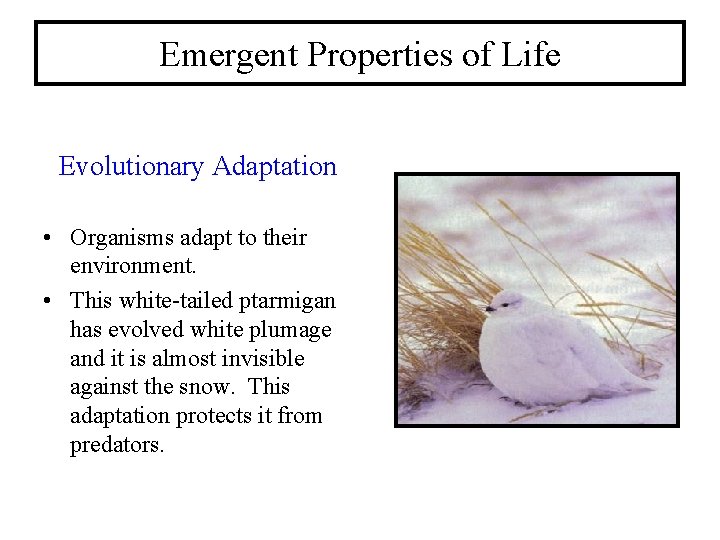
Emergent Properties of Life Evolutionary Adaptation • Organisms adapt to their environment. • This white-tailed ptarmigan has evolved white plumage and it is almost invisible against the snow. This adaptation protects it from predators.
Cells the Basic Units of Structure & Function The Cell Theory Three Basic Principles: 1. All organisms are made up of one or more cells 2. Cells are the smallest unit of life 3. Cells come from preexisting cells
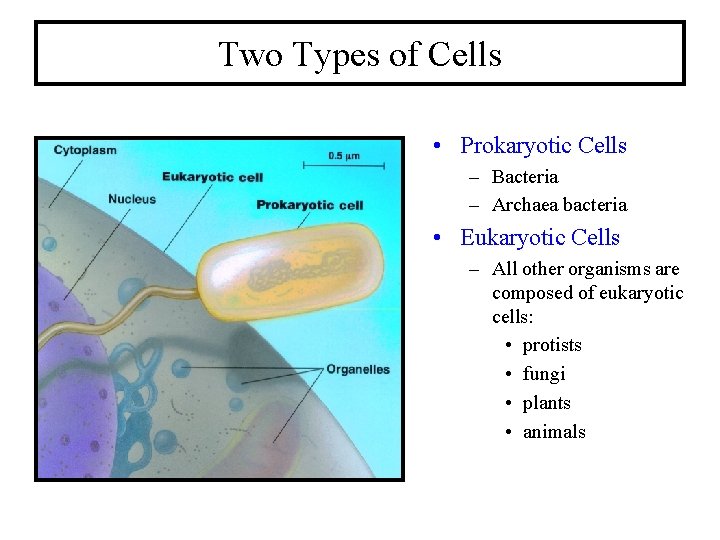
Two Types of Cells • Prokaryotic Cells – Bacteria – Archaea bacteria • Eukaryotic Cells – All other organisms are composed of eukaryotic cells: • protists • fungi • plants • animals
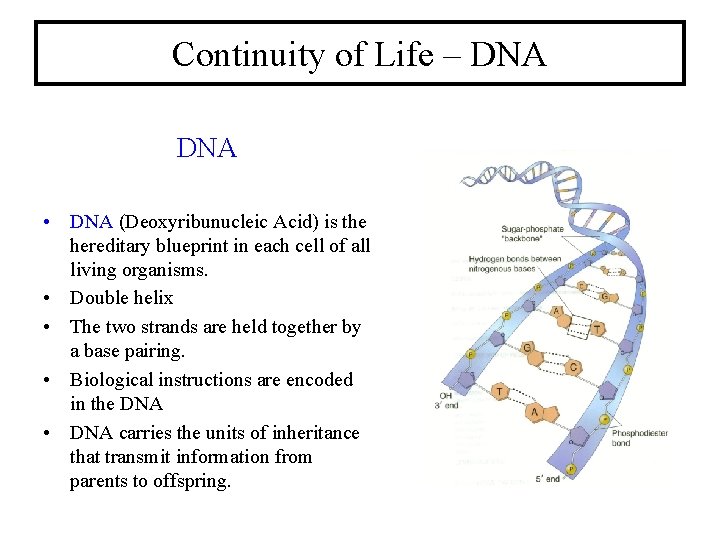
Continuity of Life – DNA • DNA (Deoxyribunucleic Acid) is the hereditary blueprint in each cell of all living organisms. • Double helix • The two strands are held together by a base pairing. • Biological instructions are encoded in the DNA • DNA carries the units of inheritance that transmit information from parents to offspring.
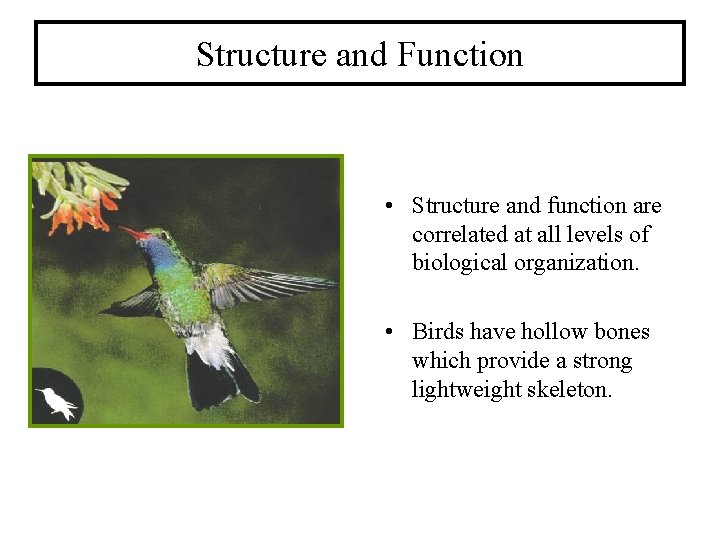
Structure and Function • Structure and function are correlated at all levels of biological organization. • Birds have hollow bones which provide a strong lightweight skeleton.
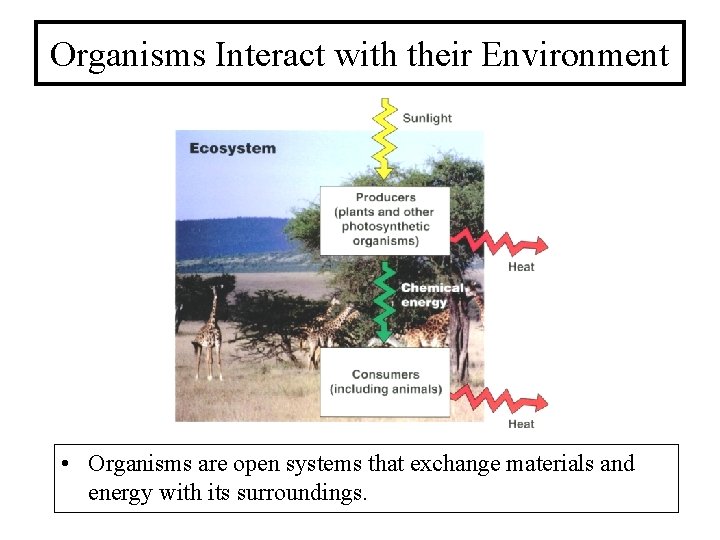
Organisms Interact with their Environment • Organisms are open systems that exchange materials and energy with its surroundings.
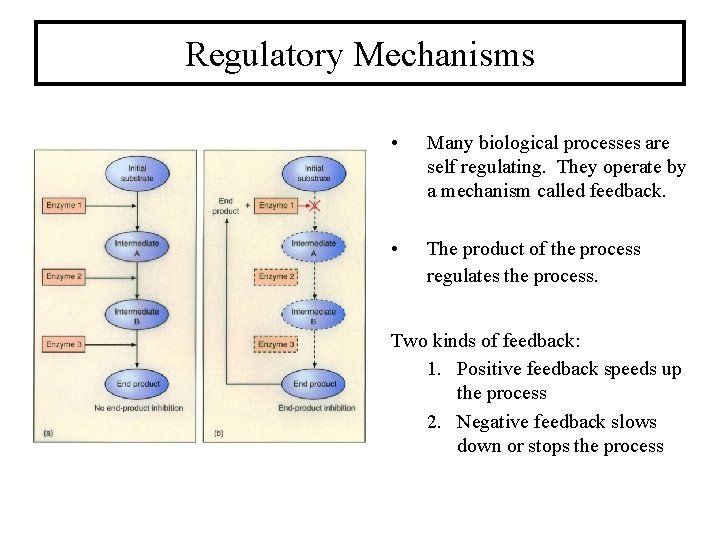
Regulatory Mechanisms • Many biological processes are self regulating. They operate by a mechanism called feedback. • The product of the process regulates the process. Two kinds of feedback: 1. Positive feedback speeds up the process 2. Negative feedback slows down or stops the process
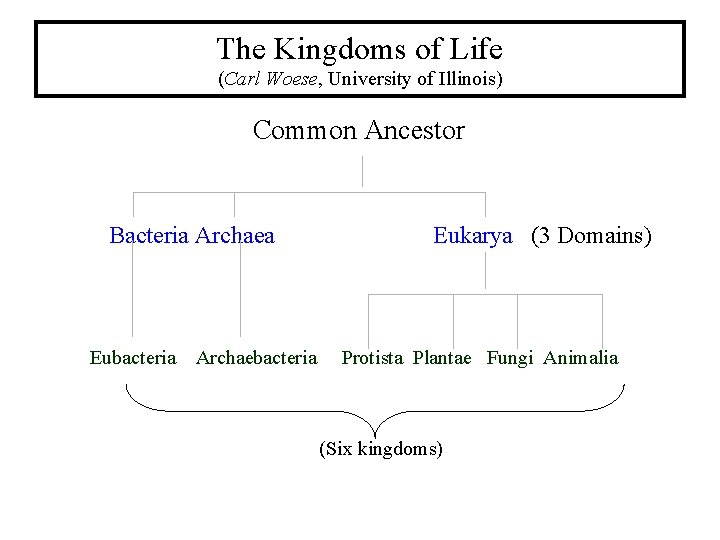
The Kingdoms of Life (Carl Woese, University of Illinois) Common Ancestor Bacteria Archaea Eubacteria Archaebacteria Eukarya (3 Domains) Protista Plantae Fungi Animalia (Six kingdoms) (Ref: Life the Science of Biology, 5 th Edition, 1998)
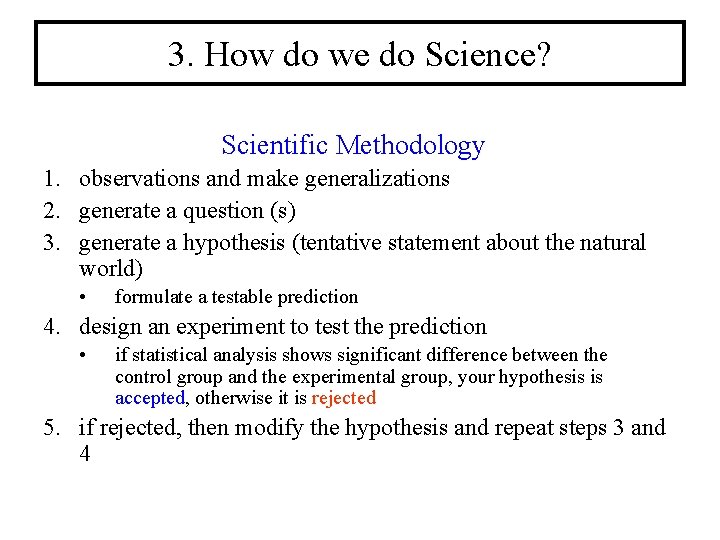
3. How do we do Science? Scientific Methodology 1. observations and make generalizations 2. generate a question (s) 3. generate a hypothesis (tentative statement about the natural world) • formulate a testable prediction 4. design an experiment to test the prediction • if statistical analysis shows significant difference between the control group and the experimental group, your hypothesis is accepted, otherwise it is rejected 5. if rejected, then modify the hypothesis and repeat steps 3 and 4
What is a Hypothesis? Commonly – A hypothesis is an idea of “how things work”. Formally – A hypothesis is a tentative answer to some question.
How do we test a hypothesis? • Hypothesis testing is based on deductive reasoning. • Deductive reasoning involves making a specific prediction about the outcome of an action and is based on observable facts. • Thus, deductive reasoning takes the “if/then” statements.
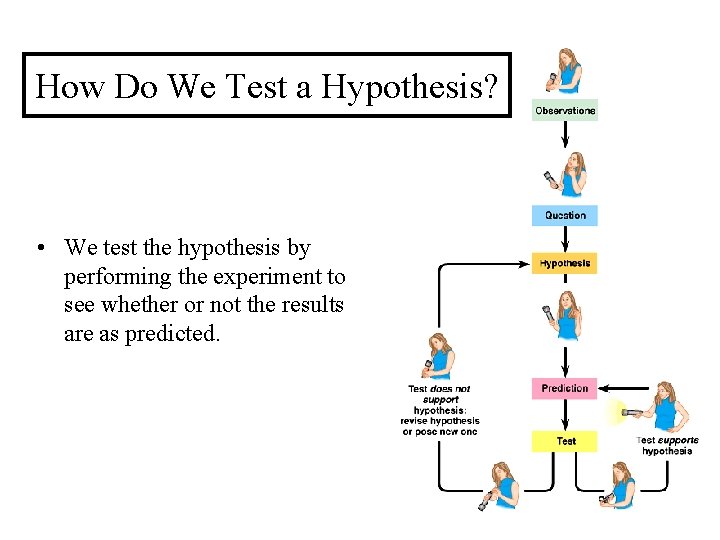
How Do We Test a Hypothesis? • We test the hypothesis by performing the experiment to see whether or not the results are as predicted.
Experimental Method Experiments are designed to test hypotheses. – Controlled Experiments • Control Group – data from a control group are used as baseline values for comparison to the measurements of the experimental group. • Experimental Group – data from the experimental group are compared against the control group and determine whether the hypothesis being tested is accepted or rejected. Example of an unbiased experimental design: • Double-blind experiments
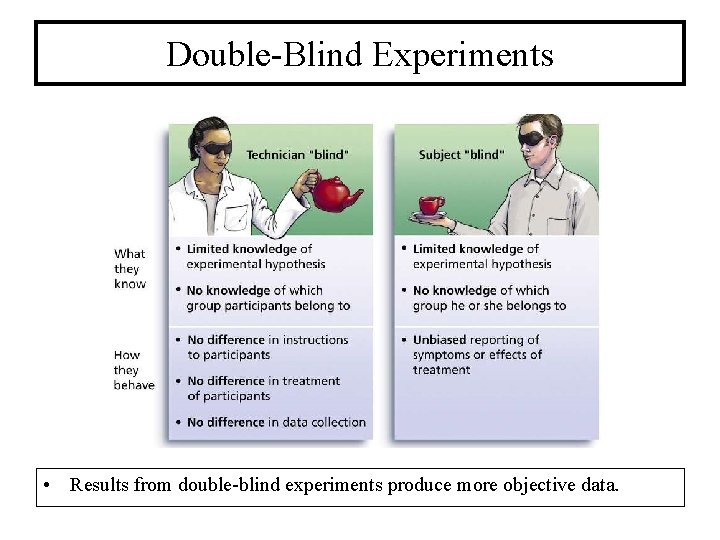
Double-Blind Experiments • Results from double-blind experiments produce more objective data.
Analysis of the Data • The data that is collected from an experiment must be statistically analyzed. • Statistically significant results indicate that there is a 5% probability or less that the results may be due to chance alone. • Types of statistical analysis include: – – Correlation between two variables Analysis of Variance t-test Multivariate tests • If the results of the statistical analysis do not support the hypothesis, then the hypothesis is rejected.
Evaluating Scientific Information Primary Sources • New findings are published in scientific journals for peer review. – A group of scientists (peers) scrutinize the article before they approve it for publication • Scientific journals contain the most recent and accurate scientific information. • After a hypothesis has been tested extensively and the results support the hypothesis then the hypothesis becomes a theory. • A theory is the highest degree that a hypothesis can ever achieve. – Ex. Theory of Evolution by Charles Darwin provides a good example of how scientific theory grows and wins acceptance.
Critical Thinking • Skepticism – questionable attitude – what are the credentials of the individual making the statement? – is there verifiable evidence to support the statement? – is there a political or monetary incentive behind the statement? • Most scientists are skeptical about radical findings – Ex. Stomach ulcers • The scientist who discovered that most stomach ulcers are caused by Heliobacter pylori bacteria encountered much ridicule from the scientific world because stomach ulcers were believed to be caused by stress.
Critical Thinking • The validity of a statement is supported by sound statistical analysis. • Beware of the claims made by nonscientists and even by some scientists. • If the claim states something like “scientific research proved that …” be very careful because – Scientific studies NEVER prove anything. – Scientists conduct research to test a hypothesis, to disprove a hypothesis.
Are there any limitations to science? Is science limited? YES !!! • Science is based on testable facts. • Science cannot be applied to: – religious beliefs because they are based on faith • faith cannot be tested – morals, value judgments, social issues, attitudes, love, or supernatural forces
Science is Self-Correcting • Science is limited by the ability of the scientists to collect data and interpret data. • New advances in technology have made it possible for science to correct misinterpreted data. New interpretation replaces the old incorrect information. Example: • belief that the earth was merely 6000 years old. • belief that the sun revolved around the earth.
- Slides: 28