
Exploring Language Comparing written and spoken texts Friday
- Slides: 9
Exploring Language Comparing written and spoken texts Friday th 15 January 2021 Today’s lesson • Recap terminology • Complete practice question (55 mins)
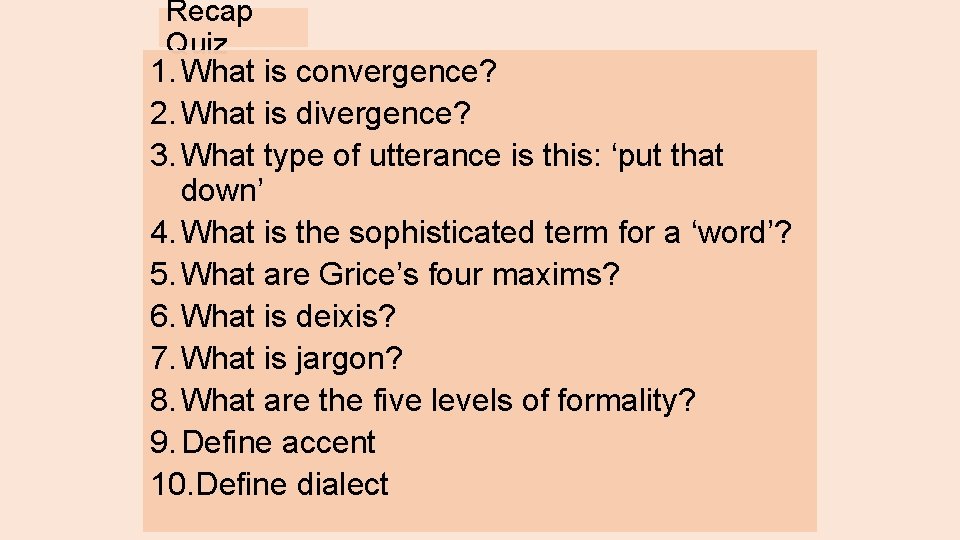
Recap Quiz 1. What is convergence? 2. What is divergence? 3. What type of utterance is this: ‘put that down’ 4. What is the sophisticated term for a ‘word’? 5. What are Grice’s four maxims? 6. What is deixis? 7. What is jargon? 8. What are the five levels of formality? 9. Define accent 10. Define dialect
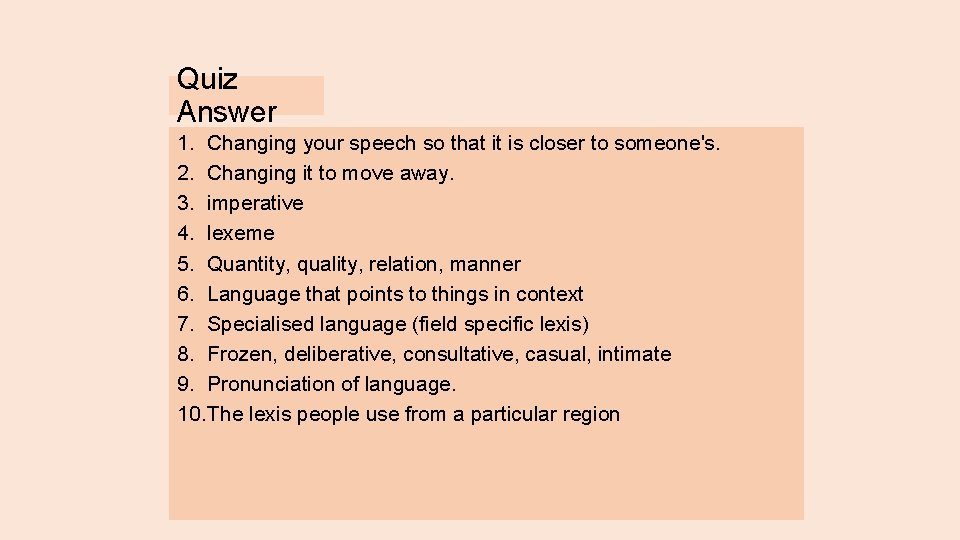
Quiz Answer 1. Changing your speech so that it is closer to someone's. 2. Changing it to move away. 3. imperative 4. lexeme 5. Quantity, quality, relation, manner 6. Language that points to things in context 7. Specialised language (field specific lexis) 8. Frozen, deliberative, consultative, casual, intimate 9. Pronunciation of language. 10. The lexis people use from a particular region
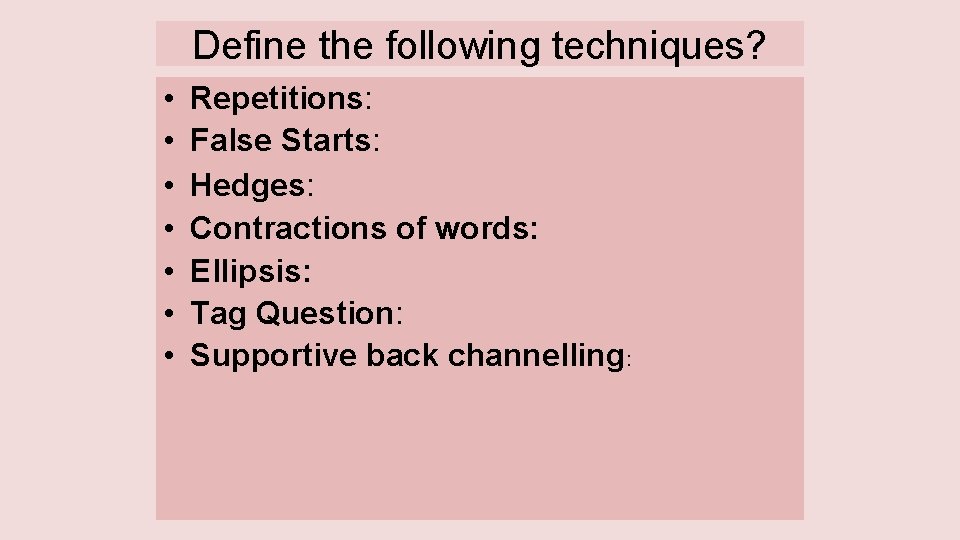
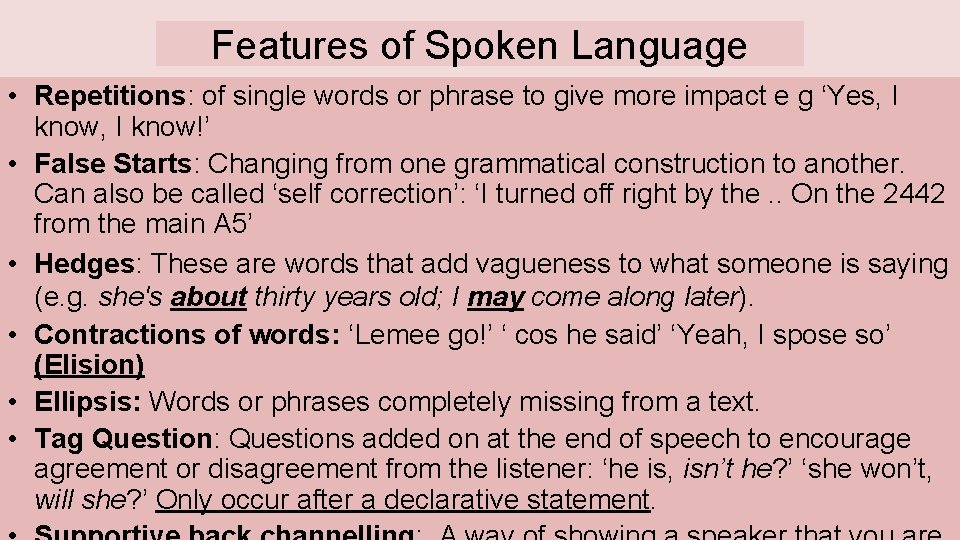
Define the following techniques? • • Repetitions: False Starts: Hedges: Contractions of words: Ellipsis: Tag Question: Supportive back channelling:
Features of Spoken Language • Repetitions: of single words or phrase to give more impact e g ‘Yes, I know!’ • False Starts: Changing from one grammatical construction to another. Can also be called ‘self correction’: ‘I turned off right by the. . On the 2442 from the main A 5’ • Hedges: These are words that add vagueness to what someone is saying (e. g. she's about thirty years old; I may come along later). • Contractions of words: ‘Lemee go!’ ‘ cos he said’ ‘Yeah, I spose so’ (Elision) • Ellipsis: Words or phrases completely missing from a text. • Tag Question: Questions added on at the end of speech to encourage agreement or disagreement from the listener: ‘he is, isn’t he? ’ ‘she won’t, will she? ’ Only occur after a declarative statement.
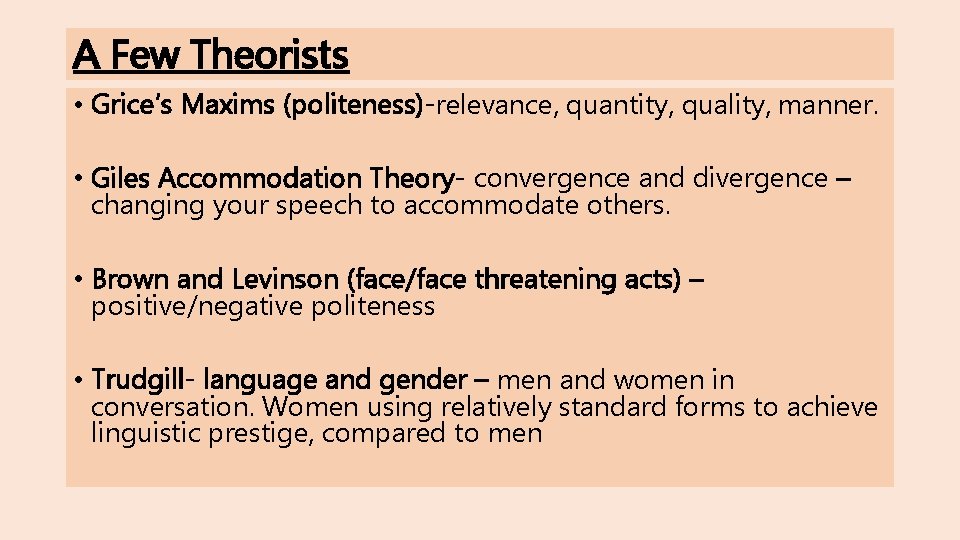
A Few Theorists • Grice’s Maxims (politeness)-relevance, quantity, quality, manner. • Giles Accommodation Theory- convergence and divergence – changing your speech to accommodate others. • Brown and Levinson (face/face threatening acts) – positive/negative politeness • Trudgill- language and gender – men and women in conversation. Women using relatively standard forms to achieve linguistic prestige, compared to men
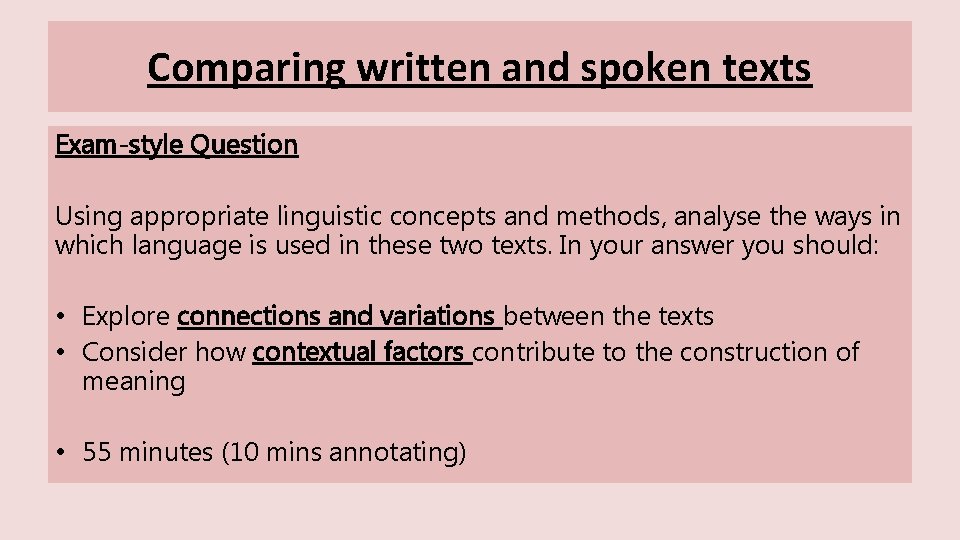
Comparing written and spoken texts Exam-style Question Using appropriate linguistic concepts and methods, analyse the ways in which language is used in these two texts. In your answer you should: • Explore connections and variations between the texts • Consider how contextual factors contribute to the construction of meaning • 55 minutes (10 mins annotating)
Task • Complete question 2 of the past paper, allowing 55 minutes, including 10 minutes to annotate each of the texts (B and C). • You may refer to your notes if you wish.
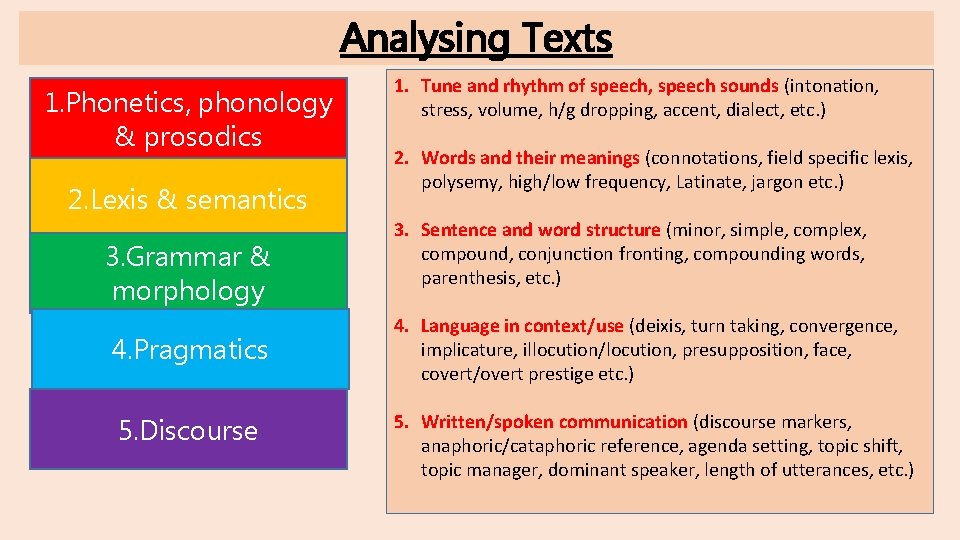
Analysing Texts 1. Phonetics, phonology & prosodics 2. Lexis & semantics 3. Grammar & morphology 4. Pragmatics 5. Discourse 1. Tune and rhythm of speech, speech sounds (intonation, stress, volume, h/g dropping, accent, dialect, etc. ) 2. Words and their meanings (connotations, field specific lexis, polysemy, high/low frequency, Latinate, jargon etc. ) 3. Sentence and word structure (minor, simple, complex, compound, conjunction fronting, compounding words, parenthesis, etc. ) 4. Language in context/use (deixis, turn taking, convergence, implicature, illocution/locution, presupposition, face, covert/overt prestige etc. ) 5. Written/spoken communication (discourse markers, anaphoric/cataphoric reference, agenda setting, topic shift, topic manager, dominant speaker, length of utterances, etc. )