
Exploring Journalism Ethics in Local Crime Reporting By
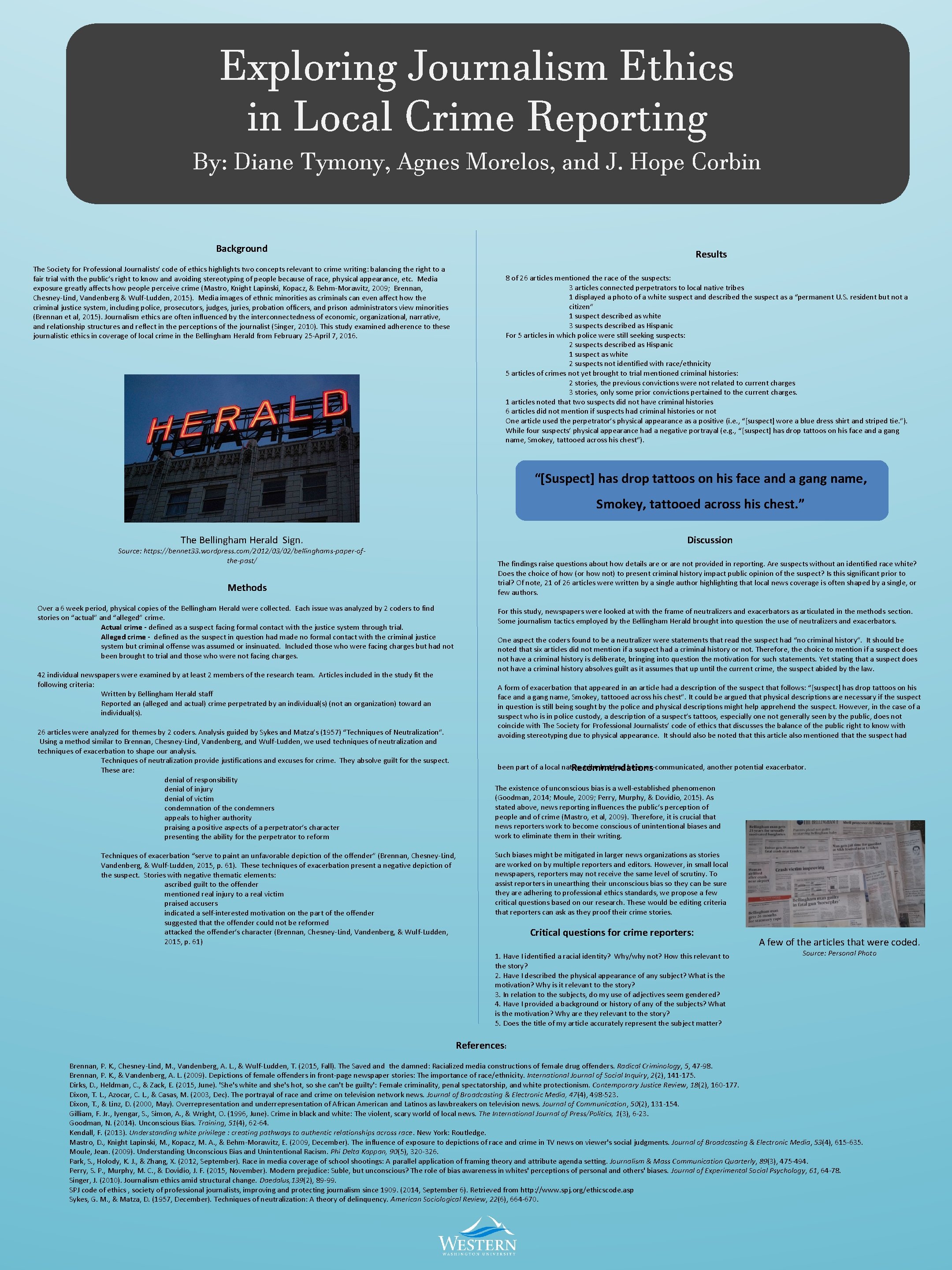
Exploring Journalism Ethics in Local Crime Reporting By: Diane Tymony, Agnes Morelos, and J. Hope Corbin Background Results The Society for Professional Journalists’ code of ethics highlights two concepts relevant to crime writing: balancing the right to a fair trial with the public’s right to know and avoiding stereotyping of people because of race, physical appearance, etc. Media exposure greatly affects how people perceive crime (Mastro, Knight Lapinski, Kopacz, & Behm-Morawitz, 2009; Brennan, Chesney-Lind, Vandenberg & Wulf-Ludden, 2015). Media images of ethnic minorities as criminals can even affect how the criminal justice system, including police, prosecutors, judges, juries, probation officers, and prison administrators view minorities (Brennan et al, 2015). Journalism ethics are often influenced by the interconnectedness of economic, organizational, narrative, and relationship structures and reflect in the perceptions of the journalist (Singer, 2010). This study examined adherence to these journalistic ethics in coverage of local crime in the Bellingham Herald from February 25 -April 7, 2016. 8 of 26 articles mentioned the race of the suspects: 3 articles connected perpetrators to local native tribes 1 displayed a photo of a white suspect and described the suspect as a “permanent U. S. resident but not a citizen” 1 suspect described as white 3 suspects described as Hispanic For 5 articles in which police were still seeking suspects: 2 suspects described as Hispanic 1 suspect as white 2 suspects not identified with race/ethnicity 5 articles of crimes not yet brought to trial mentioned criminal histories: 2 stories, the previous convictions were not related to current charges 3 stories, only some prior convictions pertained to the current charges. 1 articles noted that two suspects did not have criminal histories 6 articles did not mention if suspects had criminal histories or not One article used the perpetrator’s physical appearance as a positive (i. e. , “[suspect] wore a blue dress shirt and striped tie. ”). While four suspects’ physical appearance had a negative portrayal (e. g. , “[suspect] has drop tattoos on his face and a gang name, Smokey, tattooed across his chest”). “[Suspect] has drop tattoos on his face and a gang name, Smokey, tattooed across his chest. ” The Bellingham Herald Sign. Discussion Source: https: //bennet 33. wordpress. com/2012/03/02/bellinghams-paper-ofthe-past/ The findings raise questions about how details are or are not provided in reporting. Are suspects without an identified race white? Does the choice of how (or how not) to present criminal history impact public opinion of the suspect? Is this significant prior to trial? Of note, 21 of 26 articles were written by a single author highlighting that local news coverage is often shaped by a single, or few authors. Methods Over a 6 week period, physical copies of the Bellingham Herald were collected. Each issue was analyzed by 2 coders to find stories on “actual” and “alleged” crime. Actual crime - defined as a suspect facing formal contact with the justice system through trial. Alleged crime - defined as the suspect in question had made no formal contact with the criminal justice system but criminal offense was assumed or insinuated. Included those who were facing charges but had not been brought to trial and those who were not facing charges. For this study, newspapers were looked at with the frame of neutralizers and exacerbators as articulated in the methods section. Some journalism tactics employed by the Bellingham Herald brought into question the use of neutralizers and exacerbators. One aspect the coders found to be a neutralizer were statements that read the suspect had “no criminal history”. It should be noted that six articles did not mention if a suspect had a criminal history or not. Therefore, the choice to mention if a suspect does not have a criminal history is deliberate, bringing into question the motivation for such statements. Yet stating that a suspect does not have a criminal history absolves guilt as it assumes that up until the current crime, the suspect abided by the law. 42 individual newspapers were examined by at least 2 members of the research team. Articles included in the study fit the following criteria: Written by Bellingham Herald staff Reported an (alleged and actual) crime perpetrated by an individual(s) (not an organization) toward an individual(s). A form of exacerbation that appeared in an article had a description of the suspect that follows: “[suspect] has drop tattoos on his face and a gang name, Smokey, tattooed across his chest”. It could be argued that physical descriptions are necessary if the suspect in question is still being sought by the police and physical descriptions might help apprehend the suspect. However, in the case of a suspect who is in police custody, a description of a suspect’s tattoos, especially one not generally seen by the public, does not coincide with The Society for Professional Journalists’ code of ethics that discusses the balance of the public right to know with avoiding stereotyping due to physical appearance. It should also be noted that this article also mentioned that the suspect had 26 articles were analyzed for themes by 2 coders. Analysis guided by Sykes and Matza’s (1957) “Techniques of Neutralization”. Using a method similar to Brennan, Chesney-Lind, Vandenberg, and Wulf-Ludden, we used techniques of neutralization and techniques of exacerbation to shape our analysis. Techniques of neutralization provide justifications and excuses for crime. They absolve guilt for the suspect. These are: denial of responsibility denial of injury denial of victim condemnation of the condemners appeals to higher authority praising a positive aspects of a perpetrator’s character presenting the ability for the perpetrator to reform been part of a local native tribe but had been ex-communicated, another potential exacerbator. Recommendations The existence of unconscious bias is a well-established phenomenon (Goodman, 2014; Moule, 2009; Perry, Murphy, & Dovidio, 2015). As stated above, news reporting influences the public’s perception of people and of crime (Mastro, et al, 2009). Therefore, it is crucial that news reporters work to become conscious of unintentional biases and work to eliminate them in their writing. Techniques of exacerbation “serve to paint an unfavorable depiction of the offender” (Brennan, Chesney-Lind, Vandenberg, & Wulf-Ludden, 2015, p. 61). These techniques of exacerbation present a negative depiction of the suspect. Stories with negative thematic elements: ascribed guilt to the offender mentioned real injury to a real victim praised accusers indicated a self-interested motivation on the part of the offender suggested that the offender could not be reformed attacked the offender’s character (Brennan, Chesney-Lind, Vandenberg, & Wulf-Ludden, 2015, p. 61) Such biases might be mitigated in larger news organizations as stories are worked on by multiple reporters and editors. However, in small local newspapers, reporters may not receive the same level of scrutiny. To assist reporters in unearthing their unconscious bias so they can be sure they are adhering to professional ethics standards, we propose a few critical questions based on our research. These would be editing criteria that reporters can ask as they proof their crime stories. Critical questions for crime reporters: 1. Have I identified a racial identity? Why/why not? How this relevant to the story? 2. Have I described the physical appearance of any subject? What is the motivation? Why is it relevant to the story? 3. In relation to the subjects, do my use of adjectives seem gendered? 4. Have I provided a background or history of any of the subjects? What is the motivation? Why are they relevant to the story? 5. Does the title of my article accurately represent the subject matter? A few of the articles that were coded. Source: Personal Photo References: Brennan, P. K. , Chesney-Lind, M. , Vandenberg, A. L. , & Wulf-Ludden, T. (2015, Fall). The Saved and the damned: Racialized media constructions of female drug offenders. Radical Criminology, 5, 47 -98. Brennan, P. K. , & Vandenberg, A. L. (2009). Depictions of female offenders in front-page newspaper stories: The importance of race/ethnicity. International Journal of Social Inquiry, 2(2), 141 -175. Dirks, D. , Heldman, C. , & Zack, E. (2015, June). 'She's white and she's hot, so she can't be guilty': Female criminality, penal spectatorship, and white protectionism. Contemporary Justice Review, 18(2), 160 -177. Dixon, T. L. , Azocar, C. L. , & Casas, M. (2003, Dec). The portrayal of race and crime on television network news. Journal of Broadcasting & Electronic Media, 47(4), 498 -523. Dixon, T. , & Linz, D. (2000, May). Overrepresentation and underrepresentation of African American and Latinos as lawbreakers on television news. Journal of Communication, 50(2), 131 -154. Gilliam, F. Jr. , Iyengar, S. , Simon, A. , & Wright, O. (1996, June). Crime in black and white: The violent, scary world of local news. The International Journal of Press/Politics, 1(3), 6 -23. Goodman, N. (2014). Unconscious Bias. Training, 51(4), 62 -64. Kendall, F. (2013). Understanding white privilege : creating pathways to authentic relationships across race. New York: Routledge. Mastro, D. , Knight Lapinski, M. , Kopacz, M. A. , & Behm-Morawitz, E. (2009, December). The influence of exposure to depictions of race and crime in TV news on viewer's social judgments. Journal of Broadcasting & Electronic Media, 53(4), 615 -635. Moule, Jean. (2009). Understanding Unconscious Bias and Unintentional Racism. Phi Delta Kappan, 90(5), 320 -326. Park, S. , Holody, K. J. , & Zhang, X. (2012, September). Race in media coverage of school shootings: A parallel application of framing theory and attribute agenda setting. Journalism & Mass Communication Quarterly, 89(3), 475 -494. Perry, S. P. , Murphy, M. C. , & Dovidio, J. F. (2015, November). Modern prejudice: Suble, but unconscious? The role of bias awareness in whites' perceptions of personal and others' biases. Journal of Experimental Social Psychology, 61, 64 -78. Singer, J. (2010). Journalism ethics amid structural change. Daedalus, 139(2), 89 -99. SPJ code of ethics , society of professional journalists, improving and protecting journalism since 1909. (2014, September 6). Retrieved from http: //www. spj. org/ethicscode. asp Sykes, G. M. , & Matza, D. (1957, December). Techniques of neutralization: A theory of delinquency. American Sociological Review, 22(6), 664 -670.
- Slides: 1