
EXPLORING INDUSTRYS CONTRIBUTION TO THE LABOUR INTENSIVE CONSTRUCTION
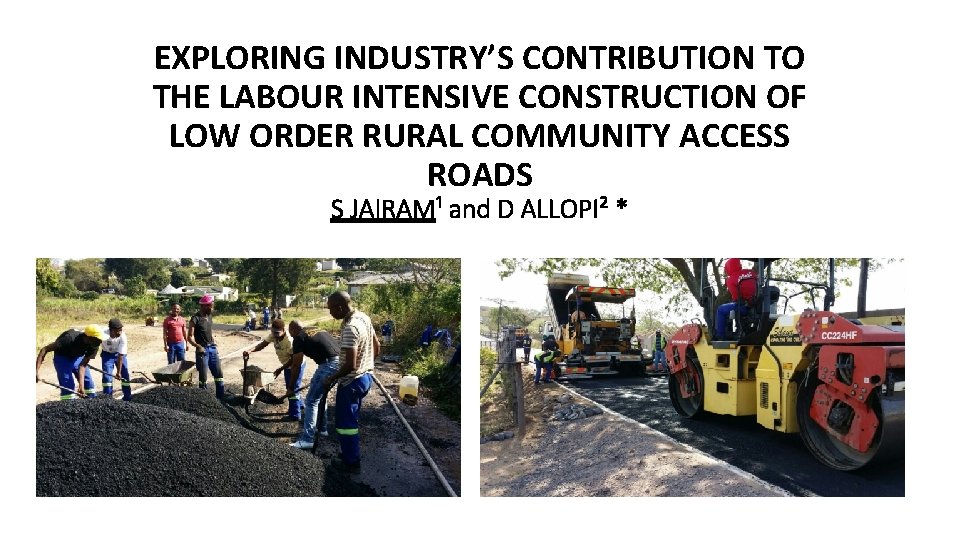
EXPLORING INDUSTRY’S CONTRIBUTION TO THE LABOUR INTENSIVE CONSTRUCTION OF LOW ORDER RURAL COMMUNITY ACCESS ROADS S JAIRAM¹ and D ALLOPI² *
STUDY AIM This study explores the extent to which consultants and contractors in the Civil Engineering Industry are involved in promoting the construction of rural community access roads, using labour intensive methods, and to provide an insight into their depth of contribution to the design and construction management, according to the Expanded Public Works Programme guidelines.
STUDY OBJECTIVES • Contribute to the knowledge base of labour intensive construction of rural community access roads. • Assessing the level and depth of contribution of the Civil Engineering industry to the construction of low order rural community access roads. • Provide a sense of how contractors and consultants address the needs of the EPWP program concerning rural community access road design and construction.

STUDY RESEARCH QUESTIONS & METHODS Data production was primarily by interviews and survey questionnaires with the companies, contractors and staff from the outer west roads division that have over the past, consistently worked on the construction of rural community access roads. This case study was restricted to three rural community access roads of e. Thekwini’s outer west region. The participants of the study were e. Thekwini’s Outer West Roads Department, consultants and contractors who have all designed and managed the construction of rural community access roads in the rural communities.
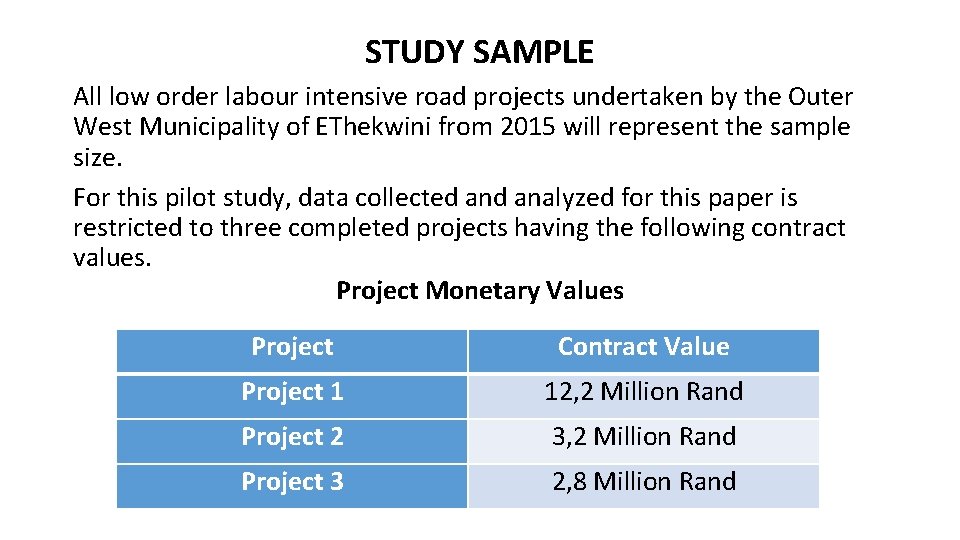
STUDY SAMPLE All low order labour intensive road projects undertaken by the Outer West Municipality of EThekwini from 2015 will represent the sample size. For this pilot study, data collected analyzed for this paper is restricted to three completed projects having the following contract values. Project Monetary Values Project Contract Value Project 1 12, 2 Million Rand Project 2 3, 2 Million Rand Project 3 2, 8 Million Rand
DISCUSSION OF RESULTS AND FINDINGS 1. Design and Contract Documentation. 1. 1 Design was not related and supportive of labour intensive construction methodology. • Lack of manual setting out of works or setting out information • Relied heavily on sophisticated survey equipment. • Low order roads were existing gravel roads that required minor realignments. • Used the expertise of professional surveyors to set out the works which was costly. • Few control points from which setting out could be done.
• According to the Expanded Public Works Programme guidelines, drawings must be produced and presented in a clear easily understandable way. Where setting out information is provided in the form of coordinates, it should be backed up with methods, not relying on sophisticated surveying instruments, such as offsets measurable with the use of a standard tape. Where possible, appropriated drawings should be produced using a background of ortho photos to provide for easy identification of surrounding features. (Department of Public Works 2015: iii). 1. 2 LI items in Contract Documentation • The Expanded Public Works Programme guidelines state that items in the bill of quantities that can be constructed labour intensively must have an abbreviated “LI” written next to it and if machinery is used in place of labour the contractor would not be paid for that item.
• The purpose of which is to prevent the contractor from constructing that item using only machines. The bill of quantities in all three projects did not have any abbreviated “LI” items. When running out of time due to slow progress the contractor used this opportunity to use a paver to lay asphalt rather than use labour to haul and spread the asphalt. This defeated the purpose of it being a labour intensive project.

2. Qualifications of the contractor and consultant. The Expanded Public Works Programme guidelines state that the staff member of the company who designed the project must be qualified with; • An NQF 7 (Develop and promote labour intensive construction strategies) qualification. • The employers site supervisor qualified with an NQF 5 (Manage labour intensive construction projects) qualification and the contractors foreman qualified with an NQF 4 (National certificate: Supervision of civil engineering construction processes) qualification. • The design flaws of not identifying labour intensive items in the bill of quantities and lack of manual setting out data indicates that the designer did not have the necessary qualifications or experience.
• The contractors did not appoint a qualified NQF 5 person from the start of the project. An appointment was made much later in the project. This resulted in a lack of guidance in setting out task rates. The contractors paid a daily wage instead of giving the labour an incentive to complete a task. Labour had no incentive to complete the work timeously. • The contractor being confronted with progress delays resorted to the use of machinery to complete the work timeously, which defeated the purpose of it being a labour intensive project.
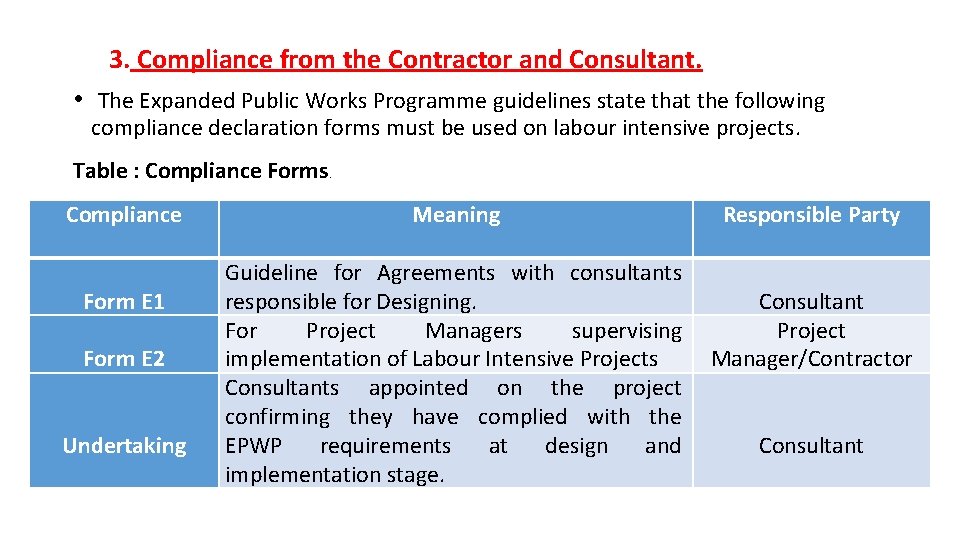
3. Compliance from the Contractor and Consultant. • The Expanded Public Works Programme guidelines state that the following compliance declaration forms must be used on labour intensive projects. Table : Compliance Forms. Compliance Form E 1 Form E 2 Undertaking Meaning Responsible Party Guideline for Agreements with consultants responsible for Designing. Consultant For Project Managers supervising Project implementation of Labour Intensive Projects Manager/Contractor Consultants appointed on the project confirming they have complied with the EPWP requirements at design and Consultant implementation stage.

4. Training and Employment of Local Labour. • According to the Expanded Public Works Programme guidelines public bodies should ensure that participants employed on their EPWP projects receive accredited training whenever possible. This may be done through submission of training applications to the relevant Regional Office of the Department of Higher Education and Training. Personnel from the National Department of Public Works of Provincial Coordinating Department EPWP units will assist the Public Body to prepare and submit the training applications to relevant Provincial office of the Department of Higher Education and Training or to any other funders like SETAs. The Public Body implementing the project must ensure that training applications for participants are made by its relevant project manager assisted by relevant training officials from the National Department of Public Works. • This however did not occur timeously which resulted in the local labour not receiving any accredited training. .
• The Expanded Public Works Programme guidelines state that an item containing a provisional sum for training of local labour be included in each contract. • None of these contracts had an item in the bill that allowed for accredited training of local labour during or prior to commencement of the project. There was also no effort to maximize opportunity for training before the implementation of the project. • This resulted in the local labour not knowing how to carry out their appointed tasks when they were initially employed resulting in the contractors being confronted with slow progress and not being able to complete the tasks using local labour. They instead hired machinery to speed up the work
• Another EPWP guideline requirement is that local labour after the completion of the project be given a certificate stating the following; The workers name The name and address of the employer The EPWP on which the worker worked The work performed by the worker Any Training received by the worker as part of the EPWP. The period for which the worker worked on the EPWP Any other information agreed on by the employer and worker • These projects did not abide by the above requirement. This also served as a double blow to the current contractors who tried employing labour who had no references from their previous contractors resulting in the current contractor not knowing which tasks labour are more proficient in.
• EPWP guidelines recommend that the project steering committee be formed prior to the design and construction of the project. • The project steering committee was formed too late for these projects • This resulted in the late appointment of a community liaison officer who plays a vital role in helping the contractor recruit the experienced unemployed labour in the ward. • This in turn made it difficult to employ temporary workers in accordance with the current Code of Good Practice for Employment and Conditions of Work for Expanded Public Works Programme. • The employment of local labour according to the demographic breakdown recommended by the EPWP guidelines could not be efficiently met. • Workers were therefore not employed through a fair and transparent process where they could be classified as poor, unemployed or underemployed and those who lived close to the project area.
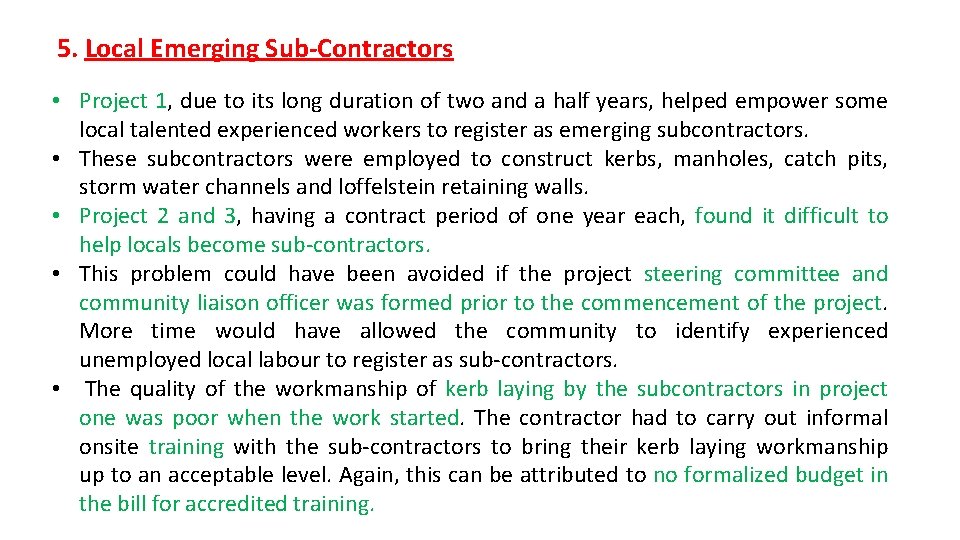
5. Local Emerging Sub-Contractors • Project 1, due to its long duration of two and a half years, helped empower some local talented experienced workers to register as emerging subcontractors. • These subcontractors were employed to construct kerbs, manholes, catch pits, storm water channels and loffelstein retaining walls. • Project 2 and 3, having a contract period of one year each, found it difficult to help locals become sub-contractors. • This problem could have been avoided if the project steering committee and community liaison officer was formed prior to the commencement of the project. More time would have allowed the community to identify experienced unemployed local labour to register as sub-contractors. • The quality of the workmanship of kerb laying by the subcontractors in project one was poor when the work started. The contractor had to carry out informal onsite training with the sub-contractors to bring their kerb laying workmanship up to an acceptable level. Again, this can be attributed to no formalized budget in the bill for accredited training.
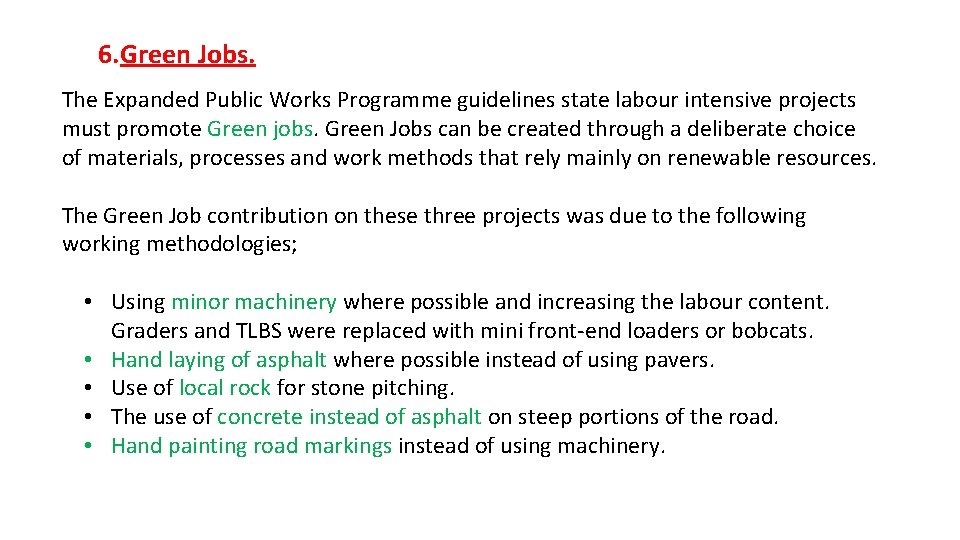
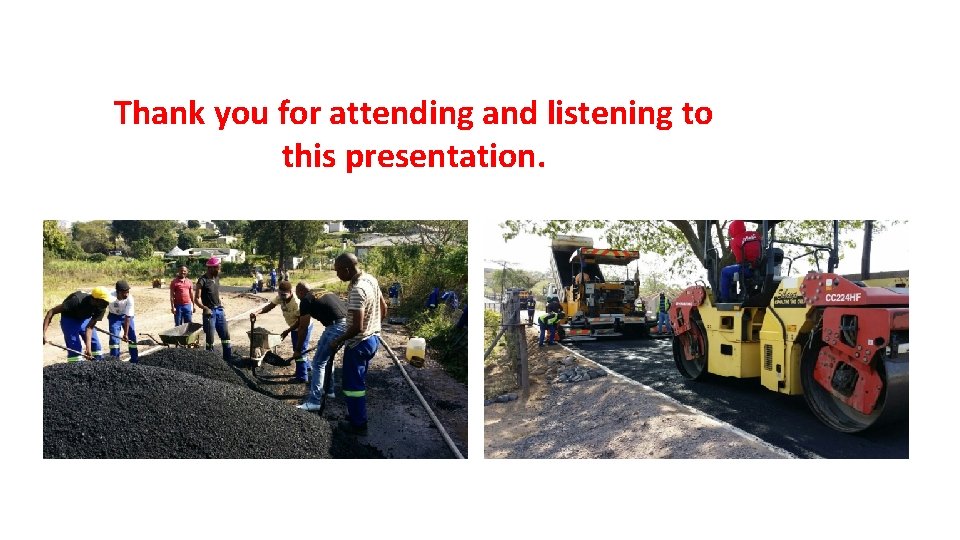
6. Green Jobs. The Expanded Public Works Programme guidelines state labour intensive projects must promote Green jobs. Green Jobs can be created through a deliberate choice of materials, processes and work methods that rely mainly on renewable resources. The Green Job contribution on these three projects was due to the following working methodologies; • Using minor machinery where possible and increasing the labour content. Graders and TLBS were replaced with mini front-end loaders or bobcats. • Hand laying of asphalt where possible instead of using pavers. • Use of local rock for stone pitching. • The use of concrete instead of asphalt on steep portions of the road. • Hand painting road markings instead of using machinery.
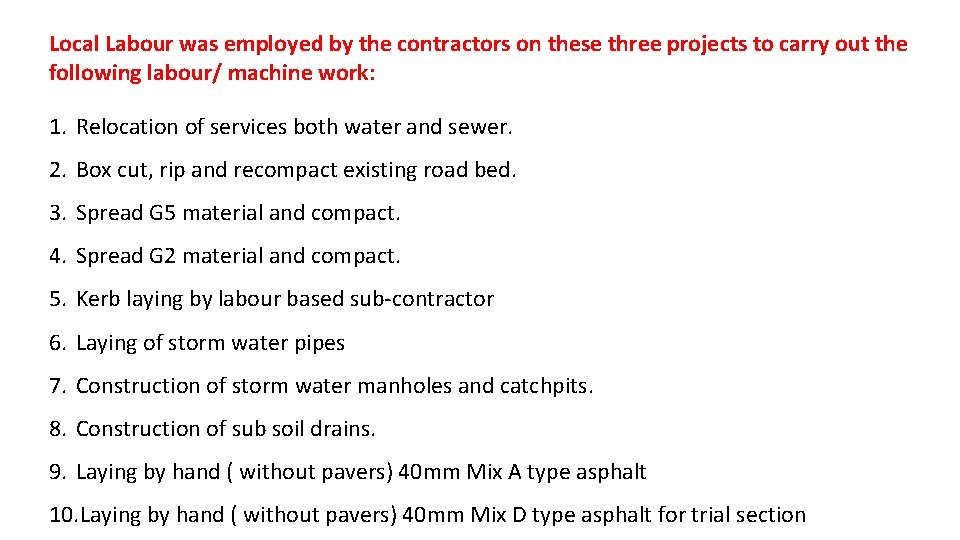
Local Labour was employed by the contractors on these three projects to carry out the following labour/ machine work: 1. Relocation of services both water and sewer. 2. Box cut, rip and recompact existing road bed. 3. Spread G 5 material and compact. 4. Spread G 2 material and compact. 5. Kerb laying by labour based sub-contractor 6. Laying of storm water pipes 7. Construction of storm water manholes and catchpits. 8. Construction of sub soil drains. 9. Laying by hand ( without pavers) 40 mm Mix A type asphalt 10. Laying by hand ( without pavers) 40 mm Mix D type asphalt for trial section

11. Finishing and clearing. 12. Traffic control 13. Reinstatement. Road patching using Mix D Asphalt. 14. Road embankment protection using Terra force L 13 Blocks. 15. Construction of steep portions of road using concrete. 16. Landscaping completed road verges. 17. Construction of concrete stairways. 18. Road patching and pothole repair. 19. Redirecting traffic. Stop Go and flagmen. 20. Installation of guard rails. 21. Erection of road signs. 22. Painting of road markings.
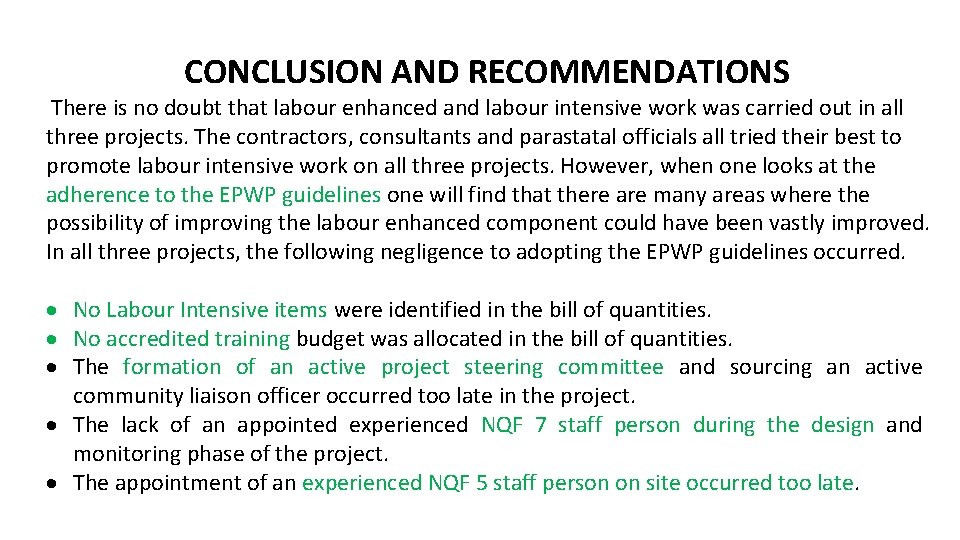
CONCLUSION AND RECOMMENDATIONS There is no doubt that labour enhanced and labour intensive work was carried out in all three projects. The contractors, consultants and parastatal officials all tried their best to promote labour intensive work on all three projects. However, when one looks at the adherence to the EPWP guidelines one will find that there are many areas where the possibility of improving the labour enhanced component could have been vastly improved. In all three projects, the following negligence to adopting the EPWP guidelines occurred. No Labour Intensive items were identified in the bill of quantities. No accredited training budget was allocated in the bill of quantities. The formation of an active project steering committee and sourcing an active community liaison officer occurred too late in the project. The lack of an appointed experienced NQF 7 staff person during the design and monitoring phase of the project. The appointment of an experienced NQF 5 staff person on site occurred too late.
Poor budget available for the NQF 5 staff to carry out the necessary duties. Contractor unwilling to adopt a task rate. Local labour was paid a daily wage instead. Consultant and contractor not willing to comply with the E 1 and E 2 compliance forms and undertaking forms. No manual setting out data on the design drawings. Consultant not providing working design drawings timeously. Inexperienced staff and lack of knowledge in labour intensive construction. Noncompliance to the Planning and implementation checklist in the EPWP guidelines during the design of labour intensive works.
Mashiri, Thevadasan and Zukulu ( 2005: 869) is of the view that, for community based labour intensive projects to be successful, government needs to not only show commitment to the objectives of the project but also to the aims of poverty alleviation and growing of local economies. One of the things that is still a challenging issue is the lack of commitment from consultants, contractors and parastatal to make labour intensive projects work. There is also lack of intense monitoring and supervision from the inception of the project. There is still a need to design more in-depth compliance declaration, monitoring and reporting forms on labour intensive projects.
Thank you for attending and listening to this presentation.
- Slides: 23