
Exploring Image Gradients for Nuclear Cataract Grading by

Exploring Image Gradients for Nuclear Cataract Grading by R. Srivastava 1, X. Gao 1, F. Yin 1, D. Wong 1, J. Liu 1, C. Y. Cheung 2, T. Y. Wong 2 1. Institute for Infocomm Research, Singapore 2. Singapore Eye Research Institute Presented at: International Conference on Biomedical Engineering (ICBME) 20

Introduction § Severity of Cataract: § Cataract is the leading cause of blindness accounting for half of the blindness worldwide. § Types of Cataract (based on its location in the eye): § Nuclear § Cortical § Posterior sub-capsular 16 February 2022 Our focus ICBME 13: Exploring Image Gradients for Nuclear Cataract Grading 2

Introduction § How to diagnose Nuclear Cataract (NC)? § By manually observing slit-lamp images of the eye-lens Least severe 16 February 2022 4 grades of NC Most severe ICBME 13: Exploring Image Gradients for Nuclear Cataract Grading 3
Introduction § Why automate the diagnosis? § The manual grading task may be cumbersome § Manual grading is prone to be subjective § Graders may lose focus and cause variability even in their own grading 16 February 2022 ICBME 13: Exploring Image Gradients for Nuclear Cataract Grading 4

Parts of the right eye as viewed in a slit-lamp image 16 February 2022 ICBME 13: Exploring Image Gradients for Nuclear Cataract Grading 5
![Related Works § Fan et al. [1] § Propose intensity based features: § Sulcus](http://slidetodoc.com/presentation_image_h2/bddaa832c17e7ce8f06916927d61b9dc/image-6.jpg "Related Works § Fan et al. [1] § Propose intensity based features: § Sulcus")
Related Works § Fan et al. [1] § Propose intensity based features: § Sulcus intensity § Intensity ratio between anterior and posterior lentil § Duncan et al. [2] § Define a circular Region Of Interest (ROI) within the lens nucleus § Compute the longitudinal profile of luminance in the ROI. § A polynomial is fit on this profile. 16 February 2022 ICBME 13: Exploring Image Gradients for Nuclear Cataract Grading 6
Related Works § Duncan et al. contd… § From the profile mean values of luminance, slope of the profile at the posterior point and residue of the polynomial fit are extracted as features. § Li et al. [3] § First to automatically extract lens nucleus § Proposed novel color and gray level intensity based features extracted from the nuclear region. 16 February 2022 ICBME 13: Exploring Image Gradients for Nuclear Cataract Grading 7
Related Works § Limitations: § Mostly explored color or gray level information. § However, NC can also be diagnosed based on the visibility of parts of the lens in slit-lamp images of the eye lens (visibility cue) [3]. 16 February 2022 ICBME 13: Exploring Image Gradients for Nuclear Cataract Grading 8
Related Works § Limitations: § Mostly explored information. color or gray level Li et al. [3] have attempted to utilize the visibility cue by proposing features such as entropy inside the lens contour and lens nucleus contour in the slit-lamp image. However we believe that utilization of the visibility cue can be explored further by using image gray level intensity information. 16 February 2022 ICBME 13: Exploring Image Gradients for Nuclear Cataract Grading 9
Contribution § Using gray level intensity gradients to utilize the visibility cue for computerized grading of NC. § Proposed approach reduces the diagnosis error (average grading difference) by more than 8% as compared to the state-of-theart [3]. Why use intensity gradients? 16 February 2022 ICBME 13: Exploring Image Gradients for Nuclear Cataract Grading 10
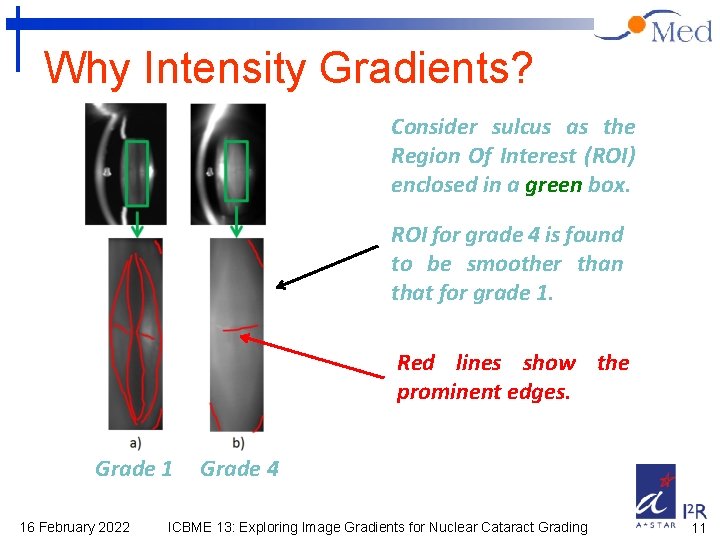
Why Intensity Gradients? Consider sulcus as the Region Of Interest (ROI) enclosed in a green box. ROI for grade 4 is found to be smoother than that for grade 1. Red lines show the prominent edges. Grade 1 16 February 2022 Grade 4 ICBME 13: Exploring Image Gradients for Nuclear Cataract Grading 11
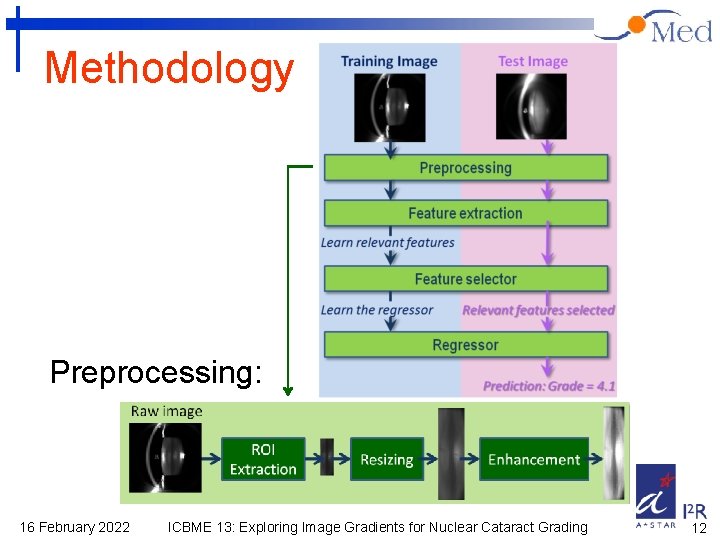
Methodology Preprocessing: 16 February 2022 ICBME 13: Exploring Image Gradients for Nuclear Cataract Grading 12

Methodology § Feature extraction: The following features are extracted from each sub-block 1. A count of the number of pixels where horizontal gradient magnitude exceeds a predefined threshold. 2. Similar count is made for vertical gradient. 3. Mean gray level intensity inside the cell. 4. Standard deviation of gray level intensity inside the cell. 5. Histogram of gradient orientation. 16 February 2022 ICBME 13: Exploring Image Gradients for Nuclear Cataract Grading 13
Methodology § NC grade prediction: § Formulated as a supervised regression problem § Support Vector Regression (SVR) used. Proposed system has been called as ACASIA-NC (Automatic CAtaract Screening from Image Analysis-Nuclear Cataract) 16 February 2022 ICBME 13: Exploring Image Gradients for Nuclear Cataract Grading 14
Experiments § Dataset: § Collected as a part of the Singapore Malay Eye Study [6] [7] conducted by Singapore Eye Research Institute. § 5378 images from 2961 subjects, Image size: 1536 x 2048 § Subjects are Malays aged 40 -80 living in Singapore § Ground truth established using the Wisconsin cataract grading system § Grades are assigned as decimal numbers 16 February 2022 ICBME 13: Exploring Image Gradients for Nuclear Cataract Grading 15
Experiments § Dataset: § Training and testing sets § All images divided into 5 groups based on the grades: 0 -1, 1. 1 -2, 2. 1 -3, 3. 1 -4 and 4. 1 -5 § 20 images from each group were chosen to form the training set yielding 100 training images § Remaining 5278 images formed testing set. 16 February 2022 ICBME 13: Exploring Image Gradients for Nuclear Cataract Grading 16
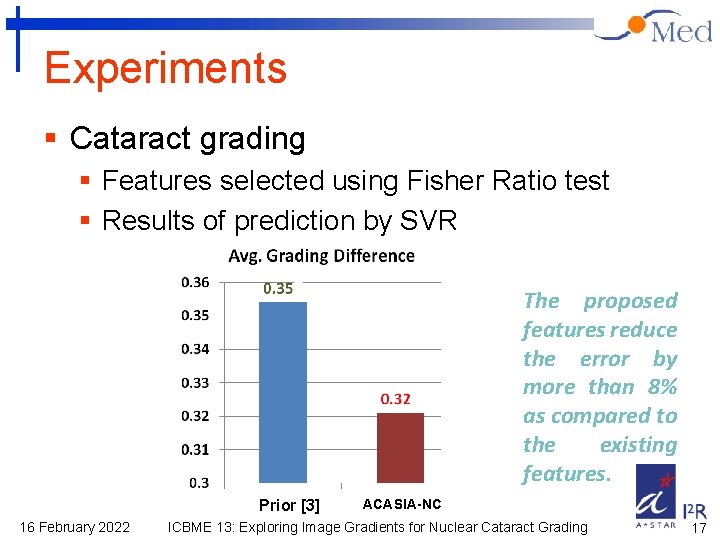
Experiments § Cataract grading § Features selected using Fisher Ratio test § Results of prediction by SVR The proposed features reduce the error by more than 8% as compared to the existing features. Prior [3] 16 February 2022 ACASIA-NC ICBME 13: Exploring Image Gradients for Nuclear Cataract Grading 17
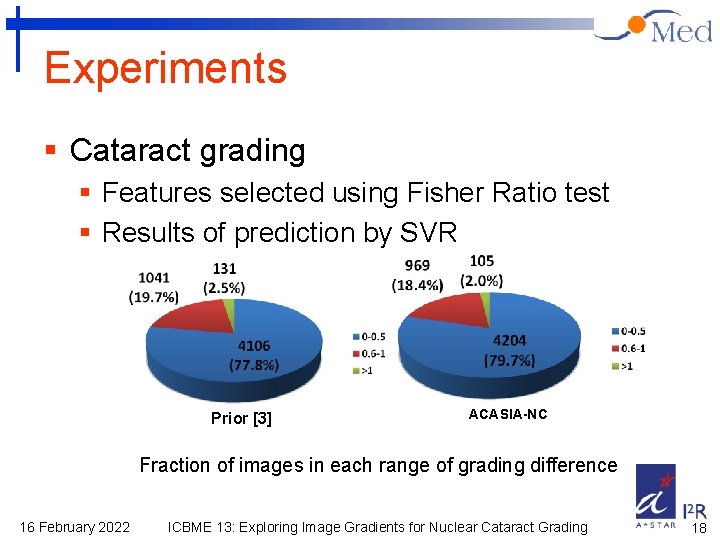
Experiments § Cataract grading § Features selected using Fisher Ratio test § Results of prediction by SVR Prior [3] ACASIA-NC Our Fraction of images in each range of grading difference 16 February 2022 ICBME 13: Exploring Image Gradients for Nuclear Cataract Grading 18
![Experiments § Cataract grading § Computation speed Prior [3] 80 times faster 16 February](http://slidetodoc.com/presentation_image_h2/bddaa832c17e7ce8f06916927d61b9dc/image-19.jpg "Experiments § Cataract grading § Computation speed Prior [3] 80 times faster 16 February")
Experiments § Cataract grading § Computation speed Prior [3] 80 times faster 16 February 2022 ICBME 13: Exploring Image Gradients for Nuclear Cataract Grading 19
Conclusions and Future Work § The proposed system uses gradient based features extracted from slit lamp images of the eye lens nucleus for NC grading § Results improved by more than 8% § Faster by almost 80 times § Histogram equalization may produce image artifacts § Fusion of proposed with existing features can be explored 16 February 2022 ICBME 13: Exploring Image Gradients for Nuclear Cataract Grading 20
Relevant References 1. S. Fan, C. Dyer, L. Hubbard, and B. Klein, “An automatic system for classification of nuclear sclerosis from slit-lamp photographs, ” Medical Image Computing and Computer-Assisted Intervention-MICCAI 2003, pp. 592– 601, 2003. 2. D. Duncan, O. Shukla, S. West, and O. Schein, “New objective classification system for nuclear opacification, ” JOSA A, vol. 14, no. 6, pp. 1197– 1204, 1997. 3. H. Li, J. Lim, J. Liu, P. Mitchell, A. Tan, J. Wang, and T. Wong, “A computeraided diagnosis system of nuclear cataract, ” Biomedical Engineering, IEEE Transactions on, vol. 57, no. 7, pp. 1690– 1698, 2010. 4. H. Li, Lim, J. , Liu, J. , Wong, T. -Y. , Tan, A. , Wang, J. , Paul, M. : Image Based Grading of Nuclear Cataract by SVM Regression. In SPIE Proceeding of Medical Imaging 6915 (2008), 691536 -8. 5. H. Li, J. H. Lim, J. Liu, T. Y. Wong, "Towards Automatic Grading of Nuclear Cataract, " Proceedings of International Conference of the IEEE Engineering in Medicine and Biology Society, 2007, pp. 4961 -4964. 16 February 2022 ICBME 13: Exploring Image Gradients for Nuclear Cataract Grading 21
Relevant References 6. A. Foong, S. Saw, J. Loo, S. Shen, S. Loon, M. Rosman, T. Aung, D. Tan, E. Tai, and T. Wong, “Rationale and methodology for a population-based study of eye diseases in Malay people: The Singapore Malay eye study (Si. MES), ” Ophthalmic epidemiology, vol. 14, no. 1, pp. 25– 35, 2007. 7. T. Wong, E. Chong, W. Wong, M. Rosman, T. Aung, J. Loo, S. Shen, S. Loon, D. Tan, E. Tai et al. , “Prevalence and causes of low vision and blindness in an urban Malay population: the Singapore Malay Eye Study, ” Archives of ophthalmology, vol. 126, no. 8, p. 1091, 2008. 16 February 2022 ICBME 13: Exploring Image Gradients for Nuclear Cataract Grading 22
Thank you 16 February 2022 ICBME 13: Exploring Image Gradients for Nuclear Cataract Grading 23
Potential Applications § The Technology can be applied in clinics to grade nuclear cataract automatically using slitlamp images. § The Technology could potentially be of interest to the company of lens camera producers to incorporate the Technology into their system to improve the function and feature of their products. § The Technology can also be used for monitoring the progress of NC. 16 February 2022 ICBME 13: Exploring Image Gradients for Nuclear Cataract Grading 24
- Slides: 24