
Exploring Environmental Science for AP 1 st Edition
- Slides: 63
Exploring Environmental Science for AP® 1 st Edition Chapter 11 Geology, Soil, and Mineral Resources Copyright © 2018 Cengage Learning. All Rights Reserved. May not be copied, scanned, or duplicated, in whole or in part, except for use as permitted in a license distributed with a certain product or service or otherwise on a password-protected website for classroom use.
Core Case Study: The Real Cost of Gold • Harmful effects of gold mining – Massive amounts of rock dug to yield small amounts of gold – Highly toxic cyanide salts used to extract the gold into settling ponds § Toxic to birds and mammals § Threaten underground drinking water supplies – Romanian gold mine dam collapsed in 2000 § Contaminated rivers with cyanide and toxic metals Copyright © 2018 Cengage Learning. All Rights Reserved. May not be copied, scanned, or duplicated, in whole or in part, except for use as permitted in a license distributed with a certain product or service or otherwise on a password-protected website for classroom use.
11. 1 What Are the Earth’s Major Geological Processes/Mineral Resources? • Dynamic processes within the earth and on its surface produce mineral resources • Mineral resources are nonrenewable – Produced and renewed over millions of years mostly by the earth’s rock cycle Copyright © 2018 Cengage Learning. All Rights Reserved. May not be copied, scanned, or duplicated, in whole or in part, except for use as permitted in a license distributed with a certain product or service or otherwise on a password-protected website for classroom use.
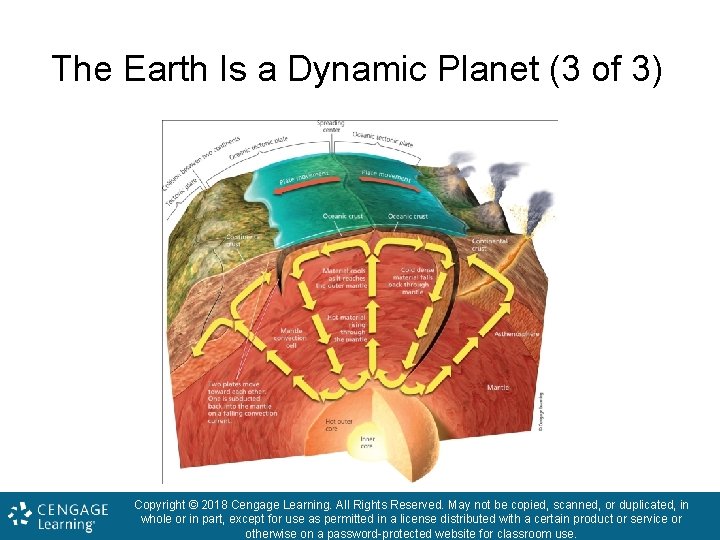
The Earth Is a Dynamic Planet (1 of 3) • Geology – Study of dynamic processes taking place on the earth’s surface and in its interior • Three major concentric zones of the earth – Core – Mantle, including the asthenosphere – Crust § Continental crust § Oceanic crust: 71% of crust Copyright © 2018 Cengage Learning. All Rights Reserved. May not be copied, scanned, or duplicated, in whole or in part, except for use as permitted in a license distributed with a certain product or service or otherwise on a password-protected website for classroom use.
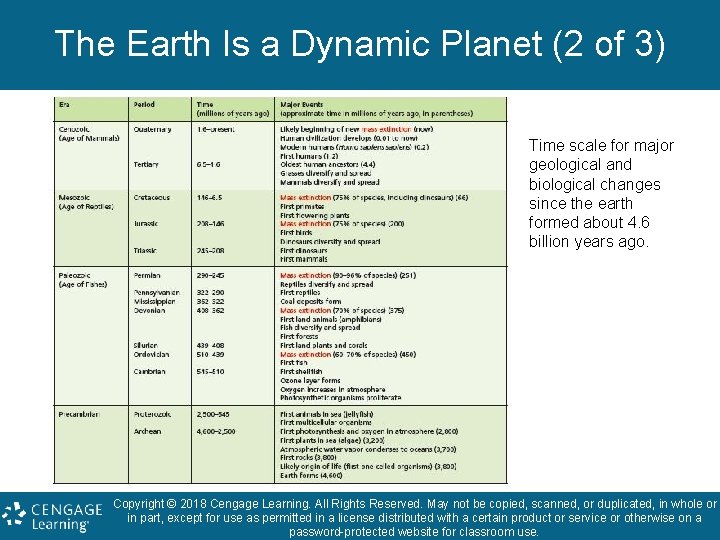
The Earth Is a Dynamic Planet (2 of 3) Time scale for major geological and biological changes since the earth formed about 4. 6 billion years ago. Copyright © 2018 Cengage Learning. All Rights Reserved. May not be copied, scanned, or duplicated, in whole or in part, except for use as permitted in a license distributed with a certain product or service or otherwise on a password-protected website for classroom use.
The Earth Is a Dynamic Planet (3 of 3) Copyright © 2018 Cengage Learning. All Rights Reserved. May not be copied, scanned, or duplicated, in whole or in part, except for use as permitted in a license distributed with a certain product or service or otherwise on a password-protected website for classroom use.
What Are Minerals and Rocks? (1 of 2) • Mineral – Naturally occurring chemical element or compound that exists as a crystalline solid • Mineral resource – Concentration that we can extract and process into raw materials – Nonrenewable • Rock – Solid combination of one or more minerals Copyright © 2018 Cengage Learning. All Rights Reserved. May not be copied, scanned, or duplicated, in whole or in part, except for use as permitted in a license distributed with a certain product or service or otherwise on a password-protected website for classroom use.
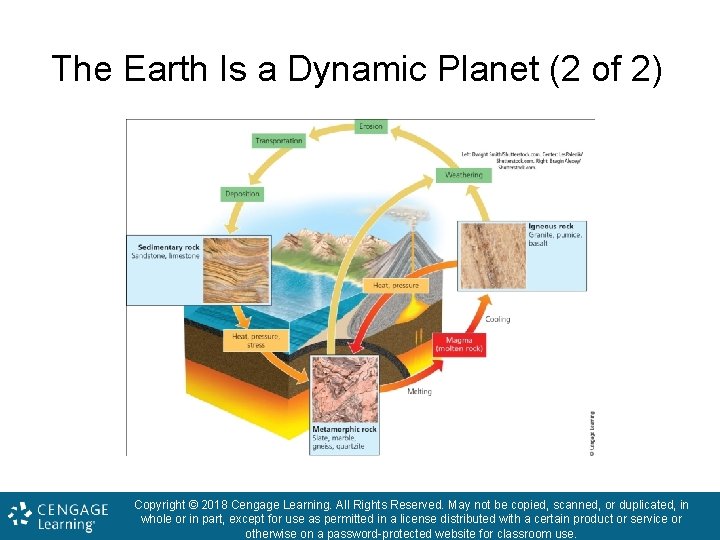
What Are Minerals and Rocks? (2 of 2) • Sedimentary rock – Made of sediments § Dead plant and animal remains § Tiny particles of weathered and eroded rocks • Igneous rock – Forms under intense heat and pressure • Metamorphic rock – Existing rock subjected to high temperatures, pressures, fluids, or a combination Copyright © 2018 Cengage Learning. All Rights Reserved. May not be copied, scanned, or duplicated, in whole or in part, except for use as permitted in a license distributed with a certain product or service or otherwise on a password-protected website for classroom use.
The Earth’s Rocks Are Recycled Slowly (1 of 2) • Rock cycle – Rocks are recycled over millions of years – Erosion, melting, and metamorphism – Slowest of the earth’s cycle processes Copyright © 2018 Cengage Learning. All Rights Reserved. May not be copied, scanned, or duplicated, in whole or in part, except for use as permitted in a license distributed with a certain product or service or otherwise on a password-protected website for classroom use.
The Earth Is a Dynamic Planet (2 of 2) Copyright © 2018 Cengage Learning. All Rights Reserved. May not be copied, scanned, or duplicated, in whole or in part, except for use as permitted in a license distributed with a certain product or service or otherwise on a password-protected website for classroom use.
11. 2 What Processes Lead to Soil Formations? • Physical, chemical, and biological processes all contribute to the formation of soil. • Soil is a renewable resource and a key factor in nutrient cycling Copyright © 2018 Cengage Learning. All Rights Reserved. May not be copied, scanned, or duplicated, in whole or in part, except for use as permitted in a license distributed with a certain product or service or otherwise on a password-protected website for classroom use.
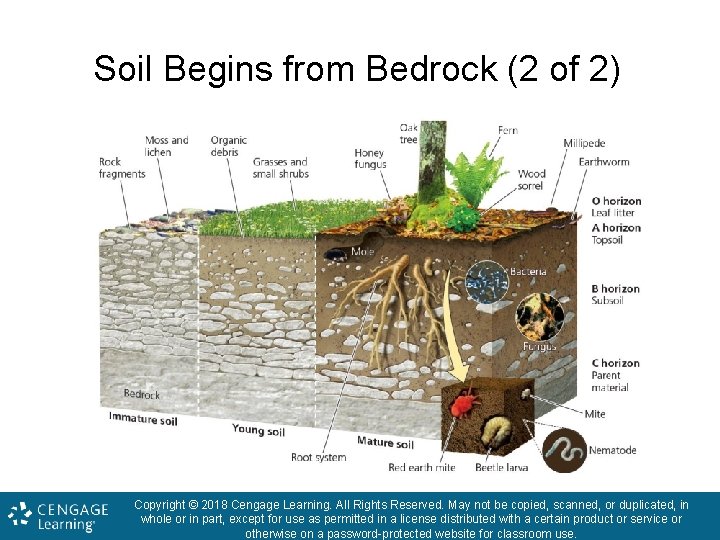
Soil Begins from Bedrock (1 of 2) • The process of weathering breaks up parent material that is the foundation of soil. • Lichens secrete acid that breaks down rock, the first step in primary succession • Humus is formed from dead organic material, releasing nutrients and holding moisture • Physical, chemical and biological processes form soil Copyright © 2018 Cengage Learning. All Rights Reserved. May not be copied, scanned, or duplicated, in whole or in part, except for use as permitted in a license distributed with a certain product or service or otherwise on a password-protected website for classroom use.
Soil Begins from Bedrock (2 of 2) Copyright © 2018 Cengage Learning. All Rights Reserved. May not be copied, scanned, or duplicated, in whole or in part, except for use as permitted in a license distributed with a certain product or service or otherwise on a password-protected website for classroom use.
Soil is a Renewable Resource (1 of 3) • Living , organisms rely on soil is essential for agriculture, provides the medium for growing timber, and provides ecological services such as purifying water and degrading wastes • Mature soils contain horizons – – O (leaf litter) A (top soil) B (subsoil) C (weathered parent material) Copyright © 2018 Cengage Learning. All Rights Reserved. May not be copied, scanned, or duplicated, in whole or in part, except for use as permitted in a license distributed with a certain product or service or otherwise on a password-protected website for classroom use.
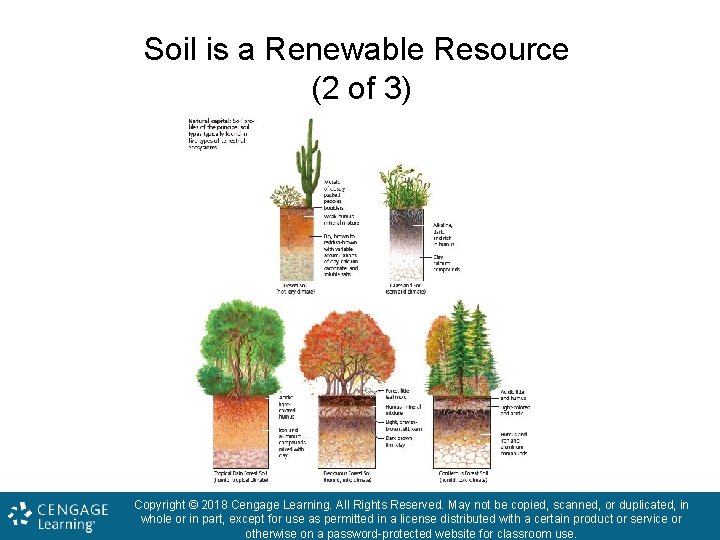
Soil is a Renewable Resource (2 of 3) Copyright © 2018 Cengage Learning. All Rights Reserved. May not be copied, scanned, or duplicated, in whole or in part, except for use as permitted in a license distributed with a certain product or service or otherwise on a password-protected website for classroom use.
Soil is a Renewable Resource (3 of 3) • Several factors influence the formation of soil – Warm and wet environments form soil faster – Tropical rain forest soils have little organic material in soil and are nutrient poor. Copyright © 2018 Cengage Learning. All Rights Reserved. May not be copied, scanned, or duplicated, in whole or in part, except for use as permitted in a license distributed with a certain product or service or otherwise on a password-protected website for classroom use.
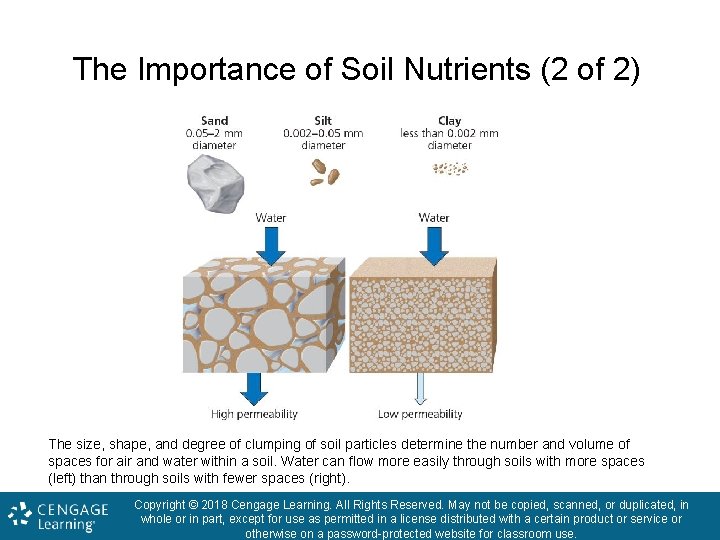
The Importance of Soil Nutrients (1 of 2) • Most nutrients in a and O horizons • Fertile soil produces high crop yields with this topsoil and bacteria that convert nitrogen into ions that plants can assimilate • B and C horizons contain most of the soil’s inorganic material • Soil texture determines porosity and permeability Copyright © 2018 Cengage Learning. All Rights Reserved. May not be copied, scanned, or duplicated, in whole or in part, except for use as permitted in a license distributed with a certain product or service or otherwise on a password-protected website for classroom use.
The Importance of Soil Nutrients (2 of 2) The size, shape, and degree of clumping of soil particles determine the number and volume of spaces for air and water within a soil. Water can flow more easily through soils with more spaces (left) than through soils with fewer spaces (right). Copyright © 2018 Cengage Learning. All Rights Reserved. May not be copied, scanned, or duplicated, in whole or in part, except for use as permitted in a license distributed with a certain product or service or otherwise on a password-protected website for classroom use.
11. 3 How Long Might Supplies of Nonrenewable Mineral Resources Last? • Nonrenewable mineral resources exist in finite amounts – Can become economically depleted when it costs more than it is worth to find, extract, and process the remaining deposits • There are several ways to extend supplies of mineral resources – Methods limited by economic and environmental factors Copyright © 2018 Cengage Learning. All Rights Reserved. May not be copied, scanned, or duplicated, in whole or in part, except for use as permitted in a license distributed with a certain product or service or otherwise on a password-protected website for classroom use.
We Depend on a Variety of Nonrenewable Mineral Resources (1 of 2) • Ore – Contains profitable concentration of a mineral – May be high-grade or low-grade • Metallic mineral resources – – – Aluminum Steel: a mixture of iron and other elements Copper Gold Molybdenum Copyright © 2018 Cengage Learning. All Rights Reserved. May not be copied, scanned, or duplicated, in whole or in part, except for use as permitted in a license distributed with a certain product or service or otherwise on a password-protected website for classroom use.
We Depend on a Variety of Nonrenewable Mineral Resources (2 of 2) • Nonmetallic mineral resources – – Sand Gravel Limestone Phosphate Copyright © 2018 Cengage Learning. All Rights Reserved. May not be copied, scanned, or duplicated, in whole or in part, except for use as permitted in a license distributed with a certain product or service or otherwise on a password-protected website for classroom use.
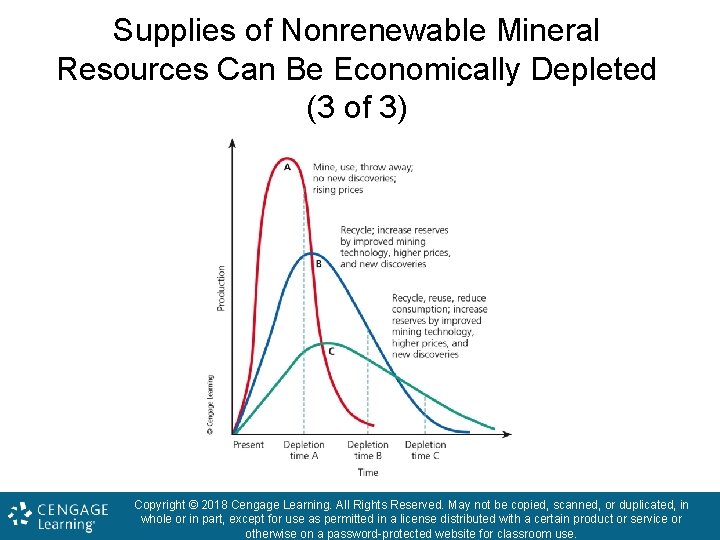
Supplies of Nonrenewable Mineral Resources Can Be Economically Depleted (1 of 3) • Reserves – Identified deposits from which we can extract the mineral profitably at current prices • Economic depletion – Occurs when extraction costs more than remaining deposits are worth • Depletion time – Time to use a certain portion (usually 80%) of reserves at a given rate of use Copyright © 2018 Cengage Learning. All Rights Reserved. May not be copied, scanned, or duplicated, in whole or in part, except for use as permitted in a license distributed with a certain product or service or otherwise on a password-protected website for classroom use.
Supplies of Nonrenewable Mineral Resources Can Be Economically Depleted (2 of 3) • Options when a resource becomes economically depleted – – – Recycle or reuse existing supplies Waste less Use less Find a substitute Do without Copyright © 2018 Cengage Learning. All Rights Reserved. May not be copied, scanned, or duplicated, in whole or in part, except for use as permitted in a license distributed with a certain product or service or otherwise on a password-protected website for classroom use.
Supplies of Nonrenewable Mineral Resources Can Be Economically Depleted (3 of 3) Copyright © 2018 Cengage Learning. All Rights Reserved. May not be copied, scanned, or duplicated, in whole or in part, except for use as permitted in a license distributed with a certain product or service or otherwise on a password-protected website for classroom use.
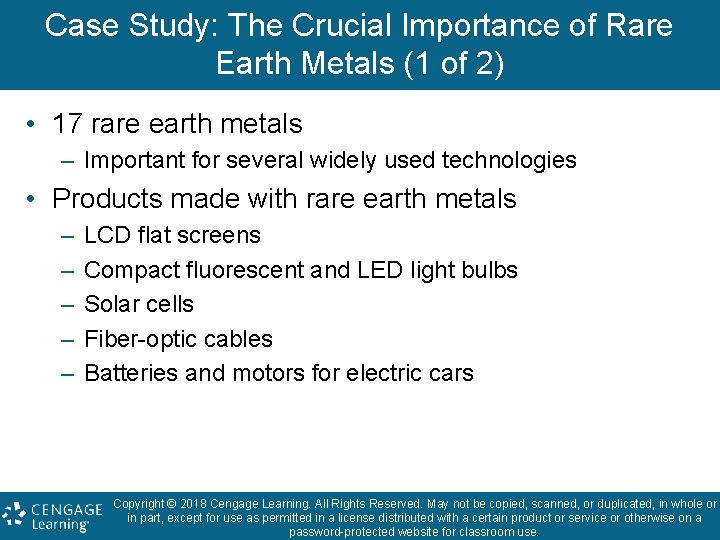
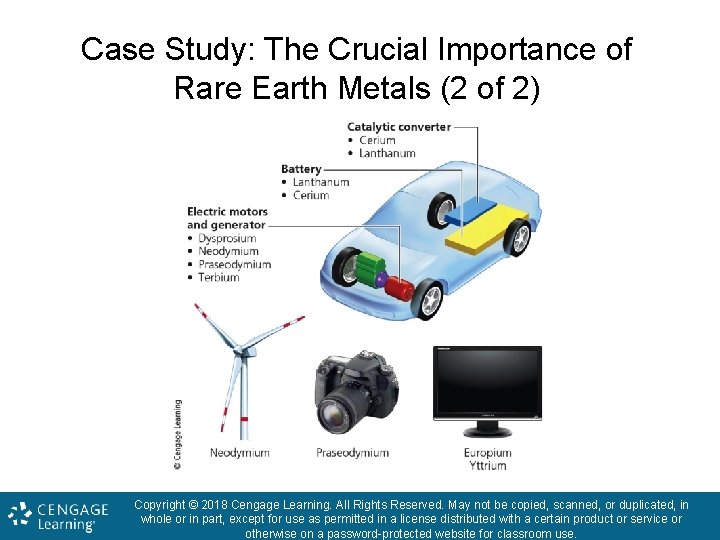
Case Study: The Crucial Importance of Rare Earth Metals (1 of 2) • 17 rare earth metals – Important for several widely used technologies • Products made with rare earth metals – – – LCD flat screens Compact fluorescent and LED light bulbs Solar cells Fiber-optic cables Batteries and motors for electric cars Copyright © 2018 Cengage Learning. All Rights Reserved. May not be copied, scanned, or duplicated, in whole or in part, except for use as permitted in a license distributed with a certain product or service or otherwise on a password-protected website for classroom use.
Case Study: The Crucial Importance of Rare Earth Metals (2 of 2) Copyright © 2018 Cengage Learning. All Rights Reserved. May not be copied, scanned, or duplicated, in whole or in part, except for use as permitted in a license distributed with a certain product or service or otherwise on a password-protected website for classroom use.
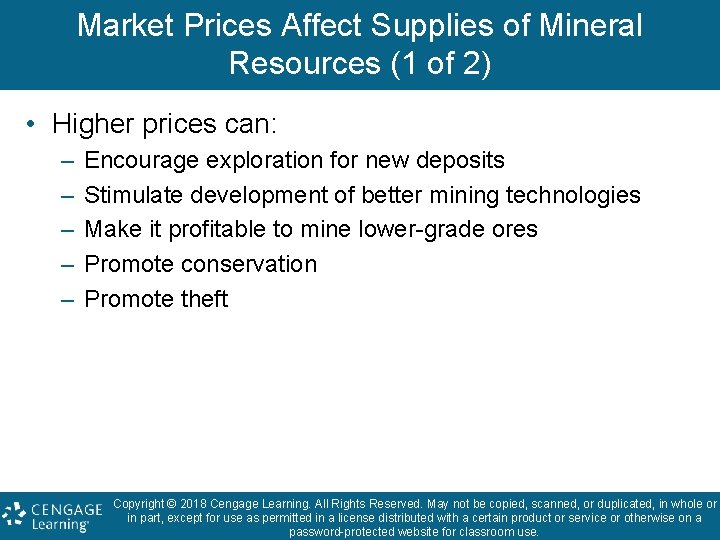
Market Prices Affect Supplies of Mineral Resources (1 of 2) • Higher prices can: – – – Encourage exploration for new deposits Stimulate development of better mining technologies Make it profitable to mine lower-grade ores Promote conservation Promote theft Copyright © 2018 Cengage Learning. All Rights Reserved. May not be copied, scanned, or duplicated, in whole or in part, except for use as permitted in a license distributed with a certain product or service or otherwise on a password-protected website for classroom use.
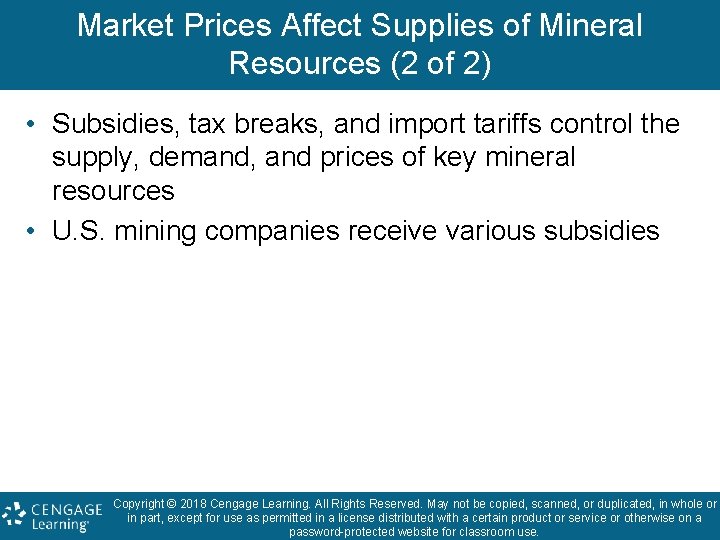
Market Prices Affect Supplies of Mineral Resources (2 of 2) • Subsidies, tax breaks, and import tariffs control the supply, demand, and prices of key mineral resources • U. S. mining companies receive various subsidies Copyright © 2018 Cengage Learning. All Rights Reserved. May not be copied, scanned, or duplicated, in whole or in part, except for use as permitted in a license distributed with a certain product or service or otherwise on a password-protected website for classroom use.
Can We Expand Reserves by Mining Lower. Grade Ores? • Factors that limit the mining of lower-grade ores – Increased cost and energy to mine and process larger volumes of ore – Availability of freshwater – Environmental impact of land disruption • Improve mining technology – Using microorganisms–biomining – Slow process Copyright © 2018 Cengage Learning. All Rights Reserved. May not be copied, scanned, or duplicated, in whole or in part, except for use as permitted in a license distributed with a certain product or service or otherwise on a password-protected website for classroom use.
Can We Get More Minerals from the Oceans? (1 of 3) • Mineral resources dissolved in the ocean – Low concentrations • Deposits of minerals in sediments along the shallow continental shelf and near shorelines Copyright © 2018 Cengage Learning. All Rights Reserved. May not be copied, scanned, or duplicated, in whole or in part, except for use as permitted in a license distributed with a certain product or service or otherwise on a password-protected website for classroom use.
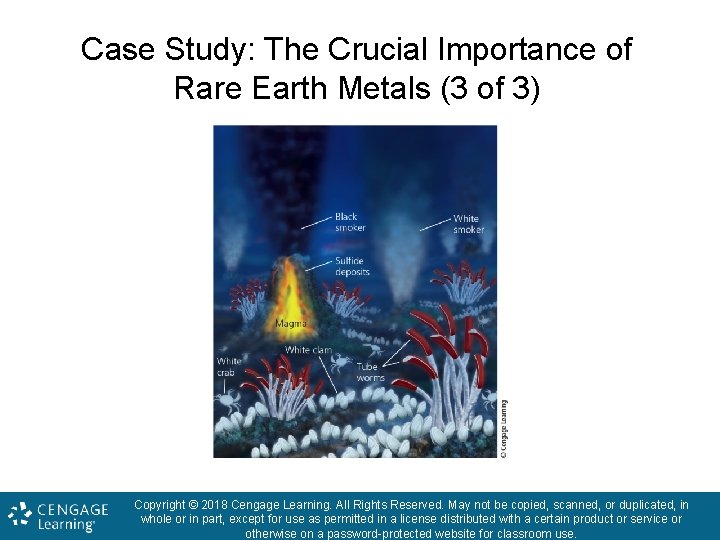
Can We Get More Minerals from the Oceans? (2 of 3) • Hydrothermal ore deposits – Hot water vents in the ocean floor • Metals from the ocean floor – Manganese nodules • What is the effect of mining on aquatic life? Copyright © 2018 Cengage Learning. All Rights Reserved. May not be copied, scanned, or duplicated, in whole or in part, except for use as permitted in a license distributed with a certain product or service or otherwise on a password-protected website for classroom use.
Case Study: The Crucial Importance of Rare Earth Metals (3 of 3) Copyright © 2018 Cengage Learning. All Rights Reserved. May not be copied, scanned, or duplicated, in whole or in part, except for use as permitted in a license distributed with a certain product or service or otherwise on a password-protected website for classroom use.
11. 4 What Are The Environmental Effects of Using Nonrenewable Mineral Resources? • Extracting minerals from the earth’s crust and converting them into useful products: – – Disturbs the land Erodes soils Produces large amounts of solid waste Pollutes the air, water, and soil Copyright © 2018 Cengage Learning. All Rights Reserved. May not be copied, scanned, or duplicated, in whole or in part, except for use as permitted in a license distributed with a certain product or service or otherwise on a password-protected website for classroom use.
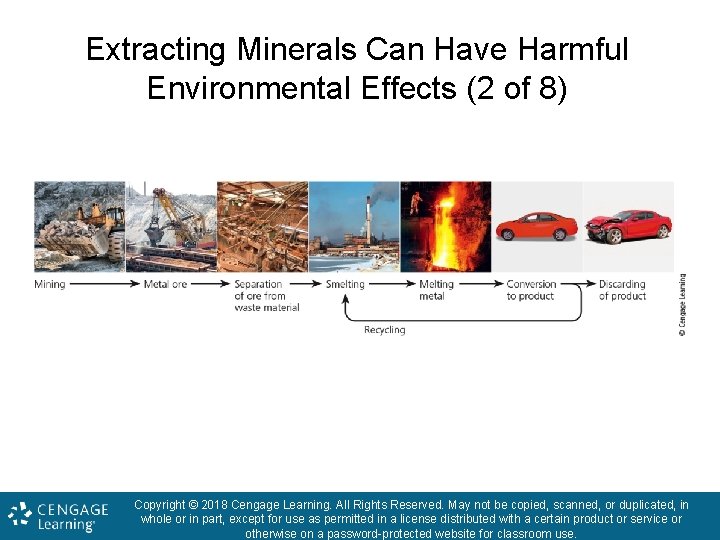
Extracting Minerals Can Have Harmful Environmental Effects (1 of 8) • Metal product life cycle – Mining, processing, manufacture, and disposal • Environmental impacts – Determined by an ore’s grade § Percentage of metal content Copyright © 2018 Cengage Learning. All Rights Reserved. May not be copied, scanned, or duplicated, in whole or in part, except for use as permitted in a license distributed with a certain product or service or otherwise on a password-protected website for classroom use.
Extracting Minerals Can Have Harmful Environmental Effects (2 of 8) Copyright © 2018 Cengage Learning. All Rights Reserved. May not be copied, scanned, or duplicated, in whole or in part, except for use as permitted in a license distributed with a certain product or service or otherwise on a password-protected website for classroom use.
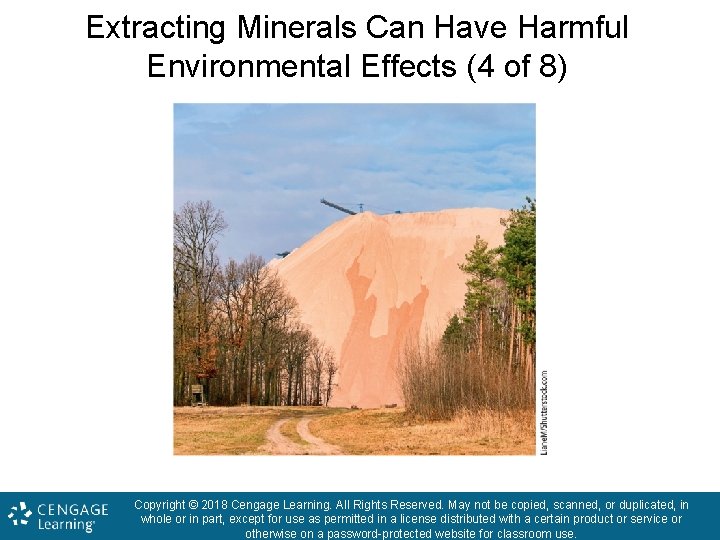
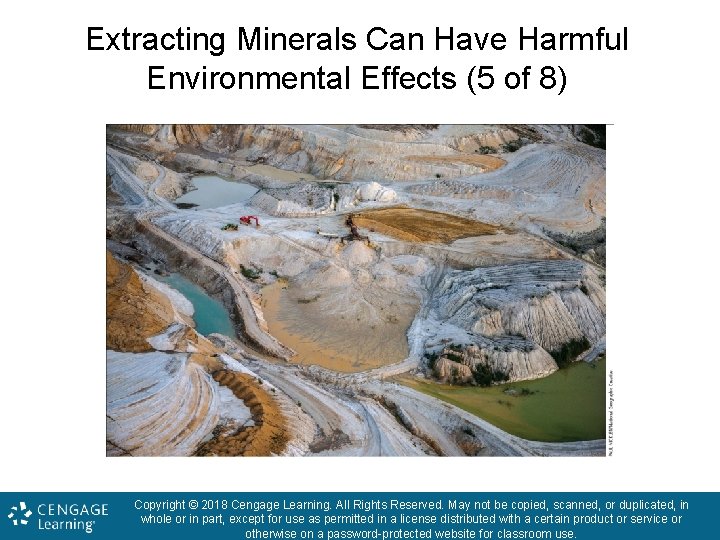
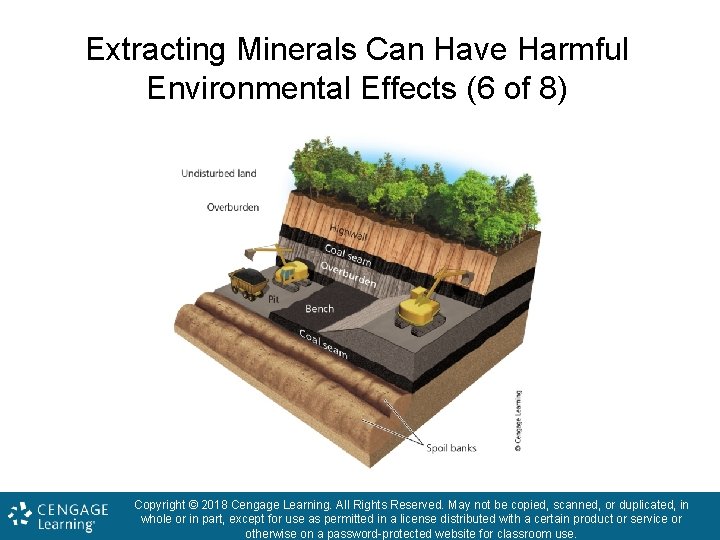
Extracting Minerals Can Have Harmful Environmental Effects (3 of 8) • Surface mining – Removes shallow deposits – Overburden deposited into spoils § Waste material • Open-pit mining • Strip mining – Area strip mining – Contour strip mining Copyright © 2018 Cengage Learning. All Rights Reserved. May not be copied, scanned, or duplicated, in whole or in part, except for use as permitted in a license distributed with a certain product or service or otherwise on a password-protected website for classroom use.
Extracting Minerals Can Have Harmful Environmental Effects (4 of 8) Copyright © 2018 Cengage Learning. All Rights Reserved. May not be copied, scanned, or duplicated, in whole or in part, except for use as permitted in a license distributed with a certain product or service or otherwise on a password-protected website for classroom use.
Extracting Minerals Can Have Harmful Environmental Effects (5 of 8) Copyright © 2018 Cengage Learning. All Rights Reserved. May not be copied, scanned, or duplicated, in whole or in part, except for use as permitted in a license distributed with a certain product or service or otherwise on a password-protected website for classroom use.
Extracting Minerals Can Have Harmful Environmental Effects (6 of 8) Copyright © 2018 Cengage Learning. All Rights Reserved. May not be copied, scanned, or duplicated, in whole or in part, except for use as permitted in a license distributed with a certain product or service or otherwise on a password-protected website for classroom use.
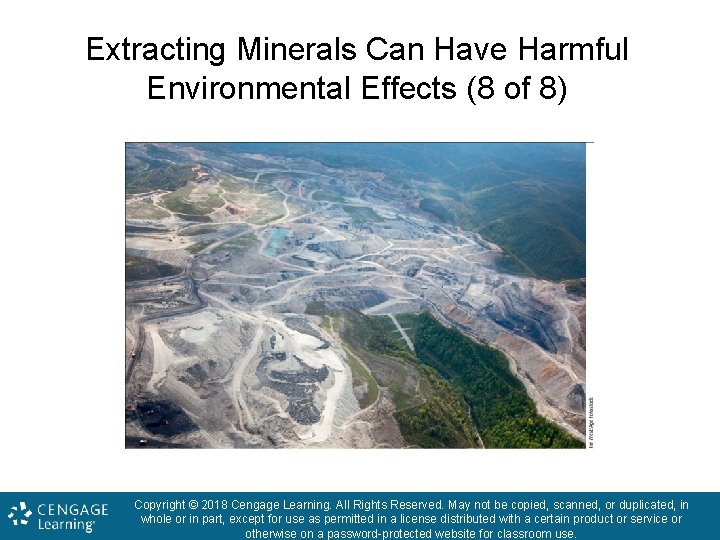
Extracting Minerals Can Have Harmful Environmental Effects (7 of 8) • Mountaintop removal • Subsurface mining – Deep deposits • Potential problems – Subsidence – Health hazards for miners – Acid mine drainage Copyright © 2018 Cengage Learning. All Rights Reserved. May not be copied, scanned, or duplicated, in whole or in part, except for use as permitted in a license distributed with a certain product or service or otherwise on a password-protected website for classroom use.
Extracting Minerals Can Have Harmful Environmental Effects (8 of 8) Copyright © 2018 Cengage Learning. All Rights Reserved. May not be copied, scanned, or duplicated, in whole or in part, except for use as permitted in a license distributed with a certain product or service or otherwise on a password-protected website for classroom use.
Critical Concept: Life Cycle of a Product • The life cycle of a product traces the impacts of each step of a product’s existence from harvesting or mining the materials to produce it, its use, and how it is discarded, as well as the energy invested at each step. Copyright © 2018 Cengage Learning. All Rights Reserved. May not be copied, scanned, or duplicated, in whole or in part, except for use as permitted in a license distributed with a certain product or service or otherwise on a password-protected website for classroom use.
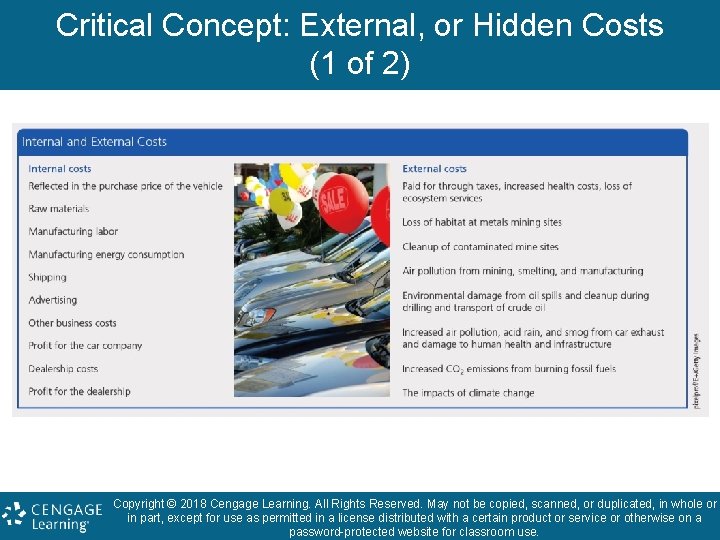
Critical Concept: External, or Hidden Costs (1 of 2) • External costs are those costs to the environment or human health not included in the price of the product. Copyright © 2018 Cengage Learning. All Rights Reserved. May not be copied, scanned, or duplicated, in whole or in part, except for use as permitted in a license distributed with a certain product or service or otherwise on a password-protected website for classroom use.
Critical Concept: External, or Hidden Costs (1 of 2) Copyright © 2018 Cengage Learning. All Rights Reserved. May not be copied, scanned, or duplicated, in whole or in part, except for use as permitted in a license distributed with a certain product or service or otherwise on a password-protected website for classroom use.
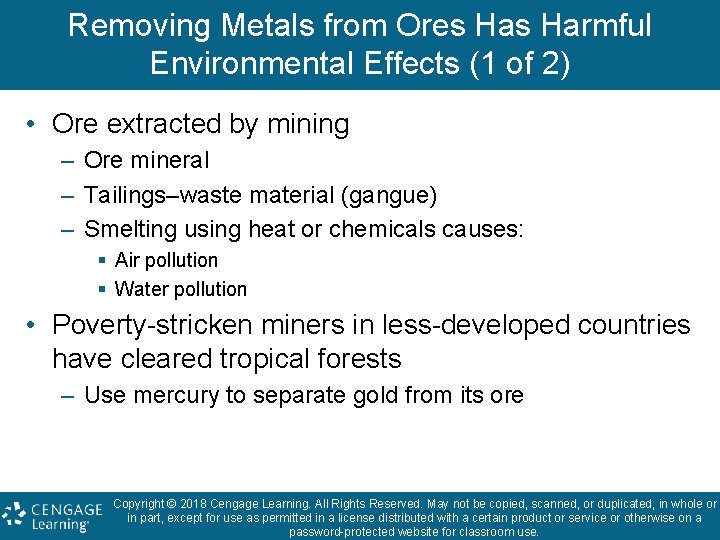
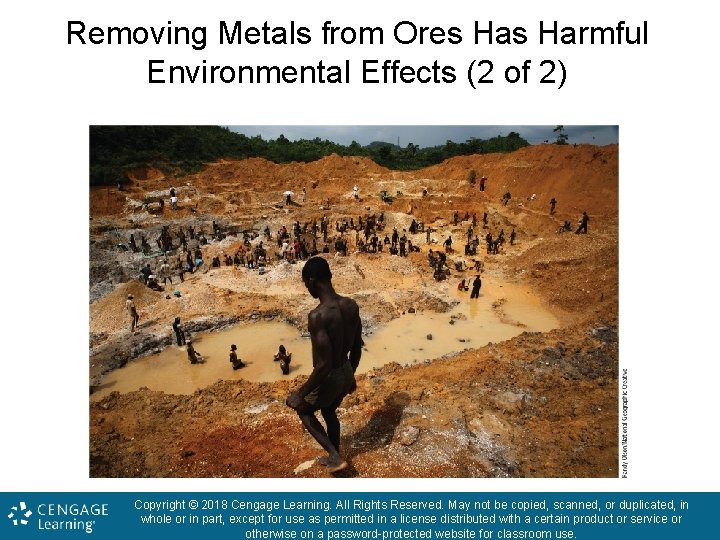
Removing Metals from Ores Harmful Environmental Effects (1 of 2) • Ore extracted by mining – Ore mineral – Tailings–waste material (gangue) – Smelting using heat or chemicals causes: § Air pollution § Water pollution • Poverty-stricken miners in less-developed countries have cleared tropical forests – Use mercury to separate gold from its ore Copyright © 2018 Cengage Learning. All Rights Reserved. May not be copied, scanned, or duplicated, in whole or in part, except for use as permitted in a license distributed with a certain product or service or otherwise on a password-protected website for classroom use.
Removing Metals from Ores Harmful Environmental Effects (2 of 2) Copyright © 2018 Cengage Learning. All Rights Reserved. May not be copied, scanned, or duplicated, in whole or in part, except for use as permitted in a license distributed with a certain product or service or otherwise on a password-protected website for classroom use.
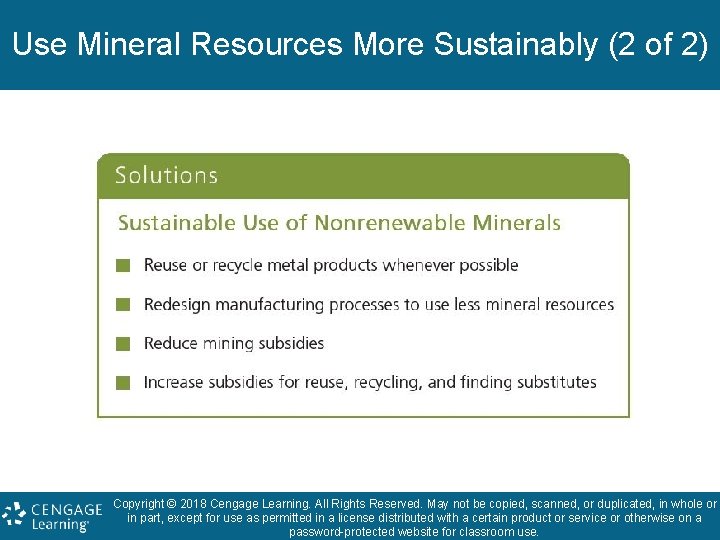
14. 4 How Can We Use Mineral Resources More Sustainability? • Methods for more sustainable mineral use – Try to find substitutes for scarce resources – Reduce resource waste – Recycle and reuse minerals Copyright © 2018 Cengage Learning. All Rights Reserved. May not be copied, scanned, or duplicated, in whole or in part, except for use as permitted in a license distributed with a certain product or service or otherwise on a password-protected website for classroom use.
Find Substitutes for Scarce Mineral Resources • Materials revolution – Silicon replacing some metals for common uses • New technologies – Nanotechnology and high-strength plastics – Graphene and phosphorene • Substitution doesn’t always work – Platinum–industrial catalyst Copyright © 2018 Cengage Learning. All Rights Reserved. May not be copied, scanned, or duplicated, in whole or in part, except for use as permitted in a license distributed with a certain product or service or otherwise on a password-protected website for classroom use.
Case Study: Graphene and Phosphorene - New Revolutionary Materials • Graphene is made from graphite – Light, flexible, stretchable, very strong – Excellent conductor of electricity – Can make stronger and lighter plastics • Phosphorene is a single layer of black phosphorus molecules – More efficient semiconductor than silicon Copyright © 2018 Cengage Learning. All Rights Reserved. May not be copied, scanned, or duplicated, in whole or in part, except for use as permitted in a license distributed with a certain product or service or otherwise on a password-protected website for classroom use.
Use Mineral Resources More Sustainably (1 of 2) • Recycling and reuse – Lower environmental impact than mining and processing metals from ores – Extract valuable metals from electronic waste • Find substitutes without heavy environmental impacts • Lithium – Supplies unevenly distributed worldwide Copyright © 2018 Cengage Learning. All Rights Reserved. May not be copied, scanned, or duplicated, in whole or in part, except for use as permitted in a license distributed with a certain product or service or otherwise on a password-protected website for classroom use.
Use Mineral Resources More Sustainably (2 of 2) Copyright © 2018 Cengage Learning. All Rights Reserved. May not be copied, scanned, or duplicated, in whole or in part, except for use as permitted in a license distributed with a certain product or service or otherwise on a password-protected website for classroom use.
11. 6 What Are the Earth’s Major Geological Hazards? • Dynamic processes move matter within the earth and on its surface – Cause volcanic eruptions, earthquakes, tsunamis, erosion, and landslides Copyright © 2018 Cengage Learning. All Rights Reserved. May not be copied, scanned, or duplicated, in whole or in part, except for use as permitted in a license distributed with a certain product or service or otherwise on a password-protected website for classroom use.
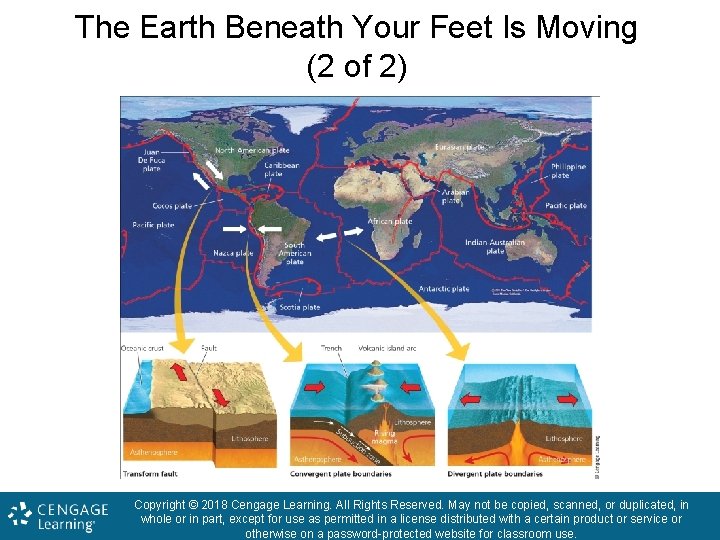
The Earth Beneath Your Feet Is Moving (1 of 2) • The earth’s crust is broken into tectonic plates – “Float” on the asthenosphere – Slow movement of continenets is called continental drift • Much geological activity takes place at plate boundaries – Divergent boundary – Convergent boundary – Transform plate boundary Copyright © 2018 Cengage Learning. All Rights Reserved. May not be copied, scanned, or duplicated, in whole or in part, except for use as permitted in a license distributed with a certain product or service or otherwise on a password-protected website for classroom use.
The Earth Beneath Your Feet Is Moving (2 of 2) Copyright © 2018 Cengage Learning. All Rights Reserved. May not be copied, scanned, or duplicated, in whole or in part, except for use as permitted in a license distributed with a certain product or service or otherwise on a password-protected website for classroom use.
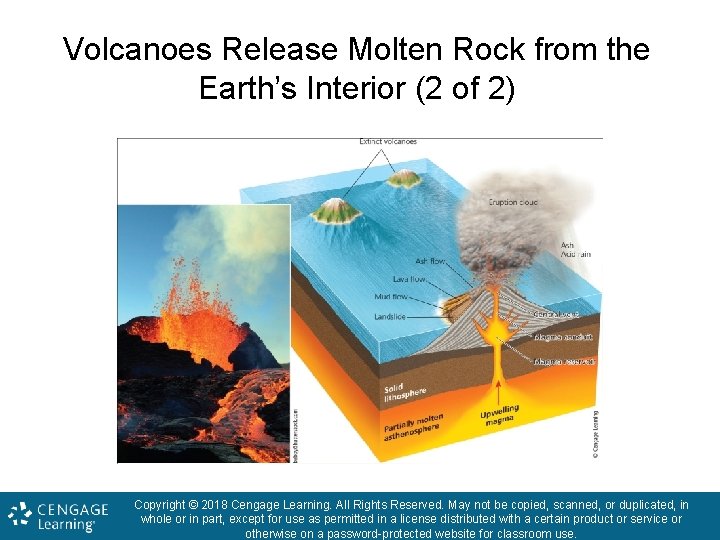
Volcanoes Release Molten Rock from the Earth’s Interior (1 of 2) • Volcano – Magma rising through the lithosphere reaches the earth’s surface through a crack (fissure) – Eruption–release of lava, hot ash, and gases into the environment • Volcanos form majestic mountain ranges and lakes – Formed Hawaiian islands – Can also cause destruction Copyright © 2018 Cengage Learning. All Rights Reserved. May not be copied, scanned, or duplicated, in whole or in part, except for use as permitted in a license distributed with a certain product or service or otherwise on a password-protected website for classroom use.
Volcanoes Release Molten Rock from the Earth’s Interior (2 of 2) Copyright © 2018 Cengage Learning. All Rights Reserved. May not be copied, scanned, or duplicated, in whole or in part, except for use as permitted in a license distributed with a certain product or service or otherwise on a password-protected website for classroom use.
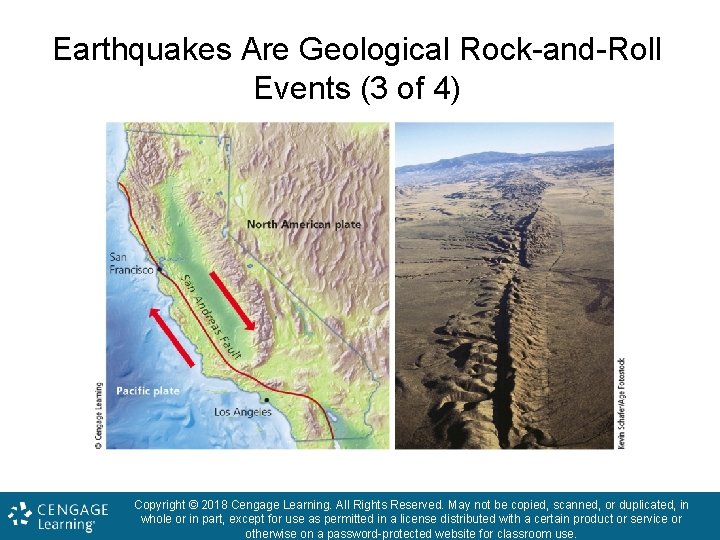
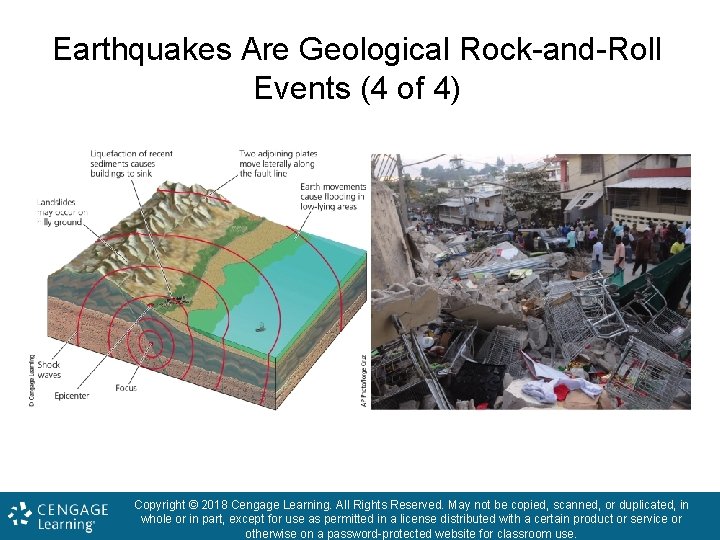
Earthquakes Are Geological Rock-and-Roll Events (1 of 4) • Earthquake – Breakage and shifting of rocks § Occurs at a fault – Seismic waves § Vibrations in the crust – Focus–origin of earthquake – Magnitude–severity of earthquake – Amplitude–size of the seismic waves Copyright © 2018 Cengage Learning. All Rights Reserved. May not be copied, scanned, or duplicated, in whole or in part, except for use as permitted in a license distributed with a certain product or service or otherwise on a password-protected website for classroom use.
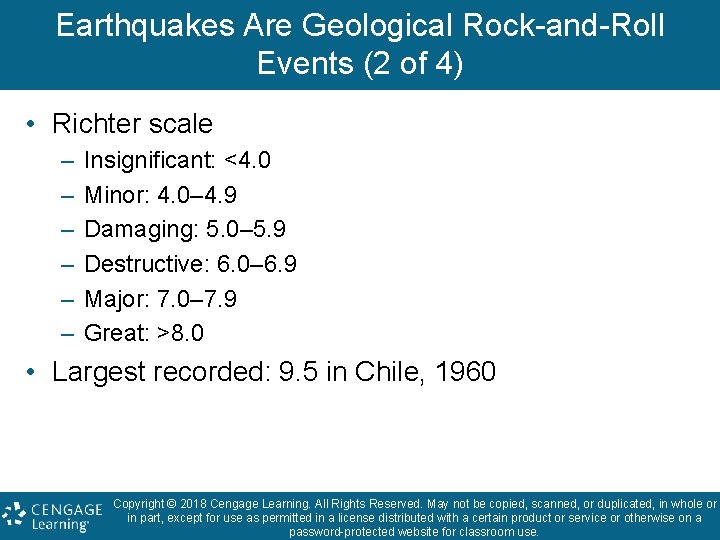
Earthquakes Are Geological Rock-and-Roll Events (2 of 4) • Richter scale – – – Insignificant: <4. 0 Minor: 4. 0– 4. 9 Damaging: 5. 0– 5. 9 Destructive: 6. 0– 6. 9 Major: 7. 0– 7. 9 Great: >8. 0 • Largest recorded: 9. 5 in Chile, 1960 Copyright © 2018 Cengage Learning. All Rights Reserved. May not be copied, scanned, or duplicated, in whole or in part, except for use as permitted in a license distributed with a certain product or service or otherwise on a password-protected website for classroom use.
Earthquakes Are Geological Rock-and-Roll Events (3 of 4) Copyright © 2018 Cengage Learning. All Rights Reserved. May not be copied, scanned, or duplicated, in whole or in part, except for use as permitted in a license distributed with a certain product or service or otherwise on a password-protected website for classroom use.
Earthquakes Are Geological Rock-and-Roll Events (4 of 4) Copyright © 2018 Cengage Learning. All Rights Reserved. May not be copied, scanned, or duplicated, in whole or in part, except for use as permitted in a license distributed with a certain product or service or otherwise on a password-protected website for classroom use.
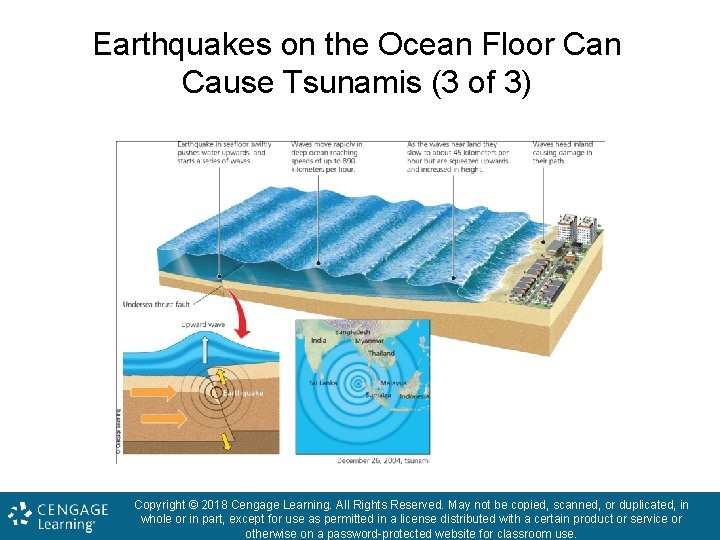
Earthquakes on the Ocean Floor Can Cause Tsunamis (1 of 3) • Tsunami – Series of huge waves generated when ocean floor suddenly rises or drops – Travels several hundred miles per hour § Slows down as it approaches coastline • December 2004–Indian Ocean tsunami – Magnitude 9. 15 earthquake – Over 230, 000 people lost their lives § No warning system in place Copyright © 2018 Cengage Learning. All Rights Reserved. May not be copied, scanned, or duplicated, in whole or in part, except for use as permitted in a license distributed with a certain product or service or otherwise on a password-protected website for classroom use.
Earthquakes on the Ocean Floor Can Cause Tsunamis (2 of 3) • 2011–Japan tsunami – Killed almost 19, 000 people – Damaged Fukushima nuclear reactors • Detection of tsunamis – Buoys in open ocean – Pressure recorders on the ocean floor Copyright © 2018 Cengage Learning. All Rights Reserved. May not be copied, scanned, or duplicated, in whole or in part, except for use as permitted in a license distributed with a certain product or service or otherwise on a password-protected website for classroom use.
Earthquakes on the Ocean Floor Can Cause Tsunamis (3 of 3) Copyright © 2018 Cengage Learning. All Rights Reserved. May not be copied, scanned, or duplicated, in whole or in part, except for use as permitted in a license distributed with a certain product or service or otherwise on a password-protected website for classroom use.