
Exploring Environmental Science for AP 1 st Edition
- Slides: 61
Exploring Environmental Science for AP® 1 st Edition Chapter 20 Climate Change • Copyright © 2018 Cengage Learning. All Rights Reserved. May not be copied, scanned, or duplicated, in whole or in part, except for use as permitted in a license distributed with a certain product or service or otherwise on a password-protected website for classroom use.
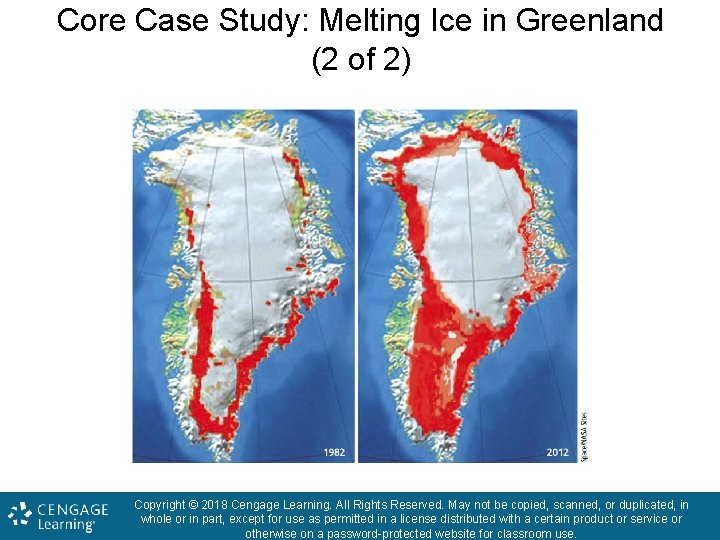
Core Case Study: Melting Ice in Greenland (1 of 2) • World’s largest island – Mostly covered by ice glaciers • Glaciers melting at an accelerating rate in summers – Atmospheric warming a key factor • Greenland’s ice loss – Responsible for nearly one-sixth of the global sea-level rise over the past 20 years Copyright © 2018 Cengage Learning. All Rights Reserved. May not be copied, scanned, or duplicated, in whole or in part, except for use as permitted in a license distributed with a certain product or service or otherwise on a password-protected website for classroom use.
Core Case Study: Melting Ice in Greenland (2 of 2) Copyright © 2018 Cengage Learning. All Rights Reserved. May not be copied, scanned, or duplicated, in whole or in part, except for use as permitted in a license distributed with a certain product or service or otherwise on a password-protected website for classroom use.
20. 1 How and Why Is the Earth’s Climate Changing? • Scientific evidence strongly indicates that the earth’s atmosphere is warming at a rate that is likely to lead to significant climate change • Weather – Short-term changes • Climate – Average weather conditions of a particular area over 30 years or more Copyright © 2018 Cengage Learning. All Rights Reserved. May not be copied, scanned, or duplicated, in whole or in part, except for use as permitted in a license distributed with a certain product or service or otherwise on a password-protected website for classroom use.
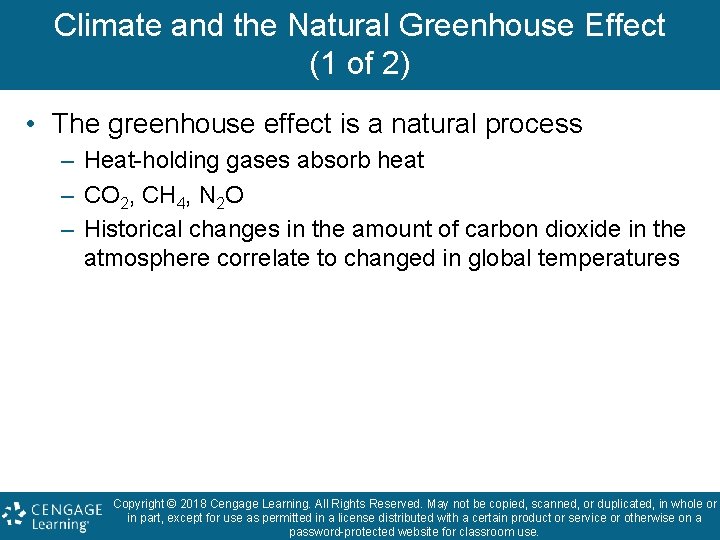
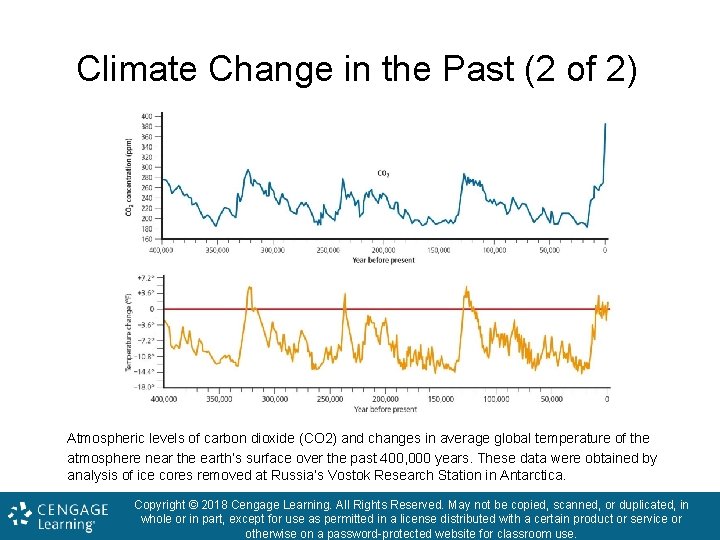
Climate and the Natural Greenhouse Effect (1 of 2) • The greenhouse effect is a natural process – Heat-holding gases absorb heat – CO 2, CH 4, N 2 O – Historical changes in the amount of carbon dioxide in the atmosphere correlate to changed in global temperatures Copyright © 2018 Cengage Learning. All Rights Reserved. May not be copied, scanned, or duplicated, in whole or in part, except for use as permitted in a license distributed with a certain product or service or otherwise on a password-protected website for classroom use.
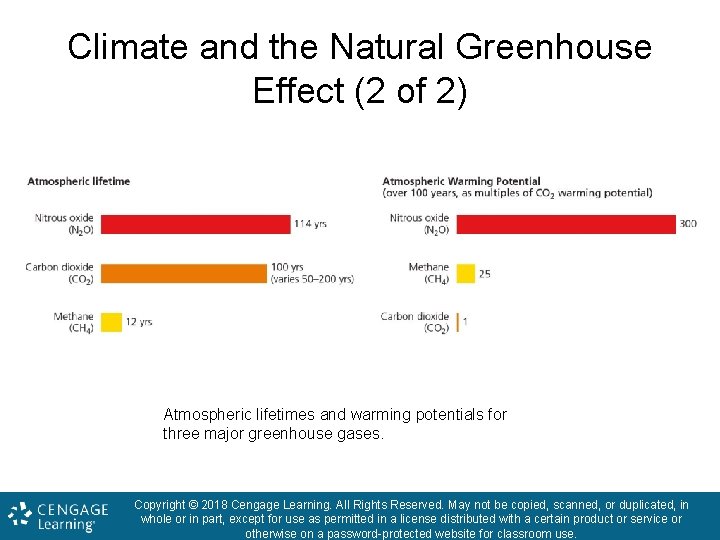
Climate and the Natural Greenhouse Effect (2 of 2) Atmospheric lifetimes and warming potentials for three major greenhouse gases. Copyright © 2018 Cengage Learning. All Rights Reserved. May not be copied, scanned, or duplicated, in whole or in part, except for use as permitted in a license distributed with a certain product or service or otherwise on a password-protected website for classroom use.
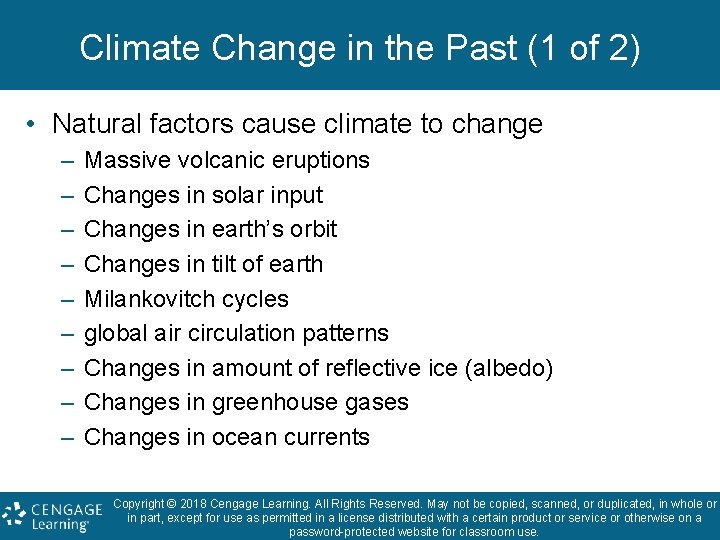
Climate Change in the Past (1 of 2) • Natural factors cause climate to change – – – – – Massive volcanic eruptions Changes in solar input Changes in earth’s orbit Changes in tilt of earth Milankovitch cycles global air circulation patterns Changes in amount of reflective ice (albedo) Changes in greenhouse gases Changes in ocean currents Copyright © 2018 Cengage Learning. All Rights Reserved. May not be copied, scanned, or duplicated, in whole or in part, except for use as permitted in a license distributed with a certain product or service or otherwise on a password-protected website for classroom use.
Climate Change in the Past (2 of 2) Atmospheric levels of carbon dioxide (CO 2) and changes in average global temperature of the atmosphere near the earth’s surface over the past 400, 000 years. These data were obtained by analysis of ice cores removed at Russia’s Vostok Research Station in Antarctica. Copyright © 2018 Cengage Learning. All Rights Reserved. May not be copied, scanned, or duplicated, in whole or in part, except for use as permitted in a license distributed with a certain product or service or otherwise on a password-protected website for classroom use.
Current Atmospheric Warming and Climate Change • Climate change is happening now – Between 1906 and 2016, earth’s temperature rose by 0. 94°C – 10 warmest years on record since 1861 have taken place since 2005 – Arctic ice has been shrinking since 1979 – Glaciers are melting – Permafrost is melting, rising sea levels reducing coast – Carbon dioxide and methane levels have risen sharply – Terrestrial organisms have migrated towards poles and up mountains where it is cooler Copyright © 2018 Cengage Learning. All Rights Reserved. May not be copied, scanned, or duplicated, in whole or in part, except for use as permitted in a license distributed with a certain product or service or otherwise on a password-protected website for classroom use.
Role of Human Activities in Current Atmospheric Warming (1 of 3) • Burning of fossil fuels, deforestation, and agriculture led to significant increases in greenhouse gases • Increase of methane (more potent than CO 2) from livestock, rice production, natural gas production • U. S. has largest per capita carbon footprint • Carbon added to the atmosphere faster than the carbon cycle can remove it Copyright © 2018 Cengage Learning. All Rights Reserved. May not be copied, scanned, or duplicated, in whole or in part, except for use as permitted in a license distributed with a certain product or service or otherwise on a password-protected website for classroom use.
Role of Human Activities in Current Atmospheric Warming (2 of 3) • Humans have also cut down forests, a sink for carbon • Change in climate is much faster than change induced by natural factors • Climate scientists agree that – – Climate change is happening now Human activities play a significant role in climate change Average atmospheric temperatures are likely to increase Immediate action is possible and affordable and would bring major benefits Copyright © 2018 Cengage Learning. All Rights Reserved. May not be copied, scanned, or duplicated, in whole or in part, except for use as permitted in a license distributed with a certain product or service or otherwise on a password-protected website for classroom use.
Role of Human Activities in Current Atmospheric Warming (3 of 3) • Fossil fuel lifestyle has led to serious problems – Air pollution – Climate change – Ocean acidification • Scientists use models to make projections about future trends Copyright © 2018 Cengage Learning. All Rights Reserved. May not be copied, scanned, or duplicated, in whole or in part, except for use as permitted in a license distributed with a certain product or service or otherwise on a password-protected website for classroom use.
Role of the Sun in Current Atmospheric Warming • Cause of warming cannot be increased solar output – Output has dropped slightly during last few decades – Troposphere has warmed while stratosphere has cooled – Atmosphere is heating from the bottom up Copyright © 2018 Cengage Learning. All Rights Reserved. May not be copied, scanned, or duplicated, in whole or in part, except for use as permitted in a license distributed with a certain product or service or otherwise on a password-protected website for classroom use.
Effects of the Oceans on Current Atmospheric Warming (1 of 2) • Sink for carbon, most stored as carbon in marine algae and vegetation, in coral reefs and bottom sediments • Also absorb heat from troposphere • Has resulted in ocean acidification Copyright © 2018 Cengage Learning. All Rights Reserved. May not be copied, scanned, or duplicated, in whole or in part, except for use as permitted in a license distributed with a certain product or service or otherwise on a password-protected website for classroom use.
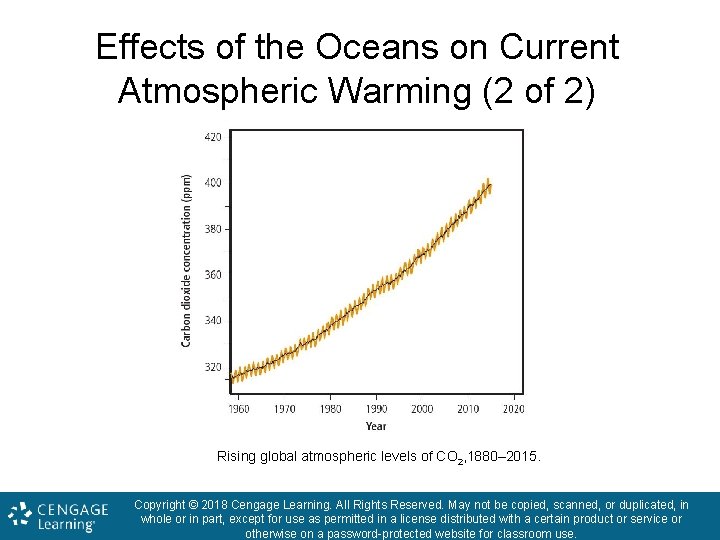
Effects of the Oceans on Current Atmospheric Warming (2 of 2) Rising global atmospheric levels of CO 2, 1880– 2015. Copyright © 2018 Cengage Learning. All Rights Reserved. May not be copied, scanned, or duplicated, in whole or in part, except for use as permitted in a license distributed with a certain product or service or otherwise on a password-protected website for classroom use.
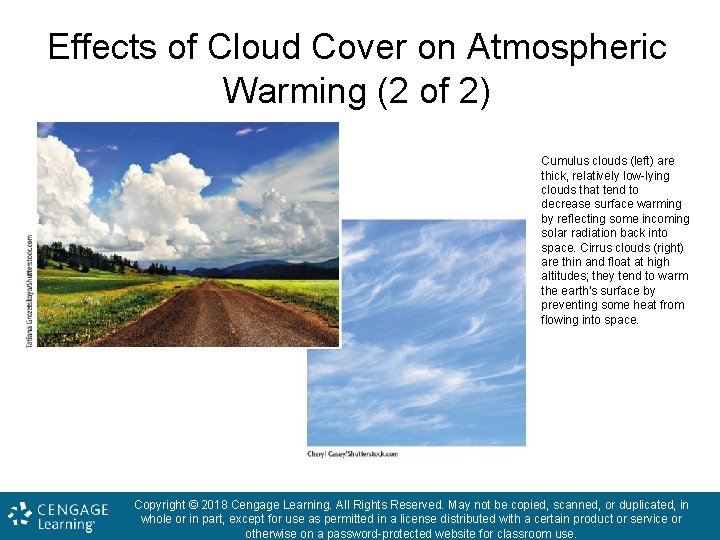
Effects of Cloud Cover on Atmospheric Warming (1 of 2) • Net effect of cloud cover change is likely to increase warming • Cumulus clouds reflect light back into space • Cirrus clouds insulate earth, increasing cooling Copyright © 2018 Cengage Learning. All Rights Reserved. May not be copied, scanned, or duplicated, in whole or in part, except for use as permitted in a license distributed with a certain product or service or otherwise on a password-protected website for classroom use.
Effects of Cloud Cover on Atmospheric Warming (2 of 2) Cumulus clouds (left) are thick, relatively low-lying clouds that tend to decrease surface warming by reflecting some incoming solar radiation back into space. Cirrus clouds (right) are thin and float at high altitudes; they tend to warm the earth’s surface by preventing some heat from flowing into space. Copyright © 2018 Cengage Learning. All Rights Reserved. May not be copied, scanned, or duplicated, in whole or in part, except for use as permitted in a license distributed with a certain product or service or otherwise on a password-protected website for classroom use.
Effects of Outdoor Air Pollution on Atmospheric Warming • Light colored aerosols reflect incoming sunlight • Dark particles like soot absorb heat • Most likely will not affect climate change Copyright © 2018 Cengage Learning. All Rights Reserved. May not be copied, scanned, or duplicated, in whole or in part, except for use as permitted in a license distributed with a certain product or service or otherwise on a password-protected website for classroom use.
20. 2 What are the Likely Effects of a Warmer Atmosphere? • Projected change in temperature could have severe and long-lasting consequences – – Flooding Rising sea levels Shifts in location of croplands and wildlife habitats More extreme weather Copyright © 2018 Cengage Learning. All Rights Reserved. May not be copied, scanned, or duplicated, in whole or in part, except for use as permitted in a license distributed with a certain product or service or otherwise on a password-protected website for classroom use.
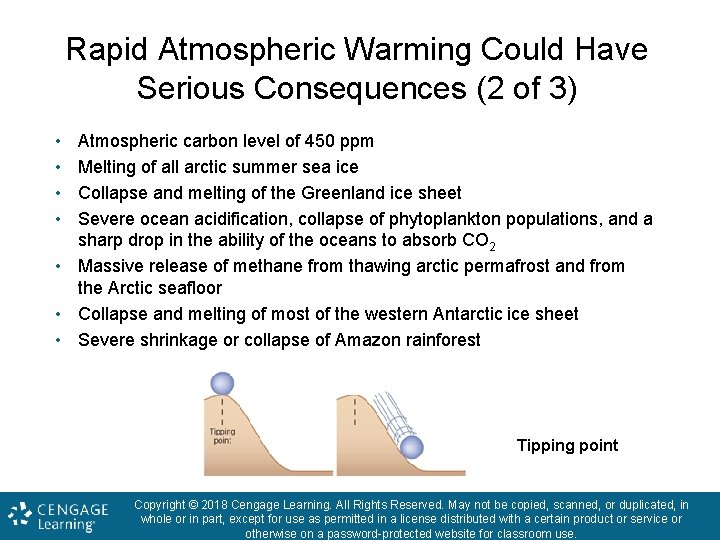
Rapid Atmospheric Warming Could Have Serious Consequences (1 of 3) • Temperatures rising rapidly • Climate change tipping points – Thresholds beyond which natural systems will not recover § Global temperature rise of 2°C § CO 2 concentration above 450 ppm • Harmful effects will be unevenly distribute – Reduce food security, increase poverty and social conflict Copyright © 2018 Cengage Learning. All Rights Reserved. May not be copied, scanned, or duplicated, in whole or in part, except for use as permitted in a license distributed with a certain product or service or otherwise on a password-protected website for classroom use.
Rapid Atmospheric Warming Could Have Serious Consequences (2 of 3) • • Atmospheric carbon level of 450 ppm Melting of all arctic summer sea ice Collapse and melting of the Greenland ice sheet Severe ocean acidification, collapse of phytoplankton populations, and a sharp drop in the ability of the oceans to absorb CO 2 • Massive release of methane from thawing arctic permafrost and from the Arctic seafloor • Collapse and melting of most of the western Antarctic ice sheet • Severe shrinkage or collapse of Amazon rainforest Tipping point Copyright © 2018 Cengage Learning. All Rights Reserved. May not be copied, scanned, or duplicated, in whole or in part, except for use as permitted in a license distributed with a certain product or service or otherwise on a password-protected website for classroom use.
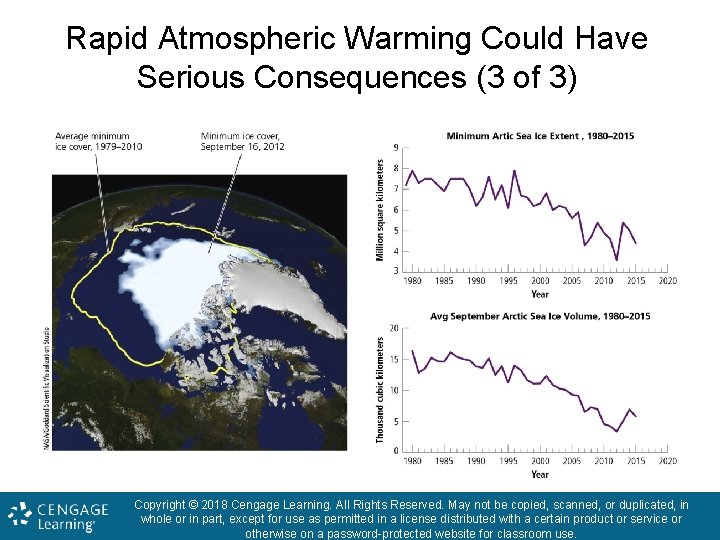
Rapid Atmospheric Warming Could Have Serious Consequences (3 of 3) Copyright © 2018 Cengage Learning. All Rights Reserved. May not be copied, scanned, or duplicated, in whole or in part, except for use as permitted in a license distributed with a certain product or service or otherwise on a password-protected website for classroom use.
Increased Melting of Ice and Snow • Less light-colored ice and snow to reflect solar energy (albedo reduced) – Accelerated polar ice melting – Positive feedback loop • Climate tipping point – Complete melting of summer arctic sea ice § May happen by 2050 – Changes in arctic seawater temperatures influence the jet stream • Mountain glaciers are shrinking – Play a vital role in the water cycle Copyright © 2018 Cengage Learning. All Rights Reserved. May not be copied, scanned, or duplicated, in whole or in part, except for use as permitted in a license distributed with a certain product or service or otherwise on a password-protected website for classroom use.
Methane Emissions from Thawing Permafrost • Permafrost: frozen soil in northern hemisphere • Climate change is projected to thaw significant amounts of permafrost – Already happening in Alaska and Siberia – Releases methane and CO 2 § Release accelerates projected warming • Methane in permafrost on Arctic Sea floor Copyright © 2018 Cengage Learning. All Rights Reserved. May not be copied, scanned, or duplicated, in whole or in part, except for use as permitted in a license distributed with a certain product or service or otherwise on a password-protected website for classroom use.
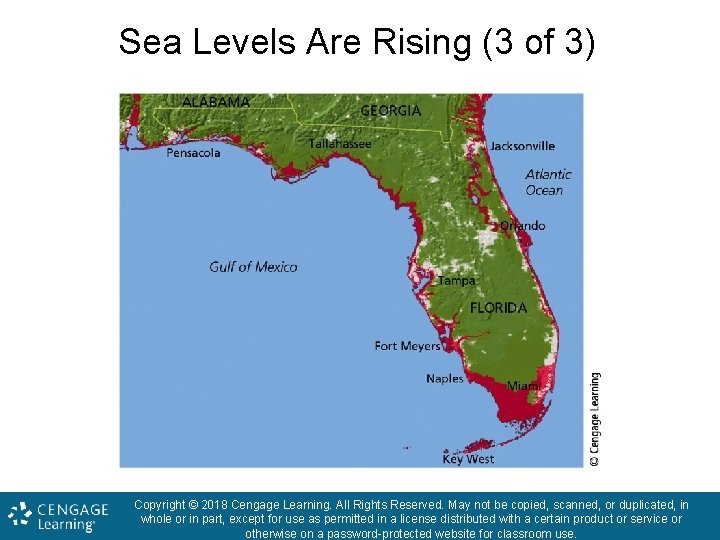
Rising Sea Levels (1 of 3) • Projected sea level rise – 40– 60 cm by the end of the century – More than half of the rise from melting of Greenland’s ice • Serious effects of sea level rise – Degradation and loss of one-third of coastal estuaries, wetlands, and coral reefs – Disruption of coastal fisheries – Flooding barrier islands and coastal areas Copyright © 2018 Cengage Learning. All Rights Reserved. May not be copied, scanned, or duplicated, in whole or in part, except for use as permitted in a license distributed with a certain product or service or otherwise on a password-protected website for classroom use.
Sea Levels Are Rising (2 of 3) • Serious effects (cont’d. ) – Contamination of freshwater coastal aquifers – Submergence of low-lying islands in the Pacific and Indian Oceans and the Caribbean – Flooding of coastal cities could displace 150 million people Copyright © 2018 Cengage Learning. All Rights Reserved. May not be copied, scanned, or duplicated, in whole or in part, except for use as permitted in a license distributed with a certain product or service or otherwise on a password-protected website for classroom use.
Sea Levels Are Rising (3 of 3) Copyright © 2018 Cengage Learning. All Rights Reserved. May not be copied, scanned, or duplicated, in whole or in part, except for use as permitted in a license distributed with a certain product or service or otherwise on a password-protected website for classroom use.
Ocean Acidification: The Other CO 2 Problem • Surface waters have increased acidity by 30% since 1800 – Could reach dangerous levels before 2050 • CO 2 combines with water to become carbonic acid (H 2 CO 3) – Threatens corals, snails, and other organisms with shells – Threatens phytoplankton § Primary producer species of ocean food webs Copyright © 2018 Cengage Learning. All Rights Reserved. May not be copied, scanned, or duplicated, in whole or in part, except for use as permitted in a license distributed with a certain product or service or otherwise on a password-protected website for classroom use.
More Severe Drought • Extra heat in the atmosphere depletes soil moisture – Prolongs droughts and makes them more severe • Higher temperatures intensify the water cycle – Additional water vapor warms the atmosphere • Increased wildfires • Reduced growth of plants and trees Copyright © 2018 Cengage Learning. All Rights Reserved. May not be copied, scanned, or duplicated, in whole or in part, except for use as permitted in a license distributed with a certain product or service or otherwise on a password-protected website for classroom use.
More Extreme Weather • Intensified water cycle will bring more flooding to some areas • Annual days of extreme heat in parts of the United States will rise dramatically by the end of the century • Some areas may experience colder winter weather – Due to changes in global air circulation patterns Copyright © 2018 Cengage Learning. All Rights Reserved. May not be copied, scanned, or duplicated, in whole or in part, except for use as permitted in a license distributed with a certain product or service or otherwise on a password-protected website for classroom use.
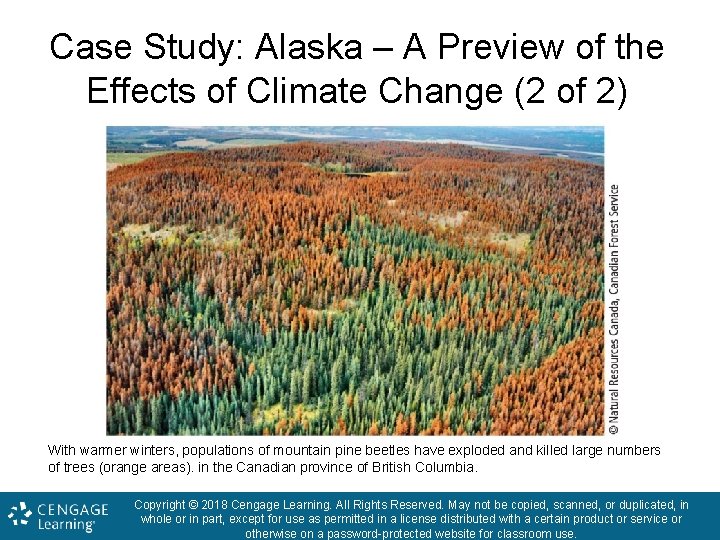
Threats to Biodiversity • Amazon rainforest – Up to 85% could be lost due to warming • Extinctions due to loss of habitat – – Polar bears and penguins Species that live at high elevations Corals Species with limited ranges • Increase in mountain pine beetle destroying forests Copyright © 2018 Cengage Learning. All Rights Reserved. May not be copied, scanned, or duplicated, in whole or in part, except for use as permitted in a license distributed with a certain product or service or otherwise on a password-protected website for classroom use.
Case Study: Alaska – A Preview of the Effects of Climate Change (1 of 2) • Warming at twice the average rate of the rest of the U. S. – All but five glaciers melting – Sea ice melting sooner and refreezing later, shortening the hunting season for walruses, polar bears, and humans – Coastal villages not protected by sea ice and damaged by storms – Melting permafrost damages roads and buildings – Population explosion of beetles that attack white spruce forests Copyright © 2018 Cengage Learning. All Rights Reserved. May not be copied, scanned, or duplicated, in whole or in part, except for use as permitted in a license distributed with a certain product or service or otherwise on a password-protected website for classroom use.
Case Study: Alaska – A Preview of the Effects of Climate Change (2 of 2) With warmer winters, populations of mountain pine beetles have exploded and killed large numbers of trees (orange areas). in the Canadian province of British Columbia. Copyright © 2018 Cengage Learning. All Rights Reserved. May not be copied, scanned, or duplicated, in whole or in part, except for use as permitted in a license distributed with a certain product or service or otherwise on a password-protected website for classroom use.
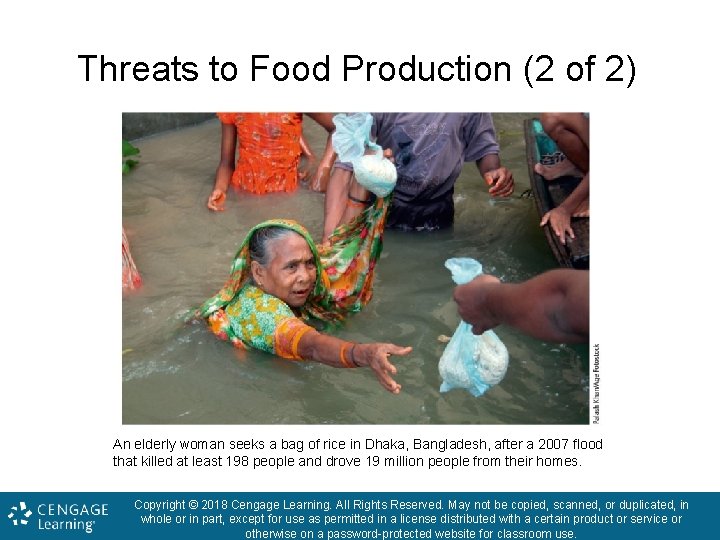
Threats to Food Production (1 of 2) • Regions of farming will shift – Decrease in tropical and subtropical areas – Increase in northern latitudes § Less productivity–soil not as fertile • Flooding will reduce crop production • Several hundred million people could face starvation and malnutrition Copyright © 2018 Cengage Learning. All Rights Reserved. May not be copied, scanned, or duplicated, in whole or in part, except for use as permitted in a license distributed with a certain product or service or otherwise on a password-protected website for classroom use.
Threats to Food Production (2 of 2) An elderly woman seeks a bag of rice in Dhaka, Bangladesh, after a 2007 flood that killed at least 198 people and drove 19 million people from their homes. Copyright © 2018 Cengage Learning. All Rights Reserved. May not be copied, scanned, or duplicated, in whole or in part, except for use as permitted in a license distributed with a certain product or service or otherwise on a password-protected website for classroom use.
Threats to Human Health, National Security, and Economies (1 of 2) • Increase in heat-related deaths • Conditions favorable for: – Disease-transmitting mosquitos and ticks – Microbes, molds, and fungi • Increase in photochemical smog • National security and economic effects – Food and water scarcity, poverty, mass migrations, political instability, and increased unemployment Copyright © 2018 Cengage Learning. All Rights Reserved. May not be copied, scanned, or duplicated, in whole or in part, except for use as permitted in a license distributed with a certain product or service or otherwise on a password-protected website for classroom use.
20. 3 How Can We Slow Climate Change? • We can reduce greenhouse gas emissions and the threat of climate change while saving money and improving human health – Reduce energy waste – Rely more on cleaner renewable energy resources Copyright © 2018 Cengage Learning. All Rights Reserved. May not be copied, scanned, or duplicated, in whole or in part, except for use as permitted in a license distributed with a certain product or service or otherwise on a password-protected website for classroom use.
Dealing with Climate Is Difficult (1 of 2) • Global problem – Requires unprecedented and prolonged international cooperation • Long-term political issue – Most people who will suffer most serious harm have not been born yet • Harmful and beneficial impacts of climate change not spread evenly worldwide Copyright © 2018 Cengage Learning. All Rights Reserved. May not be copied, scanned, or duplicated, in whole or in part, except for use as permitted in a license distributed with a certain product or service or otherwise on a password-protected website for classroom use.
Dealing with Climate Is Difficult (2 of 2) • Proposed solutions are controversial – Economic disruption • Projected effects are uncertain – Difficult to plan for avoiding or managing risk – Urgent need for more research to reduce uncertainty Copyright © 2018 Cengage Learning. All Rights Reserved. May not be copied, scanned, or duplicated, in whole or in part, except for use as permitted in a license distributed with a certain product or service or otherwise on a password-protected website for classroom use.
What Are Our Options? • Mitigation – Slow climate change to avoid its most harmful effects • Adaptation – Recognize climate change is inevitable because we have waited too long to act – Adapt to some of its harmful effects • Most urgent priority: avoid climate change tipping points Copyright © 2018 Cengage Learning. All Rights Reserved. May not be copied, scanned, or duplicated, in whole or in part, except for use as permitted in a license distributed with a certain product or service or otherwise on a password-protected website for classroom use.
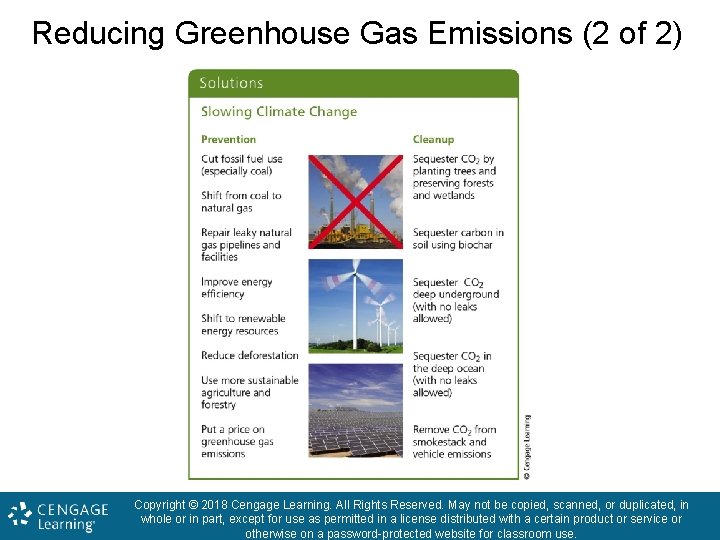
Reducing Greenhouse Gas Emissions (1 of 2) • Most of the world’s economies depend on using fossil fuel reserves – Shift is difficult but humans have done it before • Good starting points – Decrease black carbon and methane emissions § Technology exists to accomplish this quickly – Make the switch to hybrid and electric cars Copyright © 2018 Cengage Learning. All Rights Reserved. May not be copied, scanned, or duplicated, in whole or in part, except for use as permitted in a license distributed with a certain product or service or otherwise on a password-protected website for classroom use.
Reducing Greenhouse Gas Emissions (2 of 2) Copyright © 2018 Cengage Learning. All Rights Reserved. May not be copied, scanned, or duplicated, in whole or in part, except for use as permitted in a license distributed with a certain product or service or otherwise on a password-protected website for classroom use.
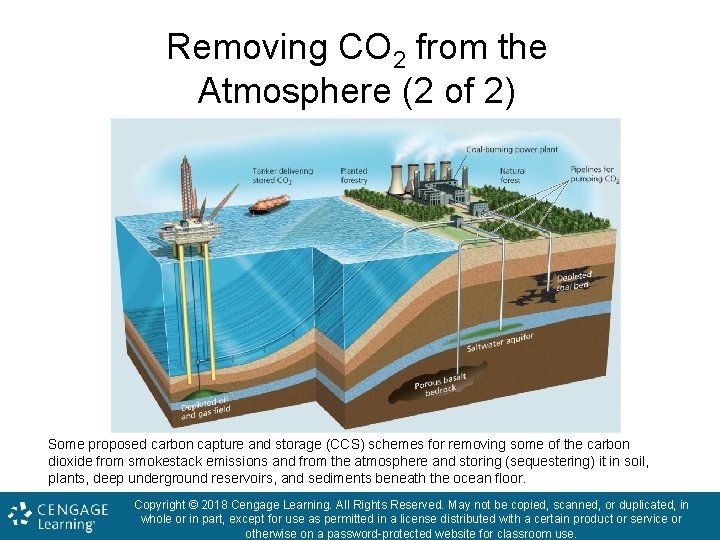
Removing CO 2 from the Atmosphere (1 of 2) • Solution strategies – Massive, global tree-planting and forestoration program – Restore wetlands drained for farming – Plant fast-growing perennials on degraded land – Produce and bury biochar in the soil – Capture and store carbon from coal-burning plants Copyright © 2018 Cengage Learning. All Rights Reserved. May not be copied, scanned, or duplicated, in whole or in part, except for use as permitted in a license distributed with a certain product or service or otherwise on a password-protected website for classroom use.
Removing CO 2 from the Atmosphere (2 of 2) Some proposed carbon capture and storage (CCS) schemes for removing some of the carbon dioxide from smokestack emissions and from the atmosphere and storing (sequestering) it in soil, plants, deep underground reservoirs, and sediments beneath the ocean floor. Copyright © 2018 Cengage Learning. All Rights Reserved. May not be copied, scanned, or duplicated, in whole or in part, except for use as permitted in a license distributed with a certain product or service or otherwise on a password-protected website for classroom use.
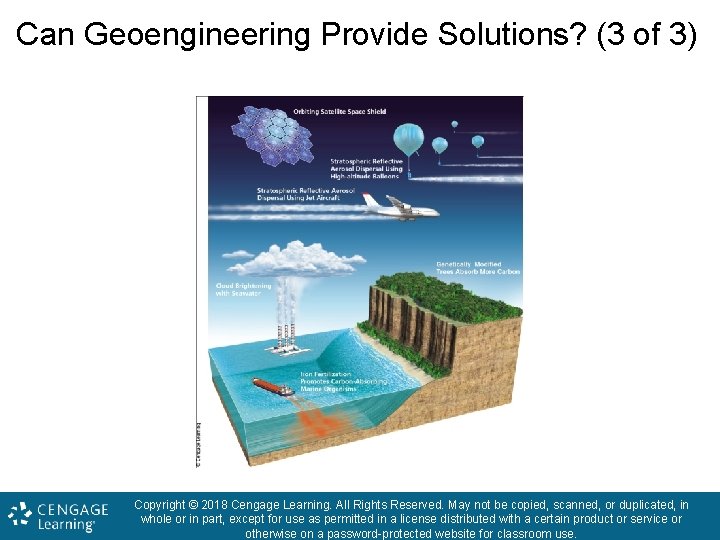
Geoengineering Solutions? (1 of 3) • Geoengineering – Manipulating natural conditions to counter the humanenhanced greenhouse effect • Concepts – Inject sulfate particles into the stratosphere – Spray saltwater into sky to make clouds more reflective – Pump nutrient-rich water from deep ocean to feed algae blooms to absorb CO 2 Copyright © 2018 Cengage Learning. All Rights Reserved. May not be copied, scanned, or duplicated, in whole or in part, except for use as permitted in a license distributed with a certain product or service or otherwise on a password-protected website for classroom use.
Can Geoengineering Provide Solutions? (2 of 3) • Problems – – Unknown side effects Huge investments of energy and materials Could justify continued use of fossil fuels Political and ethical aspects Copyright © 2018 Cengage Learning. All Rights Reserved. May not be copied, scanned, or duplicated, in whole or in part, except for use as permitted in a license distributed with a certain product or service or otherwise on a password-protected website for classroom use.
Can Geoengineering Provide Solutions? (3 of 3) Copyright © 2018 Cengage Learning. All Rights Reserved. May not be copied, scanned, or duplicated, in whole or in part, except for use as permitted in a license distributed with a certain product or service or otherwise on a password-protected website for classroom use.
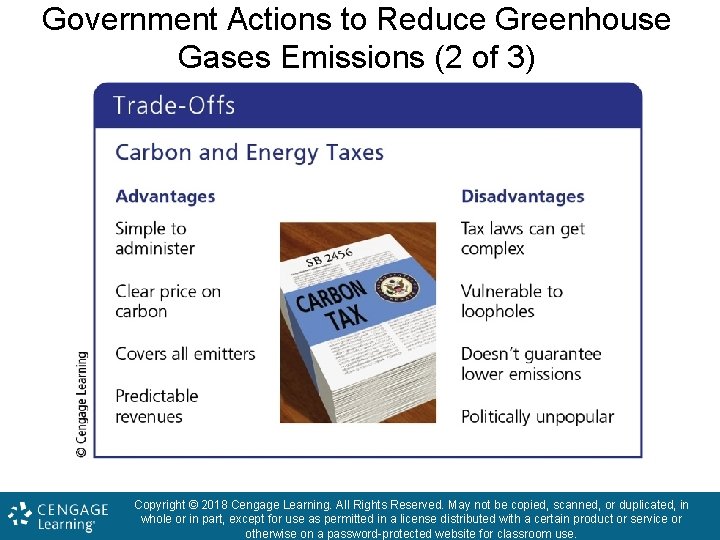
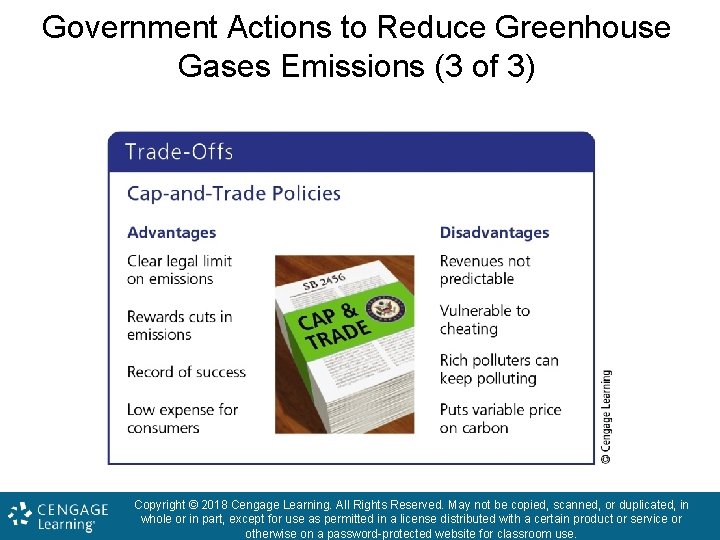
Government Actions to Reduce Greenhouse Gases Emissions (1 of 3) • Strategies to promote solutions – – – regulate CO 2 and methane as air pollutants Phase out coal burning plants Tax CO 2 and methane emissions Use cap-and-trade system Phase out government subsidies and tax breaks for fossil fuel industry – Reduce deforestation Copyright © 2018 Cengage Learning. All Rights Reserved. May not be copied, scanned, or duplicated, in whole or in part, except for use as permitted in a license distributed with a certain product or service or otherwise on a password-protected website for classroom use.
Government Actions to Reduce Greenhouse Gases Emissions (2 of 3) Copyright © 2018 Cengage Learning. All Rights Reserved. May not be copied, scanned, or duplicated, in whole or in part, except for use as permitted in a license distributed with a certain product or service or otherwise on a password-protected website for classroom use.
Government Actions to Reduce Greenhouse Gases Emissions (3 of 3) Copyright © 2018 Cengage Learning. All Rights Reserved. May not be copied, scanned, or duplicated, in whole or in part, except for use as permitted in a license distributed with a certain product or service or otherwise on a password-protected website for classroom use.
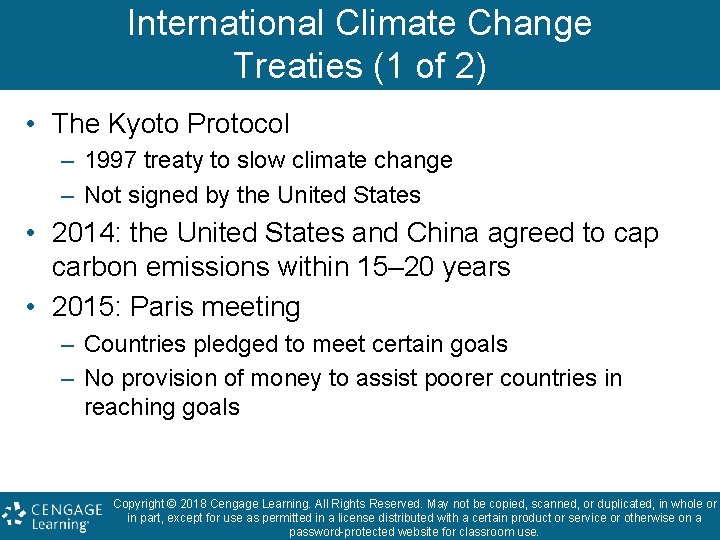
International Climate Change Treaties (1 of 2) • The Kyoto Protocol – 1997 treaty to slow climate change – Not signed by the United States • 2014: the United States and China agreed to cap carbon emissions within 15– 20 years • 2015: Paris meeting – Countries pledged to meet certain goals – No provision of money to assist poorer countries in reaching goals Copyright © 2018 Cengage Learning. All Rights Reserved. May not be copied, scanned, or duplicated, in whole or in part, except for use as permitted in a license distributed with a certain product or service or otherwise on a password-protected website for classroom use.
International Cooperation (2 of 2) • Countries not legally bound to comply • Wealthier countries must help poorer countries in meeting their goals • Benefits of slowing climate change outweigh longterm economic and environmental risks of not doing it Copyright © 2018 Cengage Learning. All Rights Reserved. May not be copied, scanned, or duplicated, in whole or in part, except for use as permitted in a license distributed with a certain product or service or otherwise on a password-protected website for classroom use.
Some Countries, States, and Localities Are Leading the Way • Costa Rica goal: carbon neutral by 2030 • China and India must change energy habits • U. S. cities and states taking initiatives to reduce carbon emissions – California Copyright © 2018 Cengage Learning. All Rights Reserved. May not be copied, scanned, or duplicated, in whole or in part, except for use as permitted in a license distributed with a certain product or service or otherwise on a password-protected website for classroom use.
Critical Concept: Government Incentives to Reduce Carbon Emissions • Cap-and-trade – Tradable pollution or resource-use permits • Carbon tax – Fee levied on units of carbons dioxide or methane produced Copyright © 2018 Cengage Learning. All Rights Reserved. May not be copied, scanned, or duplicated, in whole or in part, except for use as permitted in a license distributed with a certain product or service or otherwise on a password-protected website for classroom use.
Colleges and Universities Are Reducing Their Carbon Footprints • Arizona State University – Solar panels – Established School of Sustainability • College of the Atlantic – Carbon neutral since 2007 • EARTH University, Costa Rica – Sustainable agriculture degree program Copyright © 2018 Cengage Learning. All Rights Reserved. May not be copied, scanned, or duplicated, in whole or in part, except for use as permitted in a license distributed with a certain product or service or otherwise on a password-protected website for classroom use.
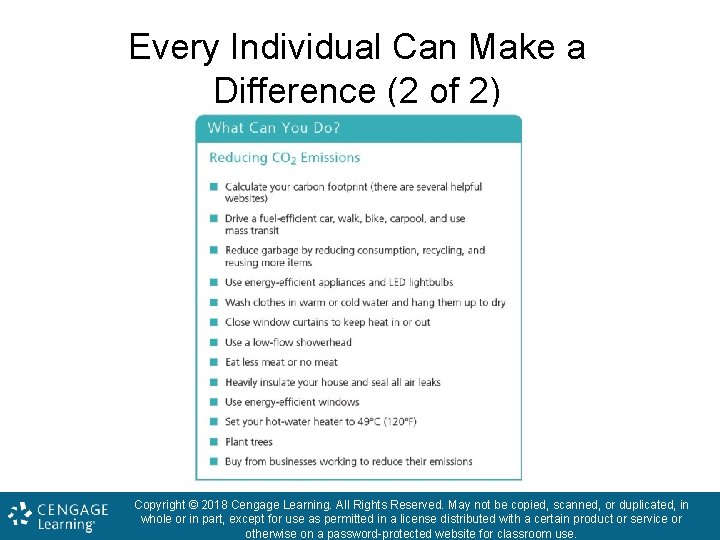
Every Individual Can Make a Difference (1 of 2) • Two-thirds of average American’s carbon footprint is embedded carbon – Energy used in manufacture • Diet choices – Processed foods require more energy than fresh fruits and vegetables – Beef requires more energy than chicken • Political involvement Copyright © 2018 Cengage Learning. All Rights Reserved. May not be copied, scanned, or duplicated, in whole or in part, except for use as permitted in a license distributed with a certain product or service or otherwise on a password-protected website for classroom use.
Every Individual Can Make a Difference (2 of 2) Copyright © 2018 Cengage Learning. All Rights Reserved. May not be copied, scanned, or duplicated, in whole or in part, except for use as permitted in a license distributed with a certain product or service or otherwise on a password-protected website for classroom use.
20. 4 How Can We Adapt to Climate Change? • Realize important economic, ecological, and health benefits by drastically reducing greenhouse gas emissions – Goal: slow projected climate change Copyright © 2018 Cengage Learning. All Rights Reserved. May not be copied, scanned, or duplicated, in whole or in part, except for use as permitted in a license distributed with a certain product or service or otherwise on a password-protected website for classroom use.
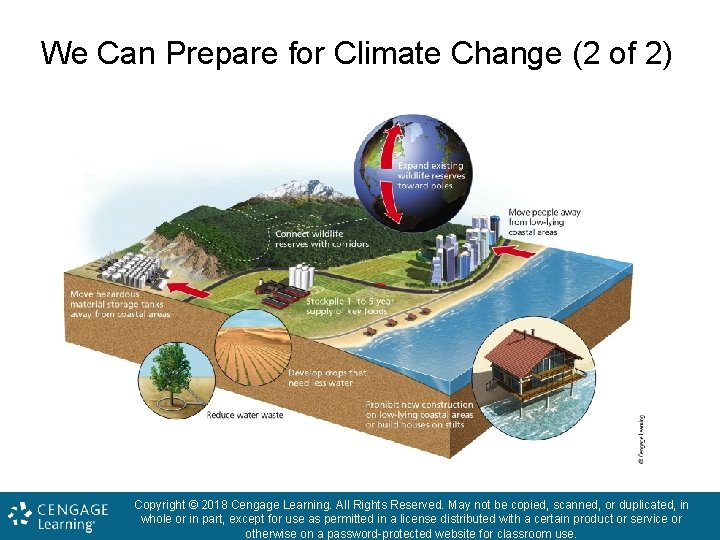
We Can Prepare for Climate Change (1 of 2) • Cut greenhouse gas emissions by 50– 85% by 2050 to stabilize concentrations • Plan for environmental refugees from coastal areas – Take measures against storm surges at coast • Prepare for more intense wildfires • Conserve water and build desalination plants Copyright © 2018 Cengage Learning. All Rights Reserved. May not be copied, scanned, or duplicated, in whole or in part, except for use as permitted in a license distributed with a certain product or service or otherwise on a password-protected website for classroom use.
We Can Prepare for Climate Change (2 of 2) Copyright © 2018 Cengage Learning. All Rights Reserved. May not be copied, scanned, or duplicated, in whole or in part, except for use as permitted in a license distributed with a certain product or service or otherwise on a password-protected website for classroom use.
A No-Regrets Strategy • What if climate models are wrong and there is no serious threat of climate change? • No-regrets strategy – Actions against climate change will benefit environments, health, and economies Copyright © 2018 Cengage Learning. All Rights Reserved. May not be copied, scanned, or duplicated, in whole or in part, except for use as permitted in a license distributed with a certain product or service or otherwise on a password-protected website for classroom use.