
Exploring Engineering Chapter 20 Design Step 3 Evaluation
- Slides: 24
Exploring Engineering Chapter 20 Design Step 3 - Evaluation of Alternatives & Selection of a Concept
What’s Covered in This Chapter Nam Suh’s Design Axioms Independence of functional requirements and minimum information content Decision Matrix Evaluation criteria and assign numerical weights. Evaluation of alternatives through a design matrix Exploring Engineering
Maintain the Independence of the Design’s Functional Requirements Axiom 1: The Independence Axiom. Maintain the independence of the functional requirements. Keep it simple, stupid (KISS principle) Minimize parts and minimize different kinds of parts Buy parts when possible, don’t make them Suh (1990), The Principles of Design, Oxford University Press, 1990 Exploring Engineering
Minimize the Information Content of the Design Axiom 2: The Information Axiom. Minimize the information content of the design. Decouple functional requirements Seek modular designs Suh (1990), The Principles of Design, Oxford University Press, 1990 Exploring Engineering
Example: Water Cannon Competition A head-to-head student design competition named Davy Jones’s Treasure Trove is based on the following problem definition: Design a system to retrieve surface (ping-pong balls) and subsurface (1 lb mass) objects from a swimming pool. Major design requirements: It must fit in a 2 ft × 2 ft × 3 ft volume at the start of the competition. It must carry a target that disables the boat if struck by opponent. Exploring Engineering
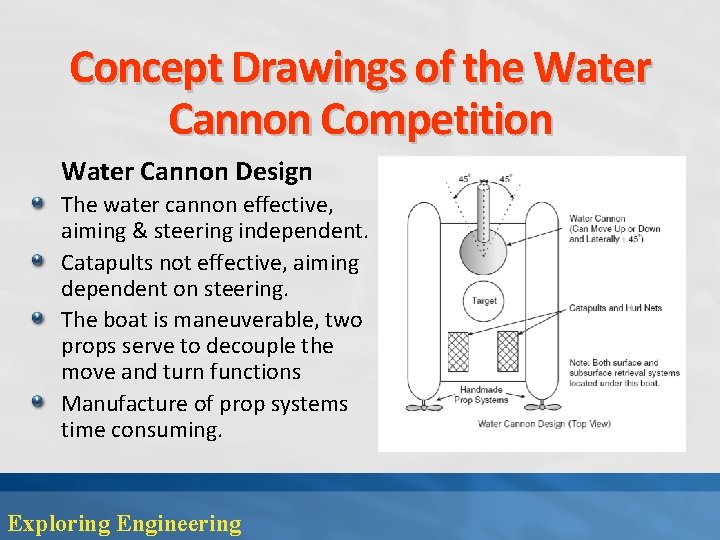
Concept Drawings of the Water Cannon Competition Water Cannon Design The water cannon effective, aiming & steering independent. Catapults not effective, aiming dependent on steering. The boat is maneuverable, two props serve to decouple the move and turn functions Manufacture of prop systems time consuming. Exploring Engineering
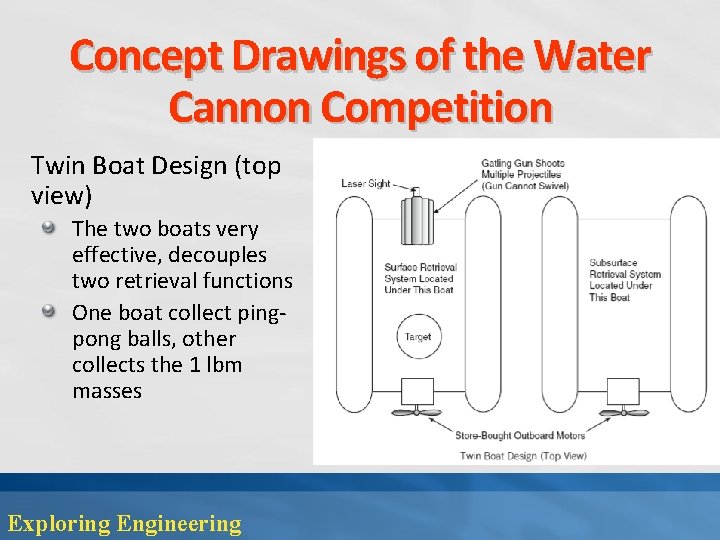
Concept Drawings of the Water Cannon Competition Twin Boat Design (top view) The two boats very effective, decouples two retrieval functions One boat collect pingpong balls, other collects the 1 lbm masses Exploring Engineering
More on the Twin Boat Design Store-bought propellers saves time. Two nearly identical hull designs simplifies design and manufacturing saving more time. The boats not as maneuverable as Water Cannon Design because the move & turn functions not independent, the single-prop design must forward in order to turn. The Gatling gun will not be as effective as the water cannon, because aiming is dependent on steering. Exploring Engineering
Result of the Competition The preceding characteristics were accurate as to how the boats performed. The Twin Boat Design won the competition largely on the strength of its dual retrieval system. Although the water cannon was far more effective than the Gatling gun, the Water Cannon Design was ultimately at the mercy of its handmade props, which took a lot of time to manufacture, left little time for testing, and proved to be unreliable. Exploring Engineering
Design for Ease of Manufacture Reduce # of parts Reduce # of different parts Do parts have complicated geometry? Can you purchase some parts? Do you have skill to make parts? Is design modular? Exploring Engineering
Design for Robustness Example: Dart player Demand requirement: darts hit within 1” circle when thrown from 8 ft Random outside effects Small manufacturing errors Environmental fluctuations – drafts, reloading player etc. Wear damage to darts and dart board Will design function over real conditions? Did you allow for the competition who may have put obstacles in your way? Exploring Engineering
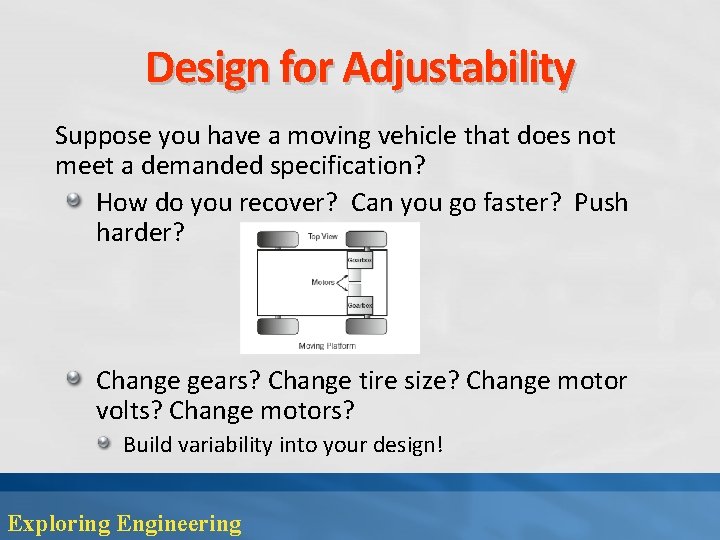
Design for Adjustability Suppose you have a moving vehicle that does not meet a demanded specification? How do you recover? Can you go faster? Push harder? Change gears? Change tire size? Change motor volts? Change motors? Build variability into your design! Exploring Engineering
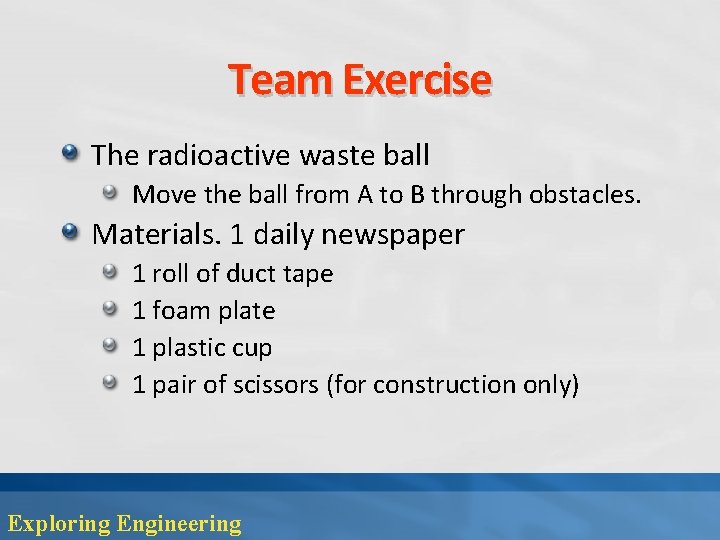
Team Exercise The radioactive waste ball Move the ball from A to B through obstacles. Materials. 1 daily newspaper 1 roll of duct tape 1 foam plate 1 plastic cup 1 pair of scissors (for construction only) Exploring Engineering
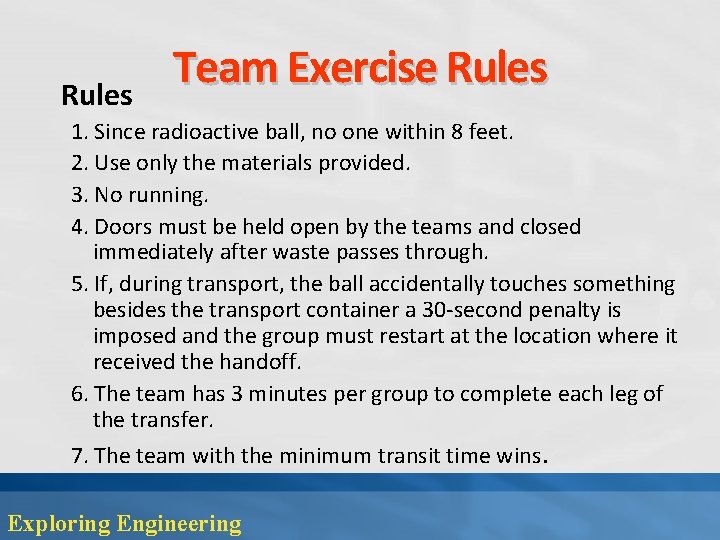
Rules Team Exercise Rules 1. Since radioactive ball, no one within 8 feet. 2. Use only the materials provided. 3. No running. 4. Doors must be held open by the teams and closed immediately after waste passes through. 5. If, during transport, the ball accidentally touches something besides the transport container a 30 -second penalty is imposed and the group must restart at the location where it received the handoff. 6. The team has 3 minutes per group to complete each leg of the transfer. 7. The team with the minimum transit time wins. Exploring Engineering
Team Exercise: Post Mortem Assess team performance by comparing times to other sections. Discuss the quality of communication between subfunctional groups. What were the lessons learned? Exploring Engineering
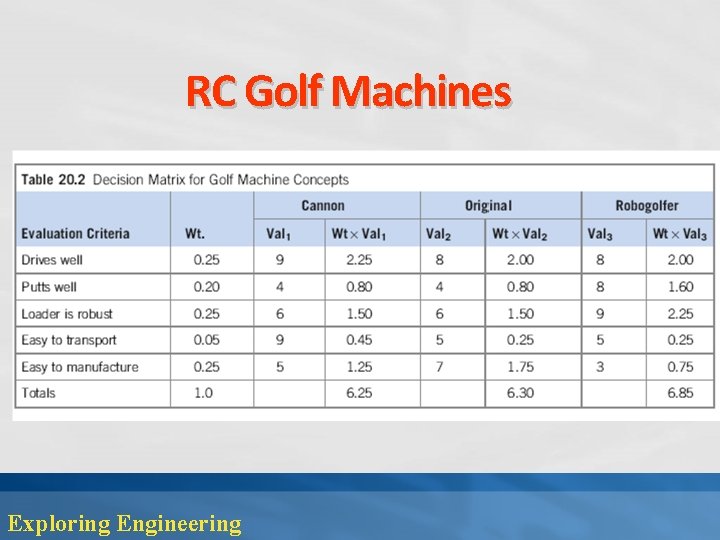
The Decision Matrix A systematic way to design a multifunctional design Evaluates strength and weakness of designs Use suggestive terms such as low wt, low cost, easy to manufacture etc. Exploring Engineering
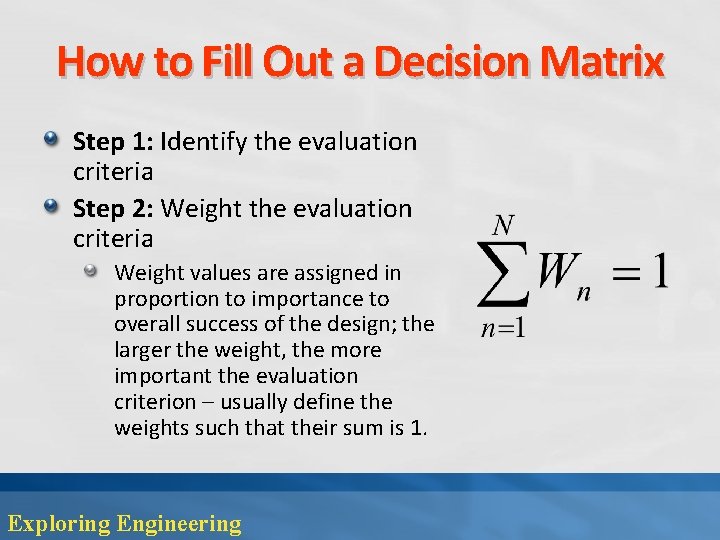
How to Fill Out a Decision Matrix Step 1: Identify the evaluation criteria Step 2: Weight the evaluation criteria Weight values are assigned in proportion to importance to overall success of the design; the larger the weight, the more important the evaluation criterion – usually define the weights such that their sum is 1. Exploring Engineering
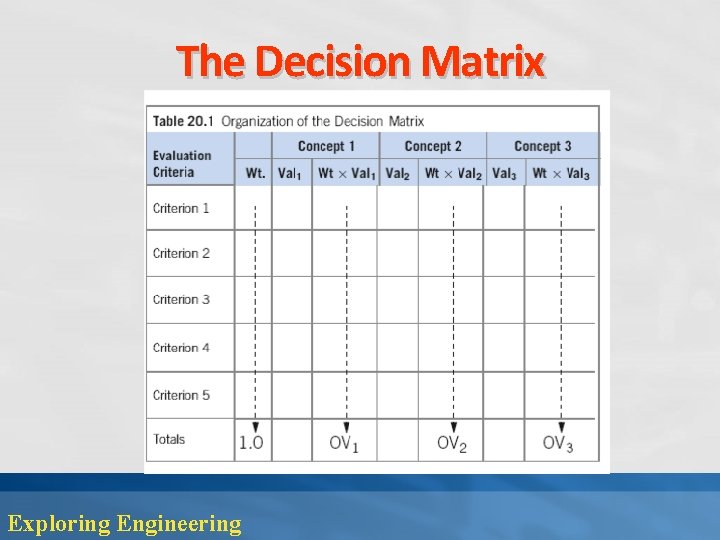
Set Up the Decision Matrix Step 3: Set up the decision matrix as illustrated in Table 20. 1 of the textbook. The names of the concepts being evaluated filled on top of each column. Likewise, the evaluation criteria and their assigned weights are written in the leftmost columns of the matrix. Scoring and intermediate calculations are recorded within the subcolumns under each concept and totaled at the bottom of the matrix. Exploring Engineering
The Decision Matrix Exploring Engineering
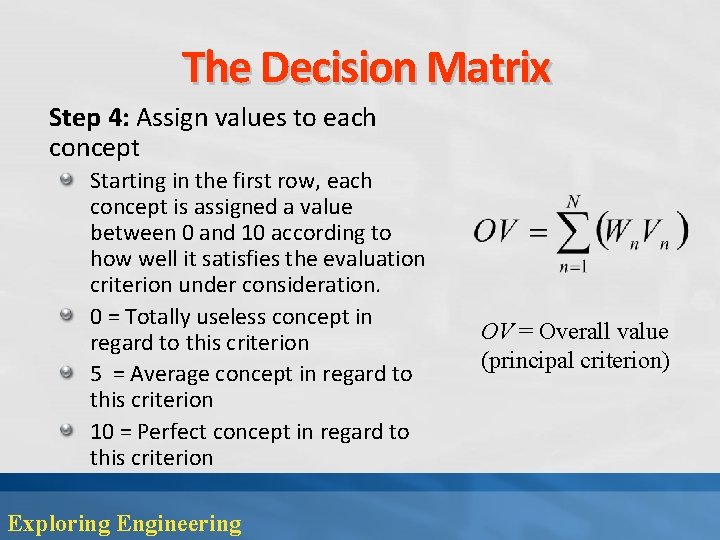
The Decision Matrix Step 4: Assign values to each concept Starting in the first row, each concept is assigned a value between 0 and 10 according to how well it satisfies the evaluation criterion under consideration. 0 = Totally useless concept in regard to this criterion 5 = Average concept in regard to this criterion 10 = Perfect concept in regard to this criterion Exploring Engineering OV = Overall value (principal criterion)
RC Golf Machines Exploring Engineering
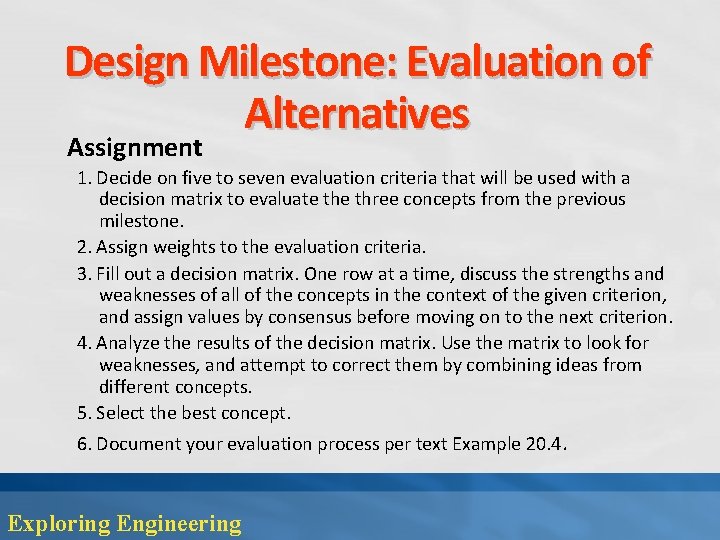
Design Milestone: Evaluation of Alternatives Assignment 1. Decide on five to seven evaluation criteria that will be used with a decision matrix to evaluate three concepts from the previous milestone. 2. Assign weights to the evaluation criteria. 3. Fill out a decision matrix. One row at a time, discuss the strengths and weaknesses of all of the concepts in the context of the given criterion, and assign values by consensus before moving on to the next criterion. 4. Analyze the results of the decision matrix. Use the matrix to look for weaknesses, and attempt to correct them by combining ideas from different concepts. 5. Select the best concept. 6. Document your evaluation process per text Example 20. 4. Exploring Engineering
Design Competition Tips Don’t rig the results of decision matrix to favor one concept (results are nonbinding). Do not blindly obey the results of your decision matrix, the evaluation criteria may be flawed. Engage everyone in the decision-making process. Do not shy away from bold designs just because they are different from everyone else’s. Those differences could lead to victory at the final competition. Exploring Engineering
Summary Use Nam Suh’s two design axioms to decouple functions; minimize information content and independence of functional requirements Design for ease of manufacture, for robustness and adjustability Make up a decision matrix and assign importance to each entry. Exploring Engineering