
Exploring different organic waste valorisation strategies From fresh


- Slides: 27
Exploring different organic waste valorisation strategies: From fresh material to power WBP – 29 March 2017, Amsterdam, NL Presented by Andrea Salimbeni
Table of content 1. World Bioenergy market outlook 2. Biomass residues availability, quality and future market 3. New Technologies and strategies for sustainable Bio. Power 4. Ongoing projects and future activities 5. Conclusions 2 March 2017
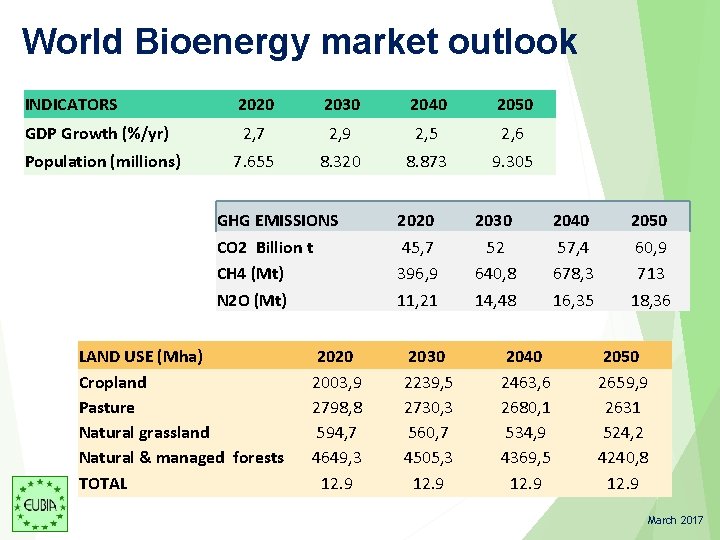
World Bioenergy market outlook INDICATORS GDP Growth (%/yr) Population (millions) 2020 2030 2040 2050 2, 7 2, 9 2, 5 2, 6 7. 655 8. 320 8. 873 9. 305 GHG EMISSIONS CO 2 Billion t CH 4 (Mt) N 2 O (Mt) LAND USE (Mha) Cropland Pasture Natural grassland Natural & managed forests TOTAL 2020 2003, 9 2798, 8 594, 7 4649, 3 12. 9 2020 45, 7 396, 9 11, 21 2030 2239, 5 2730, 3 560, 7 4505, 3 12. 9 2030 52 640, 8 14, 48 2040 2463, 6 2680, 1 534, 9 4369, 5 12. 93 2040 57, 4 678, 3 16, 35 2050 60, 9 713 18, 36 2050 2659, 9 2631 524, 2 4240, 8 12. 9 March 2017
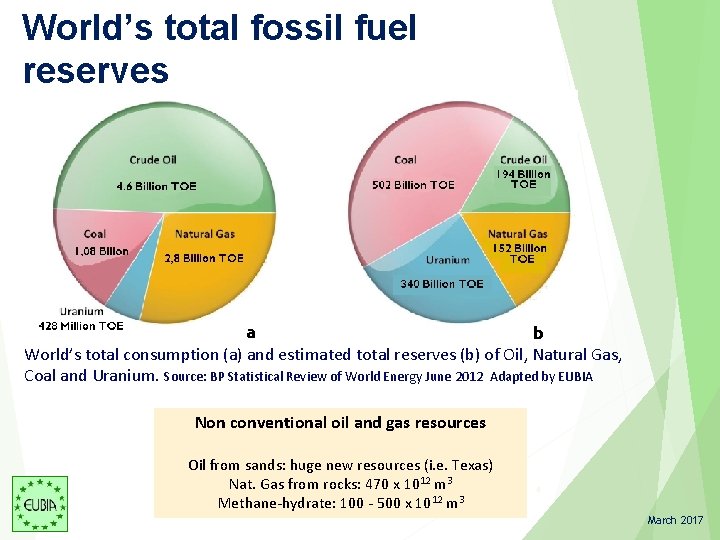
World’s total fossil fuel reserves a b World’s total consumption (a) and estimated total reserves (b) of Oil, Natural Gas, Coal and Uranium. Source: BP Statistical Review of World Energy June 2012 Adapted by EUBIA Non conventional oil and gas resources Oil from sands: huge new resources (i. e. Texas) Nat. Gas from rocks: 470 x 1012 m 3 Methane-hydrate: 100 - 500 x 1012 m 3 4 March 2017
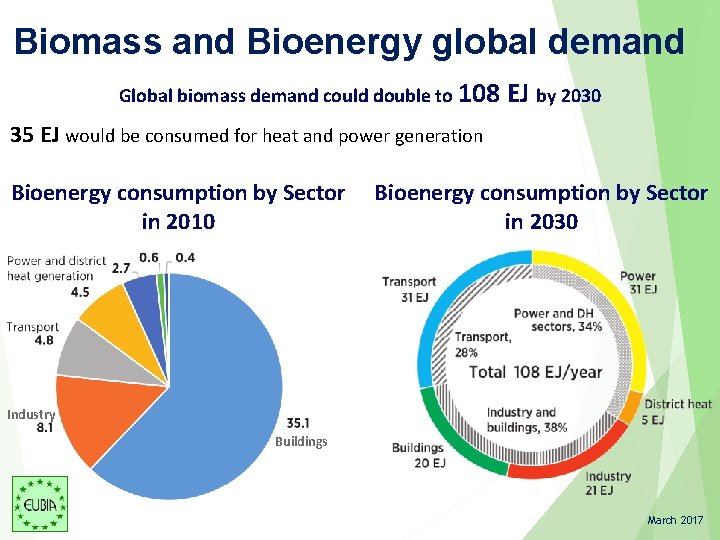
Biomass and Bioenergy global demand Global biomass demand could double to 108 EJ by 2030 35 EJ would be consumed for heat and power generation Bioenergy consumption by Sector in 2010 in 2030 Industry Buildings 5 March 2017
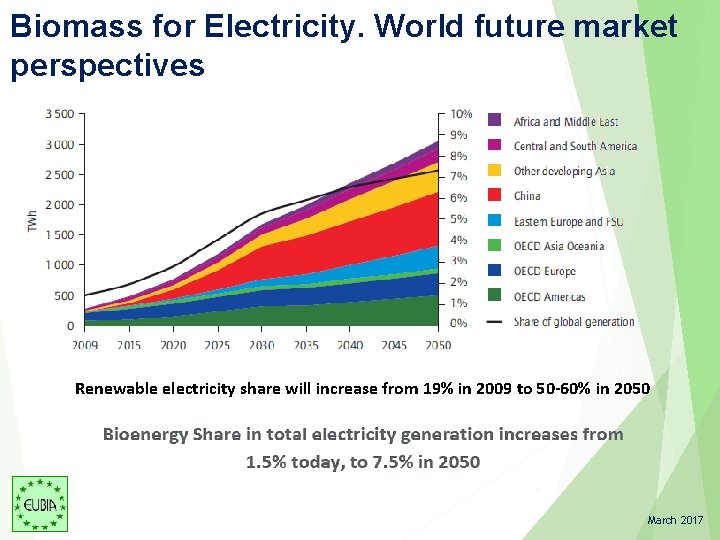
Biomass for Electricity. World future market perspectives Renewable electricity share will increase from 19% in 2009 to 50 -60% in 2050 6 March 2017
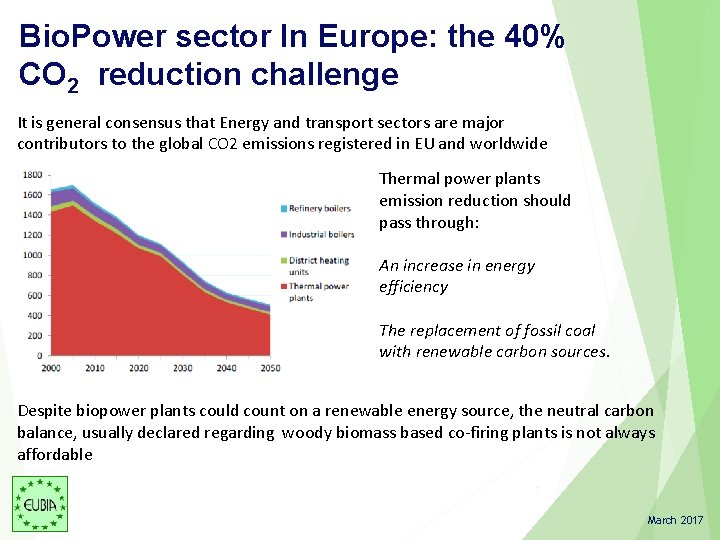
Bio. Power sector In Europe: the 40% CO 2 reduction challenge It is general consensus that Energy and transport sectors are major contributors to the global CO 2 emissions registered in EU and worldwide Thermal power plants emission reduction should pass through: An increase in energy efficiency The replacement of fossil coal with renewable carbon sources. Despite biopower plants could count on a renewable energy source, the neutral carbon balance, usually declared regarding woody biomass based co-firing plants is not always affordable 7 March 2017
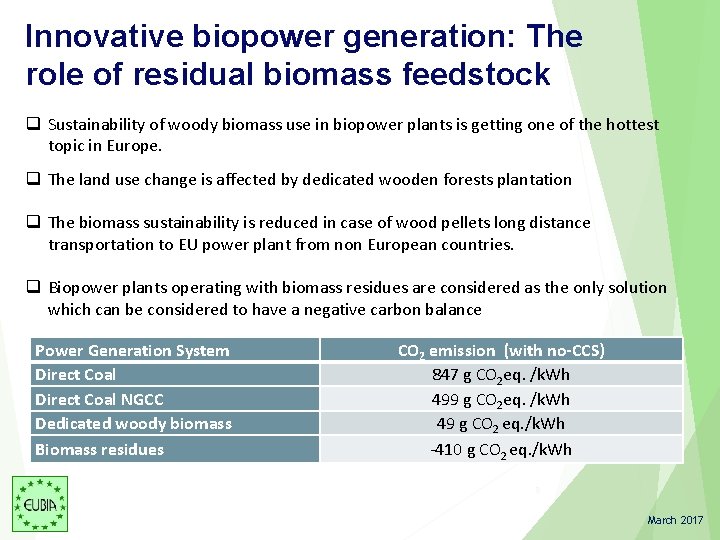
Innovative biopower generation: The role of residual biomass feedstock q Sustainability of woody biomass use in biopower plants is getting one of the hottest topic in Europe. q The land use change is affected by dedicated wooden forests plantation q The biomass sustainability is reduced in case of wood pellets long distance transportation to EU power plant from non European countries. q Biopower plants operating with biomass residues are considered as the only solution which can be considered to have a negative carbon balance Power Generation System Direct Coal NGCC Dedicated woody biomass Biomass residues CO 2 emission (with no-CCS) 847 g CO 2 eq. /k. Wh 499 g CO 2 eq. /k. Wh 49 g CO 2 eq. /k. Wh -410 g CO 2 eq. /k. Wh 8 March 2017
2 Biomass residues availability, quality and future market 9 March 2017
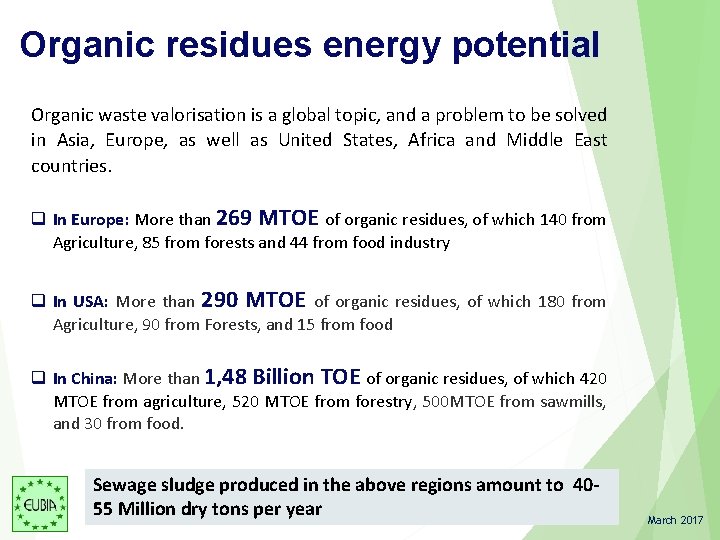
Organic residues energy potential Organic waste valorisation is a global topic, and a problem to be solved in Asia, Europe, as well as United States, Africa and Middle East countries. q In Europe: More than 269 MTOE of organic residues, of which 140 from Agriculture, 85 from forests and 44 from food industry q In USA: More than 290 MTOE of organic residues, of which 180 from Agriculture, 90 from Forests, and 15 from food q In China: More than 1, 48 Billion TOE of organic residues, of which 420 MTOE from agriculture, 520 MTOE from forestry, 500 MTOE from sawmills, and 30 from food. Sewage sludge produced in the above regions amount to 4010 55 Million dry tons per year March 2017
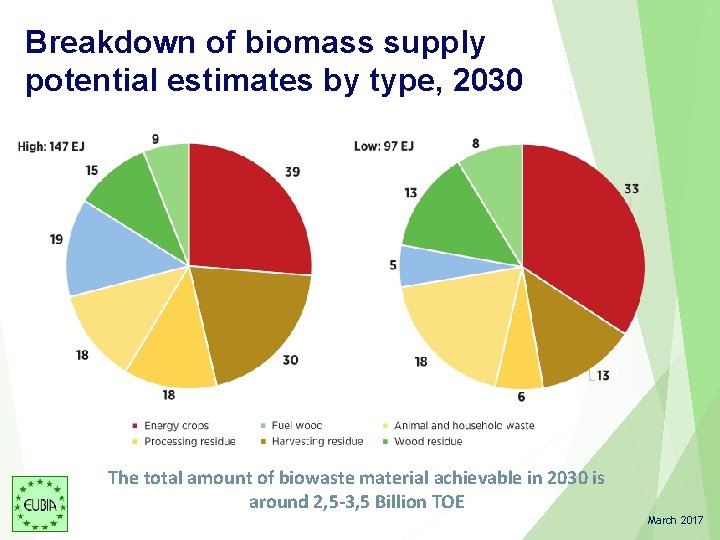
Breakdown of biomass supply potential estimates by type, 2030 The total amount of biowaste material achievable in 2030 is 11 around 2, 5 -3, 5 Billion TOE March 2017
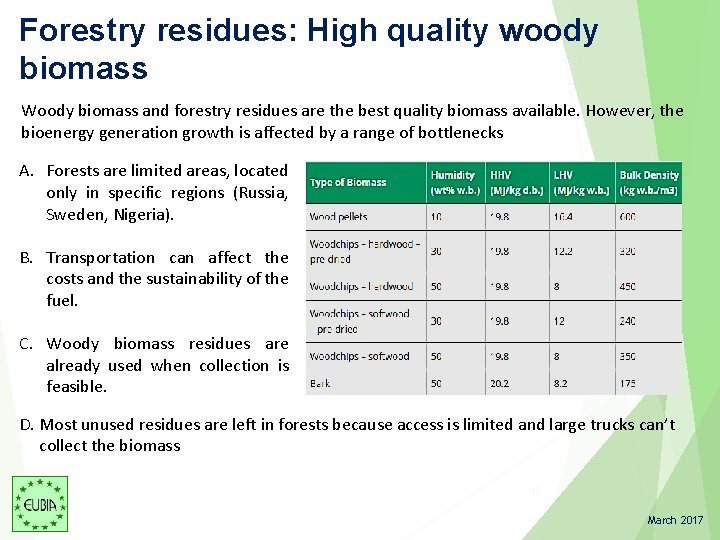
Forestry residues: High quality woody biomass Woody biomass and forestry residues are the best quality biomass available. However, the bioenergy generation growth is affected by a range of bottlenecks A. Forests are limited areas, located only in specific regions (Russia, Sweden, Nigeria). B. Transportation can affect the costs and the sustainability of the fuel. C. Woody biomass residues are already used when collection is feasible. D. Most unused residues are left in forests because access is limited and large trucks can’t collect the biomass 12 March 2017
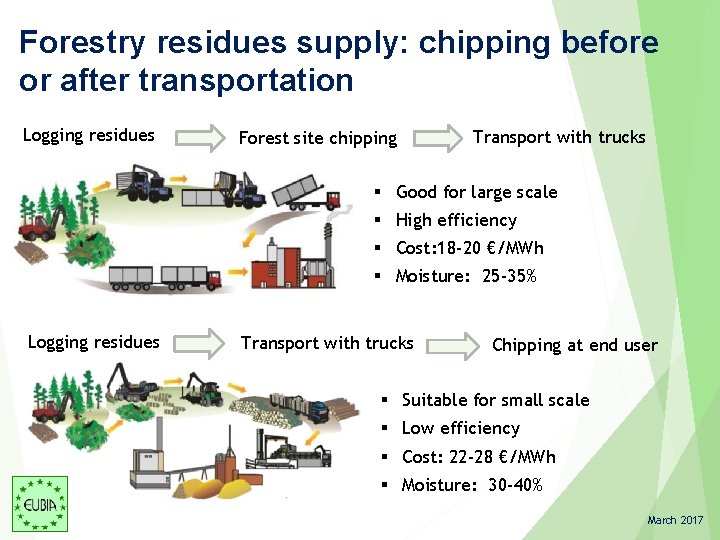
Forestry residues supply: chipping before or after transportation Logging residues Forest site chipping Transport with trucks § Good for large scale § High efficiency § Cost: 18 -20 €/MWh § Moisture: 25 -35% Logging residues Transport with trucks Chipping at end user § Suitable for small scale § Low efficiency § Cost: 22 -28 €/MWh § Moisture: 30 -40% March 2017
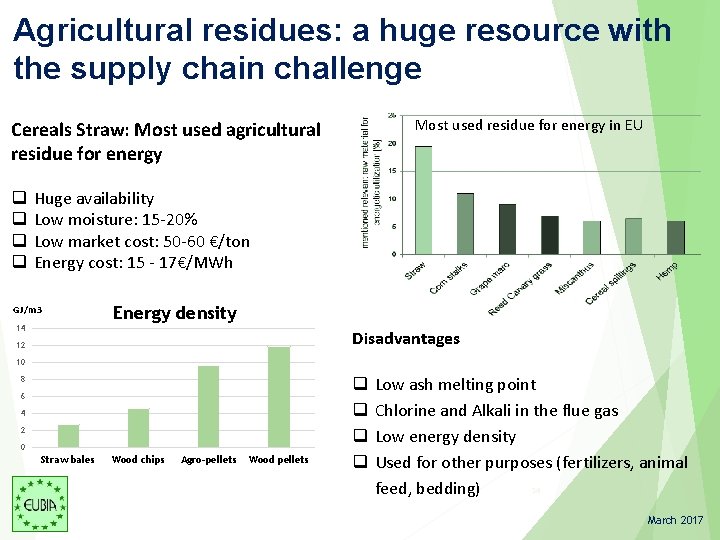
Agricultural residues: a huge resource with the supply chain challenge Most used residue for energy in EU Cereals Straw: Most used agricultural residue for energy q q Huge availability Low moisture: 15 -20% Low market cost: 50 -60 €/ton Energy cost: 15 - 17€/MWh GJ/m 3 14 Energy density Disadvantages 12 10 8 6 4 2 0 Straw bales Wood chips Agro-pellets Wood pellets q q Low ash melting point Chlorine and Alkali in the flue gas Low energy density Used for other purposes (fertilizers, animal 14 feed, bedding) March 2017
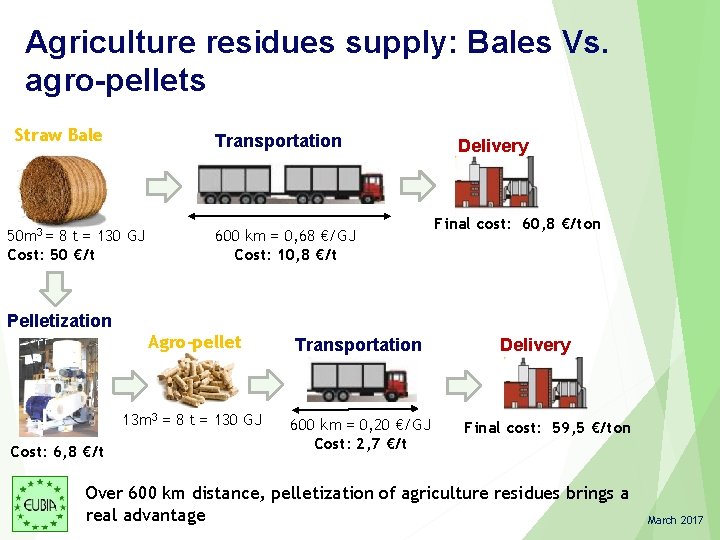
Agriculture residues supply: Bales Vs. agro-pellets Straw Bale Transportation 50 m 3 = 8 t = 130 GJ Cost: 50 €/t 600 km = 0, 68 €/GJ Cost: 10, 8 €/t Delivery Final cost: 60, 8 €/ton Pelletization Cost: 6, 8 €/t Agro-pellet Transportation 13 m 3 = 8 t = 130 GJ 600 km = 0, 20 €/GJ Cost: 2, 7 €/t Delivery Final cost: 59, 5 €/ton 15 Over 600 km distance, pelletization of agriculture residues brings a real advantage March 2017
3. New Technologies and Strategies for Sustainable Bio. Power 16 March 2017
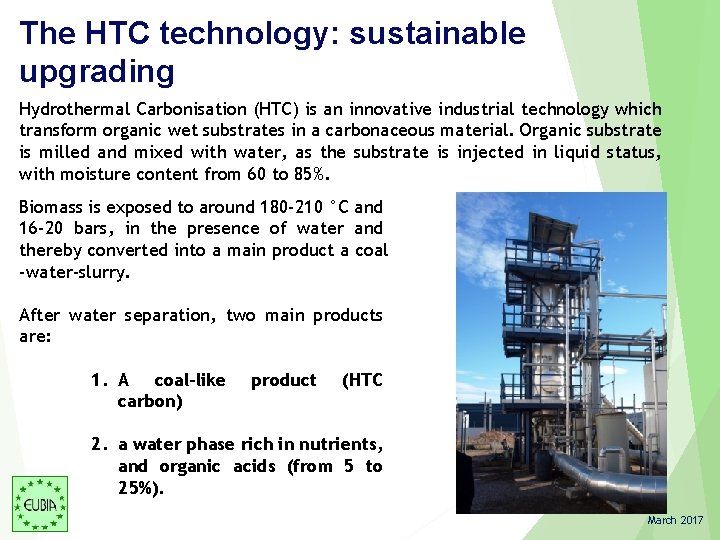
The HTC technology: sustainable upgrading Hydrothermal Carbonisation (HTC) is an innovative industrial technology which transform organic wet substrates in a carbonaceous material. Organic substrate is milled and mixed with water, as the substrate is injected in liquid status, with moisture content from 60 to 85%. Biomass is exposed to around 180 -210 °C and 16 -20 bars, in the presence of water and thereby converted into a main product a coal -water-slurry. After water separation, two main products are: 1. A coal-like carbon) product (HTC 2. a water phase rich in nutrients, and organic acids (from 5 to 25%). 17 March 2017
The wide range of organic wastes treatable by HTC Ingelia HTC facility is able to treat a wide range of substrates Organic wastes present different quality, composition and market values The organic waste quality influence the final cost of the Bio. Coal Green Waste. No tipping fee applicable. Bio. Coal of high quality, with low ash and high LHV. Industry Food Waste. Homogeneous material. Low or no tipping fee applicable. Bio. Coal of high quality, reduced ash and high LHV. Municipal organic waste. Can be of quite good as well as of bad quality. Tipping fee applicable. Bio. Coal ash content: 8 to 24%. Sludge. Bad quality product. High tipping fee applicable. Bio. Coal ash content 18 between 18 to 30%. March 2017
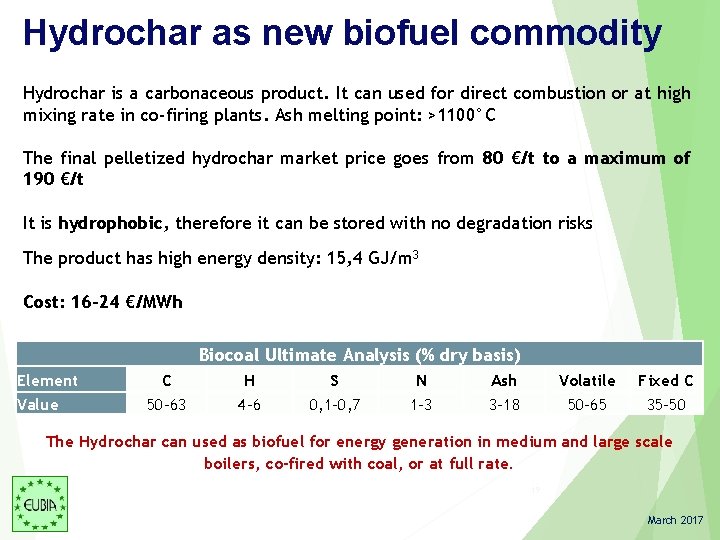
Hydrochar as new biofuel commodity Hydrochar is a carbonaceous product. It can used for direct combustion or at high mixing rate in co-firing plants. Ash melting point: >1100°C The final pelletized hydrochar market price goes from 80 €/t to a maximum of 190 €/t It is hydrophobic, therefore it can be stored with no degradation risks The product has high energy density: 15, 4 GJ/m 3 Cost: 16 -24 €/MWh Biocoal Ultimate Analysis (% dry basis) Element Value C 50 -63 H 4 -6 S 0, 1 -0, 7 N 1 -3 Ash 3 -18 Volatile 50 -65 Fixed C 35 -50 The Hydrochar can used as biofuel for energy generation in medium and large scale boilers, co-fired with coal, or at full rate. 19 March 2017
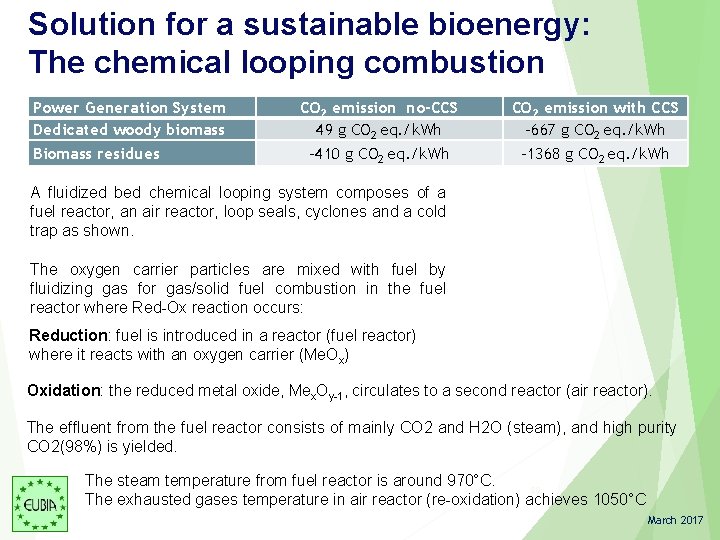
Solution for a sustainable bioenergy: The chemical looping combustion Power Generation System Dedicated woody biomass Biomass residues CO 2 emission no-CCS 49 g CO 2 eq. /k. Wh -410 g CO 2 eq. /k. Wh CO 2 emission with CCS -667 g CO 2 eq. /k. Wh -1368 g CO 2 eq. /k. Wh A fluidized bed chemical looping system composes of a fuel reactor, an air reactor, loop seals, cyclones and a cold trap as shown. The oxygen carrier particles are mixed with fuel by fluidizing gas for gas/solid fuel combustion in the fuel reactor where Red-Ox reaction occurs: Reduction: fuel is introduced in a reactor (fuel reactor) where it reacts with an oxygen carrier (Me. Ox) Oxidation: the reduced metal oxide, Mex. Oy-1, circulates to a second reactor (air reactor). The effluent from the fuel reactor consists of mainly CO 2 and H 2 O (steam), and high purity CO 2(98%) is yielded. The steam temperature from fuel reactor is around 970°C. 20 The exhausted gases temperature in air reactor (re-oxidation) achieves 1050°C March 2017
Technical, economic and environmental benefits of Bio - CLC Low Corrosion - longer life of components Fine ash from the biomass can be expected to leave the fuel reactor in the gas stream in the form of fly-ash, thus, biomass ash not expected to reach the air reactor, where cooling surfaces are located. Higher termal efficiency No corrosion problems of wall tubes due to alkali components in fuel ash steam, higher temperature in comparison with conventional biomass combustion More sustainable for the atmosphere No CO 2 emission thanks to the easy pure CO 2 storage and reutilization: a negative CO 2 balance achievable with all types of biomass used, with a very high impact in Global warming reduction. Reduced Nox 21 March 2017
4. Ongoing projects and future activities 22 March 2017
EUBIA recently realized on biomass residues valorisation ü 2013 -2016: NEWAPP project - FP 7 ü 2011 -2015: Bioen. NW - Interreg NEW ü 2010 -2014: EUROBIOREF – FP 7 ü 2012 -2014: Rec. Oil – IEE ü 2011 -2013: GERONIMO II-Biogas – IEE 23 March 2017
EUBIA ongoing projects on biomass residues valorisation 2016– 2019: Agrocycle – H 2020 waste. Sustainable techno-economic solutions for the agricultural value chain. Budget: 7, 6 M€ 2017 – 2020: Bio. Reg – H 2020 BB. Absorbing the Potential of Wood Waste in EU Regions and Industrial Bio-based Ecosystems. Budget: 1 M€ 24 March 2017
5. Conclusion 25 March 2017
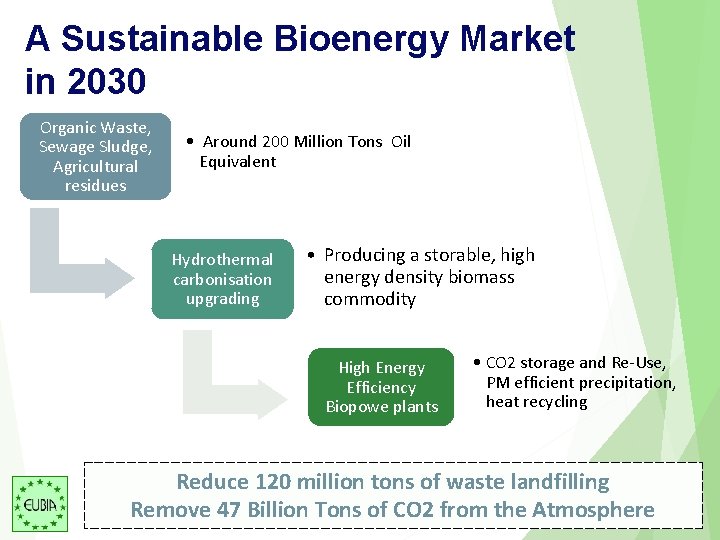
A Sustainable Bioenergy Market in 2030 Organic Waste, Sewage Sludge, Agricultural residues • Around 200 Million Tons Oil Equivalent Hydrothermal carbonisation upgrading • Producing a storable, high energy density biomass commodity High Energy Efficiency Biopowe plants • CO 2 storage and Re-Use, PM efficient precipitation, heat recycling Reduce 120 million tons of waste landfilling Remove 47 Billion Tons of CO 2 from the Atmosphere. March 2017 26
Thank You for your Attention Andrea Salimbeni EUBIA AISBL Scotland House Rond Point Schuman 6, B 1040, Brussels, Belgium T. + 32 2 282 84 40 Email: eubia@eubia. org www. eubia. org 27