
Exploring Corporate Strategy 7 th Edition Part II
- Slides: 40
Exploring Corporate Strategy 7 th Edition Part II The Strategic Position Exploring Corporate Strategy, Seventh Edition, © Pearson Education Ltd 2005
Exploring Corporate Strategy 7 th Edition Chapter 2 The Environment Exploring Corporate Strategy, Seventh Edition, © Pearson Education Ltd 2005
The Environment – Outline • Macroenvironment – PESTEL • Scenarios • Sources of competition – 5 -forces • Understanding competition – Strategic group analysis – Market segments – Critical success factors • Strategic gaps – Opportunities – Threats Exploring Corporate Strategy, Seventh Edition, © Pearson Education Ltd 2005
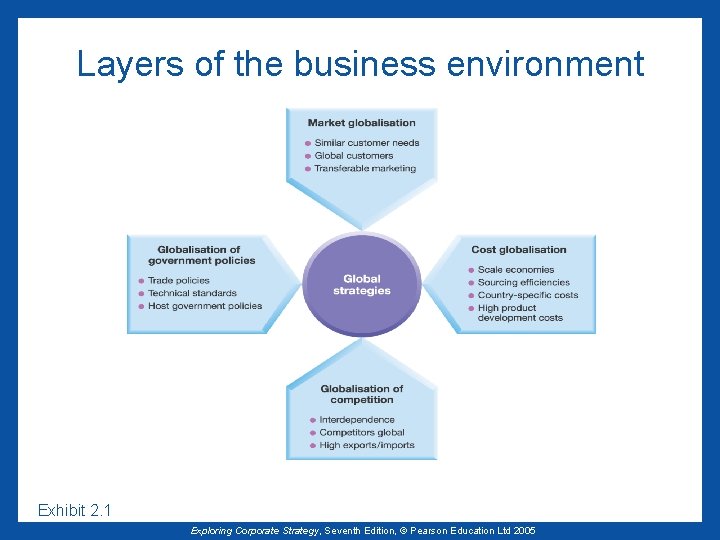
Layers of the business environment Exhibit 2. 1 Exploring Corporate Strategy, Seventh Edition, © Pearson Education Ltd 2005
Understanding the Environment • Diversity – Many different influences • Complexity – Interconnected influences • Speed of change – Particularly ICT Exploring Corporate Strategy, Seventh Edition, © Pearson Education Ltd 2005
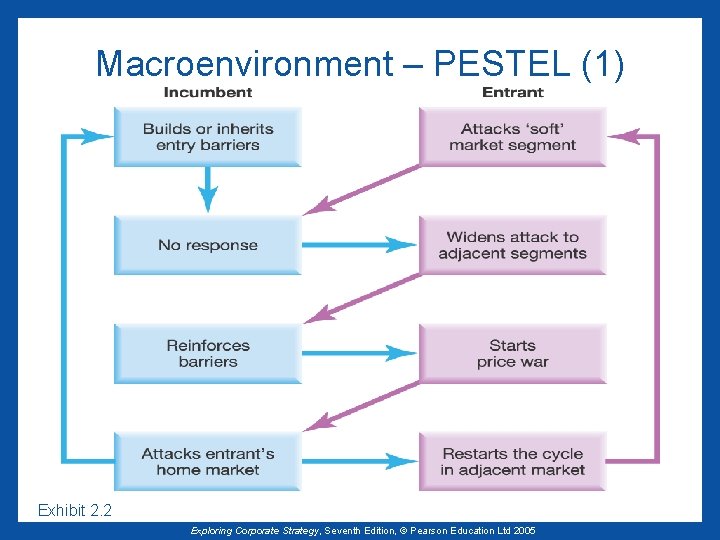
Macroenvironment – PESTEL (1) Exhibit 2. 2 Exploring Corporate Strategy, Seventh Edition, © Pearson Education Ltd 2005
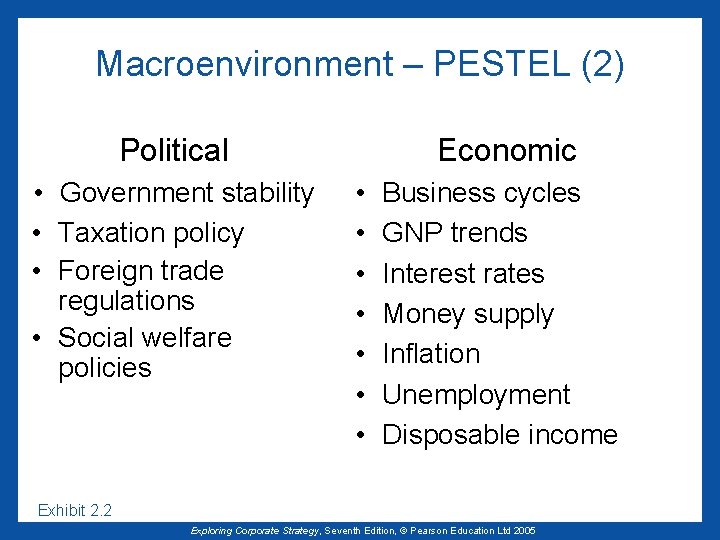
Macroenvironment – PESTEL (2) Political • Government stability • Taxation policy • Foreign trade regulations • Social welfare policies Economic • • Business cycles GNP trends Interest rates Money supply Inflation Unemployment Disposable income Exhibit 2. 2 Exploring Corporate Strategy, Seventh Edition, © Pearson Education Ltd 2005
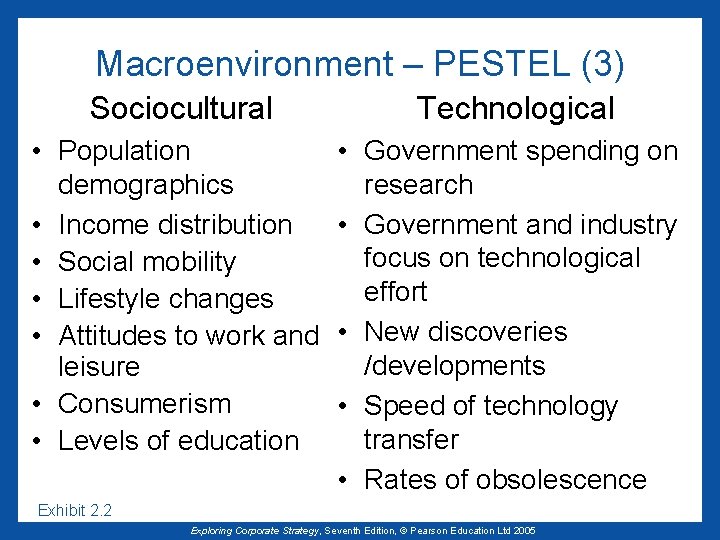
Macroenvironment – PESTEL (3) Sociocultural Technological • Population demographics • Income distribution • Social mobility • Lifestyle changes • Attitudes to work and leisure • Consumerism • Levels of education • Government spending on research • Government and industry focus on technological effort • New discoveries /developments • Speed of technology transfer • Rates of obsolescence Exhibit 2. 2 Exploring Corporate Strategy, Seventh Edition, © Pearson Education Ltd 2005
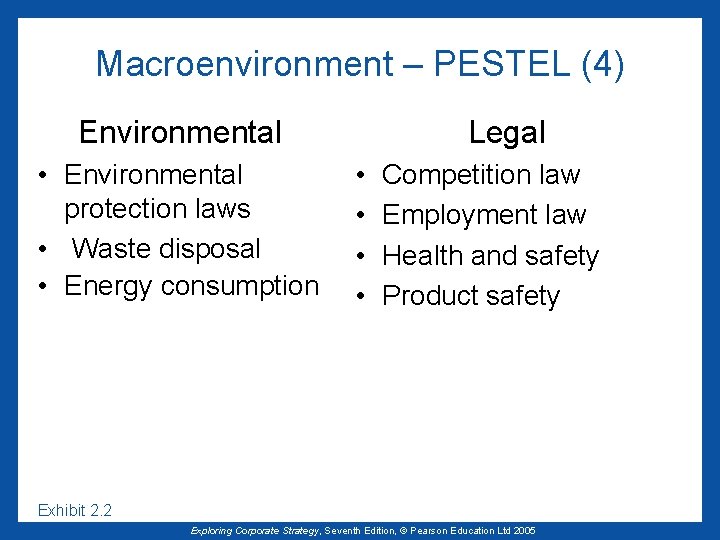
Macroenvironment – PESTEL (4) Environmental • Environmental protection laws • Waste disposal • Energy consumption Legal • • Competition law Employment law Health and safety Product safety Exhibit 2. 2 Exploring Corporate Strategy, Seventh Edition, © Pearson Education Ltd 2005
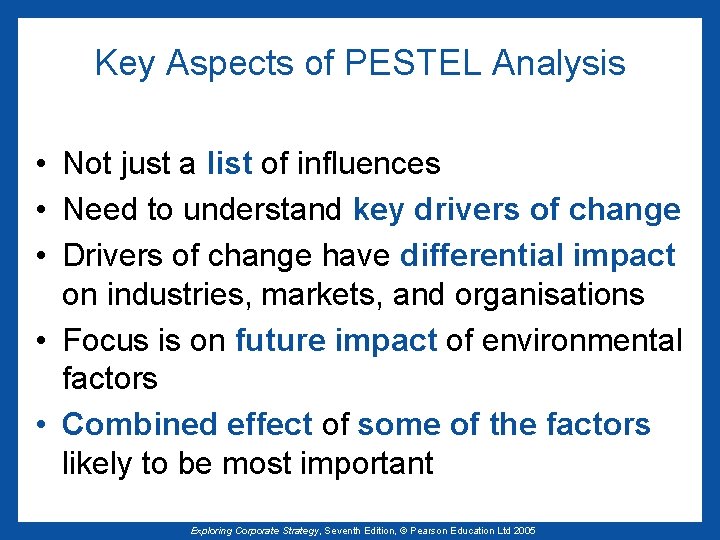
Key Aspects of PESTEL Analysis • Not just a list of influences • Need to understand key drivers of change • Drivers of change have differential impact on industries, markets, and organisations • Focus is on future impact of environmental factors • Combined effect of some of the factors likely to be most important Exploring Corporate Strategy, Seventh Edition, © Pearson Education Ltd 2005
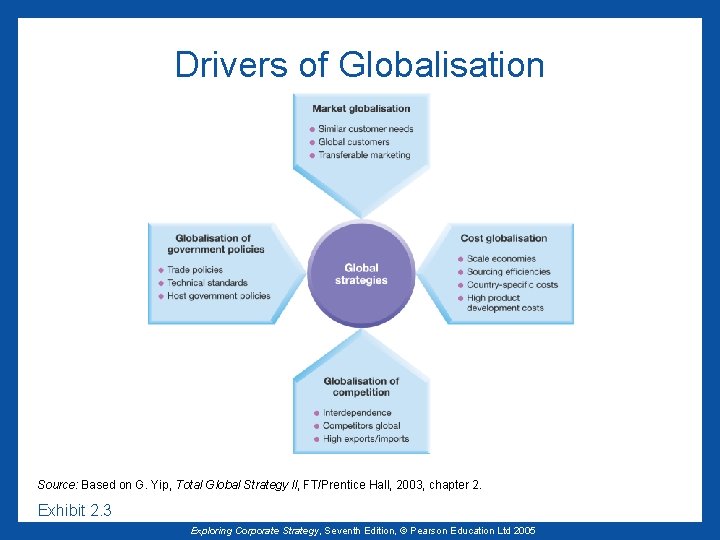
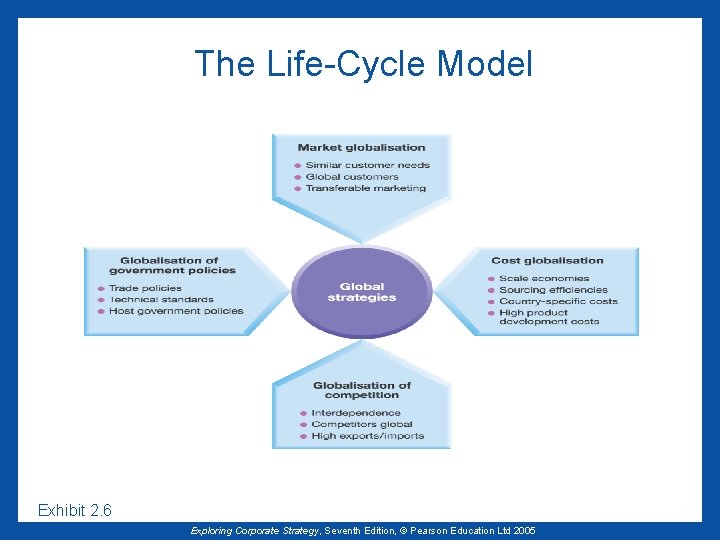
Drivers of Globalisation Source: Based on G. Yip, Total Global Strategy ll, FT/Prentice Hall, 2003, chapter 2. Exhibit 2. 3 Exploring Corporate Strategy, Seventh Edition, © Pearson Education Ltd 2005
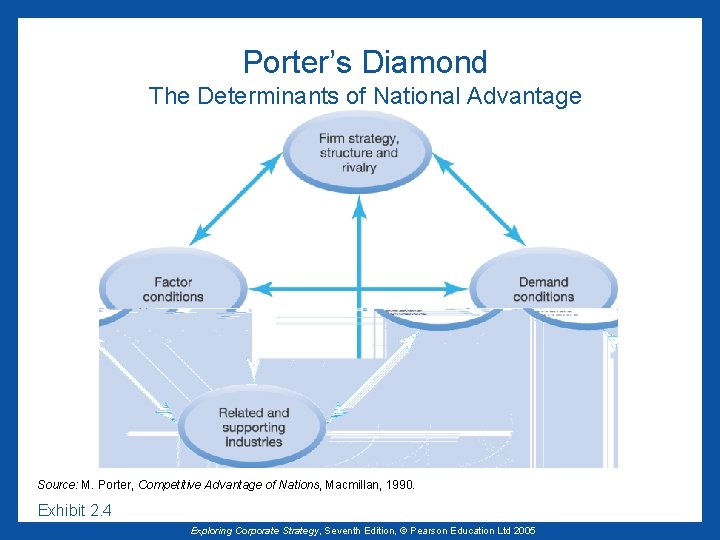
Porter’s Diamond The Determinants of National Advantage Source: M. Porter, Competitive Advantage of Nations, Macmillan, 1990. Exhibit 2. 4 Exploring Corporate Strategy, Seventh Edition, © Pearson Education Ltd 2005
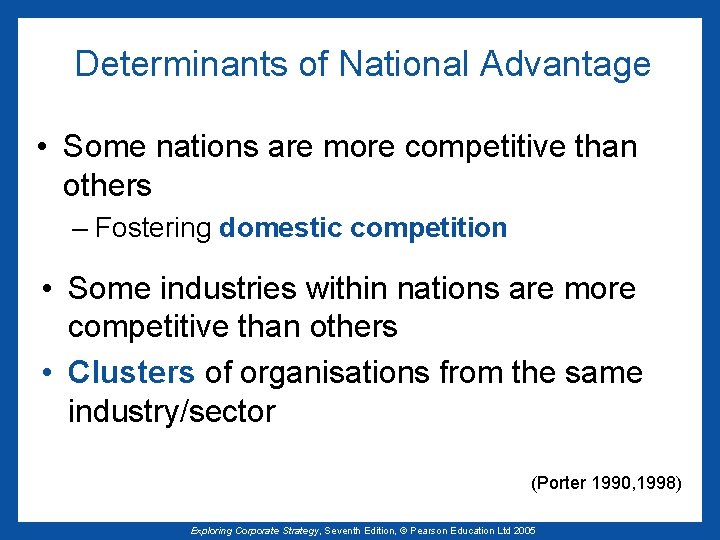
Determinants of National Advantage • Some nations are more competitive than others – Fostering domestic competition • Some industries within nations are more competitive than others • Clusters of organisations from the same industry/sector (Porter 1990, 1998) Exploring Corporate Strategy, Seventh Edition, © Pearson Education Ltd 2005
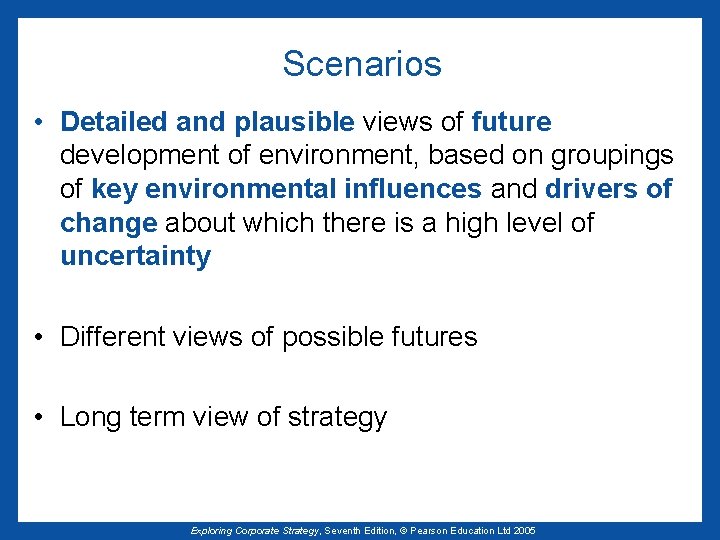
Scenarios • Detailed and plausible views of future development of environment, based on groupings of key environmental influences and drivers of change about which there is a high level of uncertainty • Different views of possible futures • Long term view of strategy Exploring Corporate Strategy, Seventh Edition, © Pearson Education Ltd 2005
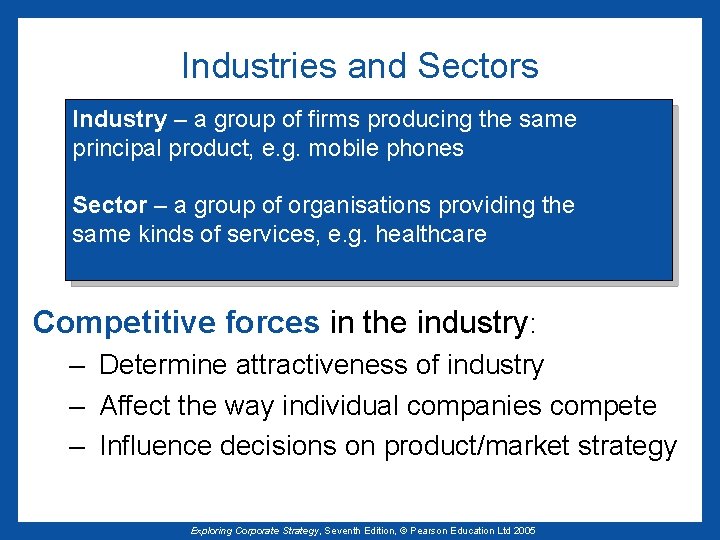
Industries and Sectors Industry – a group of firms producing the same principal product, e. g. mobile phones Sector – a group of organisations providing the same kinds of services, e. g. healthcare Competitive forces in the industry: – Determine attractiveness of industry – Affect the way individual companies compete – Influence decisions on product/market strategy Exploring Corporate Strategy, Seventh Edition, © Pearson Education Ltd 2005
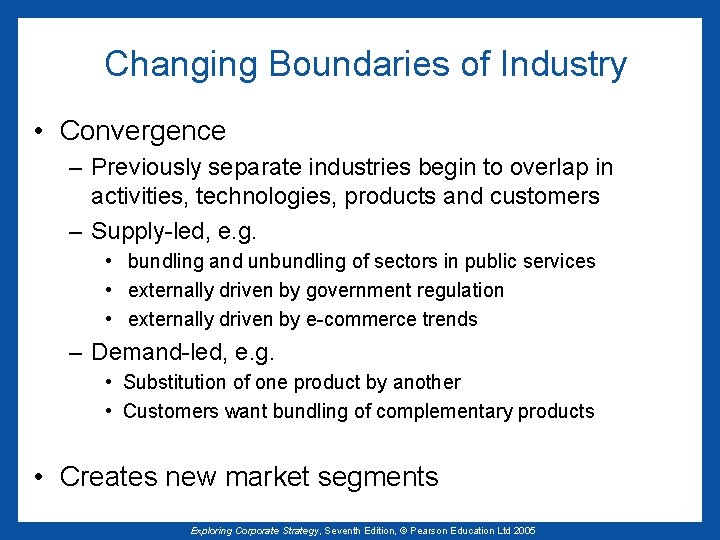
Changing Boundaries of Industry • Convergence – Previously separate industries begin to overlap in activities, technologies, products and customers – Supply-led, e. g. • bundling and unbundling of sectors in public services • externally driven by government regulation • externally driven by e-commerce trends – Demand-led, e. g. • Substitution of one product by another • Customers want bundling of complementary products • Creates new market segments Exploring Corporate Strategy, Seventh Edition, © Pearson Education Ltd 2005
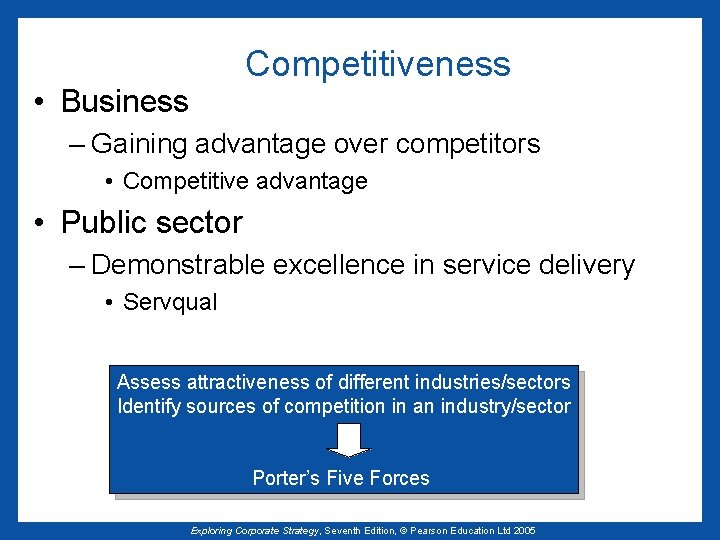
Competitiveness • Business – Gaining advantage over competitors • Competitive advantage • Public sector – Demonstrable excellence in service delivery • Servqual Assess attractiveness of different industries/sectors Identify sources of competition in an industry/sector Porter’s Five Forces Exploring Corporate Strategy, Seventh Edition, © Pearson Education Ltd 2005
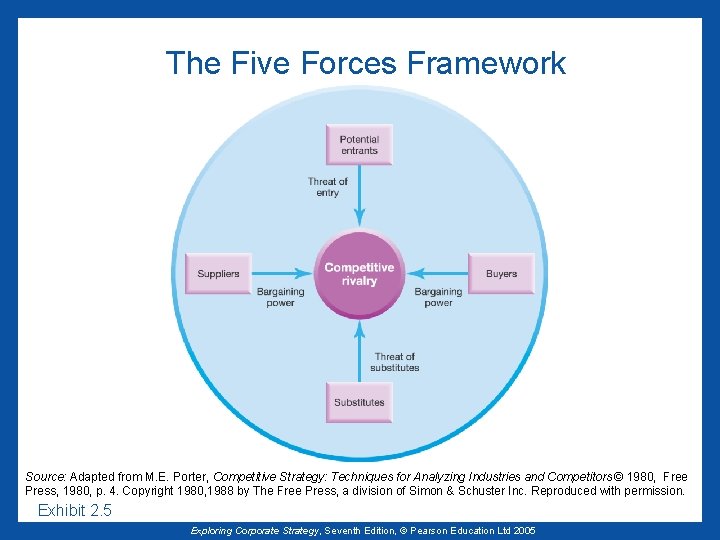
The Five Forces Framework Source: Adapted from M. E. Porter, Competitive Strategy: Techniques for Analyzing Industries and Competitors © 1980, Free Press, 1980, p. 4. Copyright 1980, 1988 by The Free Press, a division of Simon & Schuster Inc. Reproduced with permission. Exhibit 2. 5 Exploring Corporate Strategy, Seventh Edition, © Pearson Education Ltd 2005
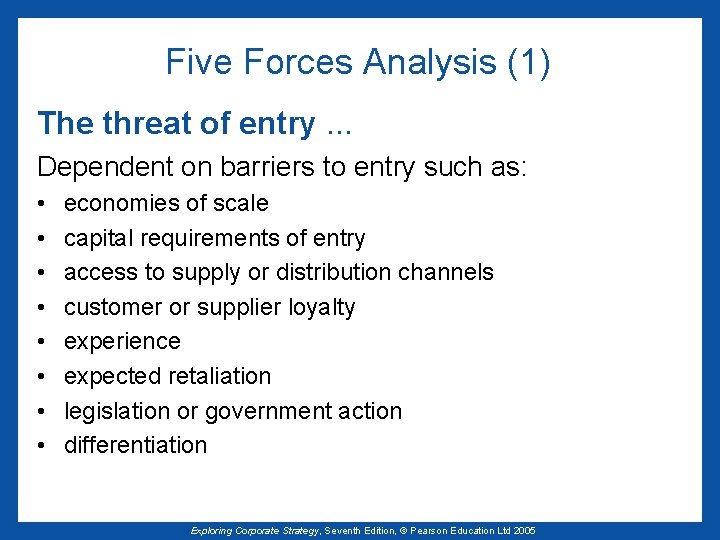
Five Forces Analysis (1) The threat of entry. . . Dependent on barriers to entry such as: • • economies of scale capital requirements of entry access to supply or distribution channels customer or supplier loyalty experience expected retaliation legislation or government action differentiation Exploring Corporate Strategy, Seventh Edition, © Pearson Education Ltd 2005
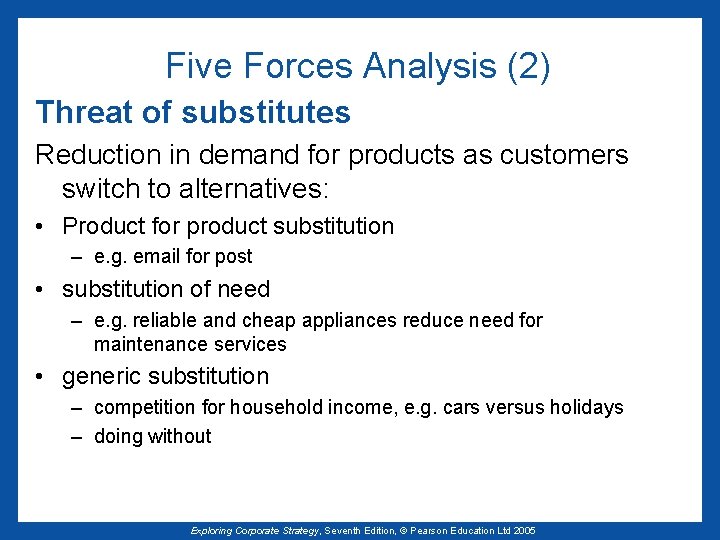
Five Forces Analysis (2) Threat of substitutes Reduction in demand for products as customers switch to alternatives: • Product for product substitution – e. g. email for post • substitution of need – e. g. reliable and cheap appliances reduce need for maintenance services • generic substitution – competition for household income, e. g. cars versus holidays – doing without Exploring Corporate Strategy, Seventh Edition, © Pearson Education Ltd 2005
Five Forces Analysis (3) Buyer power is likely to be high where there is / are: • • • a concentration of buyers many small operators in the supplying industry alternative sources of supply low switching costs components/materials that are a high percentage of cost to the buyer leading to “shopping around” • a threat of backward integration Exploring Corporate Strategy, Seventh Edition, © Pearson Education Ltd 2005
Five Forces Analysis (4) Supplier power is likely to be high where there is / are: • a concentration of suppliers • customers that are fragmented and bargaining power low • high switching costs • powerful supplier brand • possible integration forward by the supplier Exploring Corporate Strategy, Seventh Edition, © Pearson Education Ltd 2005
Five Forces Analysis (5) Competitive Rivalry is likely to be high when: • • • competitors are in balance there is slow market growth (product life cycle) there are high fixed costs in an industry there are high exit barriers markets are undifferentiated Competitive rivals are organisations with similar products and services aimed at the same customer group = direct competitors Exploring Corporate Strategy, Seventh Edition, © Pearson Education Ltd 2005
Five Forces Analysis: Key questions and implications • Are some industries more attractive than others? (weaker forces) • What underlying forces in the macroenvironment drive the competitive forces? • Will competitive forces change? • What are the strengths and weaknesses of the competitors in relation to the competitive forces? • Can competitive strategy influence competitive forces? (e. g. build barriers to entry) Exploring Corporate Strategy, Seventh Edition, © Pearson Education Ltd 2005
Key Aspects of 5 -Forces Analysis • Use at level of strategic business units (SBU) • Define the industry/market/sector • Don’t just list the forces: derive implications for industry/organisation • Note connections between competitive forces and key drivers in macroenvironment • Establish interconnections between the five forces • Competition may disrupt the forces rather than accommodate them Exploring Corporate Strategy, Seventh Edition, © Pearson Education Ltd 2005
The Life-Cycle Model Exhibit 2. 6 Exploring Corporate Strategy, Seventh Edition, © Pearson Education Ltd 2005
Dynamics of Competition (1) • Process of competition over time • Erosion of competitive advantage – Changes in five forces – Competitors overcoming adverse forces • Cycles of competitive response – Slow: long periods of established pattern of competition – Fast: hypercompetition, constant disequilibrium and change Exploring Corporate Strategy, Seventh Edition, © Pearson Education Ltd 2005
Dynamics of Competition (2) • Implications of speed of competitive cycle: – Slow-moving - build and sustain competitive advantages which are difficult to imitate – Fast-moving - advantage is temporary, disrupt status quo, sequence of short-lived moves Exploring Corporate Strategy, Seventh Edition, © Pearson Education Ltd 2005
Cycles of Competition Source: Adapted with the permission of the Free Press, a Division of Simon & Schuster, from R. A. D’Aveni with Robert Gunther, Hyper – Competitive Rivalries: Competing in a Highly Dynamic Environment © 1994, 1995 by Richard A. D’Aveni, All rights resvered. Exhibit 2. 7 Exploring Corporate Strategy, Seventh Edition, © Pearson Education Ltd 2005
Strategic Groups Strategic groups are organisations within an industry with similar strategic characteristics, following similar strategies or competing on similar bases Exploring Corporate Strategy, Seventh Edition, © Pearson Education Ltd 2005
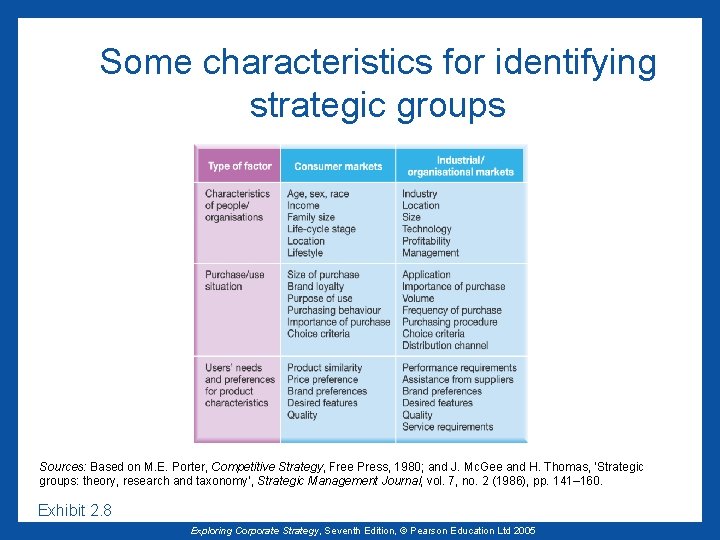
Some characteristics for identifying strategic groups Sources: Based on M. E. Porter, Competitive Strategy, Free Press, 1980; and J. Mc. Gee and H. Thomas, ‘Strategic groups: theory, research and taxonomy’, Strategic Management Journal, vol. 7, no. 2 (1986), pp. 141– 160. Exhibit 2. 8 Exploring Corporate Strategy, Seventh Edition, © Pearson Education Ltd 2005
Identification of Strategic Groups (1) • Scope of activities – Product/service diversity – Geographical coverage – Number of market segments served – Distribution channels Sources: Based on M. E. Porter, Competitive Strategy, Free Press, 1980; and J. Mc. Gee and H. Thomas, ‘Strategic groups: theory, research and taxonomy’, Strategic Management Journal, vol. 7, no. 2 (1986), pp. 141– 160. Exploring Corporate Strategy, Seventh Edition, © Pearson Education Ltd 2005
Identification of Strategic Groups (2) • Resource commitment – Extent of branding – Marketing effort – Extent of vertical integration – Product/service quality – Technological position (leader, follower) – Size of organisation Sources: Based on M. E. Porter, Competitive Strategy, Free Press, 1980; and J. Mc. Gee and H. Thomas, ‘Strategic groups: theory, research and taxonomy’, Strategic Management Journal, vol. 7, no. 2 (1986), pp. 141– 160. Exploring Corporate Strategy, Seventh Edition, © Pearson Education Ltd 2005
Uses of Strategic Group Analysis • To understand who are the most direct competitors of an organisation • To establish the different bases of competitive rivalry within and between the strategic groups • To assess if an organisation could move from one group to another – Depends on barriers to entry • To identify opportunities and threats – Changes in the macro-environment may create strategic space Exploring Corporate Strategy, Seventh Edition, © Pearson Education Ltd 2005
Market Segments A market segment is a group of customers who have similar needs that are different from customer needs in other parts of the market • The strategic customer – The person(s) to whom strategy is primarily addressed because they have the most influence • What customers value – critical success factors – Those product features particularly valued by a group of customers and where the organisation must excel to outperform competition Exploring Corporate Strategy, Seventh Edition, © Pearson Education Ltd 2005
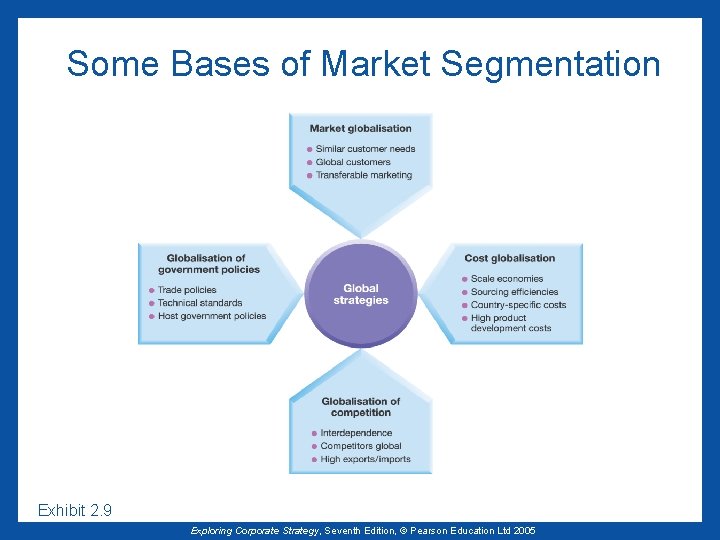
Some Bases of Market Segmentation Exhibit 2. 9 Exploring Corporate Strategy, Seventh Edition, © Pearson Education Ltd 2005
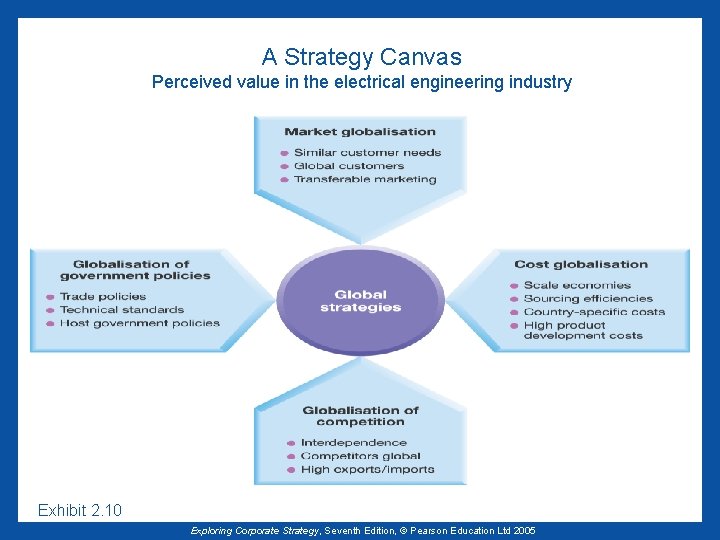
A Strategy Canvas Perceived value in the electrical engineering industry Exhibit 2. 10 Exploring Corporate Strategy, Seventh Edition, © Pearson Education Ltd 2005
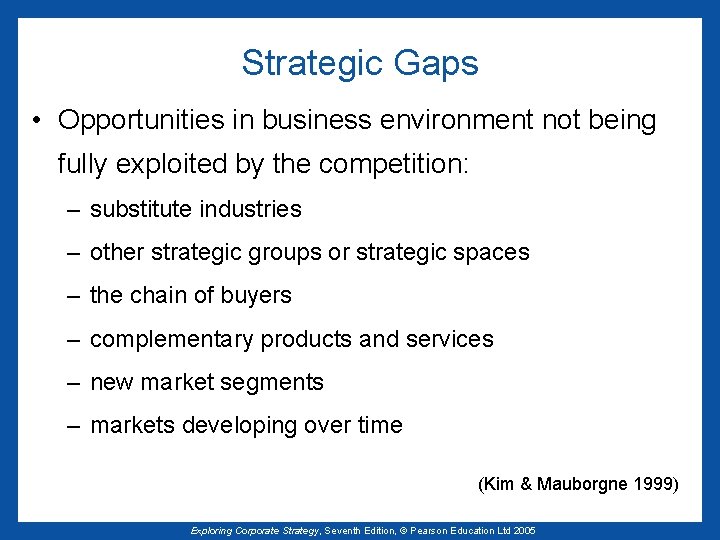
Strategic Gaps • Opportunities in business environment not being fully exploited by the competition: – substitute industries – other strategic groups or strategic spaces – the chain of buyers – complementary products and services – new market segments – markets developing over time (Kim & Mauborgne 1999) Exploring Corporate Strategy, Seventh Edition, © Pearson Education Ltd 2005
Environment – Key Points (1) • PESTEL identifies key drivers of change • Scenarios analyse future implications of uncertain environmental forces • 5 forces framework identifies sources of competition in an industry • Competition is dynamic Exploring Corporate Strategy, Seventh Edition, © Pearson Education Ltd 2005
Environment – Key Points (2) • Within an industry there are strategic groups competing on similar bases • Market segments help to understand differences between customers • Critical success factors are those features particularly valued by customers • Environmental analysis identifies opportunities and threats Exploring Corporate Strategy, Seventh Edition, © Pearson Education Ltd 2005