
Exploring cognitive metacognitive reading strategies for EFL teaching
- Slides: 10
Exploring cognitive & metacognitive reading strategies for EFL teaching and learning with Rick, Adam, Alison, Mei & Rosie
Reading is … • nutrition for the brain • a way to learn / relax • a way to communicate • therefore an essential life skill • AND a way to develop English language use through processing vocabulary and grammar in context So … EFL teachers should encourage and enable their learners to read both off and online by providing opportunities for them to develop their cognitive and metacognitive reading strategies.
Cognitive strategies … are the mental skills used to enable us to acquire knowledge. In terms of reading in a foreign language, learners often have to be reminded or even taught how to use these skills, even if they have developed them naturally in their L 1. Metacognitive strategies … are the skills and knowledge used to improve cognitive strategies. In terms of reading in a foreign language, they include reflection on the reasons for progress (or lack of) and selfawareness of how to read more effectively.
Why teach cognitive and metacognitive strategies in language learning? Most research suggests that: • successful language learners use these strategies more often and more purposefully than unsuccessful learners (Oxford, 1993) • successful learners are able to combine the strategies effectively to achieve good results (ibid) • successful test takers are good at self-evaluating their responses to questions paper (Purpura, J. E. 1998) • learners who solve problems themselves are more successful than those who rely on the teacher (Brandl, K. (2002: 91) • improving reading skills makes the wealth of information on the www more accessible to learners
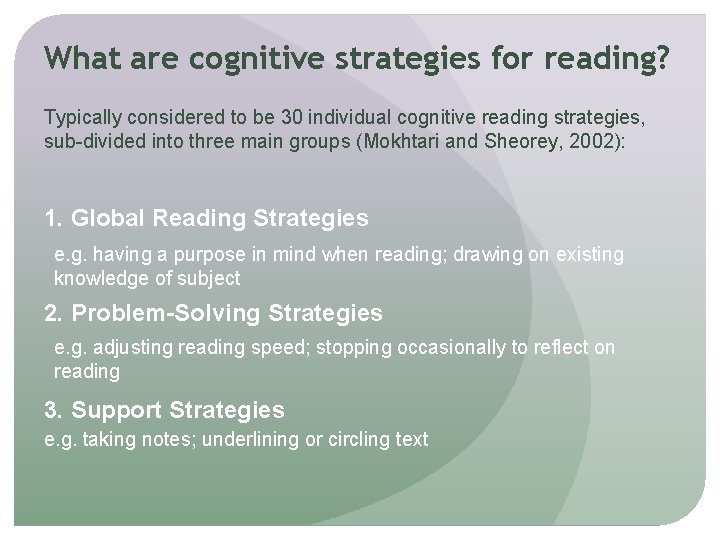
What are cognitive strategies for reading? Typically considered to be 30 individual cognitive reading strategies, sub-divided into three main groups (Mokhtari and Sheorey, 2002): 1. Global Reading Strategies e. g. having a purpose in mind when reading; drawing on existing knowledge of subject 2. Problem-Solving Strategies e. g. adjusting reading speed; stopping occasionally to reflect on reading 3. Support Strategies e. g. taking notes; underlining or circling text
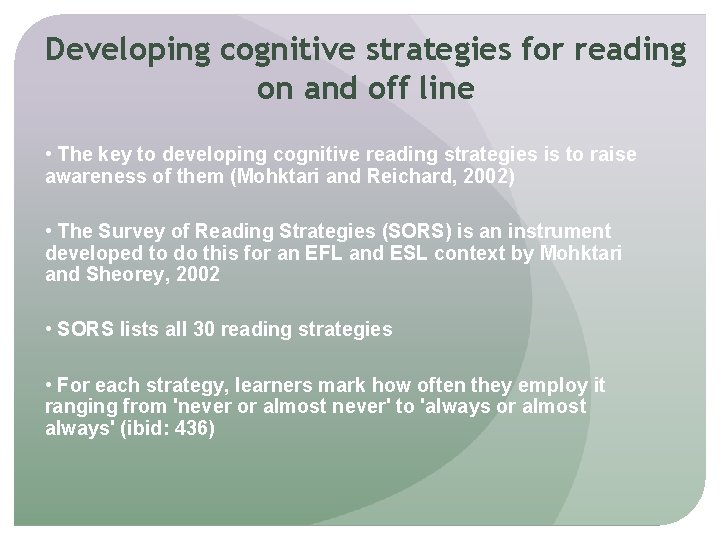
Developing cognitive strategies for reading on and off line • The key to developing cognitive reading strategies is to raise awareness of them (Mohktari and Reichard, 2002) • The Survey of Reading Strategies (SORS) is an instrument developed to do this for an EFL and ESL context by Mohktari and Sheorey, 2002 • SORS lists all 30 reading strategies • For each strategy, learners mark how often they employ it ranging from 'never or almost never' to 'always or almost always' (ibid: 436)
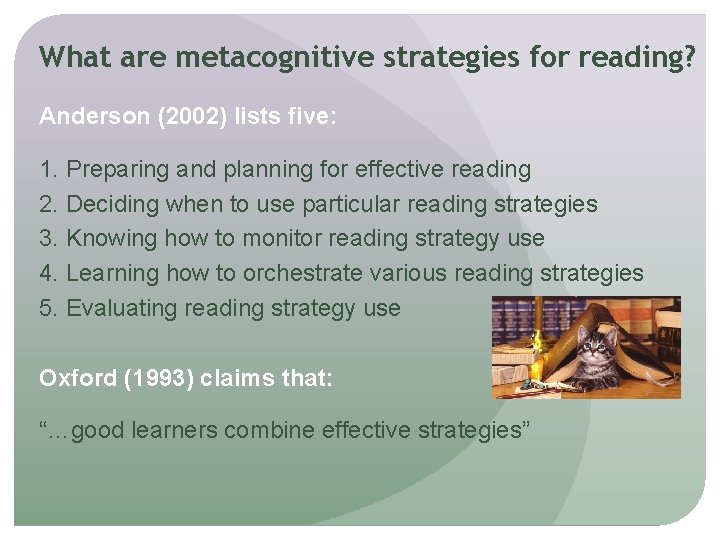
What are metacognitive strategies for reading? Anderson (2002) lists five: 1. Preparing and planning for effective reading 2. Deciding when to use particular reading strategies 3. Knowing how to monitor reading strategy use 4. Learning how to orchestrate various reading strategies 5. Evaluating reading strategy use Oxford (1993) claims that: “…good learners combine effective strategies”
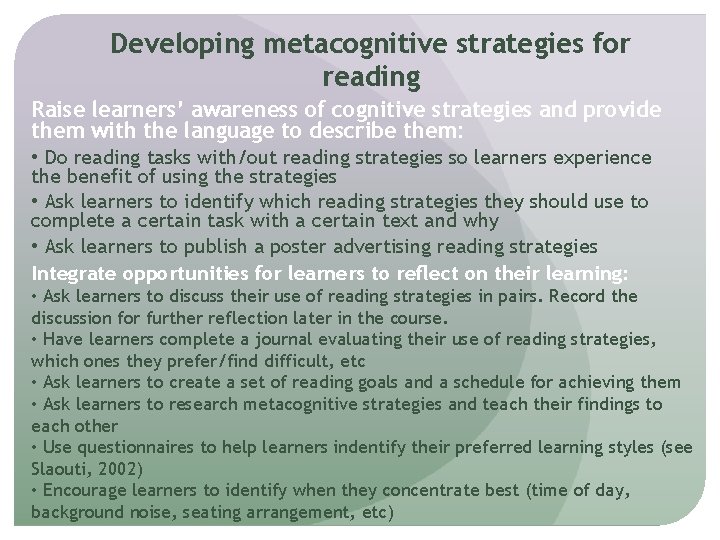
Developing metacognitive strategies for reading Raise learners’ awareness of cognitive strategies and provide them with the language to describe them: • Do reading tasks with/out reading strategies so learners experience the benefit of using the strategies • Ask learners to identify which reading strategies they should use to complete a certain task with a certain text and why • Ask learners to publish a poster advertising reading strategies Integrate opportunities for learners to reflect on their learning: • Ask learners to discuss their use of reading strategies in pairs. Record the discussion for further reflection later in the course. • Have learners complete a journal evaluating their use of reading strategies, which ones they prefer/find difficult, etc • Ask learners to create a set of reading goals and a schedule for achieving them • Ask learners to research metacognitive strategies and teach their findings to each other • Use questionnaires to help learners indentify their preferred learning styles (see Slaouti, 2002) • Encourage learners to identify when they concentrate best (time of day, background noise, seating arrangement, etc)
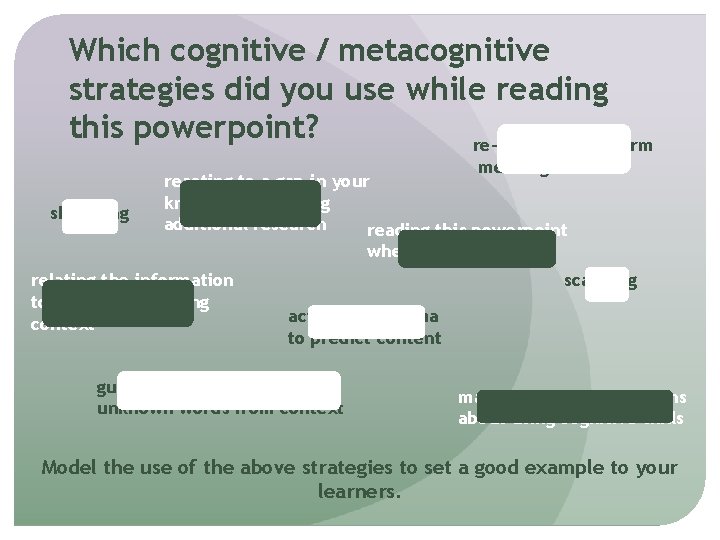
Which cognitive / metacognitive strategies did you use while reading this powerpoint? re-reading to confirm skimming meaning reacting to a gap in your knowledge by doing additional research reading this powerpoint when you feel relaxed relating the information to your own teaching context scanning activating schema to predict content guessing the meaning of unknown words from context making conscious decisions about using cognitive skills Model the use of the above strategies to set a good example to your learners.
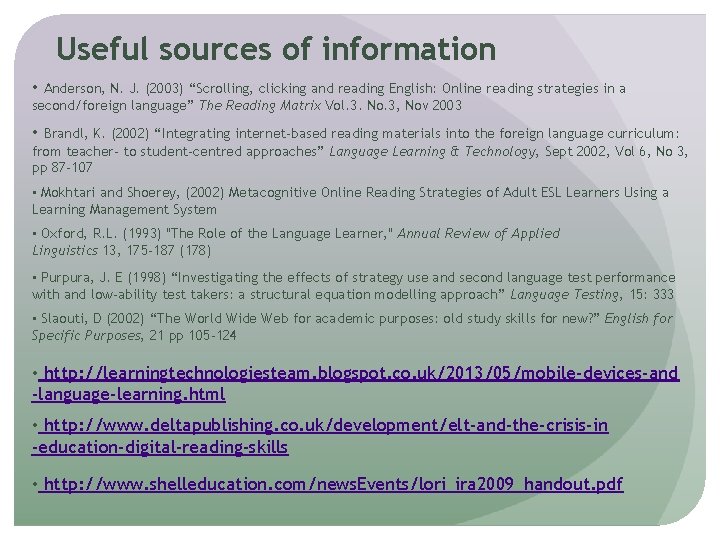
Useful sources of information • Anderson, N. J. (2003) “Scrolling, clicking and reading English: Online reading strategies in a second/foreign language” The Reading Matrix Vol. 3. No. 3, Nov 2003 • Brandl, K. (2002) “Integrating internet-based reading materials into the foreign language curriculum: from teacher- to student-centred approaches” Language Learning & Technology, Sept 2002, Vol 6, No 3, pp 87 -107 • Mokhtari and Shoerey, (2002) Metacognitive Online Reading Strategies of Adult ESL Learners Using a Learning Management System • Oxford, R. L. (1993) "The Role of the Language Learner, " Annual Review of Applied Linguistics 13, 175 -187 (178) • Purpura, J. E (1998) “Investigating the effects of strategy use and second language test performance with and low-ability test takers: a structural equation modelling approach” Language Testing, 15: 333 • Slaouti, D (2002) “The World Wide Web for academic purposes: old study skills for new? ” English for Specific Purposes, 21 pp 105 -124 • http: //learningtechnologiesteam. blogspot. co. uk/2013/05/mobile-devices-and -language-learning. html • http: //www. deltapublishing. co. uk/development/elt-and-the-crisis-in -education-digital-reading-skills • http: //www. shelleducation. com/news. Events/lori_ira 2009_handout. pdf