
Exploring Clarksons Typical Corporate and Stakeholder Issues Model
- Slides: 10
Exploring Clarkson’s Typical Corporate and Stakeholder Issues Model as an Approach to Understanding Corporate Social Responsibility in Tourism The Case of Lonely Planet Catrina Papaleo and Sue Beeton
Theories associated with CSR o o Profit maximisation theory Ethical theory Political theory Stakeholder theory
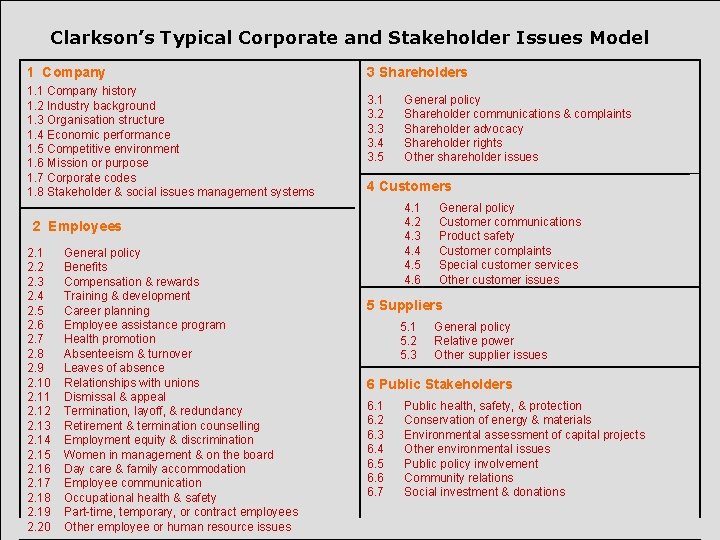
Clarkson’s Typical Corporate and Stakeholder Issues Model 1 Company 1. 1 Company history 1. 2 Industry background 1. 3 Organisation structure 1. 4 Economic performance 1. 5 Competitive environment 1. 6 Mission or purpose 1. 7 Corporate codes 1. 8 Stakeholder & social issues management systems 3 Shareholders 3. 1 3. 2 3. 3 3. 4 3. 5 4 Customers 4. 1 4. 2 4. 3 4. 4 4. 5 4. 6 2 Employees 2. 1 2. 2 2. 3 2. 4 2. 5 2. 6 2. 7 2. 8 2. 9 2. 10 2. 11 2. 12 2. 13 2. 14 2. 15 2. 16 2. 17 2. 18 2. 19 2. 20 General policy Benefits Compensation & rewards Training & development Career planning Employee assistance program Health promotion Absenteeism & turnover Leaves of absence Relationships with unions Dismissal & appeal Termination, layoff, & redundancy Retirement & termination counselling Employment equity & discrimination Women in management & on the board Day care & family accommodation Employee communication Occupational health & safety Part-time, temporary, or contract employees Other employee or human resource issues General policy Shareholder communications & complaints Shareholder advocacy Shareholder rights Other shareholder issues General policy Customer communications Product safety Customer complaints Special customer services Other customer issues 5 Suppliers 5. 1 5. 2 5. 3 General policy Relative power Other supplier issues 6 Public Stakeholders 6. 1 6. 2 6. 3 6. 4 6. 5 6. 6 6. 7 Public health, safety, & protection Conservation of energy & materials Environmental assessment of capital projects Other environmental issues Public policy involvement Community relations Social investment & donations
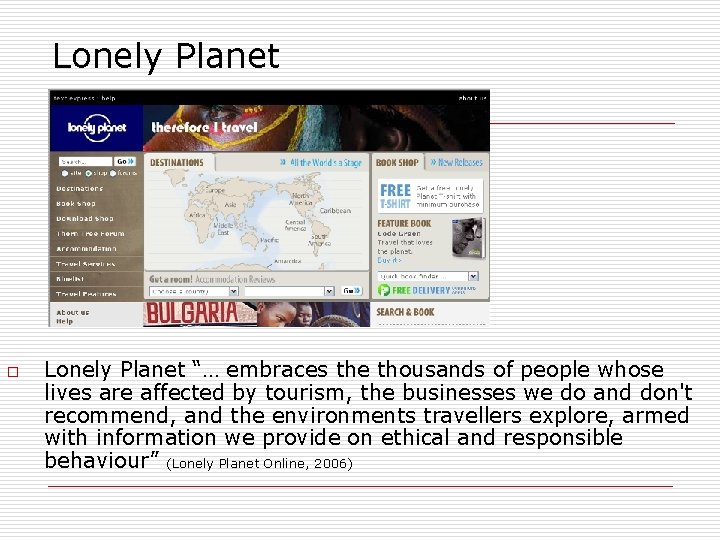
Lonely Planet o Lonely Planet “… embraces the thousands of people whose lives are affected by tourism, the businesses we do and don't recommend, and the environments travellers explore, armed with information we provide on ethical and responsible behaviour” (Lonely Planet Online, 2006)
Lonely Planet Foundation o Criteria n n Grass-roots, non-domestic projects Emphasis on education and health Clear outcomes through local initiative and support Empowering the local community.
Overview of CSR Activities at Lonely Planet The Lonely Planet Foundation Ancient forest friendly printing arrangement The use of environmentally friendly and/or soy based ink Strong responsible travel aspect to all guidebooks Ensuring labour contracts comply with laws in Australia & overseas Support local community events Recycling paper Turning the lights off at the end of the day “there’s more we can do” [LP employee]
LP Stakeholder Perceptions of CSR o What is CSR? n n o ‘doing the right thing’ Using corporation’s resources to benefit the world “there’s nothing false about them” [LP supplier]
LP Stakeholder Perceptions of CSR o How do we measure it? n o In terms of ‘sustainability’… What is sustainability? n “series of goods been created by our activity of benefit to the world” [LP employee]
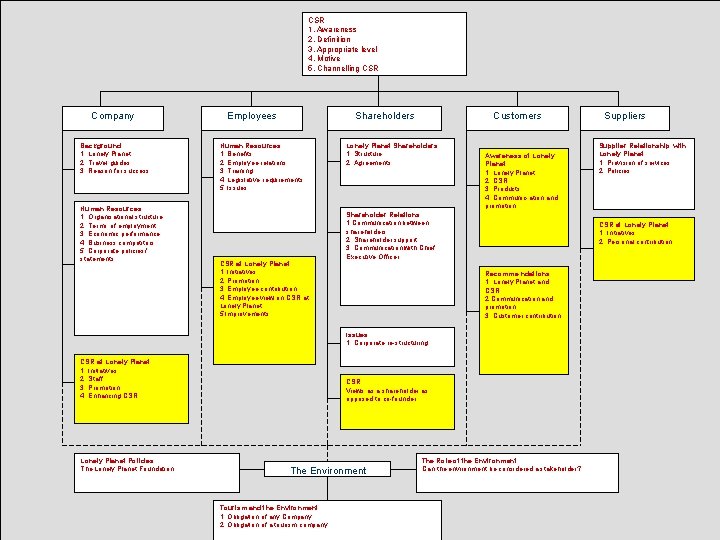
CSR 1. Awareness 2. Definition 3. Appropriate level 4. Motive 5. Channelling CSR Company Background 1. Lonely Planet 2. Travel guides 3. Reason for success Human Resources 1. Organisational structure 2. Terms of employment 3. Economic performance 4. Business competitors 5. Corporate policies/ statements Employees Shareholders Human Resources 1. Benefits 2. Employee relations 3. Training 4. Legislative requirements 5. Issues CSR at Lonely Planet 1. Initiatives 2. Promotion 3. Employee contribution 4. Employee view on CSR at Lonely Planet 5. Improvements Customers Lonely Planet Shareholders 1. Structure 2. Agreements Awareness of Lonely Planet 1. Lonely Planet 2. CSR 3. Products 4. Communic-ation and promotion Shareholder Relations 1. Communication between shareholders 2. Shareholder support 3. Communication with Chief Executive Officer Lonely Planet Policies The Lonely Planet Foundation Recomme-ndations 1. Lonely Planet and CSR 2. Communication and promotion 3. Customer contribution CSR Views as a shareholder as opposed to co-founder The Environment Tourism and the Environment 1. Obligation of any Company 2. Obligation of a tourism company Supplier Relationship with Lonely Planet 1. Provision of services 2. Policies CSR at Lonely Planet 1. Initiatives 2. Personal contribution Issues 1. Corporate re-structuring CSR at Lonely Planet 1. Initiatives 2. Staff 3. Promotion 4. Enhancing CSR Suppliers The Role of the Environment Can the environment be considered a stakeholder?
Conclusion o The use of a stakeholder theory to ascertain the perceptions of Lonely Planet’s stakeholders was a successful approach to take. It is these perceptions that informed the choices for the CSR framework developed for Lonely Planet.