
Exploring Business V 2 1 By Karen Collins

Exploring Business V 2. 1 By Karen Collins
Published by: Flat World Knowledge, Inc. 1111 19 th Street Northwest Washington, DC 20036 © 2015 by Flat World Knowledge, Inc. All rights reserved. Your use of this work is subject to the License Agreement available here http: //www. flatworldknowledge. com/legal. No part of this work may be used, modified, or reproduced in any form or by any means except as expressly permitted under the License Agreement. © 2015 Flat World Knowledge 1
Chapter 3 Business In A Global Environment © 2015 Flat World Knowledge 2
Chapter Objectives • Explain why nations and companies engage in international trade and discuss how trade between nations is measured • Identify opportunities in international business • Appreciate challenges created by cultural, economic, legal, and political differences • Describe ways governments and international bodies promote and regulate global trade • Discuss initiatives designed to reduce trade barriers and promote free trade • Understand how to prepare for a career in international business © 2015 Flat World Knowledge 3
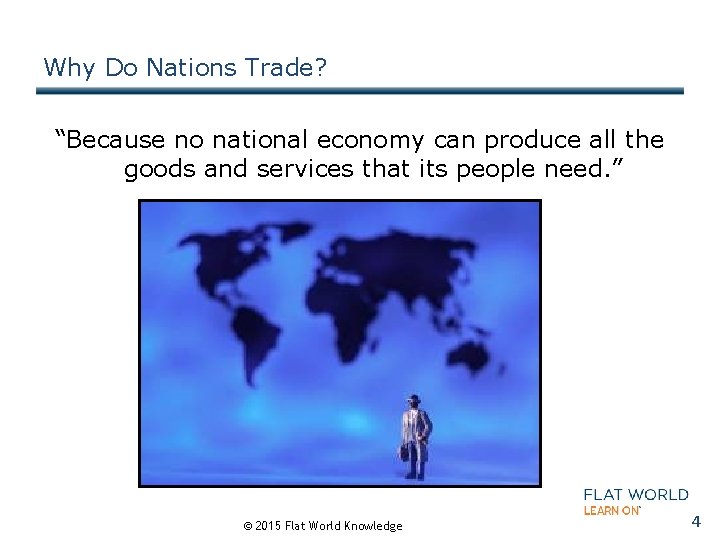
Why Do Nations Trade? “Because no national economy can produce all the goods and services that its people need. ” © 2015 Flat World Knowledge 4
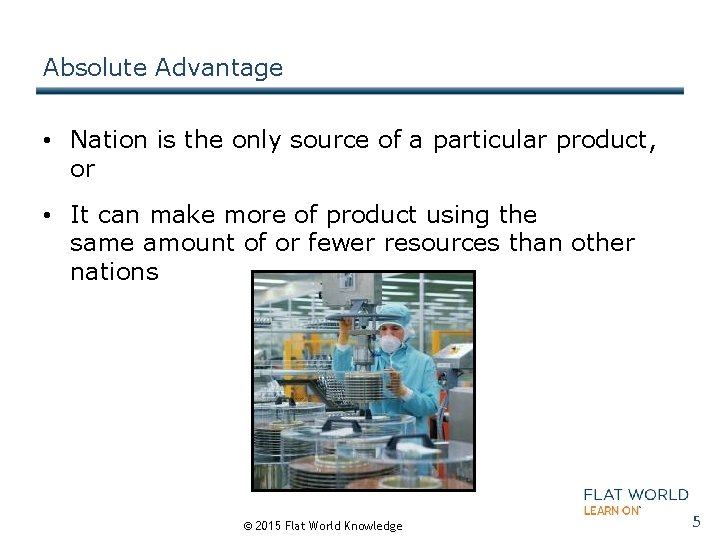
Absolute Advantage • Nation is the only source of a particular product, or • It can make more of product using the same amount of or fewer resources than other nations © 2015 Flat World Knowledge 5
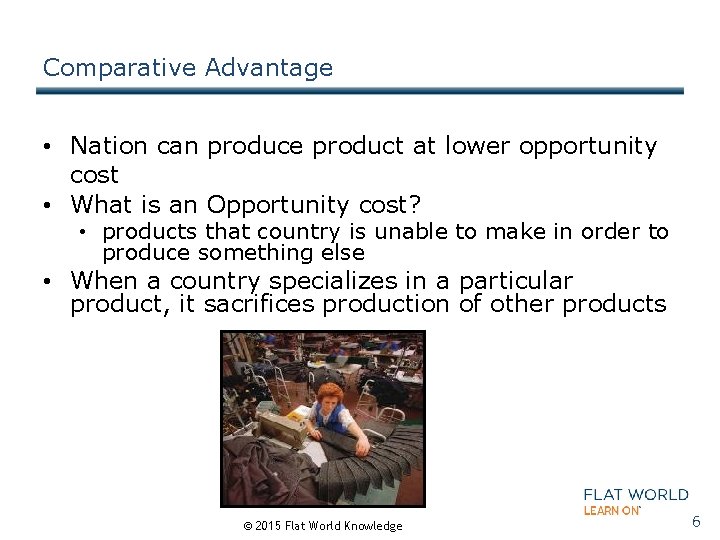
Comparative Advantage • Nation can produce product at lower opportunity cost • What is an Opportunity cost? • products that country is unable to make in order to produce something else • When a country specializes in a particular product, it sacrifices production of other products © 2015 Flat World Knowledge 6
Measuring Trade • Balance of Trade – Calculated by “subtracting the value of its imports from the value of its exports. ” • Balance of Payments – “…the difference, over a period of time, between the total flow of money coming into a country and the total flow of money going out. ” © 2015 Flat World Knowledge 7
Balance Of Trade • Trade Surplus (Favorable Balance) – Sells more products than it buys • Trade Deficit (Unfavorable Balance) – Buys more products than it sells © 2015 Flat World Knowledge 8
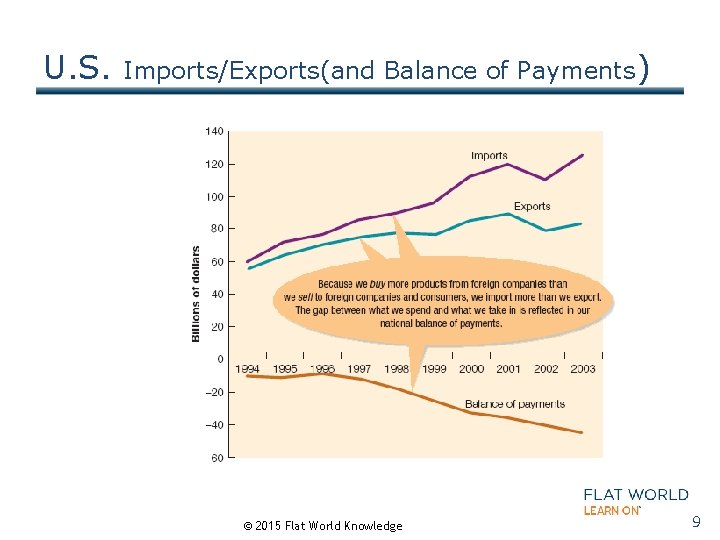
U. S. Imports/Exports(and Balance of Payments) © 2015 Flat World Knowledge 9
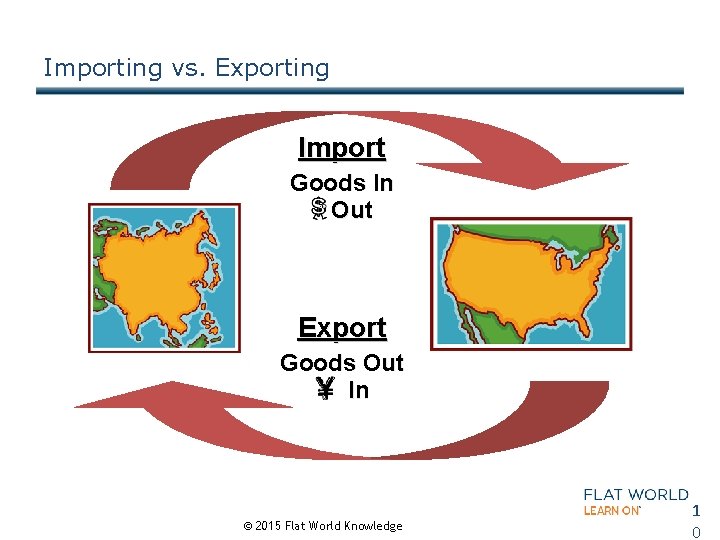
Importing vs. Exporting Import Goods In Out Export Goods Out In © 2015 Flat World Knowledge 1 0
International Licensing and Franchising • International Licensing Agreement – Allows a foreign company to sell the products of a producer/ licensor or to use intellectual property (patents, trademarks etc. ) in exchange for royalty fees • In. Franchise Agreement – Company/Franchisor grants foreign company the right to use its brand name and sell its products © 2015 Flat World Knowledge 11
Contract Manufacturing • (Also known as Outsourcing) • U. S. company contracts with a local company in a foreign Country to manufacture one of its products. • U. S. company retains control of product design and development and puts its own label on product. © 2015 Flat World Knowledge 12
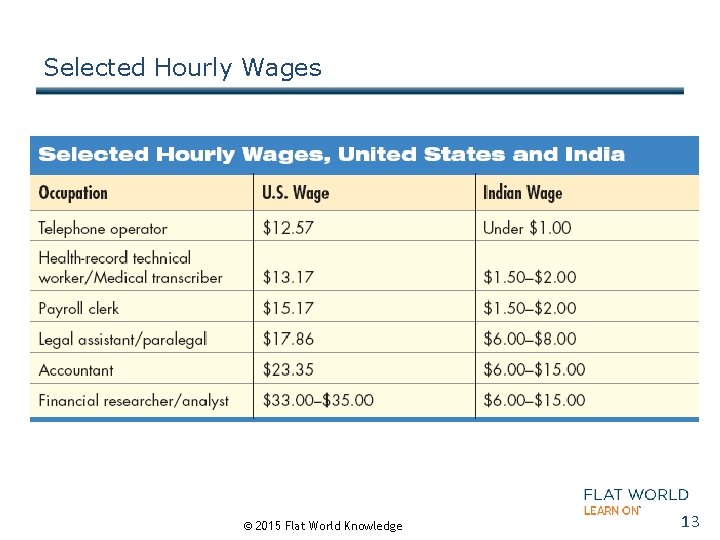
Selected Hourly Wages © 2015 Flat World Knowledge 13
International Strategic Alliances and Joint Ventures • Strategic Alliance – Agreement between two companies (or a company and a nation) to pool resources in order to achieve business goals that benefit both partners • Joint Venture – Alliance in which partners fund a separate entity to manage their joint operation © 2015 Flat World Knowledge 14
Foreign Direct Investments and Subsidiaries • Foreign Direct Investment – Formal establishment of business operations (say a factory or sales office) on foreign soil • Foreign Subsidiary – An independent company owned and controlled by a foreign firm parent) © 2015 Flat World Knowledge 15
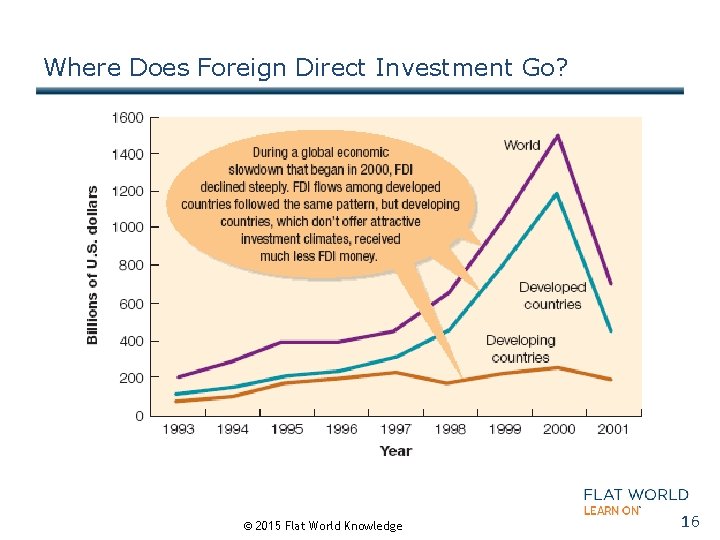
Where Does Foreign Direct Investment Go? © 2015 Flat World Knowledge 16
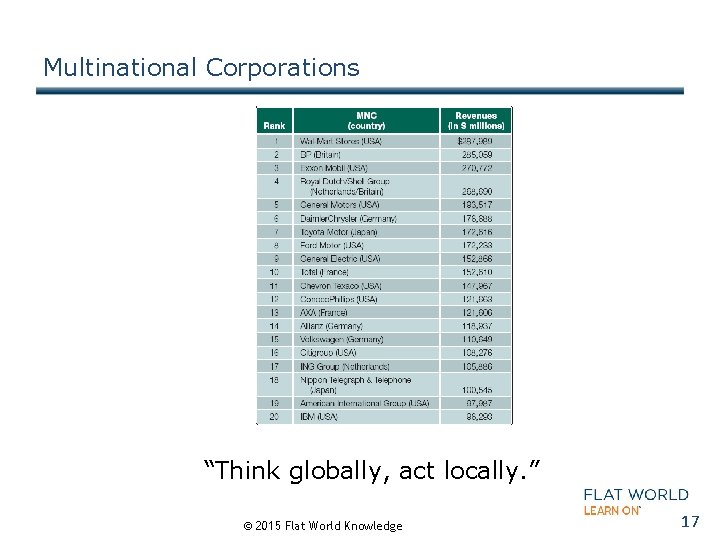
Multinational Corporations “Think globally, act locally. ” © 2015 Flat World Knowledge 17
Criticism and Defense of Multinational Corporations Criticism • Destroys jobs and lowers • • wages of home-country workers Traditional lifestyles/values weakened or destroyed Irreversible damage to environment Defense • Better, cheaper products • Creates jobs • Raises standard of living in • developing countries Increases cross- cultural understanding © 2015 Flat World Knowledge 18
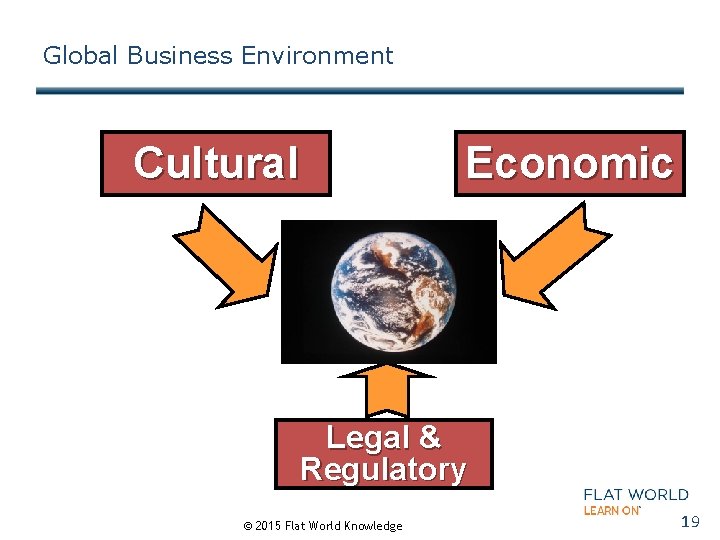
Global Business Environment Cultural Economic Legal & Regulatory © 2015 Flat World Knowledge 19
Culture “…system of shared beliefs, values, customs, and behaviors that govern the interactions of members of a society. ” © 2015 Flat World Knowledge 20
Cultural Environment • Language • Sociability • High Context— interlocking personal/family • connections • hold people together • Low Context—personal and work relationships more compartmentalized Intercultural Communication • Degrees of animation in expression • Distance © 2015 Flat World Knowledge 21
Lost In Translation • Translated into German, the slogan “Come Alive with Pepsi” became “Come out of the Grave with Pepsi • A U. S. computer company in translated “software” as underwear. ” • A German chocolate product called “Zit” didn’t sell well in the United States. © 2015 Flat World Knowledge 22
Economic Environment To effectively do business in a foreign country, you need to know the country’s level of economic development. • Currency Valuations/Exchange Rates • Universal Currency Converter http: //www. convertmymoney. com © 2015 Flat World Knowledge 23
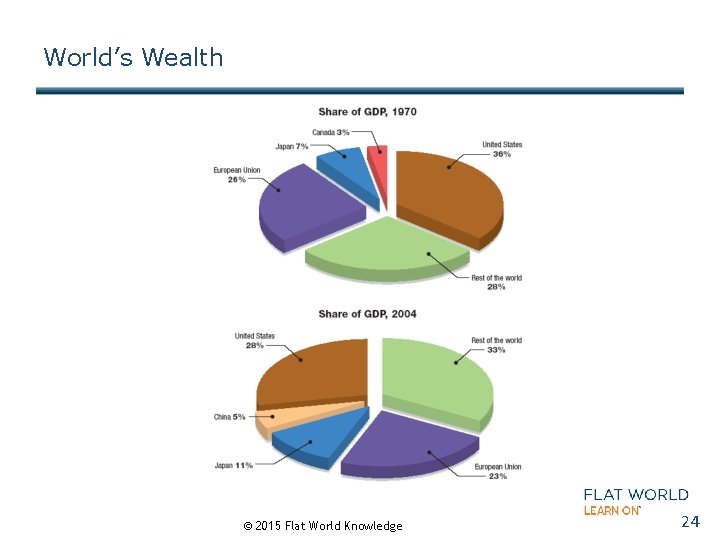
World’s Wealth © 2015 Flat World Knowledge 24
Legal and Regulatory Environment • No established global set of laws • Foreign Corrupt Practices Act (Prohibits the distribution of bribes and other favors in the conduct of business. ) © 2015 Flat World Knowledge 25
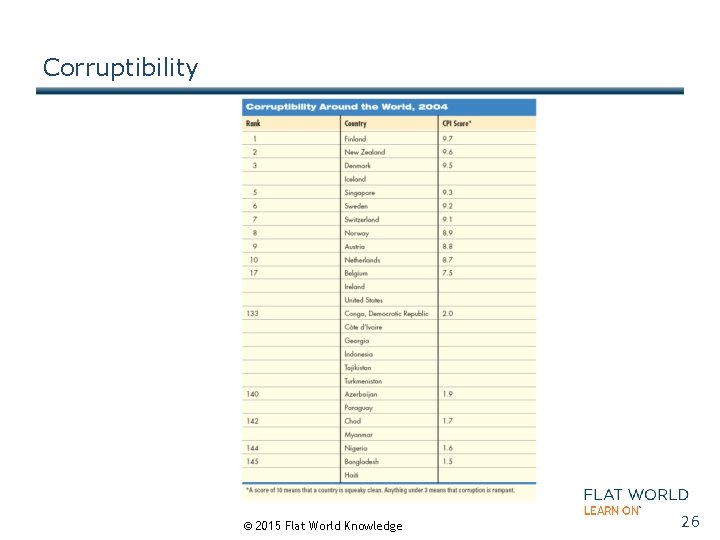
Corruptibility © 2015 Flat World Knowledge 26
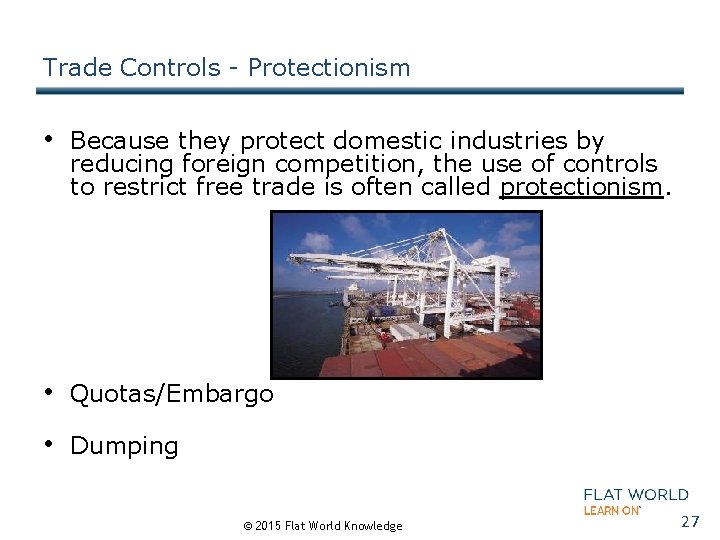
Trade Controls - Protectionism • Because they protect domestic industries by reducing foreign competition, the use of controls to restrict free trade is often called protectionism. • Quotas/Embargo • Dumping © 2015 Flat World Knowledge 27
Trade Controls Tariffs, Quotas, Embargos • Tariffs – Government taxes on imports that raise the price of imported goods and make than less competitive with domestic goods. • Quotas/Embargo – • Quota is a government • restriction on the quantity of a good that can be imported. • Embargo is an extreme form of quota which bans import of goods from a country for economic or political reasons. • Subsidiaries – Government payments given to certain industries (such as farming) to offset the cost of production © 2015 Flat World Knowledge 28
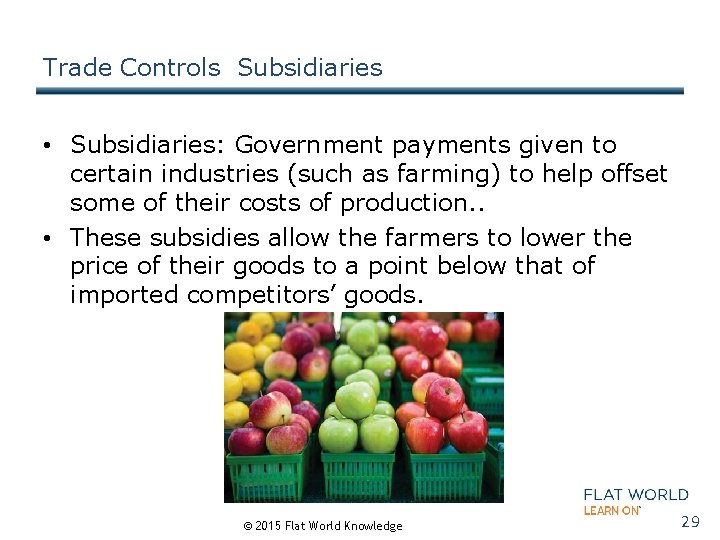
Trade Controls Subsidiaries • Subsidiaries: Government payments given to certain industries (such as farming) to help offset some of their costs of production. . • These subsidies allow the farmers to lower the price of their goods to a point below that of imported competitors’ goods. © 2015 Flat World Knowledge 29
Trade Control Debate Cons Pros • Protect specific industries • Protect new or struggling • industries Shield industries vital to national defense • Restricts free trade; • • • countries cannot compete freely Creates an un-level playing field; gives special privileges to some industries Cannot bring goods to a fair/open world market Detrimental to world economy; nations cannot focus on what they do best © 2015 Flat World Knowledge 30
Reducing International Trade Barriers • Trade Agreements/Organizations • World Trade Organization (monitors trade policies) • Financial Support for Troubled Economies • International Monetary Fund • (loans money to countries with troubled • economies) World Bank (gives support to poor and developing countries) © 2015 Flat World Knowledge 31
Reducing Trade Barriers NAFTA and EU • North American Free Trade Association (NAFTA) -Agreement among the United States, Canada and Mexico to open their borders to unrestricted trade. • European Union (EU) -- Association of European countries that joined together to eliminate trade restrictions among themselves. © 2015 Flat World Knowledge 32
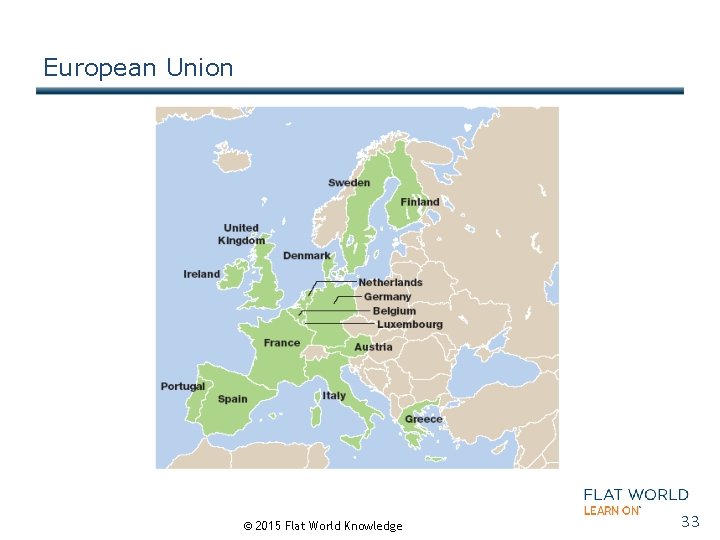
European Union © 2015 Flat World Knowledge 33
International Business Career • Plan Your Undergraduate Program to Allow You to: • Develop expertise in one of the basic areas • • of business Gain knowledge of international politics, economics, and culture Develop foreign language skills • Gain direct experience with individuals from • other counties Interact With People From Other Cultures by studying abroad © 2015 Flat World Knowledge 34
- Slides: 35