
Exploring Biology Chapter 1 Overview Introduction to Biology
Exploring Biology Chapter 1
Overview • Introduction to Biology • Levels of Organization in Nature • Cells as the Basis of Life • Unity of Life • Diversity & Classification of Organisms • Evolution
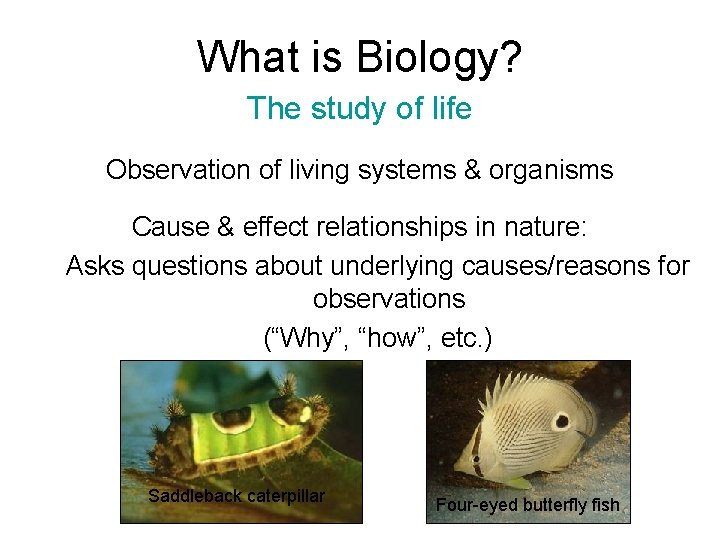
What is Biology? The study of life Observation of living systems & organisms Cause & effect relationships in nature: Asks questions about underlying causes/reasons for observations (“Why”, “how”, etc. ) Saddleback caterpillar Four-eyed butterfly fish
Unifying Concepts of Biology Structure & function are interrelated Structure dictates function e. g. blood flows in one direction through heart because heart has valves that prevent backflow e. g. opposable thumb of humans allows grasping Homeostasis State of equilibrium or balance
Unifying Concepts of Biology continued Emergent properties “The whole is greater than the sum of its parts” i. e. complex systems formed from comparatively simple parts Hierarchy of nature’s levels of organization From simple (atoms) to complex (biosphere)
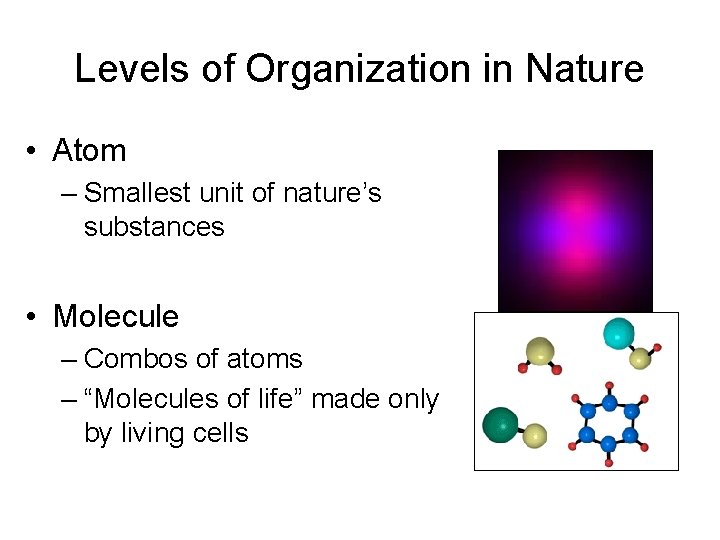
Levels of Organization in Nature • Atom – Smallest unit of nature’s substances • Molecule – Combos of atoms – “Molecules of life” made only by living cells
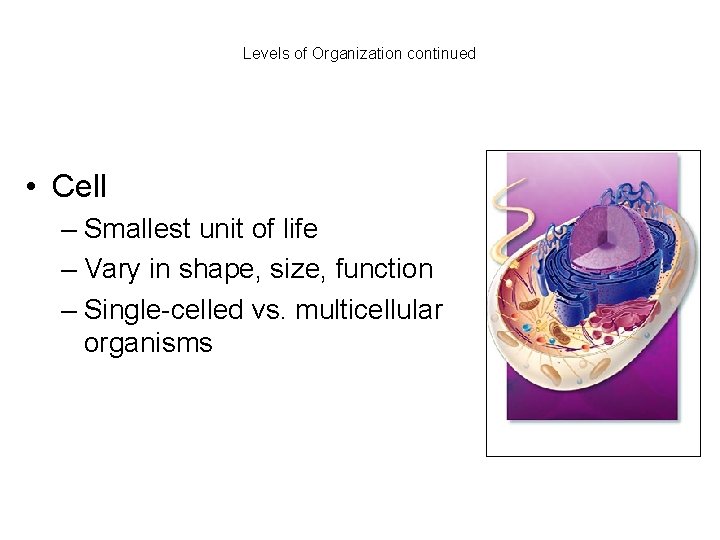
Levels of Organization continued • Cell – Smallest unit of life – Vary in shape, size, function – Single-celled vs. multicellular organisms
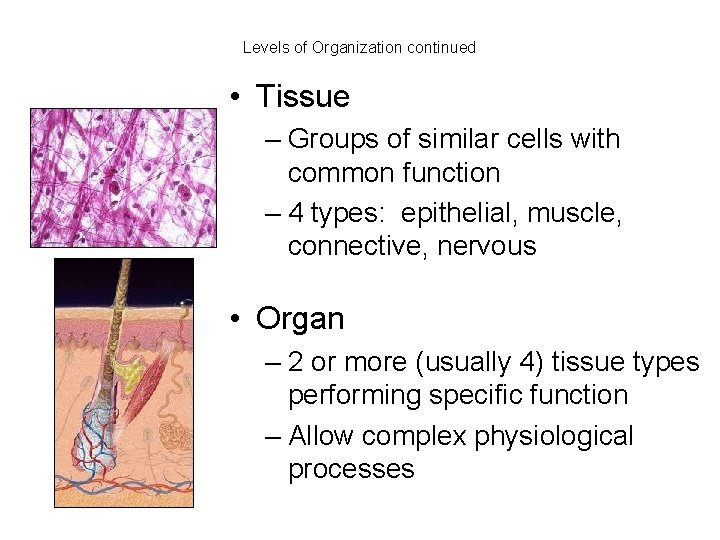
Levels of Organization continued • Tissue – Groups of similar cells with common function – 4 types: epithelial, muscle, connective, nervous • Organ – 2 or more (usually 4) tissue types performing specific function – Allow complex physiological processes
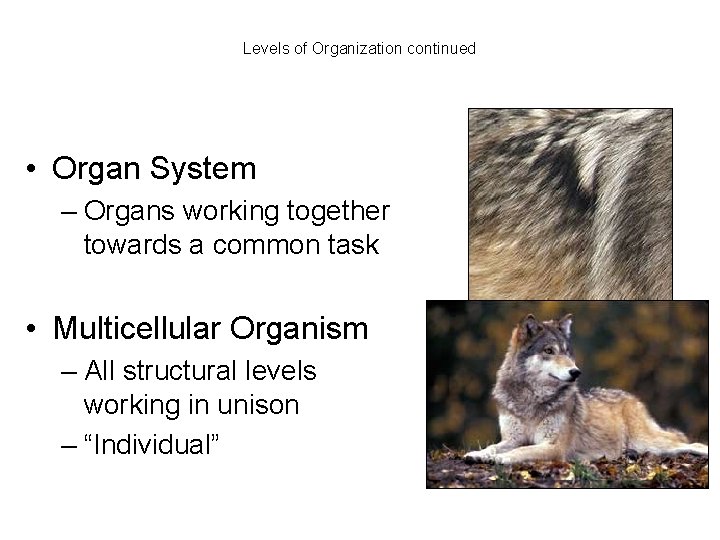
Levels of Organization continued • Organ System – Organs working together towards a common task • Multicellular Organism – All structural levels working in unison – “Individual”
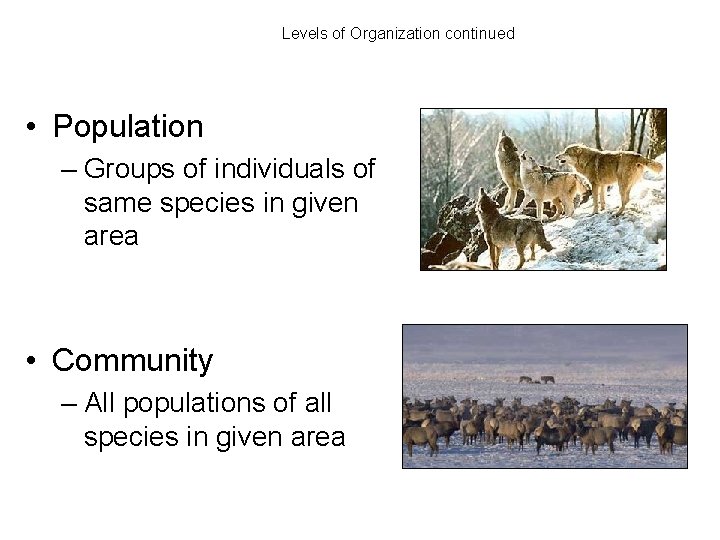
Levels of Organization continued • Population – Groups of individuals of same species in given area • Community – All populations of all species in given area
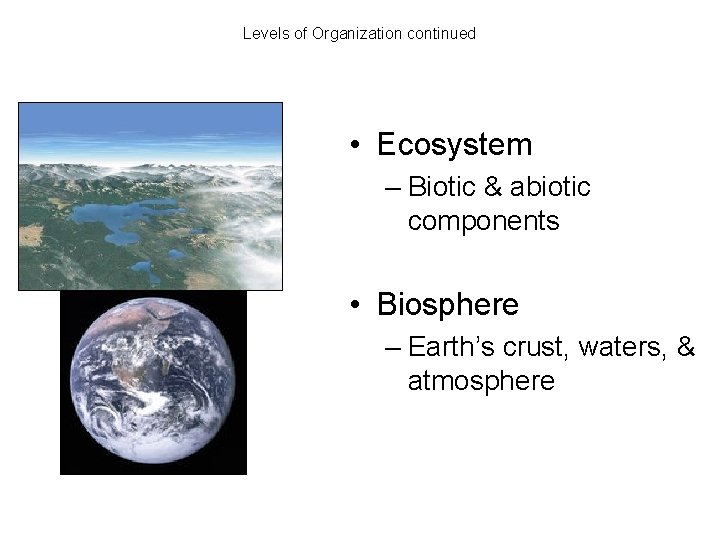
Levels of Organization continued • Ecosystem – Biotic & abiotic components • Biosphere – Earth’s crust, waters, & atmosphere
Cells Structural & functional units of life A cell can: • Regulate its internal environment • Obtain & use energy • Respond to external environment • Develop & maintain complex organization • Divide to form new cells
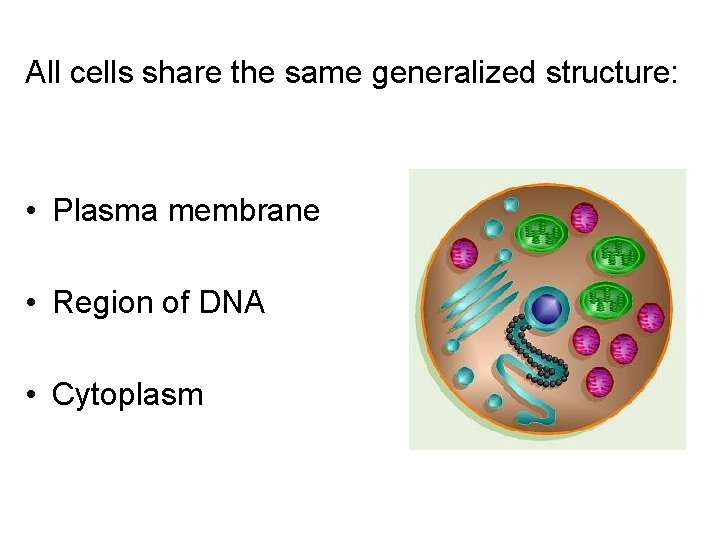
All cells share the same generalized structure: • Plasma membrane • Region of DNA • Cytoplasm
Several different types of cells will be encountered by you while working on your Microworlds project for lab: Prokaryotic (bacteria) Eukaryotic (protists, fungi, plants, animals)
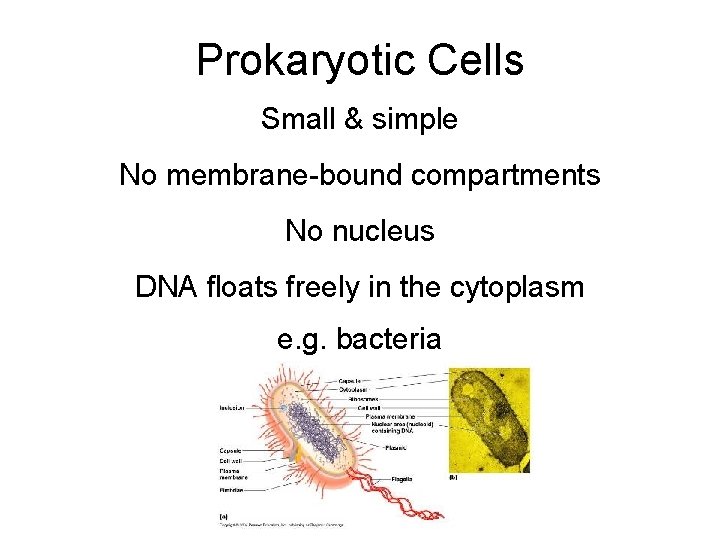
Prokaryotic Cells Small & simple No membrane-bound compartments No nucleus DNA floats freely in the cytoplasm e. g. bacteria
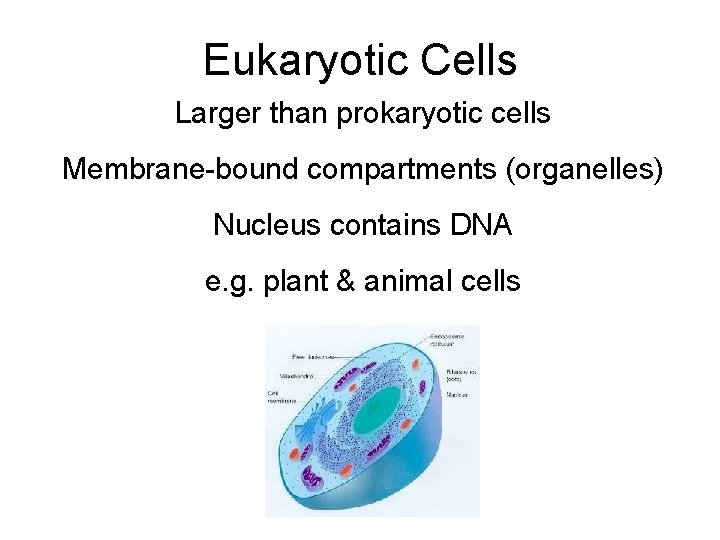
Eukaryotic Cells Larger than prokaryotic cells Membrane-bound compartments (organelles) Nucleus contains DNA e. g. plant & animal cells
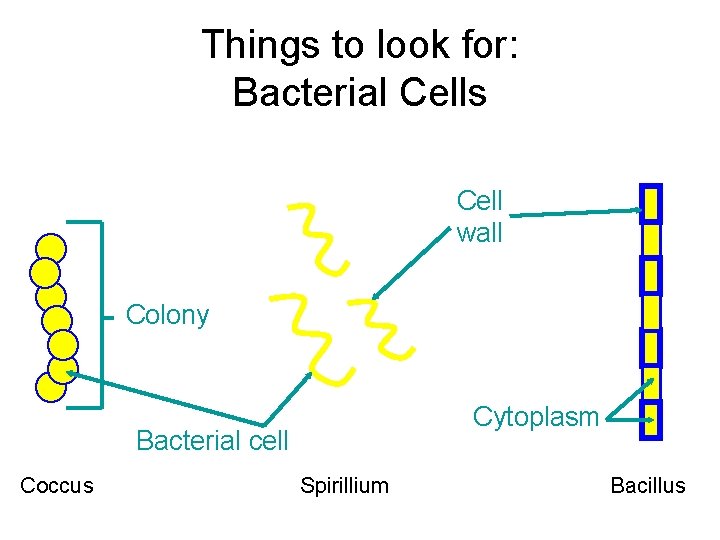
Things to look for: Bacterial Cells Cell wall Colony Cytoplasm Bacterial cell Coccus Spirillium Bacillus
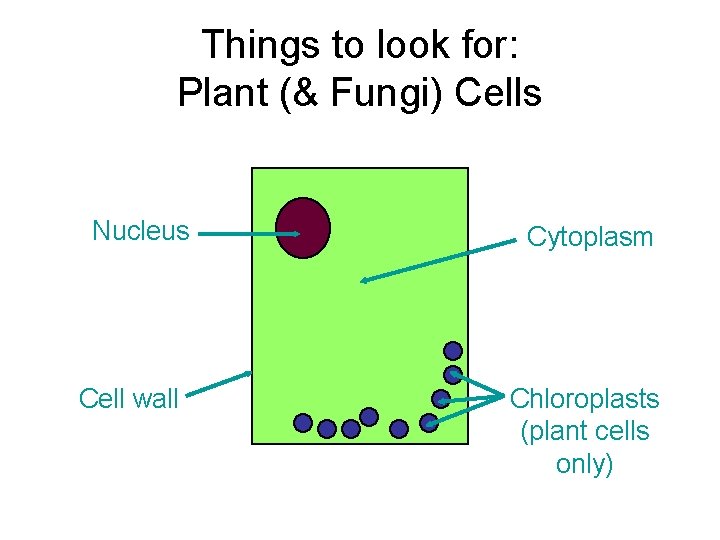
Things to look for: Plant (& Fungi) Cells Nucleus Cell wall Cytoplasm Chloroplasts (plant cells only)
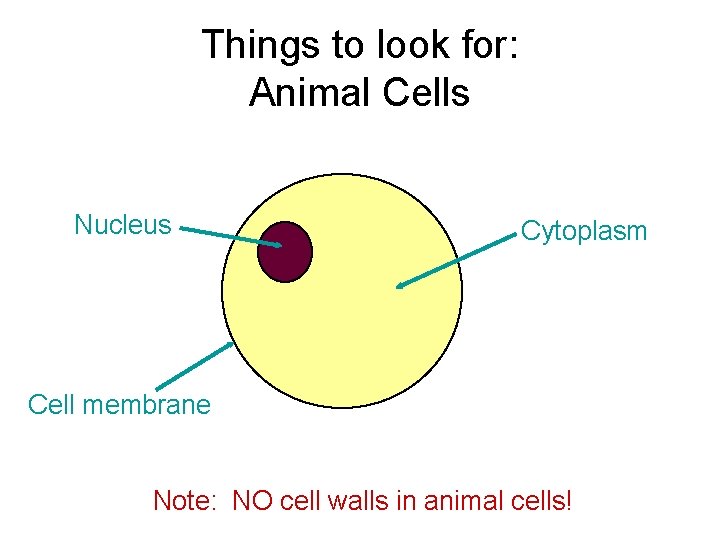
Things to look for: Animal Cells Nucleus Cytoplasm Cell membrane Note: NO cell walls in animal cells!
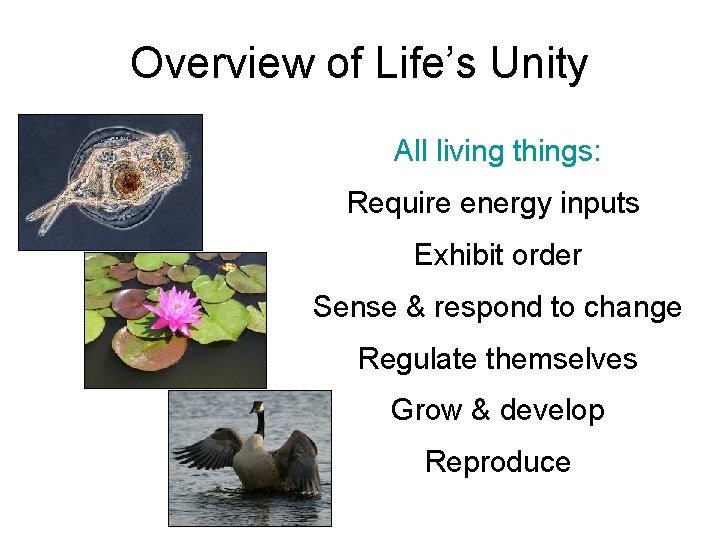
Overview of Life’s Unity All living things: Require energy inputs Exhibit order Sense & respond to change Regulate themselves Grow & develop Reproduce
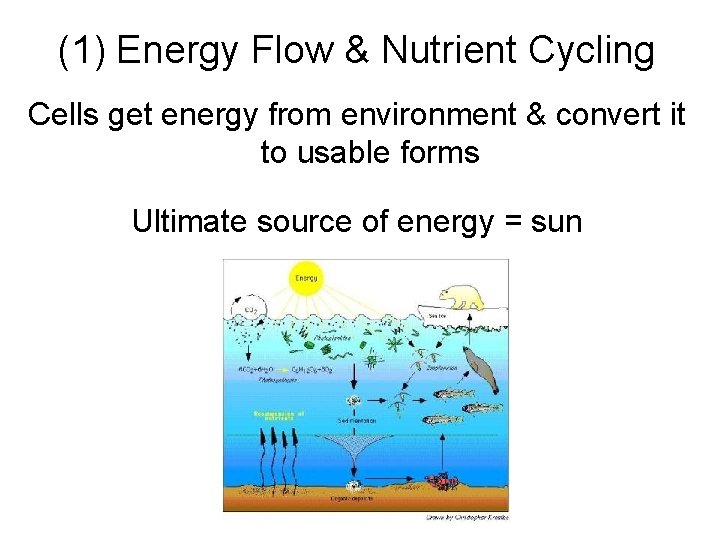
(1) Energy Flow & Nutrient Cycling Cells get energy from environment & convert it to usable forms Ultimate source of energy = sun
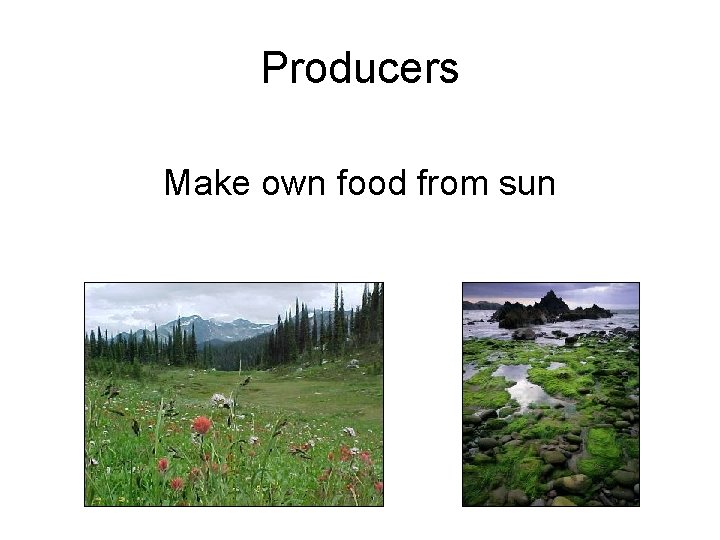
Producers Make own food from sun
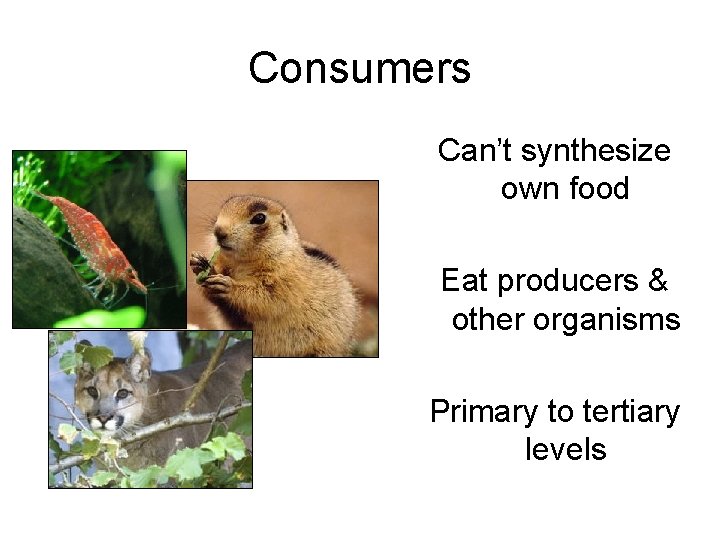
Consumers Can’t synthesize own food Eat producers & other organisms Primary to tertiary levels
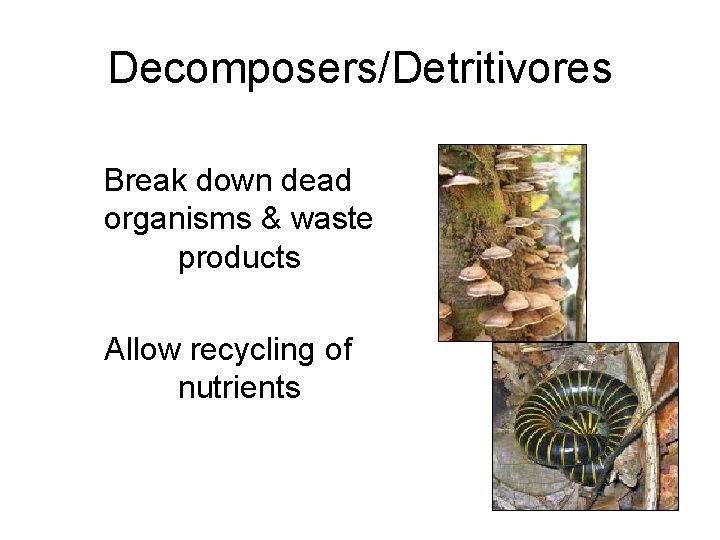
Decomposers/Detritivores Break down dead organisms & waste products Allow recycling of nutrients
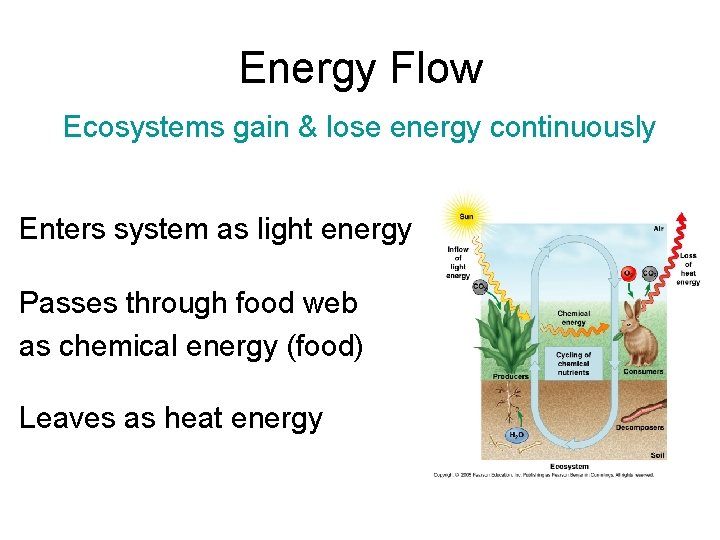
Energy Flow Ecosystems gain & lose energy continuously Enters system as light energy Passes through food web as chemical energy (food) Leaves as heat energy
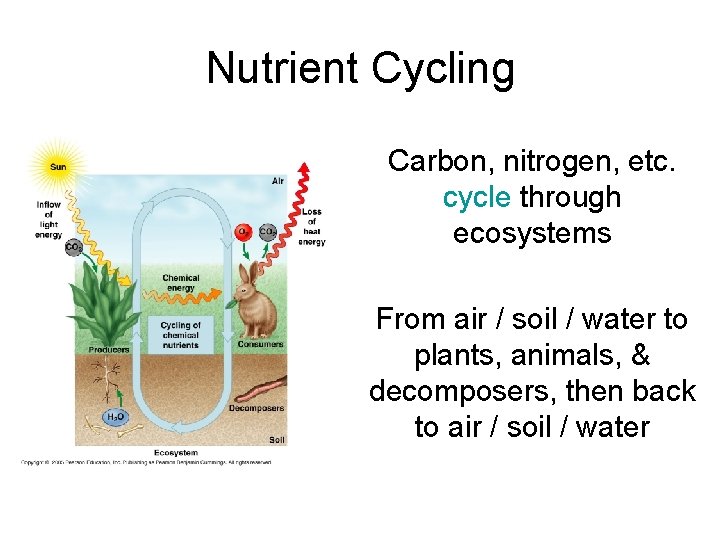
Nutrient Cycling Carbon, nitrogen, etc. cycle through ecosystems From air / soil / water to plants, animals, & decomposers, then back to air / soil / water
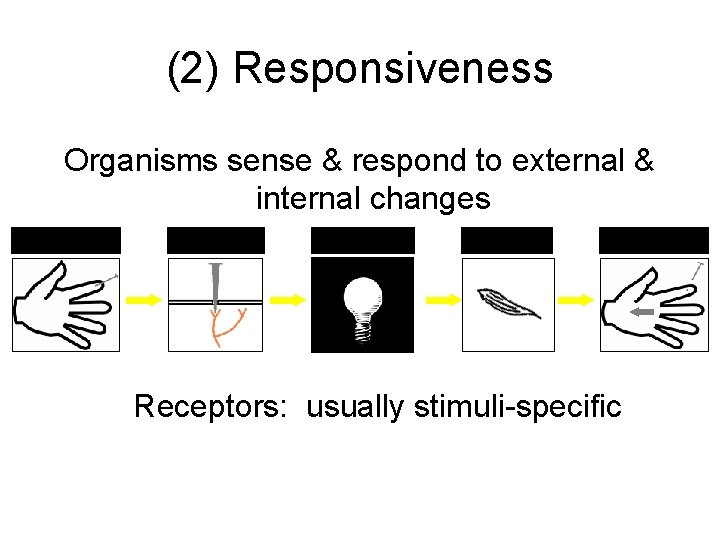
(2) Responsiveness Organisms sense & respond to external & internal changes stimulus receptor control centre effector Receptors: usually stimuli-specific response
Homeostasis = “unchanging” Dynamic state of equilibrium Internal conditions vary within narrow range
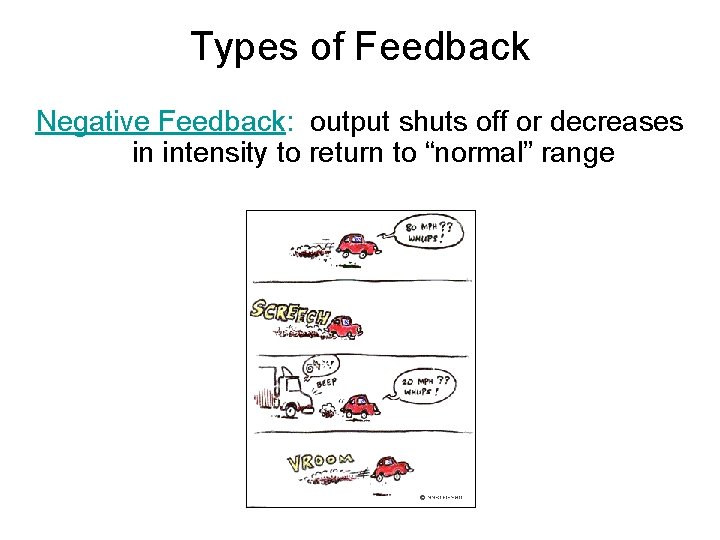
Types of Feedback Negative Feedback: output shuts off or decreases in intensity to return to “normal” range
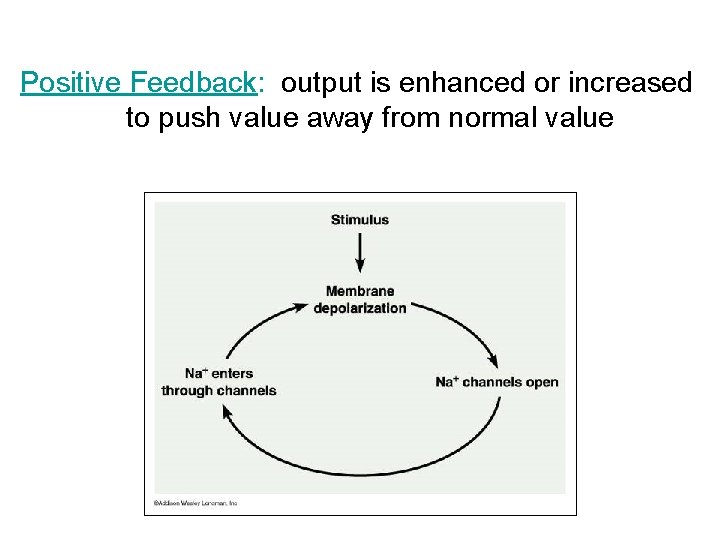
Positive Feedback: output is enhanced or increased to push value away from normal value
Homeostatic Imbalance = disease 3 possible causes: 1. Receptor not responding to stimuli 2. Control centre not analyzing/responding to information correctly 3. Effector over- or under-reacting
(3) Growth & Reproduction Development = from first cell of individual to adult form Growth = increase in size of body part or organism
Reproduction Cellular = body growth & repair Organismal = production of whole new organism Determined by information located in DNA Organism inherits DNA from parents
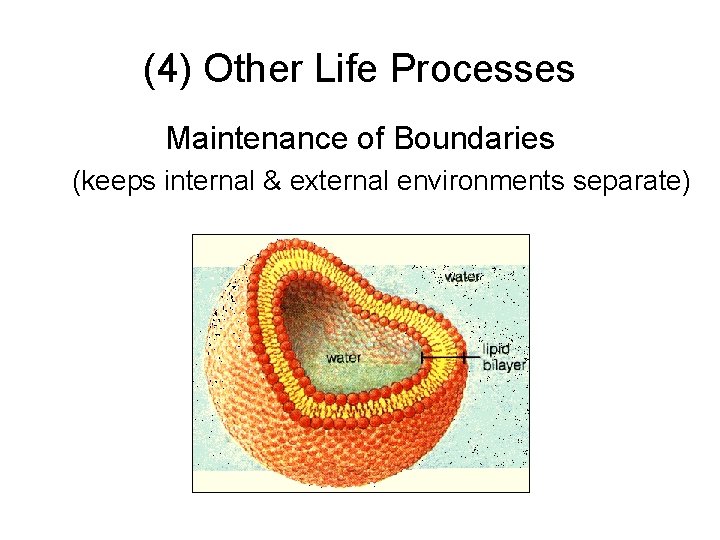
(4) Other Life Processes Maintenance of Boundaries (keeps internal & external environments separate)
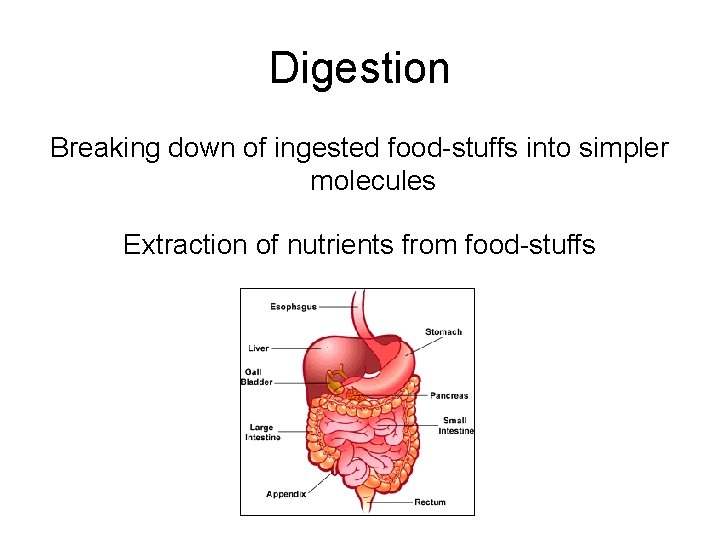
Digestion Breaking down of ingested food-stuffs into simpler molecules Extraction of nutrients from food-stuffs
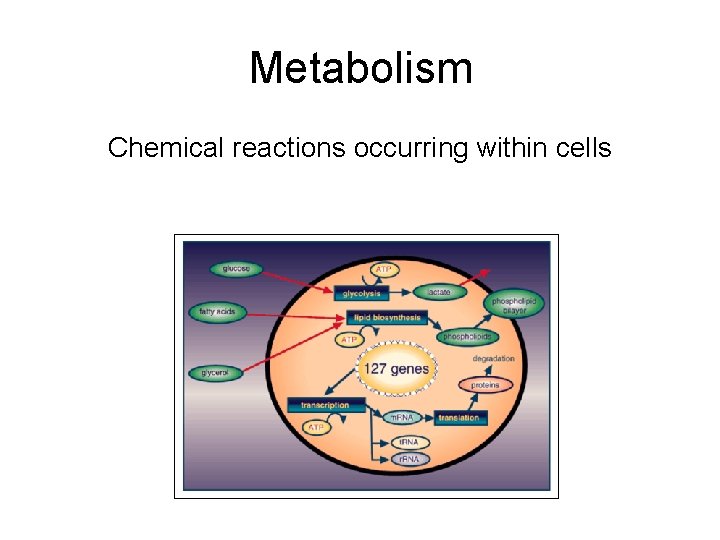
Metabolism Chemical reactions occurring within cells
Excretion Removal of wastes from body
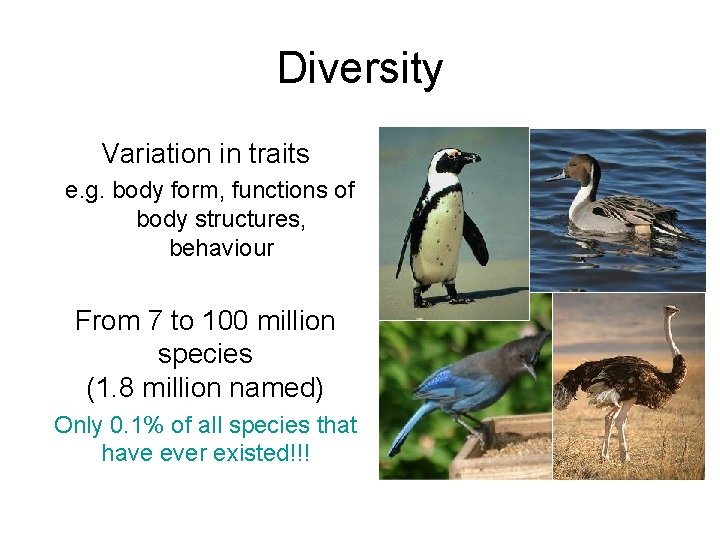
Diversity Variation in traits e. g. body form, functions of body structures, behaviour From 7 to 100 million species (1. 8 million named) Only 0. 1% of all species that have ever existed!!!
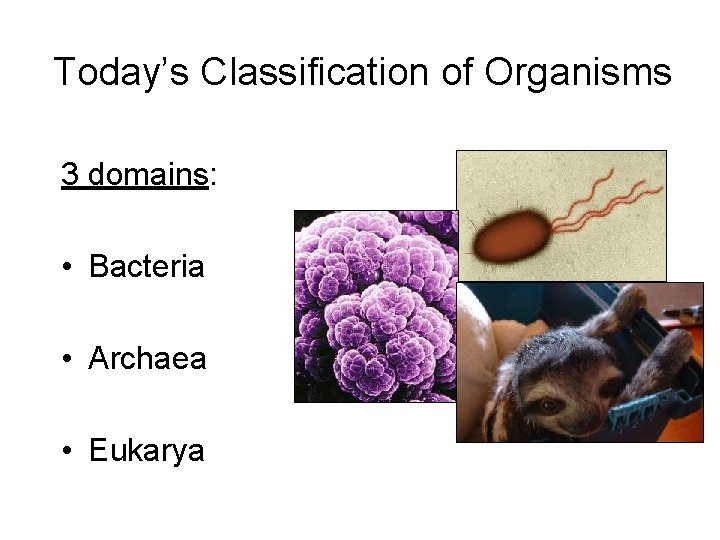
Today’s Classification of Organisms 3 domains: • Bacteria • Archaea • Eukarya
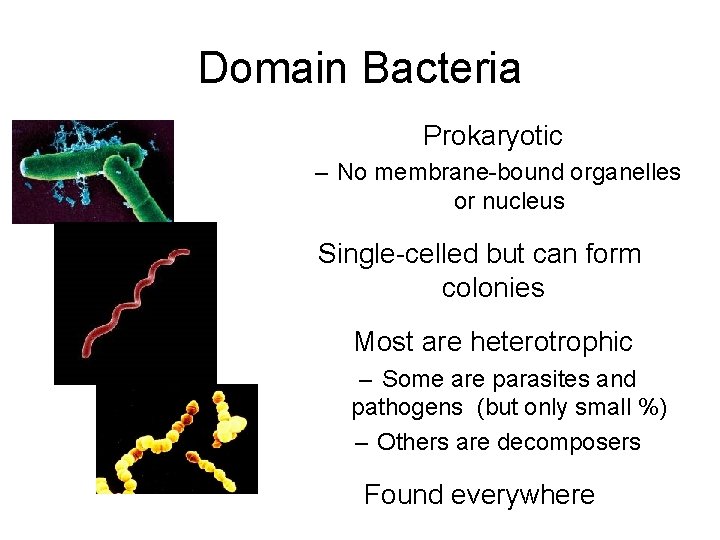
Domain Bacteria Prokaryotic – No membrane-bound organelles or nucleus Single-celled but can form colonies Most are heterotrophic – Some are parasites and pathogens (but only small %) – Others are decomposers Found everywhere
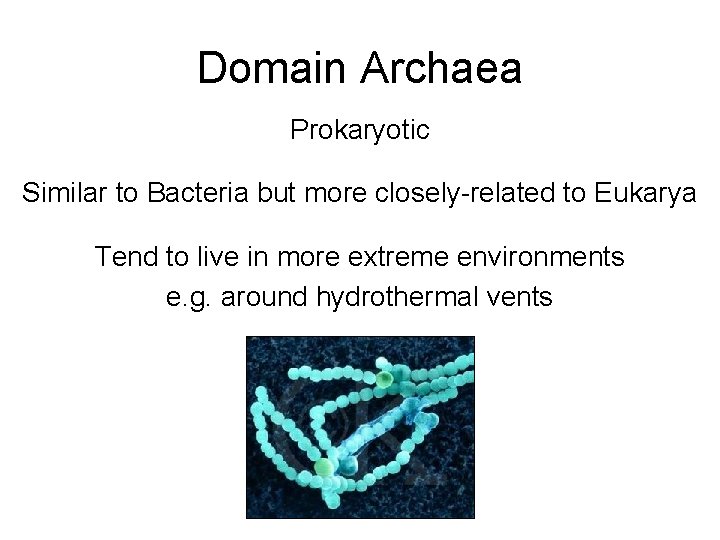
Domain Archaea Prokaryotic Similar to Bacteria but more closely-related to Eukarya Tend to live in more extreme environments e. g. around hydrothermal vents
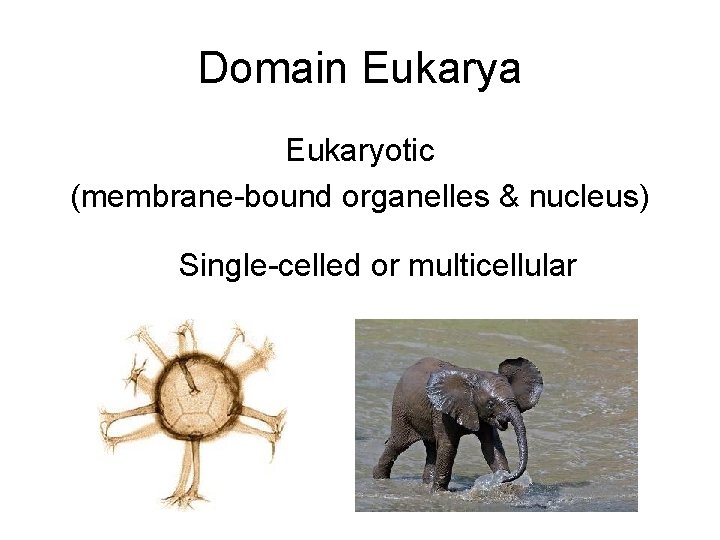
Domain Eukarya Eukaryotic (membrane-bound organelles & nucleus) Single-celled or multicellular
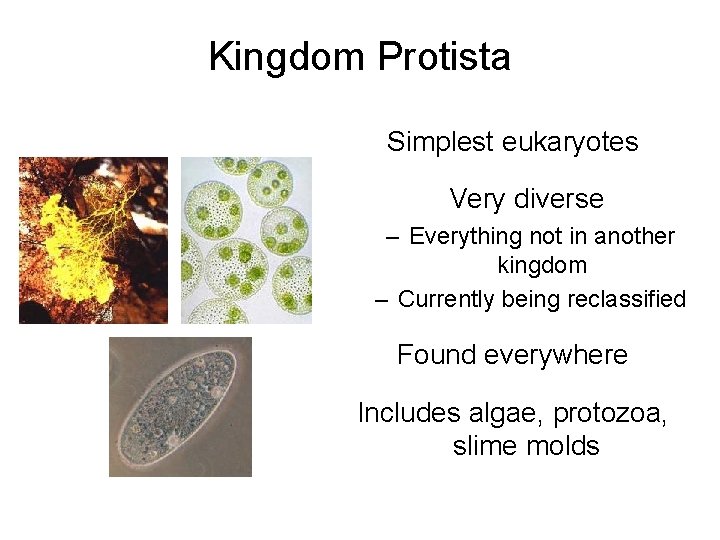
Kingdom Protista Simplest eukaryotes Very diverse – Everything not in another kingdom – Currently being reclassified Found everywhere Includes algae, protozoa, slime molds
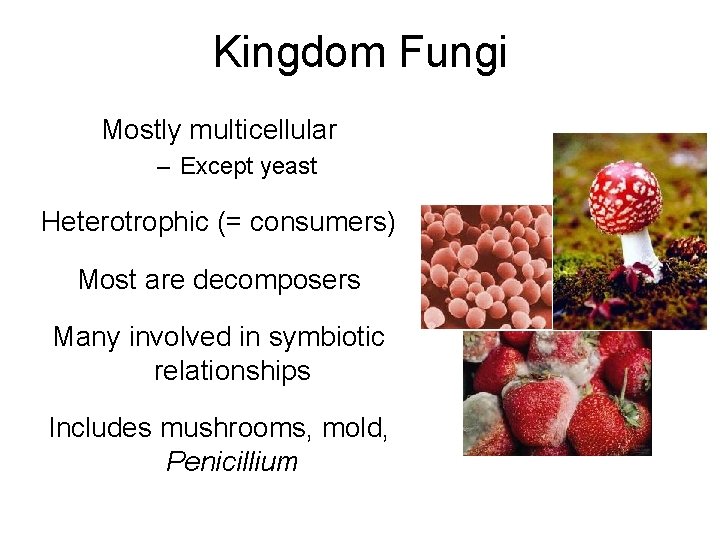
Kingdom Fungi Mostly multicellular – Except yeast Heterotrophic (= consumers) Most are decomposers Many involved in symbiotic relationships Includes mushrooms, mold, Penicillium
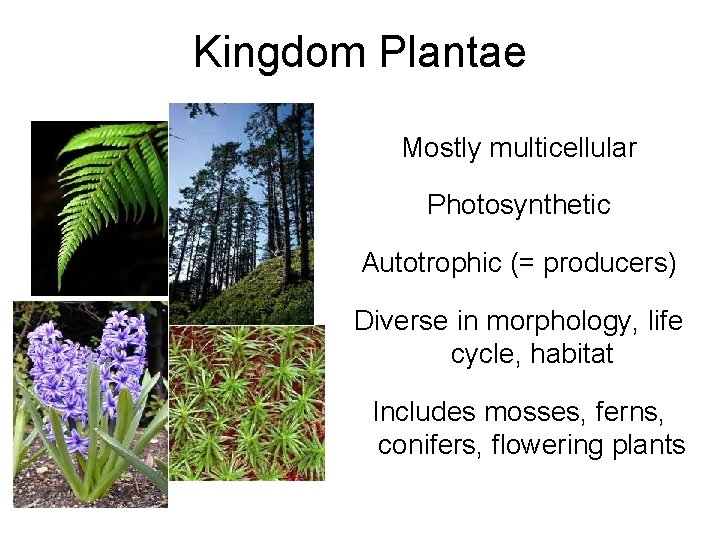
Kingdom Plantae Mostly multicellular Photosynthetic Autotrophic (= producers) Diverse in morphology, life cycle, habitat Includes mosses, ferns, conifers, flowering plants
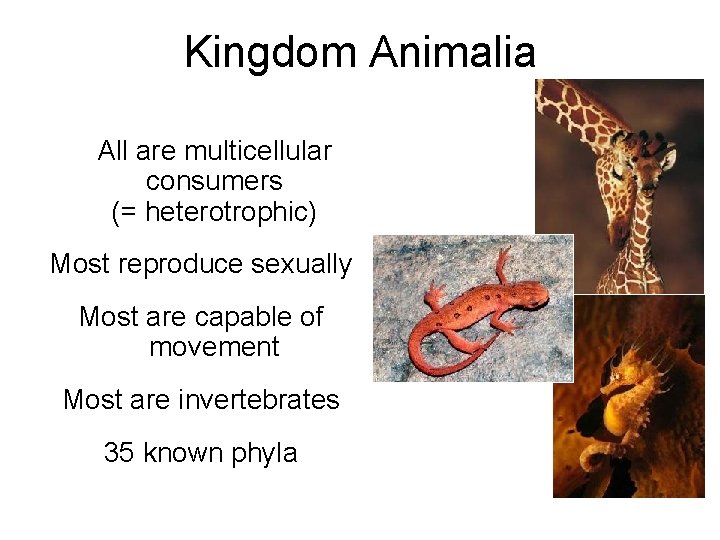
Kingdom Animalia All are multicellular consumers (= heterotrophic) Most reproduce sexually Most are capable of movement Most are invertebrates 35 known phyla
Taxonomic Classification of Organisms Organization of information about diversity A way to show relationships among species
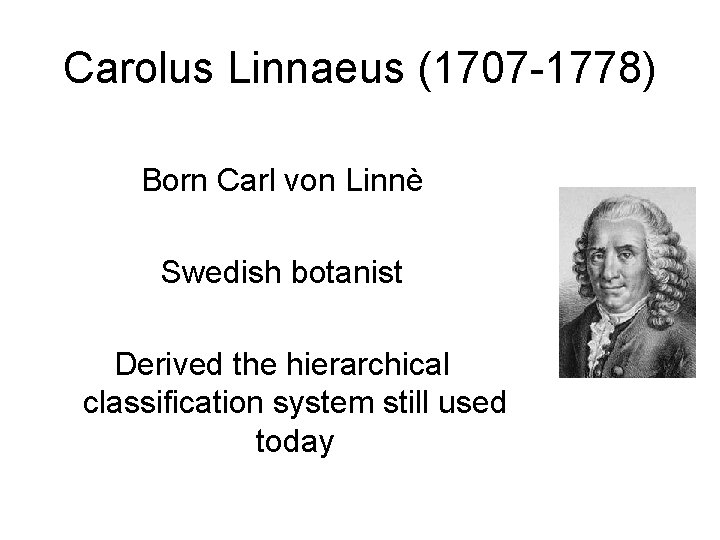
Carolus Linnaeus (1707 -1778) Born Carl von Linnè Swedish botanist Derived the hierarchical classification system still used today
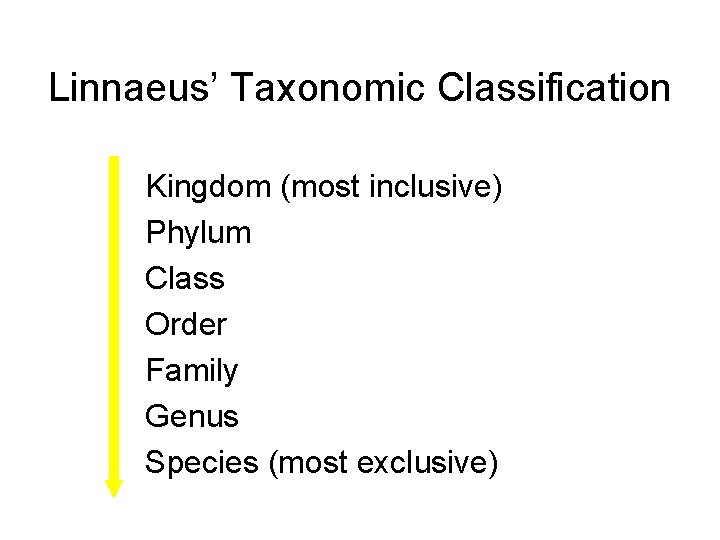
Linnaeus’ Taxonomic Classification Kingdom (most inclusive) Phylum Class Order Family Genus Species (most exclusive)
Linnaeus’ Genus-Species Concept Two-part Latin species names: 1 st part: Genus – 1 or more species with certain unique traits 2 nd part: Species – Within a genus, has 1 or more trait that none of the other species do e. g. Canis lupus (wolf), C. familiaris (dog)
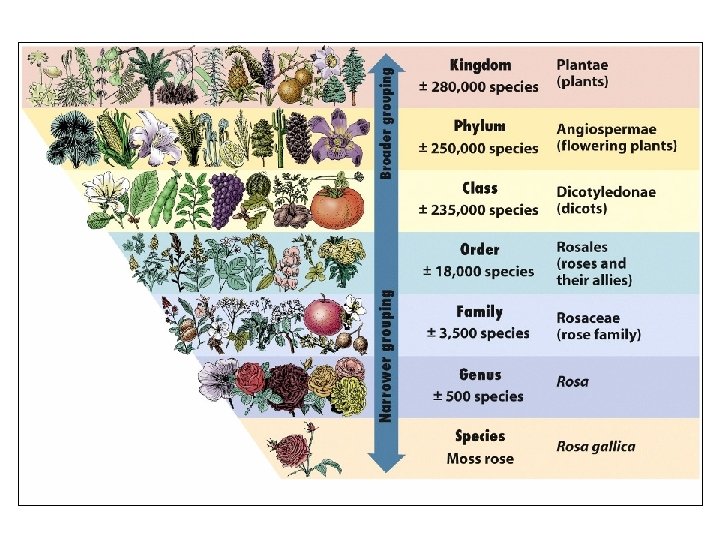
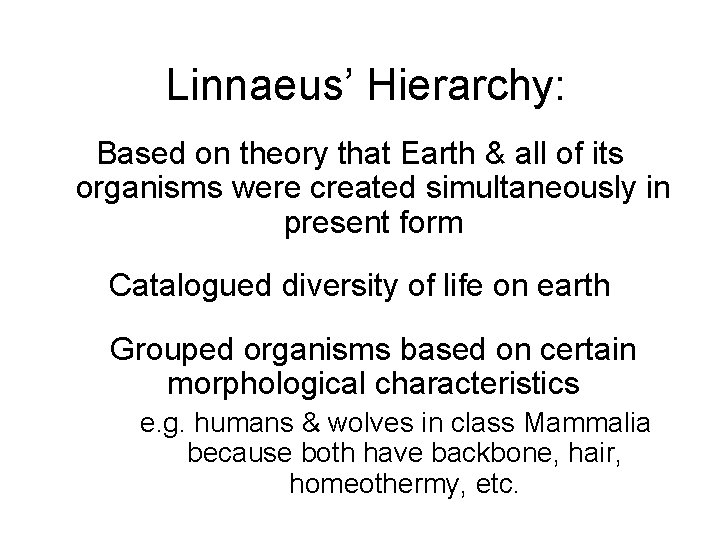
Linnaeus’ Hierarchy: Based on theory that Earth & all of its organisms were created simultaneously in present form Catalogued diversity of life on earth Grouped organisms based on certain morphological characteristics e. g. humans & wolves in class Mammalia because both have backbone, hair, homeothermy, etc.
An Evolutionary View of Diversity Individuals of the same species share common traits Individuals within species differ in variety of ways Variations happen via: 1. Random mutations (changes in DNA) (happen spontaneously & regularly; can be good, bad, or neutral) 2. Evolutionary pathways
Evolution Allele: – DNA sequence that codes for a gene – Determines genotype for individual Allele frequency: – Proportion of a given allele in a population Evolution: – Changes in allele frequency over time via random & non-random processes
Genetic Drift Random change in allele frequency from one generation to the next Important evolutionary force when population size drastically drops (disease, low food supply, disaster, etc. ) = genetic bottleneck Unpredictable combinations of alleles in generations occurring after bottleneck
If population is small enough, can lead to loss of all but one possible allele on any gene locus = “Fixed” allele Beneficial alleles can be eliminated via genetic drift
Example of genetic drift • 2 individuals (2 alleles each) in a small population – Each is Aa so proportion of A: a is 50: 50 • Next generation, 2 more offspring – One is AA, one is Aa so A: a is 75: 25 • Next generation, 2 more offspring: – One is AA, one is Aa so A: a is 75: 25 • And so on, until: – Both are AA so A: a is 100: 0 • Allele fixation: good vs. bad allele? • Can’t get a back unless immigration into population or random mutation occurs
Founder Effect Random change in allele frequency Occurs when small population splinters off from main population (e. g. colonizing a new island) Can also lead to fixed alleles and loss of beneficial alleles
Natural Selection Non-random change in allele frequency Favours traits that increase survival and reproduction = “Survival of the fittest”
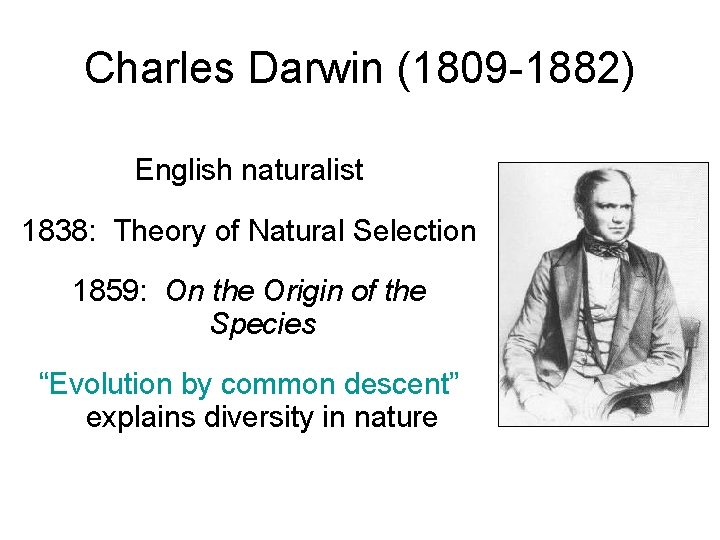
Charles Darwin (1809 -1882) English naturalist 1838: Theory of Natural Selection 1859: On the Origin of the Species “Evolution by common descent” explains diversity in nature
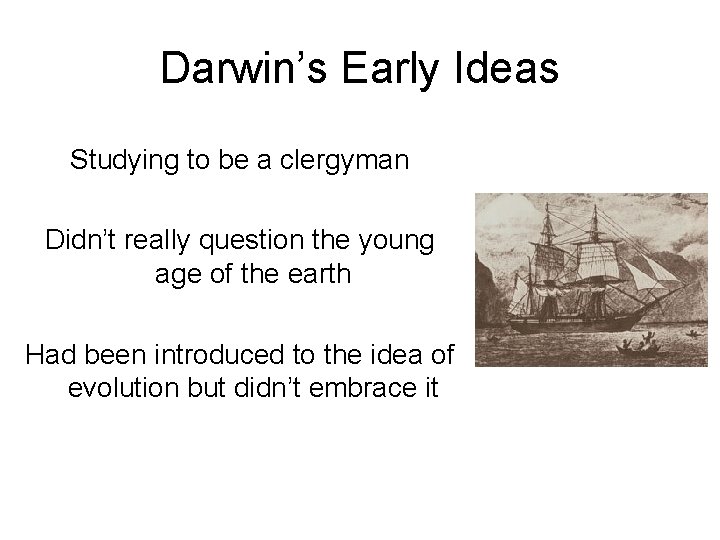
Darwin’s Early Ideas Studying to be a clergyman Didn’t really question the young age of the earth Had been introduced to the idea of evolution but didn’t embrace it
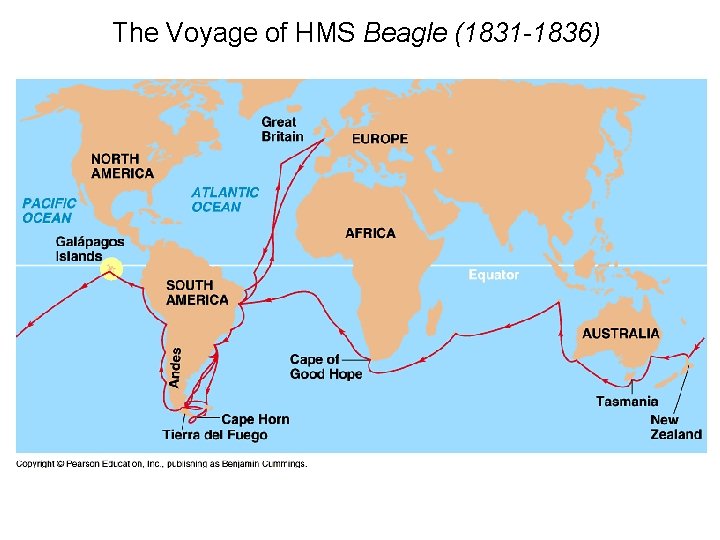
The Voyage of HMS Beagle (1831 -1836)
Darwin on the trip: Noted that the plants and animals of South America were very distinct from those of Europe Organisms from temperate regions of South America were more similar to those from the tropics of South America than to those from temperate regions of Europe Further, South American fossils more closely resembled modern species from that continent than those from Europe
The origin of the fauna of the Galapagos, 900 km west of the South American coast, especially puzzled Darwin On further study after his voyage, Darwin noted that while most of the animal species on the Galapagos lived nowhere else, they resembled species living on the South American mainland. It seemed that the islands had been colonized by plants & animals from the mainland that had then diversified on the different islands
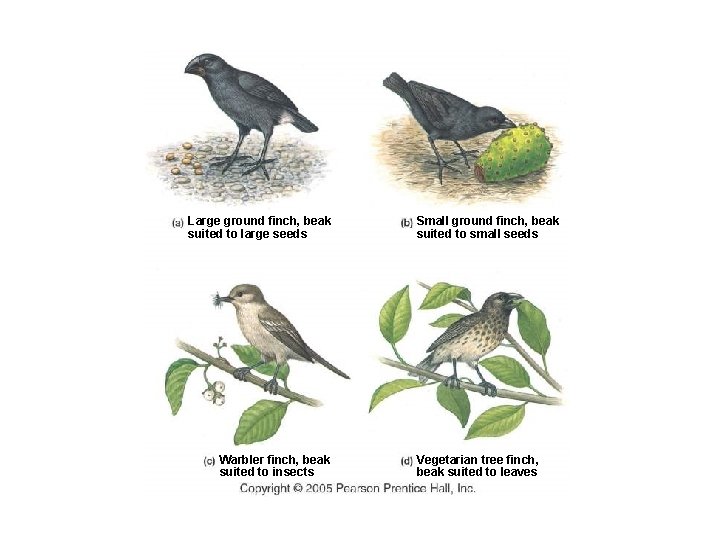
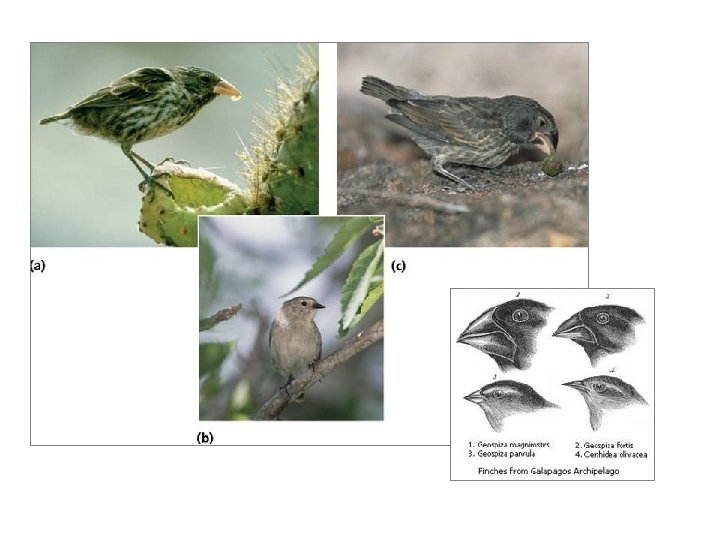
Large ground finch, beak suited to large seeds Warbler finch, beak suited to insects Small ground finch, beak suited to small seeds Vegetarian tree finch, beak suited to leaves
Darwin’s Ideas After His Trip Questioned the young age of the earth Couldn’t explain distribution of species with creationism Thought species that were similar were related
Darwin’s “Origin of Species” Took him from 1836 -1844 to get main ideas: didn’t present until 1858 Proposed a mechanism for evolution Was pushed to publish by Alfred Wallace’s development of the same theory
Central to Darwin’s view of the evolution of life is descent with modification In descent with modification, all present day organisms are related through descent from unknown ancestors in the past Descendents of these ancestors accumulated diverse modifications or adaptations that fit them to specific ways of life & habitats
Natural Selection: How Does It Work? Each generation is slightly different from preceding one Over time, small differences add up to major transformation Based on 4 observations
Observation #1 All species have such great potential fertility that their population size would increase exponentially if all individuals that are born reproduced successfully
Observation #2 Populations tend to remain stable in size, except for seasonal fluctuations
Conclusion #1 Production of more individuals than the environment can support leads to a struggle for existence among the individuals of a population, with only a fraction of the offspring surviving each generation
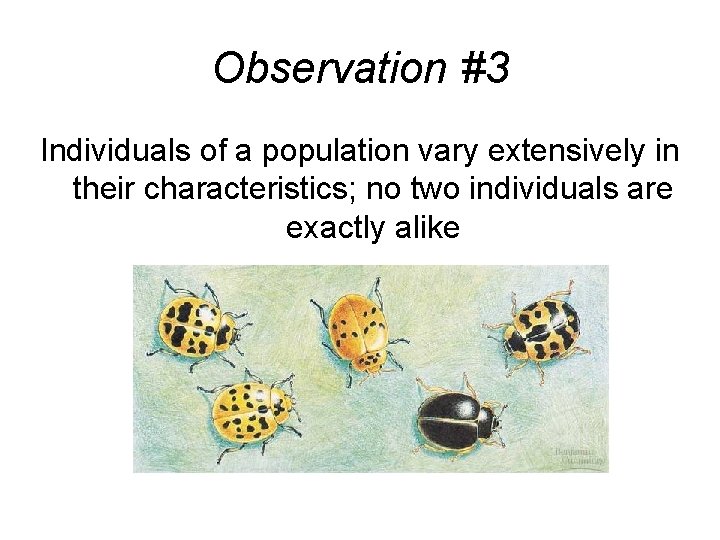
Observation #3 Individuals of a population vary extensively in their characteristics; no two individuals are exactly alike
Conclusion #2 These differences determine which individuals survive & reproduce most successfully = natural selection
Observation #4 Much of this variation is heritable
Conclusion #3 Because fittest individuals have more offspring, their traits are passed to a larger proportion of individuals in the population This unequal ability of individuals to survive & reproduce will lead to a gradual change in a population, with favorable characteristics accumulating over the generations. = evolution by natural selection
Darwin’s main ideas can be summarized in three points: Natural selection is differential success in reproduction (unequal ability of individuals to survive & reproduce) Natural selection occurs through an interaction between the environment & the variability inherent among the individual organisms making up a population The product of natural selection is the adaptation of populations of organisms to their environment Copyright © 2002 Pearson Education, Inc. , publishing as Benjamin Cummings
Darwin’s views on the role of environmental factors in the screening of heritable variation was heavily influenced by artificial selection Humans have modified a variety of domesticated plants & animals over many generations by selecting individuals with the desired traits as breeding stock
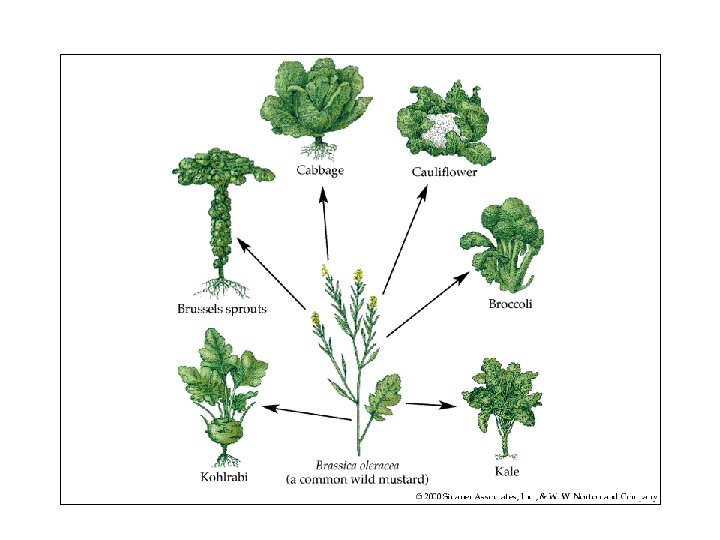
If artificial selection can achieve such major changes in a relatively short time, natural selection should be capable of major modifications of species over hundreds or thousands of generations Darwin envisioned the diversity of life as evolving by a gradual accumulation of minute changes through the actions of natural selection operating over vast spans of time
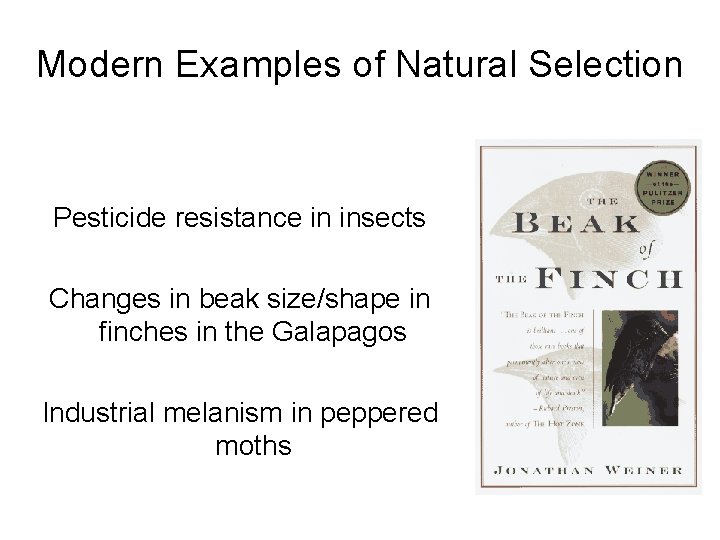
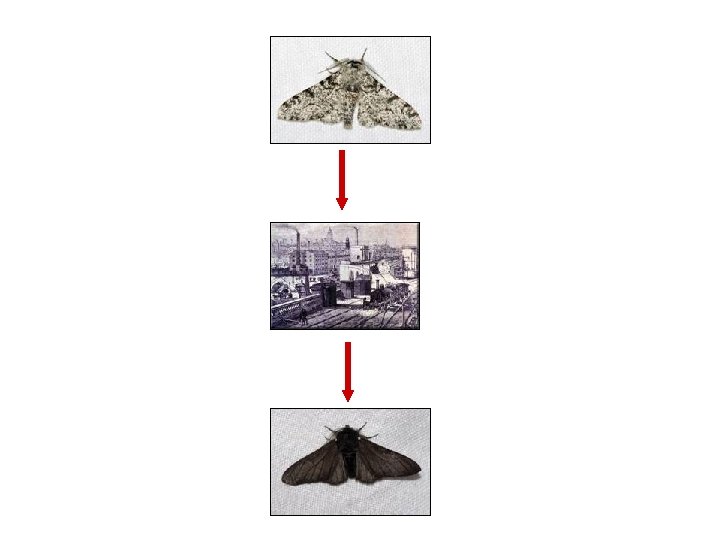
Modern Examples of Natural Selection Pesticide resistance in insects Changes in beak size/shape in finches in the Galapagos Industrial melanism in peppered moths
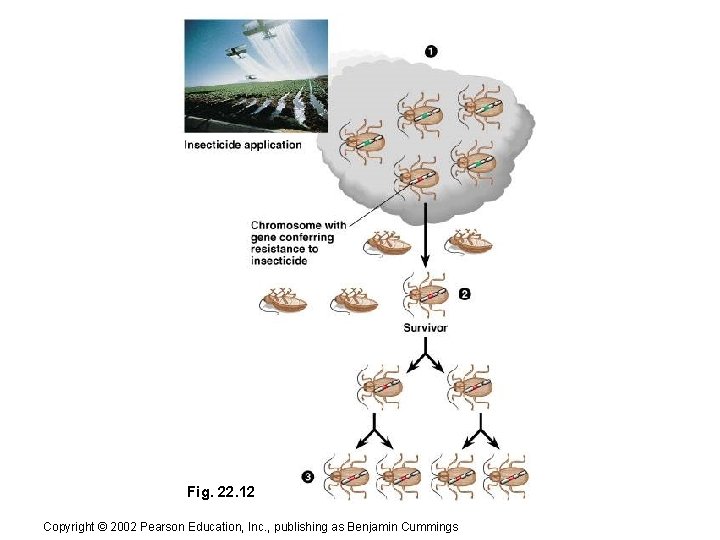
Fig. 22. 12 Copyright © 2002 Pearson Education, Inc. , publishing as Benjamin Cummings
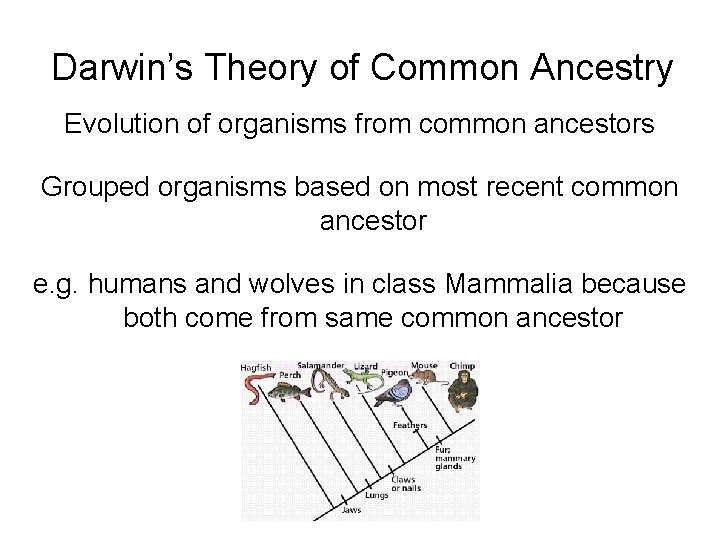
Darwin’s Theory of Common Ancestry Evolution of organisms from common ancestors Grouped organisms based on most recent common ancestor e. g. humans and wolves in class Mammalia because both come from same common ancestor
Evolution explains the diversity of organisms Organisms in different environments often look different because they have different adaptations for survival
When classifying organisms, must be able to distinguish between similarities that result from a common ancestor (i. e. divergent evolution) and those that arise from convergent evolution.
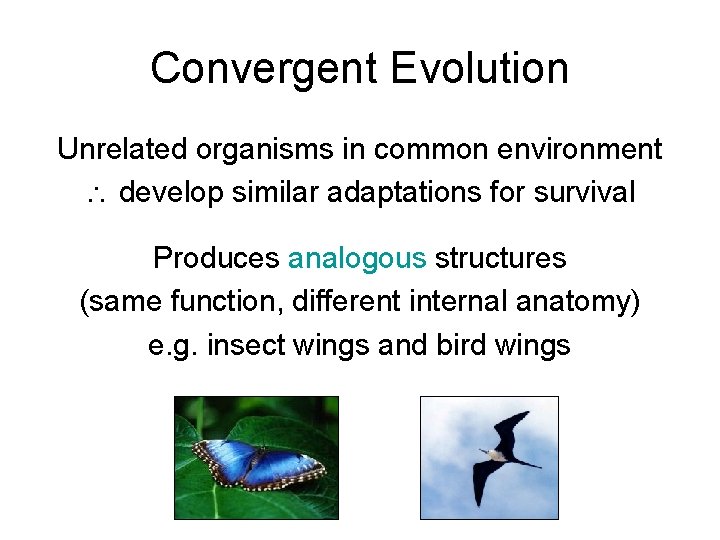
Convergent Evolution Unrelated organisms in common environment develop similar adaptations for survival Produces analogous structures (same function, different internal anatomy) e. g. insect wings and bird wings
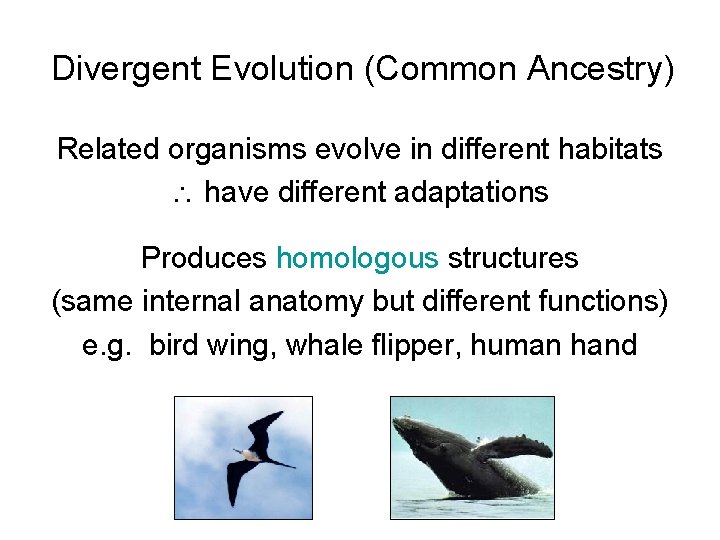
Divergent Evolution (Common Ancestry) Related organisms evolve in different habitats have different adaptations Produces homologous structures (same internal anatomy but different functions) e. g. bird wing, whale flipper, human hand
- Slides: 89