
Exploring and supporting students digital learning transition from



- Slides: 21
Exploring and supporting students’ digital learning transition from school to university Stephanie Mc. Donald*, Cristina De Matteis, Elizabeth Newall, Fiona Mc. Cullough, Lisa Mott, Barbara Villa Marcos, Vibhu Solanki, Nicholas Rea, Rossana Wright, Steven Bagley, Steven Bamford, Qingqi Wang, Anshul Lau *Stephanie. Mcdonald@nottingham. ac. uk
Background information § Gap between secondary and tertiary education § Students as ‘digital natives’ (Prensky, 2001) § Research suggests a variation in students’ experiences with digital technologies (Kennedy et al. , 2008) § Evidence-based approach – insights into incoming UG students’ digital learning experiences to support transition and learning at university 2
Aims of project • First year students’ experiences in digital learning, perspectives, digital skills at school or college • Identify opportunities to further support student transition • Run across all seven Schools in the Faculty of Science 3
Methods § Survey § Experience in digital learning at school or college § Activities and tools to support learning § Digital skills § Confidence, attitudes § Expectations & challenges at the start of UG course (transition to university) § Some of the questions adapted from JISC’s Digital Experiences Insights survey (DEI; 2020), with permission § Focus groups 4
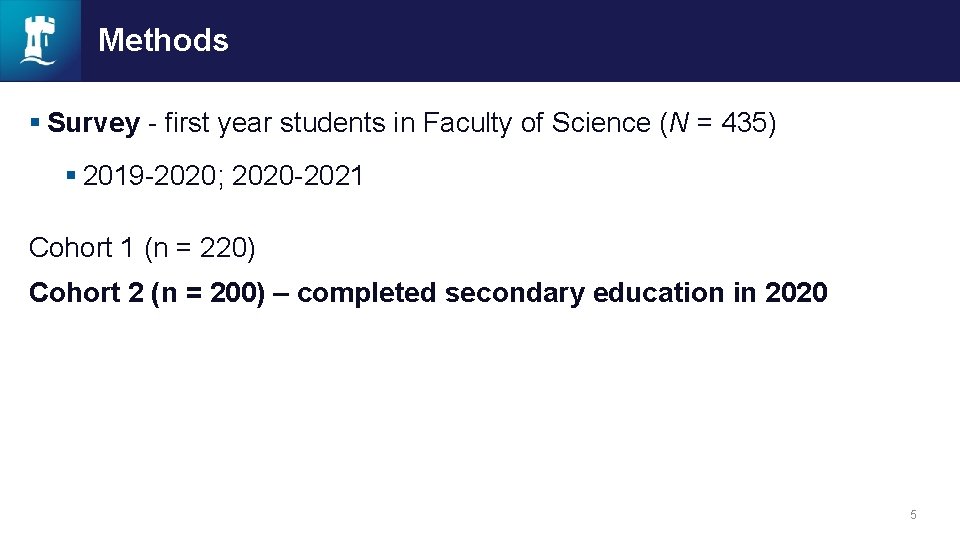
Methods § Survey - first year students in Faculty of Science (N = 435) § 2019 -2020; 2020 -2021 Cohort 1 (n = 220) Cohort 2 (n = 200) – completed secondary education in 2020 5
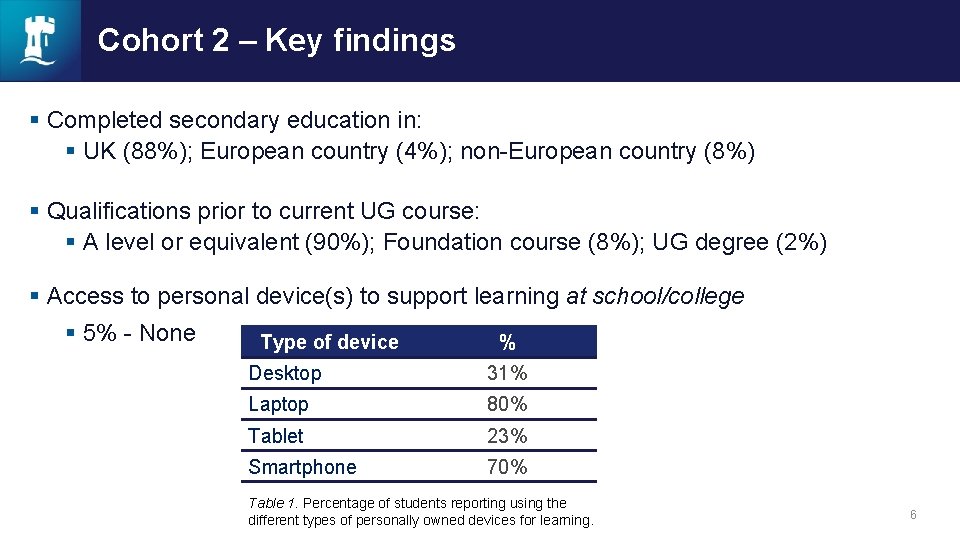
Cohort 2 – Key findings § Completed secondary education in: § UK (88%); European country (4%); non-European country (8%) § Qualifications prior to current UG course: § A level or equivalent (90%); Foundation course (8%); UG degree (2%) § Access to personal device(s) to support learning at school/college § 5% - None Type of device % Desktop 31% Laptop 80% Tablet 23% Smartphone 70% Table 1. Percentage of students reporting using the different types of personally owned devices for learning. 6
Engagement with a VLE
Engagement with VLE at school or college § Access to a VLE: 61% 100 Frequency 80 60 40 20 0 Resources Deadlines Quiz Submit work Collaborate Question teacher Lesson teacher CW teacher Lesson peers CW peers Access recordings Type of activity Weekly or more Monthly or less Never Figure 1. Frequency of student engagement with different types of digital learning activities through a VLE at school or college 8
Digital learning activities and tools
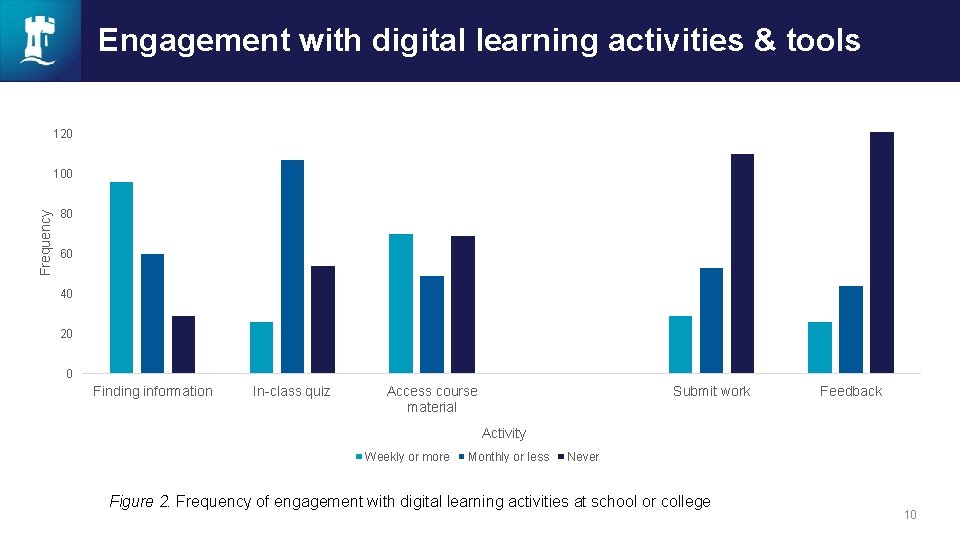
Engagement with digital learning activities & tools 120 Frequency 100 80 60 40 20 0 Finding information In-class quiz Access course material Submit work Feedback Activity Weekly or more Monthly or less Never Figure 2. Frequency of engagement with digital learning activities at school or college 10
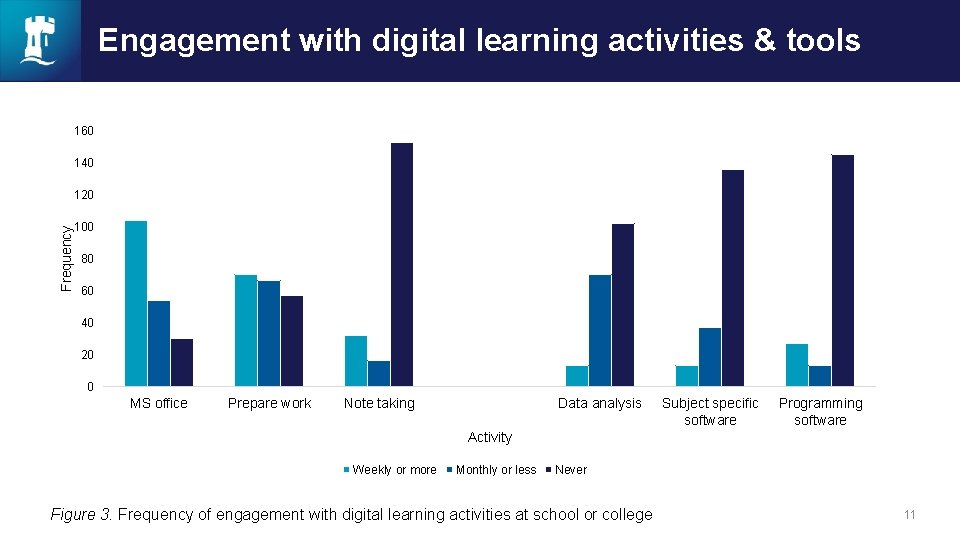
Engagement with digital learning activities & tools 160 140 Frequency 120 100 80 60 40 20 0 MS office Prepare work Note taking Data analysis Subject specific software Programming software Activity Weekly or more Monthly or less Never Figure 3. Frequency of engagement with digital learning activities at school or college 11
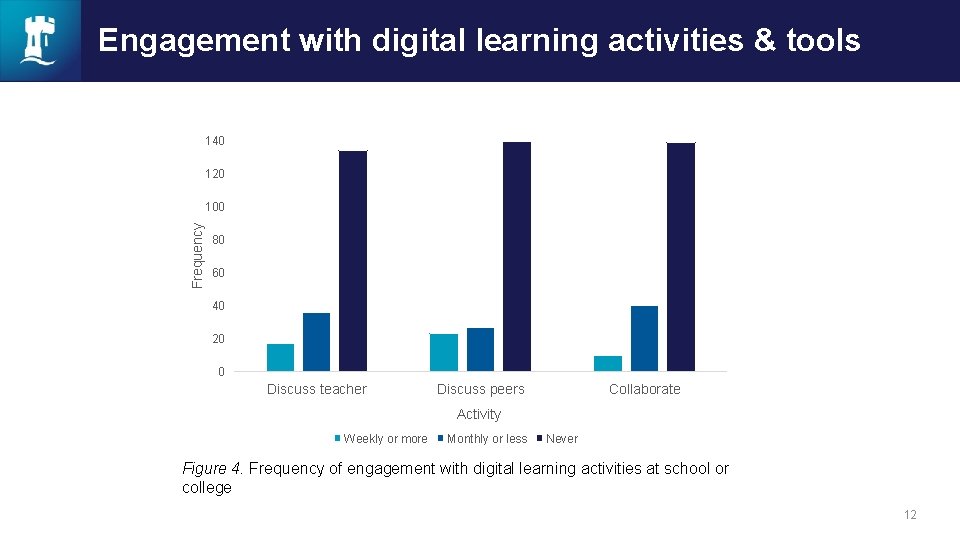
Engagement with digital learning activities & tools 140 120 Frequency 100 80 60 40 20 0 Discuss teacher Discuss peers Collaborate Activity Weekly or more Monthly or less Never Figure 4. Frequency of engagement with digital learning activities at school or college 12
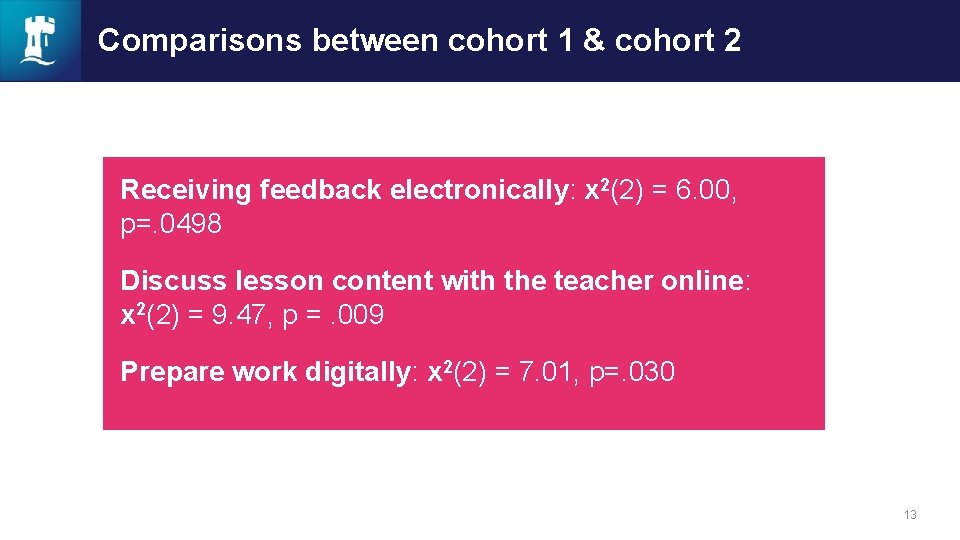
Comparisons between cohort 1 & cohort 2 Receiving feedback electronically: x 2(2) = 6. 00, p=. 0498 Discuss lesson content with the teacher online: x 2(2) = 9. 47, p =. 009 Prepare work digitally: x 2(2) = 7. 01, p=. 030 13
Digital skills
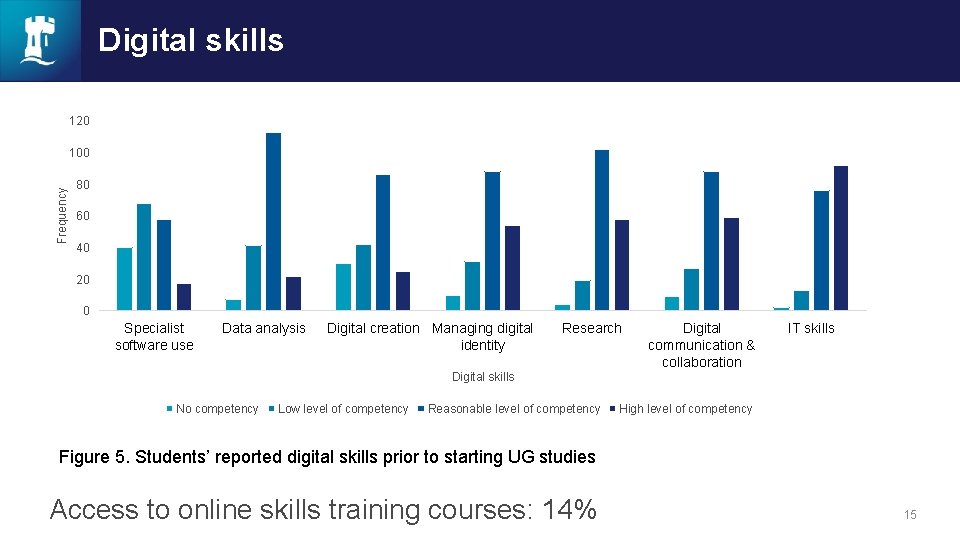
Digital skills 120 Frequency 100 80 60 40 20 0 Specialist software use Data analysis Digital creation Managing digital identity Research Digital communication & collaboration IT skills Digital skills No competency Low level of competency Reasonable level of competency High level of competency Figure 5. Students’ reported digital skills prior to starting UG studies Access to online skills training courses: 14% 15
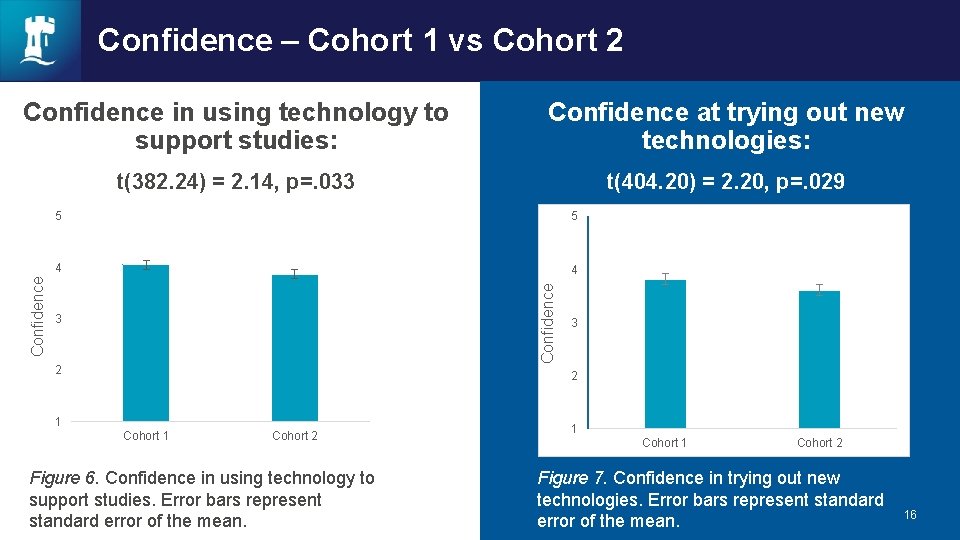
Confidence – Cohort 1 vs Cohort 2 Confidence at trying out new technologies: t(382. 24) = 2. 14, p=. 033 t(404. 20) = 2. 20, p=. 029 5 5 4 4 Confidence in using technology to support studies: 3 2 1 Cohort 2 Figure 6. Confidence in using technology to support studies. Error bars represent standard error of the mean. 1 Cohort 2 Figure 7. Confidence in trying out new technologies. Error bars represent standard error of the mean. 16
Supporting student transition – Some key messages Supporting students in managing their learning § ‘Managing yourself’ in a digital learning environment § “… hard to keep up to date with work …”; “… indication of how long each task is expected to take…” § “… hard to keep up with emails and notifications from moodle or teams … overwhelming … difficult to feel organised or on top of things …” § Effective use of tools/apps to support aspects of learning § “using new software required for my degree, getting to grips with it … how to use apps available to make notes and revise” § “… how to use things like Microsoft Teams or Powerpoint when doing collaborative pieces of work with other students 17
Supporting student transition – Some key messages Supporting students in managing their learning § ‘Pre-arrival & post-arrival (e. g. , induction weeks) § “the programming software is not compatible with the laptop I bought for university”. § “a step-by-step welcome pack detailing how to get set up such as logging into the wifi or moodle for the first time …” § “… if the school sent out a video or did a teams meeting for prospective students and asked us to do a small task. . . just to familiarise with the process” 18
Concluding remarks and Next steps § Digital communication, digital collaboration, using subject-specific software, digital notetaking § 61% used VLE but in very limited capacity § Confidence: cohort 2 seemingly less confident - yet likely to have had more experience via remote learning 19
Concluding remarks and Next steps § Running survey & focus groups again in 2021 -2022 (Cohort 3) § Next year’s cohort particularly significant § Student engagement in remote learning § Teachers developing skills in engaging students with their learning digitally § Comparison with DEI student survey § Transition findings to influence ‘The Digital Student’ – provision in development for new students 2021/22 – as part of Student Digital Capabilities Delivery Plan 20
Acknowledgments Uo. N Faculty of Science Education & Student Experience Grant Scheme (2019 -2020) William Smith