
Exploring Active Particle Flows Using AgentBased Modeling Gyuchan
Exploring Active Particle Flows Using Agent-Based Modeling Gyuchan Lee, YSP Student, Andover High School Alice Zhang, YSP Student, Boston Latin School Lisa Pepdjonovic, Undergraduate Student, Northeastern University Professor Sara Hashmi, Chemical Engineering, Northeastern University
Introduction The objective is to simulate the swimming behavior of E. coli through Agent-Based modeling (ABM) to understand patterns surrounding bacterial biofilm formation. Biofilms are assemblages of microbial organisms with constructs which allow them to stick to one another and to surfaces. Agent-based modeling (ABM) • Collection of autonomous decision-making entities called agents • Each agent makes decisions according to a set of rules • Data structure stores the attributes of the agents and the states of the environment. • Rules are defined for agent behavior and their interactions with the environment and each other • ABMs are built to model empirically observed phenomena and reproduce it
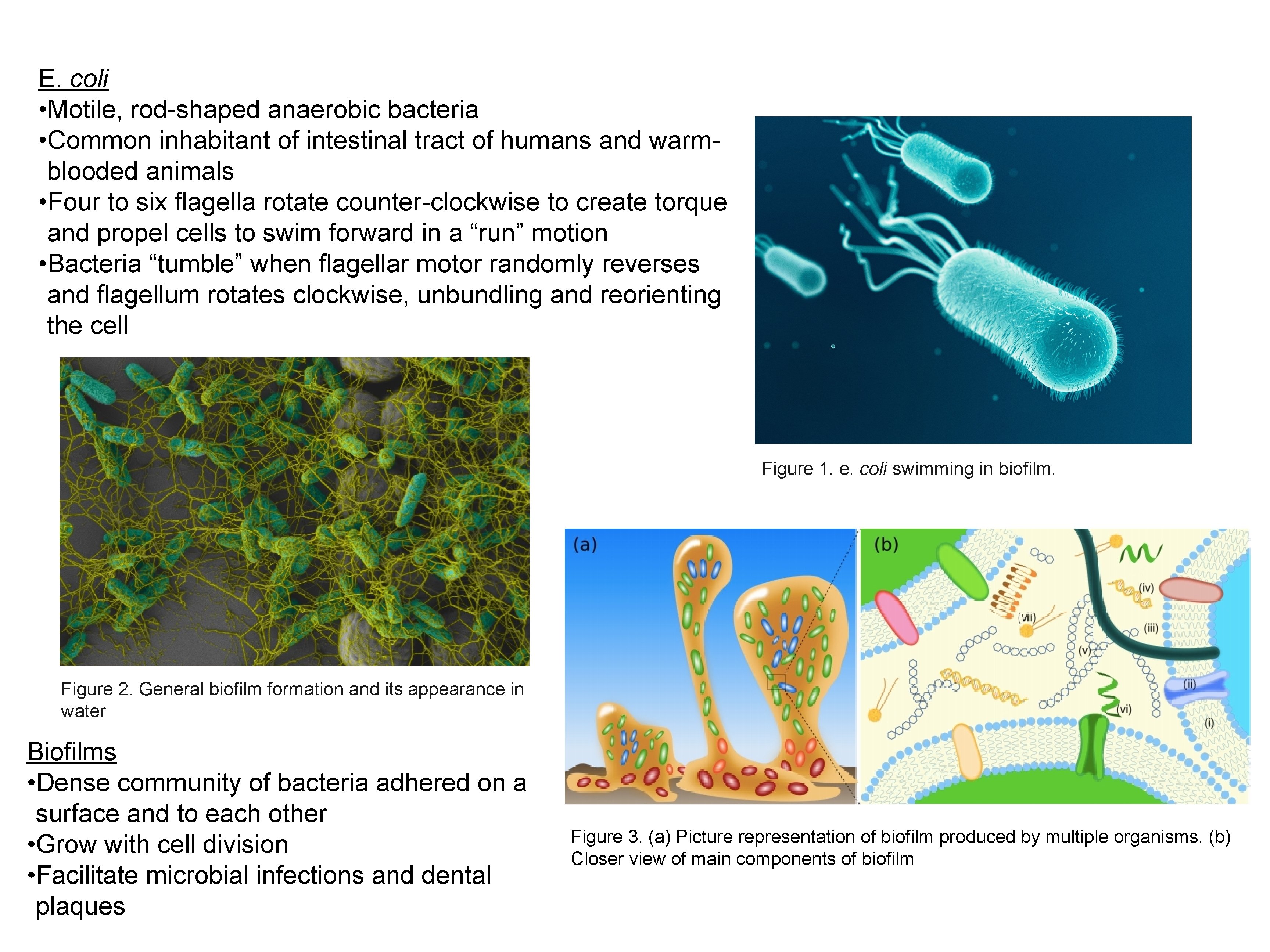
E. coli • Motile, rod-shaped anaerobic bacteria • Common inhabitant of intestinal tract of humans and warmblooded animals • Four to six flagella rotate counter-clockwise to create torque and propel cells to swim forward in a “run” motion • Bacteria “tumble” when flagellar motor randomly reverses and flagellum rotates clockwise, unbundling and reorienting the cell Figure 1. e. coli swimming in biofilm. Figure 2. General biofilm formation and its appearance in water Biofilms • Dense community of bacteria adhered on a surface and to each other • Grow with cell division • Facilitate microbial infections and dental plaques Figure 3. (a) Picture representation of biofilm produced by multiple organisms. (b) Closer view of main components of biofilm
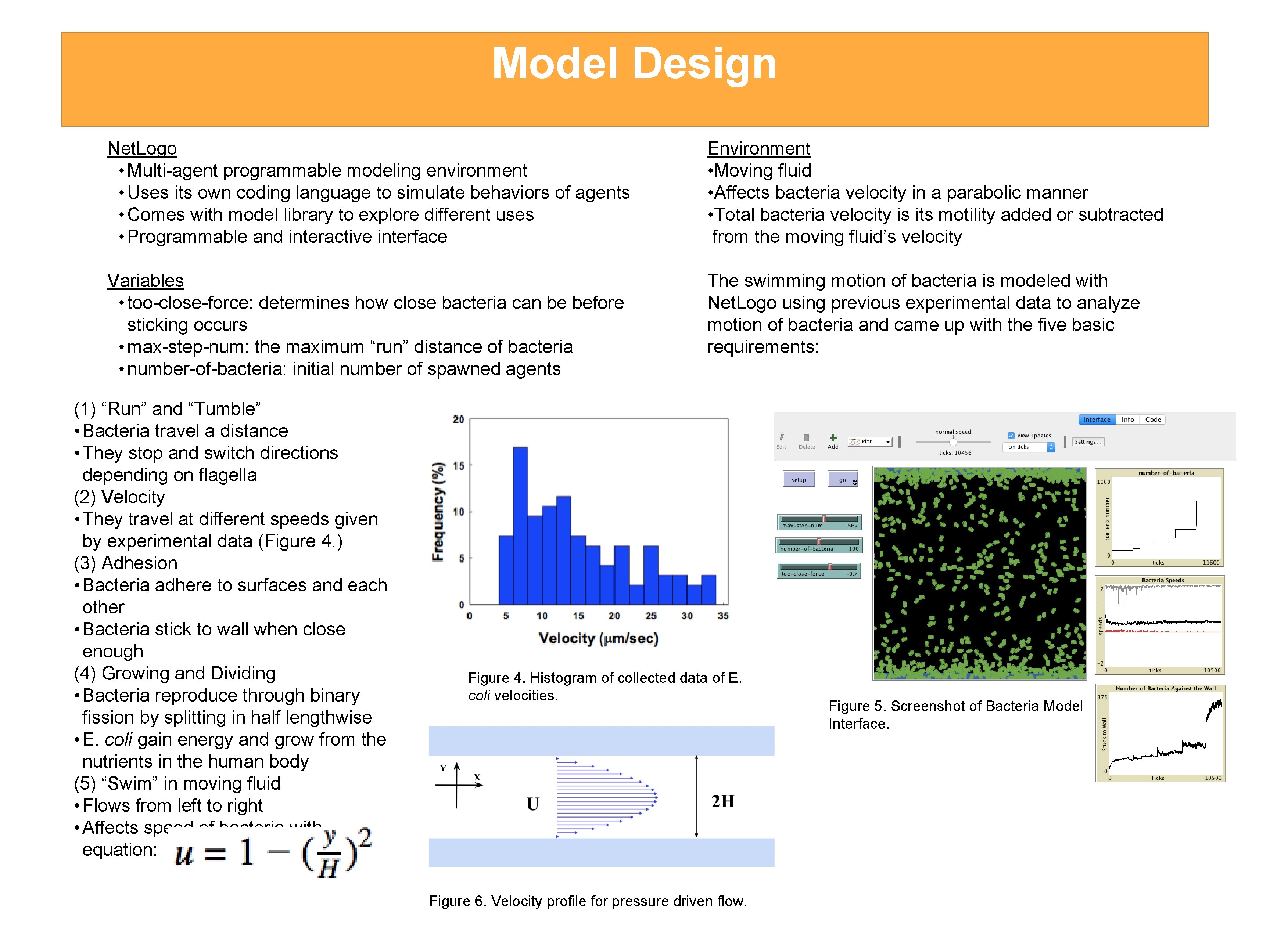
Model Design Net. Logo • Multi-agent programmable modeling environment • Uses its own coding language to simulate behaviors of agents • Comes with model library to explore different uses • Programmable and interactive interface Environment • Moving fluid • Affects bacteria velocity in a parabolic manner • Total bacteria velocity is its motility added or subtracted from the moving fluid’s velocity Variables • too-close-force: determines how close bacteria can be before sticking occurs • max-step-num: the maximum “run” distance of bacteria • number-of-bacteria: initial number of spawned agents The swimming motion of bacteria is modeled with Net. Logo using previous experimental data to analyze motion of bacteria and came up with the five basic requirements: (1) “Run” and “Tumble” • Bacteria travel a distance • They stop and switch directions depending on flagella (2) Velocity • They travel at different speeds given by experimental data (Figure 4. ) (3) Adhesion • Bacteria adhere to surfaces and each other • Bacteria stick to wall when close enough (4) Growing and Dividing • Bacteria reproduce through binary fission by splitting in half lengthwise • E. coli gain energy and grow from the nutrients in the human body (5) “Swim” in moving fluid • Flows from left to right • Affects speed of bacteria with equation: Figure 4. Histogram of collected data of E. coli velocities. Figure 6. Velocity profile for pressure driven flow. Figure 5. Screenshot of Bacteria Model Interface.
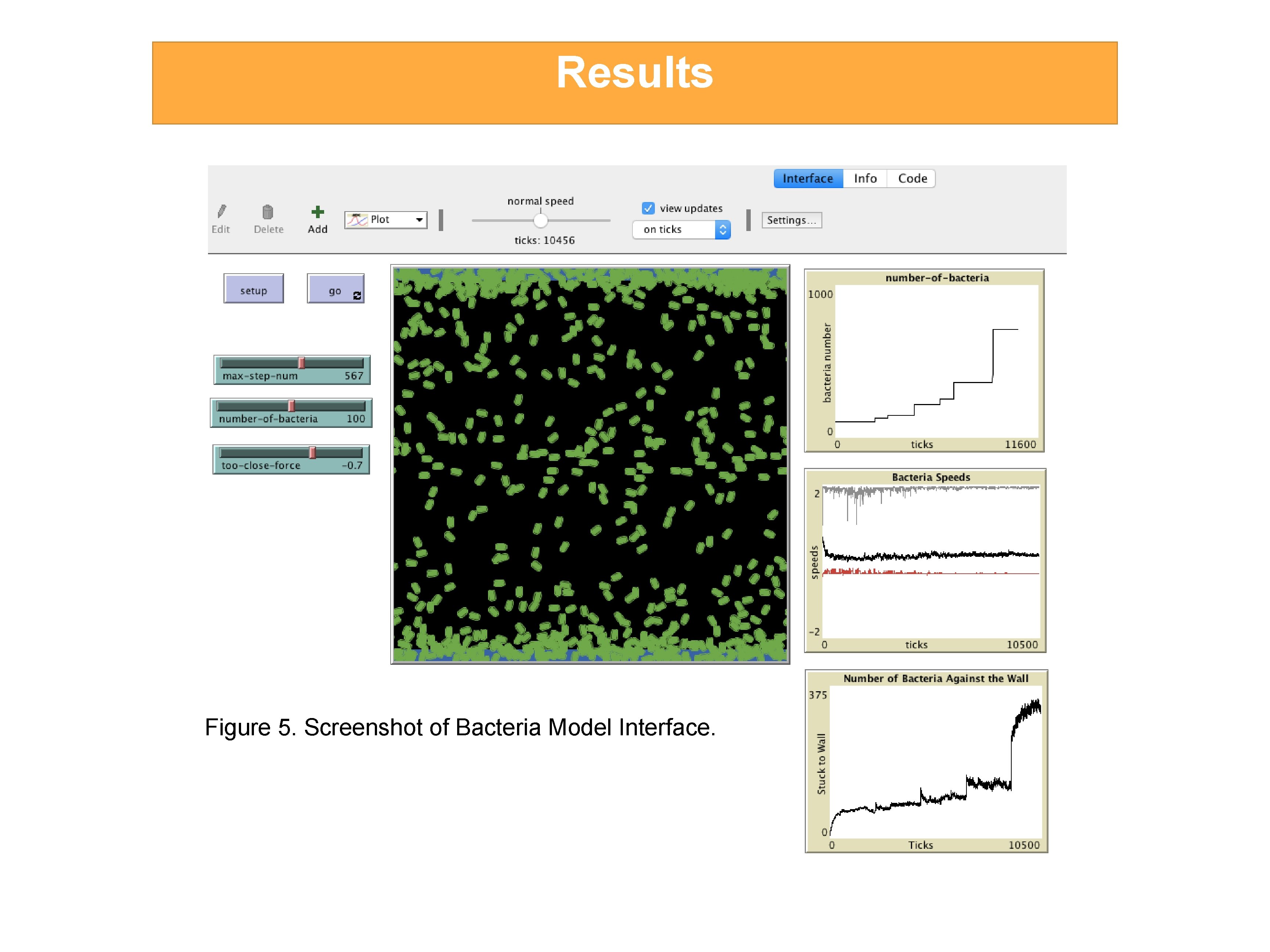
Results Figure 5. Screenshot of Bacteria Model Interface.
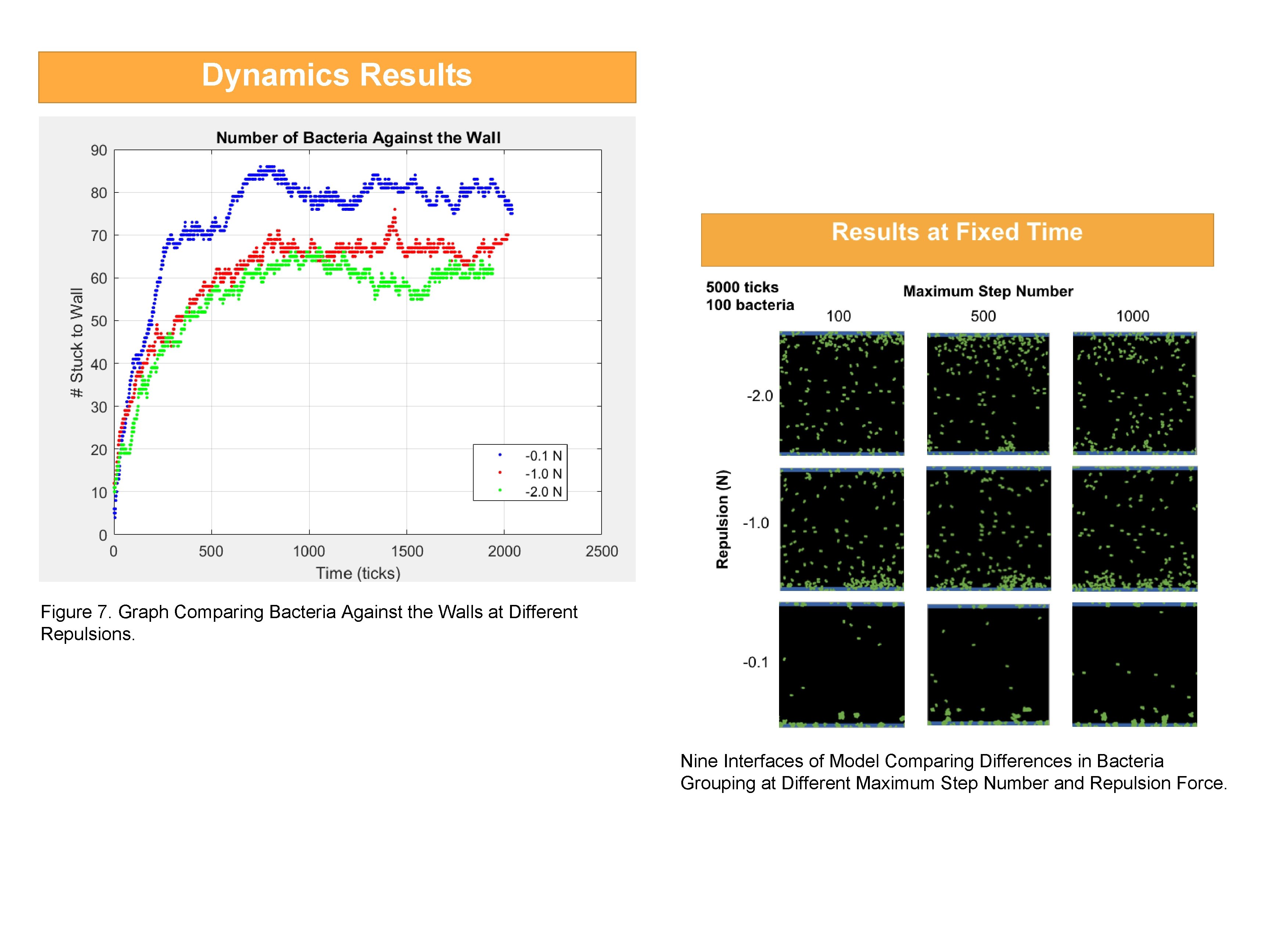
Dynamics Results Figure 7. Graph Comparing Bacteria Against the Walls at Different Repulsions. Nine Interfaces of Model Comparing Differences in Bacteria Grouping at Different Maximum Step Number and Repulsion Force.
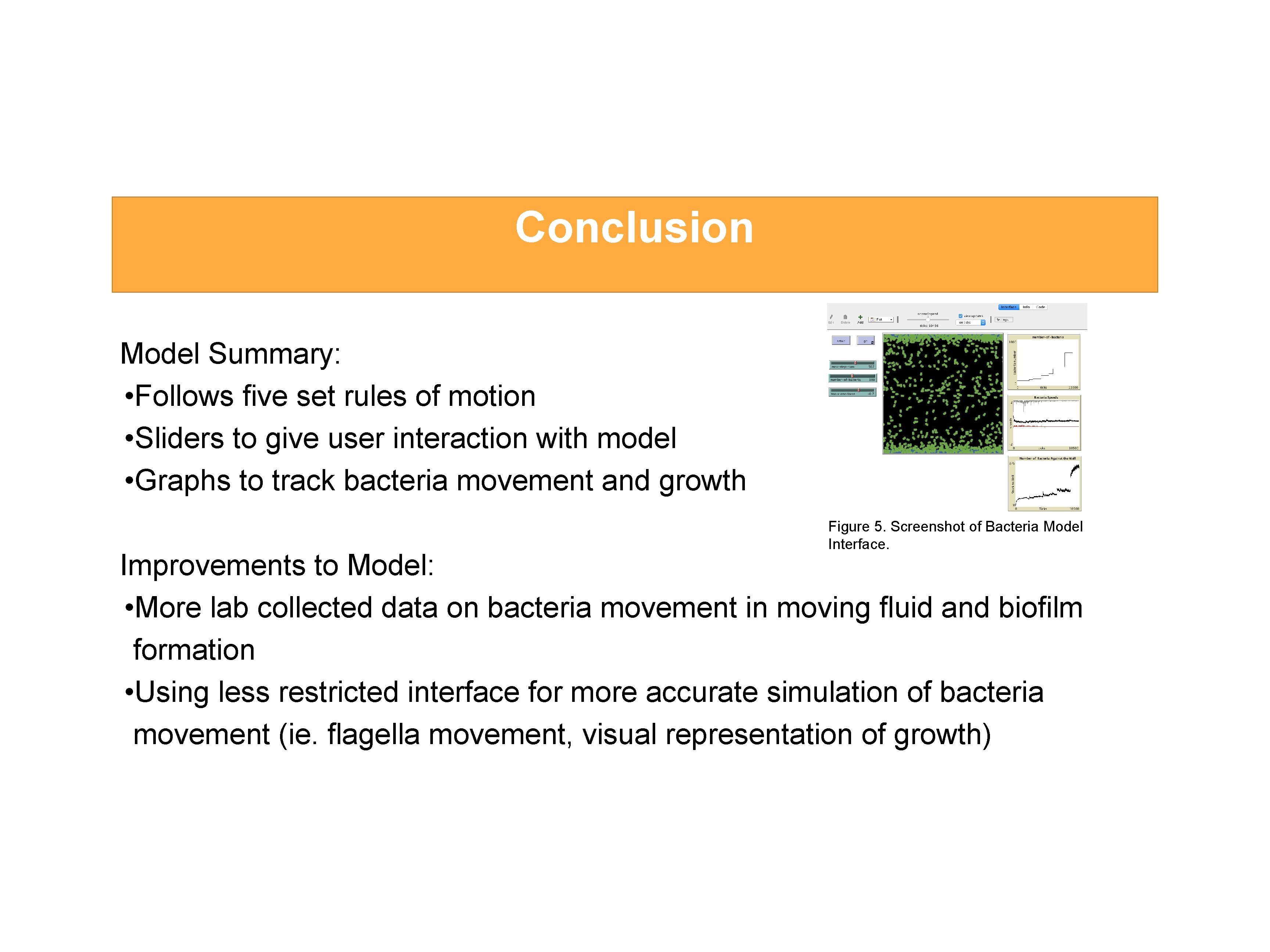
Conclusion Model Summary: • Follows five set rules of motion • Sliders to give user interaction with model • Graphs to track bacteria movement and growth Figure 5. Screenshot of Bacteria Model Interface. Improvements to Model: • More lab collected data on bacteria movement in moving fluid and biofilm formation • Using less restricted interface for more accurate simulation of bacteria movement (ie. flagella movement, visual representation of growth)
Conclusion Future Investigations: • Effects of different flow rates • What happens when chemical is added Next Steps: • Transferring Net. Logo model code into Mat. Lab • Upgrading the model to make it display nuances of bacteria movement in moving fluid
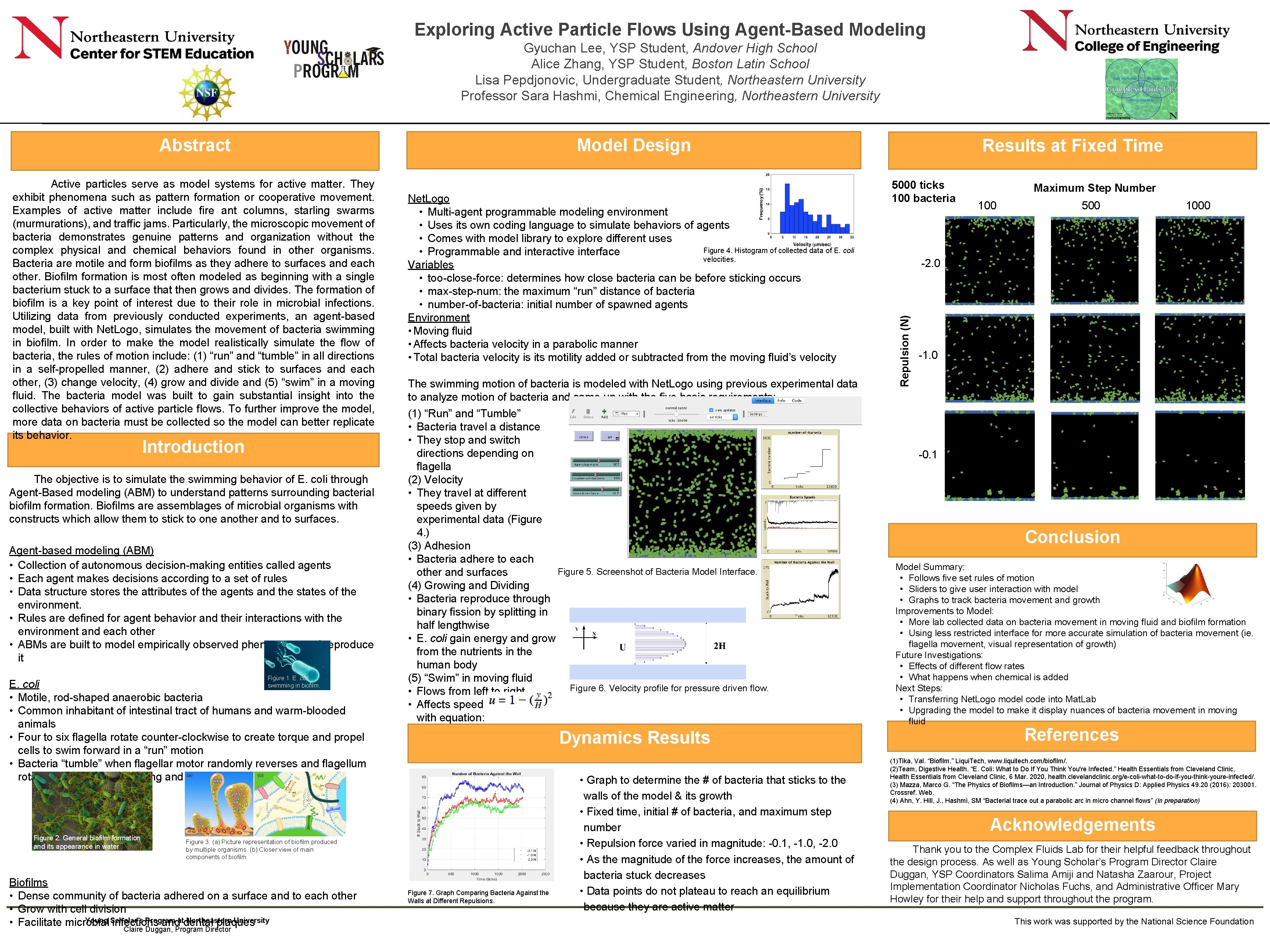
Exploring Active Particle Flows Using Agent-Based Modeling Gyuchan Lee, YSP Student, Andover High School Alice Zhang, YSP Student, Boston Latin School Lisa Pepdjonovic, Undergraduate Student, Northeastern University Professor Sara Hashmi, Chemical Engineering, Northeastern University Abstract Model Design Introduction The objective is to simulate the swimming behavior of E. coli through Agent-Based modeling (ABM) to understand patterns surrounding bacterial biofilm formation. Biofilms are assemblages of microbial organisms with constructs which allow them to stick to one another and to surfaces. Agent-based modeling (ABM) • Collection of autonomous decision-making entities called agents • Each agent makes decisions according to a set of rules • Data structure stores the attributes of the agents and the states of the environment. • Rules are defined for agent behavior and their interactions with the environment and each other • ABMs are built to model empirically observed phenomena and reproduce it Figure 1. E. coli swimming in biofilm. E. coli • Motile, rod-shaped anaerobic bacteria • Common inhabitant of intestinal tract of humans and warm-blooded animals • Four to six flagella rotate counter-clockwise to create torque and propel cells to swim forward in a “run” motion • Bacteria “tumble” when flagellar motor randomly reverses and flagellum rotates clockwise, unbundling and reorienting the cell Figure 2. General biofilm formation and its appearance in water Net. Logo • Multi-agent programmable modeling environment • Uses its own coding language to simulate behaviors of agents • Comes with model library to explore different uses Figure 4. Histogram of collected data of E. coli • Programmable and interactive interface velocities. Variables • too-close-force: determines how close bacteria can be before sticking occurs • max-step-num: the maximum “run” distance of bacteria • number-of-bacteria: initial number of spawned agents Environment • Moving fluid • Affects bacteria velocity in a parabolic manner • Total bacteria velocity is its motility added or subtracted from the moving fluid’s velocity The swimming motion of bacteria is modeled with Net. Logo using previous experimental data to analyze motion of bacteria and came up with the five basic requirements: (1) “Run” and “Tumble” • Bacteria travel a distance • They stop and switch directions depending on flagella (2) Velocity • They travel at different speeds given by experimental data (Figure 4. ) (3) Adhesion • Bacteria adhere to each Figure 5. Screenshot of Bacteria Model Interface. other and surfaces (4) Growing and Dividing • Bacteria reproduce through binary fission by splitting in half lengthwise • E. coli gain energy and grow from the nutrients in the human body (5) “Swim” in moving fluid Figure 6. Velocity profile for pressure driven flow. • Flows from left to right • Affects speed of bacteria with equation: Dynamics Results Figure 3. (a) Picture representation of biofilm produced by multiple organisms. (b) Closer view of main components of biofilm Biofilms • Dense community of bacteria adhered on a surface and to each other • Grow with cell division Young Scholar’s Program Northeastern University • Facilitate microbial infections andatdental plaques Claire Duggan, Program Director Figure 7. Graph Comparing Bacteria Against the Walls at Different Repulsions. • Graph to determine the # of bacteria that sticks to the walls of the model & its growth • Fixed time, initial # of bacteria, and maximum step number • Repulsion force varied in magnitude: -0. 1, -1. 0, -2. 0 • As the magnitude of the force increases, the amount of bacteria stuck decreases • Data points do not plateau to reach an equilibrium because they are active matter 5000 ticks 100 bacteria Maximum Step Number 100 500 1000 -2. 0 Repulsion (N) Active particles serve as model systems for active matter. They exhibit phenomena such as pattern formation or cooperative movement. Examples of active matter include fire ant columns, starling swarms (murmurations), and traffic jams. Particularly, the microscopic movement of bacteria demonstrates genuine patterns and organization without the complex physical and chemical behaviors found in other organisms. Bacteria are motile and form biofilms as they adhere to surfaces and each other. Biofilm formation is most often modeled as beginning with a single bacterium stuck to a surface that then grows and divides. The formation of biofilm is a key point of interest due to their role in microbial infections. Utilizing data from previously conducted experiments, an agent-based model, built with Net. Logo, simulates the movement of bacteria swimming in biofilm. In order to make the model realistically simulate the flow of bacteria, the rules of motion include: (1) “run” and “tumble” in all directions in a self-propelled manner, (2) adhere and stick to surfaces and each other, (3) change velocity, (4) grow and divide and (5) “swim” in a moving fluid. The bacteria model was built to gain substantial insight into the collective behaviors of active particle flows. To further improve the model, more data on bacteria must be collected so the model can better replicate its behavior. Results at Fixed Time -1. 0 -0. 1 Conclusion Model Summary: • Follows five set rules of motion • Sliders to give user interaction with model • Graphs to track bacteria movement and growth Improvements to Model: • More lab collected data on bacteria movement in moving fluid and biofilm formation • Using less restricted interface for more accurate simulation of bacteria movement (ie. flagella movement, visual representation of growth) Future Investigations: • Effects of different flow rates • What happens when chemical is added Next Steps: • Transferring Net. Logo model code into Mat. Lab • Upgrading the model to make it display nuances of bacteria movement in moving fluid References (1)Tika, Val. “Biofilm. ” Liqui. Tech, www. liquitech. com/biofilm/. (2)Team, Digestive Health. “E. Coli: What to Do If You Think You're Infected. ” Health Essentials from Cleveland Clinic, 6 Mar. 2020, health. clevelandclinic. org/e-coli-what-to-do-if-you-think-youre-infected/. (3) Mazza, Marco G. “The Physics of Biofilms—an Introduction. ” Journal of Physics D: Applied Physics 49. 20 (2016): 203001. Crossref. Web. (4) Ahn, Y. Hill, J. , Hashmi, SM “Bacterial trace out a parabolic arc in micro channel flows” (in preparation) Acknowledgements Thank you to the Complex Fluids Lab for their helpful feedback throughout the design process. As well as Young Scholar’s Program Director Claire Duggan, YSP Coordinators Salima Amiji and Natasha Zaarour, Project Implementation Coordinator Nicholas Fuchs, and Administrative Officer Mary Howley for their help and support throughout the program. This work was supported by the National Science Foundation
Questions?
- Slides: 12