
Exploring 16 Psyche Psyche Orbiter Kenneth Jops Carter
Exploring 16 Psyche: Psyche Orbiter Kenneth Jops, Carter Robinson and Joshua Schwartz-Dodek
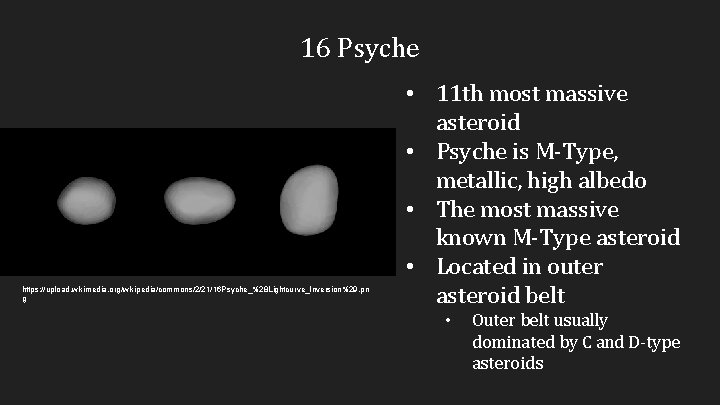
16 Psyche https: //upload. wikimedia. org/wikipedia/commons/2/21/16 Psyche_%28 Lightcurve_Inversion%29. pn g • 11 th most massive asteroid • Psyche is M-Type, metallic, high albedo • The most massive known M-Type asteroid • Located in outer asteroid belt • Outer belt usually dominated by C and D-type asteroids
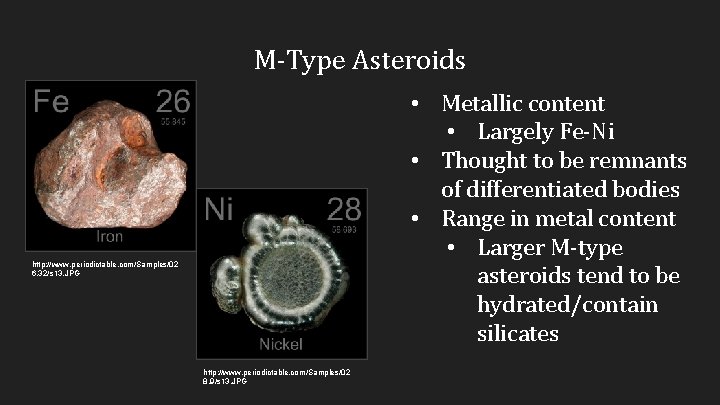
M-Type Asteroids • Metallic content • Largely Fe-Ni • Thought to be remnants of differentiated bodies • Range in metal content • Larger M-type asteroids tend to be hydrated/contain silicates http: //www. periodictable. com/Samples/02 6. 32/s 13. JPG http: //www. periodictable. com/Samples/02 8. 9/s 13. JPG
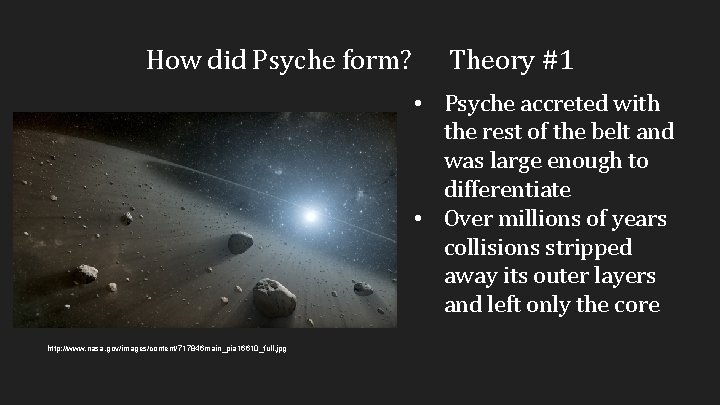
How did Psyche form? Theory #1 • Psyche accreted with the rest of the belt and was large enough to differentiate • Over millions of years collisions stripped away its outer layers and left only the core http: //www. nasa. gov/images/content/717846 main_pia 16610_full. jpg
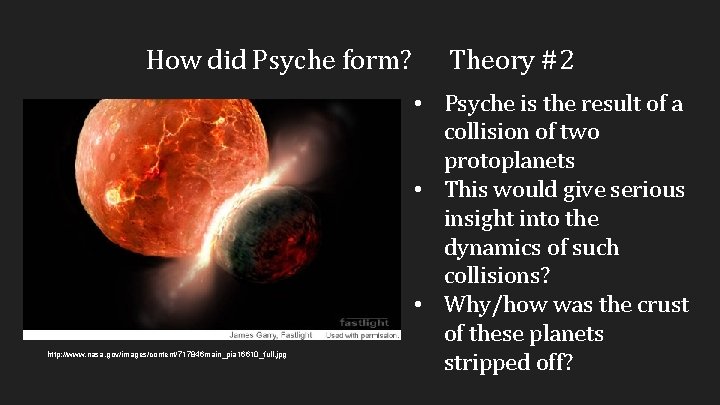
How did Psyche form? http: //www. nasa. gov/images/content/717846 main_pia 16610_full. jpg Theory #2 • Psyche is the result of a collision of two protoplanets • This would give serious insight into the dynamics of such collisions? • Why/how was the crust of these planets stripped off?
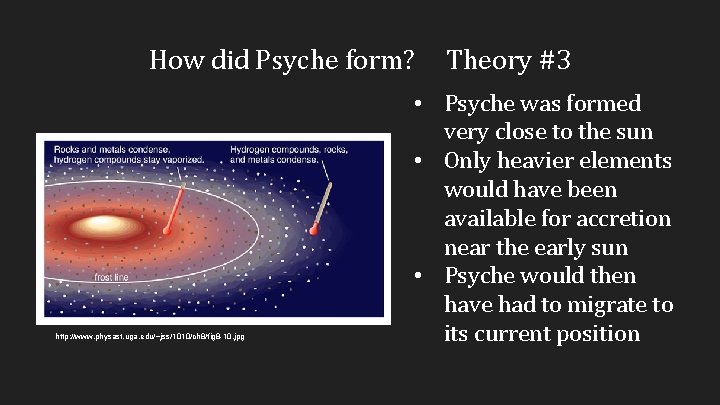
How did Psyche form? http: //www. physast. uga. edu/~jss/1010/ch 8/fig 8 -10. jpg Theory #3 • Psyche was formed very close to the sun • Only heavier elements would have been available for accretion near the early sun • Psyche would then have had to migrate to its current position
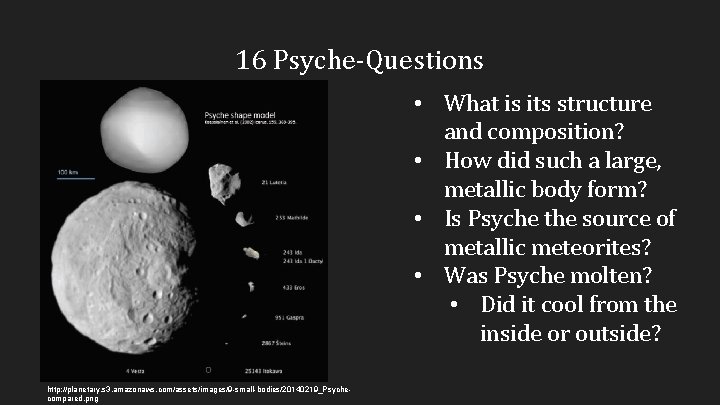
16 Psyche-Questions • What is its structure and composition? • How did such a large, metallic body form? • Is Psyche the source of metallic meteorites? • Was Psyche molten? • Did it cool from the inside or outside? http: //planetary. s 3. amazonaws. com/assets/images/9 -small-bodies/20140219_Psychecompared. png
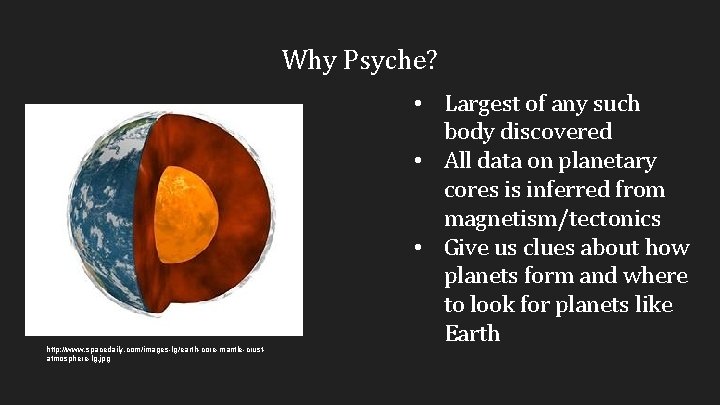
Why Psyche? http: //www. spacedaily. com/images-lg/earth-core-mantle-crustatmosphere-lg. jpg • Largest of any such body discovered • All data on planetary cores is inferred from magnetism/tectonics • Give us clues about how planets form and where to look for planets like Earth
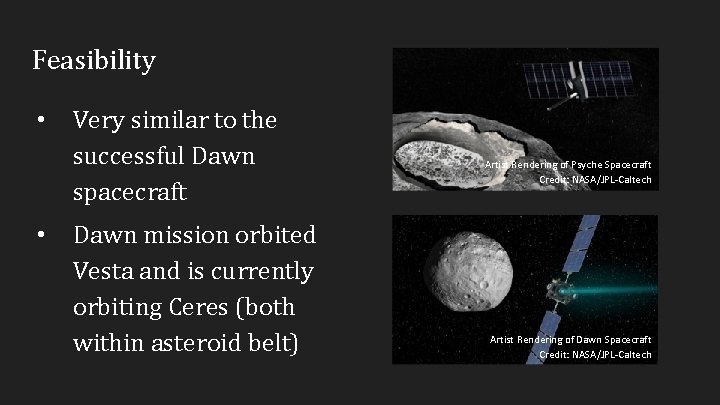
Feasibility • • Very similar to the successful Dawn spacecraft Dawn mission orbited Vesta and is currently orbiting Ceres (both within asteroid belt) Artist Rendering of Psyche Spacecraft Credit: NASA/JPL-Caltech Artist Rendering of Dawn Spacecraft Credit: NASA/JPL-Caltech
“The Psyche Mission could be ready to launch relatively quickly because it requires no new technology development” -Dr. Elkins-Tanton, Lead Program Scientist and Principal Investigator for Psyche Team
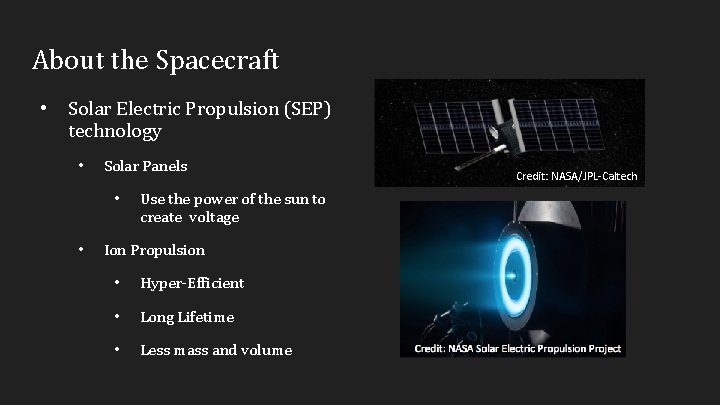
About the Spacecraft • Solar Electric Propulsion (SEP) technology • Solar Panels • • Use the power of the sun to create voltage Ion Propulsion • Hyper-Efficient • Long Lifetime • Less mass and volume Credit: NASA/JPL-Caltech
About the Spacecraft • Solar Electric Propulsion (SEP) technology • Solar Panels • • Use the power of the sun to capture voltage Ion Propulsion • Hyper-Efficient • Long Lifetime • Less mass and volume Credit: NASA/JPL-Caltech
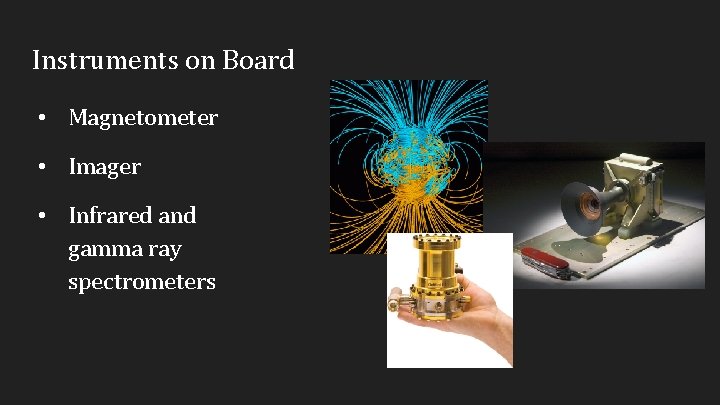
Instruments on Board • Magnetometer • Imager • Infrared and gamma ray spectrometers
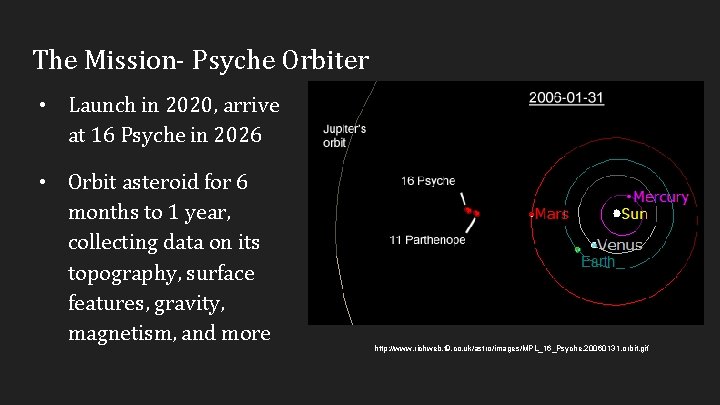
The Mission- Psyche Orbiter • Launch in 2020, arrive at 16 Psyche in 2026 • Orbit asteroid for 6 months to 1 year, collecting data on its topography, surface features, gravity, magnetism, and more http: //www. richweb. f 9. co. uk/astro/images/MPL_16_Psyche. 20060131. orbit. gif
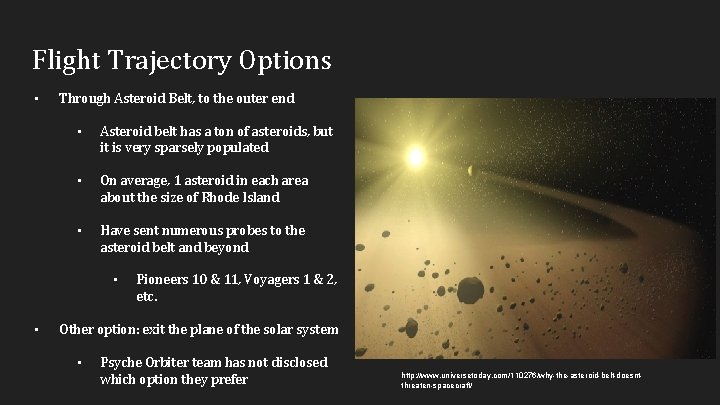
Flight Trajectory Options • Through Asteroid Belt, to the outer end • Asteroid belt has a ton of asteroids, but it is very sparsely populated • On average, 1 asteroid in each area about the size of Rhode Island • Have sent numerous probes to the asteroid belt and beyond • • Pioneers 10 & 11, Voyagers 1 & 2, etc. Other option: exit the plane of the solar system • Psyche Orbiter team has not disclosed which option they prefer http: //www. universetoday. com/110276/why-the-asteroid-belt-doesntthreaten-spacecraft/
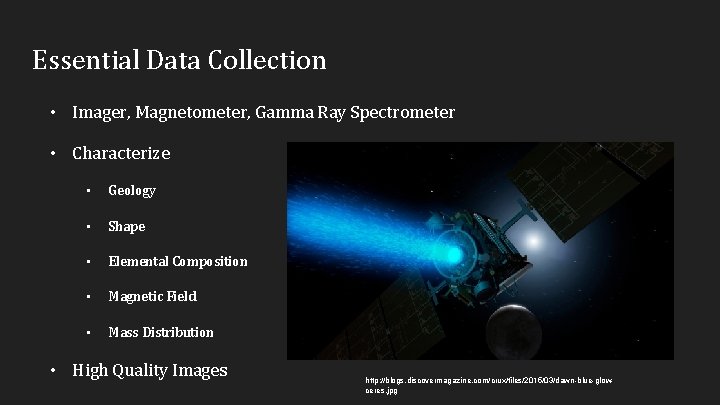
Essential Data Collection • Imager, Magnetometer, Gamma Ray Spectrometer • Characterize • Geology • Shape • Elemental Composition • Magnetic Field • Mass Distribution • High Quality Images http: //blogs. discovermagazine. com/crux/files/2015/03/dawn-blue-glowceres. jpg
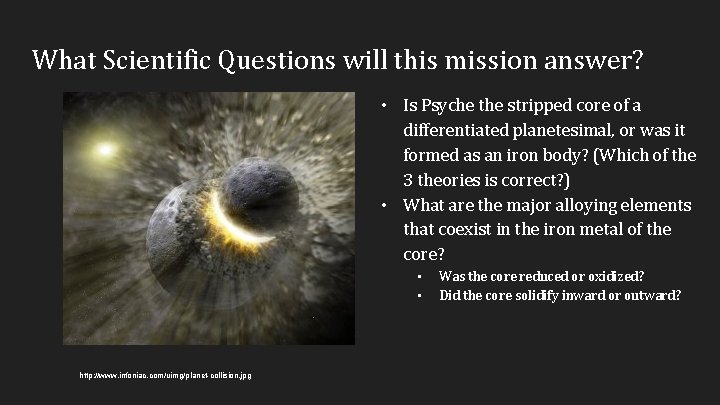
What Scientific Questions will this mission answer? • Is Psyche the stripped core of a differentiated planetesimal, or was it formed as an iron body? (Which of the 3 theories is correct? ) • What are the major alloying elements that coexist in the iron metal of the core? • • http: //www. infoniac. com/uimg/planet-collision. jpg Was the core reduced or oxidized? Did the core solidify inward or outward?
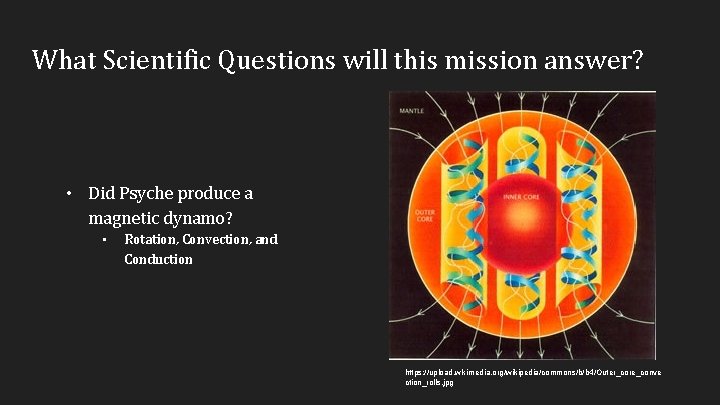
What Scientific Questions will this mission answer? • Did Psyche produce a magnetic dynamo? • Rotation, Convection, and Conduction https: //upload. wikimedia. org/wikipedia/commons/b/b 4/Outer_core_conve ction_rolls. jpg
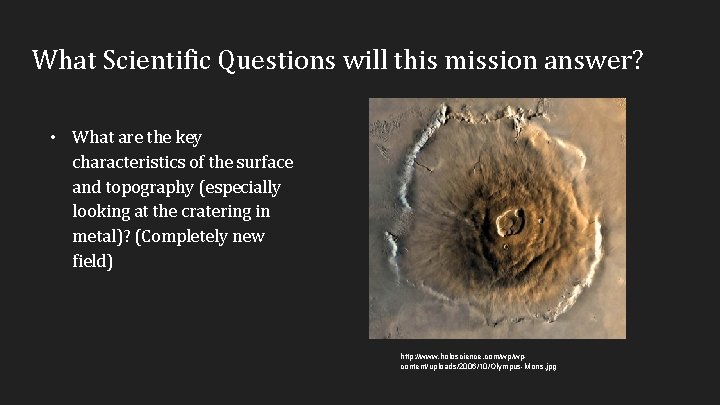
What Scientific Questions will this mission answer? • What are the key characteristics of the surface and topography (especially looking at the cratering in metal)? (Completely new field) http: //www. holoscience. com/wp/wpcontent/uploads/2006/10/Olympus-Mons. jpg
“This is one of the few missions (proposed) that’s truly exploration, ” said Lindy Elkins-Tanton, a planetary scientist from Arizona State University who leads the Psyche mission, in an interview earlier this year. “Nobody has ever seen a metal world before. We have no idea what it’s going to look like. ” - Lindy Elkins-Tanton
- Slides: 20