
Explore the life journey of Siddhartha Gautama Explore
- Slides: 29
Explore the life journey of Siddhartha Gautama. Explore the teachings of Buddha and Buddhism. Identify the Four Noble Truths and the Eightfold Path to Enlightenment. Key Terms to identify include: Nirvana, and Stupa. Explore how the religion spread east.
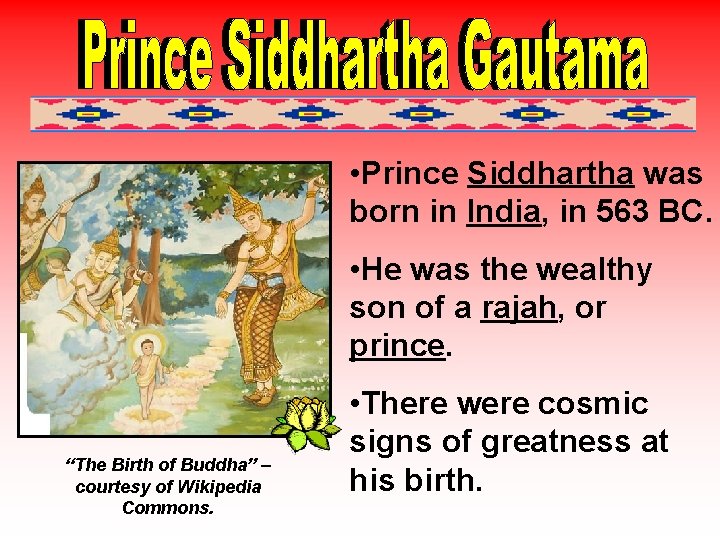
• Prince Siddhartha was born in India, in 563 BC. • He was the wealthy son of a rajah, or prince. “The Birth of Buddha” – courtesy of Wikipedia Commons. • There were cosmic signs of greatness at his birth.
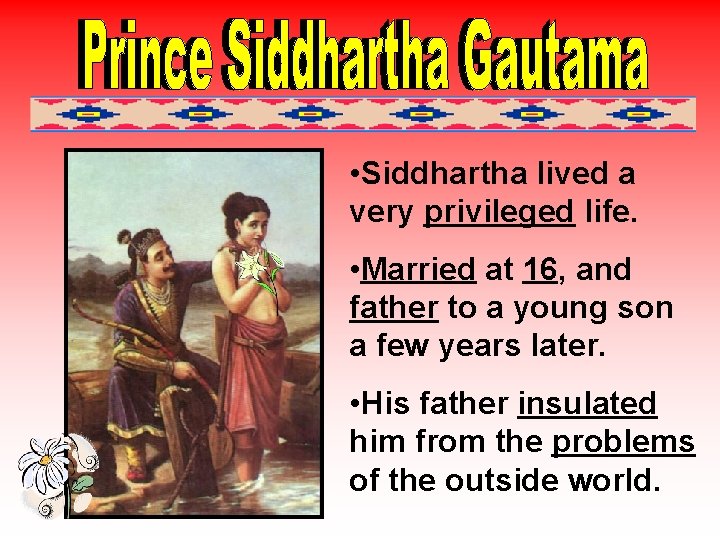
• Siddhartha lived a very privileged life. • Married at 16, and father to a young son a few years later. • His father insulated him from the problems of the outside world.
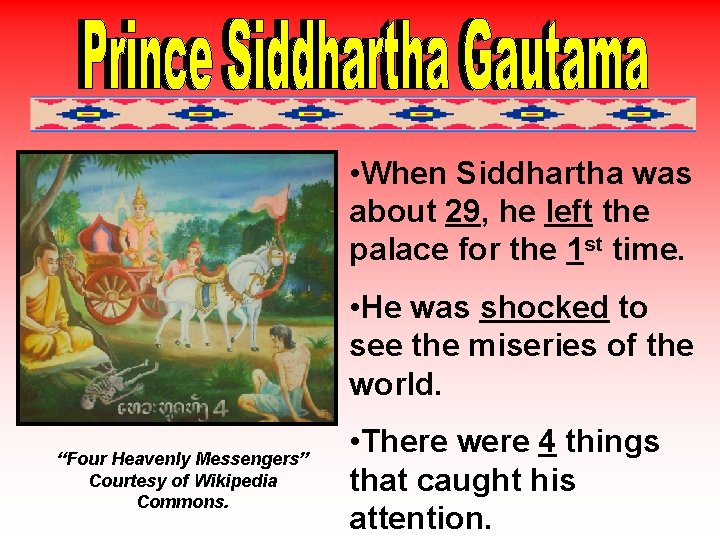
• When Siddhartha was about 29, he left the palace for the 1 st time. • He was shocked to see the miseries of the world. “Four Heavenly Messengers” Courtesy of Wikipedia Commons. • There were 4 things that caught his attention.
• 1 st – Siddhartha saw a man who old. • 2 nd – He saw a person who was sick and diseased. • 3 rd – Last, he saw a dead body. • Finally, Siddhartha met a monk who was at peace.
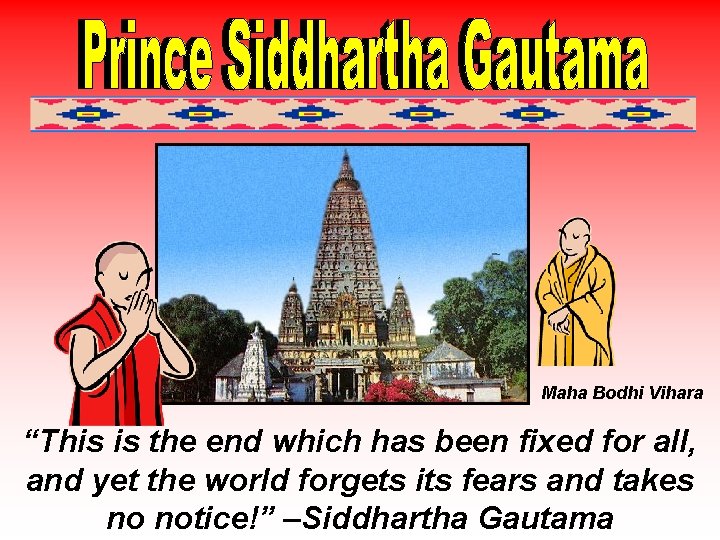
Maha Bodhi Vihara “This is the end which has been fixed for all, and yet the world forgets its fears and takes no notice!” –Siddhartha Gautama
• Siddhartha left the palace and began the life of a wandering monk. • His goal was find the cause of suffering and to become an enlightened man.
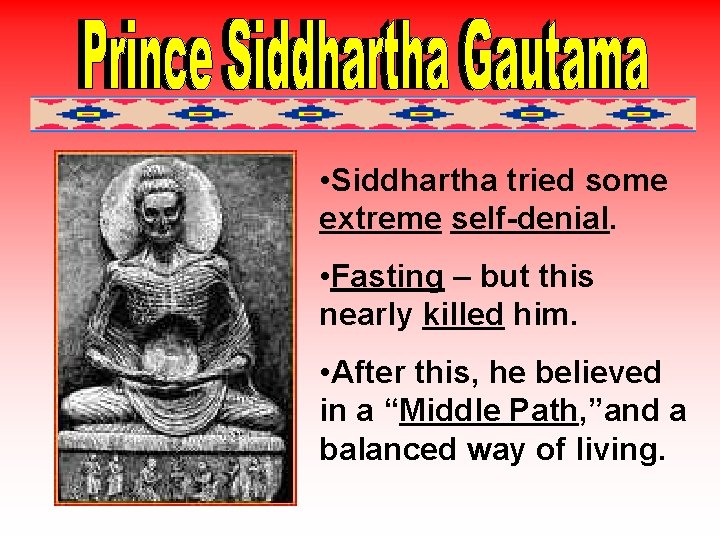
• Siddhartha tried some extreme self-denial. • Fasting – but this nearly killed him. • After this, he believed in a “Middle Path, ”and a balanced way of living.
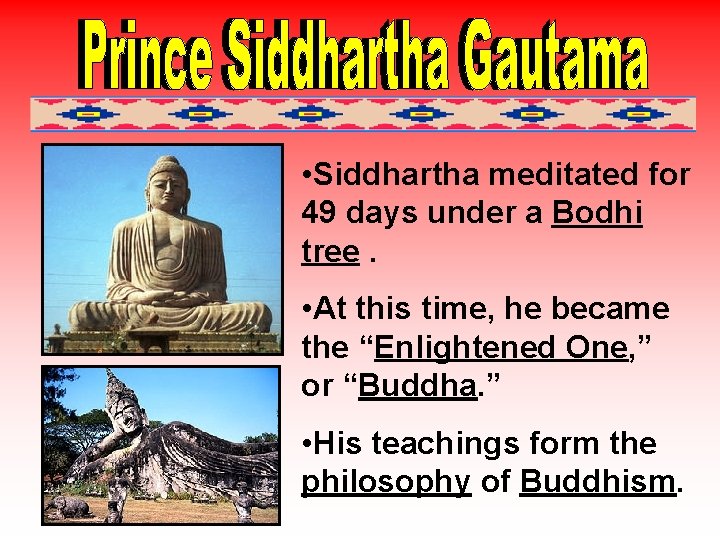
• Siddhartha meditated for 49 days under a Bodhi tree. • At this time, he became the “Enlightened One, ” or “Buddha. ” • His teachings form the philosophy of Buddhism.
1. What 3 things had Siddhartha never seen? 2. What did Siddhartha do in response to what he had seen? 3. What happened to Siddhartha when he sat under the bodhi tree? 4. What did Buddha mean when he called his path a “Middle Path? ”
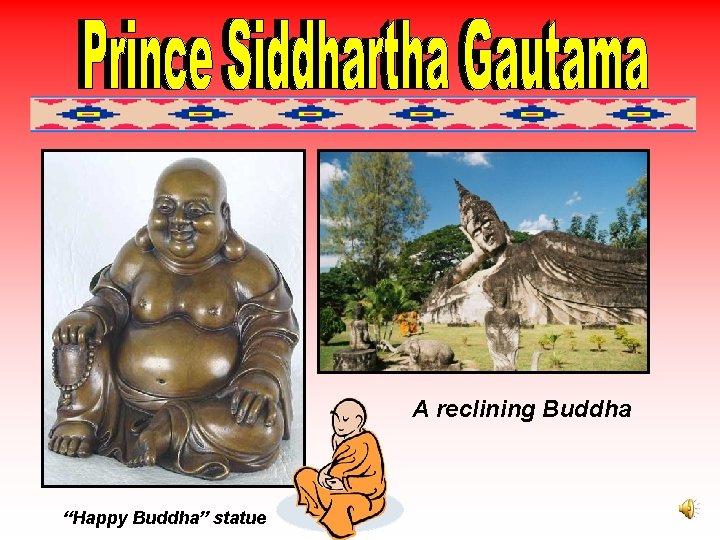
A reclining Buddha “Happy Buddha” statue
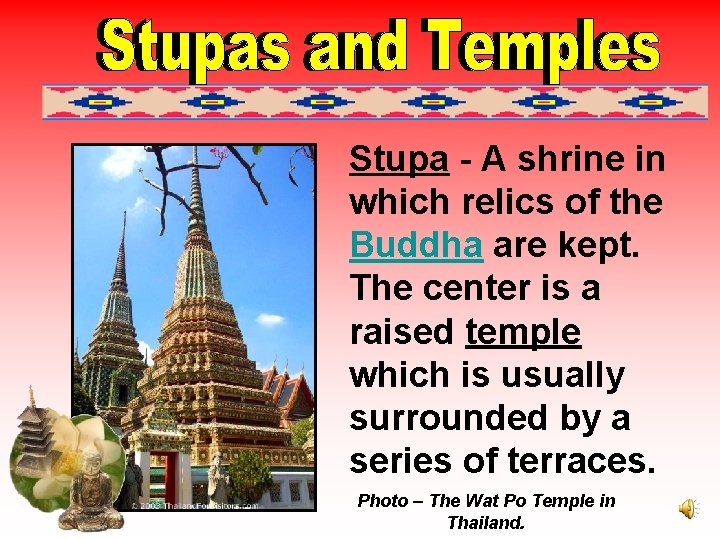
Stupa - A shrine in which relics of the Buddha are kept. The center is a raised temple which is usually surrounded by a series of terraces. Photo – The Wat Po Temple in Thailand.
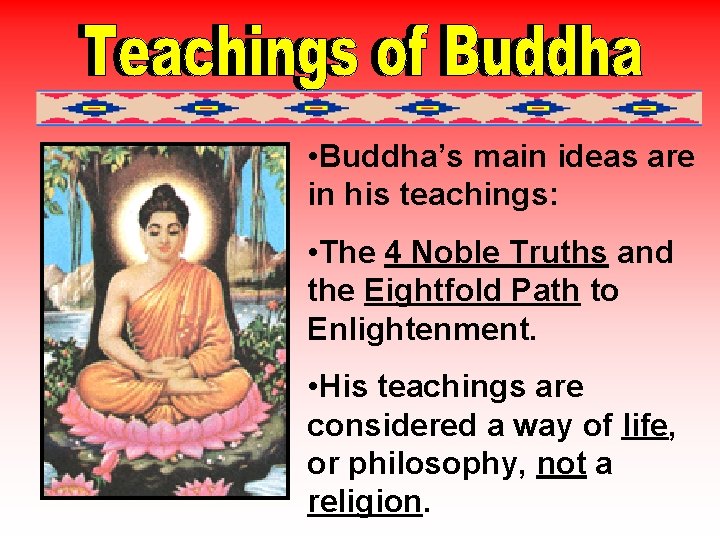
• Buddha’s main ideas are in his teachings: • The 4 Noble Truths and the Eightfold Path to Enlightenment. • His teachings are considered a way of life, or philosophy, not a religion.
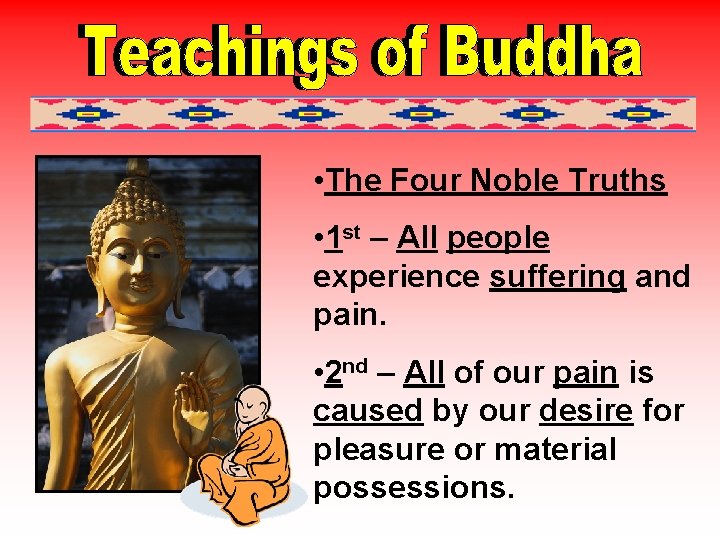
• The Four Noble Truths • 1 st – All people experience suffering and pain. • 2 nd – All of our pain is caused by our desire for pleasure or material possessions.
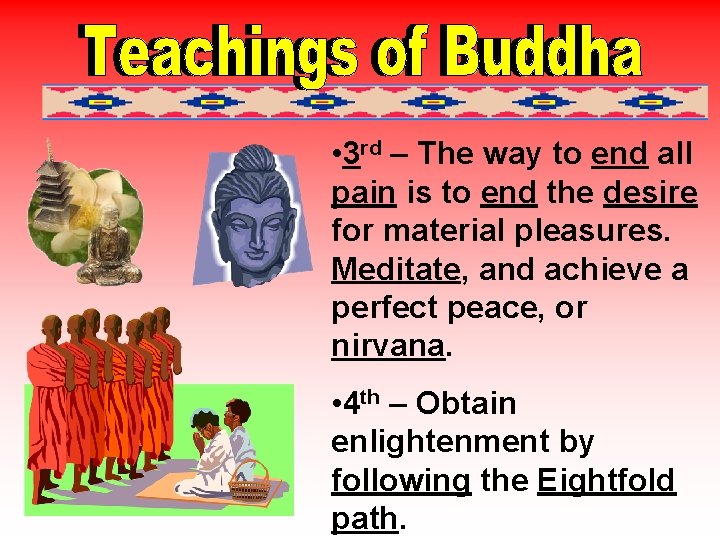
• 3 rd – The way to end all pain is to end the desire for material pleasures. Meditate, and achieve a perfect peace, or nirvana. • 4 th – Obtain enlightenment by following the Eightfold path.
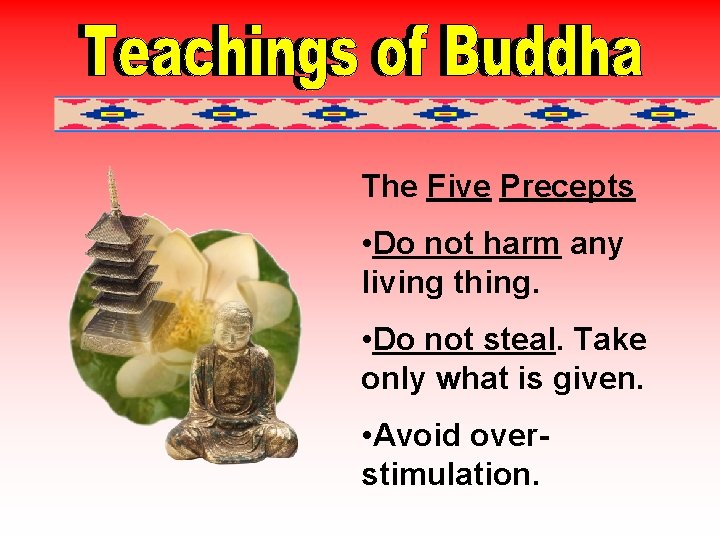
The Five Precepts • Do not harm any living thing. • Do not steal. Take only what is given. • Avoid overstimulation.
The Five Precepts • Do not say unkind things. • Do not take alcohol or drugs. • The Five Precepts are considered Buddhist laws.
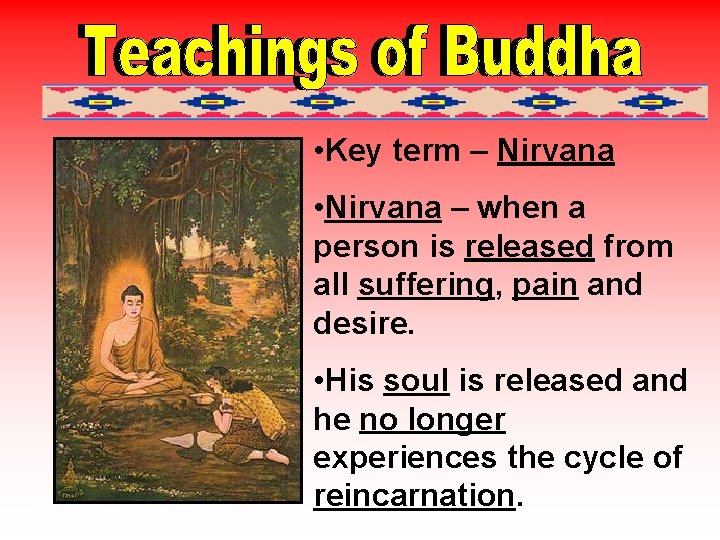
• Key term – Nirvana • Nirvana – when a person is released from all suffering, pain and desire. • His soul is released and he no longer experiences the cycle of reincarnation.
• The Eightfold Path to Enlightenment – • Right thought • Right understanding • Right speech • Right action
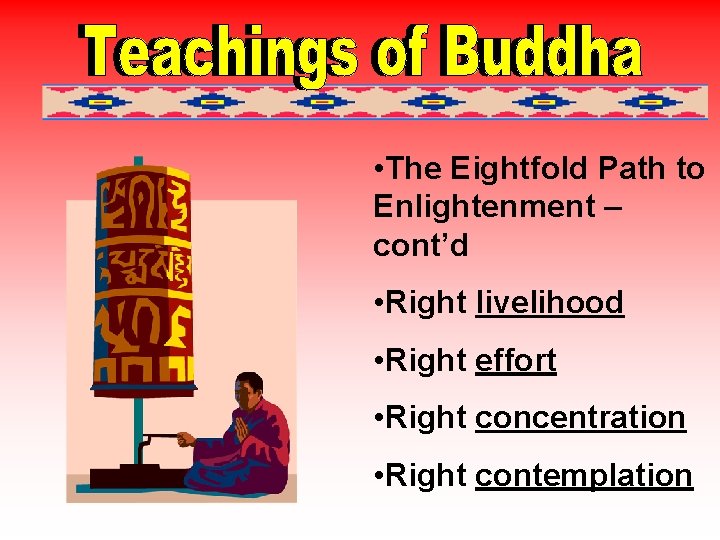
• The Eightfold Path to Enlightenment – cont’d • Right livelihood • Right effort • Right concentration • Right contemplation
1. What is a Buddhist temple called? 2. What does a fat Buddha represent? 3. Define nirvana. 4. Name one of the 4 Noble Truths. 5. List one of the “Rights” for the Eightfold Path.
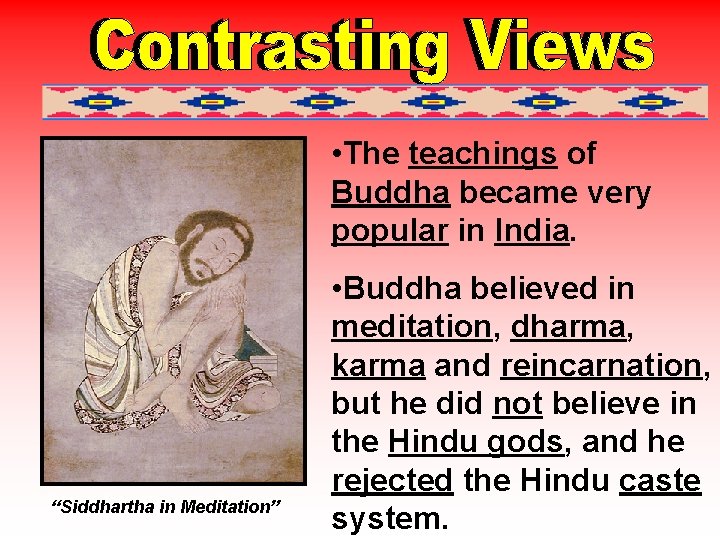
• The teachings of Buddha became very popular in India. “Siddhartha in Meditation” • Buddha believed in meditation, dharma, karma and reincarnation, but he did not believe in the Hindu gods, and he rejected the Hindu caste system.
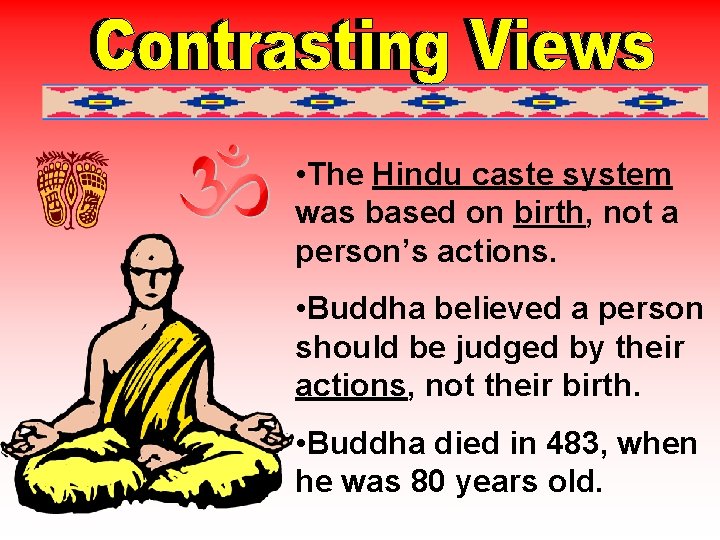
• The Hindu caste system was based on birth, not a person’s actions. • Buddha believed a person should be judged by their actions, not their birth. • Buddha died in 483, when he was 80 years old.
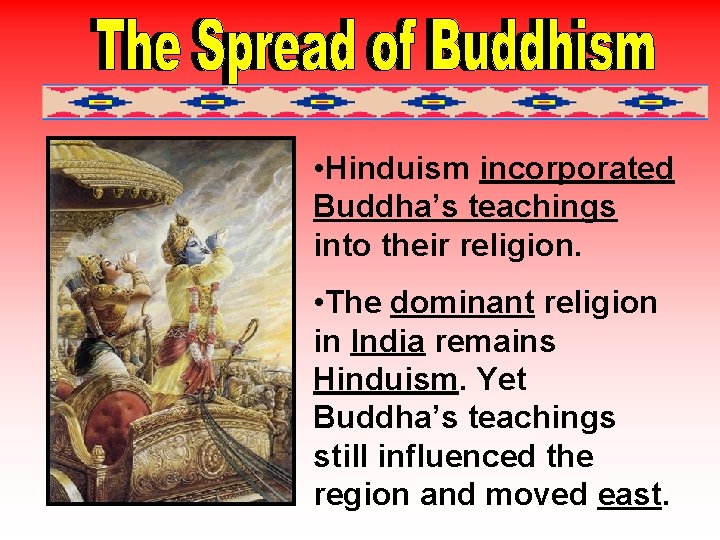
• Hinduism incorporated Buddha’s teachings into their religion. • The dominant religion in India remains Hinduism. Yet Buddha’s teachings still influenced the region and moved east.
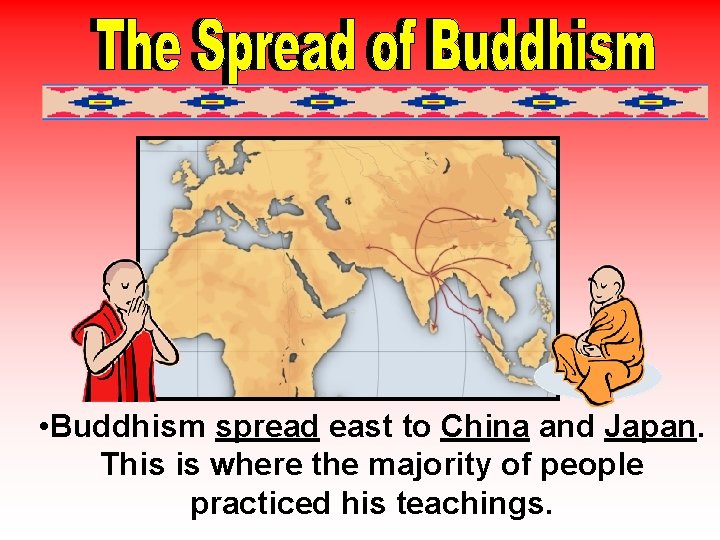
• Buddhism spread east to China and Japan. This is where the majority of people practiced his teachings.
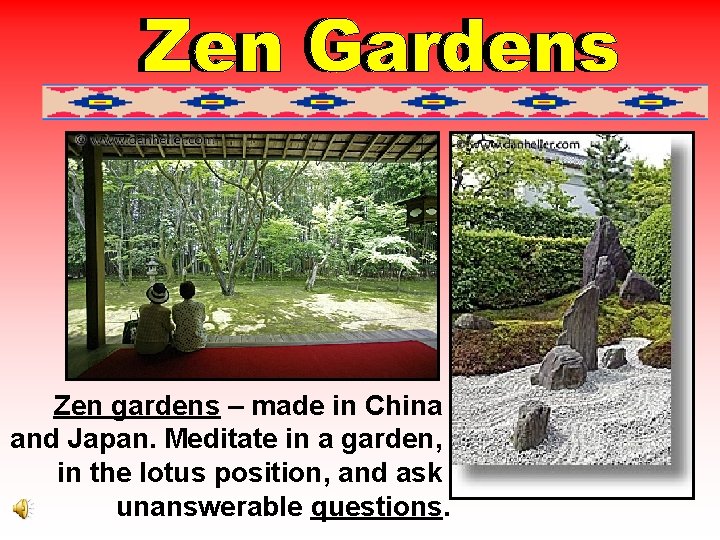
Zen gardens – made in China and Japan. Meditate in a garden, in the lotus position, and ask unanswerable questions.
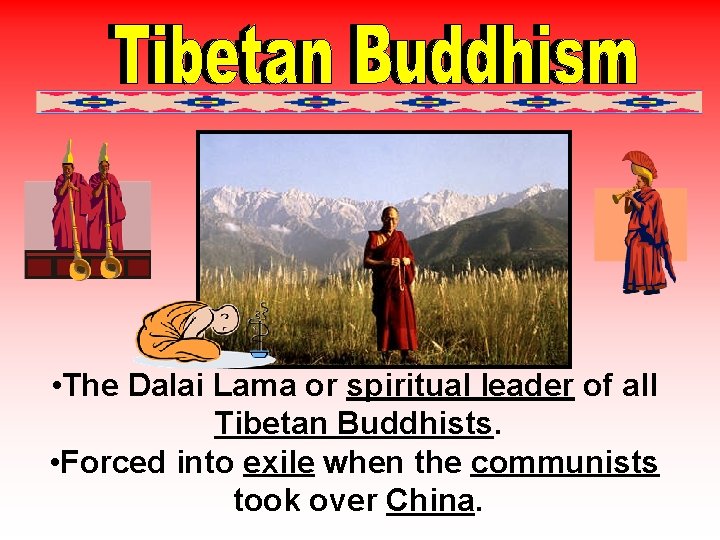
• The Dalai Lama or spiritual leader of all Tibetan Buddhists. • Forced into exile when the communists took over China.
1. Who is the spiritual leader of the Tibetan Buddhists? 2. Where did the religion of Buddhism spread? 3. How did Hindus respond to Buddhist teachings? 4. Why would Buddha’s teachings appeal to the poor of India?