
Explore post war troubles Identify discrimination and response
• Explore post war troubles. • Identify discrimination and response to discrimination in the 20’s.
� Would you rather be able to stop time or fly? � What do you know about 1919 -1929? � What would you like to know…specifically? � “People seem to enjoy things more when they know a lot of other people have been left out of the pleasure. ” Russell Baker Time Table � � Bell Work – 10 min. Lecture Notes – 20 min. Note Cards – 10 min. The Golden Twenties – 15 min.
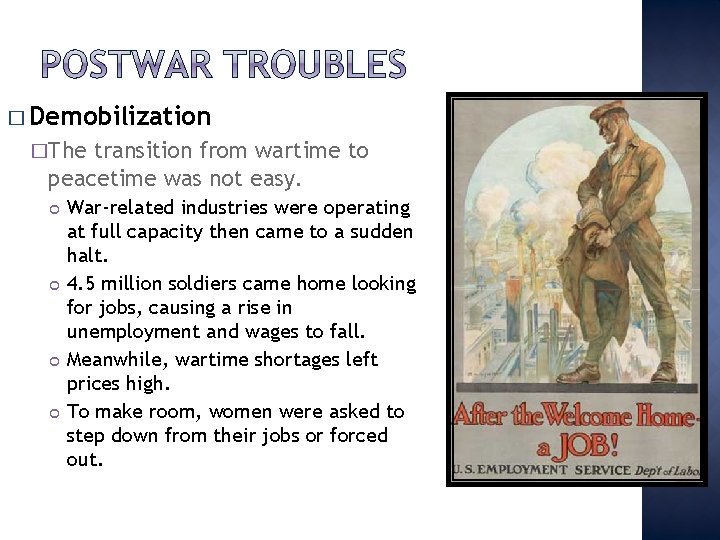
� Demobilization �The transition from wartime to peacetime was not easy. War-related industries were operating at full capacity then came to a sudden halt. 4. 5 million soldiers came home looking for jobs, causing a rise in unemployment and wages to fall. Meanwhile, wartime shortages left prices high. To make room, women were asked to step down from their jobs or forced out.

� Labor Strife � In response to the difficulties of demobilization, workers demanded higher wages and shorter work days. � Management refused to listen. � More than 3, 600 work stoppages involving 4 million workers came as a result in 1919. The Seattle General Strike � Some 60, 000 strikers The Boston Police Strike � 75% of Boston’s Police � Looting broke out as a result The Steel Strike � 365, 000 steel workers � Strikers were jailed, beaten and shot. The United Mine Workers Strike � The only successful strike of the four � Resulted in a 14% pay increase
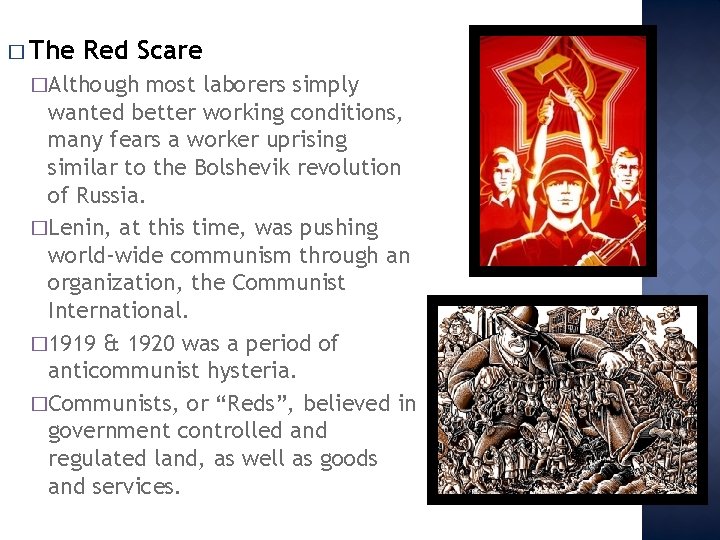
� The Red Scare �Although most laborers simply wanted better working conditions, many fears a worker uprising similar to the Bolshevik revolution of Russia. �Lenin, at this time, was pushing world-wide communism through an organization, the Communist International. � 1919 & 1920 was a period of anticommunist hysteria. �Communists, or “Reds”, believed in government controlled and regulated land, as well as goods and services.
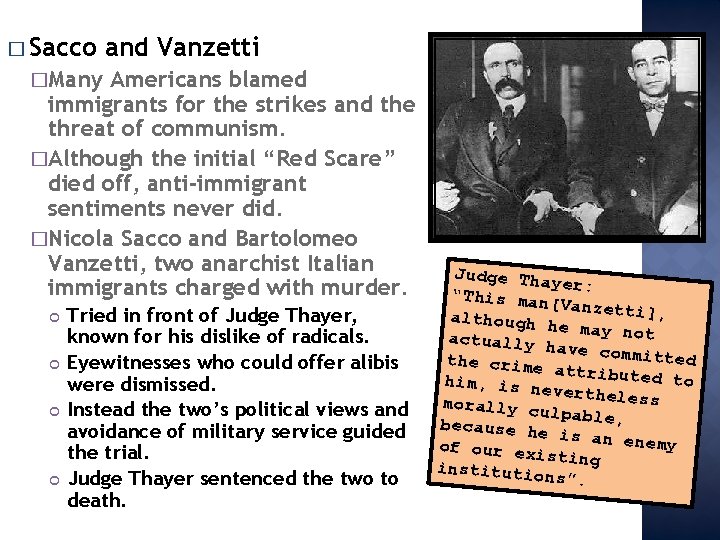
� Sacco and Vanzetti �Many Americans blamed immigrants for the strikes and the threat of communism. �Although the initial “Red Scare” died off, anti-immigrant sentiments never did. �Nicola Sacco and Bartolomeo Vanzetti, two anarchist Italian immigrants charged with murder. Tried in front of Judge Thayer, known for his dislike of radicals. Eyewitnesses who could offer alibis were dismissed. Instead the two’s political views and avoidance of military service guided the trial. Judge Thayer sentenced the two to death. Judge Thay er: “This man[ Vanzetti], although h e may not actually h ave commit ted the crime attributed to him, is ne vertheless morally cu lpable, because he is an enem y of our exi sting institutio ns”.
� Red Scare � Sacco & Vanzetti � Feminists � Equal Rights Amendment � Teapot Dome Scandal � The Brotherhood of Sleeping Car Porters � Installment plan � Assembly line � Henry Ford � Model T
- Slides: 7