
Explore Polygons Around the World Movie The Polygons

- Slides: 13
Explore Polygons Around the World Movie The Polygons Travel Journal Click About Our Trip Webcam Image Courtesy of Shutterstock The f ld o Wor ons g Poly Pamela J Oliveira
Welcome to POLYGONS AROUND THE WORLD • About Our Trip……Polygons are all around us in our everyday lives. They are on buildings, road signs, playgrounds, and even in the classroom! We are going to travel the world looking for polygons in real life situations. • A polygon is a two dimensional shape that is closed and made with straight lines only. It can be simple or complex, regular or irregular, and concave or convex. It is named according to the number of sides it has. Let’s find out what we will learn on our trip to find polygons……………. . VFT MENU
Trip Objectives • Identify and name different polygons in real world structures. • List attributes of each polygon including angle types, and congruent or parallel sides. • Calculate the sum of the interior angles. • Calculate the value of each interior angle. • Identify if polygon is regular or irregular. • Classify triangles by their angles and sides. Glossary of Trip Terms VFT MENU
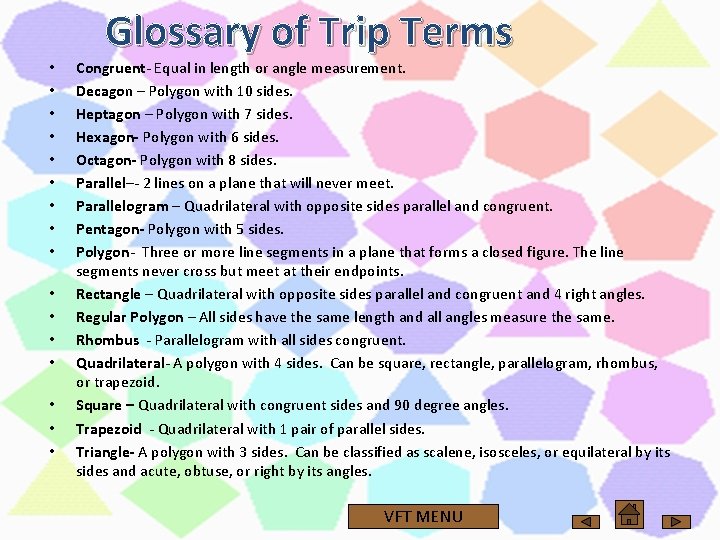
• • • • Glossary of Trip Terms Congruent- Equal in length or angle measurement. Decagon – Polygon with 10 sides. Heptagon – Polygon with 7 sides. Hexagon- Polygon with 6 sides. Octagon- Polygon with 8 sides. Parallel–- 2 lines on a plane that will never meet. Parallelogram – Quadrilateral with opposite sides parallel and congruent. Pentagon- Polygon with 5 sides. Polygon- Three or more line segments in a plane that forms a closed figure. The line segments never cross but meet at their endpoints. Rectangle – Quadrilateral with opposite sides parallel and congruent and 4 right angles. Regular Polygon – All sides have the same length and all angles measure the same. Rhombus - Parallelogram with all sides congruent. Quadrilateral- A polygon with 4 sides. Can be square, rectangle, parallelogram, rhombus, or trapezoid. Square – Quadrilateral with congruent sides and 90 degree angles. Trapezoid - Quadrilateral with 1 pair of parallel sides. Triangle- A polygon with 3 sides. Can be classified as scalene, isosceles, or equilateral by its sides and acute, obtuse, or right by its angles. VFT MENU
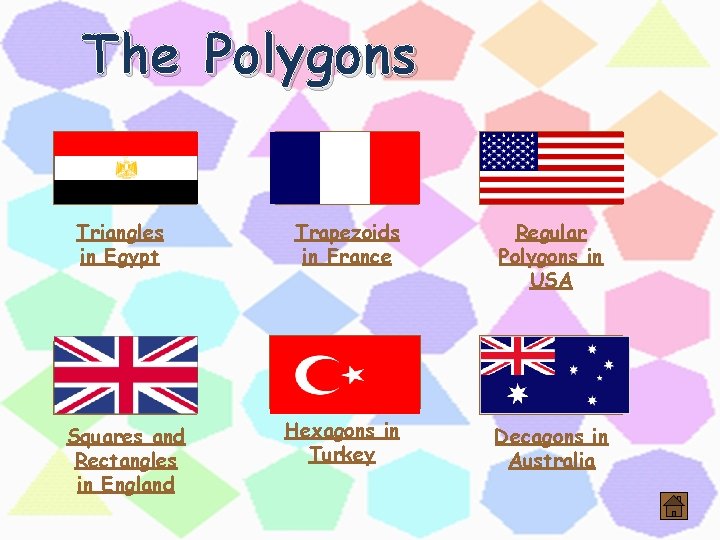
The Polygons Triangles in Egypt Squares and Rectangles in England Trapezoids in France Regular Polygons in USA Hexagons in Turkey Decagons in Australia
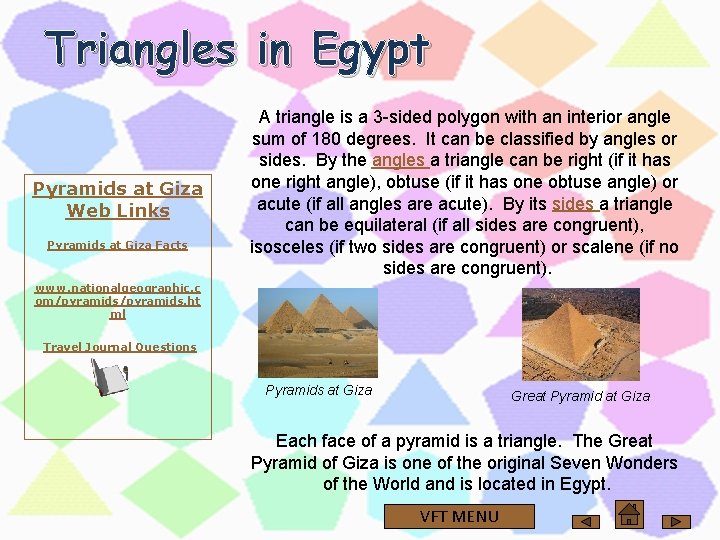
Triangles in Egypt Pyramids at Giza Web Links Pyramids at Giza Facts A triangle is a 3 -sided polygon with an interior angle sum of 180 degrees. It can be classified by angles or sides. By the angles a triangle can be right (if it has one right angle), obtuse (if it has one obtuse angle) or acute (if all angles are acute). By its sides a triangle can be equilateral (if all sides are congruent), isosceles (if two sides are congruent) or scalene (if no sides are congruent). www. nationalgeographic. c om/pyramids. ht ml Travel Journal Questions Pyramids at Giza Great Pyramid at Giza Each face of a pyramid is a triangle. The Great Pyramid of Giza is one of the original Seven Wonders of the World and is located in Egypt. VFT MENU
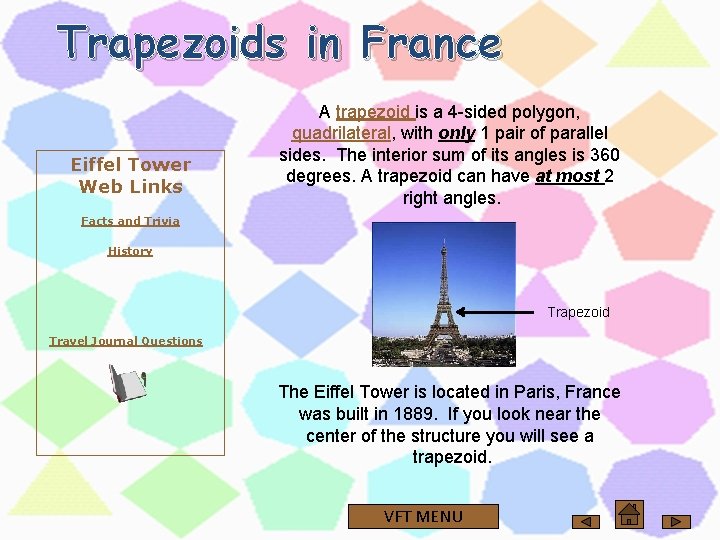
Trapezoids in France Eiffel Tower Web Links A trapezoid is a 4 -sided polygon, quadrilateral, with only 1 pair of parallel sides. The interior sum of its angles is 360 degrees. A trapezoid can have at most 2 right angles. Facts and Trivia History Trapezoid Travel Journal Questions The Eiffel Tower is located in Paris, France was built in 1889. If you look near the center of the structure you will see a trapezoid. VFT MENU
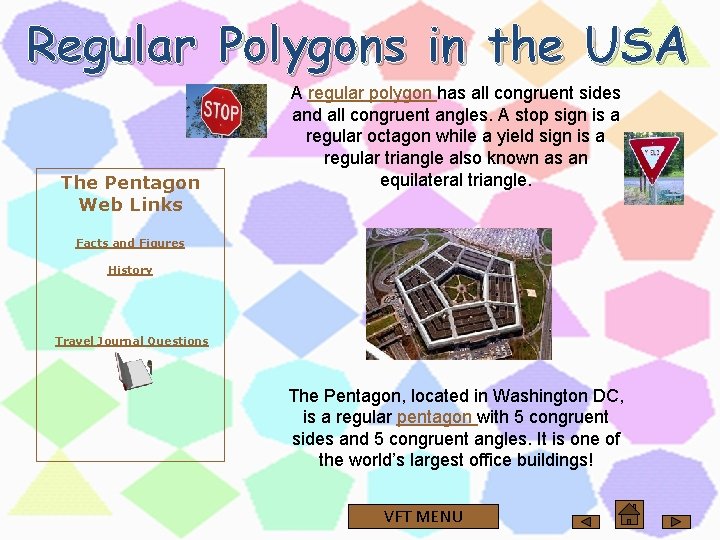
Regular Polygons in the USA The Pentagon Web Links A regular polygon has all congruent sides and all congruent angles. A stop sign is a regular octagon while a yield sign is a regular triangle also known as an equilateral triangle. Facts and Figures History Travel Journal Questions The Pentagon, located in Washington DC, is a regular pentagon with 5 congruent sides and 5 congruent angles. It is one of the world’s largest office buildings! VFT MENU
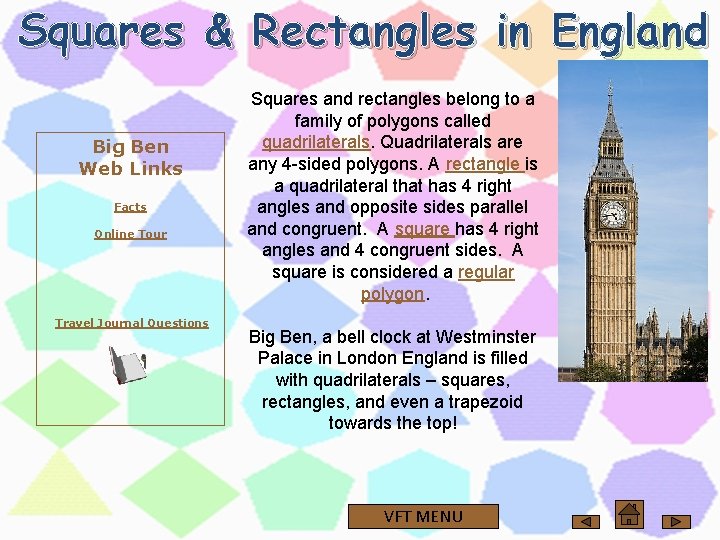
Squares & Rectangles in England Big Ben Web Links Facts Online Tour Travel Journal Questions Squares and rectangles belong to a family of polygons called quadrilaterals. Quadrilaterals are any 4 -sided polygons. A rectangle is a quadrilateral that has 4 right angles and opposite sides parallel and congruent. A square has 4 right angles and 4 congruent sides. A square is considered a regular polygon. Big Ben, a bell clock at Westminster Palace in London England is filled with quadrilaterals – squares, rectangles, and even a trapezoid towards the top! VFT MENU
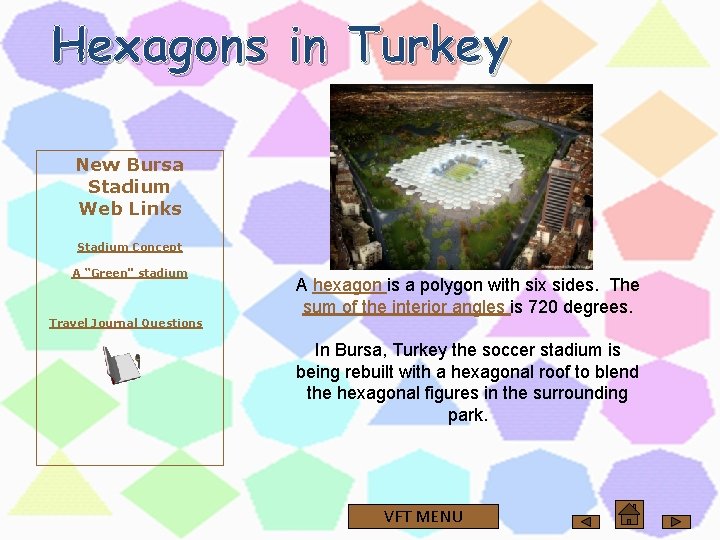
Hexagons in Turkey New Bursa Stadium Web Links Stadium Concept A “Green" stadium Travel Journal Questions A hexagon is a polygon with six sides. The sum of the interior angles is 720 degrees. In Bursa, Turkey the soccer stadium is being rebuilt with a hexagonal roof to blend the hexagonal figures in the surrounding park. VFT MENU
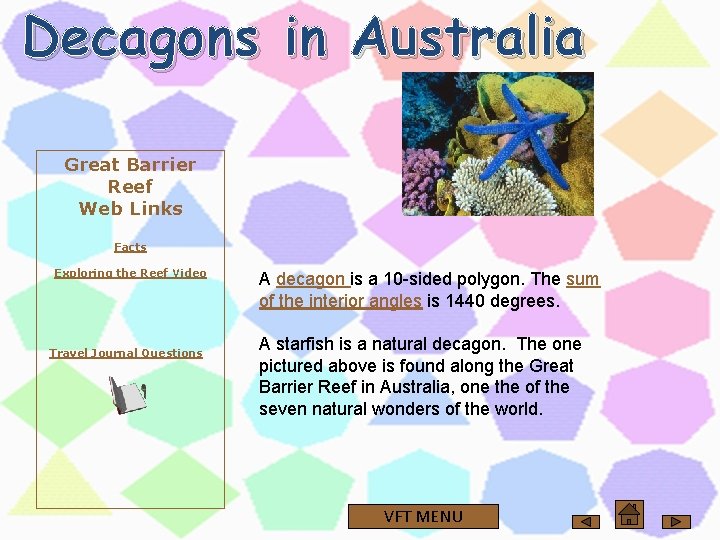
Decagons in Australia Great Barrier Reef Web Links Facts Exploring the Reef Video Travel Journal Questions A decagon is a 10 -sided polygon. The sum of the interior angles is 1440 degrees. A starfish is a natural decagon. The one pictured above is found along the Great Barrier Reef in Australia, one the of the seven natural wonders of the world. VFT MENU
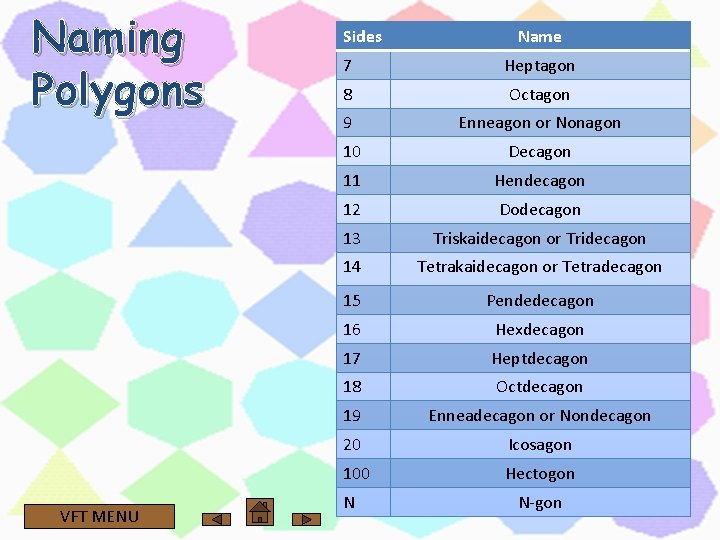
Naming Polygons VFT MENU Sides Name 7 Heptagon 8 Octagon 9 Enneagon or Nonagon 10 Decagon 11 Hendecagon 12 Dodecagon 13 Triskaidecagon or Tridecagon 14 Tetrakaidecagon or Tetradecagon 15 Pendedecagon 16 Hexdecagon 17 Heptdecagon 18 Octdecagon 19 Enneadecagon or Nondecagon 20 Icosagon 100 Hectogon N N-gon
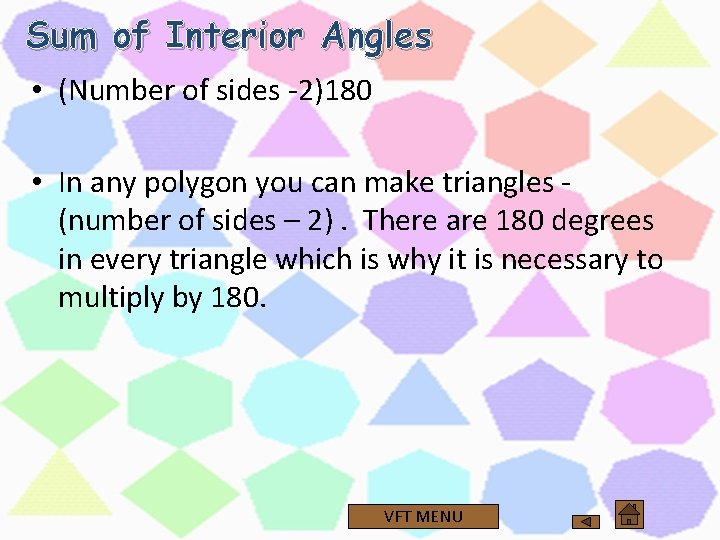
Sum of Interior Angles • (Number of sides -2)180 • In any polygon you can make triangles (number of sides – 2). There are 180 degrees in every triangle which is why it is necessary to multiply by 180. VFT MENU