
Explorations in Artificial Intelligence Prof Carla P Gomes

- Slides: 84
Explorations in Artificial Intelligence Prof. Carla P. Gomes gomes@cs. cornell. edu Module 3 -1 -2 Logic Based Reasoning Proof Methods 1
Proofs Methods 2
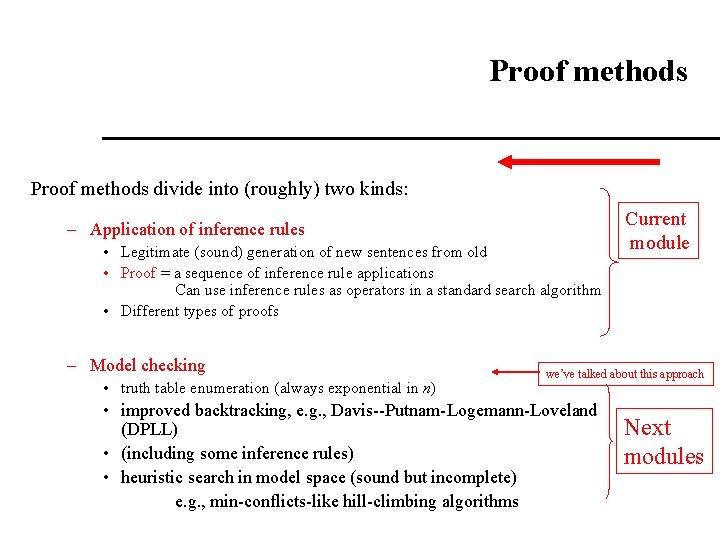
Proof methods divide into (roughly) two kinds: – Application of inference rules • Legitimate (sound) generation of new sentences from old • Proof = a sequence of inference rule applications Can use inference rules as operators in a standard search algorithm • Different types of proofs – Model checking • truth table enumeration (always exponential in n) Current module we’ve talked about this approach • improved backtracking, e. g. , Davis--Putnam-Logemann-Loveland (DPLL) • (including some inference rules) • heuristic search in model space (sound but incomplete) e. g. , min-conflicts-like hill-climbing algorithms Next modules
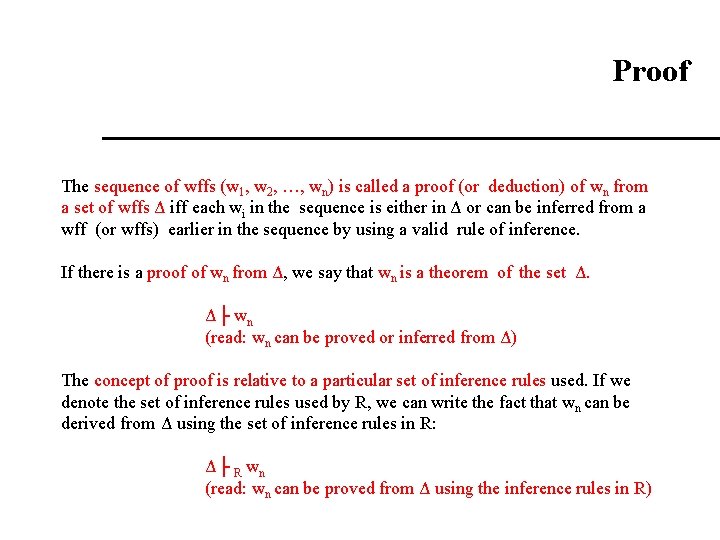
Proof The sequence of wffs (w 1, w 2, …, wn) is called a proof (or deduction) of wn from a set of wffs Δ iff each wi in the sequence is either in Δ or can be inferred from a wff (or wffs) earlier in the sequence by using a valid rule of inference. If there is a proof of wn from Δ, we say that wn is a theorem of the set Δ. Δ├ wn (read: wn can be proved or inferred from Δ) The concept of proof is relative to a particular set of inference rules used. If we denote the set of inference rules used by R, we can write the fact that wn can be derived from Δ using the set of inference rules in R: Δ├ R wn (read: wn can be proved from Δ using the inference rules in R)
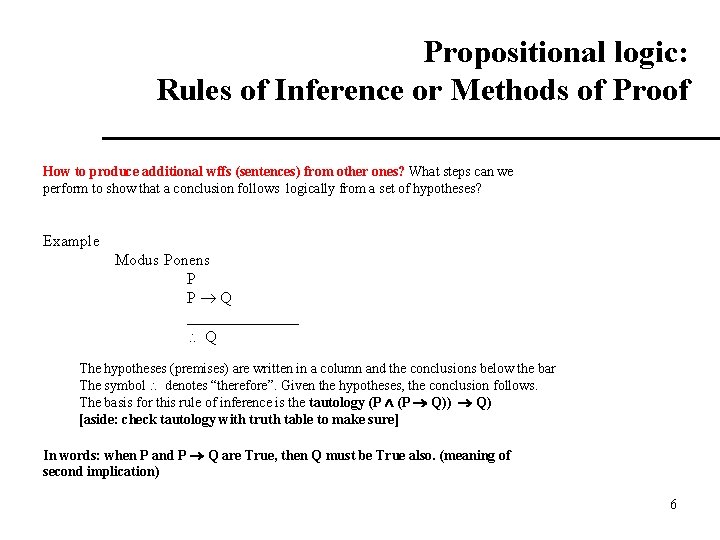
Propositional logic: Rules of Inference or Methods of Proof How to produce additional wffs (sentences) from other ones? What steps can we perform to show that a conclusion follows logically from a set of hypotheses? Example Modus Ponens P P Q _______ Q The hypotheses (premises) are written in a column and the conclusions below the bar The symbol denotes “therefore”. Given the hypotheses, the conclusion follows. The basis for this rule of inference is the tautology (P Q)) Q) [aside: check tautology with truth table to make sure] In words: when P and P Q are True, then Q must be True also. (meaning of second implication) 6
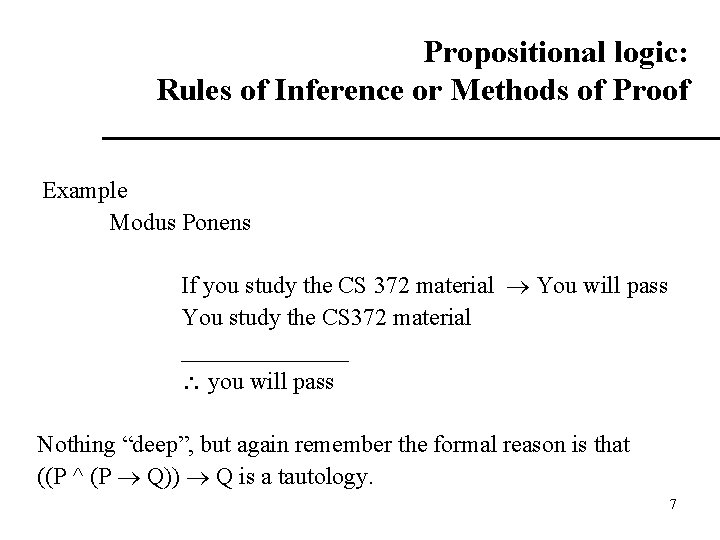
Propositional logic: Rules of Inference or Methods of Proof Example Modus Ponens If you study the CS 372 material You will pass You study the CS 372 material _______ you will pass Nothing “deep”, but again remember the formal reason is that ((P ^ (P Q)) Q is a tautology. 7
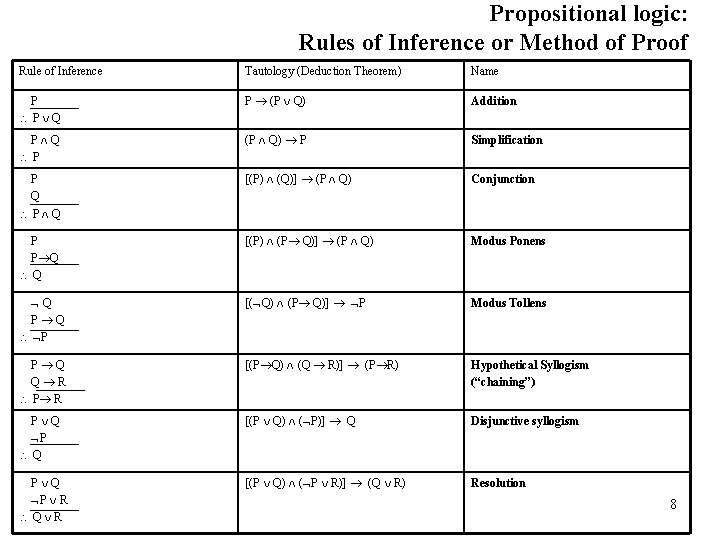
Propositional logic: Rules of Inference or Method of Proof Rule of Inference Tautology (Deduction Theorem) Name P P Q P (P Q) Addition P Q P (P Q) P Simplification P Q [(P) (Q)] (P Q) Conjunction P P Q Q [(P) (P Q)] (P Q) Modus Ponens Q P Q P [( Q) (P Q)] P Modus Tollens P Q Q R P R [(P Q) (Q R)] (P R) Hypothetical Syllogism (“chaining”) P Q [(P Q) ( P)] Q Disjunctive syllogism P Q P R Q R [(P Q) ( P R)] (Q R) Resolution 8
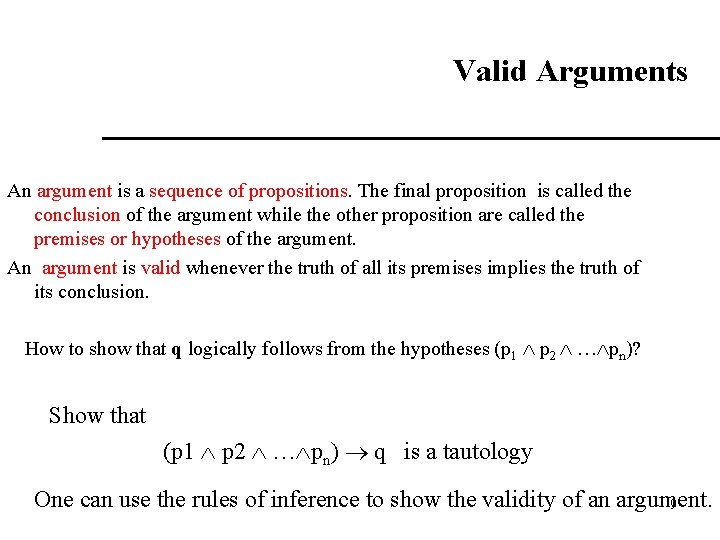
Valid Arguments An argument is a sequence of propositions. The final proposition is called the conclusion of the argument while the other proposition are called the premises or hypotheses of the argument. An argument is valid whenever the truth of all its premises implies the truth of its conclusion. How to show that q logically follows from the hypotheses (p 1 p 2 … pn)? Show that (p 1 p 2 … pn) q is a tautology One can use the rules of inference to show the validity of an argument. 9
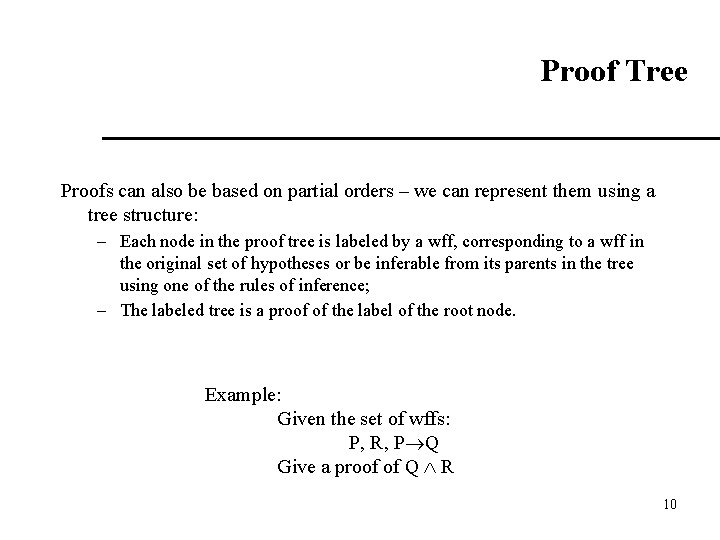
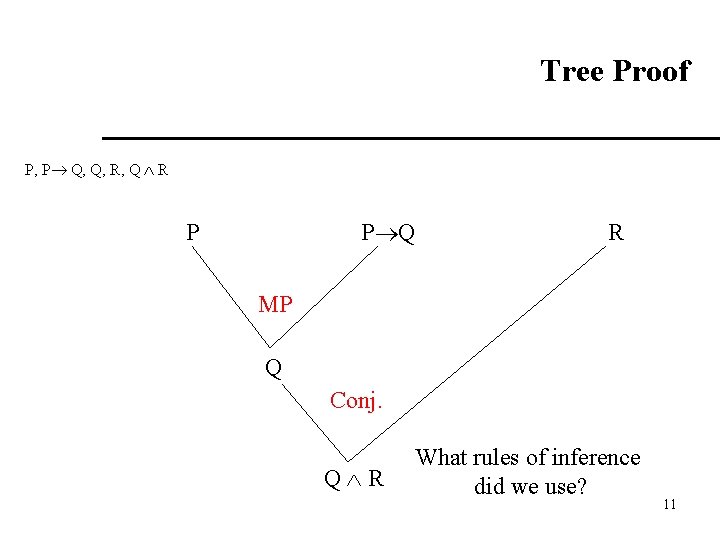
Proof Tree Proofs can also be based on partial orders – we can represent them using a tree structure: – Each node in the proof tree is labeled by a wff, corresponding to a wff in the original set of hypotheses or be inferable from its parents in the tree using one of the rules of inference; – The labeled tree is a proof of the label of the root node. Example: Given the set of wffs: P, R, P Q Give a proof of Q R 10
Tree Proof P, P Q, Q, R, Q R P P Q R MP Q Conj. Q R What rules of inference did we use? 11
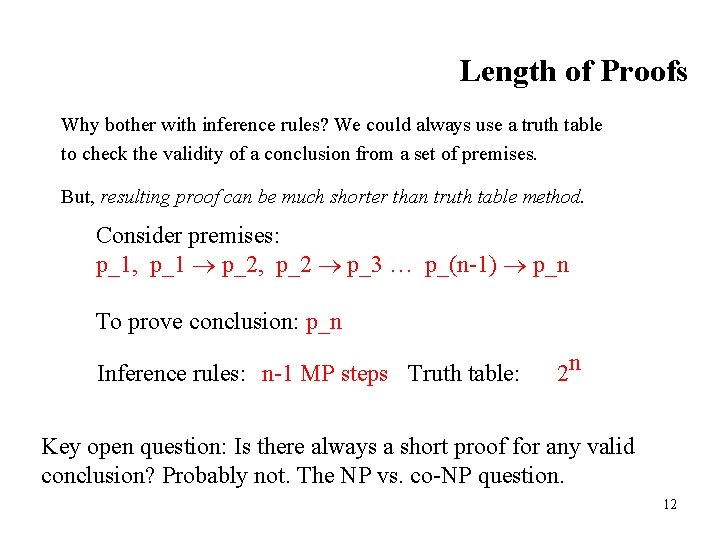
Length of Proofs Why bother with inference rules? We could always use a truth table to check the validity of a conclusion from a set of premises. But, resulting proof can be much shorter than truth table method. Consider premises: p_1, p_1 p_2, p_2 p_3 … p_(n-1) p_n To prove conclusion: p_n Inference rules: n-1 MP steps Truth table: 2 n Key open question: Is there always a short proof for any valid conclusion? Probably not. The NP vs. co-NP question. 12
Beyond Propositional Logic: Predicates and Quantifiers 13
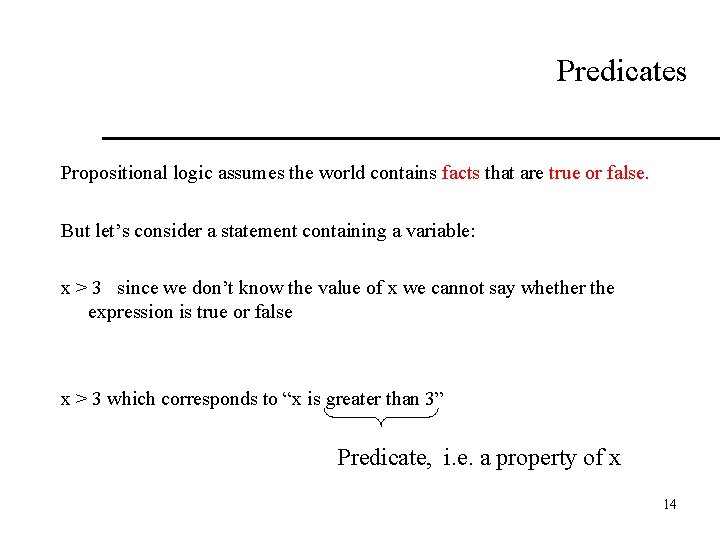
Predicates Propositional logic assumes the world contains facts that are true or false. But let’s consider a statement containing a variable: x > 3 since we don’t know the value of x we cannot say whether the expression is true or false x > 3 which corresponds to “x is greater than 3” Predicate, i. e. a property of x 14
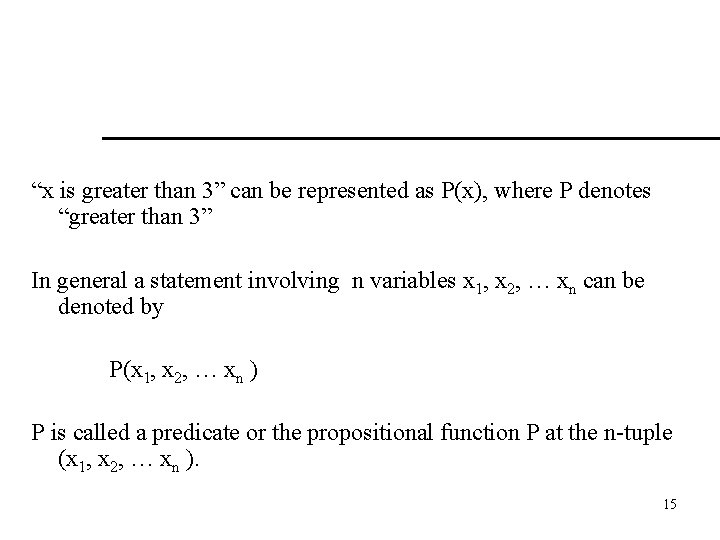
“x is greater than 3” can be represented as P(x), where P denotes “greater than 3” In general a statement involving n variables x 1, x 2, … xn can be denoted by P(x 1, x 2, … xn ) P is called a predicate or the propositional function P at the n-tuple (x 1, x 2, … xn ). 15
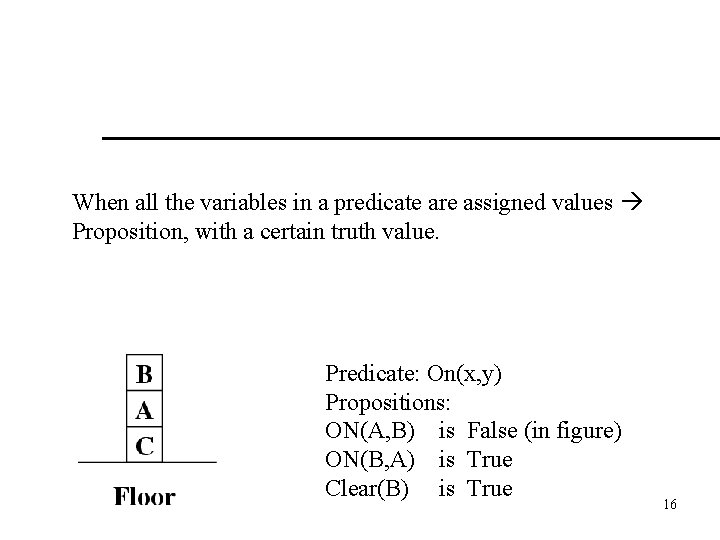
When all the variables in a predicate are assigned values Proposition, with a certain truth value. Predicate: On(x, y) Propositions: ON(A, B) is False (in figure) ON(B, A) is True Clear(B) is True 16
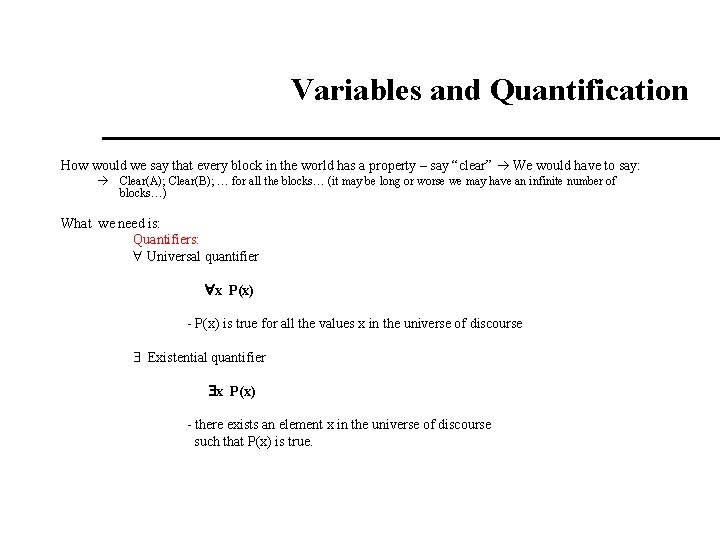
Variables and Quantification How would we say that every block in the world has a property – say “clear” We would have to say: Clear(A); Clear(B); … for all the blocks… (it may be long or worse we may have an infinite number of blocks…) What we need is: Quantifiers: Universal quantifier x P(x) - P(x) is true for all the values x in the universe of discourse Existential quantifier x P(x) - there exists an element x in the universe of discourse such that P(x) is true.
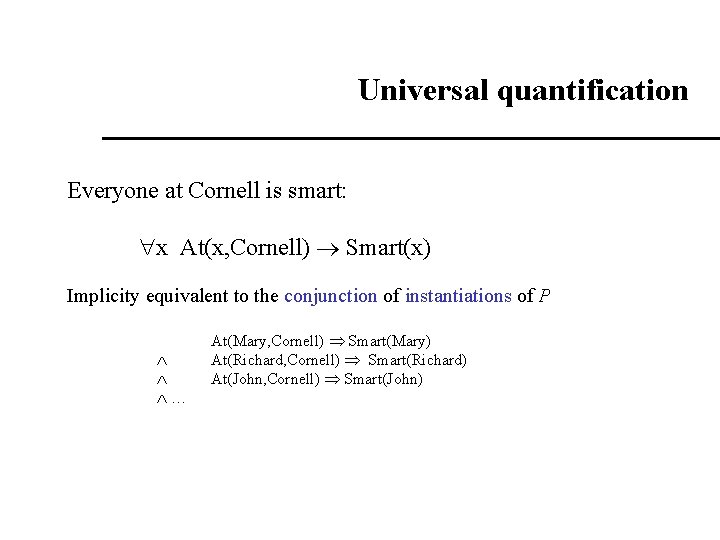
Universal quantification Everyone at Cornell is smart: x At(x, Cornell) Smart(x) Implicity equivalent to the conjunction of instantiations of P … At(Mary, Cornell) Smart(Mary) At(Richard, Cornell) Smart(Richard) At(John, Cornell) Smart(John)
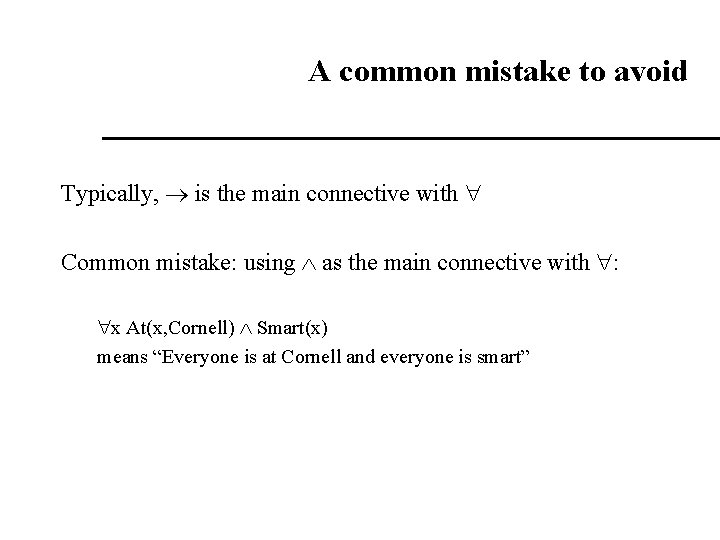
A common mistake to avoid Typically, is the main connective with Common mistake: using as the main connective with : x At(x, Cornell) Smart(x) means “Everyone is at Cornell and everyone is smart”
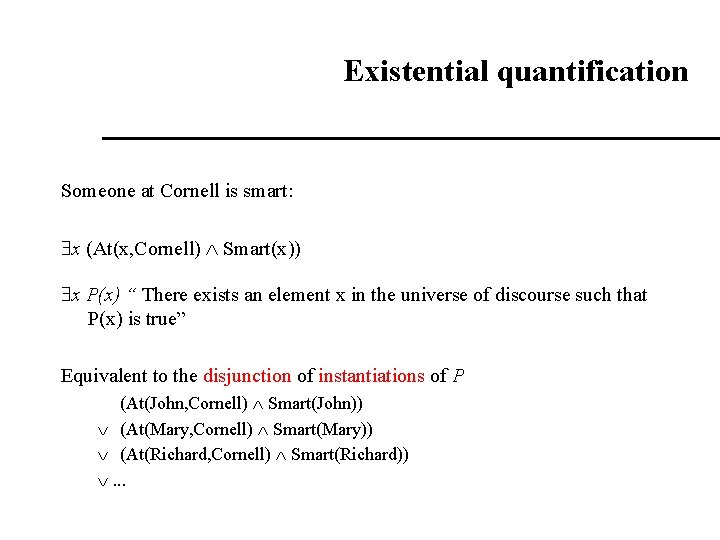
Existential quantification Someone at Cornell is smart: x (At(x, Cornell) Smart(x)) x P(x) “ There exists an element x in the universe of discourse such that P(x) is true” Equivalent to the disjunction of instantiations of P (At(John, Cornell) Smart(John)) (At(Mary, Cornell) Smart(Mary)) (At(Richard, Cornell) Smart(Richard)) . . .
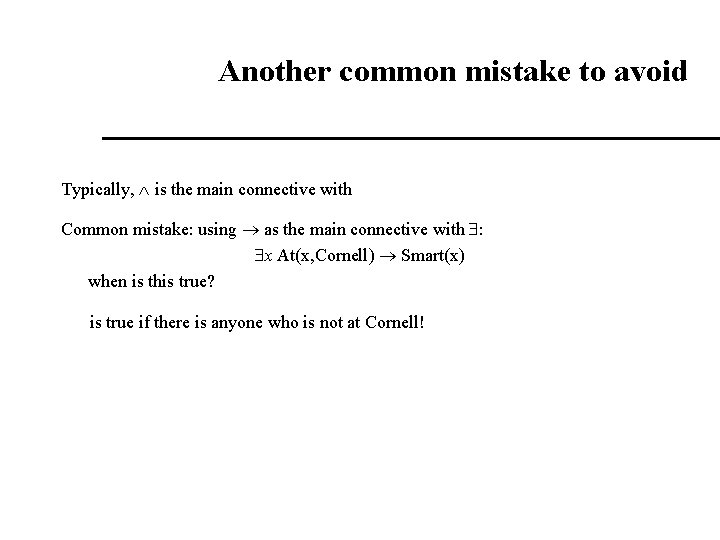
Another common mistake to avoid Typically, is the main connective with Common mistake: using as the main connective with : x At(x, Cornell) Smart(x) when is this true? is true if there is anyone who is not at Cornell!
Quantified formulas If ω is a wff and x is a variable symbol, then both x ω and x ω are wffs. x is the variable quantified over ω is said to be within the scope of the quantifier if all the variables in ω are quantified over in ω, we say that we have a closed wff or closed sentence. Examples: x [P(x) R(x)] x [P(x) ( y [R(x, y) S(x))]]
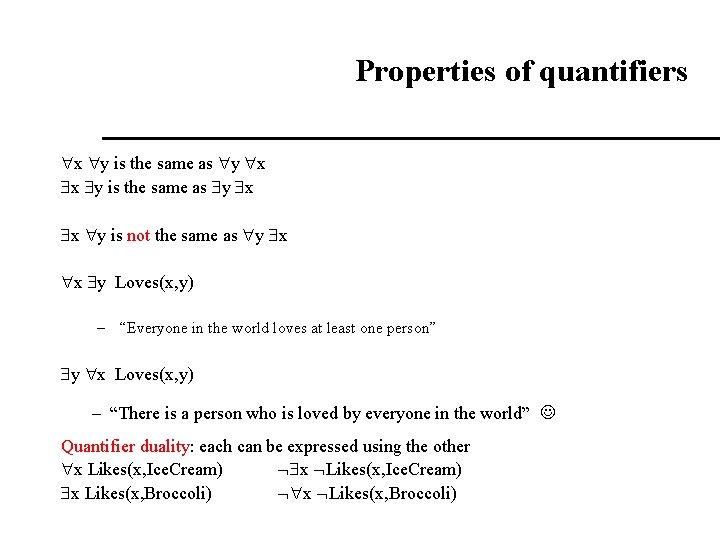
Properties of quantifiers x y is the same as y x x y is not the same as y x x y Loves(x, y) – “Everyone in the world loves at least one person” y x Loves(x, y) – “There is a person who is loved by everyone in the world” Quantifier duality: each can be expressed using the other x Likes(x, Ice. Cream) x Likes(x, Broccoli)
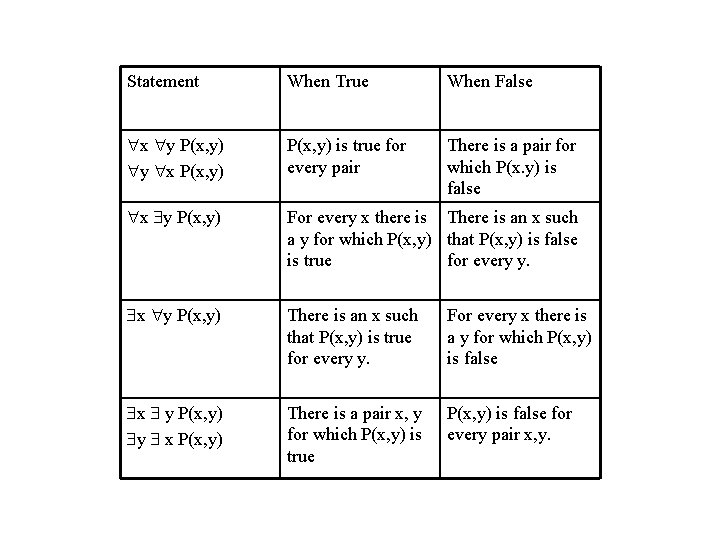
Statement When True When False x y P(x, y) y x P(x, y) is true for every pair There is a pair for which P(x. y) is false x y P(x, y) For every x there is There is an x such a y for which P(x, y) that P(x, y) is false is true for every y. x y P(x, y) There is an x such that P(x, y) is true for every y. For every x there is a y for which P(x, y) is false x y P(x, y) y x P(x, y) There is a pair x, y for which P(x, y) is true P(x, y) is false for every pair x, y.
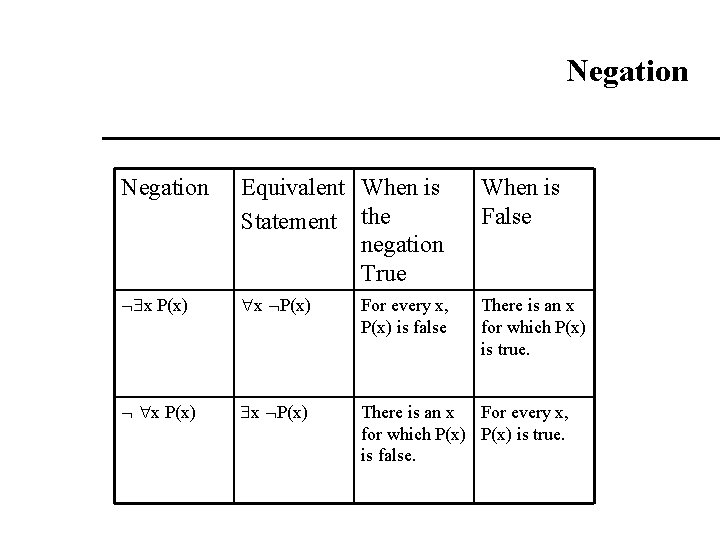
Negation Equivalent When is Statement the negation True When is False x P(x) For every x, P(x) is false There is an x for which P(x) is true. x P(x) There is an x For every x, for which P(x) is true. is false.
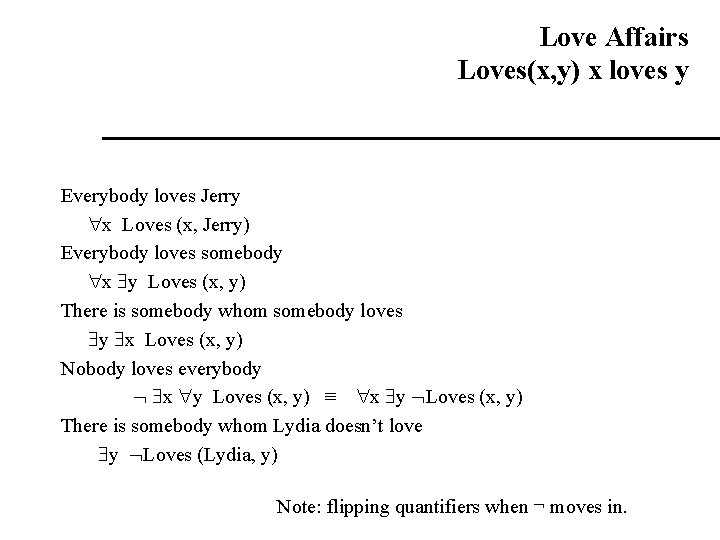
Love Affairs Loves(x, y) x loves y Everybody loves Jerry x Loves (x, Jerry) Everybody loves somebody x y Loves (x, y) There is somebody whom somebody loves y x Loves (x, y) Nobody loves everybody x y Loves (x, y) ≡ x y Loves (x, y) There is somebody whom Lydia doesn’t love y Loves (Lydia, y) Note: flipping quantifiers when ¬ moves in.
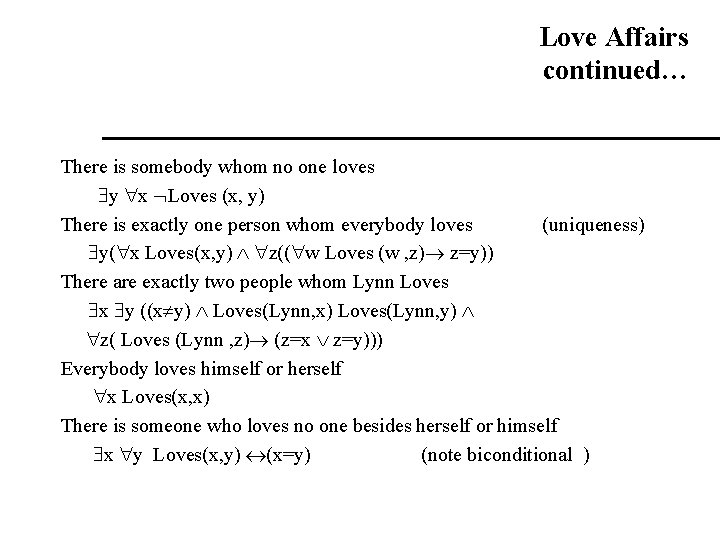
Love Affairs continued… There is somebody whom no one loves y x Loves (x, y) There is exactly one person whom everybody loves (uniqueness) y( x Loves(x, y) z(( w Loves (w , z) z=y)) There are exactly two people whom Lynn Loves x y ((x y) Loves(Lynn, x) Loves(Lynn, y) z( Loves (Lynn , z) (z=x z=y))) Everybody loves himself or herself x Loves(x, x) There is someone who loves no one besides herself or himself x y Loves(x, y) (x=y) (note biconditional )
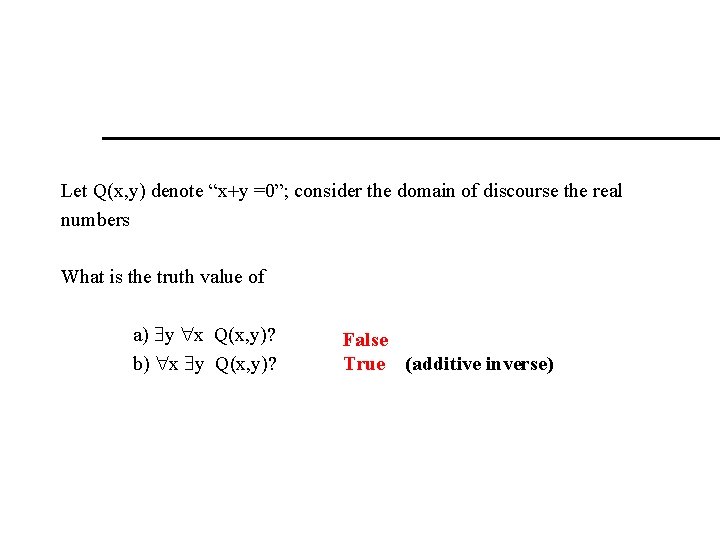
Let Q(x, y) denote “x y =0”; consider the domain of discourse the real numbers What is the truth value of a) y x Q(x, y)? b) x y Q(x, y)? False True (additive inverse)
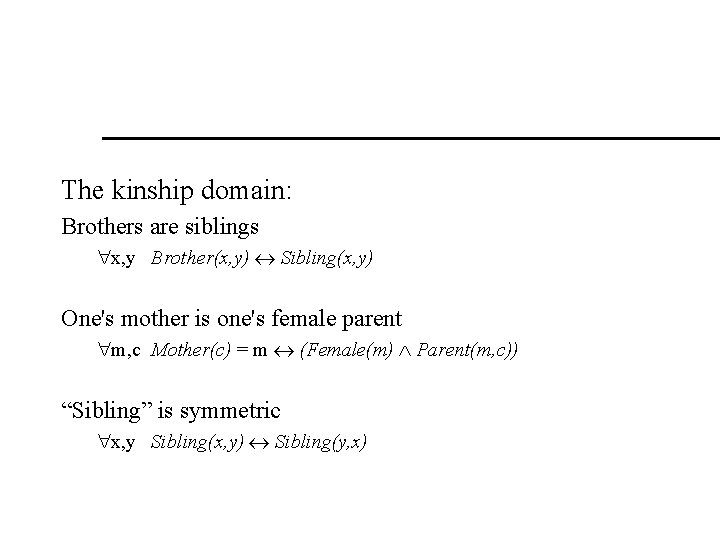
The kinship domain: Brothers are siblings x, y Brother(x, y) Sibling(x, y) One's mother is one's female parent m, c Mother(c) = m (Female(m) Parent(m, c)) “Sibling” is symmetric x, y Sibling(x, y) Sibling(y, x)
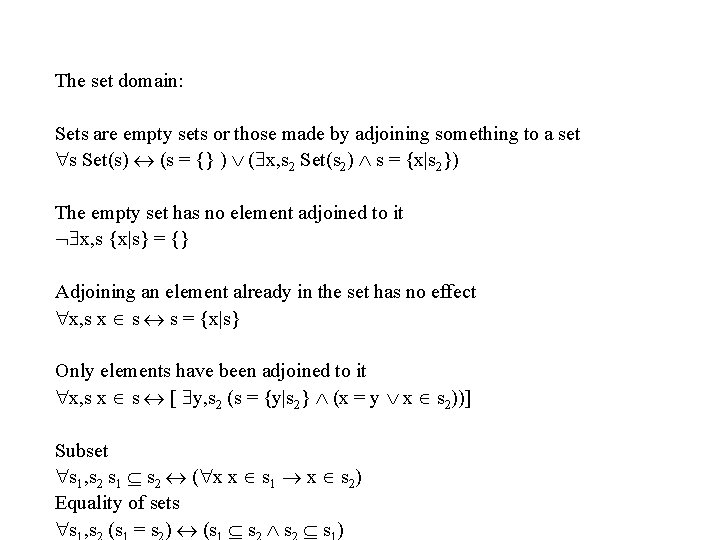
The set domain: Sets are empty sets or those made by adjoining something to a set s Set(s) (s = {} ) ( x, s 2 Set(s 2) s = {x|s 2}) The empty set has no element adjoined to it x, s {x|s} = {} Adjoining an element already in the set has no effect x, s x s s = {x|s} Only elements have been adjoined to it x, s x s [ y, s 2 (s = {y|s 2} (x = y x s 2))] Subset s 1, s 2 s 1 s 2 ( x x s 1 x s 2) Equality of sets s , s (s = s ) (s s )
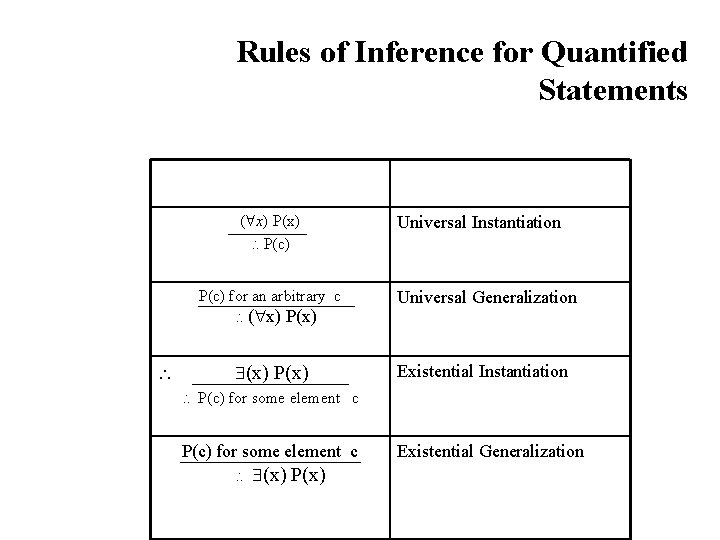
Rules of Inference for Quantified Statements ( x) P(c) Universal Instantiation P(c) for an arbitrary c ( x) P(x) Universal Generalization (x) P(x) Existential Instantiation P(c) for some element c (x) P(x) Existential Generalization
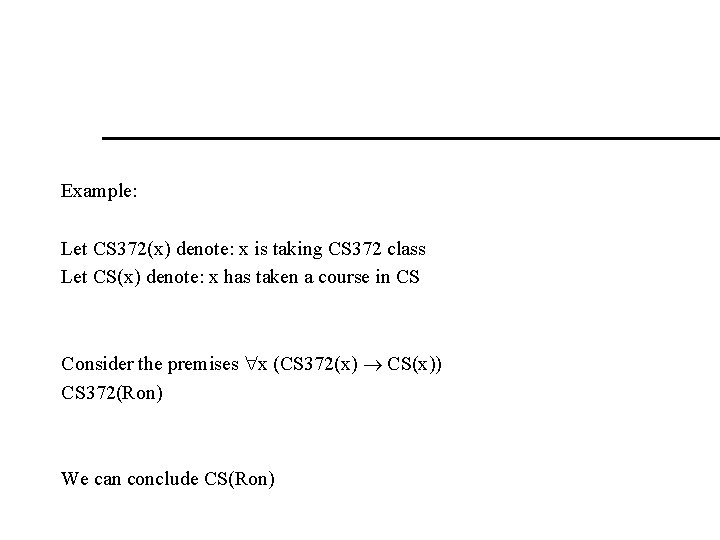
Example: Let CS 372(x) denote: x is taking CS 372 class Let CS(x) denote: x has taken a course in CS Consider the premises x (CS 372(x) CS(x)) CS 372(Ron) We can conclude CS(Ron)
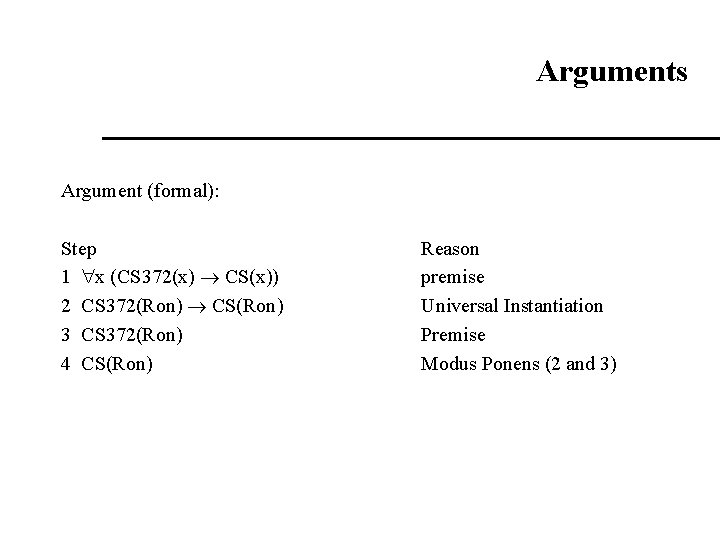
Arguments Argument (formal): Step 1 x (CS 372(x) CS(x)) 2 CS 372(Ron) CS(Ron) 3 CS 372(Ron) 4 CS(Ron) Reason premise Universal Instantiation Premise Modus Ponens (2 and 3)
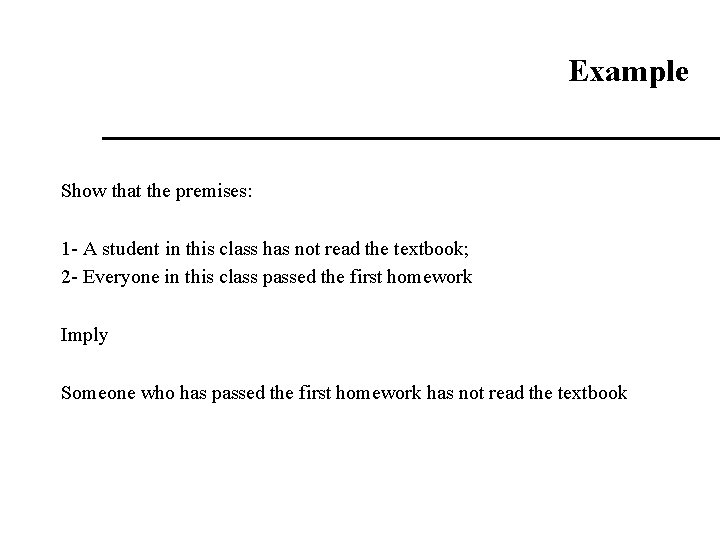
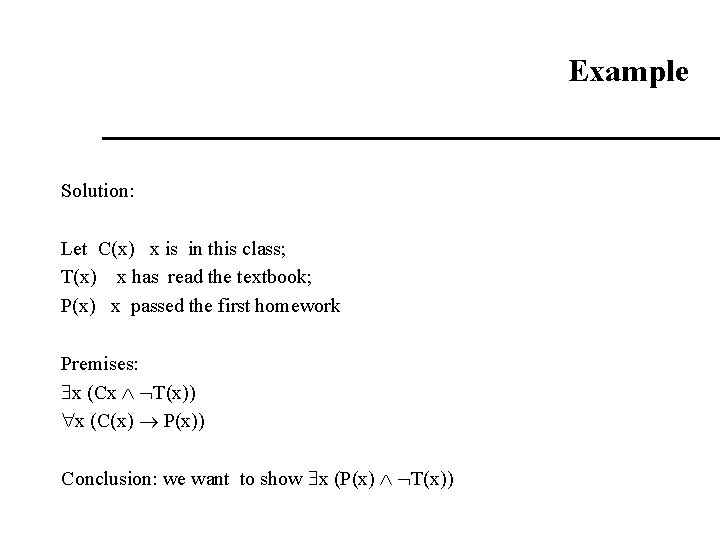
Example Show that the premises: 1 - A student in this class has not read the textbook; 2 - Everyone in this class passed the first homework Imply Someone who has passed the first homework has not read the textbook
Example Solution: Let C(x) x is in this class; T(x) x has read the textbook; P(x) x passed the first homework Premises: x (Cx T(x)) x (C(x) P(x)) Conclusion: we want to show x (P(x) T(x))
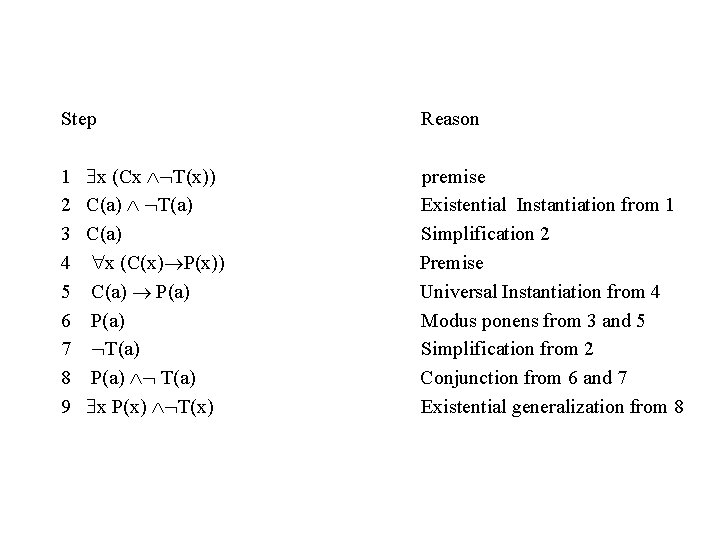
Step 1 2 3 4 5 6 7 8 9 x (Cx T(x)) C(a) T(a) C(a) x (C(x) P(x)) C(a) P(a) T(a) P(a) T(a) x P(x) T(x) Reason premise Existential Instantiation from 1 Simplification 2 Premise Universal Instantiation from 4 Modus ponens from 3 and 5 Simplification from 2 Conjunction from 6 and 7 Existential generalization from 8
Resolution in Propositional Logic
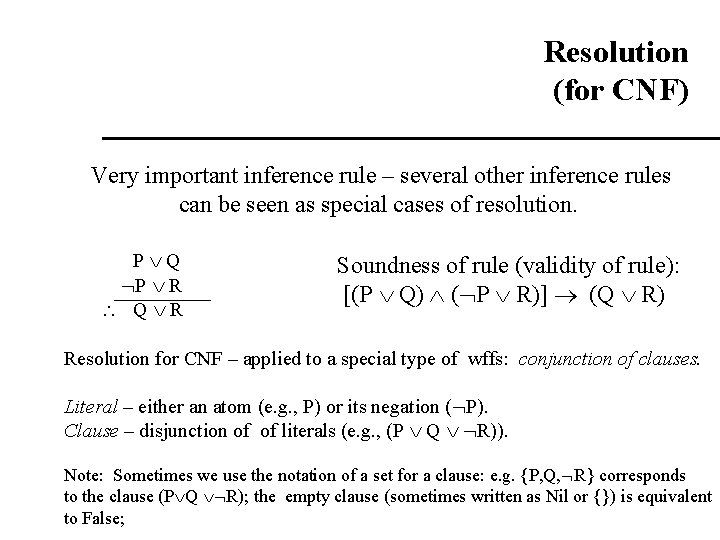
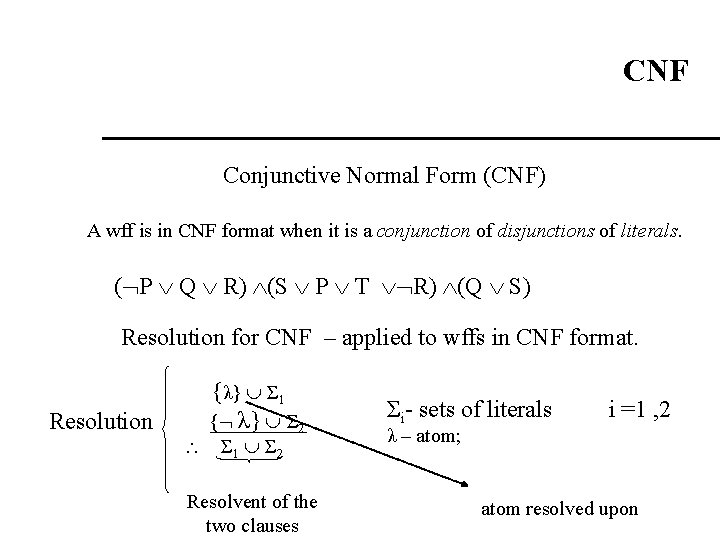
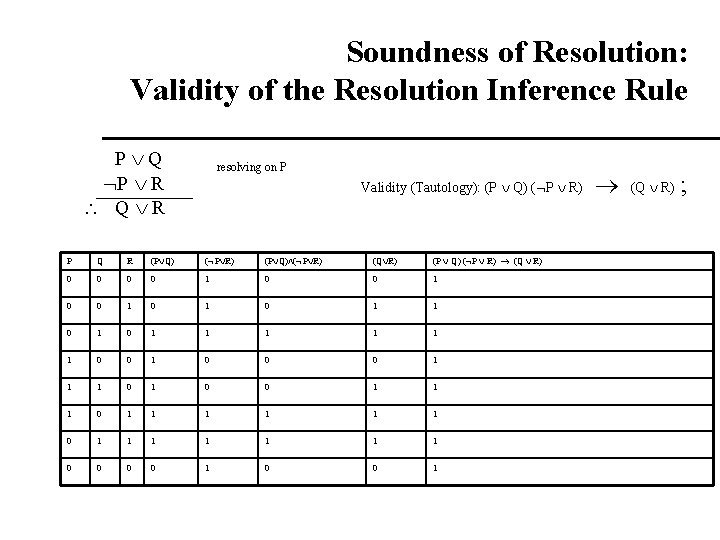
Resolution (for CNF) Very important inference rule – several other inference rules can be seen as special cases of resolution. P Q P R Q R Soundness of rule (validity of rule): [(P Q) ( P R)] (Q R) Resolution for CNF – applied to a special type of wffs: conjunction of clauses. Literal – either an atom (e. g. , P) or its negation ( P). Clause – disjunction of of literals (e. g. , (P Q R)). Note: Sometimes we use the notation of a set for a clause: e. g. {P, Q, R} corresponds to the clause (P Q R); the empty clause (sometimes written as Nil or {}) is equivalent to False;
CNF Conjunctive Normal Form (CNF) A wff is in CNF format when it is a conjunction of disjunctions of literals. ( P Q R) (S P T R) (Q S) Resolution for CNF – applied to wffs in CNF format. Resolution {λ} Σ 1 { λ} Σ 2 Σ 1 Σ 2 Resolvent of the two clauses Σi- sets of literals i =1 , 2 λ – atom; atom resolved upon
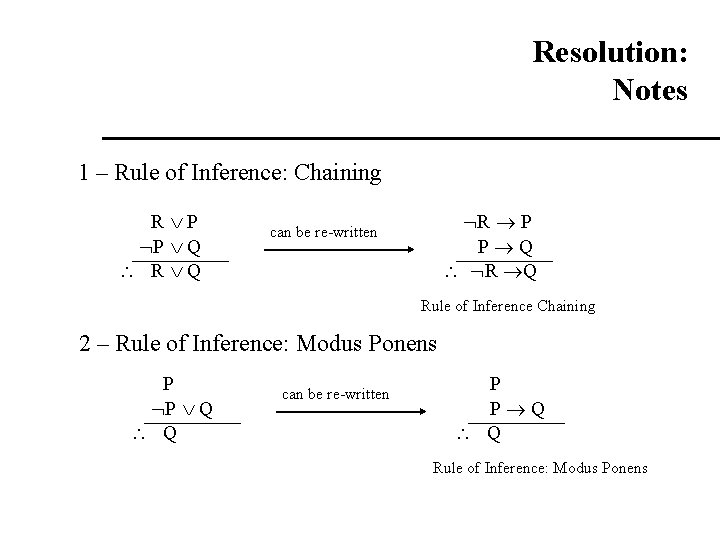
Resolution: Notes 1 – Rule of Inference: Chaining R P P Q R P P Q R Q can be re-written Rule of Inference Chaining 2 – Rule of Inference: Modus Ponens P P Q Q can be re-written P P Q Q Rule of Inference: Modus Ponens
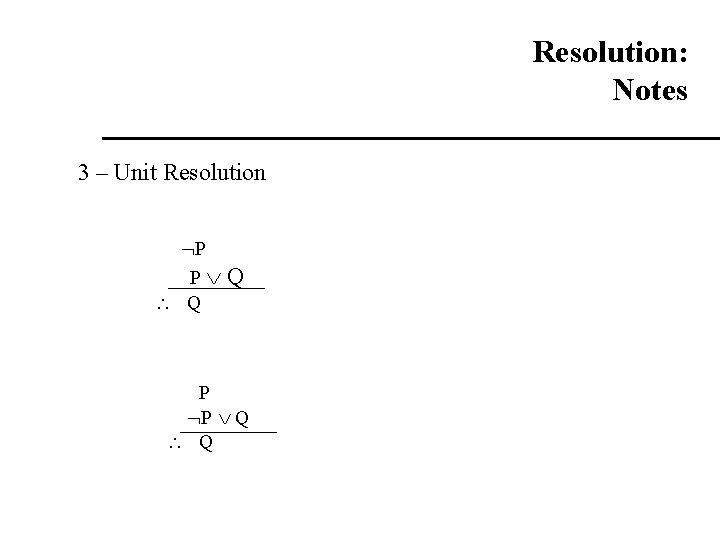
Resolution: Notes 3 – Unit Resolution P P Q Q P P Q Q
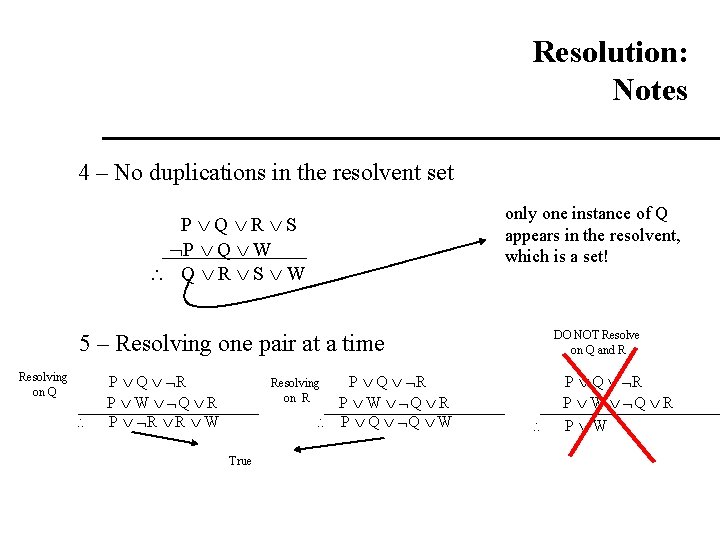
Resolution: Notes 4 – No duplications in the resolvent set only one instance of Q appears in the resolvent, which is a set! P Q R S P Q W Q R S W DO NOT Resolve on Q and R 5 – Resolving one pair at a time Resolving on Q P Q R P W Q R P R R W P Q R P W Q R P Q Q W Resolving on R True P Q R P W Q R P W
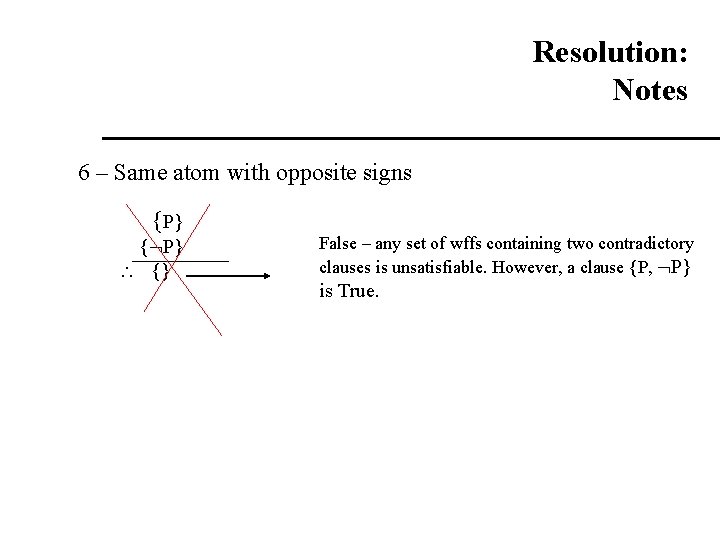
Resolution: Notes 6 – Same atom with opposite signs {P} { P} {} False – any set of wffs containing two contradictory clauses is unsatisfiable. However, a clause {P, P} is True.
Soundness of Resolution: Validity of the Resolution Inference Rule P Q P R Q R resolving on P Validity (Tautology): (P Q) ( P R) P Q R (P Q) ( P R) (Q R) (P Q) ( P R) (Q R) 0 0 1 0 1 0 1 1 1 1 0 0 0 1 1 1 1 1 1 0 1 1 1 1 0 0 1 (Q R) ;
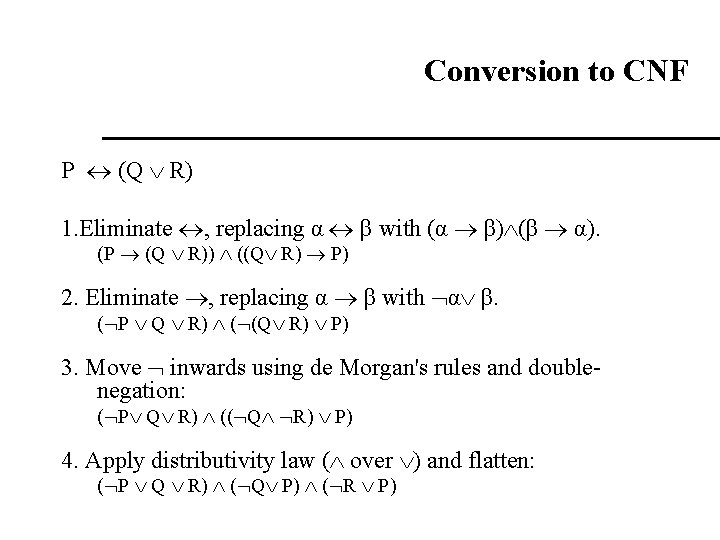
Conversion to CNF P (Q R) 1. Eliminate , replacing α β with (α β) (β α). (P (Q R)) ((Q R) P) 2. Eliminate , replacing α β with α β. ( P Q R) ( (Q R) P) 3. Move inwards using de Morgan's rules and doublenegation: ( P Q R) (( Q R) P) 4. Apply distributivity law ( over ) and flatten: ( P Q R) ( Q P) ( R P)
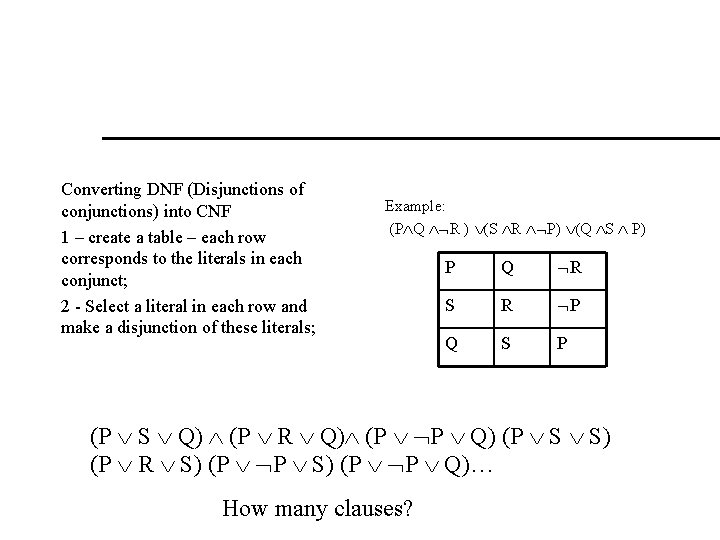
Converting DNF (Disjunctions of conjunctions) into CNF 1 – create a table – each row corresponds to the literals in each conjunct; 2 - Select a literal in each row and make a disjunction of these literals; Example: (P Q R ) (S R P) (Q S P) P Q R S R P Q S P (P S Q) (P R Q) (P P Q) (P S S) (P R S) (P P Q)… How many clauses?
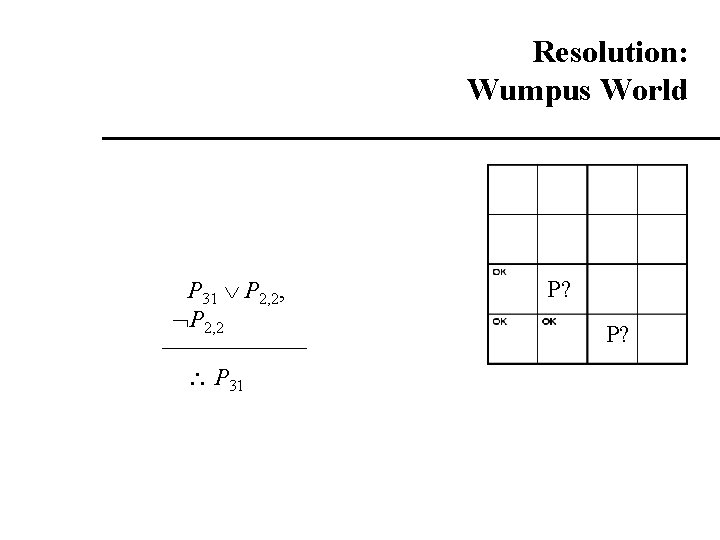
Resolution: Wumpus World P 31 P 2, 2, P 2, 2 P 31 P? P?
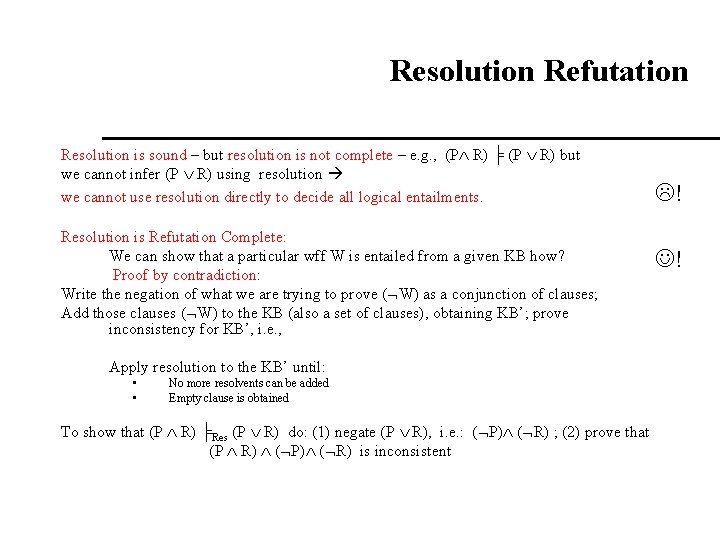
Resolution Refutation Resolution is sound – but resolution is not complete – e. g. , (P R) ╞ (P R) but we cannot infer (P R) using resolution we cannot use resolution directly to decide all logical entailments. Resolution is Refutation Complete: We can show that a particular wff W is entailed from a given KB how? Proof by contradiction: Write the negation of what we are trying to prove ( W) as a conjunction of clauses; Add those clauses ( W) to the KB (also a set of clauses), obtaining KB’; prove inconsistency for KB’, i. e. , Apply resolution to the KB’ until: • • No more resolvents can be added Empty clause is obtained To show that (P R) ╞Res (P R) do: (1) negate (P R), i. e. : ( P) ( R) ; (2) prove that (P R) ( P) ( R) is inconsistent ! !
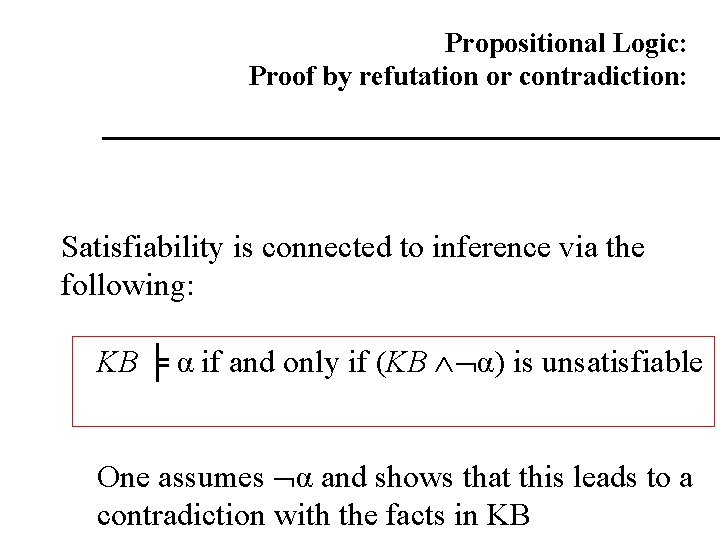
Propositional Logic: Proof by refutation or contradiction: Satisfiability is connected to inference via the following: KB ╞ α if and only if (KB α) is unsatisfiable One assumes α and shows that this leads to a contradiction with the facts in KB
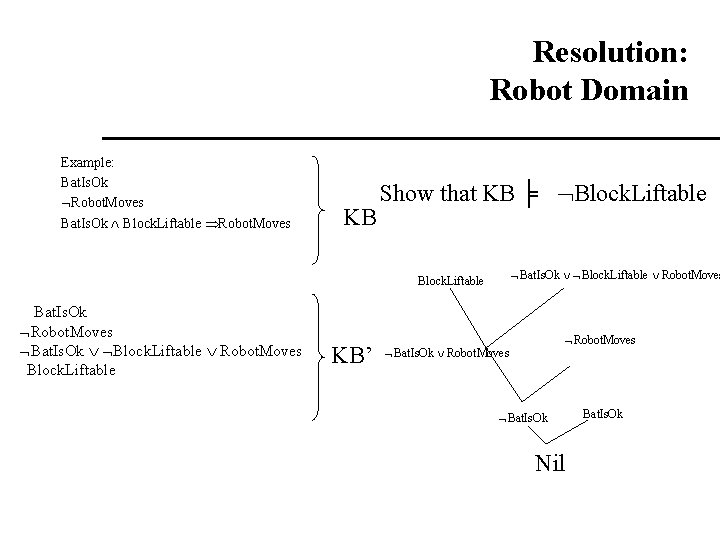
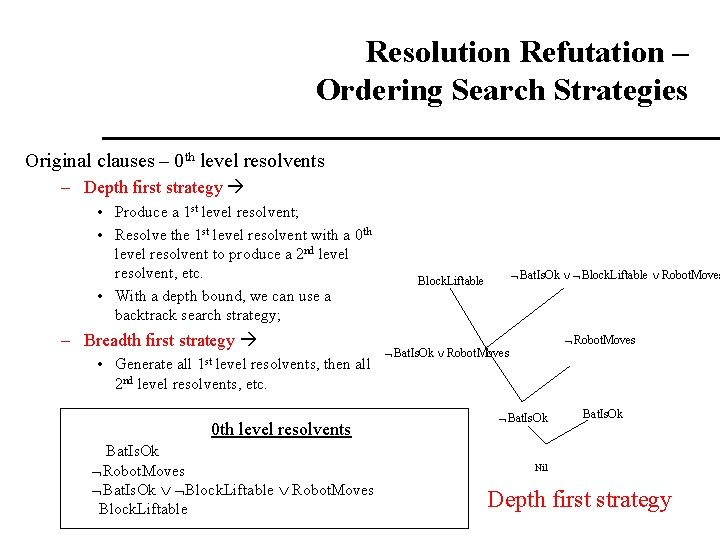
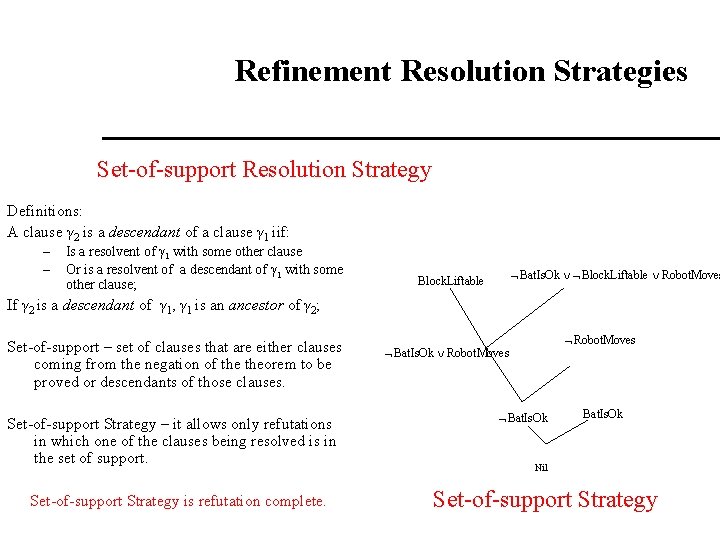
Resolution: Robot Domain Example: Bat. Is. Ok Robot. Moves Bat. Is. Ok Block. Liftable Robot. Moves KB Show that KB ╞ Block. Liftable Bat. Is. Ok Block. Liftable Robot. Moves Block. Liftable Bat. Is. Ok Robot. Moves Bat. Is. Ok Block. Liftable Robot. Moves Block. Liftable KB’ Robot. Moves Bat. Is. Ok Nil Bat. Is. Ok
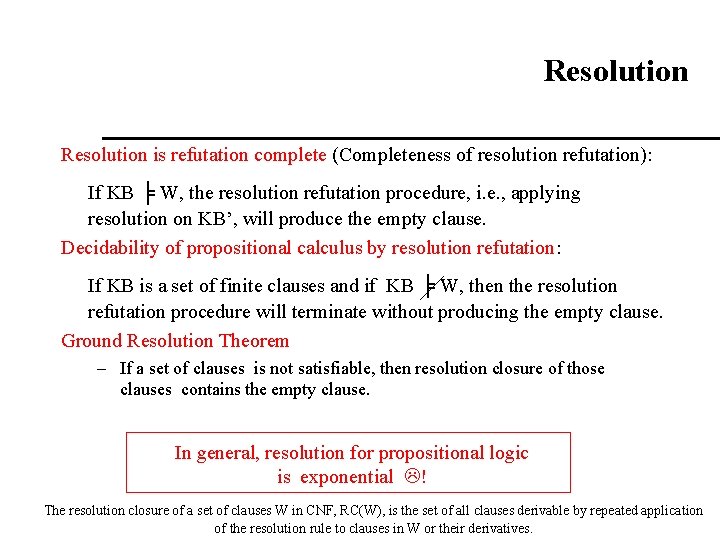
Resolution is refutation complete (Completeness of resolution refutation): If KB ╞ W, the resolution refutation procedure, i. e. , applying resolution on KB’, will produce the empty clause. Decidability of propositional calculus by resolution refutation: If KB is a set of finite clauses and if KB ╞ W, then the resolution refutation procedure will terminate without producing the empty clause. Ground Resolution Theorem – If a set of clauses is not satisfiable, then resolution closure of those clauses contains the empty clause. In general, resolution for propositional logic is exponential ! The resolution closure of a set of clauses W in CNF, RC(W), is the set of all clauses derivable by repeated application of the resolution rule to clauses in W or their derivatives.
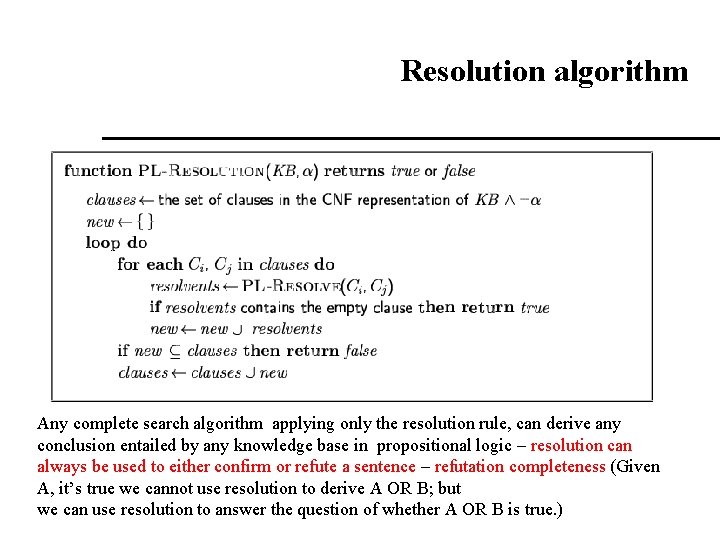
Resolution algorithm Proof by contradiction, i. e. , show KB α unsatisfiable Any complete search algorithm applying only the resolution rule, can derive any conclusion entailed by any knowledge base in propositional logic – resolution can always be used to either confirm or refute a sentence – refutation completeness (Given A, it’s true we cannot use resolution to derive A OR B; but we can use resolution to answer the question of whether A OR B is true. )
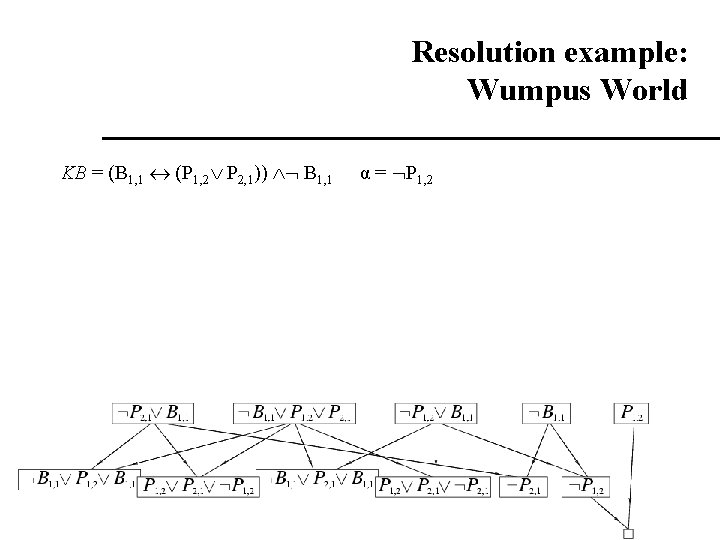
Resolution example: Wumpus World KB = (B 1, 1 (P 1, 2 P 2, 1)) B 1, 1 α = P 1, 2
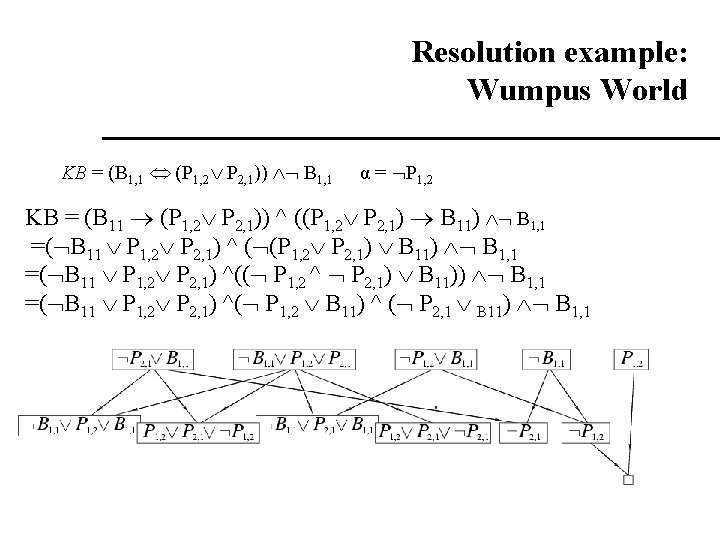
Resolution example: Wumpus World KB = (B 1, 1 (P 1, 2 P 2, 1)) B 1, 1 α = P 1, 2 KB = (B 11 (P 1, 2 P 2, 1)) ^ ((P 1, 2 P 2, 1) B 1, 1 =( B 11 P 1, 2 P 2, 1) ^ ( (P 1, 2 P 2, 1) B 1, 1 =( B 11 P 1, 2 P 2, 1) ^(( P 1, 2 ^ P 2, 1) B 11)) B 1, 1 =( B 11 P 1, 2 P 2, 1) ^( P 1, 2 B 11) ^ ( P 2, 1 B 11) B 1, 1
Resolution Refutation – Ordering Search Strategies Original clauses – 0 th level resolvents – Depth first strategy • Produce a 1 st level resolvent; • Resolve the 1 st level resolvent with a 0 th level resolvent to produce a 2 nd level resolvent, etc. • With a depth bound, we can use a backtrack search strategy; – Breadth first strategy • Generate all 1 st level resolvents, then all 2 nd level resolvents, etc. 0 th level resolvents Bat. Is. Ok Robot. Moves Bat. Is. Ok Block. Liftable Robot. Moves Bat. Is. Ok Nil Depth first strategy
Refinement Resolution Strategies Set-of-support Resolution Strategy Definitions: A clause γ 2 is a descendant of a clause γ 1 iif: – – Is a resolvent of γ 1 with some other clause Or is a resolvent of a descendant of γ 1 with some other clause; Bat. Is. Ok Block. Liftable Robot. Moves Block. Liftable If γ 2 is a descendant of γ 1, γ 1 is an ancestor of γ 2; Set-of-support – set of clauses that are either clauses coming from the negation of theorem to be proved or descendants of those clauses. Set-of-support Strategy – it allows only refutations in which one of the clauses being resolved is in the set of support. Set-of-support Strategy is refutation complete. Robot. Moves Bat. Is. Ok Nil Set-of-support Strategy
Refinement Strategies Ancestry-filtered strategy – allows only resolutions in which at least one member of the clauses being resolved either is a member of the original set of clauses or is an ancestor of the other clause being resolved; The ancestry-filtered strategy is refutation complete.
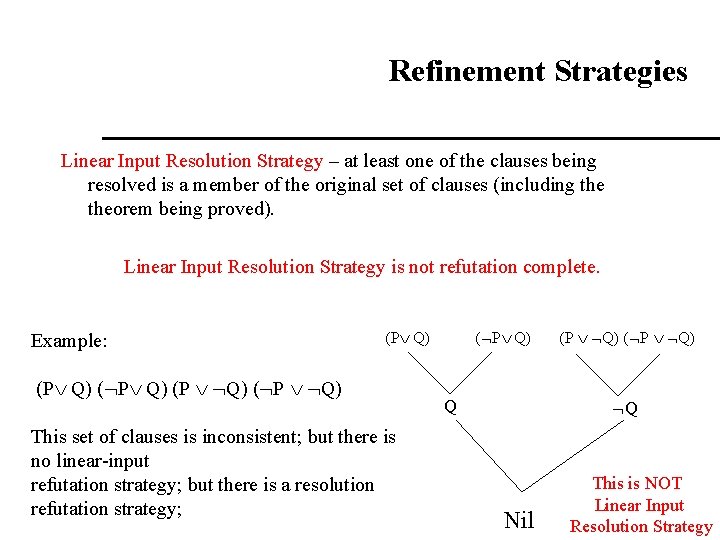
Refinement Strategies Linear Input Resolution Strategy – at least one of the clauses being resolved is a member of the original set of clauses (including theorem being proved). Linear Input Resolution Strategy is not refutation complete. Example: (P Q) (P Q) ( P Q) This set of clauses is inconsistent; but there is no linear-input refutation strategy; but there is a resolution refutation strategy; ( P Q) (P Q) ( P Q) Q Q Nil This is NOT Linear Input Resolution Strategy
Horn Clauses
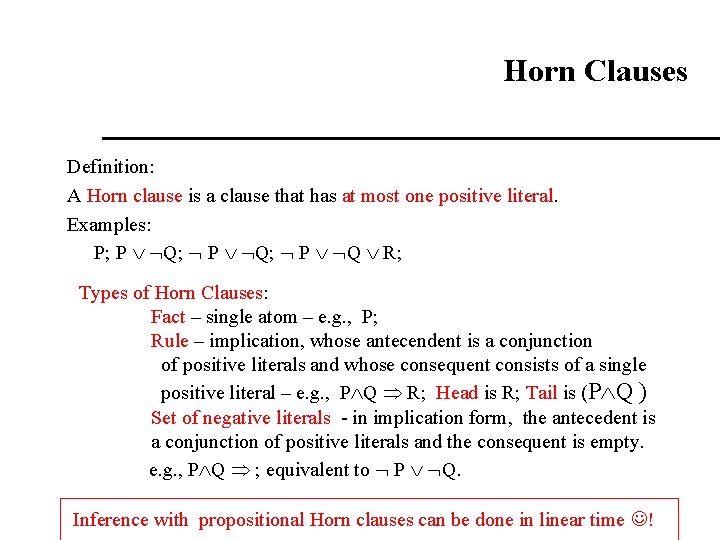
Horn Clauses Definition: A Horn clause is a clause that has at most one positive literal. Examples: P; P Q; P Q R; Types of Horn Clauses: Fact – single atom – e. g. , P; Rule – implication, whose antecendent is a conjunction of positive literals and whose consequent consists of a single positive literal – e. g. , P Q R; Head is R; Tail is (P Q ) Set of negative literals - in implication form, the antecedent is a conjunction of positive literals and the consequent is empty. e. g. , P Q ; equivalent to P Q. Inference with propositional Horn clauses can be done in linear time !
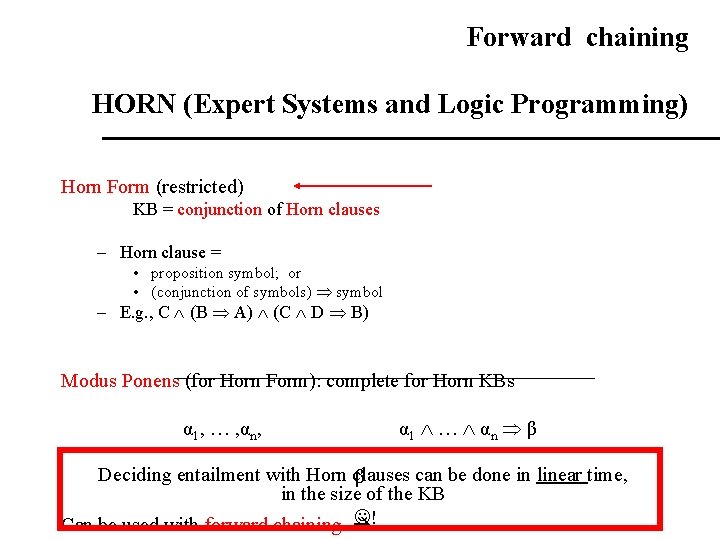
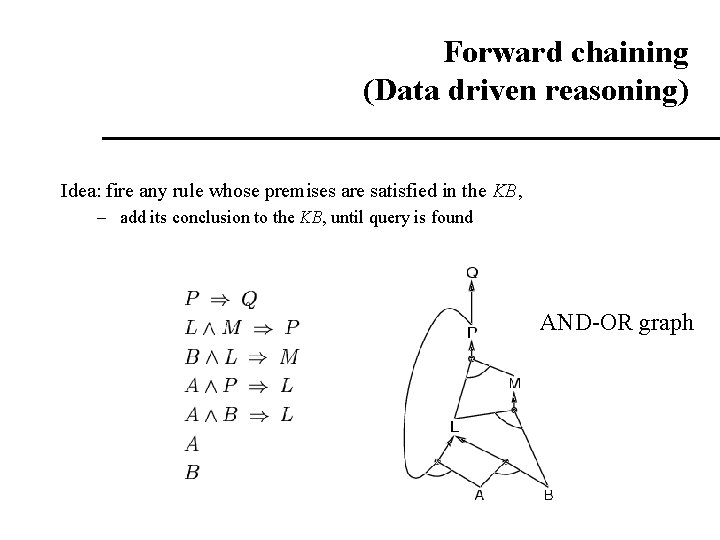
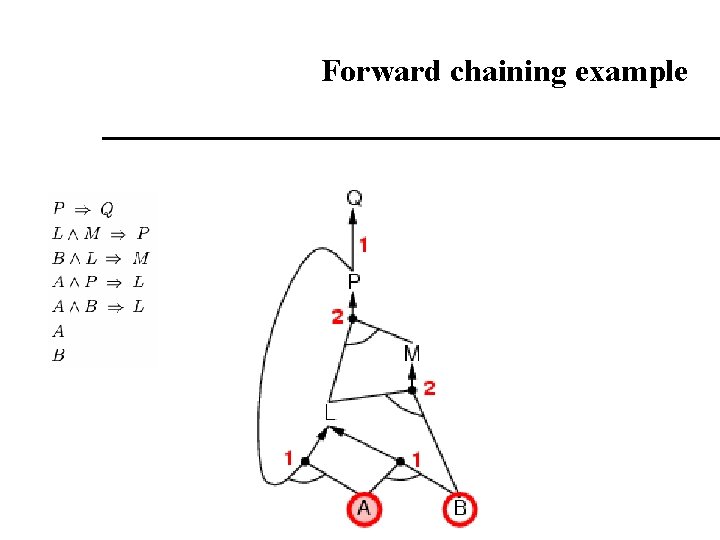
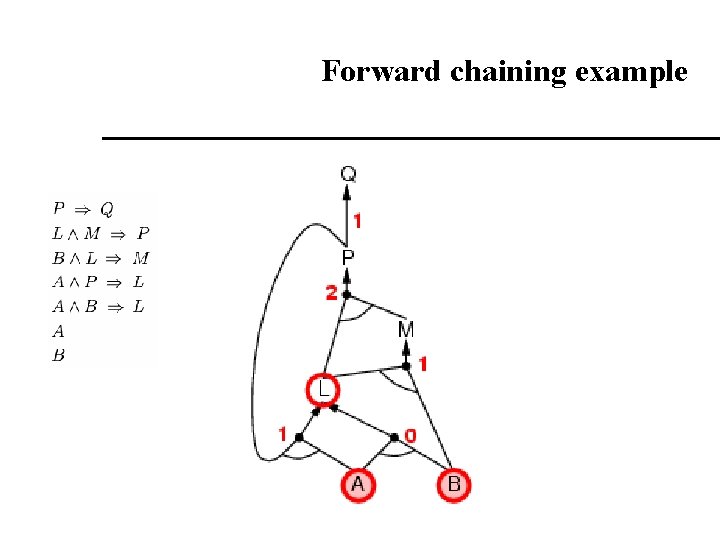
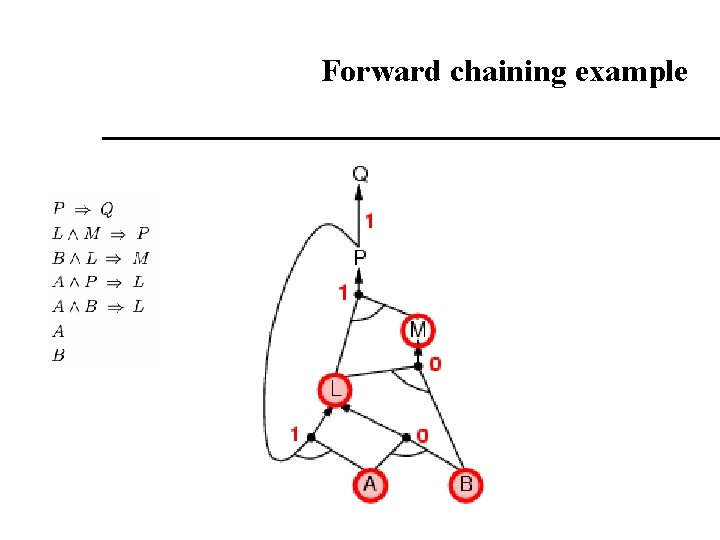
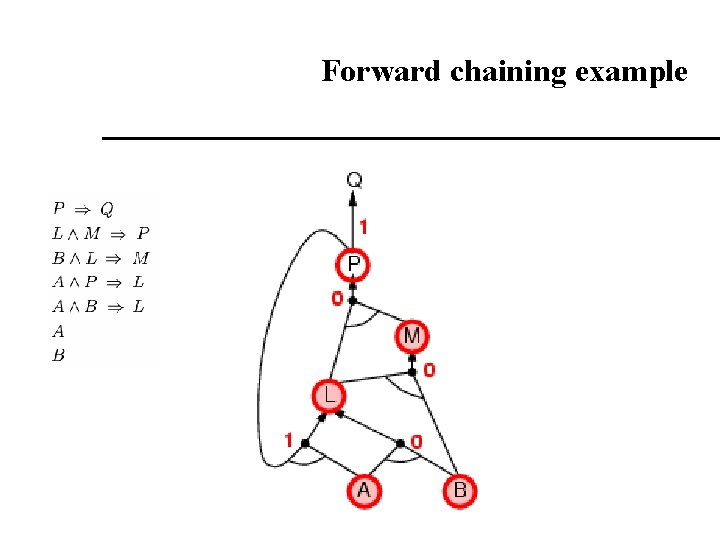
Forward chaining HORN (Expert Systems and Logic Programming) Horn Form (restricted) KB = conjunction of Horn clauses – Horn clause = • proposition symbol; or • (conjunction of symbols) symbol – E. g. , C (B A) (C D B) Modus Ponens (for Horn Form): complete for Horn KBs α 1, … , αn, α 1 … αn β Deciding entailment with Horn clauses can be done in linear time, β in the size of the KB ! Can be used with forward chaining
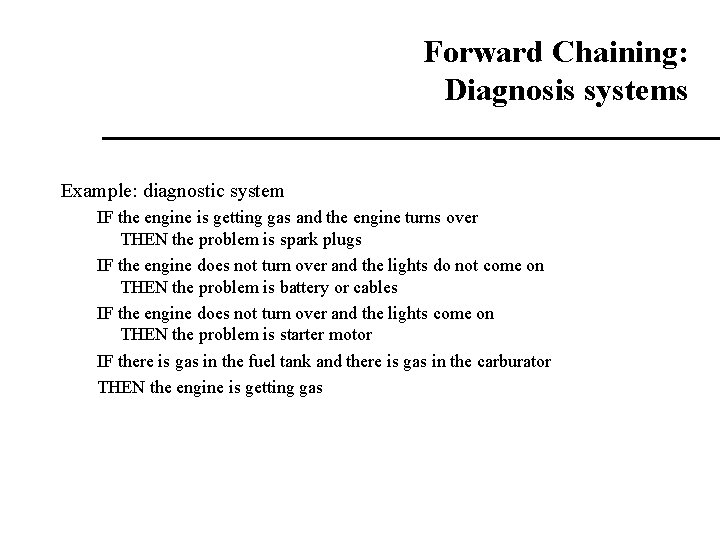
Forward Chaining: Diagnosis systems Example: diagnostic system IF the engine is getting gas and the engine turns over THEN the problem is spark plugs IF the engine does not turn over and the lights do not come on THEN the problem is battery or cables IF the engine does not turn over and the lights come on THEN the problem is starter motor IF there is gas in the fuel tank and there is gas in the carburator THEN the engine is getting gas
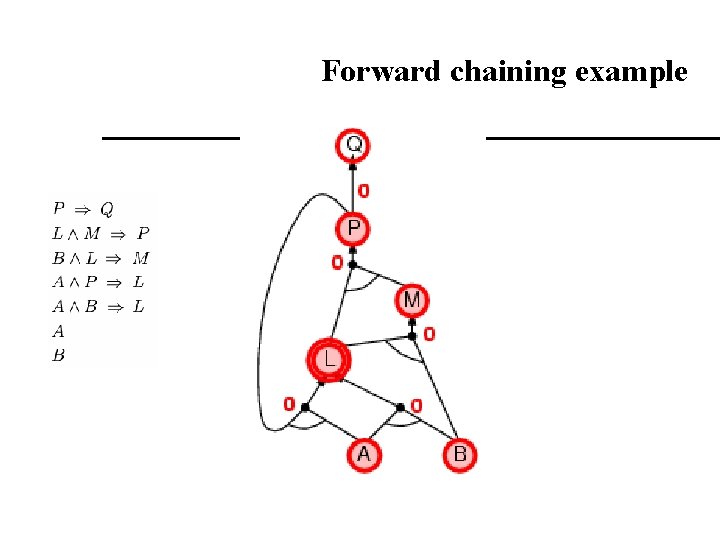
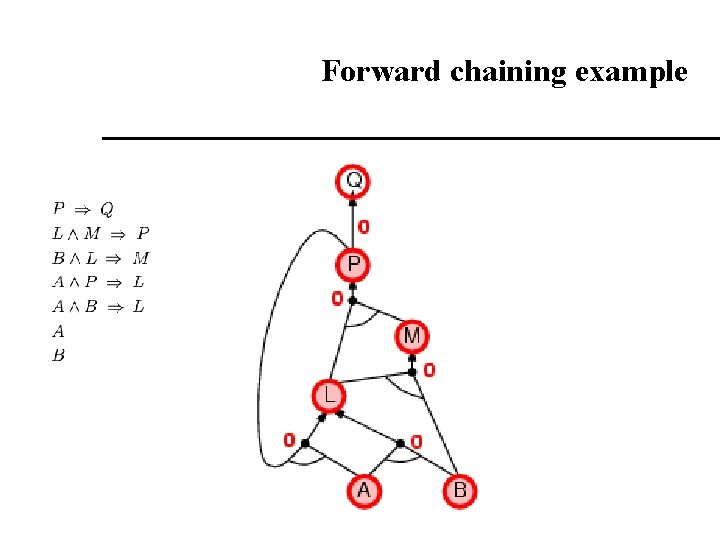
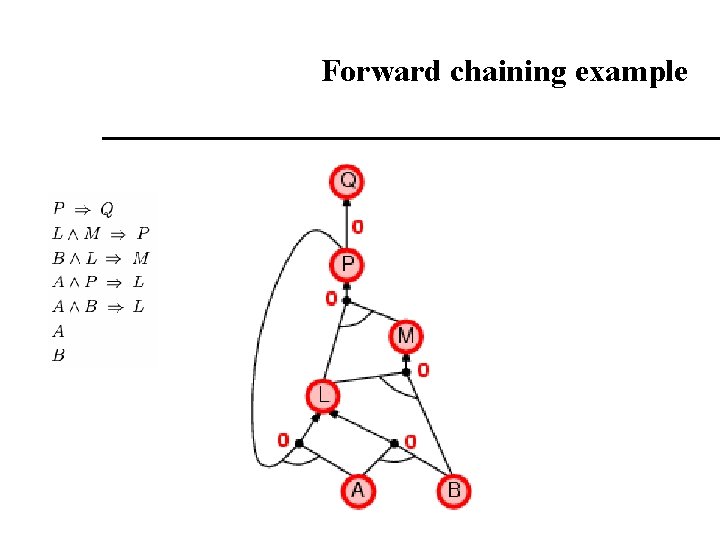
Forward chaining (Data driven reasoning) Idea: fire any rule whose premises are satisfied in the KB, – add its conclusion to the KB, until query is found AND-OR graph
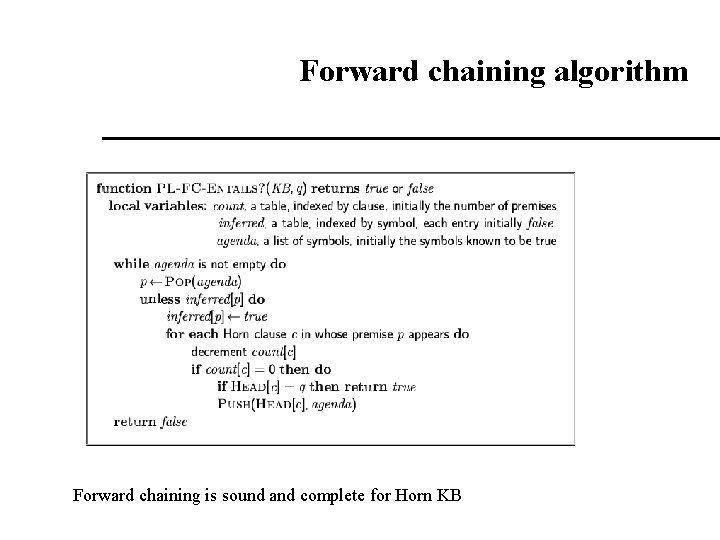
Forward chaining algorithm Forward chaining is sound and complete for Horn KB
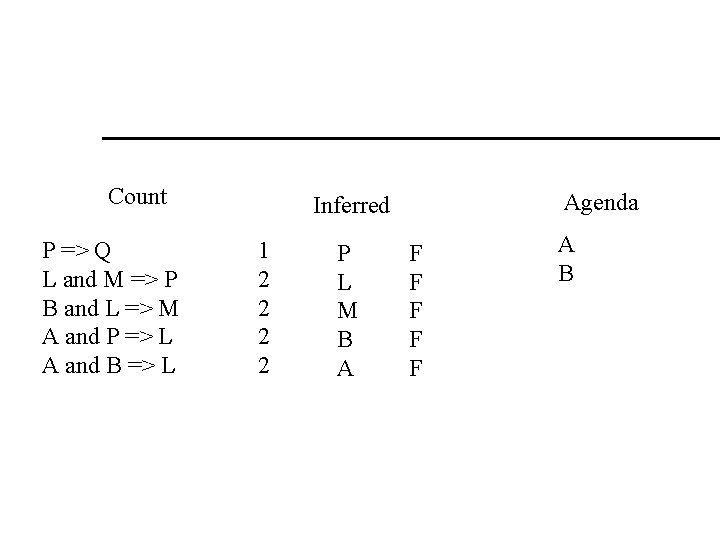
Count P => Q L and M => P B and L => M A and P => L A and B => L Agenda Inferred 1 2 2 P L M B A F F F A B
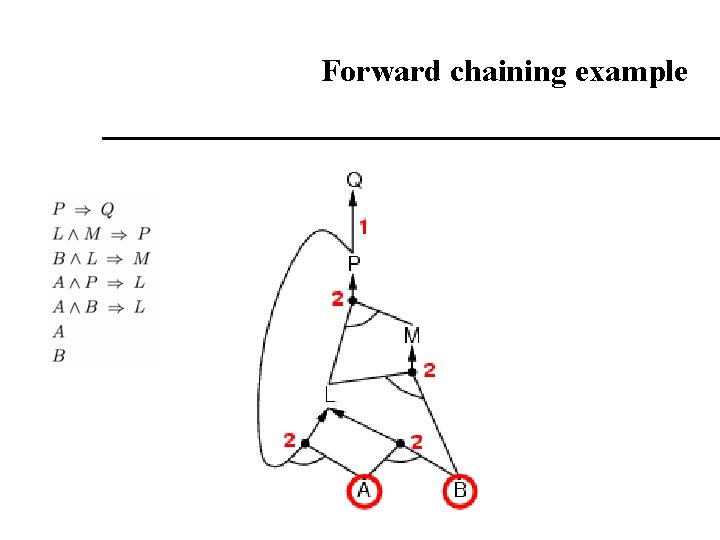
Forward chaining example
Forward chaining example
Forward chaining example
Forward chaining example
Forward chaining example
Forward chaining example
Forward chaining example
Forward chaining example
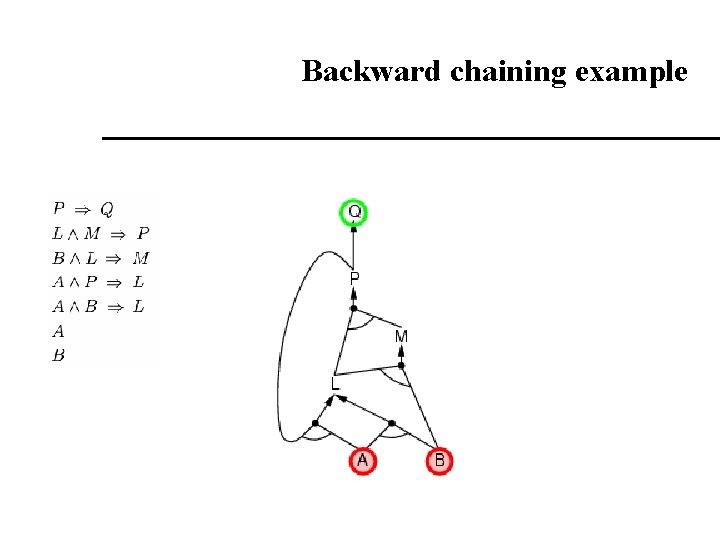
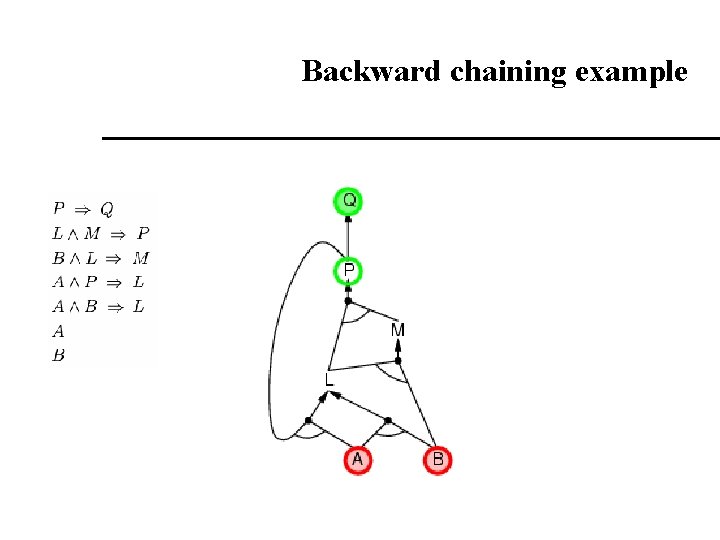
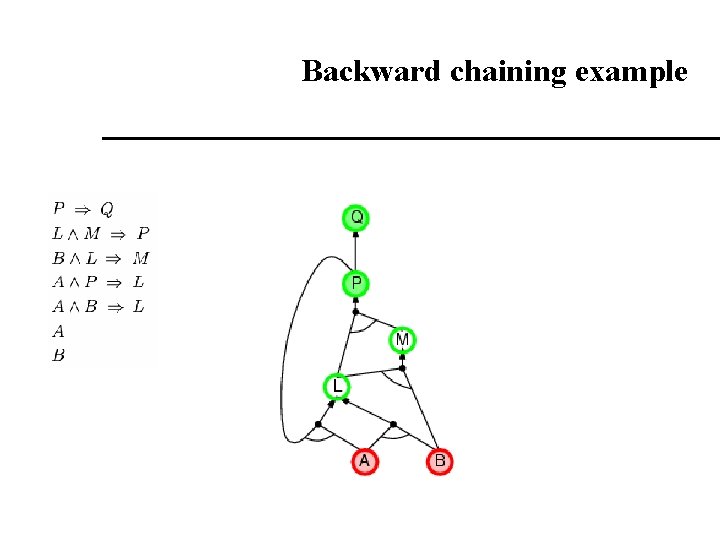
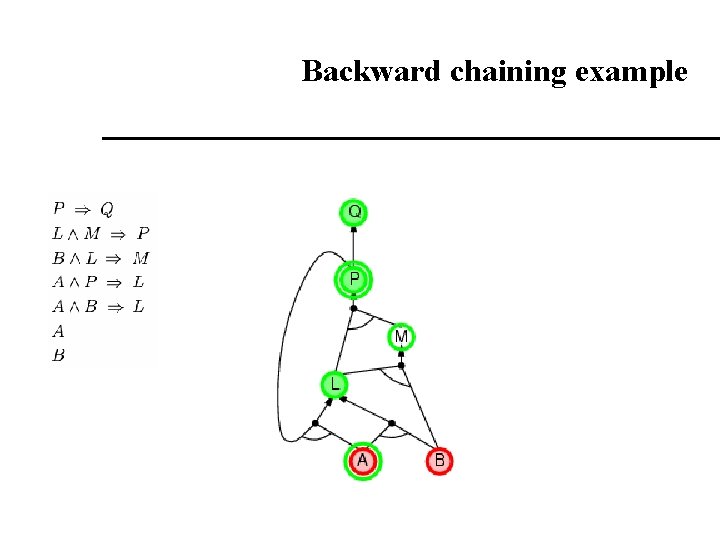
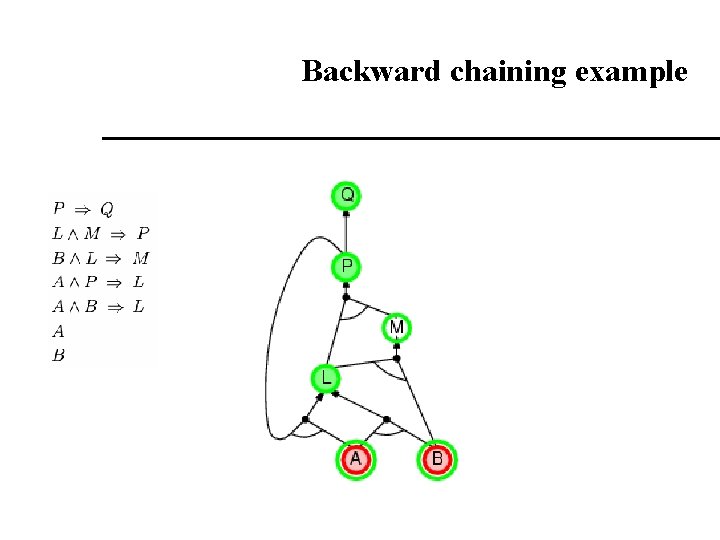
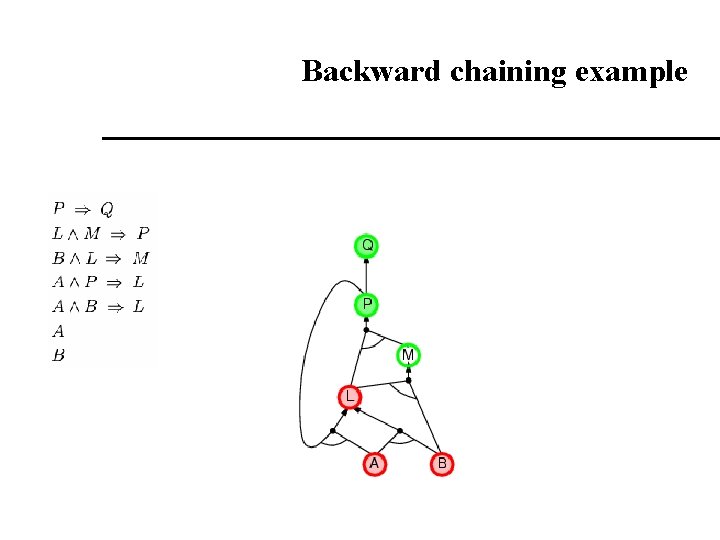
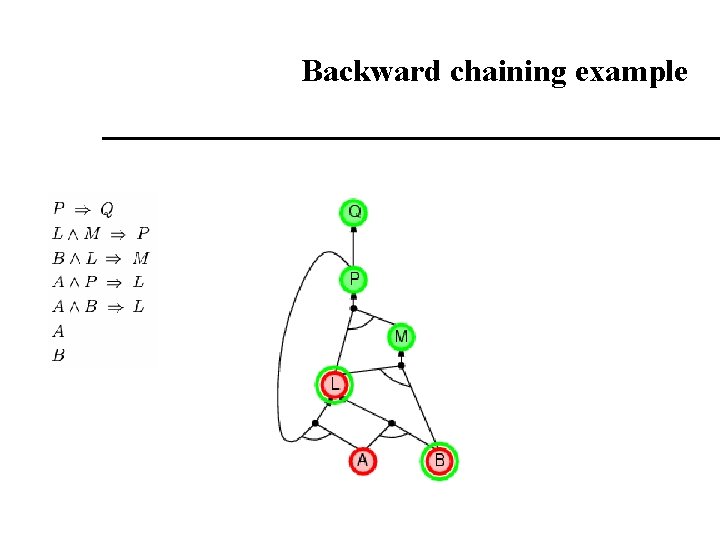
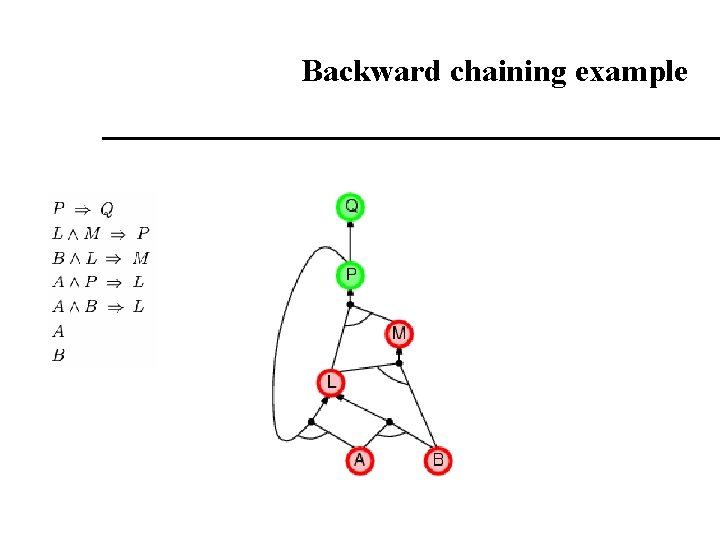
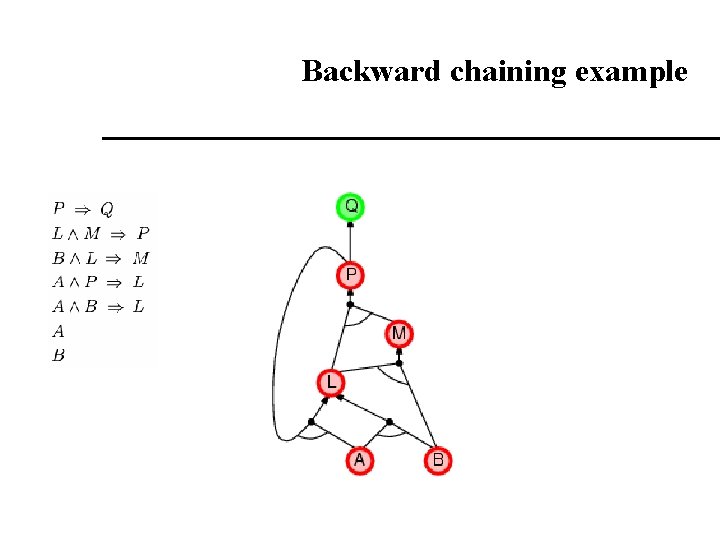
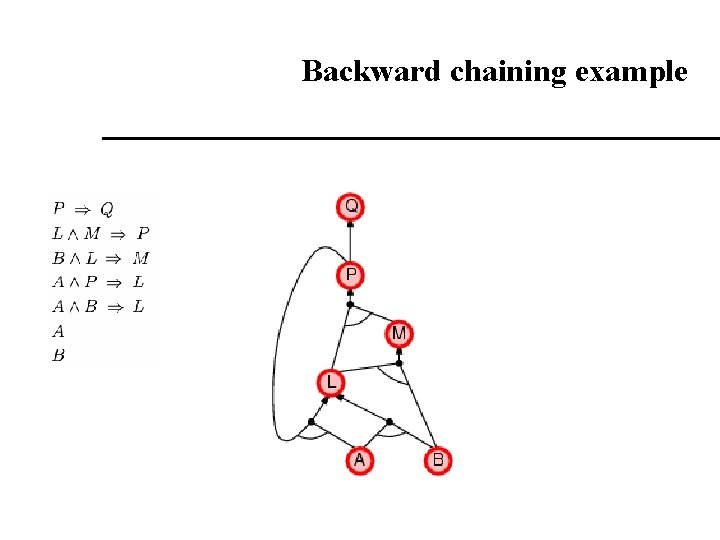
Backward chaining Idea: work backwards from the query q: to prove q by BC, check if q is known already, or prove by BC all premises of some rule concluding q Avoid loops: check if new subgoal is already on the goal stack Avoid repeated work: check if new subgoal 1. has already been proved true, or 2. has already failed
Backward chaining example
Backward chaining example
Backward chaining example
Backward chaining example
Backward chaining example
Backward chaining example
Backward chaining example
Backward chaining example
Backward chaining example
Backward chaining example
Forward vs. backward chaining FC is data-driven, automatic, unconscious processing, – e. g. , object recognition, routine decisions May do lots of work that is irrelevant to the goal BC is goal-driven, appropriate for problem-solving, – e. g. , Where are my keys? How do I get into a Ph. D program? Complexity of BC can be much less than linear in size of KB