
Exploration of single cell spatial proteomics Lauren Hsu


- Slides: 23
Exploration of single cell spatial proteomics Lauren Hsu Culhane Lab June 15, 2020
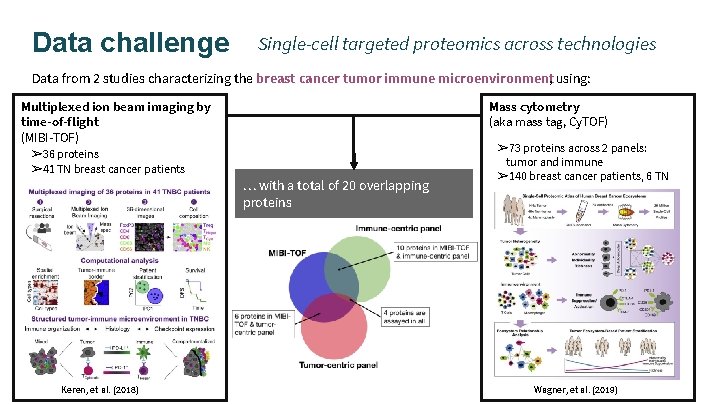
Data challenge Single-cell targeted proteomics across technologies Data from 2 studies characterizing the breast cancer tumor immune microenvironment, using: Multiplexed ion beam imaging by time-of-flight (MIBI-TOF) ➢ 36 proteins ➢ 41 TN breast cancer patients Keren, et al. (2018) Mass cytometry (aka mass tag, Cy. TOF) … with a total of 20 overlapping proteins ➢ 73 proteins across 2 panels: tumor and immune ➢ 140 breast cancer patients, 6 TN Wagner, et al. (2019)
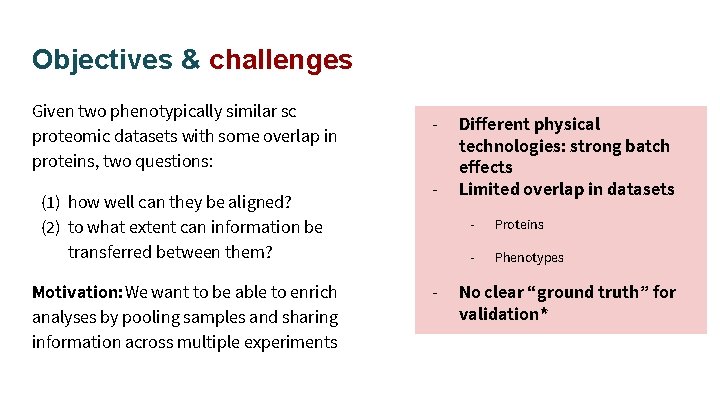
Objectives & challenges Given two phenotypically similar sc proteomic datasets with some overlap in proteins, two questions: (1) how well can they be aligned? (2) to what extent can information be transferred between them? Motivation: We want to be able to enrich analyses by pooling samples and sharing information across multiple experiments - - Different physical technologies: strong batch effects Limited overlap in datasets - Proteins - Phenotypes No clear “ground truth” for validation*
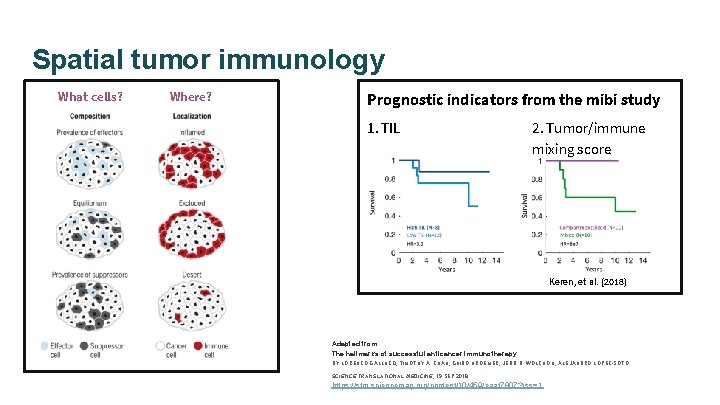
Spatial tumor immunology What cells? Where? Prognostic indicators from the mibi study 1. TIL 2. Tumor/immune mixing score Keren, et al. (2018) Adapted from: The hallmarks of successful anticancer immunotherapy BY LORENZO GALLUZZI, TIMOTHY A. CHAN, GUIDO KROEMER, JEDD D. WOLCHOK, ALEJANDRO LÓPEZ-SOTO SCIENCE TRANSLATIONAL MEDICINE, 19 SEP 2018 https: //stm. sciencemag. org/content/10/459/eaat 7807? rss=1
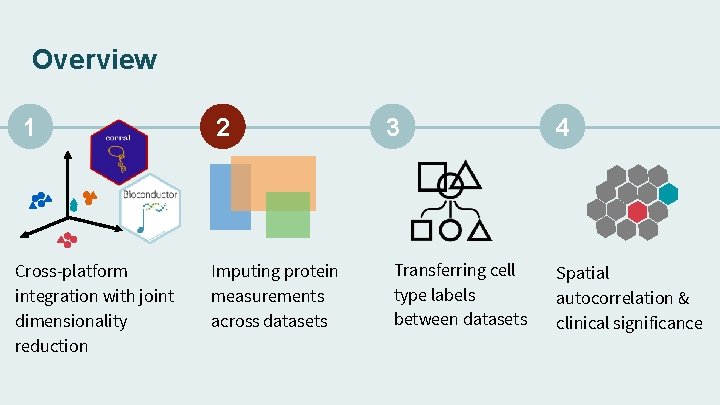
Overview 1 Cross-platform integration with joint dimensionality reduction 2 Imputing protein measurements across datasets 3 Transferring cell type labels between datasets 4 Spatial autocorrelation & clinical significance
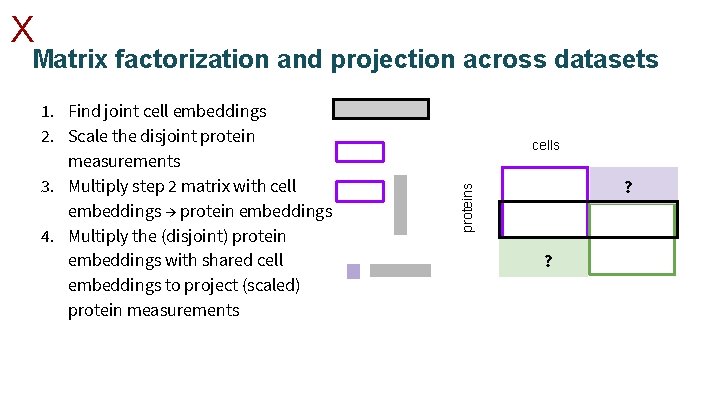
X Matrix factorization and projection across datasets cells ? proteins 1. Find joint cell embeddings 2. Scale the disjoint protein measurements 3. Multiply step 2 matrix with cell embeddings → protein embeddings 4. Multiply the (disjoint) protein embeddings with shared cell embeddings to project (scaled) protein measurements ?
3 Transferring cell type labels between datasets
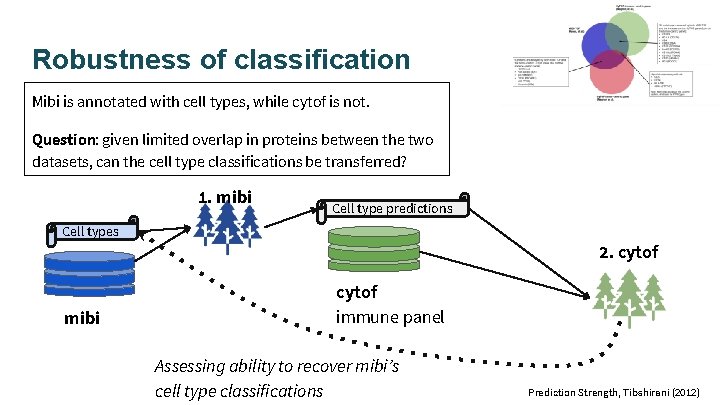
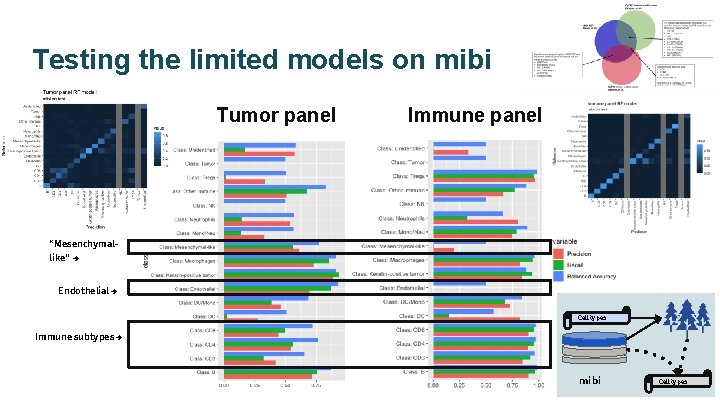
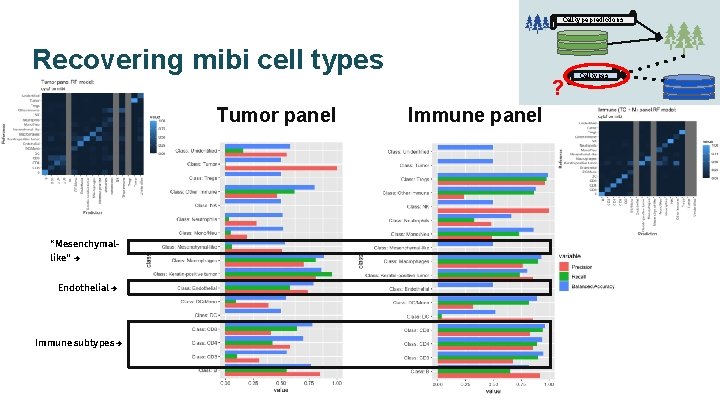
Robustness of classification Mibi is annotated with cell types, while cytof is not. Question: given limited overlap in proteins between the two datasets, can the cell type classifications be transferred? 1. mibi Cell type predictions Cell types 2. cytof mibi cytof immune panel Assessing ability to recover mibi’s cell type classifications Prediction Strength, Tibshirani (2012)
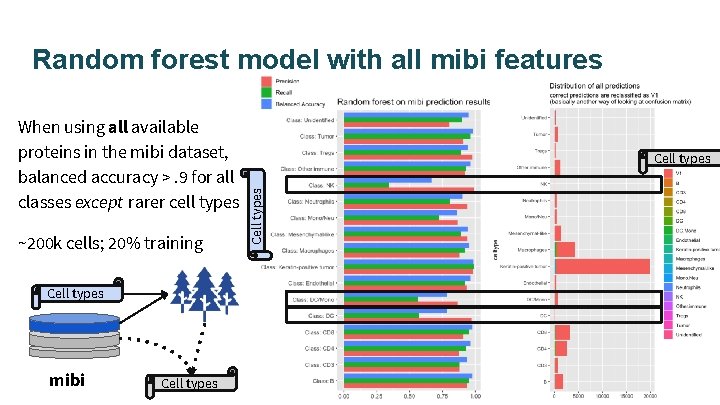
Random forest model with all mibi features ~200 k cells; 20% training Cell types mibi Cell types When using all available proteins in the mibi dataset, balanced accuracy >. 9 for all classes except rarer cell types
Testing the limited models on mibi Tumor panel Immune panel “Mesenchymallike” → Endothelial → Cell types Immune subtypes → mibi Cell types
Cell type predictions Recovering mibi cell types ? Tumor panel “Mesenchymallike” → Endothelial → Immune subtypes → Immune panel Cell types
4 Spatial autocorrelation & clinical significance
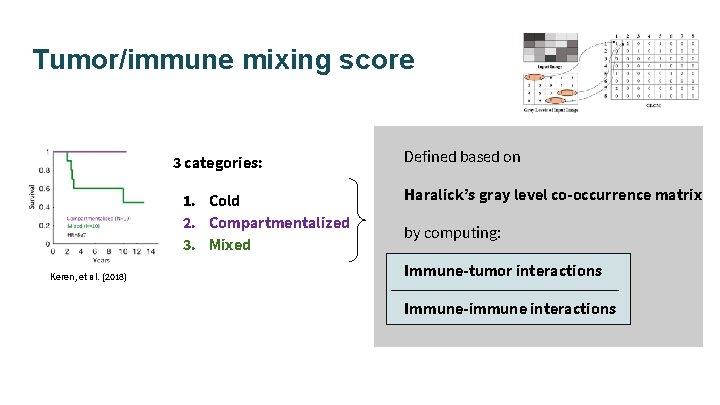
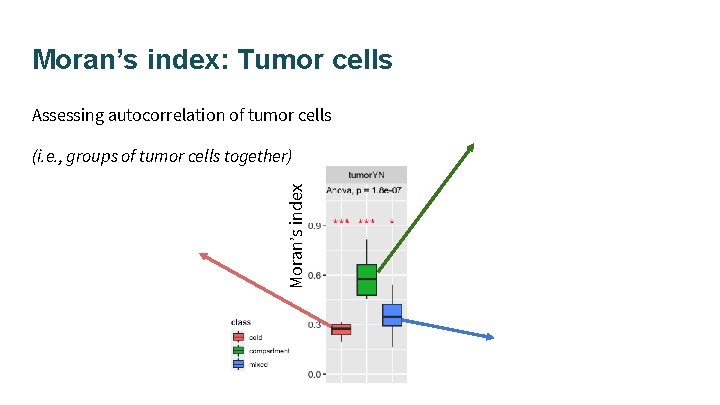
Tumor/immune mixing score 3 categories: 1. Cold 2. Compartmentalized 3. Mixed Keren, et al. (2018) Defined based on Haralick’s gray level co-occurrence matrix by computing: Immune-tumor interactions Immune-immune interactions
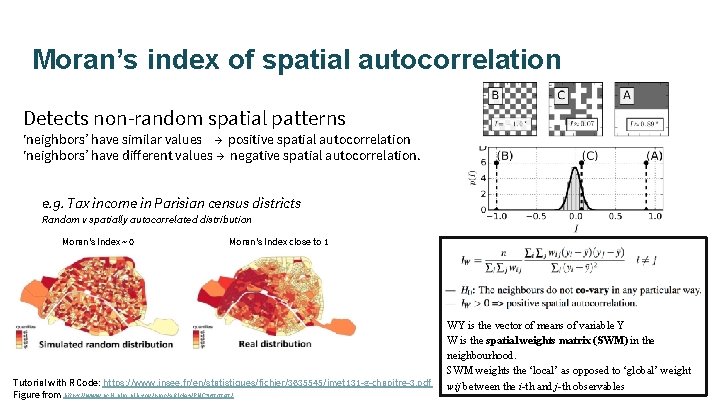
Moran’s index of spatial autocorrelation Detects non-random spatial patterns ‘neighbors’ have similar values → positive spatial autocorrelation ‘neighbors’ have different values → negative spatial autocorrelation. e. g. Tax income in Parisian census districts Random v spatially autocorrelated distribution Moran’s Index ~ 0 Moran’s Index close to 1 Tutorial with R Code: https: //www. insee. fr/en/statistiques/fichier/3635545/imet 131 -g-chapitre-3. pdf Figure from https: //www. ncbi. nlm. nih. gov/pmc/articles/PMC 5870747/ WY is the vector of means of variable Y W is the spatial weights matrix (SWM) in the neighbourhood. SWM weights the ‘local’ as opposed to ‘global’ weight wij between the i-th and j-th observables
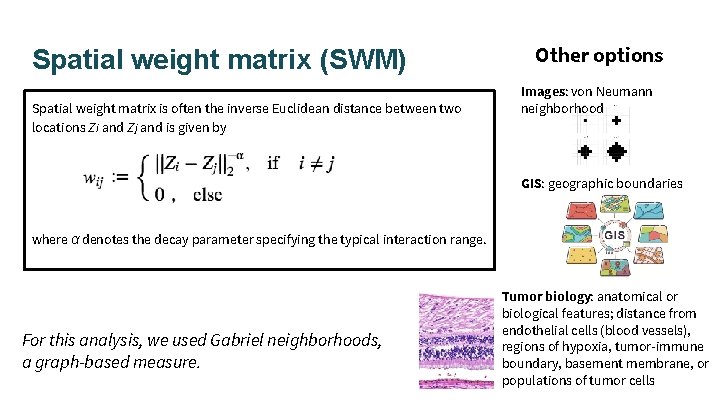
Spatial weight matrix (SWM) Spatial weight matrix is often the inverse Euclidean distance between two locations Zi and Zj and is given by Other options Images: von Neumann neighborhood GIS: geographic boundaries where α denotes the decay parameter specifying the typical interaction range. For this analysis, we used Gabriel neighborhoods, a graph-based measure. Tumor biology: anatomical or biological features; distance from endothelial cells (blood vessels), regions of hypoxia, tumor-immune boundary, basement membrane, or populations of tumor cells
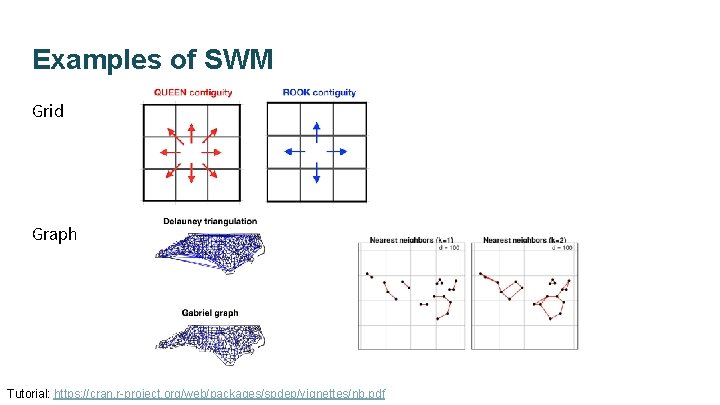
Examples of SWM Grid Graph Tutorial: https: //cran. r-project. org/web/packages/spdep/vignettes/nb. pdf
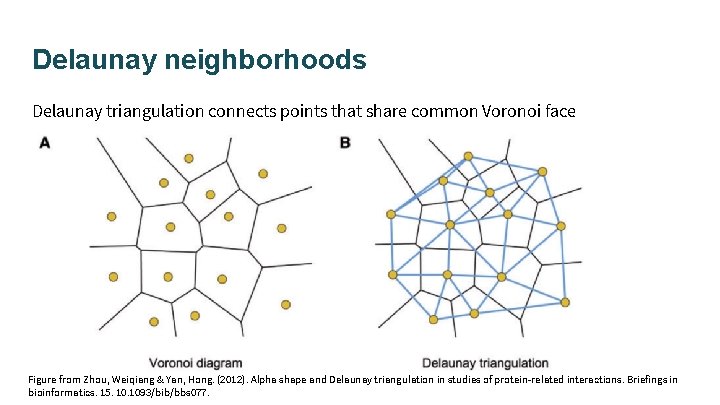
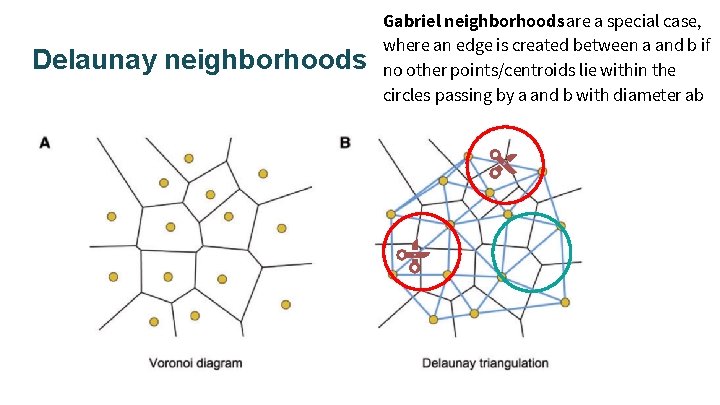
Delaunay neighborhoods Delaunay triangulation connects points that share common Voronoi face Figure from Zhou, Weiqiang & Yan, Hong. (2012). Alpha shape and Delaunay triangulation in studies of protein-related interactions. Briefings in bioinformatics. 15. 1093/bib/bbs 077.
Delaunay neighborhoods Gabriel neighborhoods are a special case, where an edge is created between a and b if no other points/centroids lie within the circles passing by a and b with diameter ab
Moran’s index: Tumor cells Assessing autocorrelation of tumor cells Moran’s index (i. e. , groups of tumor cells together)
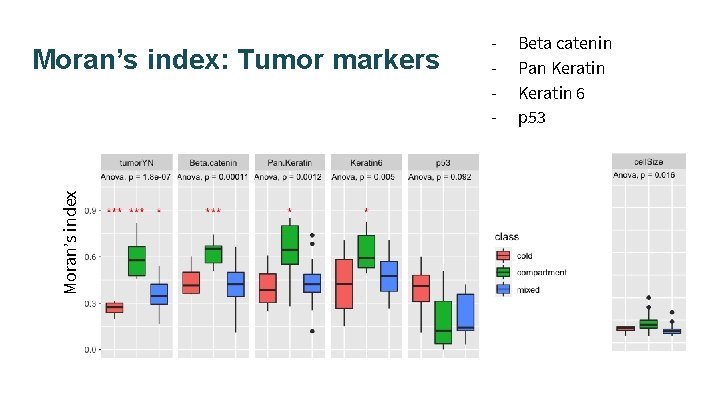
Moran’s index: Tumor markers - Beta catenin Pan Keratin 6 p 53
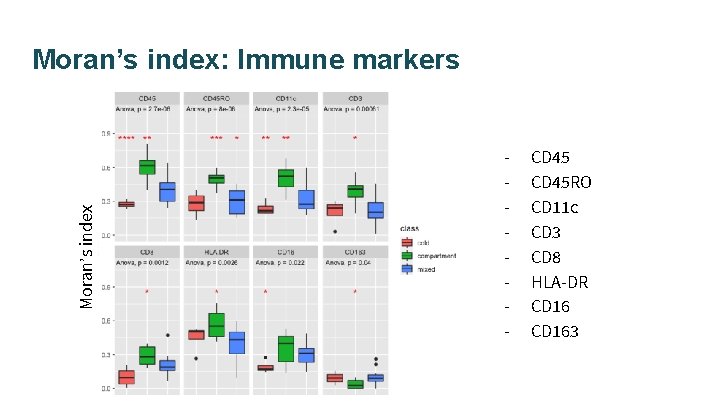
Moran’s index: Immune markers - CD 45 RO CD 11 c CD 3 CD 8 HLA-DR CD 163
Summary - Robustness of cell-type classification between datasets - - Performance would improve with tuning, etc. Prediction ability is limited by the small number of intersecting proteins Moran’s index is a metric for spatial autocorrelation with clinically relevant results - Agnostic to cell type, etc. Reveals structure in data based on various “layers” of measurement
Thank you Questions? Aedín Culhane, DFCI