
Exploration and Practice of Talent Cultivation Model of
- Slides: 1
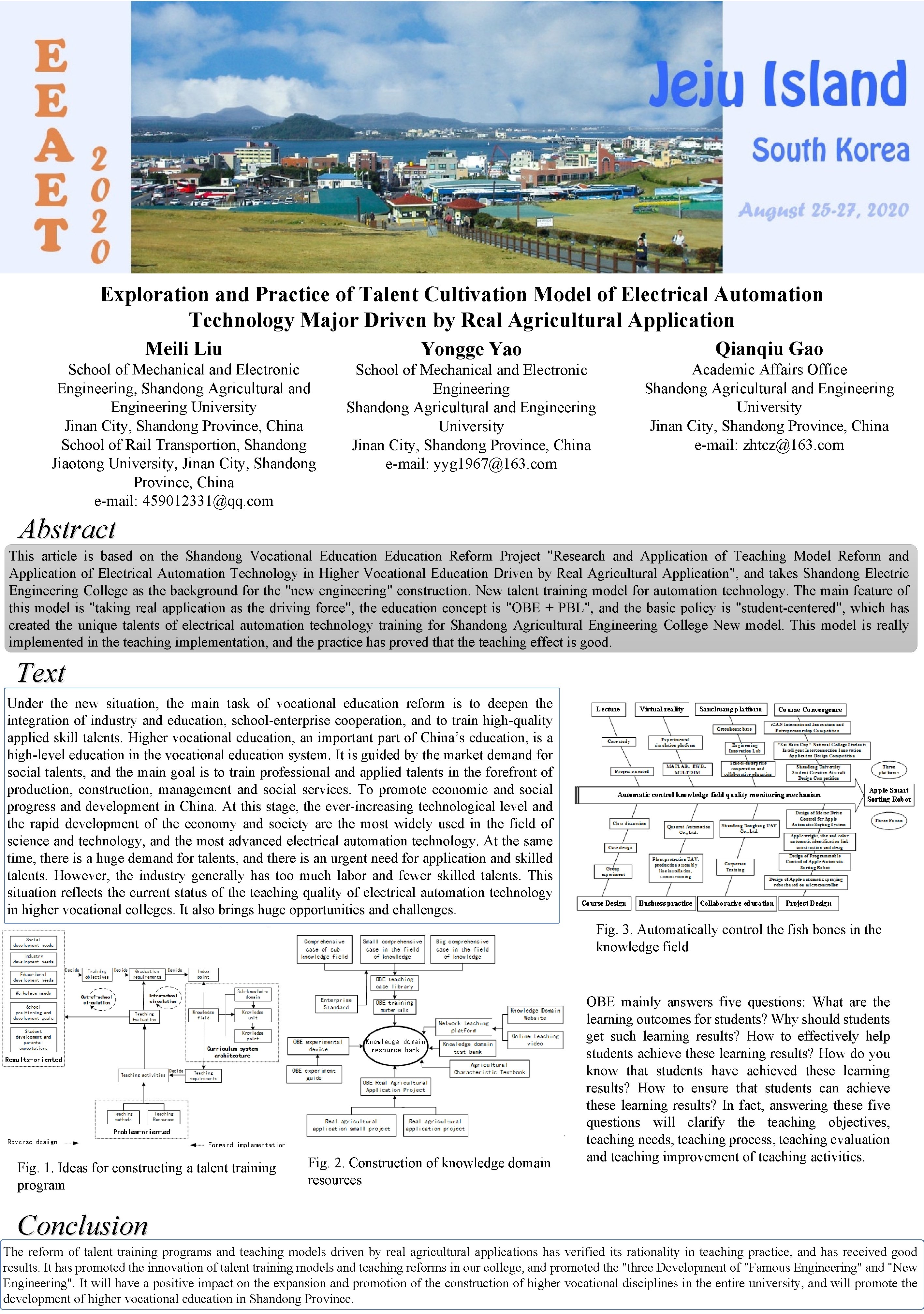
Exploration and Practice of Talent Cultivation Model of Electrical Automation Technology Major Driven by Real Agricultural Application Meili Liu Yongge Yao Qianqiu Gao School of Mechanical and Electronic Engineering, Shandong Agricultural and Engineering University Jinan City, Shandong Province, China School of Rail Transportion, Shandong Jiaotong University, Jinan City, Shandong Province, China e-mail: 459012331@qq. com School of Mechanical and Electronic Engineering Shandong Agricultural and Engineering University Jinan City, Shandong Province, China e-mail: yyg 1967@163. com Academic Affairs Office Shandong Agricultural and Engineering University Jinan City, Shandong Province, China e-mail: zhtcz@163. com Abstract This article is based on the Shandong Vocational Education Reform Project "Research and Application of Teaching Model Reform and Application of Electrical Automation Technology in Higher Vocational Education Driven by Real Agricultural Application", and takes Shandong Electric Engineering College as the background for the "new engineering" construction. New talent training model for automation technology. The main feature of this model is "taking real application as the driving force", the education concept is "OBE + PBL", and the basic policy is "student-centered", which has created the unique talents of electrical automation technology training for Shandong Agricultural Engineering College New model. This model is really implemented in the teaching implementation, and the practice has proved that the teaching effect is good. Text Under the new situation, the main task of vocational education reform is to deepen the integration of industry and education, school-enterprise cooperation, and to train high-quality applied skill talents. Higher vocational education, an important part of China’s education, is a high-level education in the vocational education system. It is guided by the market demand for social talents, and the main goal is to train professional and applied talents in the forefront of production, construction, management and social services. To promote economic and social progress and development in China. At this stage, the ever-increasing technological level and the rapid development of the economy and society are the most widely used in the field of science and technology, and the most advanced electrical automation technology. At the same time, there is a huge demand for talents, and there is an urgent need for application and skilled talents. However, the industry generally has too much labor and fewer skilled talents. This situation reflects the current status of the teaching quality of electrical automation technology in higher vocational colleges. It also brings huge opportunities and challenges. Fig. 3. Automatically control the fish bones in the knowledge field Fig. 1. Ideas for constructing a talent training program Fig. 2. Construction of knowledge domain resources OBE mainly answers five questions: What are the learning outcomes for students? Why should students get such learning results? How to effectively help students achieve these learning results? How do you know that students have achieved these learning results? How to ensure that students can achieve these learning results? In fact, answering these five questions will clarify the teaching objectives, teaching needs, teaching process, teaching evaluation and teaching improvement of teaching activities. Conclusion The reform of talent training programs and teaching models driven by real agricultural applications has verified its rationality in teaching practice, and has received good results. It has promoted the innovation of talent training models and teaching reforms in our college, and promoted the "three Development of "Famous Engineering" and "New Engineering". It will have a positive impact on the expansion and promotion of the construction of higher vocational disciplines in the entire university, and will promote the development of higher vocational education in Shandong Province.