
Exploits Against Software and How To Avoid Them
![Comp. Sec COMPGA 01 Exploit against Linksys router [2004] It has a ping utility.](https://slidetodoc.com/presentation_image_h2/72ea546becfdff0a4647fbc04b3029e2/image-12.jpg "Comp. Sec COMPGA 01 Exploit against Linksys router [2004] It has a ping utility.")
![SQL Attacks! • Buffer overflows - later • Race conditions [already covered] • Malware](https://slidetodoc.com/presentation_image_h2/72ea546becfdff0a4647fbc04b3029e2/image-30.jpg "SQL Attacks! • Buffer overflows - later • Race conditions [already covered] • Malware")
![Comp. Sec COMPGA 01 Buffer Overflow in C char command[256]=“”; allocated from the stack.](https://slidetodoc.com/presentation_image_h2/72ea546becfdff0a4647fbc04b3029e2/image-46.jpg "Comp. Sec COMPGA 01 Buffer Overflow in C char command[256]=“”; allocated from the stack.")
![Comp. Sec COMPGA 01 exploit on f void f(params) { char command[256]=“”; … strcpy(command,](https://slidetodoc.com/presentation_image_h2/72ea546becfdff0a4647fbc04b3029e2/image-51.jpg "Comp. Sec COMPGA 01 exploit on f void f(params) { char command[256]=“”; … strcpy(command,")
![Comp. Sec COMPGA 01 exploit on f void f(params) { char command[256]=“”; … strcpy(command,](https://slidetodoc.com/presentation_image_h2/72ea546becfdff0a4647fbc04b3029e2/image-52.jpg "Comp. Sec COMPGA 01 exploit on f void f(params) { char command[256]=“”; … strcpy(command,")
- Slides: 82
Exploits Against Software and How To Avoid Them Nicolas T. Courtois - University College London
Goals of Attackers
Comp. Sec COMPGA 01 Break In Stage 1: Get to run some code (even without privileges). Stage 2: Gain admin/TCB access, usually by calling other local programs and exploiting their vulnerabilities. Stage 3: Exfiltrate data, encrypt, and ask for a ransom payment in bitcoins etc. 3 Nicolas T. Courtois, 2009 -2018
Comp. Sec COMPGA 01 Goals for Software Exploits 4 • • crash software (can be DOS) crash/infect hardware • • get some data or side channels inject arbitrary code (user/root/Kernel/TCB level) (e. g. hard drive, USB systems and devices) Nicolas T. Courtois, 2009 -2018 these also happen accidentally…
Reading How to Break Into Computers? • • • 5 Stack attacks: Chapter 10. 4. Defences: Chapter 10. 7. Chapter 14: Software Security Nicolas T. Courtois, 2009 -2018
What’s Wrong?
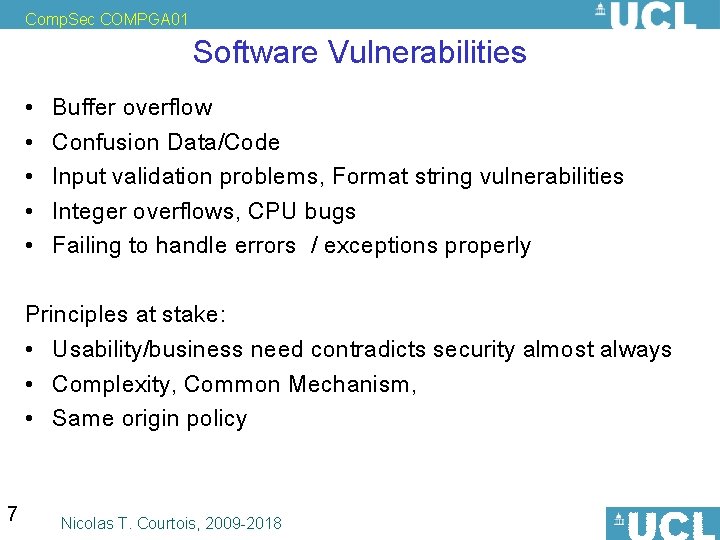
Comp. Sec COMPGA 01 Software Vulnerabilities • • • Buffer overflow Confusion Data/Code Input validation problems, Format string vulnerabilities Integer overflows, CPU bugs Failing to handle errors / exceptions properly Principles at stake: • Usability/business need contradicts security almost always • Complexity, Common Mechanism, • Same origin policy 7 Nicolas T. Courtois, 2009 -2018
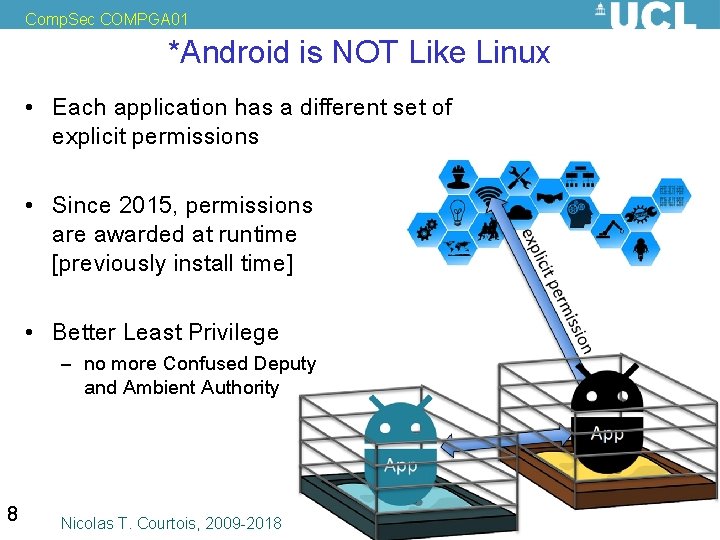
Comp. Sec COMPGA 01 *Android is NOT Like Linux • Each application has a different set of explicit permissions • Since 2015, permissions are awarded at runtime [previously install time] • Better Least Privilege – no more Confused Deputy and Ambient Authority 8 Nicolas T. Courtois, 2009 -2018
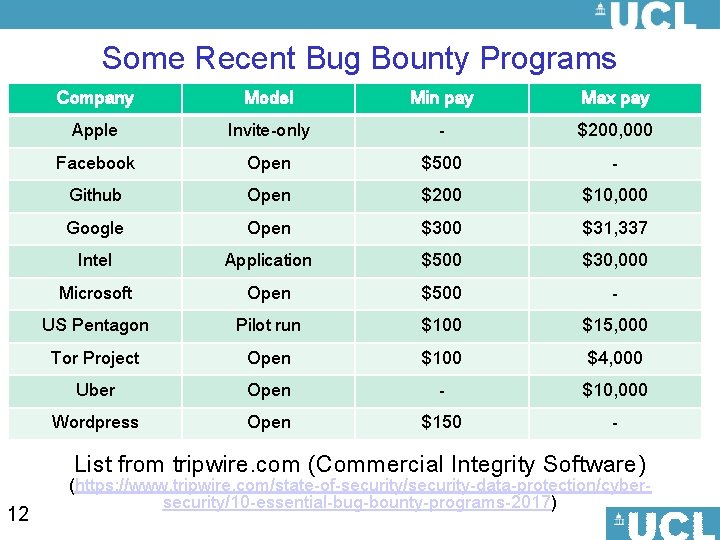
Some Recent Bug Bounty Programs Company Model Min pay Max pay Apple Invite-only - $200, 000 Facebook Open $500 - Github Open $200 $10, 000 Google Open $300 $31, 337 Intel Application $500 $30, 000 Microsoft Open $500 - US Pentagon Pilot run $100 $15, 000 Tor Project Open $100 $4, 000 Uber Open - $10, 000 Wordpress Open $150 - List from tripwire. com (Commercial Integrity Software) 12 (https: //www. tripwire. com/state-of-security/security-data-protection/cybersecurity/10 -essential-bug-bounty-programs-2017)
Vectors of Attack - Inputs
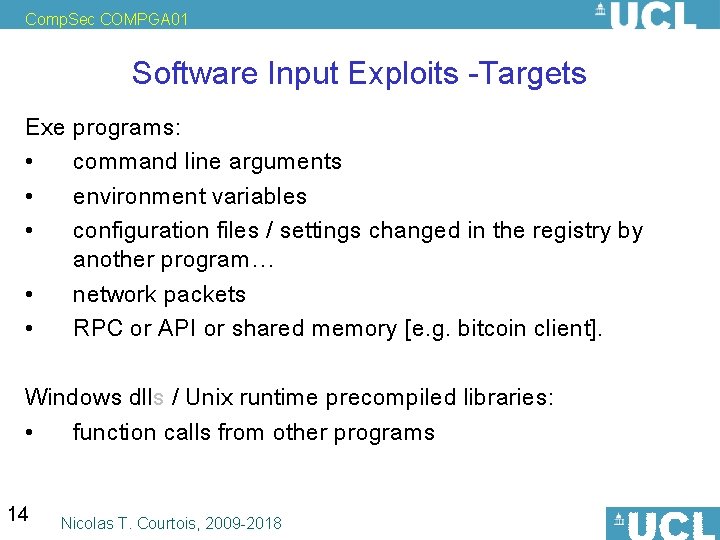
Comp. Sec COMPGA 01 Software Input Exploits -Targets Exe programs: • command line arguments • environment variables • configuration files / settings changed in the registry by another program… • network packets • RPC or API or shared memory [e. g. bitcoin client]. Windows dlls / Unix runtime precompiled libraries: • function calls from other programs 14 Nicolas T. Courtois, 2009 -2018
Comp. Sec COMPGA 01 Exploit against Linksys router [2004] It has a ping utility. Pretty innocent? The attacker types: 127. 0. 0. 1|ls>/tmp//ping. log 15 Nicolas T. Courtois, 2009 -2018
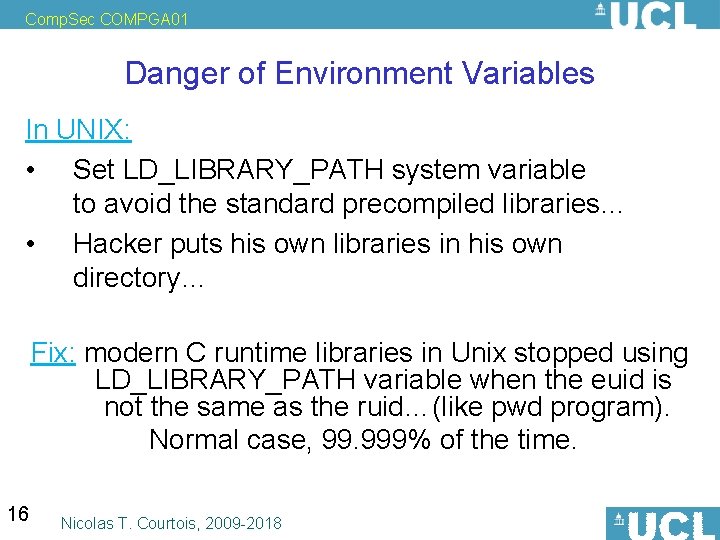
Comp. Sec COMPGA 01 Danger of Environment Variables In UNIX: • Set LD_LIBRARY_PATH system variable to avoid the standard precompiled libraries… • Hacker puts his own libraries in his own directory… Fix: modern C runtime libraries in Unix stopped using LD_LIBRARY_PATH variable when the euid is not the same as the ruid…(like pwd program). Normal case, 99. 999% of the time. 16 Nicolas T. Courtois, 2009 -2018
Comp. Sec COMPGA 01 ****Recall: In Unix each process has several user IDs: • Real User ID == ruid, identifies the owner of the process • Effective User ID == euid, determines current access rights 17 Nicolas T. Courtois, 2009 -2018
Comp. Sec COMPGA 01 set-uid programs Definition: A “set-uid program” (property acquired at creation/compilation/installation time) is a program that assumes the identity and has privileges of the owner of the program, though a different user uses it. Examples: • passwd • su, sudo 18 Nicolas T. Courtois, 2009 -2018 BTW: if copied to a “user” directory, they will stop working!
Injection Attacks vs. Path • path traversal or path abuse… • what if my path is or contains “. ”? – See later slides. • what if the user can write files of their choice and uses “. . /filename”? 19 – Quiz: what if a Microsoft compiler is given this path? ? any special privileges? How do we call this sort of attack? C. D.
Code Injection Attacks • Code injection (e. g. : the eval function) • OS Command Injection – In C/C++ we use system(some Unix or Windows command in a char * buffer); os. system(“procmail %s” % user_input) 21
Comp. Sec COMPGA 01 More Attacks on PATH in Unix Now imagine that any “setuid program” contains the following line: system(“ls … ”); OOPS… there are several ways to use this to run any program as root… 22 Nicolas T. Courtois, 2009 -2018
Comp. Sec COMPGA 01 More Attacks on PATH in Unix A “setuid program” ABC contains the following line: system(“ls …”); The user sets his PATH to be “. ” and places his own program ls in this directory. This program will be run as root! (remark: the program A can reset PATH or do checks on PATH…) 23 Nicolas T. Courtois, 2009 -2018
Comp. Sec COMPGA 01 Can this be done remotely? • • In PHP language, used by all web servers, they have PASSTHRU() function that executes arbitrary code… Assume it contains a user input that comes from the web client browser. insert “; command 231” or “| command 231”. This will make the server execute command 231 and output the result to the web page displayed. PHP have later banned this and many other things from the PHP language… 24 Nicolas T. Courtois, 2009 -2018
Comp. Sec COMPGA 01 Another Classical Exploit in Unix • • the IFS variable: the characters that the system considers as white space now add “s” to the IFS set of characters – system(ls) becomes system(l) – a function l in the current directory will be run as root… 25 Nicolas T. Courtois, 2009 -2018
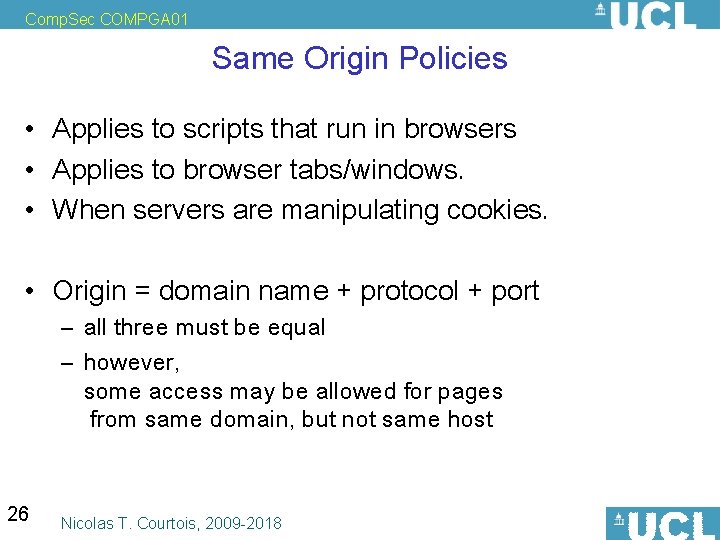
Comp. Sec COMPGA 01 Same Origin Policies • Applies to scripts that run in browsers • Applies to browser tabs/windows. • When servers are manipulating cookies. • Origin = domain name + protocol + port – all three must be equal – however, some access may be allowed for pages from same domain, but not same host 26 Nicolas T. Courtois, 2009 -2018
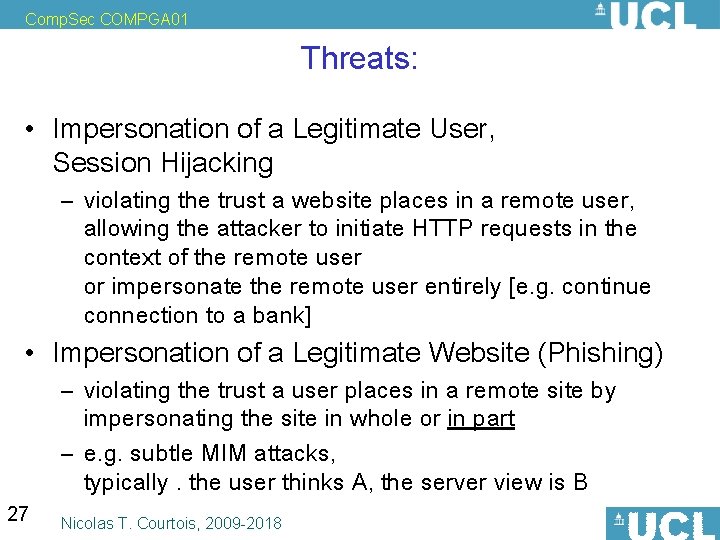
Comp. Sec COMPGA 01 Threats: • Impersonation of a Legitimate User, Session Hijacking – violating the trust a website places in a remote user, allowing the attacker to initiate HTTP requests in the context of the remote user or impersonate the remote user entirely [e. g. continue connection to a bank] • Impersonation of a Legitimate Website (Phishing) – violating the trust a user places in a remote site by impersonating the site in whole or in part – e. g. subtle MIM attacks, typically. the user thinks A, the server view is B 27 Nicolas T. Courtois, 2009 -2018
Comp. Sec COMPGA 01 Attacks Against Web Servers • (SQL) injection attacks: confusion data/code. • Cross site request forgery (CSRF)==Session Riding • Cross site scripting (XSS) 28 Nicolas T. Courtois, 2009 -2018
Comp. Sec COMPGA 01 Unix and Web Servers • Old times: running as root. Needed to open port 80 < 1024. • Exploit the web server =>you become root. • Solution: containment prevention: limiting the powers of the server. 29 Nicolas T. Courtois, 2009 -2018
Comp. Sec COMPGA 01 Dropping Privileges • Unix provides several ways to drop privileges: – setuid(nobody) – chroot() – Free. BSD’s jail() – Open. BSD’s systrace() 30 Nicolas T. Courtois, 2009 -2018
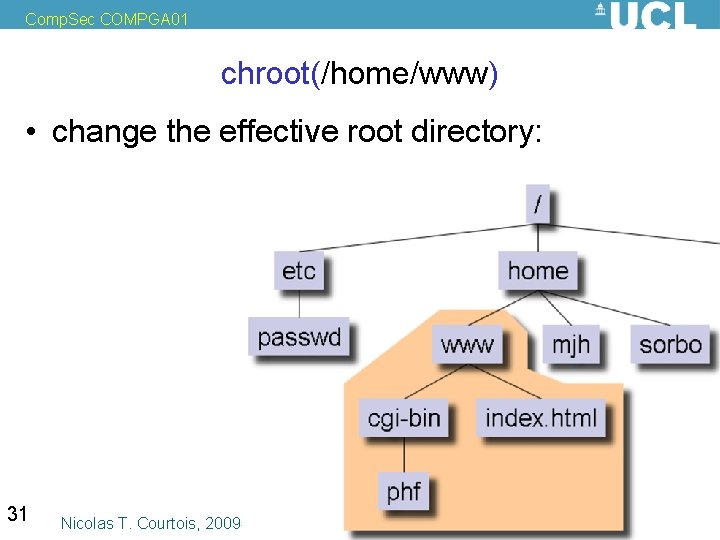
Comp. Sec COMPGA 01 chroot(/home/www) • change the effective root directory: 31 Nicolas T. Courtois, 2009 -2018
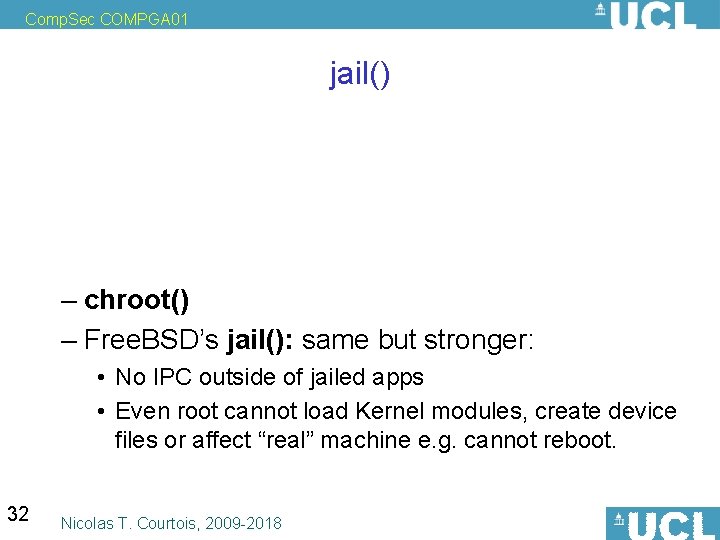
Comp. Sec COMPGA 01 jail() • Unix provides several ways to drop privileges: – setuid(nobody) – chroot() – Free. BSD’s jail(): same but stronger: • No IPC outside of jailed apps • Even root cannot load Kernel modules, create device files or affect “real” machine e. g. cannot reboot. 32 Nicolas T. Courtois, 2009 -2018
Comp. Sec COMPGA 01 systrace() • Unix provides several ways to drop privileges: – setuid(nobody) – chroot() – Free. BSD’s jail() – Open. BSD’s systrace(): limits which system calls may be used. 33 Nicolas T. Courtois, 2009 -2018
SQL Attacks! • Buffer overflows - later • Race conditions [already covered] • Malware and Ransomware – another lecture. For web servers specifically: • (SQL) injection attacks: confusion data/code. • Cross site request forgery (CSRF) • Cross site scripting (XSS) 34 https: //xkcd. com/327/
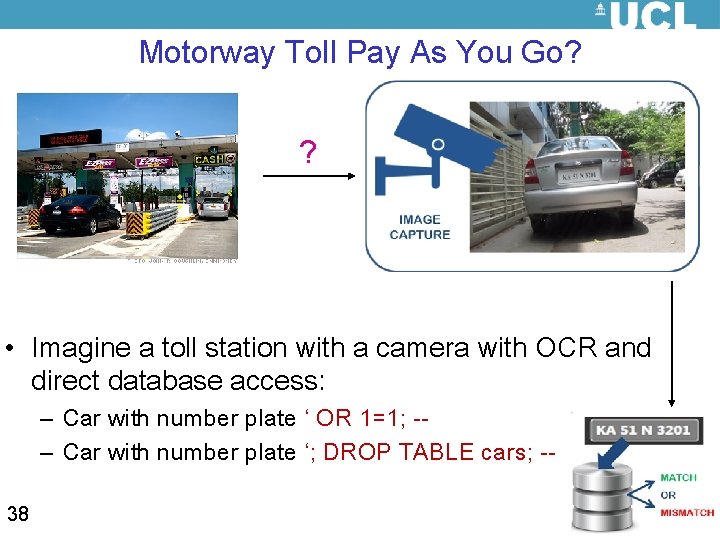
Motorway Toll Pay As You Go? ? • Imagine a toll station with a camera with OCR and direct database access: – Car with number plate ‘ OR 1=1; -– Car with number plate ‘; DROP TABLE cars; -38
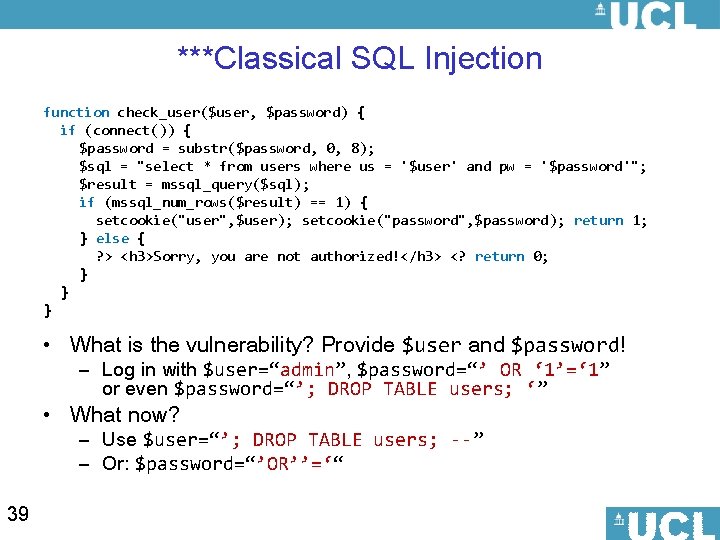
***Classical SQL Injection function check_user($user, $password) { if (connect()) { $password = substr($password, 0, 8); $sql = "select * from users where us = '$user' and pw = '$password'"; $result = mssql_query($sql); if (mssql_num_rows($result) == 1) { setcookie("user", $user); setcookie("password", $password); return 1; } else { ? > <h 3>Sorry, you are not authorized!</h 3> <? return 0; } } } • What is the vulnerability? Provide $user and $password! – Log in with $user=“admin”, $password=“’ OR ‘ 1’=‘ 1” or even $password=“’; DROP TABLE users; ‘” • What now? – Use $user=“’; DROP TABLE users; --” – Or: $password=“’OR’’=‘“ 39
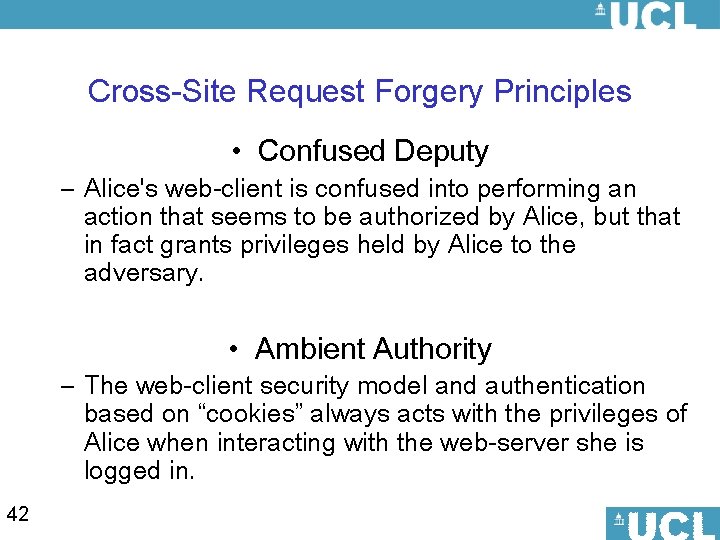
Cross-Site Request Forgery Principles • Confused Deputy – Alice's web-client is confused into performing an action that seems to be authorized by Alice, but that in fact grants privileges held by Alice to the adversary. • Ambient Authority – The web-client security model and authentication based on “cookies” always acts with the privileges of Alice when interacting with the web-server she is logged in. 42
*Mitigations • Options: confirm origin of authority and request. – Make “GET” requests side-effect free. – Include within each (valid) form an authenticator that the adversary cannot guess. Check for the authenticator before acting on a request. – Check the HTTP “referrer” or “origin” field of the request before executing it. – Request re-authentication for every action. • Why is all this so hard? – HTTP requires web developers to re-define a session layer for each application. No standard way of managing sessions → errors. 43
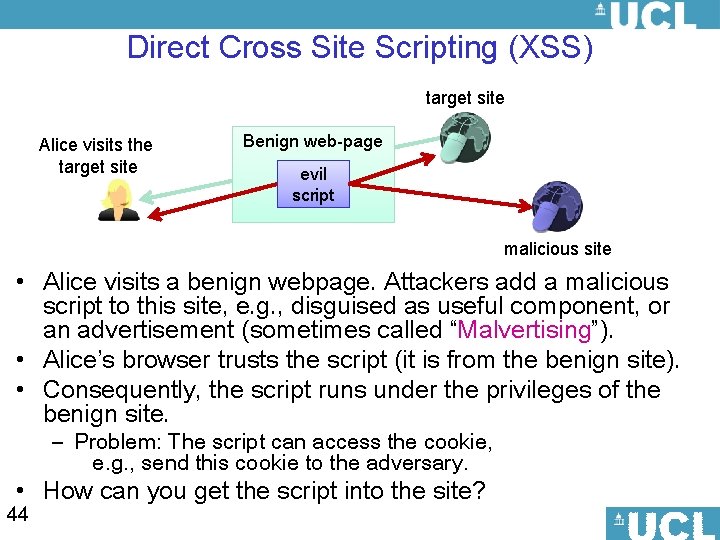
Direct Cross Site Scripting (XSS) target site Alice visits the target site Benign web-page evil script malicious site • Alice visits a benign webpage. Attackers add a malicious script to this site, e. g. , disguised as useful component, or an advertisement (sometimes called “Malvertising”). • Alice’s browser trusts the script (it is from the benign site). • Consequently, the script runs under the privileges of the benign site. – Problem: The script can access the cookie, e. g. , send this cookie to the adversary. • How can you get the script into the site? 44
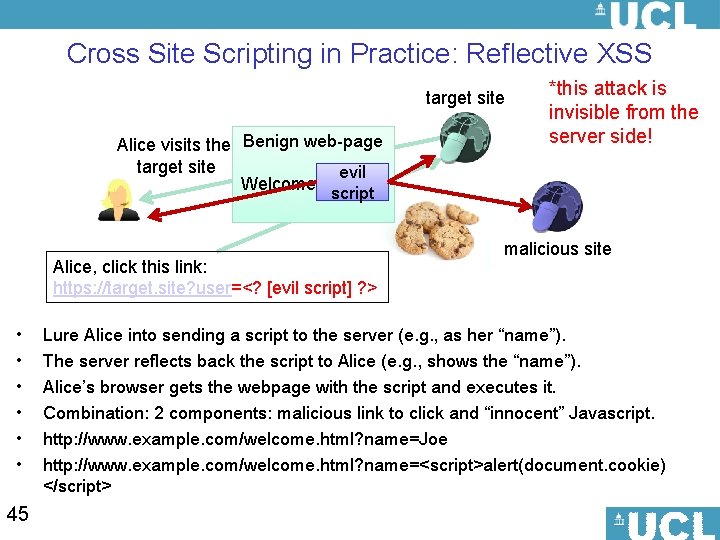
Cross Site Scripting in Practice: Reflective XSS target site Alice visits the Benign web-page target site evil Welcome script Alice, click this link: https: //target. site? user=<? [evil script] ? > • • • 45 *this attack is invisible from the server side! malicious site Lure Alice into sending a script to the server (e. g. , as her “name”). The server reflects back the script to Alice (e. g. , shows the “name”). Alice’s browser gets the webpage with the script and executes it. Combination: 2 components: malicious link to click and “innocent” Javascript. http: //www. example. com/welcome. html? name=Joe http: //www. example. com/welcome. html? name=<script>alert(document. cookie) </script>
Buffer Overflow since 1972!!!
Comp. Sec COMPGA 01 Software Buffer Overflow Exploits I will explain in details only 1 type of buffer overflow attack… Stack Smashing There are many other types of software vulnerabilities… Study of these requires a lot of technical expertise about programming, compilers, assembly and CPUs… 47 Nicolas T. Courtois, 2009 -2018
Comp. Sec COMPGA 01 Buffer Overflow History Extremely common since the 1980 s. Consistently about 50 % of all CERT advisories. Usually leads to a total compromise of the machine… 48 Nicolas T. Courtois, 2009 -2018
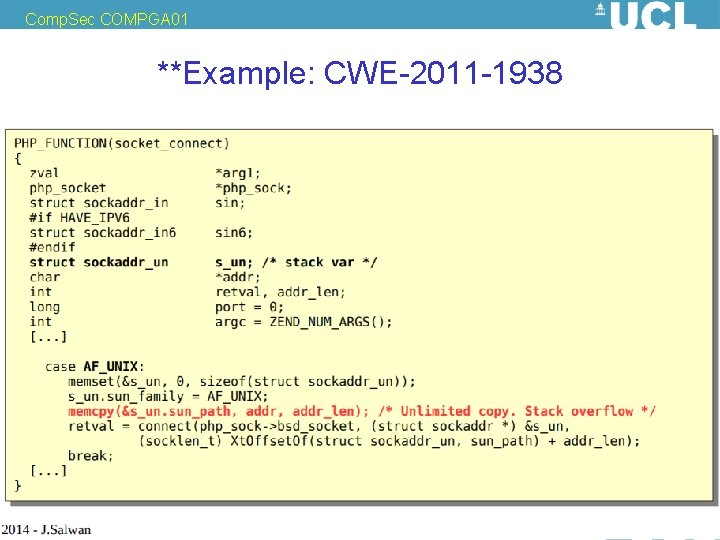
Comp. Sec COMPGA 01 **Example: CWE-2011 -1938 49 Nicolas T. Courtois, 2009 -2018
Comp. Sec COMPGA 01 Can Programmers Get It Right? Lot of evidence around that they cannot. • the behavior of Turing machines is very HARD to analyse, – • • cf. Rice thm. it is usually easier to rewrite code from the scratch than to find all bugs in it software economics, time to market, code re-use etc… Major problems also occur at the compiler and runtime level… (even CPUs have bugs that can be used for exploits). 50 Nicolas T. Courtois, 2009 -2018
Comp. Sec COMPGA 01 Problems with C and C++ • C and C++ particularly dangerous – – Fast, therefore used in servers and all critical code (performance-wise and security-wise) allows arbitrary manipulation of pointers • 51 but not outside the virtual 2 Gbyte space allocated by the OS Nicolas T. Courtois, 2009 -2018
Comp. Sec COMPGA 01 Software Under Attack Main goal: inject arbitrary code through standard input channels of the program. Input-dependent vulnerabilities. Excessively common in software we use every day… Unix and Windows alike… 52 Nicolas T. Courtois, 2009 -2018
Comp. Sec COMPGA 01 Exploit = specially crafted input that allows a certain task to be accomplished compromising the security policy usually executing arbitrary code. Goal: execute with the privilege level of the program: • web server running as superuser… • Ordinary programs running as user… Furthermore, injected code may use another vulnerability to permit privilege escalation. 53 Nicolas T. Courtois, 2009 -2018
Buffer Overflow Attack: Stack Smashing and ASM Code Injection in C
Comp. Sec COMPGA 01 Buffer Overflow in C char command[256]=“”; allocated from the stack. Now imagine we input longer data than 256 bytes and use strcpy(command, *input_data). In theory: “undefined behaviour”. . In practice: we can predict what will happen. 55 Nicolas T. Courtois, 2009 -2018
Comp. Sec COMPGA 01 historical roots Since ever, in CPU assembly and in compiling structured programs, the habit is to save the state of the CPU when calling a sub-routine. And saving the return address. It is essential which comes first… otherwise there would be no such attack. This is saved on the process stack. 56 Nicolas T. Courtois, 2009 -2018
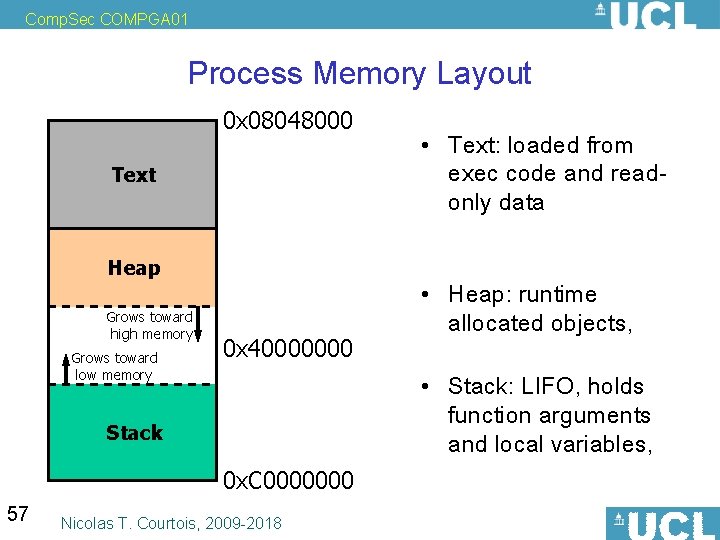
Comp. Sec COMPGA 01 Process Memory Layout 0 x 08048000 Text Heap Grows toward high memory Grows toward low memory 0 x 40000000 Stack 0 x. C 0000000 57 Nicolas T. Courtois, 2009 -2018 • Text: loaded from exec code and readonly data size fixed at compilation • Heap: runtime allocated objects, large (2 Gb) • Stack: LIFO, holds function arguments and local variables, small size (256 K)
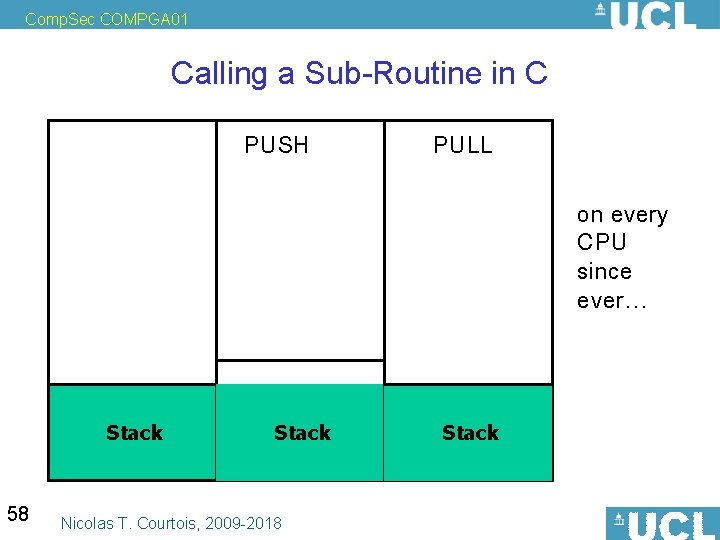
Comp. Sec COMPGA 01 Calling a Sub-Routine in C PUSH PULL on every CPU since ever… Stack 58 Stack Nicolas T. Courtois, 2009 -2018 Stack
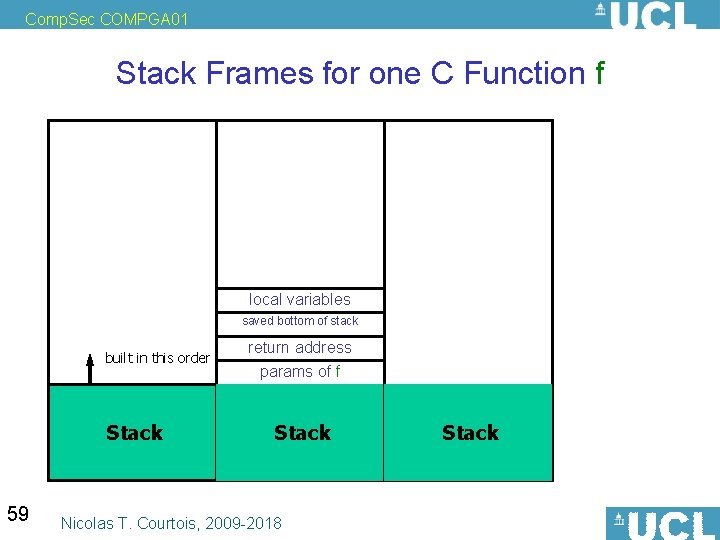
Comp. Sec COMPGA 01 Stack Frames for one C Function f local variables saved bottom of stack built in this order Stack 59 return address params of f Stack Nicolas T. Courtois, 2009 -2018 Stack
Comp. Sec COMPGA 01 exploit on f void f(params) { char command[256]=“”; … strcpy(command, sth) } local variables overwrite saved bottom of stack return address params of f Stack 60 Nicolas T. Courtois, 2009 -2018 increasing addresses size easy to guess
Comp. Sec COMPGA 01 exploit on f void f(params) { char command[256]=“”; … strcpy(command, sth) } local variables overwrite shell code saved bottom of stack return address 0 x 80707050 params of f Stack 61 Nicolas T. Courtois, 2009 -2018 increasing addresses easy to guess
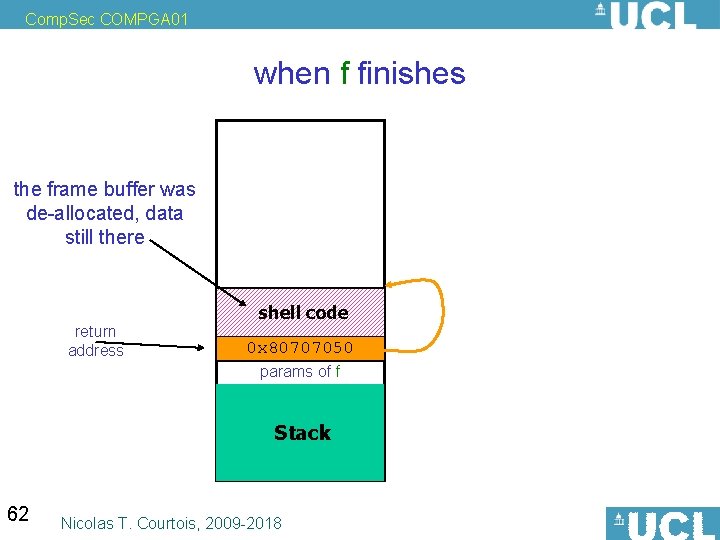
Comp. Sec COMPGA 01 when f finishes the frame buffer was de-allocated, data still there local variables return address shell code saved bottom of stack return address 0 x 80707050 params of f Stack 62 Nicolas T. Courtois, 2009 -2018
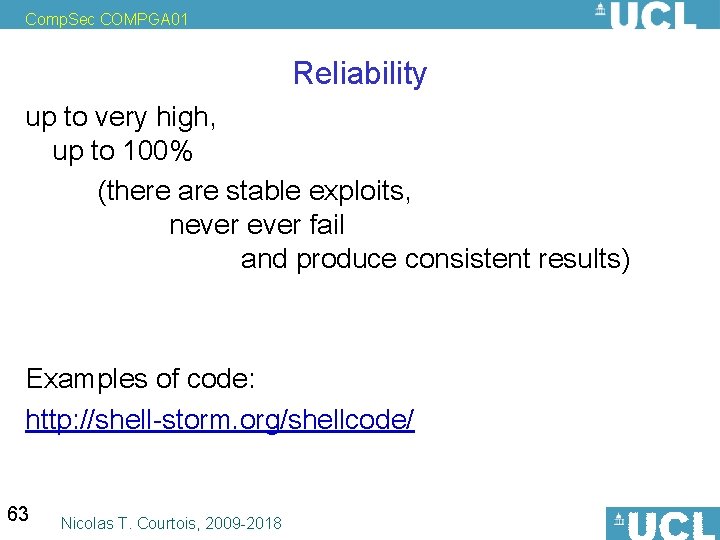
Comp. Sec COMPGA 01 Reliability up to very high, up to 100% (there are stable exploits, never fail and produce consistent results) Examples of code: http: //shell-storm. org/shellcode/ 63 Nicolas T. Courtois, 2009 -2018
Hackers vs. Defenders Advanced Exploits
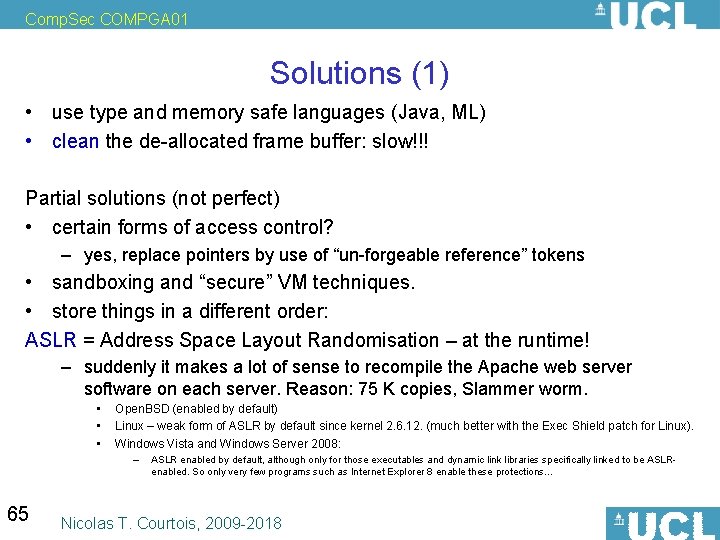
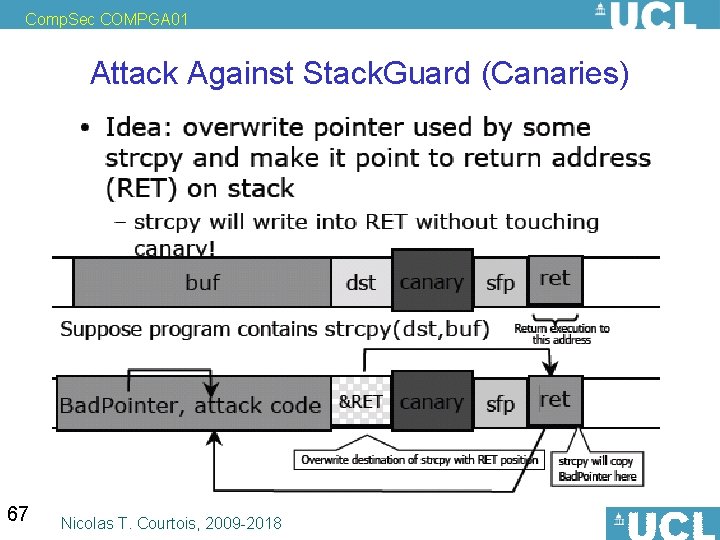
Comp. Sec COMPGA 01 Solutions (1) • use type and memory safe languages (Java, ML) • clean the de-allocated frame buffer: slow!!! Partial solutions (not perfect) • certain forms of access control? – yes, replace pointers by use of “un-forgeable reference” tokens • sandboxing and “secure” VM techniques. • store things in a different order: ASLR = Address Space Layout Randomisation – at the runtime! – suddenly it makes a lot of sense to recompile the Apache web server software on each server. Reason: 75 K copies, Slammer worm. • • • Open. BSD (enabled by default) Linux – weak form of ASLR by default since kernel 2. 6. 12. (much better with the Exec Shield patch for Linux). Windows Vista and Windows Server 2008: – 65 ASLR enabled by default, although only for those executables and dynamic link libraries specifically linked to be ASLRenabled. So only very few programs such as Internet Explorer 8 enable these protections… Nicolas T. Courtois, 2009 -2018
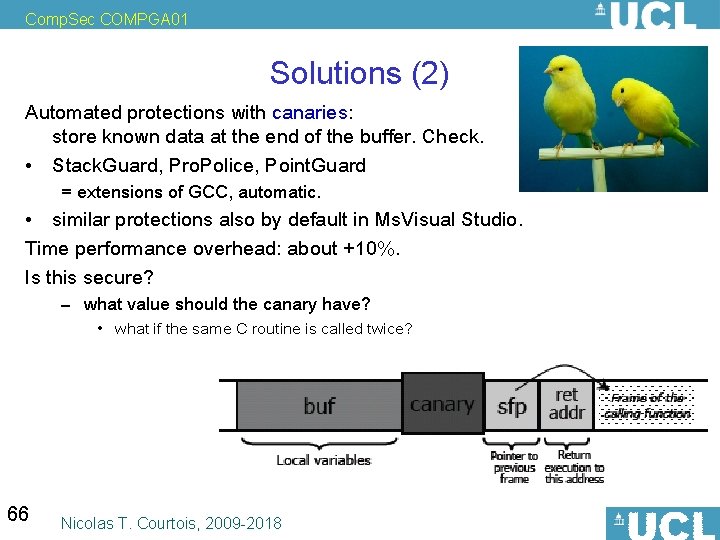
Comp. Sec COMPGA 01 Solutions (2) Automated protections with canaries: store known data at the end of the buffer. Check. • Stack. Guard, Pro. Police, Point. Guard = extensions of GCC, automatic. • similar protections also by default in Ms. Visual Studio. Time performance overhead: about +10%. Is this secure? – what value should the canary have? • what if the same C routine is called twice? 66 Nicolas T. Courtois, 2009 -2018
Comp. Sec COMPGA 01 Attack Against Stack. Guard (Canaries) 67 Nicolas T. Courtois, 2009 -2018
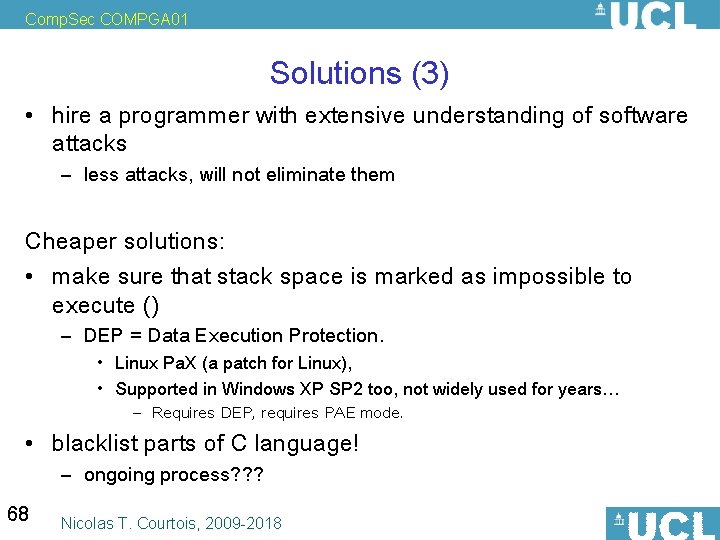
Comp. Sec COMPGA 01 Solutions (3) • hire a programmer with extensive understanding of software attacks – less attacks, will not eliminate them Cheaper solutions: • make sure that stack space is marked as impossible to execute () – DEP = Data Execution Protection. • Linux Pa. X (a patch for Linux), • Supported in Windows XP SP 2 too, not widely used for years… – Requires DEP, requires PAE mode. • blacklist parts of C language! – ongoing process? ? ? 68 Nicolas T. Courtois, 2009 -2018
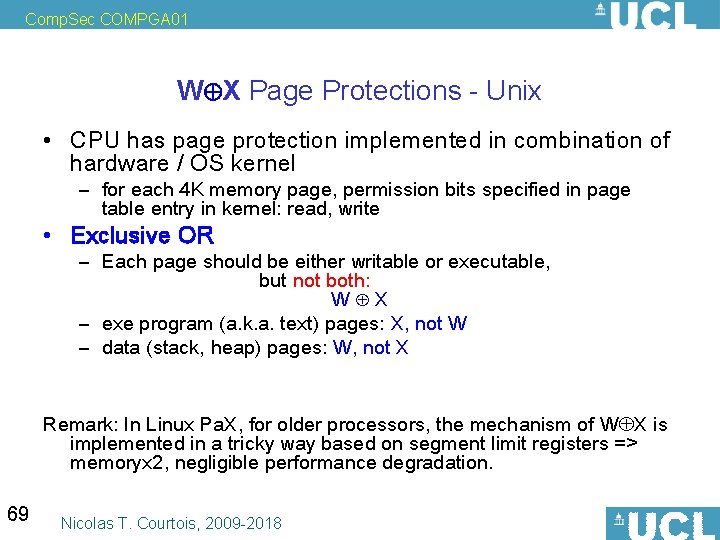
Comp. Sec COMPGA 01 W X Page Protections - Unix • CPU has page protection implemented in combination of hardware / OS kernel – for each 4 K memory page, permission bits specified in page table entry in kernel: read, write • Exclusive OR – Each page should be either writable or executable, but not both: W X – exe program (a. k. a. text) pages: X, not W – data (stack, heap) pages: W, not X Remark: In Linux Pa. X, for older processors, the mechanism of W X is implemented in a tricky way based on segment limit registers => memoryx 2, negligible performance degradation. 69 Nicolas T. Courtois, 2009 -2018
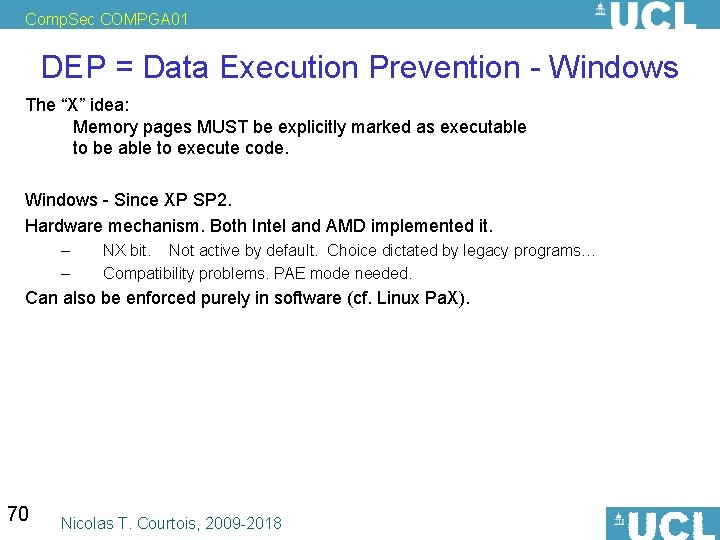
Comp. Sec COMPGA 01 DEP = Data Execution Prevention - Windows The “X” idea: Memory pages MUST be explicitly marked as executable to be able to execute code. Windows - Since XP SP 2. Hardware mechanism. Both Intel and AMD implemented it. – – NX bit. Not active by default. Choice dictated by legacy programs… Compatibility problems. PAE mode needed. Can also be enforced purely in software (cf. Linux Pa. X). 70 Nicolas T. Courtois, 2009 -2018
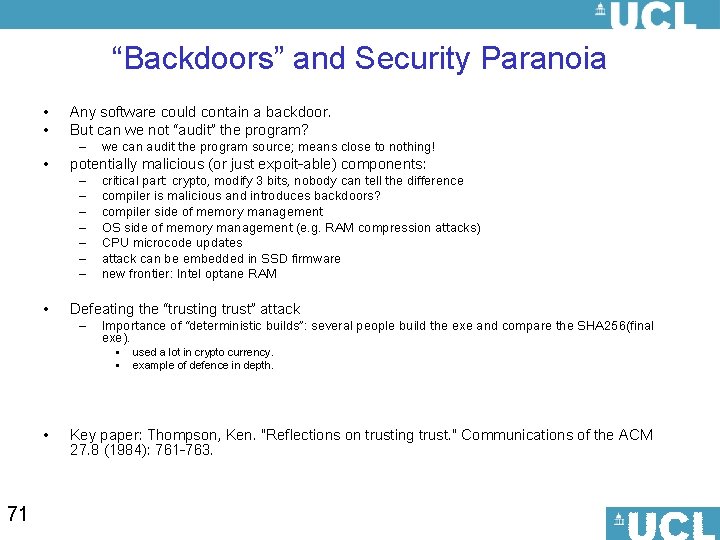
“Backdoors” and Security Paranoia • • Any software could contain a backdoor. But can we not “audit” the program? • potentially malicious (or just expoit-able) components: • Defeating the “trusting trust” attack – we can audit the program source; means close to nothing! – – – – critical part: crypto, modify 3 bits, nobody can tell the difference compiler is malicious and introduces backdoors? compiler side of memory management OS side of memory management (e. g. RAM compression attacks) CPU microcode updates attack can be embedded in SSD firmware new frontier: Intel optane RAM – Importance of “deterministic builds”: several people build the exe and compare the SHA 256(final exe). • • • 71 used a lot in crypto currency. example of defence in depth. Key paper: Thompson, Ken. "Reflections on trusting trust. " Communications of the ACM 27. 8 (1984): 761 -763.
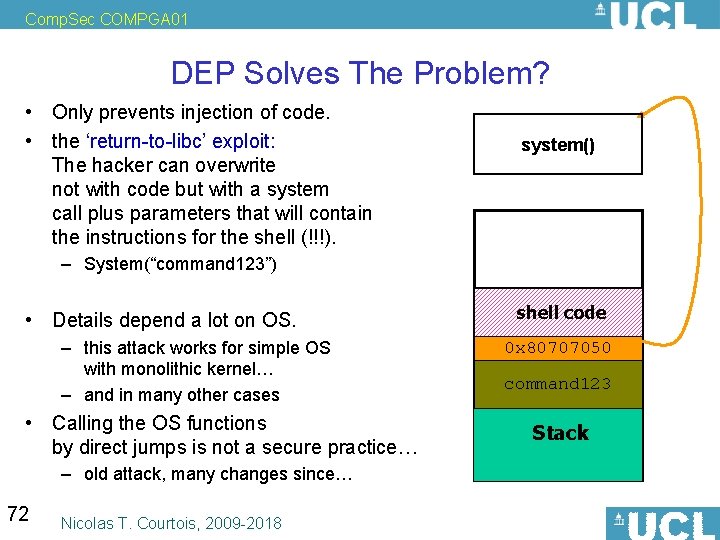
Comp. Sec COMPGA 01 DEP Solves The Problem? • Only prevents injection of code. • the ‘return-to-libc’ exploit: The hacker can overwrite not with code but with a system call plus parameters that will contain the instructions for the shell (!!!). system() – System(“command 123”) local variables • Details depend a lot on OS. – this attack works for simple OS with monolithic kernel… – and in many other cases • Calling the OS functions by direct jumps is not a secure practice… – old attack, many changes since… 72 Nicolas T. Courtois, 2009 -2018 shell code saved bottom of stack return address 0 x 80707050 command 123 Stack
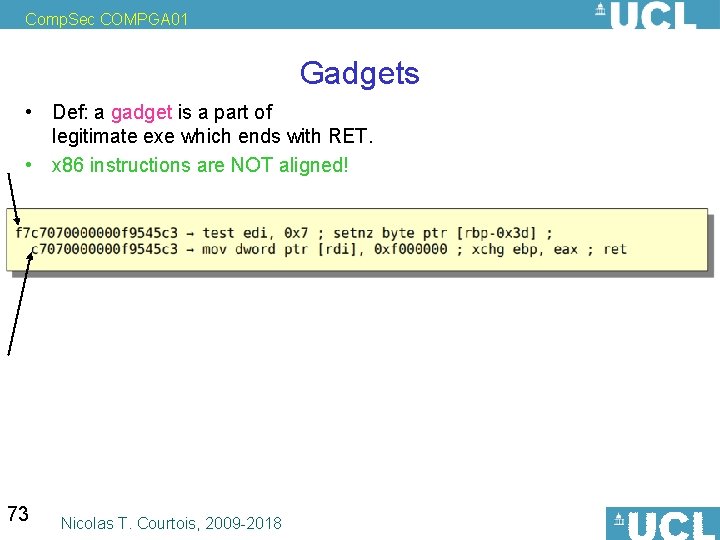
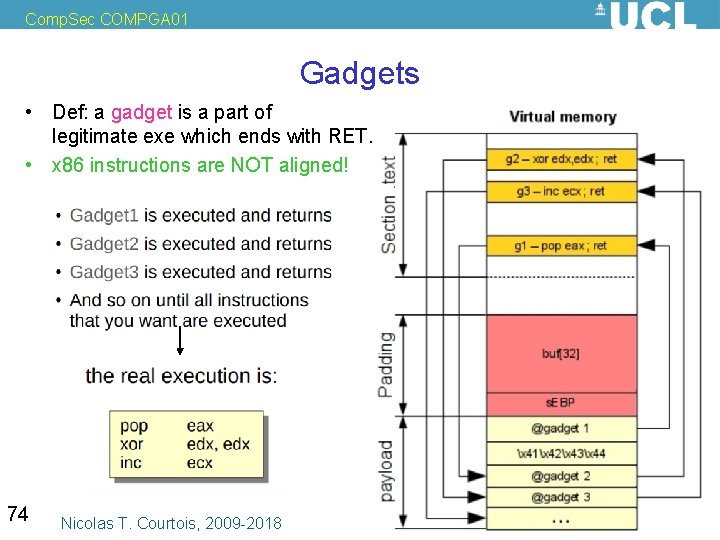
Comp. Sec COMPGA 01 Gadgets • Def: a gadget is a part of legitimate exe which ends with RET. • x 86 instructions are NOT aligned! 73 Nicolas T. Courtois, 2009 -2018
Comp. Sec COMPGA 01 Gadgets • Def: a gadget is a part of legitimate exe which ends with RET. • x 86 instructions are NOT aligned! 74 Nicolas T. Courtois, 2009 -2018
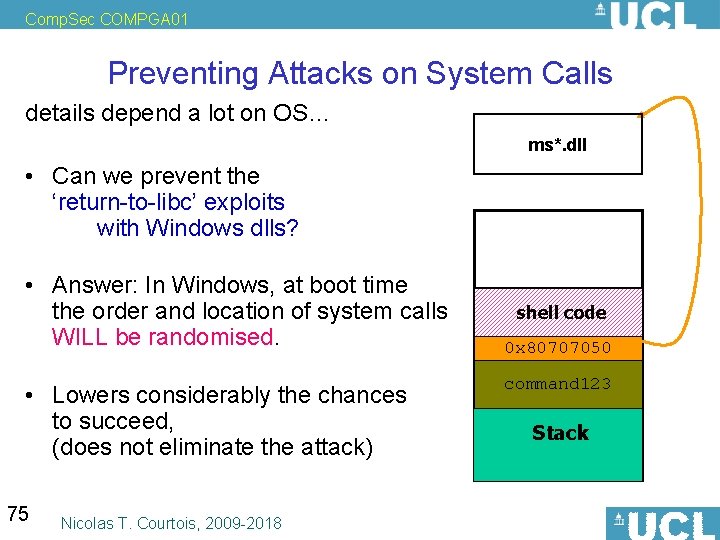
Comp. Sec COMPGA 01 Preventing Attacks on System Calls details depend a lot on OS… ms*. dll • Can we prevent the ‘return-to-libc’ exploits with Windows dlls? • Answer: In Windows, at boot time the order and location of system calls WILL be randomised. • Lowers considerably the chances to succeed, (does not eliminate the attack) 75 Nicolas T. Courtois, 2009 -2018 local variables shell code saved bottom of stack return address 0 x 80707050 command 123 Stack
Comp. Sec COMPGA 01 DEP Solves The Problem? • Can still jump to some code injected on the heap • Does not prevent against attacks on the heap… see later slides. 76 Nicolas T. Courtois, 2009 -2018
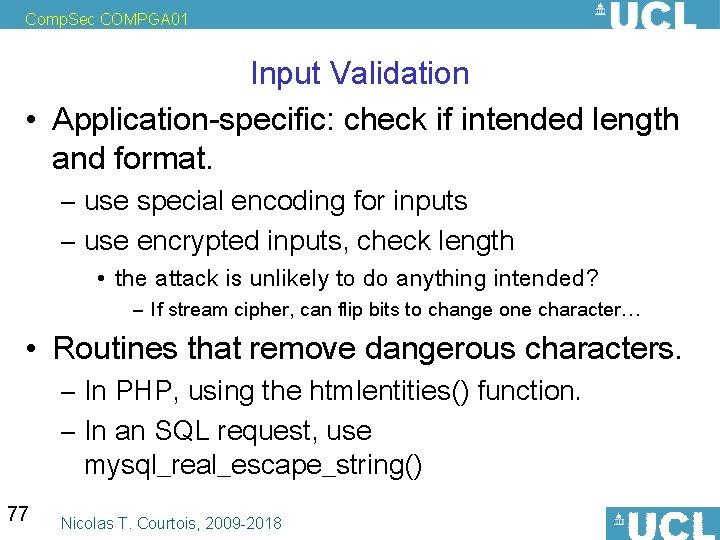
Comp. Sec COMPGA 01 Input Validation • Application-specific: check if intended length and format. – use special encoding for inputs – use encrypted inputs, check length • the attack is unlikely to do anything intended? – If stream cipher, can flip bits to change one character… • Routines that remove dangerous characters. – In PHP, using the htmlentities() function. – In an SQL request, use mysql_real_escape_string() 77 Nicolas T. Courtois, 2009 -2018
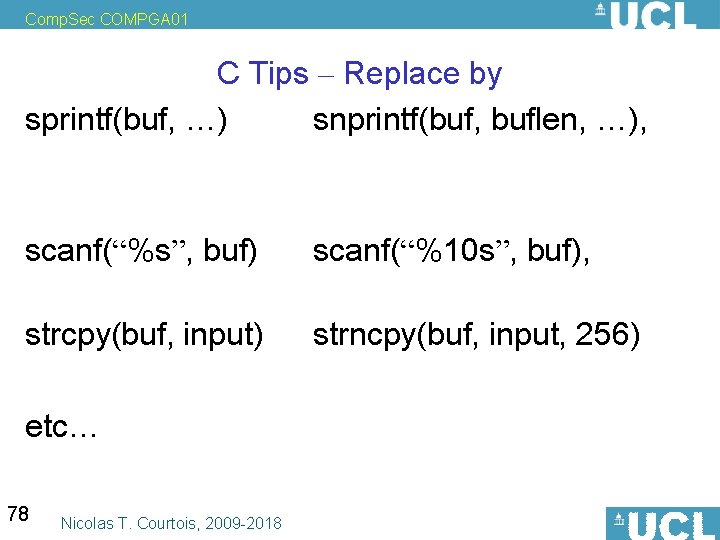
Comp. Sec COMPGA 01 C Tips – Replace by sprintf(buf, …) snprintf(buf, buflen, …), scanf(“%s”, buf) scanf(“%10 s”, buf), strcpy(buf, input) strncpy(buf, input, 256) etc… 78 Nicolas T. Courtois, 2009 -2018
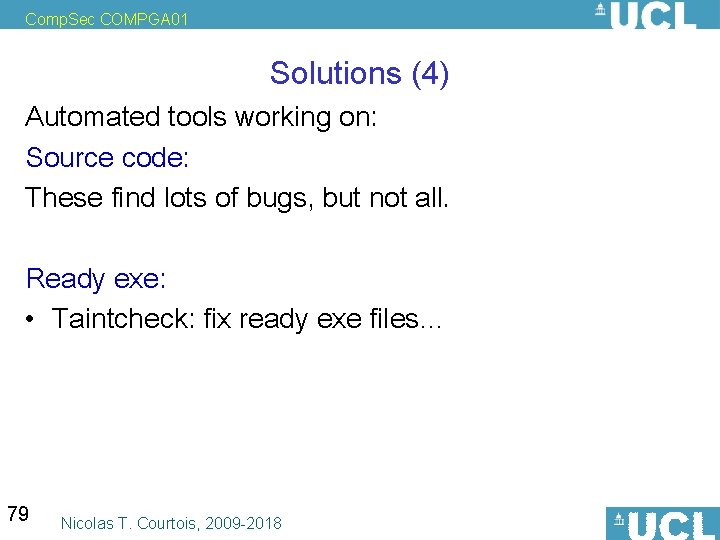
Comp. Sec COMPGA 01 Solutions (4) Automated tools working on: Source code: These find lots of bugs, but not all. Ready exe: • Taintcheck: fix ready exe files… 79 Nicolas T. Courtois, 2009 -2018
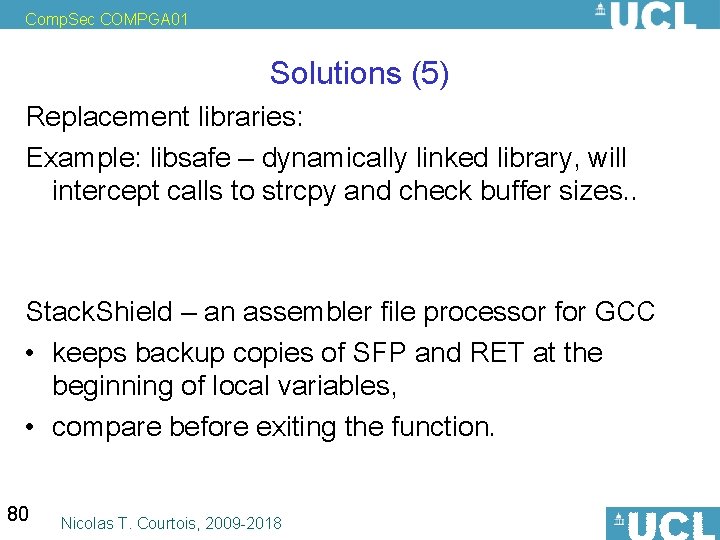
Comp. Sec COMPGA 01 Solutions (5) Replacement libraries: Example: libsafe – dynamically linked library, will intercept calls to strcpy and check buffer sizes. . Stack. Shield – an assembler file processor for GCC • keeps backup copies of SFP and RET at the beginning of local variables, • compare before exiting the function. 80 Nicolas T. Courtois, 2009 -2018
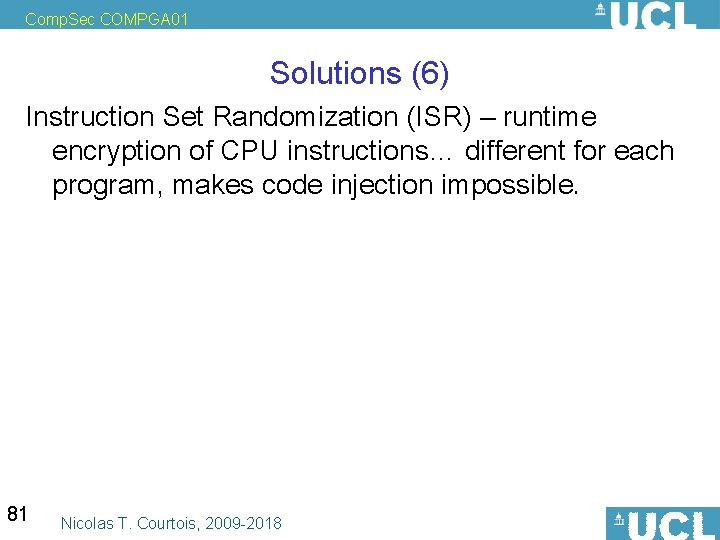
Comp. Sec COMPGA 01 Solutions (6) Instruction Set Randomization (ISR) – runtime encryption of CPU instructions… different for each program, makes code injection impossible. 81 Nicolas T. Courtois, 2009 -2018
Heap Overflow Attacks (about chained lists pointers etc)
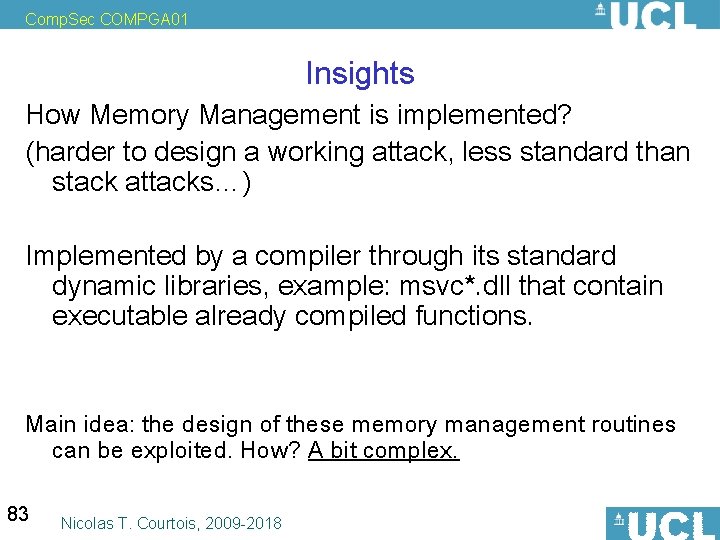
Comp. Sec COMPGA 01 Insights How Memory Management is implemented? (harder to design a working attack, less standard than stack attacks…) Implemented by a compiler through its standard dynamic libraries, example: msvc*. dll that contain executable already compiled functions. Main idea: the design of these memory management routines can be exploited. How? A bit complex. 83 Nicolas T. Courtois, 2009 -2018
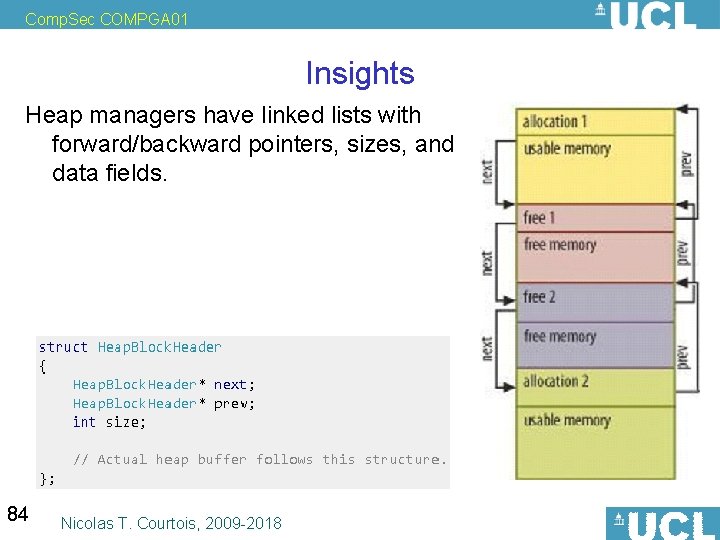
Comp. Sec COMPGA 01 Insights Heap managers have linked lists with forward/backward pointers, sizes, and data fields. 84 Nicolas T. Courtois, 2009 -2018
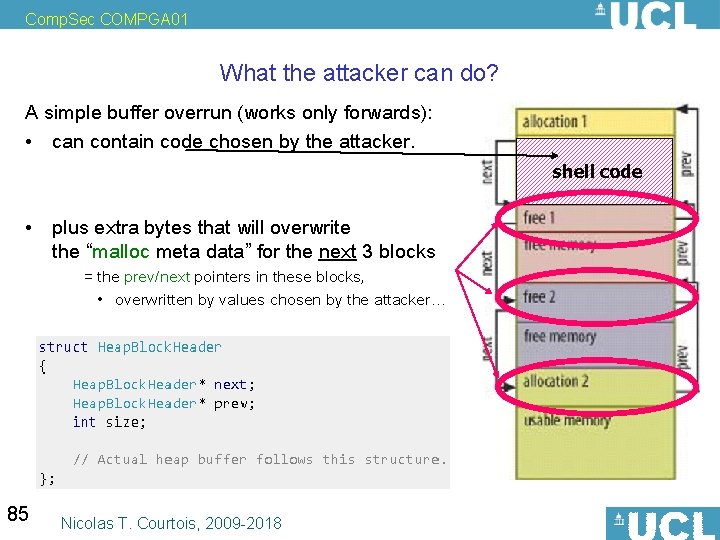
Comp. Sec COMPGA 01 What the attacker can do? A simple buffer overrun (works only forwards): • can contain code chosen by the attacker. and if heap is marked NX, pointers to libc functions + parameters in the following bytes. . • plus extra bytes that will overwrite the “malloc meta data” for the next 3 blocks = the prev/next pointers in these blocks, • overwritten by values chosen by the attacker… 85 Nicolas T. Courtois, 2009 -2018 shell code
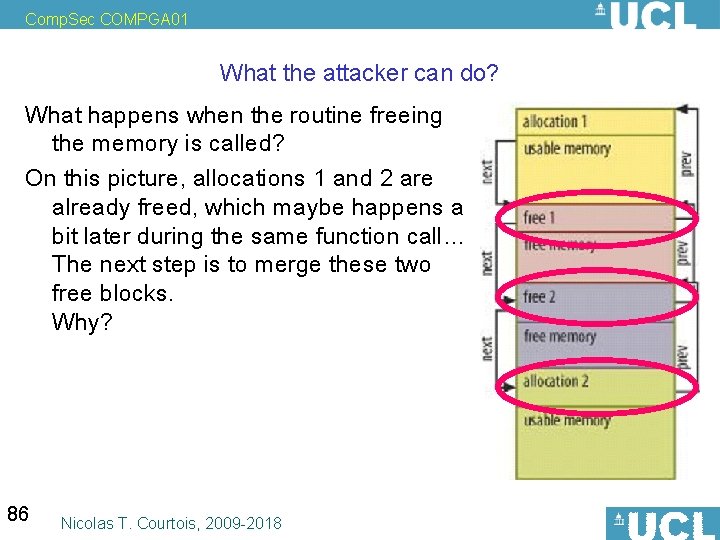
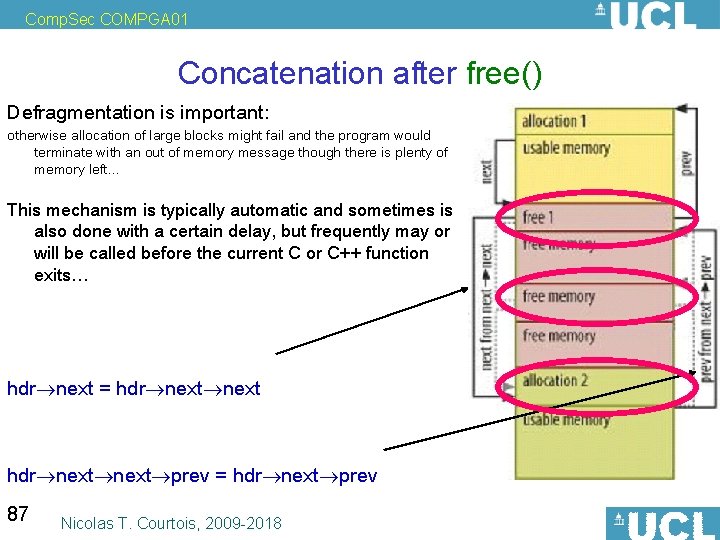
Comp. Sec COMPGA 01 What the attacker can do? What happens when the routine freeing the memory is called? On this picture, allocations 1 and 2 are already freed, which maybe happens a bit later during the same function call… The next step is to merge these two free blocks. Why? 86 Nicolas T. Courtois, 2009 -2018
Comp. Sec COMPGA 01 Concatenation after free() Defragmentation is important: otherwise allocation of large blocks might fail and the program would terminate with an out of memory message though there is plenty of memory left… This mechanism is typically automatic and sometimes is also done with a certain delay, but frequently may or will be called before the current C or C++ function exits… hdr next = hdr next prev = hdr next prev 87 Nicolas T. Courtois, 2009 -2018
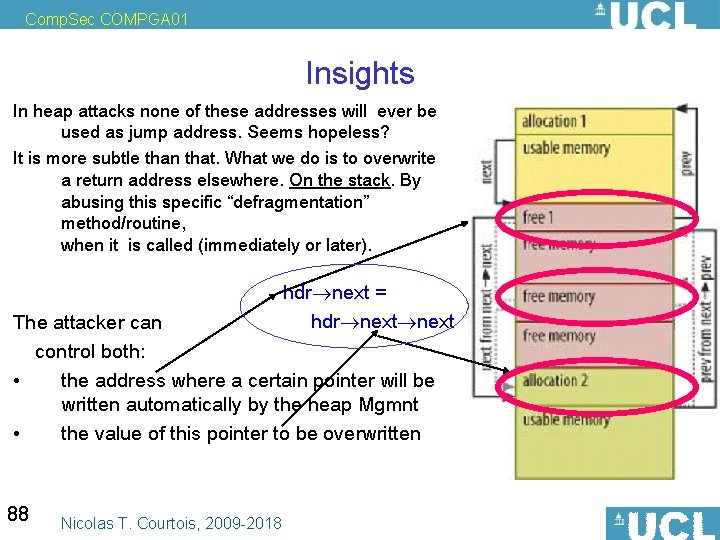
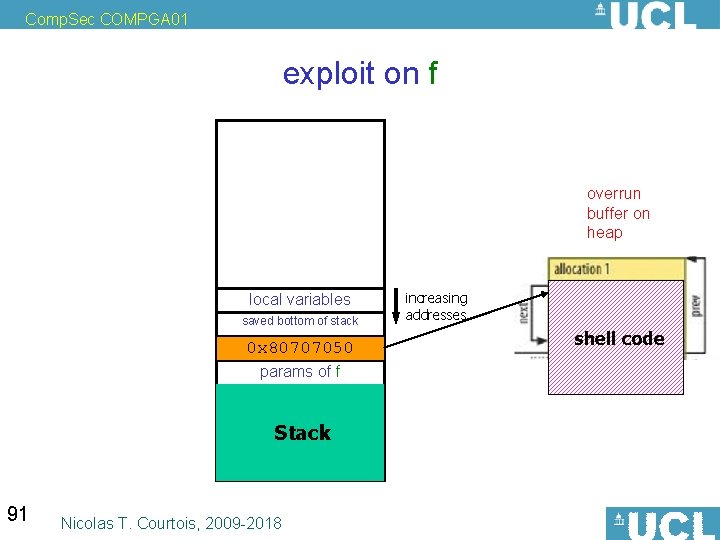
Comp. Sec COMPGA 01 Insights In heap attacks none of these addresses will ever be used as jump address. Seems hopeless? It is more subtle than that. What we do is to overwrite a return address elsewhere. On the stack. By abusing this specific “defragmentation” method/routine, when it is called (immediately or later). hdr next = hdr next The attacker can control both: • the address where a certain pointer will be written automatically by the heap Mgmnt • the value of this pointer to be overwritten 88 Nicolas T. Courtois, 2009 -2018
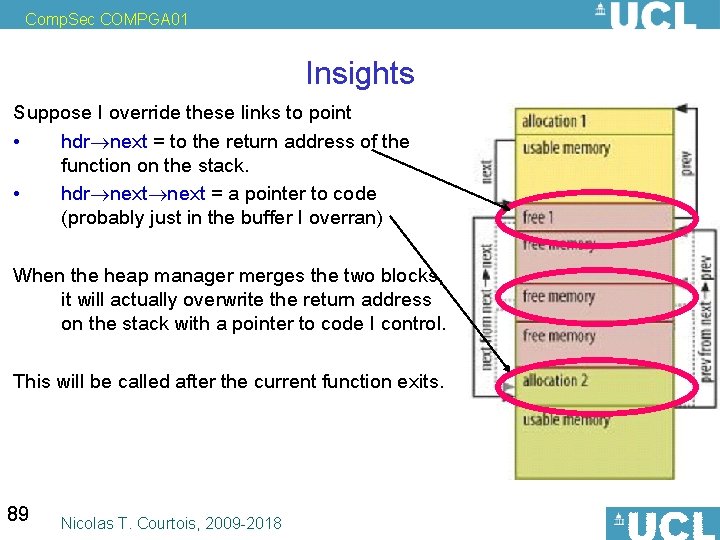
Comp. Sec COMPGA 01 Insights Suppose I override these links to point • hdr next = to the return address of the function on the stack. • hdr next = a pointer to code (probably just in the buffer I overran) When the heap manager merges the two blocks, it will actually overwrite the return address on the stack with a pointer to code I control. This will be called after the current function exits. 89 Nicolas T. Courtois, 2009 -2018
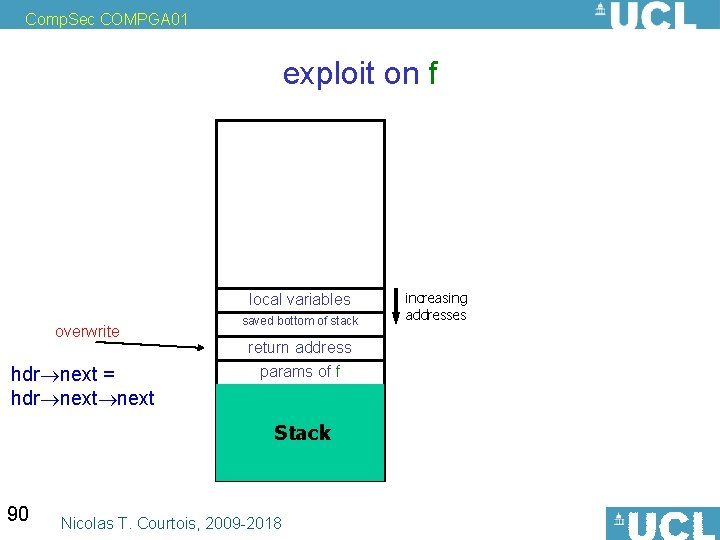
Comp. Sec COMPGA 01 exploit on f local variables overwrite hdr next = hdr next saved bottom of stack return address params of f Stack 90 Nicolas T. Courtois, 2009 -2018 increasing addresses
Comp. Sec COMPGA 01 exploit on f overrun buffer on heap local variables saved bottom of stack return address 0 x 80707050 params of f Stack 91 Nicolas T. Courtois, 2009 -2018 increasing addresses shell code