
Exploiting Superposition and TimeInvariance DT LTI System Are
![Graphical Convolution (Cont. ) • Observations: § y[n] = 0 for n > 4](https://slidetodoc.com/presentation_image_h/f76a99413619006559c8c89d7c9a48a2/image-9.jpg "Graphical Convolution (Cont. ) • Observations: § y[n] = 0 for n > 4")
- Slides: 13
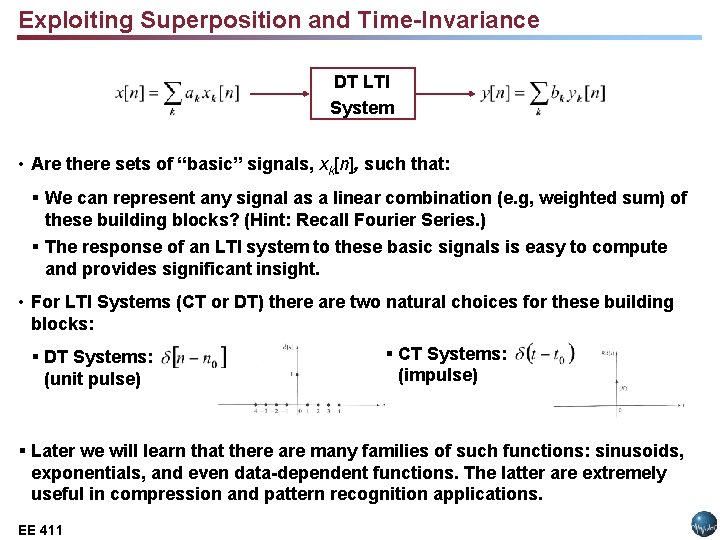
Exploiting Superposition and Time-Invariance DT LTI System • Are there sets of “basic” signals, xk[n], such that: § We can represent any signal as a linear combination (e. g, weighted sum) of these building blocks? (Hint: Recall Fourier Series. ) § The response of an LTI system to these basic signals is easy to compute and provides significant insight. • For LTI Systems (CT or DT) there are two natural choices for these building blocks: § DT Systems: (unit pulse) § CT Systems: (impulse) § Later we will learn that there are many families of such functions: sinusoids, exponentials, and even data-dependent functions. The latter are extremely useful in compression and pattern recognition applications. EE 411 Lecture 14, Slide 0 EE 3512:
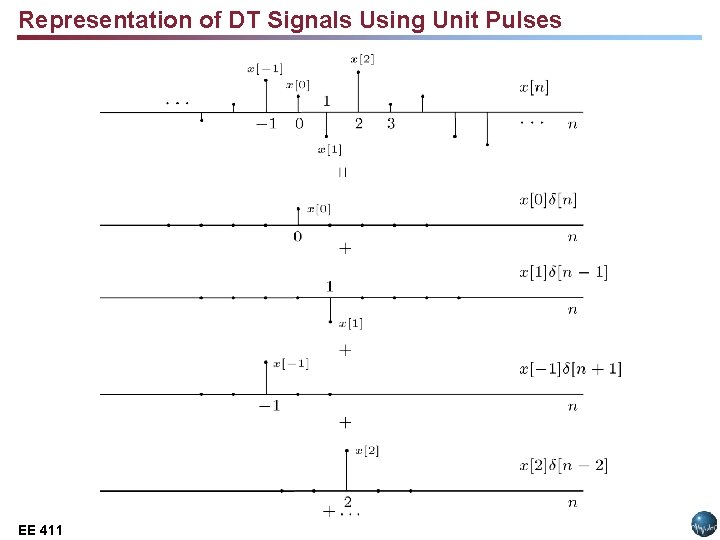
Representation of DT Signals Using Unit Pulses EE 411 Lecture 14, Slide 1 EE 3512:
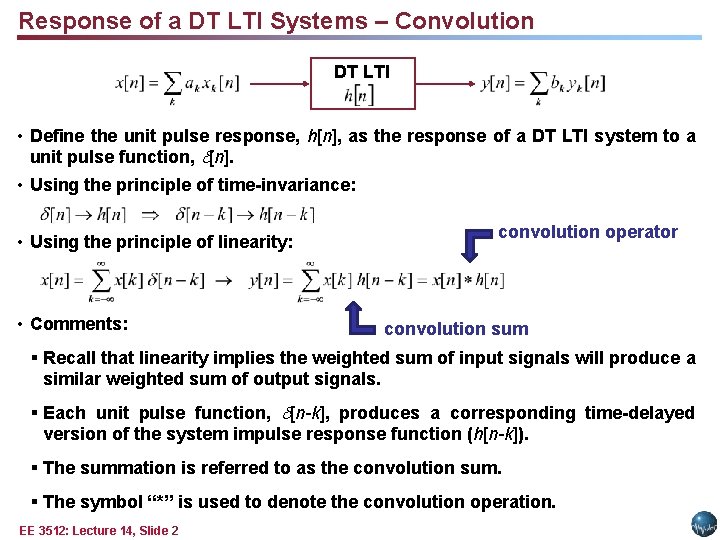
Response of a DT LTI Systems – Convolution DT LTI • Define the unit pulse response, h[n], as the response of a DT LTI system to a unit pulse function, [n]. • Using the principle of time-invariance: • Using the principle of linearity: • Comments: convolution operator convolution sum § Recall that linearity implies the weighted sum of input signals will produce a similar weighted sum of output signals. § Each unit pulse function, [n-k], produces a corresponding time-delayed version of the system impulse response function (h[n-k]). § The summation is referred to as the convolution sum. § The symbol “*” is used to denote the convolution operation. EE 3512: Lecture 14, Slide 2
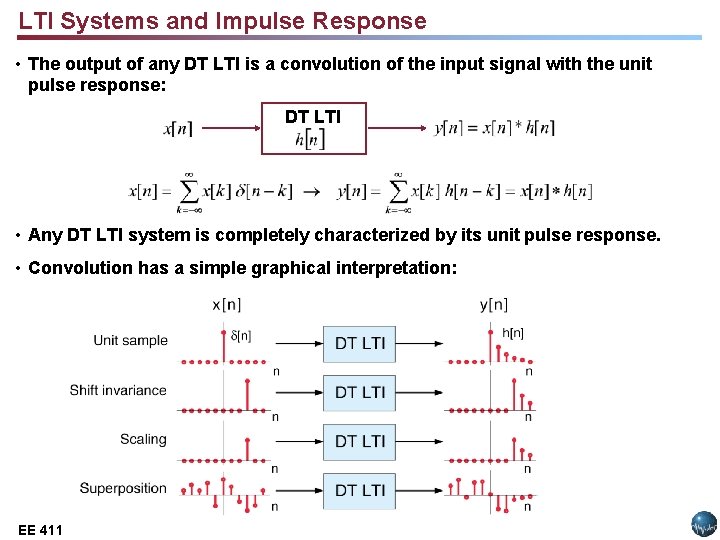
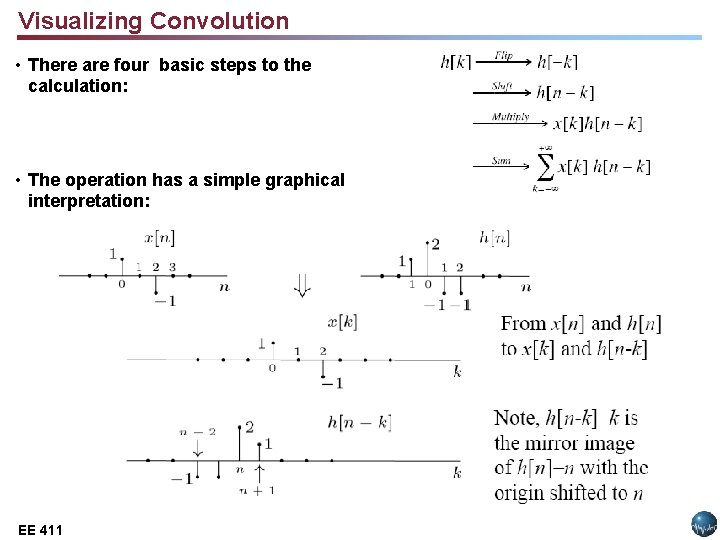
LTI Systems and Impulse Response • The output of any DT LTI is a convolution of the input signal with the unit pulse response: DT LTI • Any DT LTI system is completely characterized by its unit pulse response. • Convolution has a simple graphical interpretation: EE 411 Lecture 14, Slide 3 EE 3512:
Visualizing Convolution • There are four basic steps to the calculation: • The operation has a simple graphical interpretation: EE 411 Lecture 14, Slide 4 EE 3512:
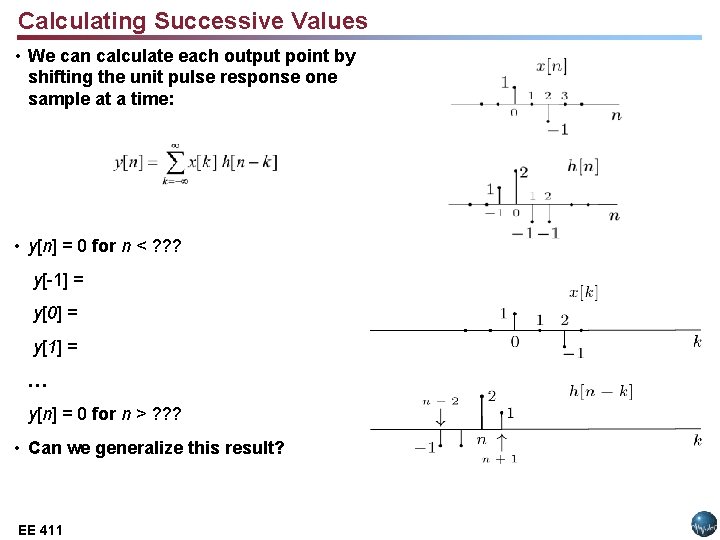
Calculating Successive Values • We can calculate each output point by shifting the unit pulse response one sample at a time: • y[n] = 0 for n < ? ? ? y[-1] = y[0] = y[1] = … y[n] = 0 for n > ? ? ? • Can we generalize this result? EE 411 Lecture 14, Slide 5 EE 3512:
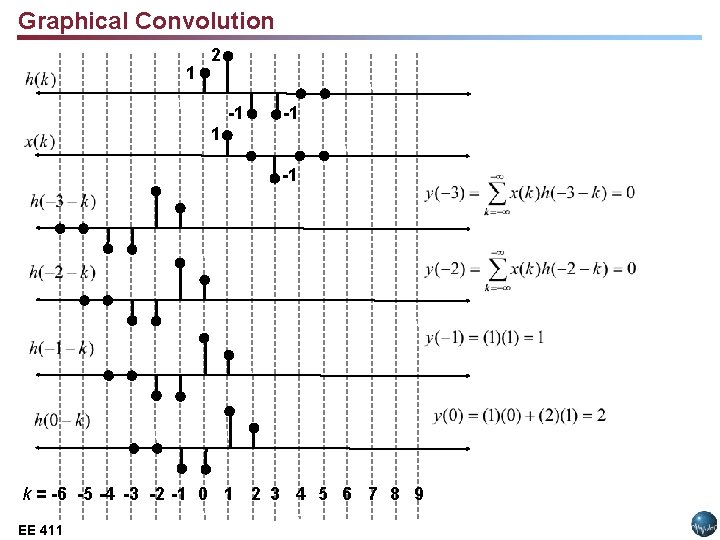
Graphical Convolution 1 2 -1 -1 k = -6 -5 -4 -3 -2 -1 0 1 2 3 4 5 6 7 8 9 EE 411 Lecture 14, Slide 6 EE 3512:
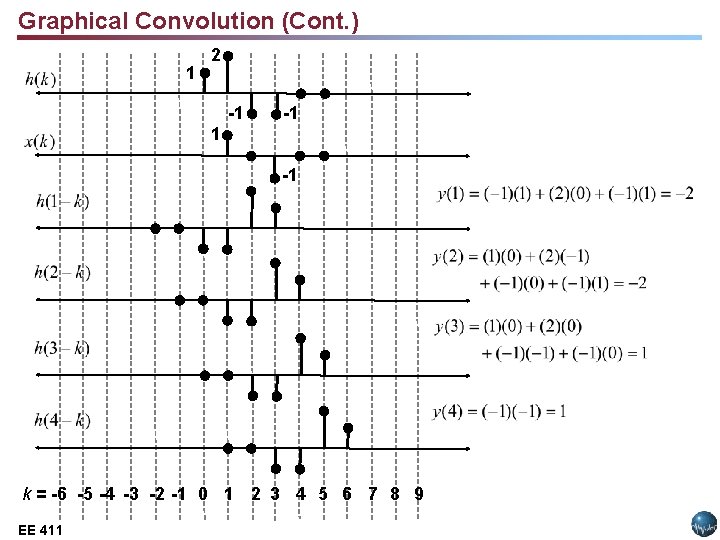
Graphical Convolution (Cont. ) 1 2 -1 -1 k = -6 -5 -4 -3 -2 -1 0 1 2 3 4 5 6 7 8 9 EE 411 Lecture 14, Slide 7 EE 3512:
Graphical Convolution (Cont. ) • Observations: § y[n] = 0 for n > 4 § If we define the duration of h[n] as the difference in time from the first nonzero sample to the last nonzero sample, the duration of h[n], Lh, is 4 samples. § Similarly, Lx = 3. § The duration of y[n] is: Ly = Lx + Lh – 1. This is a good sanity check. • The fact that the output has a duration longer than the input indicates that convolution often acts like a low pass filter and smoothes the signal. EE 411 Lecture 14, Slide 8 EE 3512:
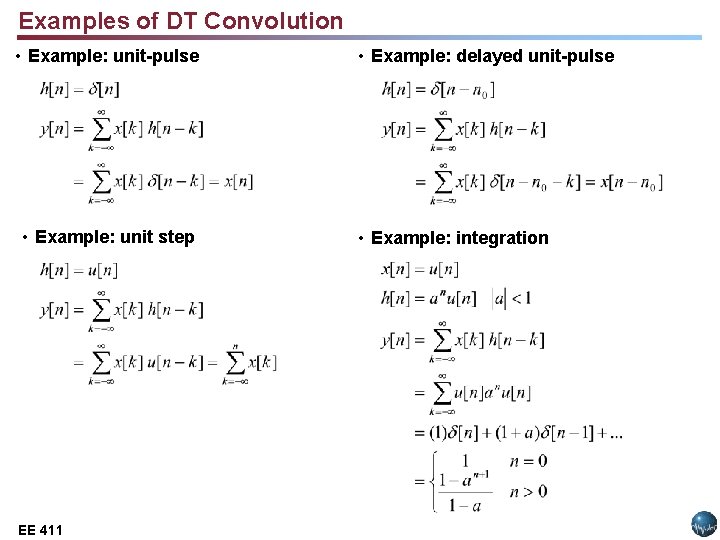
Examples of DT Convolution • Example: unit-pulse • Example: unit step EE 411 Lecture 14, Slide 9 EE 3512: • Example: delayed unit-pulse • Example: integration
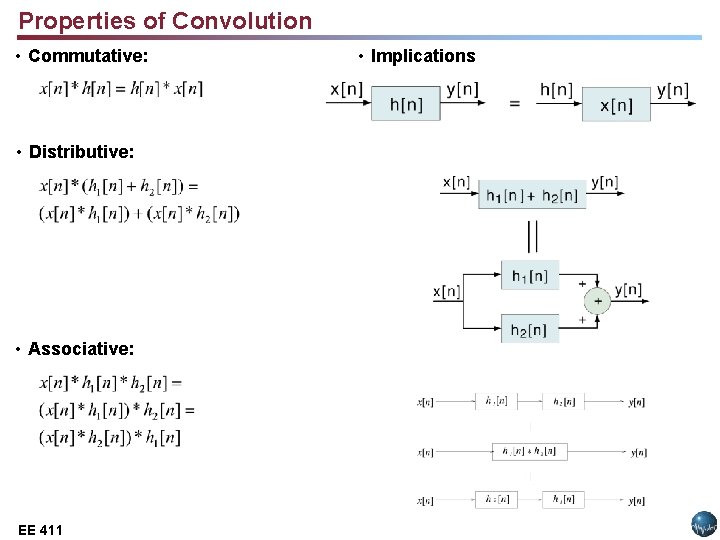
Properties of Convolution • Commutative: • Distributive: • Associative: EE 411 Lecture 14, Slide 10 EE 3512: • Implications
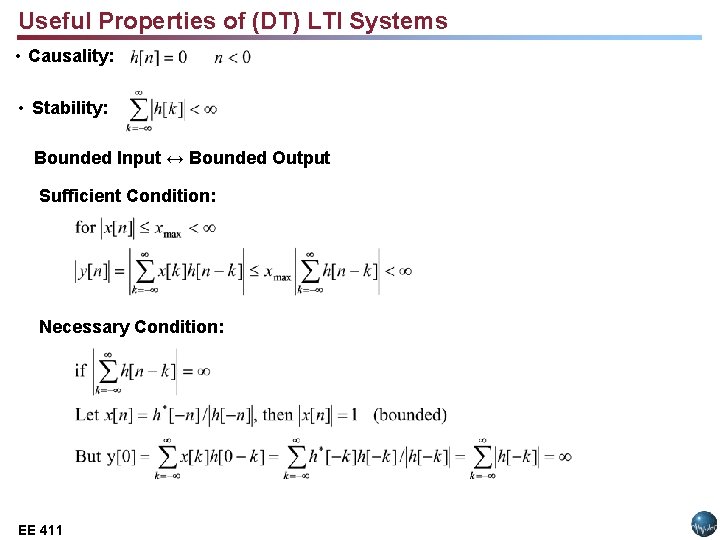
Useful Properties of (DT) LTI Systems • Causality: • Stability: Bounded Input ↔ Bounded Output Sufficient Condition: Necessary Condition: EE 411 Lecture 14, Slide 11 EE 3512:
Summary • We introduced a method for computing the output of a discrete-time (DT) linear time-invariant (LTI) system known as convolution. • We demonstrated how this operation can be performed analytically and graphically. • We discussed three important properties: commutative, associative and distributive. • Question: can we determine key properties of a system, such as causality and stability, by examining the system impulse response? • There are several interactive tools available that demonstrate graphical convolution: ISIP: Convolution Java Applet. EE 411 Lecture 14, Slide 12 EE 3512: