
Exploiting objective ABR noise SNR measurements Guy Lightfoot
Exploiting objective ABR noise & SNR measurements Guy Lightfoot ERA Training & Consultancy Ltd email: admin@eratraining. co. uk web: www. eratraining. co. uk
CR & RA using replicated waveforms • BSA guidance uses the residual noise of pairs of waveforms for: – Candidacy for “RA” – Calculating the SNR for “CR” candidacy • Not all ABR systems objectively report residual noise • Therefore primary method is based on visual assessment: • Optimally superimpose a pair of waveforms • Estimate noise as the average gap (across entire width) • Using that method of estimating residual noise, – The criterion for RA is 25 n. V (& no evidence of a response) – The SNR criterion for CR is 3 (& expected ABR morphology)
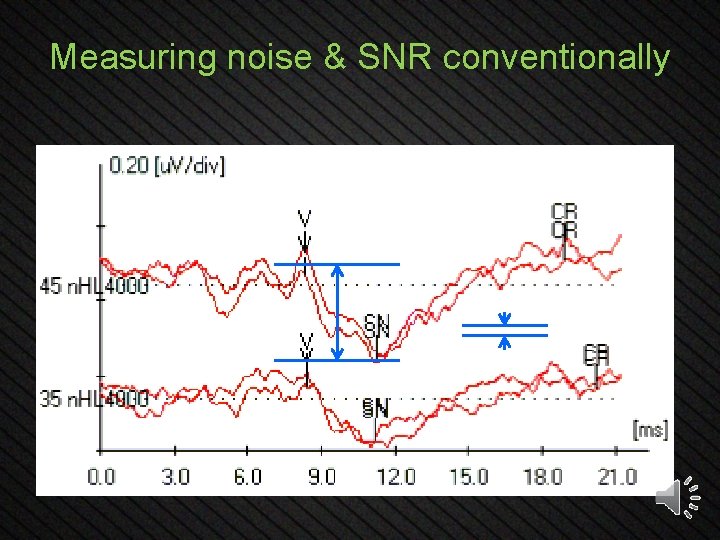
Measuring noise & SNR conventionally
2019 BSA ABR guidance • Rather than using a pre-set number of sweeps, we should use only as many sweeps as we need to in order to conclude either CR or RA • Introduced the option to use objective measurements: • Fsp/Fmp for CR candidacy (criterion: ≥ 7) – Replication not essential at levels above threshold • Residual noise for RA – Replication not essential for RA if an objective measurement used • The 25 n. V “average gap” noise suggested for RA is 15 n. V for the Biologic Nav. Pro and Interacoustics Eclipse
What if I have replicated? • For RA, we can monitor the noise whilst averaging and use it to inform us when it is safe to stop averaging • Question: If I have replicated, what values for noise in each of 2 waveforms combine to ≤ 15 n. V? • Answer: ≤ 21 n. V in each waveform; we can use that to tell us when to stop averaging each run (or use ≤ 15 n. V in a single run)
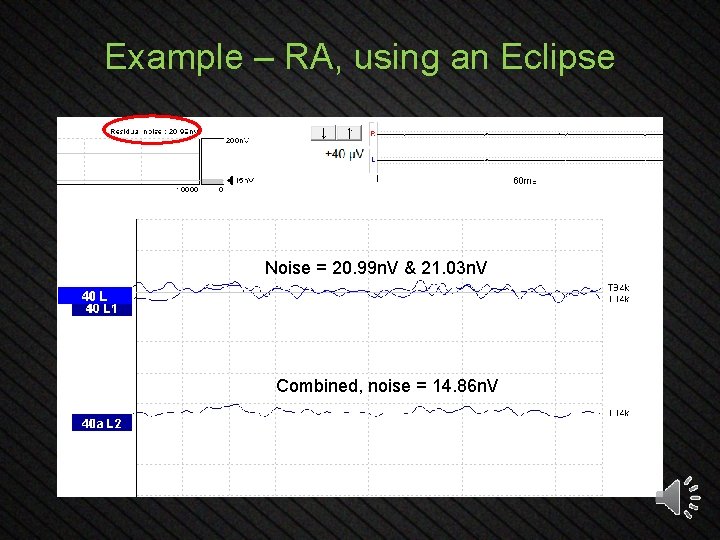
Example – RA, using an Eclipse Noise = 20. 99 n. V & 21. 03 n. V Combined, noise = 14. 86 n. V
How about CR? • Fmp works fine above threshold, where we are allowed to use an unreplicated waveform, but Fmp is insensitive at threshold i. e. responses with an acceptable SNR often fail to meet the Fmp CR criterion of ≥ 7 • Question: Can SNR be measured objectively, for each waveform in isolation, using the reported residual noise? • Question: Can this be measured during averaging (like Fmp) to inform our decision on when to stop averaging? • Remember: at threshold, we must replicate
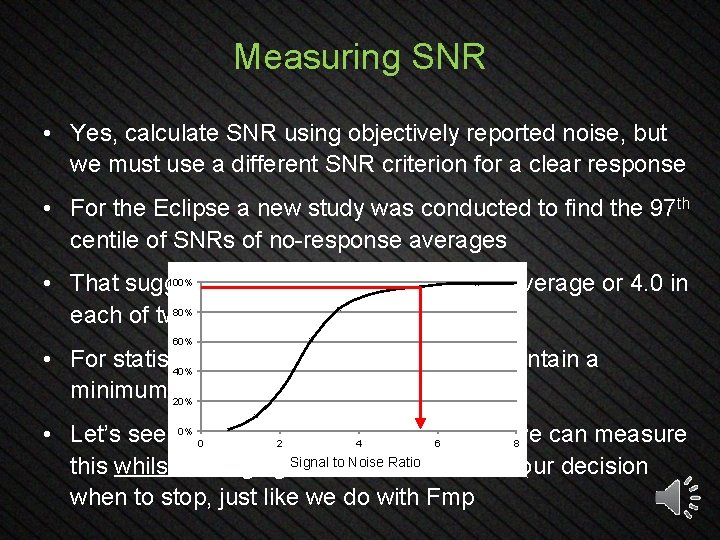
Measuring SNR • Yes, calculate SNR using objectively reported noise, but we must use a different SNR criterion for a clear response • For the Eclipse a new study was conducted to find the 97 th centile of SNRs of no-response averages 100% • That suggests an SNR of 5. 5 for a single average or 4. 0 in 80% each of two averages 60% • For statistical reasons, an average must contain a 40% minimum 20% of 2000 sweeps 0% • Let’s see an using 4 the Eclipse – we can measure 0 example 2 6 8 Noise Ratio this whilst averaging Signal andtoallow it to inform our decision when to stop, just like we do with Fmp
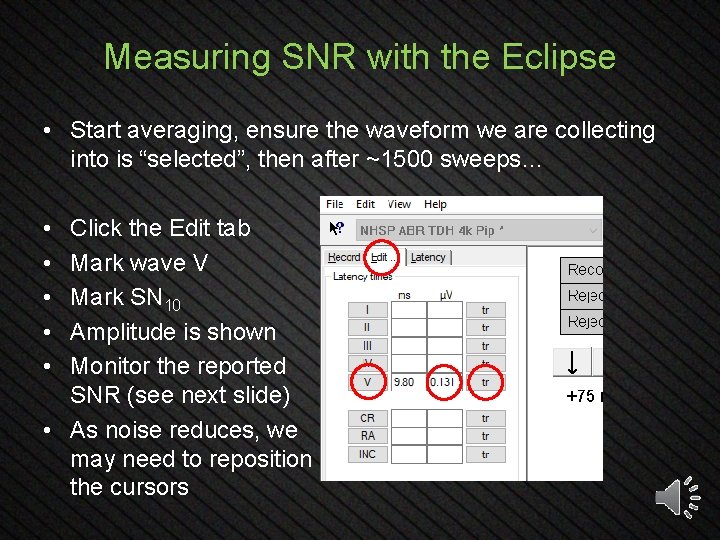
Measuring SNR with the Eclipse • Start averaging, ensure the waveform we are collecting into is “selected”, then after ~1500 sweeps… • • • Click the Edit tab Mark wave V Mark SN 10 Amplitude is shown Monitor the reported SNR (see next slide) • As noise reduces, we may need to reposition the cursors
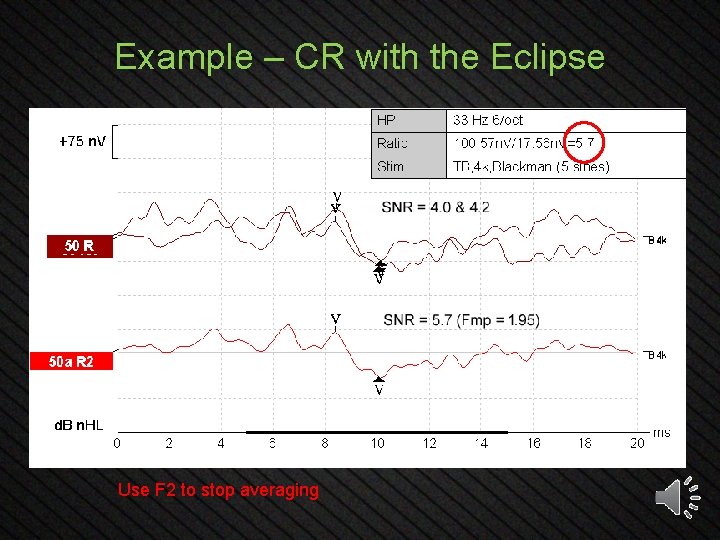
Example – CR with the Eclipse Use F 2 to stop averaging
Summary • We can use objective measurements to help us decide when RA & CR are met but we must modify the criteria, because of the way in which noise is measured • For RA (Nav. Pro & Eclipse): – When an unreplicated waveform has noise ≤ 15 n. V – When each of two waveforms have noise ≤ 21 n. V • For CR (Eclipse only): – Place cursors and monitor SNR whilst averaging – When an unreplicated waveform has an SNR of ≥ 5. 5 – When when each of two waveforms have an SNR ≥ 4. 0
- Slides: 12