
Exploiting Dark Silicon for Energy Efficiency Nikos Hardavellas
- Slides: 7
Exploiting Dark Silicon for Energy Efficiency Nikos Hardavellas Northwestern University, EECS
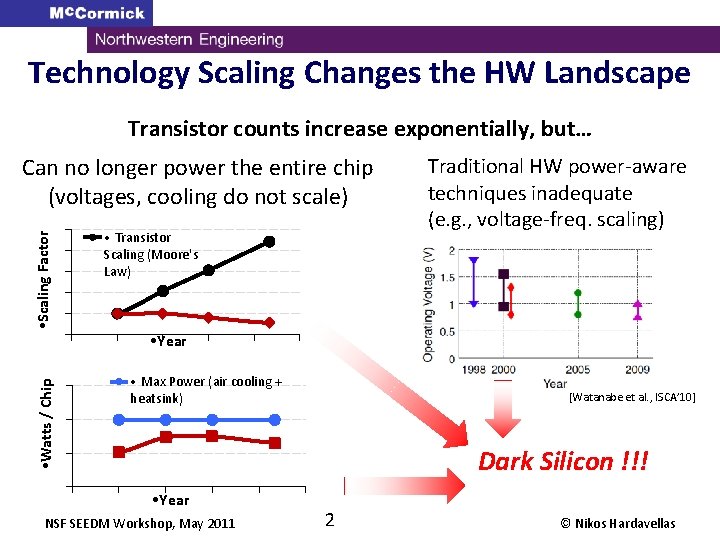
Technology Scaling Changes the HW Landscape Transistor counts increase exponentially, but… • Watts / Chip • Scaling Factor Can no longer power the entire chip (voltages, cooling do not scale) • Transistor Scaling (Moore's Law) Traditional HW power-aware techniques inadequate (e. g. , voltage-freq. scaling) • Year • Max Power (air cooling + heatsink) [Watanabe et al. , ISCA’ 10] Dark Silicon !!! • Year NSF SEEDM Workshop, May 2011 2 © Nikos Hardavellas
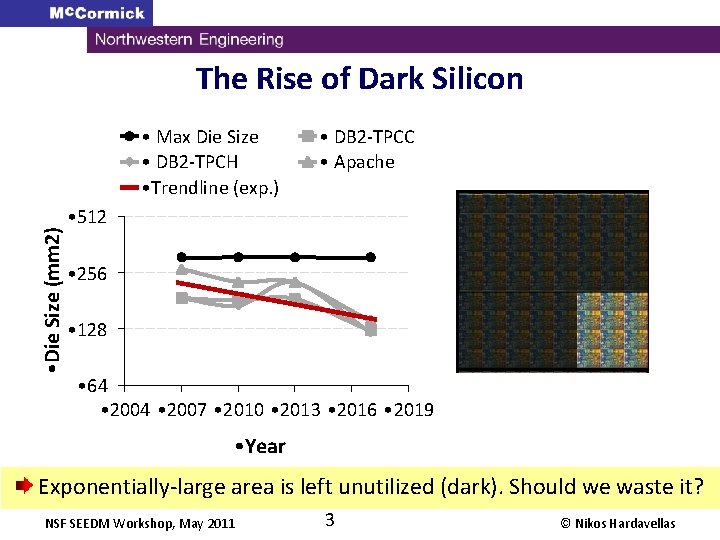
The Rise of Dark Silicon • Die Size (mm 2) • Max Die Size • DB 2 -TPCH • Trendline (exp. ) • DB 2 -TPCC • Apache • 512 • 256 • 128 • 64 • 2007 • 2010 • 2013 • 2016 • 2019 • Year Exponentially-large area is left unutilized (dark). Should we waste it? NSF SEEDM Workshop, May 2011 3 © Nikos Hardavellas
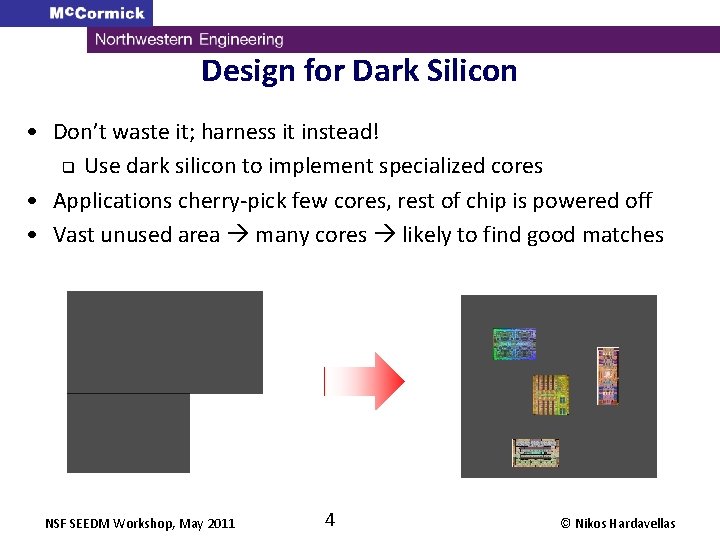
Design for Dark Silicon • Don’t waste it; harness it instead! q Use dark silicon to implement specialized cores • Applications cherry-pick few cores, rest of chip is powered off • Vast unused area many cores likely to find good matches NSF SEEDM Workshop, May 2011 4 © Nikos Hardavellas
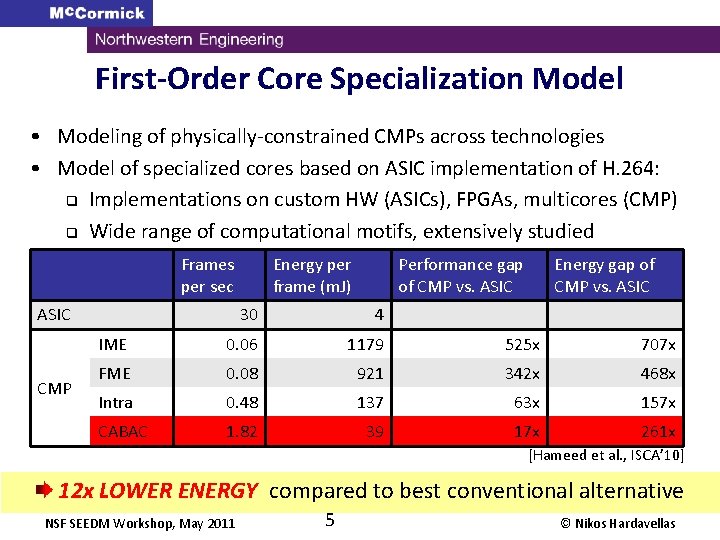
First-Order Core Specialization Model • Modeling of physically-constrained CMPs across technologies • Model of specialized cores based on ASIC implementation of H. 264: q Implementations on custom HW (ASICs), FPGAs, multicores (CMP) q Wide range of computational motifs, extensively studied Frames per sec ASIC CMP Energy per frame (m. J) Performance gap of CMP vs. ASIC Energy gap of CMP vs. ASIC 30 4 IME 0. 06 1179 525 x 707 x FME 0. 08 921 342 x 468 x Intra 0. 48 137 63 x 157 x CABAC 1. 82 39 17 x 261 x [Hameed et al. , ISCA’ 10] 12 x LOWER ENERGY compared to best conventional alternative NSF SEEDM Workshop, May 2011 5 © Nikos Hardavellas
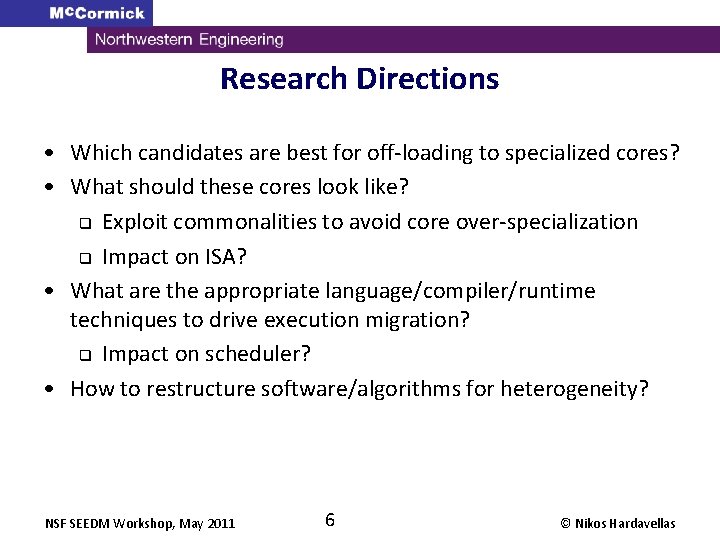
Research Directions • Which candidates are best for off-loading to specialized cores? • What should these cores look like? q Exploit commonalities to avoid core over-specialization q Impact on ISA? • What are the appropriate language/compiler/runtime techniques to drive execution migration? q Impact on scheduler? • How to restructure software/algorithms for heterogeneity? NSF SEEDM Workshop, May 2011 6 © Nikos Hardavellas
Thank You! Questions? References: • N. Hardavellas, M. Ferdman, B. Falsafi, and A. Ailamaki. Toward Dark Silicon in Servers. IEEE Micro, Vol. 31, No. 4, July/August 2011. • N. Hardavellas. Chip multiprocessors for server workloads. Ph. D thesis, Carnegie Mellon University, Dept. of Computer Science, August 2009. • N. Hardavellas, M. Ferdman, A. Ailamaki, and B. Falsafi. Power scaling: the ultimate obstacle to 1 K-core chips. Technical Report NWU-EECS-10 -05, Northwestern University, Evanston, IL, March 2010. • R. Hameed, W. Qadeer, M. Wachs, O. Azizi, A. Solomatnikov, B. C. Lee, S. Richardson, C. Kozyrakis, and M. Horowitz. Understanding sources of inefficiency in general-purpose chips. In Proc. of ISCA, June 2010. • E. S. Chung, P. A. Milder, J. C. Hoe, and K. Mai. Single-chip heterogeneous computing: does the future include custom logic, FPGAs, and GPGPUs? In Proc. of MICRO, December 2010. 7 NSF SEEDM Workshop, May 2011 © Nikos Hardavellas