
Exploiting Combined Locality for WideStripe Erasure Coding in
Exploiting Combined Locality for Wide-Stripe Erasure Coding in Distributed Storage Yuchong Hu 1, Liangfeng Cheng 1, Qiaori Yao 1, Patrick P. C. Lee 2, Weichun Wang 3 , Wei Chen 3 1 Huazhong University of Science and Technology 2 The Chinese University of Hong Kong, 3 HIKVISION Speaker: Yuchong Hu 1
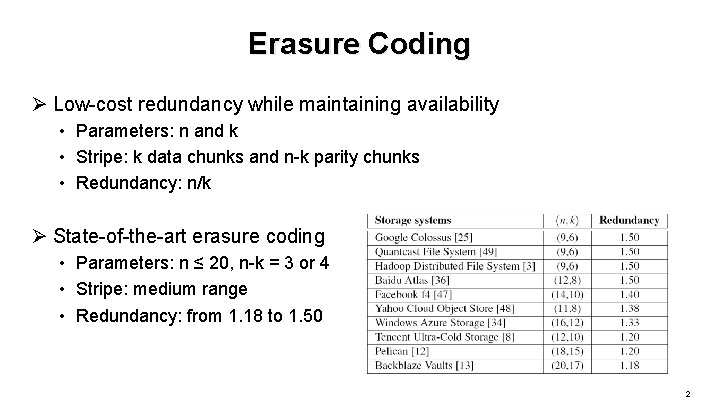
Erasure Coding Ø Low-cost redundancy while maintaining availability • Parameters: n and k • Stripe: k data chunks and n-k parity chunks • Redundancy: n/k Ø State-of-the-art erasure coding • Parameters: n ≤ 20, n-k = 3 or 4 • Stripe: medium range • Redundancy: from 1. 18 to 1. 50 2

Wide-stripe Erasure Coding Ø Motivation • Can we further reduce redundancy? • Small redundancy reduction (e. g. , from 1. 5 to 1. 33) can save millions of dollars in production [Plank and Huang, FAST’ 13] Ø Wide stripes • • Parameters: n and k are very large while n-k = 3 or 4. Redundancy: n/k 1 (near-optimal) Goal: Extreme storage savings Example: VAST considers (n, k) = (154, 150) with redundancy = 1. 027 3
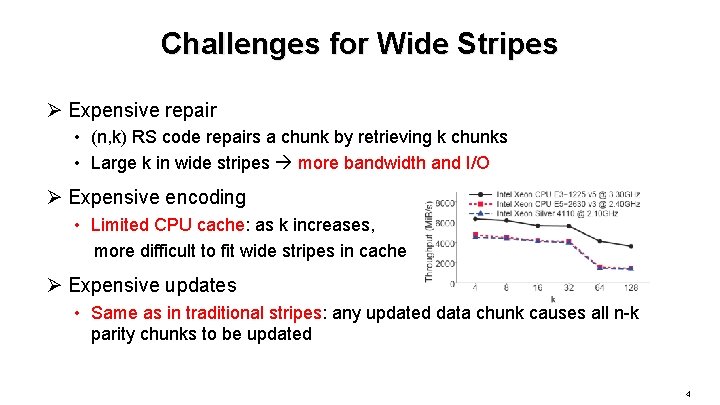
Challenges for Wide Stripes Ø Expensive repair • (n, k) RS code repairs a chunk by retrieving k chunks • Large k in wide stripes more bandwidth and I/O Ø Expensive encoding • Limited CPU cache: as k increases, more difficult to fit wide stripes in cache Ø Expensive updates • Same as in traditional stripes: any updated data chunk causes all n-k parity chunks to be updated 4
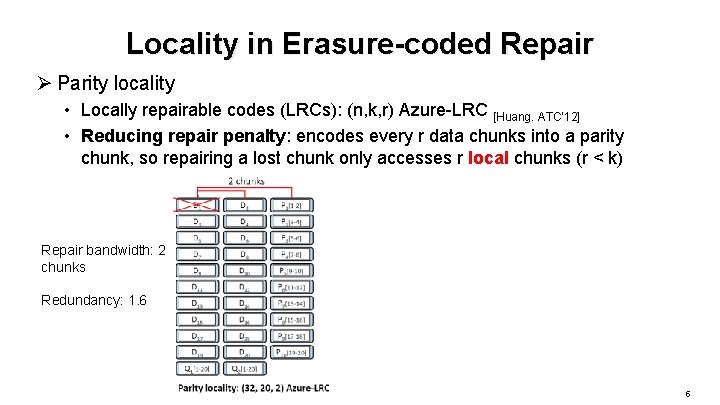
Locality in Erasure-coded Repair Ø Parity locality • Locally repairable codes (LRCs): (n, k, r) Azure-LRC [Huang. ATC’ 12] • Reducing repair penalty: encodes every r data chunks into a parity chunk, so repairing a lost chunk only accesses r local chunks (r < k) Repair bandwidth: 2 chunks Redundancy: 1. 6 5
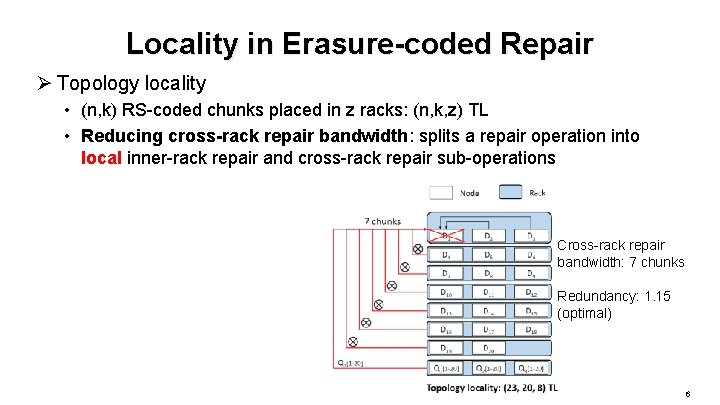
Locality in Erasure-coded Repair Ø Topology locality • (n, k) RS-coded chunks placed in z racks: (n, k, z) TL • Reducing cross-rack repair bandwidth: splits a repair operation into local inner-rack repair and cross-rack repair sub-operations Cross-rack repair bandwidth: 7 chunks Redundancy: 1. 15 (optimal) 6
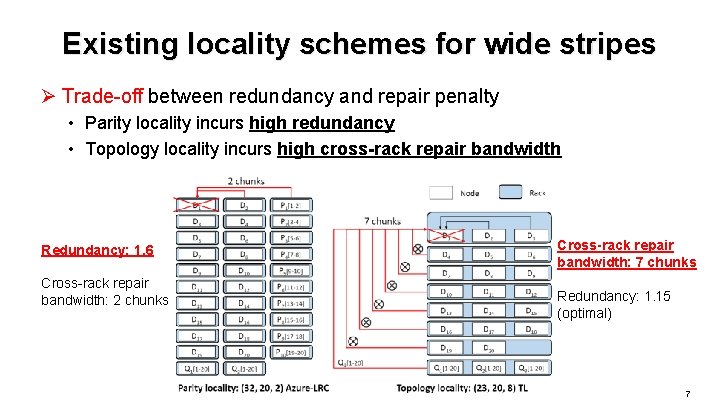
Existing locality schemes for wide stripes Ø Trade-off between redundancy and repair penalty • Parity locality incurs high redundancy • Topology locality incurs high cross-rack repair bandwidth Redundancy: 1. 6 Cross-rack repair bandwidth: 2 chunks Cross-rack repair bandwidth: 7 chunks Redundancy: 1. 15 (optimal) 7
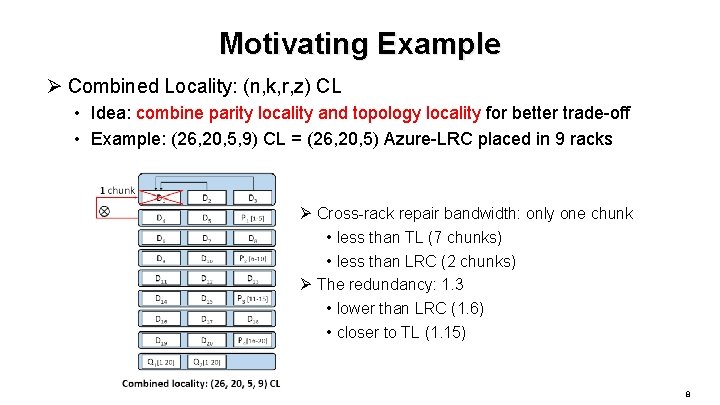
Motivating Example Ø Combined Locality: (n, k, r, z) CL • Idea: combine parity locality and topology locality for better trade-off • Example: (26, 20, 5, 9) CL = (26, 20, 5) Azure-LRC placed in 9 racks Ø Cross-rack repair bandwidth: only one chunk • less than TL (7 chunks) • less than LRC (2 chunks) Ø The redundancy: 1. 3 • lower than LRC (1. 6) • closer to TL (1. 15) 8
Our Contributions Ø First systematic study on wide-stripe repair problem • Construction details of combined locality • Trade-off analysis between redundancy and cross-rack repair bandwidth • Reliability analysis on combined locality Ø ECWide: design of a wide-stripe erasure-coded system • Combined locality for single-chunk repair and full-node repair • Efficient encoding via multi-node encoding • Efficient updates via inner-rack parity updates • Two ECWide prototypes: cold (ECWide-C) and hot (ECWide-H) storage Ø Evaluation: single-chunk repair time reduced by 90. 5% with ultralow storage (1. 063×) 9
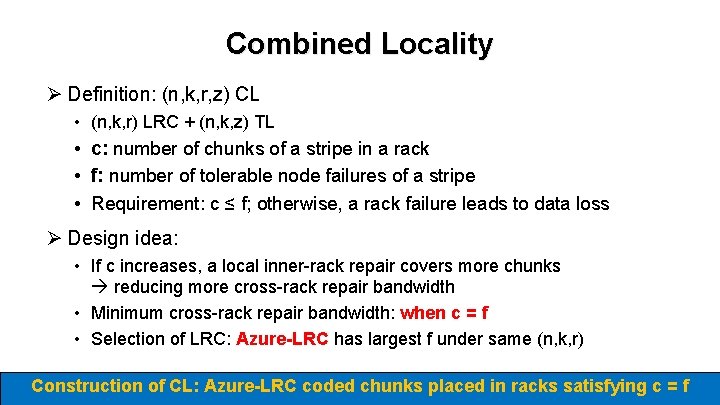
Combined Locality Ø Definition: (n, k, r, z) CL • (n, k, r) LRC + (n, k, z) TL • c: number of chunks of a stripe in a rack • f: number of tolerable node failures of a stripe • Requirement: c ≤ f; otherwise, a rack failure leads to data loss Ø Design idea: • If c increases, a local inner-rack repair covers more chunks reducing more cross-rack repair bandwidth • Minimum cross-rack repair bandwidth: when c = f • Selection of LRC: Azure-LRC has largest f under same (n, k, r) Construction of CL: Azure-LRC coded chunks placed in racks satisfying c = 10 f
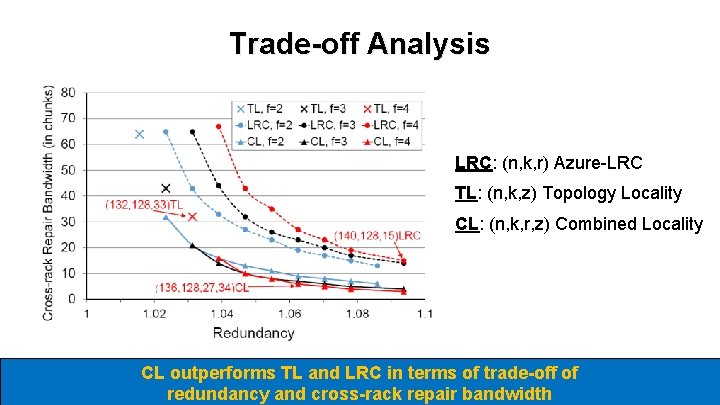
Trade-off Analysis LRC: (n, k, r) Azure-LRC TL: (n, k, z) Topology Locality CL: (n, k, r, z) Combined Locality CL outperforms TL and LRC in terms of trade-off of redundancy and cross-rack repair bandwidth 11
ECWide Ø ECWide: a wide-stripe erasure-coded storage system Ø Goals: • Minimum cross-rack repair bandwidth: realizes combined locality • Efficient encoding: proposes a multi-node encoding design • Efficient parity updates: proposes an inner-rack parity update design 12
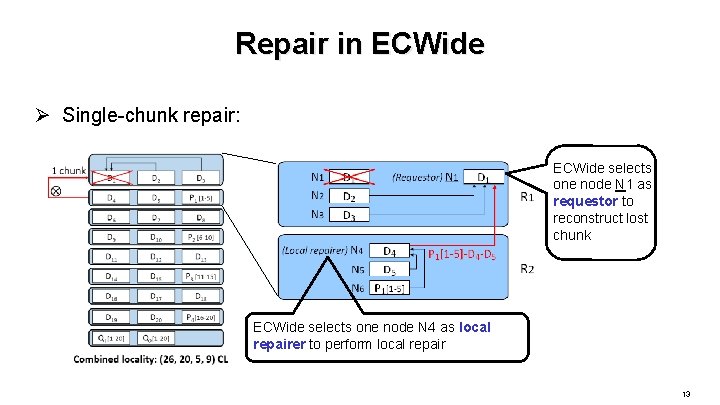
Repair in ECWide Ø Single-chunk repair: ECWide selects one node N 1 as requestor to reconstruct lost chunk ECWide selects one node N 4 as local repairer to perform local repair 13
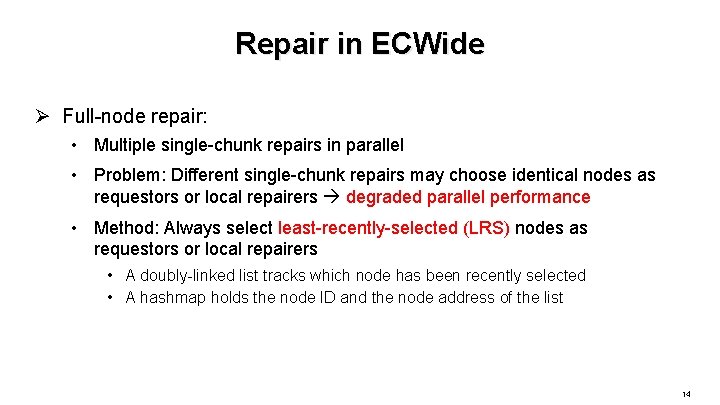
Repair in ECWide Ø Full-node repair: • Multiple single-chunk repairs in parallel • Problem: Different single-chunk repairs may choose identical nodes as requestors or local repairers degraded parallel performance • Method: Always select least-recently-selected (LRS) nodes as requestors or local repairers • A doubly-linked list tracks which node has been recently selected • A hashmap holds the node ID and the node address of the list 14
Implementation Ø Two ECWide prototypes: • ECWide-C: for cold storage • Large-sized chunks (e. g. , 64 Mi. B in HDFS) • Mainly implemented in Java with about 1, 500 SLo. C • Encoding implemented in C++ with about 300 SLo. C on Intel ISA-L • ECWide-H: for hot storage • Small-size chunks (e. g. 4 Ki. B [Zhang et al. , FAST’ 16]) • Built on Memcached • Extending lib. Memcached with about 3000 SLo. C in C 15
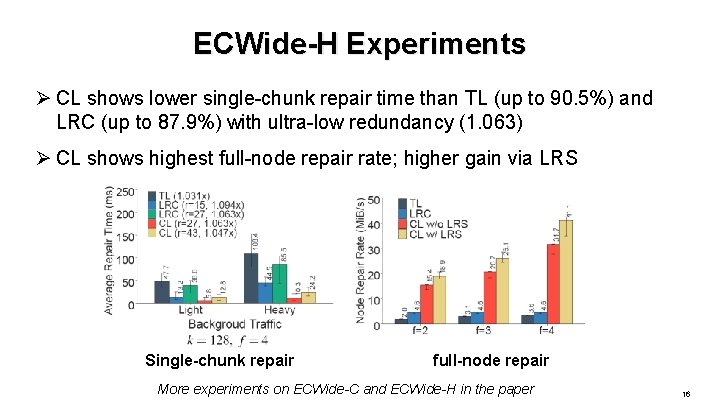
ECWide-H Experiments Ø CL shows lower single-chunk repair time than TL (up to 90. 5%) and LRC (up to 87. 9%) with ultra-low redundancy (1. 063) Ø CL shows highest full-node repair rate; higher gain via LRS Single-chunk repair full-node repair More experiments on ECWide-C and ECWide-H in the paper 16
Conclusions Ø Propose combined locality to first address the wide-stripe repair problem systematically Ø Design ECWide, a system that realizes combined locality, multi-node encoding, and inner-rack parity updates Ø Implement ECWide for both cold and hot storage systems Ø Show ECWide’s efficiency in repair, encoding, and updates ECWide source code: https: //github. com/yuchonghu/ecwide 17

THANK YOU Contacts: Yuchong Hu yuchonghu@hust. edu. cn Patrick Lee pclee@cse. cuhk. edu. hk 18
- Slides: 18