
Explicit Instruction Cadre Accountable Questioning Annette Brinkman How
Explicit Instruction Cadre Accountable Questioning Annette Brinkman
How did it go? n Your Homework: – Observe at least one teacher using the “Explicit Instruction Rubric” n Discuss with a partner 2
Is it possible … That during instruction, a student could sit in a class in your school and NEVER answer a question or be called upon… and have it be OK? ? Which teachers?
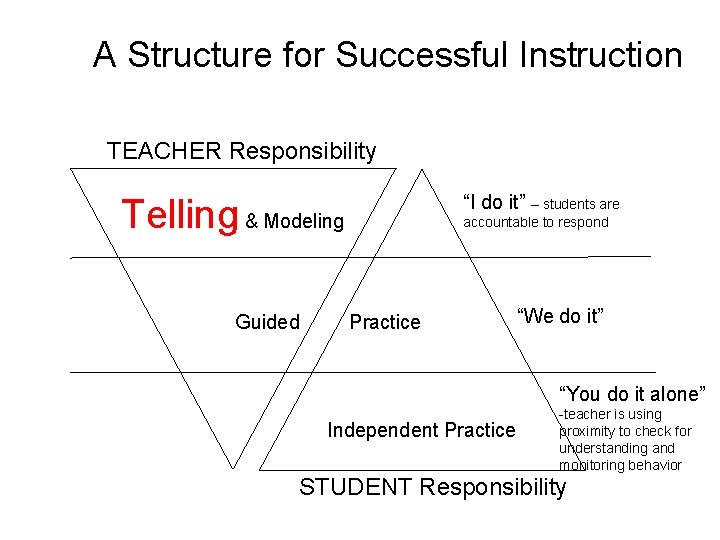
A Structure for Successful Instruction TEACHER Responsibility “I do it” – students are Telling & Modeling Guided accountable to respond Practice “We do it” “You do it alone” Independent Practice -teacher is using proximity to check for understanding and monitoring behavior STUDENT Responsibility
“Bored” n Will students who are bored find something else to do? n Is it what you would have selected for them to do?
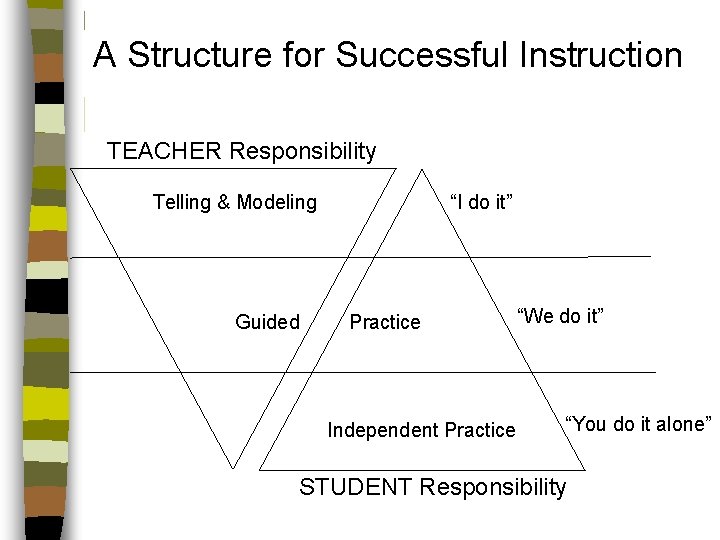
A Structure for Successful Instruction TEACHER Responsibility Telling & Modeling Guided “I do it” Practice Independent Practice “We do it” “You do it alone” STUDENT Responsibility
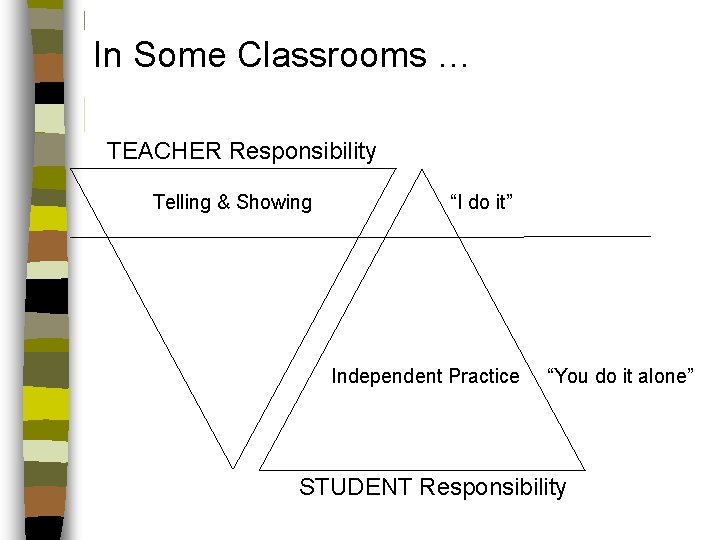
In Some Classrooms … TEACHER Responsibility Telling & Showing “I do it” Independent Practice “You do it alone” STUDENT Responsibility
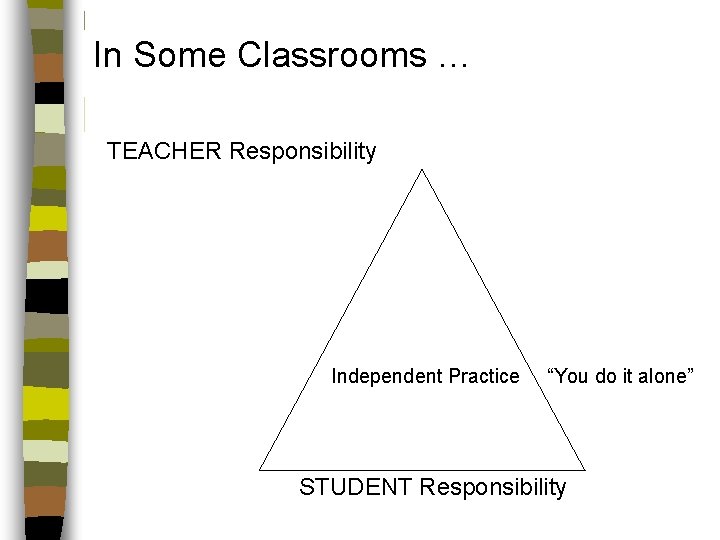
In Some Classrooms … TEACHER Responsibility Independent Practice “You do it alone” STUDENT Responsibility
Sylvester: “Doing worksheets in school, prepares students to do worksheets in life. ”
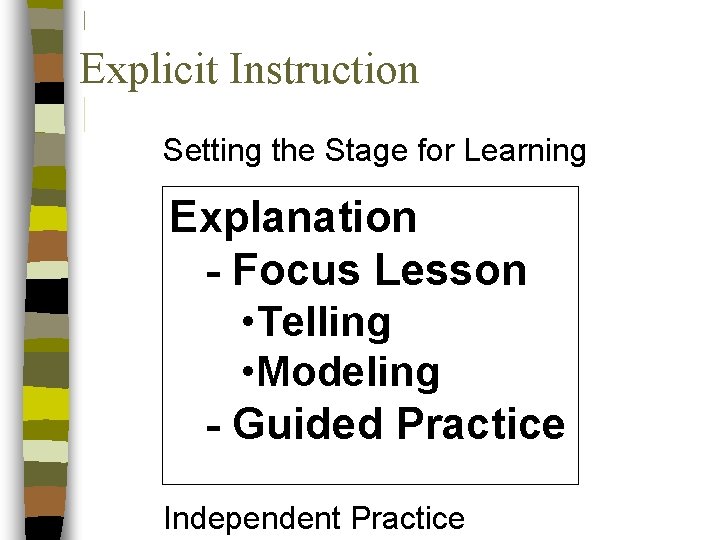
Explicit Instruction Setting the Stage for Learning Explanation - Focus Lesson • Telling • Modeling - Guided Practice Independent Practice
Explanation Phase What percentage of students do you want engaged during your explanation phase? (benchmark 80%)
Have you felt this way … n “It’s my job to present the material. ” n “It’s not my job to make them pay attention. ” (Whose job is it? )
So, what is the difference between ACTIVE & PASSIVE?
Evidence Students are… n actively participating… Looks Like Sounds Like
We are not discussing… n Higher Order Questioning n We are discussing – the management of questioning. Holding students accountable to respond. 15
Time to Read n Be the Article… prepared to share: – a sentence that you want to remember – a phrase that you want to remember – a word that you want to remember 16
Explanation Phase What percentage of students do you want engaged during your explanation phase? (benchmark 80%)
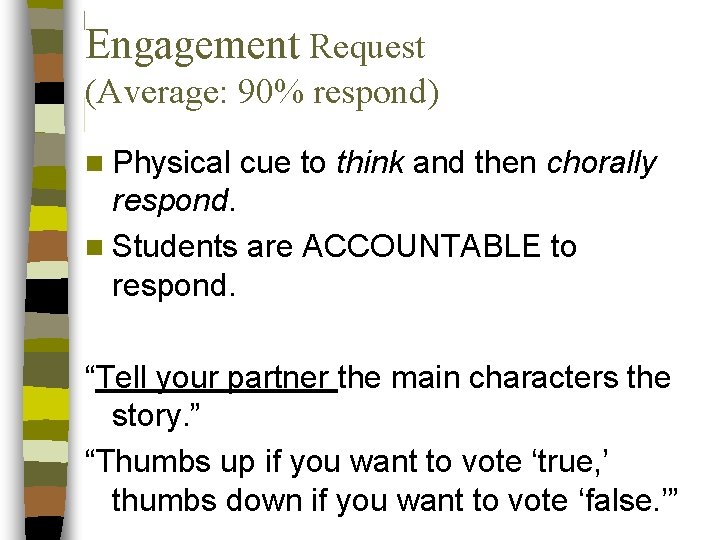
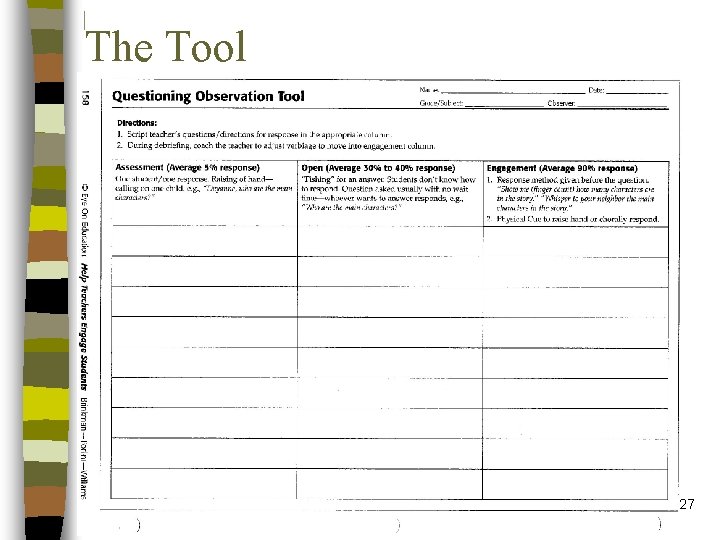
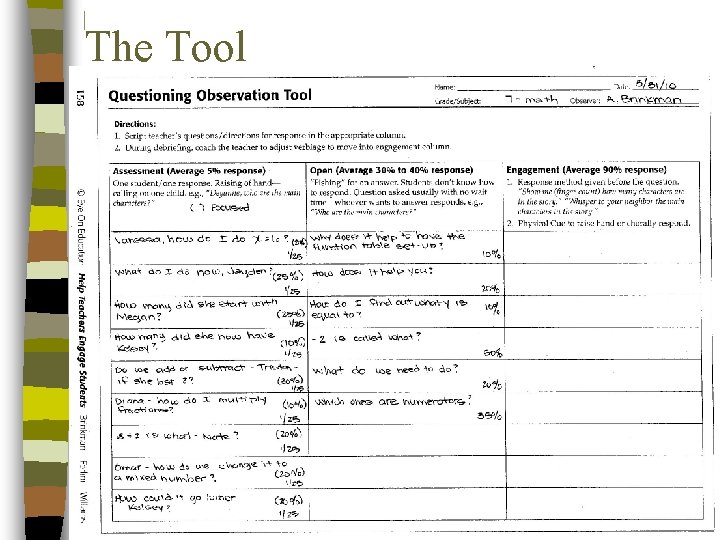
Engagement Request (Average: 90% respond) n Physical cue to think and then chorally respond. n Students are ACCOUNTABLE to respond. “Tell your partner the main characters the story. ” “Thumbs up if you want to vote ‘true, ’ thumbs down if you want to vote ‘false. ’”
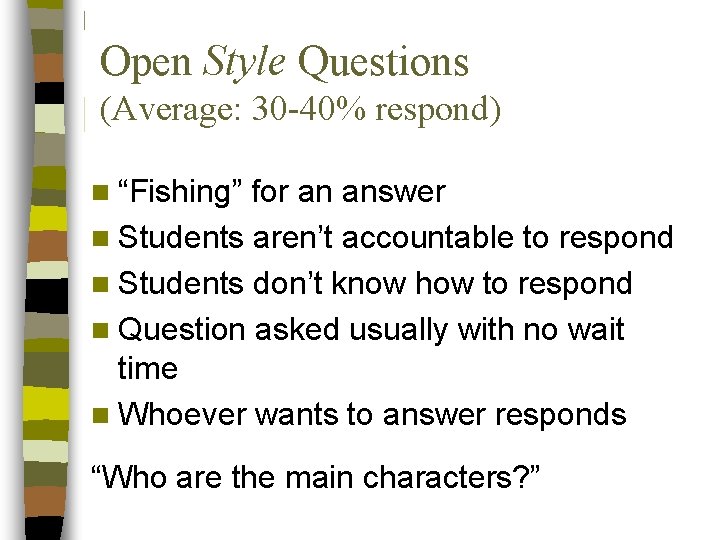
Open Style Questions (Average: 30 -40% respond) n “Fishing” for an answer n Students aren’t accountable to respond n Students don’t know how to respond n Question asked usually with no wait time n Whoever wants to answer responds “Who are the main characters? ”
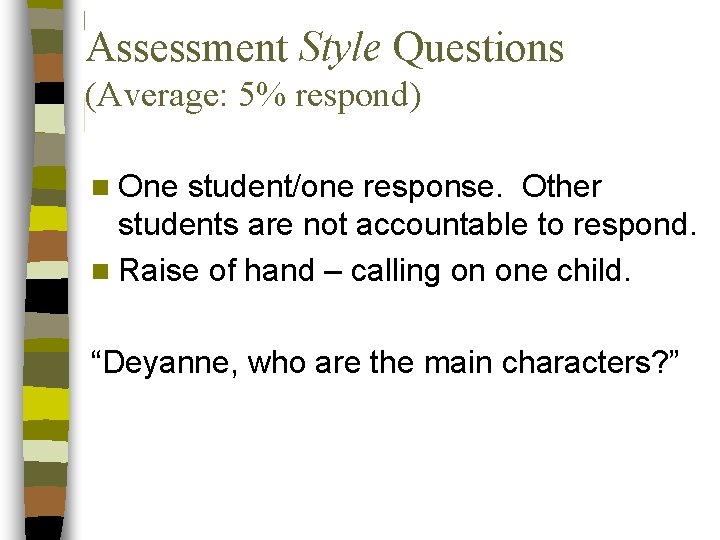
Assessment Style Questions (Average: 5% respond) n One student/one response. Other students are not accountable to respond. n Raise of hand – calling on one child. “Deyanne, who are the main characters? ”
Questioning during the Telling Phase The teacher uses: 70% ENGAGEMENT Questions 30% ASSESSMENT Questions
“Telling” Engagement Stems… Look at the “Engagement Stems” information sheet. Put a √ by 3 -5 ideas that your teachers could incorporate into the telling phase. Share your thoughts with a partner. 22
Oddly Enough… n If a teacher makes a statement with a question mark at the end – it is not engagement. 23
Assess Your Teachers n School Overall n A specific department or grade level n A specific teacher 24
Diagnostic: Explicit Instruction Tool – Telling Component Assistance Tools: Consulting Tools - Tasking 25
LABEL n In order for a teacher to transfer a strategy, labels must be attached. 26
The Tool 27
The Tool 28
Observations n What do you predict will you will see? 29
Or Perhaps… n Do an observation of – one of your “best” teachers – one of your, ummm “struggling” teachers – Level One teachers – A department or grade level 30
Jane Vella “We learn what we are doing. ”
- Slides: 31