
Explanations forgetting You need to learn 2 theories

- Slides: 21
Explanations forgetting You need to learn 2 theories that explain why we forget information
Learning outcomes: you should understand what forgetting is And be able to explain the ways in which forgetting can occur
What is forgetting? • To forget is the failure to retrieve information from LTM or STM
This can occur through interference… What is interference? This is when information is stored in LTM however it cannot be accessed The process of interference happens when one memory blocks another memory This causes one or both memories to be distorted or forgotten
Interference theory (IT) • Is an explanation forgetting mainly in LTM • It perceives forgetting as a direct result of information in the LTM being confused with other information during the coding stages • This leads to inaccurate recall • There are two forms of interference: proactive and retroactive
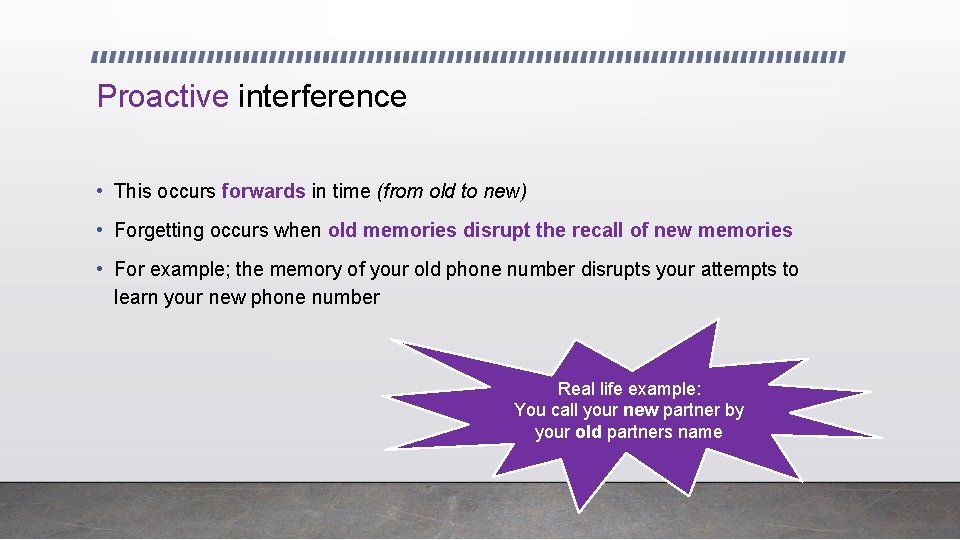
Proactive interference • This occurs forwards in time (from old to new) • Forgetting occurs when old memories disrupt the recall of new memories • For example; the memory of your old phone number disrupts your attempts to learn your new phone number Real life example: You call your new partner by your old partners name
Retroactive interference • Works backwards in time (from new to old) • Forgetting occurs when newer memories disrupt the recall of older memories • For example, your teacher has learned so many names this year she has difficulty remembering the names of students last year
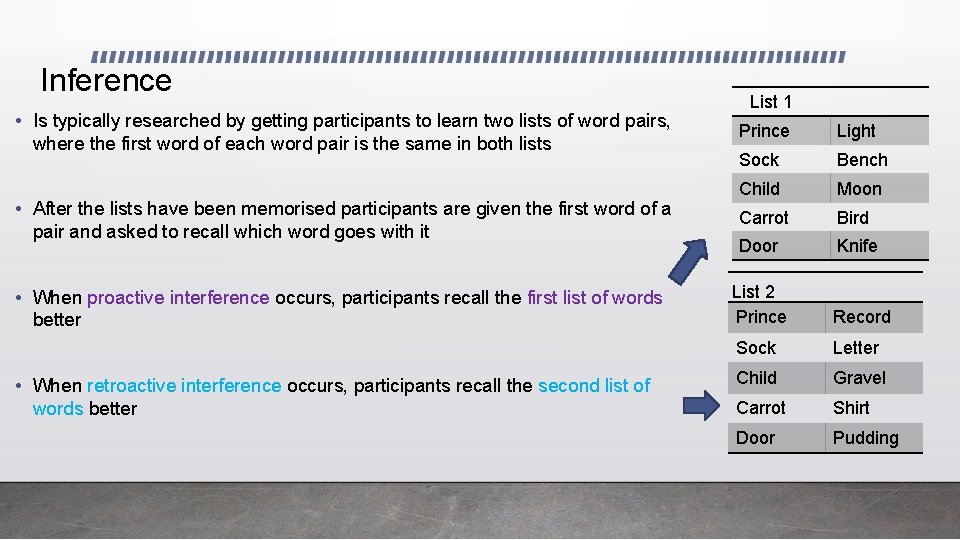
Inference • Is typically researched by getting participants to learn two lists of word pairs, where the first word of each word pair is the same in both lists • After the lists have been memorised participants are given the first word of a pair and asked to recall which word goes with it • When proactive interference occurs, participants recall the first list of words better • When retroactive interference occurs, participants recall the second list of words better List 1 Prince Light Sock Bench Child Moon Carrot Bird Door Knife List 2 Prince Record Sock Letter Child Gravel Carrot Shirt Door Pudding
Evaluation Do we normally learn and remember information like this in real life? No The studies which support theory can be accused of lacking mundane realism The setting for the research is also artificial – this means it lacks ecological validity
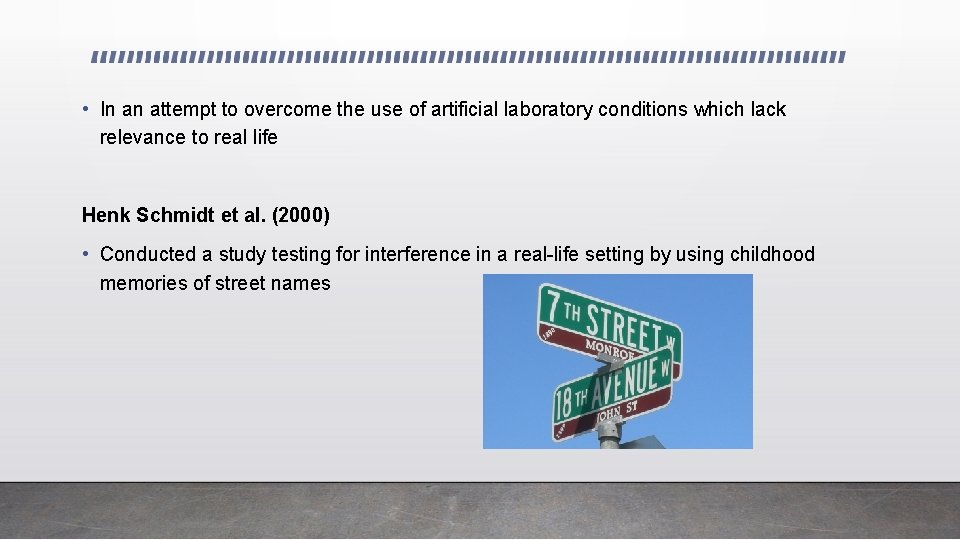
• In an attempt to overcome the use of artificial laboratory conditions which lack relevance to real life Henk Schmidt et al. (2000) • Conducted a study testing for interference in a real-life setting by using childhood memories of street names
Henk Schmidt et al. (2000) When new information disrupts old information Aim: to assess the influence of retroactive interference on the memory of street names learned during childhood Procedure: • 700 randomly selected former students of Dutch elementary schools, aged between 11 -79, were sent a questionnaire • 211 responded What is the RM issue with this? • Each were given a map of the area where they attended school with all 48 street names replaced with numbers • Participants were asked to recall as many of them as possible
• Questionnaires were also provided to participants to see how many times they had moved house, where they moved to, for how long, and how often they visited the area in question etc. • The amount of retroactive interference experienced was assessed by the number of times individuals had moved house
Findings: • There was a positive association found between the number of times the ppt had moved outside the area in question and the number of street names forgotten • As the number of times moved increased, so too did the number of names forgotten • Conclusions: learning new patterns of street names when moving house makes recalling older patterns of street names harder ü This demonstrates retroactive interference in a real life scenario
Cue-dependent forgetting This is the second theory of forgetting you need to know
Cue-dependent forgetting (CDF) • We assume that information is available in the LTM however it cannot be accessed without additional information to jog the memory • Recall is therefore dependent on retrieval cues – like the labels on files in a filing system – they remind you what’s in the files. • Recall is dependent upon accessing information by remembering the retrieval cue under which the information is stored Tulving (1973) explained this as the encoding-specifity principle
Encoding-specifity principle • This is where recall is hindered if the context of recall is different to that at encoding • The effectiveness of a retrieval cue depends on… • how overloaded it is (the fewer the number of items associated with it, the more effective the cue) • How deep the processing of the cue was • How well the cue fits the information it is associated with
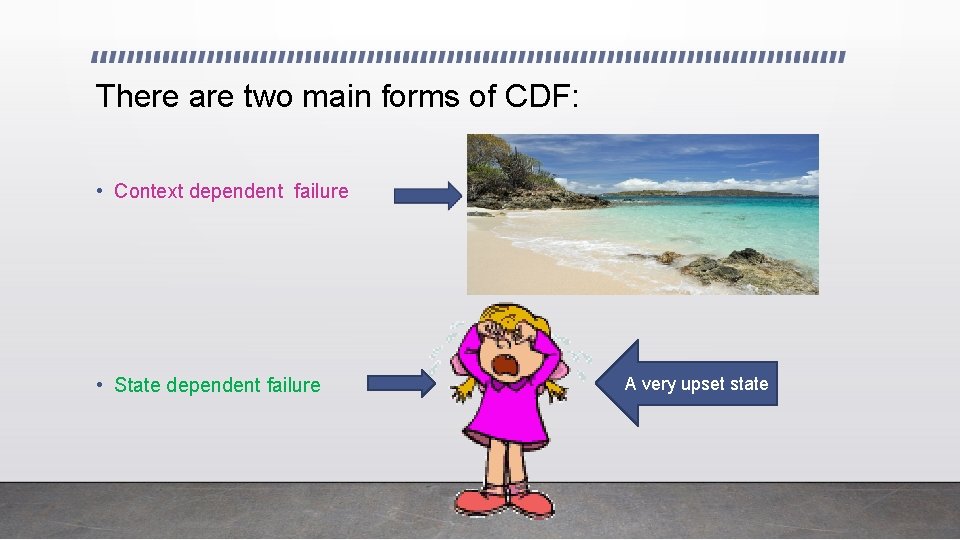
There are two main forms of CDF: • Context dependent failure • State dependent failure A very upset state
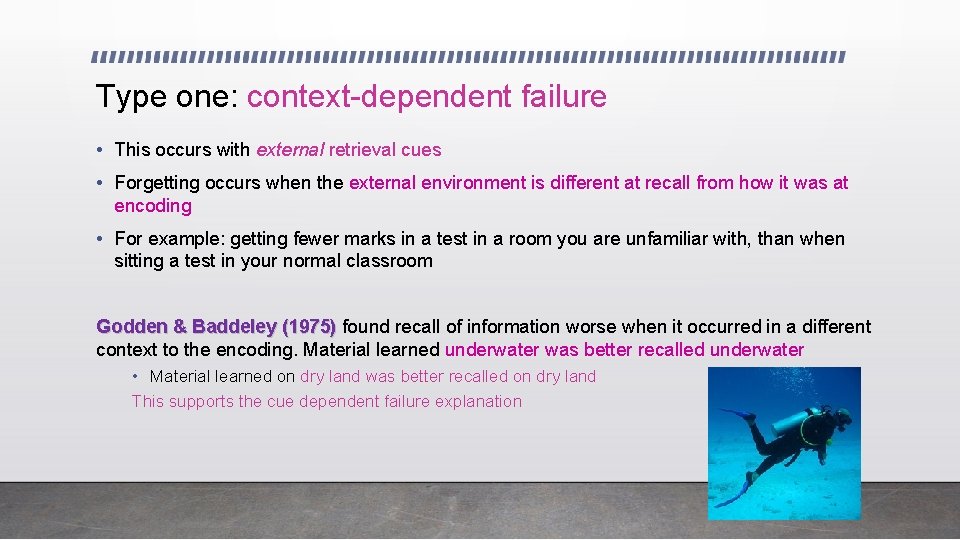
Type one: context-dependent failure • This occurs with external retrieval cues • Forgetting occurs when the external environment is different at recall from how it was at encoding • For example: getting fewer marks in a test in a room you are unfamiliar with, than when sitting a test in your normal classroom Godden & Baddeley (1975) found recall of information worse when it occurred in a different context to the encoding. Material learned underwater was better recalled underwater • Material learned on dry land was better recalled on dry land This supports the cue dependent failure explanation
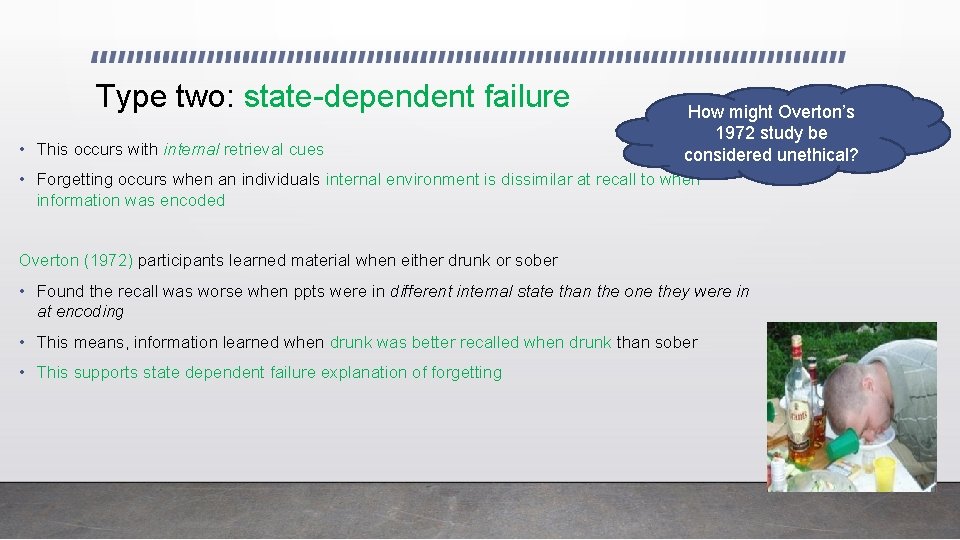
Type two: state-dependent failure • This occurs with internal retrieval cues How might Overton’s 1972 study be considered unethical? • Forgetting occurs when an individuals internal environment is dissimilar at recall to when information was encoded Overton (1972) participants learned material when either drunk or sober • Found the recall was worse when ppts were in different internal state than the one they were in at encoding • This means, information learned when drunk was better recalled when drunk than sober • This supports state dependent failure explanation of forgetting
Real life application of cue-dependent forgetting • Application is very real. It has practical use, the police carry out reconstructions of unsolved crimes • This aims to ‘jog’ the memory of the witness by recreating the context of the incident. • This may include the participants wearing identical clothing, the reconstruction taking place in the same location or same timescale as the original • This provides retrieval cues to help the witness remember.
Real life application of cue-dependent forgetting • In 2001, Danielle Jones was murdered in Essex • Her uncle was convicted of the crime, largely based around the witness statement which emerged after the reconstruction of the crime • Witnesses recalled seeing Danielle argue with a man and getting into a blue transit van – a vehicle owned by her uncle